Latest News and Comment from Education

Thursday, November 17, 2016

California Practitioners Advisory Group + Meeting Snacks & Meal Standards for After School Programs

CPAG Meeting Notice and Agenda, December 2016 - California Practitioners Advisory Group (CA Dept of Education):

Image result for attention everyone

Joint Meeting of the California Practitioners Advisory Group 
and the State Board of Education

AGENDA

December 7, 2016

California Practitioners Advisory Group Members

  • Jo Ann Isken, Chair
  • Ed Manansala, Vice Chair
  • Melissa Agudelo
  • Jorge Aguilar
  • Mariana Astorga-Almanza
  • Ulises Garcia
  • Carolina Hernandez-Malone
  • John-Damien Huntley
  • Linda Kaminski
  • Kimberly Kenne
  • Tara Kini
  • Nancy Lara
  • L. Karen Monroe
  • Marco Petruzzi
  • Neva Rowden
  • Susan Salcido
  • Araceli Simeon
  • Karen Valdes

Liaisons to the State Board of Education

  • Sue Burr
  • Ilene Straus
Note: The State Board of Education (SBE) meeting is a study session and the SBE members in attendance will take no action on any Items.

State Board Members

  • Michael W. Kirst, President
  • Ilene W. Straus, Vice President
  • Sue Burr
  • Bruce Holaday
  • Feliza I. Ortiz-Licon
  • Patricia A. Rucker
  • Niki Sandoval
  • Ting L. Sun
  • Trish Williams
  • Olivia Sison, Student Member
  • Vacancy

Secretary & Executive Officer

  • Hon. Tom Torlakson

Executive Director

  • Karen Stapf Walters
Schedule of MeetingLocation
Wednesday, December 7, 2016
9 a.m. Pacific Time ±
California Department of Education
1430 N Street, Room 1101
Sacramento, California 95814 
916-319-0843

Please see the detailed agenda for more information about the items to be considered and acted upon. The public is welcome.
ALL TIMES ARE APPROXIMATE AND ARE PROVIDED FOR CONVENIENCE ONLY.
ALL ITEMS MAY BE RE-ORDERED TO BE HEARD AT ANY TIME OF THE NOTICED MEETING. A LIVE STREAM OF THE MEETING WILL BE PROVIDED; HOWEVER, THE VIDEO FEED AND PUBLIC VIEWING OF THE MEETING WILL BE PAUSED IF THE CPAG PARTICIPATES IN SMALL GROUP DISCUSSION/ACTIVITY.
The California Practitioners Advisory Group and the State Board of Education will hold a one-day meeting on Wednesday, December 7, 2016, at the location indicated above. The meeting may include some activities involving the group as a whole and small group discussion involving one or more of the members. The following outline of activities is provided for convenience only. The actual order of business may be changed without notice to accommodate the needs of members, invited presenters, and key staff. Anyone interested in a particular matter should plan on being in attendance for the whole meeting, December 7, 2016. Timing and order of activities may change. The full Advisory Group will commence, recess, and reconvene as necessary throughout the one-day meeting.
GUIDELINES FOR PUBLIC INPUT SESSIONS
Time is set aside for individuals desiring to speak on any topic not otherwise on the agenda. Please see the detailed public agenda for the Public Session. In all cases, the presiding officer reserves the right to impose time limits on presentations as may be necessary to ensure that the agenda is completed.
REASONABLE ACCOMMODATION FOR ANY INDIVIDUAL WITH A DISABILITY
Pursuant to the Rehabilitation Act of 1973 and the Americans with Disabilities Act of 1990, any individual with a disability or any other individual who requires reasonable accommodation to attend or participate in a meeting or function of the California Practitioners Advisory Group may request assistance by contacting the California Department of Education, Improvement and Accountability Division at 1430 N Street, Room 6208, Sacramento, CA, 95814, by telephone at 916-319-0843 or by email at cpag@cde.ca.gov.
Wednesday, December 7, 2016
9:00 a.m. Pacific Time ±
  • Call to Order
  • Salute to the Flag
  • Overview of Agenda
  • Announcements
  • Roll Call and Introductions
  • Special Presentations
    Public notice is hereby given that special presentations for informational purposes may take place during this session.
  • Agenda Items
  • Adjournment

AGENDA ITEMS

Item 01
Subject: Orientation of California Practitioners Advisory Group, including, but not limited to, Administer the Oath of Office, Taking the Oath of Office, Review the Roles, Terms of Office, and Bagley Keene Act and Ethics Training.
Type of Action: Information
Item 02
Subject: Review of the Local Control Funding Formula Evaluation Rubrics State Indicators, including, but not limited to, the Academic Indicator for Small Group Activity and Large Group Discussion on Recommendations.
Type of Action: Action, Information
Item 03
Subject: Update on the Additional Components of the Local Control Funding Formula Evaluation Rubrics, including, but not limited to, the Draft of the Local Performance Indicators Self-Assessment Tools and Menu of Local Measures, the School Conditions and Climate Work Group, the English Learner Indicator Work Group, and Statements of Model Practices.
Type of Action: Action, Information
Item 04
Subject: Development of California's Every Student Succeeds Act Consolidated State Plan including, but not limited to, Small Group Activity and Large Group Discussion on Recommendations.
Type of Action: Action, Information
Item 05
Subject: California Practitioners Advisory Group Priorities, including, but not limited to, future meeting plans; agenda items; approval of minutes; general comments and questions from CPAG members; and other matters of interest.
Type of Action: Action, Information
Item 06
Subject: General Public Comment Public. Comment is invited on any matter not included on the printed agenda. Depending on the number of individuals wishing to address the California Practitioners Advisory Group, the presiding officer may establish specific time limits on presentations.
Type of Action: Action, Information
***ADJOURNMENT OF THE MEETING***
For more information concerning this agenda, please contact the California Department of Education at 1430 N Street, Room 5111, Sacramento, CA, 95814; telephone 916-319-0787; facsimile 916-319-0972. Individuals desiring to speak on the items presented below will be limited to two minutes each. A group of five speakers may sign up together and designate one speaker who will be allocated a total of three minutes for the group. Members of the public wishing to send written comments about an agenda item to the CPAG members are encouraged to send an electronic copy to cpag@cde.ca.gov, with the item number clearly marked in the subject line. In order to ensure that comments are received by CPAG members in advance of the meeting, please submit these and any related materials to our office by noon on December 4, 2016, the Friday prior to the meeting. For the December 2016 meeting, the agenda will also be posted on the State Board of Education’s Web site and all letters submitted to the CPAG members will also be distributed to the SBE members.
Last Reviewed: Thursday, November 17, 2016


Snacks & Meal Standards for After School Programs

This fact sheet identifies the state nutrition standards as well as the federal reimbursable requirements for snacks and meals offered in after school programs (ASP).

Summary

California Department of Education (CDE) Administered After School Programs. After school programs have the option to serve a snack, a meal, or both. All snacks provided to students in the CDE’s After School Education and Safety (ASES) programs or the federally funded 21st Century Community Learning Centers (21st CCLC) programs must meet, at a minimum, the California nutrition standards identified below. Furthermore, programs must seek to qualify for a federally funded after school snack or meal program. If snacks are provided through one of the federally reimbursable meal programs, known as child nutrition programs, the food must meet both the federal requirements and the California nutrition standards. Federal Program Monitoring (FPM) reviewers will evaluate the after school program for compliance with the California nutrition standards.
Meals served in after school programs (ASPs) through the Child and Adult Care Food Program (CACFP) must meet the CACFP nutrition requirements to receive the federal reimbursement for the meals. For flexibility, the CACFP allows School Food Authorities to use either the CACFP or the National School Lunch Program meal pattern. After school meals are notrequired to comply with the California nutrition standards identified below.
Non-CDE Administered After School Programs. If the after school program is not funded through the ASES and/or 21st CCLC grants, compliance with the nutrition standards below are not required. However, we strongly encourage ASPs to serve food that meets the nutrition standards. If ASP snacks or meals are provided through a federally reimbursable meal program, the food must meet the federal requirements for that specific program.
Summary Tables
CDE Administered After School ProgramsCalifornia State Snack StandardsChild Nutrition Program (CNP) Federal Standards
SNACKS provided by ASES or 21st CCLC fundsYesNo
SNACKS provided through CNP fundsYesYes
MEALS provided through CNP, ASES or 21st CCLC fundsNoYes

Non-CDE Administered After School ProgramsCalifornia State Snack StandardsChild Nutrition Program (CNP) Federal Standards
Snacks or meals NOT funded through ASES or 21st CCLCRecommendedYes
Snacks or meals provided through CNP fundsNoYes

California Education Code Requirements

(Education Code sections 49430-49431.7, 8423(c)3, 8482-8484.6)

Food

Snacks provided in ASES and 21st Century funded ASPs must be fruits, vegetables, dairy, protein or whole grain-rich food items; foods with a fruit, vegetable, dairy, protein, or whole grain-rich item as the first ingredient; or combination foods containing at least one-quarter cup of fruit or vegetable that meet all of the following standards. Each individual food item must:  http://www.cde.ca.gov/ls/nu/as/afterschoolnutstan.asp

Teacher: Why we don’t need a single standardized test - The Washington Post

Teacher: Why we don’t need a single standardized test - The Washington Post:

Teacher: Why we don’t need a single standardized test


If you are tired of reading about Donald Trump, take a look a this. Peter Greene,  a veteran teacher of English in a small town in Pennsylvania, wrote on his  lively Curmudgucation blogthat he has found himself in conversations about standardized testing that go something like this: people who like standardized testing defend it to the max while he counters that the number of standardized tests necessary for students to take is zero.
For taking that position he writes, he has been called a “union shill,” lectured that data from these tests are the life blood of education, and asked to be explain what the alternative to standardized testing is. Here in this post, he explains his thinking. This is a shortened version of the original, which you can find here.

By Peter Greene
Is there such a thing as a useful standardized test?
To have this conversation, we have to get one thing out of the way. If you believe (and I think some school reformers sincerely do) that the only reason that teachers oppose the current high stakes test-and-punish status quo is because their self-serving union tells them to, you are blinding yourself to some real issues.
First, there is a real gulf between national union leadership and rank-and-file teachers precisely because union opposition to reformer policies has usually been tepid. Teacher opposition to testing comes first and foremost from teachers who have been watching testing become a toxic, destructive element in our classrooms that interferes with our ability to deliver real education. It’s detrimental to our students. And it is used in many places to deliver a professional verdict on our schools and ourselves with an accuracy no greater than a roll of the dice.
Opposition to testing also comes from other people who see how it plays out on the ground: parents. The Opt Out movement — in which hundreds of thousands of parents have not allowed their children to take state-mandated accountability standardized tests — was not created by teachers. It is not led by teachers — and in some places, it is actually potentially damaging to teachers under the current bizarre test-driven accountability system.
So if you imagine that test opposition is some sort of political ploy engineered top-down by unions, you are kidding yourself.
None of That Answers the Question, so Let’s Get Back To It
If I am such a dedicated opponent of standardized testing, what do I propose as an acceptable substitute?
Let’s first clarify our rather fuzzy terms.
“Standardized” Test?
Come to think of it, we’d better clarify “test” as well. For many folks, it’s only a “test” if the student is answering questions. A five-page paper assignment, for instance, is usually not called Teacher: Why we don’t need a single standardized test - The Washington Post:


CURMUDGUCATION: MA: Charter Lessons

CURMUDGUCATION: MA: Charter Lessons:

MA: Charter Lessons


By now, you've heard that the folks who threw a giant pile of money at Question 2, the initiative to free charter-preneurs from their chains so that they could romp freely in fields of money-- those guys lost, and lost hard.

There have been plenty of pieces that dissected the victory for public education from the public education advocate side of things. But I found some interesting points to note in the Boston Globe, just one of the media outlets that was shoveling coal for the charteristas. How did this loss look to the losers? What lessons can be gleaned? Here they are, in no particular order:

Who wants charters?

Charteristas tried hard to sell the narrative that selfish wealthy white suburbanites were denying non-wealthy non-white city dwellers the chance to get great schools. This turned out to be hugely wrong and exactly backward-- the only areas that voted in favor of 2 were the wealthy white suburbs. Even the neighborhoods of the lowest achievers voted against charter expansion. The Globe has half a clue here:

But civil rights advocates say families of color yearn for something deeper: A robust commitment and plan to improve the quality of education in the city’s school system so they don’t need alternatives. 

I've said it before and I'll say it again. People don't want choice. They want what they want. People mostly don't want a selection of schools; they want their school, the school they already have, that already serves their community, to be a good school.

And they want to work in partnership with policymakers rather than having outsiders coming in and proposing a solution.

Folks are starting to catch on to the heart of the charter deal-- "we will give you our idea of a good 
CURMUDGUCATION: MA: Charter Lessons:


I will stand up, I will speak up for my students: Sign the pledge - Lily's Blackboard

I will stand up, I will speak up for my students: Sign the pledge - Lily's Blackboard:

I will stand up, I will speak up for my students: Sign the pledge

Image result for I will stand up, I will speak up for my students

Our schools should be havens. But right now, many of our students are scared, anxious, and feeling threatened. At NEA, we are hearing from students and educators all around the country who are encountering hostile environments in their schools and communities, with fake deportation notices being handed out and swastikas drawn in bathrooms.
We are being flooded with reports of hateful words, actions, and images directed at students in our schools. Nooses. Racist graffiti. Threats to our LGBTQ students. Headscarves being torn off. Girls being assaulted. Children are hearing that they are not welcome in their schools and even in the country they call home.
My heart is breaking. There is no place for this anywhere, let alone in our schools.
It’s no secret where I stood during this election. But this isn’t about politics. It is about the simple fact that every student deserves a safe, welcoming, affirming learning environment. The three million members of the NEA and our allies are here to tell students: you are safe with me.
Join us, and show you’re standing up for students.
I will stand up and I will speak up for my students, so that they all have a safe and affirming learning environment. I will take action with NEA so that EVERY student feels welcome and safe at school.
Sign the pledge here: I will stand up, I will speak up for my students: Sign the pledge - Lily's Blackboard:

Educators get blamed for everything. Now, it’s for fanning fear of Trump. - The Washington Post

Educators get blamed for everything. Now, it’s for fanning fear of Trump. - The Washington Post:

Educators get blamed for everything. Now, it’s for fanning fear of Trump.

Educators can’t get a break.
Teachers are routinely blamed for poor student achievement — even when kids come to school in no condition to learn — and for being greedy, with their outlandish desire for adequate pay and collective bargaining rights so they can’t be fired without cause. School leaders are accused of being tradition-bound and motivated too much by a desire to maintain the status quo (and their jobs).
Now there’s something new: Educators are being accused of fanning fear of Donald Trump. As if Trump hadn’t scared a lot of kids with his own rhetoric about, for example, tossing out millions of undocumented immigrants, banning Muslims from entering the country and mocking a reporter with a disability. As if many teachers didn’t confront kids coming to class already crying.
A piece in USA Today, written by two respected conservatives, Frederick Hess and Chester Finn, titled “Stop Teaching Anti-Trump Bias,” admonished educators for sowing fear among students and mourning the loss of Hillary Clinton. Hess is director of education policy studies at the American Enterprise Institute and Finn is a senior fellow and president emeritus at the Thomas B. Fordham Institute. They noted in their opinion piece that many messages have been sent out by schools and universities trying to address student fears and said in part:
Had Hillary Clinton won the bitter contest, would any of this have still been deemed necessary by so many educators? Of course not.
We’re no fans of the president-elect, whose behavior has frequently been appalling, whose policy ignorance is vast, and who appears to lack any coherent philosophy of government. That said, we are astonished that so many educators, schools and colleges chose to treat his election as reason to alarm their students and to suggest that only a Democratic victory would have aligned with the nation’s values.
Although some educators may have been lamenting the Clinton loss and the Trump victory, there is no evidence that “so many educators, schools and colleges” are reacting to the election Educators get blamed for everything. Now, it’s for fanning fear of Trump. - The Washington Post:
Image result for Teachers are routinely blamed

L.A. leaders just vowed to fight deportations under Trump. Here's what they've proposed - LA Times

L.A. leaders just vowed to fight deportations under Trump. Here's what they've proposed - LA Times:

L.A. leaders just vowed to fight deportations under Trump. Here's what they've proposed

Image result for fight deportations under Trump
Los Angeles city leaders are considering a series of moves designed to protect immigrants in this city illegally in the wake of Donald Trump’s election, including the hiring of an immigration advocate and policies to prevent L.A. residents from being deported. 
Worried that Trump will pursue mass deportations once in office, Los Angeles City Council President Herb Wesson announced the effort Thursday, saying Angelenos are “deeply concerned” about changes to federal immigration policies under Trump.
“These concerns should not be underestimated,” he wrote.
Wesson said he wants the City Council to create a new position of immigrant advocate and come up with strategies for protecting all federal grants, loans and other funds during the Trump administration. He also asked city analysts to provide a formal definition of “sanctuary city” and determine how such a term might affect Los Angeles.
s Angeles city leaders are considering a series of moves designed to protect immigrants in this city illegally in the wake of Donald Trump’s election, including the hiring of an immigration advocate and policies to prevent L.A. residents from being deported. 
Worried that Trump will pursue mass deportations once in office, Los Angeles City Council President Herb Wesson announced the effort Thursday, saying Angelenos are “deeply concerned” about changes to federal immigration policies under Trump.
“These concerns should not be underestimated,” he wrote.
Wesson said he wants the City Council to create a new position of immigrant advocate and come up with strategies for protecting all federal grants, loans and other funds during the Trump administration. He also asked city analysts to provide a formal definition of “sanctuary city” and determine how such a term might affect Los Angeles.L.A. leaders just vowed to fight deportations under Trump. Here's what they've proposed - LA Times:
California Democrats ask Obama to pardon nearly 750,000 'Dreamers'
California Democrats ask Obama to pardon nearly 750,000 'Dreamers' - LA Times - http://www.latimes.com/politics/essential/la-pol-ca-essential-politics-updates-california-democrats-ask-obama-to-1479410268-htmlstory.html on @latimes

Education leaders contemplate what Trump presidency means for California education | EdSource

Education leaders contemplate what Trump presidency means for California education | EdSource:

Education leaders contemplate what Trump presidency means for California education


Education was not a major theme in the Trump for President campaign. Among his few specific proposals: eliminate the Common Core standards in English and math, and establish a $20 billion program to expand school choice for low-income children. Last week, President-elect Trump posted a two-paragraph statement framing his position on education on a new website, greatagain.org. Clearly, many details have yet to be fleshed out.
EdSource asked 16 leaders in their respective fields or organizations in California to anticipate possible change in education during the Donald Trump presidency. Their voices are not intended to be representative of the education community in California, or of all political points of view. EdSource did approach Californians thought to be in touch with the Trump transition team, but they did not wish to express their ideas publicly. We will add other perspectives in the days and weeks ahead.

MICHAEL KIRST

President, State Board of Education

“If Trump wants to change the draft regulations, he would have to reopen the process.”
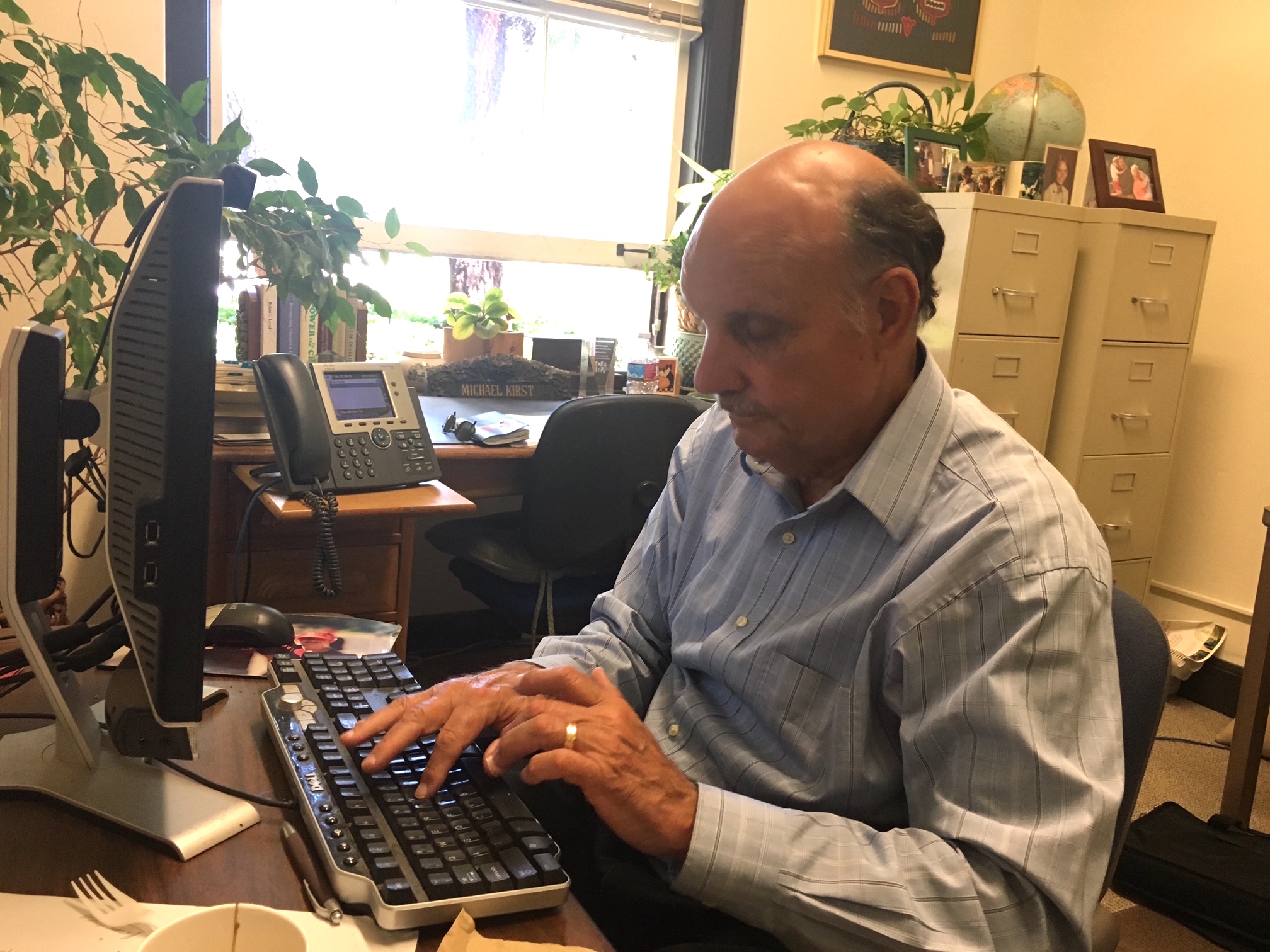
State Board President Michael Kirst in his Stanford office
CREDIT: LOUIS FREEDBERG/EDSOURCE
Michael Kirst
In the short term, K-12 education wouldn’t appear to be a top priority of the Trump administration.
The big thing we are looking for right now is the proposed regulations for ESSA (Every Student Succeeds Act). We are in the middle of the draft regulations, so we are looking for a signal as to the intent and timing. We would expect more flexibility (from the Trump administration) with ESSA, but if the Obama administration promulgates the regulations, as they have a right to do, and Trump wants to change them, he would have to reopen the process, which would take awhile.
My view is Lamar Alexander (Republican senator from Tennessee who was instrumental in the law’s passage) is satisfied with the law he’s got.
This state does not want a voucher program, so a big issue is what Trump would do about that. He could cut federal aid to education to fund his big infrastructure plan.
If he wants to repeal Common Core, this is not something he could do through executive action or regulations. A new law would be needed to say that states cannot teach certain standards. He would have to override the viewpoint (in the Every Student Succeeds Act that says) that the federal government should not get involved in determining academic standards.

ERIN GABEL

Deputy Director, First 5 California

“President-elect Trump has said he believes in family leave and child care.”
Erin Gabel
Erin Gabel
Early childhood advocates had the distinction of having one of the only issues the two candidates agreed on. President-elect Trump has said he believes in family leave and child care.
Those of us in the early childhood world look forward to seizing on that statement. We hope to pave the way for protecting federal investments in that area in partnership with California. We hope to use that support as a bridge to discuss the crucial importance of other safety nets to keep parents working and keep their children in school.
The types of strategies that Trump has mentioned, such as tax credits, have not been consistent with what California has been doing. But we hope we can piece together what Trump is proposing with California’s approach. The patchwork quilt can take a lot of threads, and it’s a good thing to explore.

JOSHUA PECHTHALT

President, California Federation of Teachers

Trump has voiced a national right-to-work agenda. He has the wind at his back.”
Joshua Pechthalt
Joshua Pechthalt
There is an opening (for Trump) to nominate somebody to the Supreme Court who will not be friendly to unions. There had been a reprieve with the death of Justice Antonin Scalia. Now we will go back to preparing for (another Friedrichs case before the court) and other things. Since the Senate and the House are controlled by the GOP, this opens the door to Friedrichs-like efforts across the U.S. labor movement. (Note: Friedrichs v. Californiachallenged the right of public employee unions to collect collective bargaining fees from all workers covered by a contract.)
Trump has voiced a national right-to-work agenda. The Republicans control two branches of government, which gives them the power and the political will to do it. Trump has the wind at his back.
He has expressed support for (federal funding of) vouchers. I’m not sure how that happens, but with the Senate and House (under Republican control), that makes Education leaders contemplate what Trump presidency means for California education | EdSource:

Betsy DeVos under consideration by Donald Trump for U.S. Secretary of Education | MLive.com

Betsy DeVos under consideration by Donald Trump for U.S. Secretary of Education | MLive.com:

Betsy DeVos under consideration by Donald Trump for U.S. Secretary of Education

Image result for big education ape Betsy DeVos


Betsy DeVos, a prominent school choice advocate and GOP supporter, is under consideration by president-elect Donald Trump to serve as U.S. Secretary of Education, according to news reports.
Several news organizations, including the Washington Post and Politico, have said DeVos is among a handful of people under consideration for the position.
Greg McNeilly, a family spokesman, declined to comment Wednesday afternoon.
DeVos, whose husband Dick unsuccessfully ran for governor in 2006, is a renowned advocate -- both in Michigan and nationally -- for school choice and charter schools. She serves on the board of the Michigan-based Great Lakes Education Project and the Washington D.C.-based American Federation for Children -- each of which works to expand educational options for children.
Trump, for his part, pushed for greater school choice on the campaign trail, including a proposal to pump $20 billion into expanding options for low-income students.
DeVos, a former chair of the Michigan Republican Party, previously expressed reservations about Trump. At the Republican National Convention in July she cast her vote as an at-large delegate for Ohio Gov. John Kasich, and said she was still hoping to "hear something from our nominee to convince me that I should support him."
Betsy DeVos still looking for a reason to support Donald Trump
Former Michigan Republican Party chair Betsy DeVos is bullish on the future of her party, but she's still not quite sold on the presidential candidate Republicans have now officially chosen.


In addition to DeVos, other people under consideration for the position include Indiana Rep. Luke Messer, as well as William Evers, a research fellow at the Hoover Institution at Stanford University, according to news reports.
The DeVos family has long been staunch supporters of the Republican party, lavishing candidates with donations and supporting conservative causes such as school vouchers and making Michigan a right-to-work state.
DeVos, as quoted on the American Federation for Children website, says she's "part of an education revolution – a revolution that results in parents, especially those who have children trapped in failing schools, having choices."
"And, only through educational choice can we unleash the power of bold innovation to transform the lives of these children and to give them hope for a much brighter future," she said.Betsy DeVos under consideration by Donald Trump for U.S. Secretary of Education | MLive.com:
Image result for big education ape Betsy DeVos

Charter schools enroll more girls, with boys more likely to leave

Charter schools enroll more girls, with boys more likely to leave:

Charter schools enroll more girls, with boys more likely to leave


Charter schools - particularly middle and high schools - enroll a larger share of girls than do traditional public schools, in part because boys are more likely to exit charter schools, finds a new study by New York University researchers.


The study, published in the journal Educational Policy, is the first to examine  in charter school enrollment.
"As the charter school sector has grown, so has the gender gap with traditional public schools," said study author Sean Corcoran, associate professor of economics and education policy at NYU's Steinhardt School of Culture, Education, and Human Development and co-interim director of the NYU Institute for Education and Social Policy. "This gap seems to be a function of both more  choosing to enroll in charter schools and boys being less likely to stay in these schools."
Research has examined whether students in charter schools differ from those in traditional public schools with respect to prior achievement, special education, or English learner status, but until now, it has overlooked gender differences.
In order to study the gender gap in enrollment between charters and non-charter schools, Corcoran and NYU's Jennifer Jennings looked at more than a decade of data for all public schools in the U.S., including charters (from the 1999-2000 school year to 2010-2011).
The researchers found that charter schools enroll a modestly larger share of girls than do traditional public schools serving the same communities - approximately 1.9 percentage points more (50.7 percent in charters versus 48.8 percent in traditional public schools, in 2010-2011). This gap was largest in high school, peaking at 3.1 percentage points in 11th grade. The gender gap also widened over the period studied, more than doubling from 1999-2000 to 2010-2011.
While these gaps appear small, Corcoran noted that they are only slightly smaller than the gaps in English learner and special education status, which have commanded far greater attention from policymakers.
The researchers were unable to fully explain why the gender gap existed between charter and traditional public schools, but highlighted a number of reasons why charter schools might enroll more girls than boys.
"Girls may be more likely to apply to charter schools because of differences in curriculum and program offerings. The finding of larger gaps in middle and high school suggests a student'sown interest in attending charter schools may be an important factor," Corcoran said.
"Gender differences in educational needs and behavior may also play a role," said Jennings, associate professor of sociology at NYU and the study's coauthor. Jennings and Corcoran found the gender gap in charter enrollment was larger in KIPP charter schools, which tend to adhere to strict "no excuses" academic and behavioral expectations, which may present a greater challenge for boys. The gender gap in KIPP schools was nearly 50 percent larger than other charter schools (2.9 versus 1.9 percent).
The researchers also examined whether rates of retention differed between boys and girls and whether this could explain the  they saw in the national data. In order to do this, they looked at data for all students in grades 3 through 12 who attended North Carolina public and charter schools between 2005-2006 and 2010-2011. This statewide dataset followed students across grades and between schools, allowing the researchers to get a better sense of attrition patterns.
Both boys and girls were both more likely to leave charter schools than traditional . However, boys were more likely than girls to exit charters at every grade level, by as much as 1 to 3 percentage points more per year, with larger gaps in the upper grades.
The researchers concluded that the higher attrition among boys was not enough to explain the full gender gap between charter and traditional schools in North Carolina, suggesting that the gap begins when students - more girls - initially enroll in .
"Our study suggests that preferences for certain education environments, combined with the ability to succeed in these environments, may drive gender gaps in charter school enrollment," said Jennings.

Read more at: http://phys.org/news/2016-11-charter-schools-enroll-girls-boys.html#jCp

Let's Privatize American Education Even If There Is Little to No Research to Support School Choice — The Art of Teaching Science

Let's Privatize American Education Even If There Is Little to No Research to Support School Choice — The Art of Teaching Science:

Let’s Privatize American Education Even If There Is Little to No Research to Support School Choice

Image result for Let’s Privatize American Education Even If There Is Little to No Research to Support School Choice

The new administration-elect in Washington has a plan. Take $20 billion from public education, possibly destroying a core idea of democracy, and then distribute it as vouchers that could that could be used at a host of private institutions, especially charter schools.
You might say that this seems like a democratic way to education our youth.
However, its my view that education needs to be in the public domain, and citizens need to fight to make sure that the slow creep of privatization does not turn into an avalanche. The democratic values that are the centerpiece of our society have been under assault, especially with the rise of the extreme conservative movement that began with Barry Goldwater, and continues today with the take over of the Republican party by extreme right-wing ideologues, who took the White House on November 8, 2016.
Although we don’t know if Twimpie* (I’m using George Lakoff’s sound symbolic renaming of the president-elect) will follow through with his campaign ideas (he’s backed off some, but then he hasn’t appointed anyone for his cabinet).
Privatizing public education will be a big push of Twimpie’s administration, even if the research on privatization of education tends either to show that private ventures such as charter schools do not outperform public schools, or that the research is rather limited, such as when we look at virtual schools.
School choice has been around, but accelerated after the 1954 Brown v. Board of Education of Topeka ruling (1954), when white parents wanted to continue with the segregation of schools by sending their children to private schools.
None of these initiatives is as effective or more so than public schools in boosting student achievement on standardized tests. And the research on some forms of choice, such as home schooling and virtual schools is meager.
Research on School Choice
According to G. Miron and J.L. Urschel, research on school choice needs to improve, as well as how it is interpreted. In their chapter on the impact of school choice on school achievement published in Learning From the Federal Market-Based Reforms (Library Copy), they survey the research on the effect of the following types of school choice on student achievement:
  • Vouchers
  • Home schooling
  • Interdistrict, Intradistrict and Magnet schools
  • Charter schools,
  • Virtual schools.
Considering the quality of the research (the authors analyzed each study using a weighting scheme) and effect on achievement, the researchers found that overall, the effect on learning was mixed, and in some cases (virtual schools) almost nonexistent. The the impact Let's Privatize American Education Even If There Is Little to No Research to Support School Choice — The Art of Teaching Science: