The "Curiosity Chemical"
-
Dopamine is a neurotransmitter that is commonly misunderstood as the
"pleasure chemical." In modern slang, we talk of "dopamine hits" to
describe what pe...
Why Do We Have Schools?
-
Every state in our union has a compulsory school attendance law, but why do
we require schooling? What is the purpose of school? Or the purposes? Here
are ...
Iran Has Changed the Question by Vijay Prashad
-
For more than three decades, the United States has treated Middle Eastern
diplomacy as an exercise in writing the terms for others. Iran’s emerging
regio...
If you weren’t worried about A.I. . . .
-
Explore this gift article from The New York Times. You can read it for free
without a subscription. www.nytimes.com/2026/08/13/o...
[image or embed]
—...
Federal Voucher Money Will Not Go To Public Schools
-
Remember "backpacks full of cash"? It was a phrase coined by reforster Jeanne
Allen that captured the way that taxpayer-funded vouchers turned private
scho...
When we went to Mexico City (Part 3 – Teotihuacan)
-
Mommy found a private guide (small group). He was great. Turned out to have
studied ethnomusicology – two advanced degrees – but taking tourists to the
pyr...
Final Office Hours
-
I had to move out of my office on Stanford’s campus. I had retired from the
Graduate School of Education in 2001 and since GSE had allotted offices in
one ...
The Psychiatry of MAGA
-
Here is a very interesting presentation about how to understand the MAGA
mind. Check it out
A Psychiatrist Explains Why Followers Of Trump Believe Ever...
This Guy Used to Be My Congressman
-
And now he wants to be my senator. Again. Meet Mike Rogers. I spent most of
my life and nearly all of my teaching career in Livingston County,
Michigan—a r...
Time to change our Nation’s Diaper
-
It’s time to change our nation’s diaper. Our national identity now reeks
due to our inability to clean out the mess caused by the Orange Turd.
Corruption i...
The Silly Season Comes to School
-
“What is truth?” Sometimes people ask this question because they wish to do
nothing. Generic cynicism makes us feel hip and alternative even as we slip
alo...
GLP-1 Meds for Kids? Some Info.
-
Like many consumers of television and social media, I have been bombarded
with ads for GLP-1s (short for glucagon-like peptide-1). The ads are
everywhere. ...
By One Dishonest Measure
-
A loaded question that education reformers like to ponder is: Exactly how
many students in the boroughs of New York City are trapped in failing
schools? In...
1776
-
__________
“The fate of unborn millions will now depend, under God, on the courage and
conduct of this army…. We have, therefore, resolved to conquer...
May’s Parent Engagement Resources
-
San Diego Unified Created a System to ‘Empower’ Parents. It Unraveled is
from The Voice of San Diego. Why Those Disengaged Parents in Your School
Deserve a...
Reflections on America, the world, and life
-
I acknowledge that I rarely post here anymore. Folks should remember that I
am approaching my 80th birthday in less than 9 weeks, I am still teaching
ful...
Shutting Down The Site
-
Ten years ago, I ran for a seat on the LAUSD School Board of Education with
the goal to *Change the LAUSD*.
I am proud of the campaign we ran. We achieve...
The Company You Keep
-
Even though the filing period for the 2026 elections isn't until April,
let's all pay close attention. The candidates lining up to run will tell
you more a...
Blogoversary #19 — Time to Move on
-
Times have changed. I had a nice long run here, but let’s face it, it ended
a while ago. So I’ve moved. I’m not writing much any more, but when I do it
wil...
Il Papa è Morto
-
Francis brought a distinct pastoral outlook to his papacy. A simple man, he
lived in a small apartment in the guesthouse. He sought to make the church
acce...
Mike Shulman the ARISE UFT Judenrat
-
I was surprised to learn that Mike Shulman has aligned himself with ARISE.
I previously supported him, advocating that the Castle Doctrine could have
bee...
AIN’T IT AWFUL
-
As the terrible feelings of dread and angst spread across the world the
great majority of the American people feel powerless before the onslaught
of those ...
Vote NO on the UFT Contract. Here is Why:
-
The best reason to vote no on this contract is this: UFT Unity* lied* to us
in 2018. They misrepresented that contract. It was predicated on deals we
wer...
Testimony to the CPS Truancy Task Force
-
I prepared testimony for one of two public hearings held by the Chicago
Public Schools Truancy Task Force, a body mandated by state legislation.
The meetin...
There Is A Teacher Shortage.Not.
-
THERE IS A TEACHER SHORTAGE. And just to be sure you understand, it’s not
that teachers don’t want to teach. It’s not that there aren’t enough
teachers cer...
Book Banning Turns to Dick and Jane
-
Breaking News: Dateline February 4, 2022 - Parents in Dimwitty, Alabama
have asked the Dimwitty Board of Education to ban the children's primer *Fun
with...
Have You Heard Has a New Website
-
TweetHave You Heard has a new website. Visit us at
www.haveyouheardpodcast.com to find our latest episodes and our entire
archive. And be sure to check out...
Follow me at Substack
-
I've moved. Follow me at Substack
I'm now posting regularly at Substack. You can subscribe for free to my new
Edu/Pol blog at michaelklonsky.substack.com
...
I’ve moved.
-
I’m on Substack now. You can continue to receive periodic posts for free.
Or you can read every post and comment for $5 a month, $60 a year.
fredklonsky.su...
Aspiring Teachers Get New Help Paying For College
-
[image: colorful classroom pattern]
*; Credit: shuoshu/Getty Images*
Cory Turner | NPR
New rules kick in today that will help aspiring teachers pay for c...
Tips Akses Situs Judi Qq Tanpa Perlu Takut Nawala
-
Kegiatan berjudi slot melalui situs judi qq online, sekarang sudah
dilakukan oleh banyak penjudi Indonesia. Tentu, Kamu yang sedang membaca
artikel ini a...
The Threat of Integration
-
I have lived in the same house in the Miracle Mile section of Los Angeles
for over 30 years, where up until now I have had little or no interaction
with th...
We fight for a democracy worthy of us all!
-
The nation stands at a crossroads, said NEA President Lily Eskelsen García
in her final keynote address to the 2020 NEA Representative Assembly and
it’s up...
The Passing Of Chaz 1951-2020 Age 69
-
I am the son of Chaz and like to inform you that he passed away this
afternoon from the COVID virus. My father passed in peace beside his loved
ones. We ar...
The Fight For Our Children
-
*The number of suicides among people ages 10 to 24 nationally increased by
56 percent between 2007 and 2017, according to a new federal report showing
the ...
Read to Self: Just a Kid and a Book.
-
Date: Monday, January 5, 2020 Place: My classroom Student: Mrs.Mims, could
we start doing Read to Self again because I got this great book for
Christmas an...
Reminiscences
-
I just finished dumping the rest of my lesson plans. I guess I held on to
the calculus ones for so long because I spent so much time working on them
an...
Just Asking for some Teachers I know.
-
Recently Wisconsin Governor Tony Evers stated, We must … recognize that
part of supporting our kids in the classroom means supporting the educators
who t...
Cara Menang Bermain Judi Bola Online
-
Bermain judi bola online tentu saja memiliki kesenangannya tersendiri baik
itu mendapatkan keuntungan maupun ketika menantikan hasil skor pada sebuah
perta...
A Critique of Standards-Based Grading
-
It first happened to me about ten years ago. I was beginning my third year
of teaching in a new school in Washington, DC. Social studies teachers were
si...
Reduced time for testing? Not so fast.
-
NYSED and Commish Elia continue to say that the NYS Assessments are of
reasonable length, I completely disagree.
Here is what NYSED states are average expe...
The World According to Michelle Rhee
-
The men behind the curtain fashioning the brave new world of corporate run
education in America! Michelle Rhee is the founder of StudentsFirst, The
New T...
Whose Opinions Matter in Education World?
-
It's hard to identify education heroes and sheroes. And perhaps even harder
to pinpoint just whose work is slanted, paid-for and dishonest.
New Local Businesses in Sacramento
-
Starting a new local business in Sacramento is a monumental task, but can
be accomplished with footwork, perseverance and knowledge. One must learn
the loc...
Lesson Plan: Rhyme and Rhythm in Poetry
-
I’ve started a recent unit on poetry with my class. I’m not a poet, and I’m
not a poetry fan (I don’t hate it, but I’m a prose gal), so this makes it
harde...
The Apotheosis of Betsy DeVos
-
Betsy Devos has drawn few headlines in recent months, and that is a good
thing for the Secretary of Education. Her tenure began with Vice President
Mike P...
Education Is a Civic Question
-
In their final post to end Bridging Differences' decade-long run, Deborah
Meier and Harry Boyte urge readers to put the energy, talents, wisdom, and
hard w...
Site News: New Home for Education News & Commentary
-
Quick! Get over there! The daily education news roundup and education
commentaries that you're probably looking for are now being published over
at The Gra...
Should We Be Grateful?
-
In an odd turn of events, and with little explanation, Michigan Governor
Rick Snyder has decided to return the state’s School Reform Office back to
the Dep...
An Open Letter to NC Lawmakers
-
An Open Letter to NC State Lawmakers and NC State Superintendent Mark
Johnson: I am a NC native, voter, and public school teacher. I am
addressing you all ...
The Secret to Fixing Schools (My Next Bestseller)
-
The Secret to Fixing Schools (My next bestseller) Prologue I just finished
watching a fascinating documentary on Netflix entitled, “The Secret”. The
film p...
Farewell, Sleep
-
Today is the official last day of my spring break. I've done a scientific
survey: My natural bedtime is 2 AM, and my natural wake up time is 9:41
AM. Tom...
REPORT: States With the Best and Worst Schools
-
States With the Best (and Worst)Schools
By *Evan Comen, Michael B. Sauter, Samuel Stebbins and Thomas C. Frohlich*
January 20, 2017- http://247wallst.com
...
Test Refusal = People Power
-
In recent months, social media has been ablaze with talk of regular folk
taking action to resist the Trump agenda. Protests are a daily occurrence,
and ev...
Random Musings and Observations. . . .
-
I’ve been gone a while from the blogging scene. Some of my more regular
readers no doubt noticed but did not hassle me about it. Thank you for
that. Sinc...
AB 934: A LEGISLATIVE FIX FOR VERGARA?
-
By Michael Stratford | in the Politco Morning Education Report | via email
05/24/2016 10:00 AM EDT :: Two national education groups are backing a
Califor...
MY NEW BLOG
-
My new blog will consist of fictitious headlines, meant to be a blend of
humor and satire. I apologize ahead of time if any other satirical site has
simila...
Thank you
-
Dear Readers,
Thank you for visiting *The Perimeter Primate*. This blog is being retired
for the time being. Although I no longer post here, I do still s...
I am Retiring
-
I have some news: I am retiring from the PBS NewsHour and Learning Matters.
[[ This is a content summary only. Visit my website for full links, other
conte...
New Beginnings: Kickstarter and EdWeek Teacher
-
Greetings to InterACT readers one and all! If you’ve been following posts
here recently you might recall that I’m moving my blogging activity to
other loca...
Adelaide L. Sanford Charter School
-
*“With Adelaide L. Sanford Charter School closing, Newark families must
move on.”* The Star-Ledger (NJ), 6/25/2013
NEWARK — Bobby and Troy Shanks saw the...
Did Arne Duncan's attack on suburban parents help Trump win the election?
Arne Duncan at Boston DFER meeting supporting unfettered charter expansion. MA voters disagreed and defeated Question#2 and Trump in the process.
It was back in 2013 parent protests against Common Core testing were bubbling up around the country and the opt-out movement was moving ahead full-steam.
Instead of uniting with or at least trying to understand parent/teacher discontent with testing madness, former Ed. Sec. Arne Duncan, representing Pres. Obama, lashed out at what he called, "White suburban moms’ upset that Common Core shows their kids aren’t ‘brilliant’".
At anther appearance at the National Press Club in Washington, Duncan claimed that opposition to the Common Core testing had been fueled by “political silliness.” He told a convention of newspaper editors that his critics were misinformed at best and laboring under paranoid delusions at worst.
Aside from being a terribly misleading statement -- tens of thousands of urban parents, black, white and Latino joined the opt-out movement -- it was an insulting sting, not only for parents, but their children, that left a permanent mark.
As a parent and grandparent of public school students, in a city like Chicago, where Duncan once ruled the education roost, I can tell you that calling parents "paranoid" and "delusional" is probably not the best way to win an election for your party.
Longtime Davis resident and veteran high school English teacher Matt Biers-Ariel has published a new book — a novel titled “Light the Fire.” Biers-Ariel will hold a book-signing event at 7:30 p.m. Friday at The Avid Reader, 617 Second St. in downtown Davis.
Author Matt Biers-Ariel lives in Davis and teaches in Winters. Courtesy photo
“The book has to do with high school,” Biers-Ariel told The Enterprise. “It took me 15 years of teaching in a high school to really understand the dynamics that I wanted to write about.
“The issues I wanted to look at are teacher-student relationships, test scores and how tests are ‘the tail that wags the dog.’ I wanted to show the different student groups … the group that’s college-bound, and those who just want to get a high school diploma, and how we treat them differently as teachers.
“And I also wanted to look at the whole notion of the Common Core academic standards, and who determines what should be taught.”
The main character is a teacher named Samson, who observes at one point that nothing in the Common Core academic standards “deals with the appreciation of literature, or building a creative mind. … Mr. Samson is fighting a rear-guard war against the (school district) administration, which is focused on test scores. Everyone’s job depends on it,” Biers-Ariel said.
But the novel is also a story about a particular teacher, who gives in to a particular temptation.
“This is not just a ‘policy book,’ it is about a teacher who loses his bearings, and tries to ‘get with the program.’ And it takes a toll on him, it turns him toward alcohol,” the author said. “He’s a young teacher, and young teachers and students sometimes have special bonds.
“High school is a crucible where students really begin to explore themselves in the world, and the teachers become guides, friends, they take part in this journey with them, and sometimes those lines get blurred. Even though we morally know the right thing to do, Mr. Samson finds himself in territory that he doesn’t not want to be in, he did not choose to be there, but there he is. So how does he respond?”
The book follows two different classes — an Advanced Placement class, where the students want to get college credit, and a regular English class, Biers-Ariel said. Samson has a very different way of approaching these two classes. It’s a flaw of his that he doesn’t give the non-AP kids intellectual rigor.
“The plot is fiction,” he stressed. “The teacher — in the classroom — that’s pretty much based on me. The main character, Mo Samson, is not me at all. But if one of my students were to walk into this character’s classroom, they would recognize the teaching.”
Dean Vogel of Davis, former president of the California Teachers Association who taught for many years in Vacaville, says that “many books try to capture the dynamics between teachers and their students. Usually they miss the mark, but ‘Light the Fire‘ hits the bull’s-eye. As an educator for over 45 years, I am thoroughly impressed by Biers-Ariel’s ability to translate the feel of a classroom into a novel. This book is real.”
Biers-Ariel has written six books, including a memoir and a book for children. This new novel is independently published.
“I like the control that I never got (before) with a publisher,” he said.
He grew up in Los Angeles — “a Valley boy,” as he puts it. He did his undergraduate studies at UC Berkeley, followed by graduate studies at Hebrew Union College in both Israel and Los Angeles.
He came to Davis 17 years ago, and teaches in Winters. He describes himself as an agnostic Jew who thinks the Bible is the root of western fiction. When he isn’t teaching or writing, he can often be found river kayaking.
Sarah Mondale is a documentary filmmaker and teacher. Ten years ago, she and her partners created the multi-part documentary School: The Story of American Education (you can find the book form at many booksellers). Now she has a new project and it deserves your support.
The film takes us to New Orleans, Philadelphia and Nashville, a pretty perfect selection of cities to give the real sense of the forms the privatization movement takes.
And I particularly love the central question that the film settles on, because I have the same question:
Why dismantle the public school system? Why not make it work well for every child instead?
The marquee name attached to the film is Matt Damon, who reads the narration. It's a nice gesture and a necessary feature in today's market ("Oh, the narrator is someone I've heard of, so this must be a real movie.")
The production is three days away from the end of its Kickstarter campaign to collect the $31,600 needed to finalize this production. This is a story that needs to be told and a film that needs to be out there for the public to see. I'm asking you, if you're at all a fan of this blog, to head over to Kickstarter and make a contribution, however small. We can't all be filmmakers and we can't all be activists, but we can all kick in a few bucks to help amplify the voices of people who speak out on important issues. This is a story that needs to be told-- help tell it.
I've put the link in several times, but here it is again. If you're worried about public education in a Trumpian world, here's an actual concrete thing you can do to help. If you're concerned about the health of public education, here's a concrete thing you can do to help. If you want to protect the promise of public education, here's a concrete thing you can do to help. Please help.
There's an aspect of Candidate Trump's success that I think is both under-discussed and also a good lesson/reminder for those of us in the teaching biz. Trump never made folks feel stupid. Seriously. Members of the public would figuratively run up to him hollering, "Good lord, did you see this terrible story on the internet," and without batting an eye, Trump would respond "I know!! Incredible, ri
I have news. Not political news or even education news, but completely personal news. My wife and I are expecting. In fact, we're expecting twins. This is only partially a surprise. There was some science involved, but science does
Growing up in California in 2016: Here's how kids fare
What is it like to be a child growing up in California in 2016? A new report that analyzes indicators of child well-being paints a bleak picture: Large numbers of Californian children live in poverty, and educational and health outcomes statewide are, at best, fair.
The non-partisan research group Children Now conducted the analysis. It used census, American Community Service, Department of Education, school district and other data sources to build a picture of how children are faring statewide across a broad range of economic, health and education outcomes.
The report asks questions like: How many children attend preschool? How many children are reading at grade level by third grade? Do children have health insurance for the entire year? Are newborns exclusively breastfed? (You can see a full list of the indicators the group used to gauge child well-being here.)
The Californian counties where children are most likely to be thriving are in Northern California. Marin, Napa and San Mateo counties have the fewest kids in poverty and more kids reading at grade level in third grade. In these counties, more children have health insurance, are a healthy weight, and were probably breast-fed.
In Southern California counties, children don’t fare so well. In Los Angeles and San Bernardino counties, about one quarter of all children live in poverty. Children in Kern county were worse off, 33 percent were living in “concentrated poverty.”
Report author Jessica Mindnich said when a child lives in a neighborhood where 30 percent or more of children are impoverished, it makes life harder. “This impacts the resources in your direct community,” she said.
The report also tracked early education indicators, and just over half of all LA County and San Bernardino children aged zero to five were read to every day. Yet in San Bernardino county, just 36 percent of three and four year-olds attend preschool, and that very same number of children are reading at grade level in third grade.
L.A. County children are better off – 52 percent of three and four year-olds were enrolled in preschool last year. The statewide average for preschool is just 47 percent of all children. Report authors noted they did not assess the quality of the preschool programs; rather they looked simply whether children are enrolled.
Yet stark disparities exist in educational outcomes for children in counties statewide. Even in Orange County, which has the best scores for Southern California counties, with 50 percent of their third graders reading at grade level, children of color are not performing as well as their white peers. Nearly 70 percent of white third graders are hitting that benchmark, compared to only 39 percent of African-American students in this age group and to 31 percent of Latino third graders.
This is not unique to Orange County, Mindnich said. “It’s the same pattern across all counties and we’re trying to make the point that we need schools to make sure that they are meeting the needs of all our kids.”
When it comes to the health of children, one area stood out. Low-income kids in Southern California are not seeing a dentist. In Riverside and San Bernardino counties, only one quarter of poor children aged zero to three had a dentist visit in the last year.
While nearly all L.A. County children had health insurance year-round, only 11 percent of children with asthma were given a written asthmatic plan – the state average for children in this category is 26 percent.
Check out how children in your country are doing here.
The “R” Word as Taboo in Twenty-First Century U.S.A.
Margaret Atwood’s The Handmaid’s Tale offers a not-to-distant dystopia in which Atwood explores the rise of a theocracy as a sanctuary for the declining white race; the work is a tour-de-force confrontation of sexism and misogyny as well as dramatization of the relationship between power and language, including the power inherent in what humans name* and what humans taboo.
The central handmaid of the tale, June/Offred, narrates her own journey through hell that includes being assigned to a Commander who monthly is charged with attempting to impregnate his handmaid in what this new nation of Gilead calls the Ceremony, infusing the act with religious and official overtones.
However, June/Offred characterizes the Ceremony with a disturbing and clinical precision:
My red skirt is hitched up to my waist, though no higher. Below it the Commander is fucking. What he is fucking is the lower part of my body. I do not say making love, because this is not what he’s doing. Copulating too would be inaccurate, because it would imply two people and only one is involved. Nor does rape cover it: nothing is going on here that I haven’t signed up for. There wasn’t a lot of choice but there was some, and this is what I chose. (p. 94)
Many aspects of this passage are worth emphasizing, but let’s focus on the importance and value in June/Offred naming accurately this awful thing happening—and not ignore the weight of taboo language (such as the word “fucking”).
“I have guarded my name as people/ in other times kept their own clipped hair,” opens Barbara Kingsolver’s poem, “Naming Myself,” “believing the soul could be scattered/ if they were careless.”
Here too are the intersections of naming, gender, and power: why must women abandon their names in the legal/religious act of marriage while men retain theirs?
Kingsolver’s speaker, like Atwood’s narrator, both uses and values language as power—guarding a name and naming.
#
The election of Donald Trump as the president of the U.S. comes in the wake of Trump making inflammatory comments about Mexicans, Muslims, and women. Nonpartisan and measured assessments of Trump’s words rightly label them as racist, xenophobic, and sexist/misogynistic.
The rise of Trump as a political leader has exposed the lingering taboo in the U.S. for naming racism, even when there is direct evidence of racist language and behavior and especially when that racism is coded (getting tough on crime, building a wall, evoking the specter of terrorism).
Serious public debate has parsed making the distinction between Trump being a racist and Trump courting and/or attracting racists, such as being endorsed by the KKK, neo-Nazi organizations, and the white nationalist movement.
A perverse shift has occurred, in fact, from the mislabeling of Barack Obama’s being elected president as proof that the U.S. is a post-racial society to Trump’s rise asking the U.S. to reconsider what counts as racism.
Trump personifies the triple-Teflon of being white, male, and affluent, most notably in the power of those attributes to deflect the label “racist.” As Trump himself asserted defiantly:
I can never apologize for the truth. I don’t mind apologizing for things. But I can’t apologize for the truth. I said tremendous crime is coming across. Everybody knows that’s true. And it’s happening all the time. So, why, when I mention, all of a sudden I’m a racist. I’m not a racist. I don’t have a racist bone in my body.
Trump’s own strategy frames his words and behavior as “truth,” therefore not “racist.”
Federal segregation complaint filed against Red Bank Charter School
Two groups have filed a federal complaint against Red Bank Charter School, alleging discriminatory practices in enrollment and asking that the school be closed.
Fair Schools Red Bank, a group of parents at Red Bank Borough Public Schools, and the Latino Coalition of New Jersey filed the complaint to the Civil Rights Division of the U.S. Justice Department on Tuesday, accusing the charter school of violating a consent order requiring it to have demographics that match the school-age population of Red Bank. The complaint blamed the charter school for making Red Bank "the most segregated school district in the state of New Jersey."
Red Bank Charter School Principal Meredith Pennotti defended her school in a statement.
"It’s sad this small group that seems bent on further dividing the community has chosen to file a meritless complaint against our school," she said. "The fact is our student body more closely reflects the borough's school-age population than the district schools.
"How this group can willfully ignore this fact is truly an indication of how desperate they have become in their zeal to close a school that has served children of Red Bank well for nearly two decades."
Data from the state Department of Education show divergent demographics in the two schools, both of which serve students from pre-kindergarten to eighth grade.
Red Bank Borough Schools' population is 89 percent economically disadvantaged, compared to just 41 percent at the charter school. Economically disadvantaged students are those who get free or reduced-price lunch.
Additionally, 38 percent of district school students have limited proficiency in English; only 3.5 percent of the charter school students fall into this category. The charter school is 50 percent white, while the borough schools are about 7 percent white, enrollment data show. Hispanics comprise 81 percent of the borough schools, compared to 38.5 percent of the charter school. Both schools are about 10 percent black.
The Justice Department acknowledged receiving a copy of the complaint, but wouldn't comment about any action it would take. The New Jersey Department of Education also received the complaint, but declined to address it.
"I'm amenable to anything that just levels the playing field," said Wayne Woolley, a parent with daugthers at Red Bank Borough Schools and a member of Fair Schools Red Bank. He added that enrollment at the charter schools "violates my fundamental sense of fairness."
The complaint says that the charter school has a higher percentage of white students than the school-age population of the borough and a lower percentage of Hispanic and economically disadvantaged students. Woolley said those numbers are based on research done by the borough school and factors in Red Bank students who don't attend the borough school.
In an op-ed written last week in the Press, Pennotti said the school-age population of Red Bank is 41 percent white, 40 percent Latino and 18 percent black, which is close to the charter school's demographics. That data come from the Census Bureau and the complaint says it includes everyone under the age of 18 in Red Bank, not just school-aged kids.
In an effort to make the school more diverse, Red Bank Charter began a weighted lottery this year that gives preference to economically disadvantaged students. Pennotti acknowledged changing the schools demographics to better mirror Red Bank will be a slow process.
“How long is that going to take? Forever," she said. "But we’re working on it.”
Rep. Judy Chu asks President Obama to protect the information of 'Dreamers' before Trump takes office
With President-elect Donald Trump vowing to deport thousands of people in the country illegally, Rep. Judy Chu on Tuesday urged the Obama administration to protect the names of "Dreamers," people brought to the country illegally as children who applied for temporary status in the United States.
Trump is expected to unwind the Deferred Action for Childhood Arrivals program created by President Obama that gave temporary legal status to Dreamers.
Of the 742,000 people across the country protected under DACA, about one in three are estimated to live in California and state officials are already gearing up for a fight over immigration with the Trump administration.
"These children and families provided extensive amounts of sensitive information to their government, including fingerprints and relatives’ home addresses, with the understanding that it would not be used against them. We promised them security," Chu said in a statement. "Now they are facing a nightmare. When we asked immigrants to come out of the shadows, we never imagined the election of a candidate who ran on a policy of mass deportation."
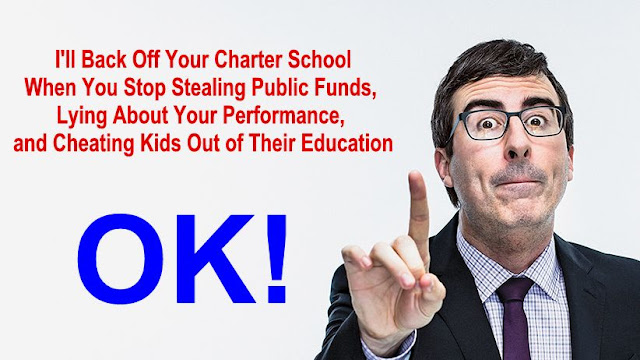
Who is Funding the Backlash against John Oliver's Charter School Critique?
On August 21, 2016, John Oliver stepped into the heated debate around charter schools. His segment reported on mismanagement and misspending at charter schools in several states. It also called into question the free market approach advocated by some in the charter school community. How? By, among other things, hilariously swiping at former presidential candidate and Ohio Governor John Kasich’s comparison between schools and pizzerias.
In response, the Center for Education Reform—a charter school advocacy outfit funded by big names such as the Walton Family Foundation, the Gates Foundation and the Broad Foundation—has launched a $100,000 competition called “Hey John Oliver! Back off My Charter School!” in which it is soliciting responses to Oliver’s segment from charter schools around the country. The organization has noted that funding for this particular campaign will come from “program funds” that it collects from over 1000 donors each year. That said, these big-name funders have a long history of supporting advocacy efforts for charter schools and this effort is just the latest salvo in a long-running battle that is reaching its 25th year.
As the charter school advocacy movement comes of age, even the founder and CEO of the Center for Education Reform, Jeanne Allen, has tough words for its leaders. She notes that charter reformers have become “our own worst enemy” and that their agenda comes across as “narrow, hollow and hostile.” Earlier this summer, Allen released a white paper calling for a new direction for the charter school movement while calling into the question the money and muscle of funders and the organizations they sponsor to “struggle every day to defend what already exists.”
From 1991 to 2000, 36 laws were enacted governing the creation of new charter schools and two creating new full school choice programs. Since then, progress seems to have slowed and funders like Gates and Walton are beginning to ask why, even as they continue to cut checks. Part of this trend is obviously due simply to the initial ramp-up and early novelty of the movement when it was just getting started. Still, with all of this investment from major philanthropic institutions and withering critiques from major media figures like Oliver, many in the movement are questioning why it feels like more was accomplished in the early years of the movement than in the recent past.
As much as Oliver’s segment highlighted important distinctions between how charter schools and district schools operate, a 2015 report by the Mind Trust, a charter advocacy organization based in Indianapolis, found that most charters very closely resemble their district school counterparts despite claims about innovation in the sector. This is fueled by risk-averse authorizers and philanthropists who place big bets on well-established models, such as charter management organizations (CMOs), as opposed to radical new ideas.
Despite the mixed record for charters over the past quarter century, as noted by Oliver, major foundation dollars have flowed big time towards charters and away from traditional public schools. In fact, funding for charters increased from 3 percent in 2000 to 16 percent in 2010, while it was cut in half for district schools over the same period, according to Michigan State University researchers Sarah Reckhow and Jeffrey Snyder.
But we wonder what more recent data might show. As we've reported, some emerging big ed funders like Mark Zuckerberg and Priscilla Chan are looking beyond charters as they plot to reinvent American education. Personalized learning is one idea with the potential to edge aside charters in the competition for funder dollars, with major attention from Zuckerberg and Gates, as well as others from the tech philanthropy community.
A great many of the new activist philanthropists coming on the scene are focused on scalable solutions. Yet, as we've noted before, charters have struggled on this front. While large shares of students in some poor cities are now in charters, these schools still only educate 5 percent of all K-12 students—after 25 years of effort and billions of dollars in donor backing. Scaling the charters that are actually good is even harder.
If you're a young tech type looking at what new solution might sweep over and remake the K-12 landscape, it's not clear you'd see charters as an obvious candidate. How enthusiastic do you think Silicon Valley VCs might be about a product that had captured only 5 percent of market share after a quarter-century? At this point, funding charters looks more a bit more akin to backing direct services than fomenting a disruptive revolution.
All of which is to say that you can understand why charter backers might be so sensitive about John Oliver’s humorous broadside. As we've reported, the biggest charter funders have lately doubled down, but there's a growing struggle underway for the hearts and minds of new funders coming on the scene.
Municipal Bond Analysts Seek Greater Transparency from Charter Schools
We are well aware that charter schools open and close, sometimes for academic reasons, sometimes for financial reasons. Unfortunately, some of these schools are financed with municipal bonds, which makes them a risky endeavor. The story below is behind a pay wall. I subscribed to The Bond Buyer so I could read it in full. It shows why the NAACP and other organizations are calling for charter school accountability and transparency. It is not good for either municipal finance or for children to have schools that close in the middle of the year without warning.
Racently, the National Federation of Municipal Analysts urged charter schools “to provide detailed financial, academic, and staffing information in primary and secondary disclosure documents.” This is the first time that the NFMA has made disclosure recommendations for charter schools.
“The charter school sector has been very active in the last … four to five years [and] it traditionally has not had a lot of public rating coverage,” said Gilbert Southwell, vice president at Wells Capital Management and co-chair of the NFMA disclosure subcommittee that drafted the paper. “[The RBP] is both educational for our membership but also helps to establish our disclosure expectations when we’re looking at these deals.”
Dean Lewallen, vice president and senior analyst at AllianceBernstein L.P. and co-chair of the subcommittee with Southwell, said the RBP is the product of a year-long vetting process with a variety of market participants and thus reflects “an industry consensus.”
The document’s recommendations begin with key information that should be included in a primary offering statement (POS). According to the RBP, a charter school’s POS should disclose all material financial agreements, including the proposed indenture, loan agreement, capital leases, management agreements, and tax regulatory agreements. It should also include information from twelve other broader topics, like descriptions of facilities and their financing, pledged revenues, and projected cash flows. NFMA also wants descriptions of debt service, repair and replacement, operating and deficit, as well as insurance and property tax reserve funds.
The RBP lists disclosures in a successful charter school POS related to academic performance as well as school management and operations.
“A charter school’s academic performance has been identified as an especially important factor in charter school long-term stability and success,” NFMA said in its RBP. “Consequently, the POS should disclose all relevant aspects of the charter school academic performance.”
Such disclosures should include information covering regulatory authorities that have jurisdiction over the charter school, along with the school’s curriculum and education programs at varying grade levels and how those programs satisfy applicable educational standards, the RBP says. Information on how the school tests students to measure academic growth as well as how recent school data stacks up against historic measurements should be presented in an easily accessible way for investors, NFMA said.
In terms of school staff and management, an effective POS should provide detailed information in eight key areas, according to NFMA, including: charter board membership, compensation, and tenure; information available on the school’s website; management qualification, experience, and compensation; third-party manager control, compensation, and replacement; and charter school teaching faculty, classroom ratios, and teachers’ union affiliation. Additionally, the POS should have information regarding teacher and staff compensation, including retirement benefits, any complaints and claims the school is facing, as well as operating and funding information related to extracurricular activities.
ESP Day: Honoring the Hard-Working Women and Men who Help Educate the Whole Student
From coast to coast, students, teachers, and parents are rolling out the red carpet in a national day of recognition for education support professionals (ESP), who are integral members of the education team.
As part of American Education Week (AEW) 2016, ESP Day (Nov. 16) focuses on the importance of these school employees, who make up 40 percent of the school staff and take care of students every day, making sure they have the tools they need to succeed in school.
Among the day’s events and activities are appreciation breakfasts, luncheons, and other celebrations to honor the individuals who work behind the scenes to support students and help schools run smoothly.
NEA President Lily Eskelsen García, along with National ESP of the Year Doreen McGuire Grigg and Council for Education Support President Debby Chandler will spend the day today honoring the hard work and dedication of ESPs from Rogers High School in Spokane, Wash. The trio teamed up with the DUDE. be nice Project to pull off a series of surprises!
NEA Secretary-Treasurer Princess Moss Thanks ESPs During American Education Week 2016
At a kick-off event on Tuesday, NEA Secretary-Treasurer Princess Moss—joined by Dawn Lewis, president of the Education Association of Alexandria (EAA)—spent the day yesterday in Alexandria, Va. The duo visited three area schools: TC Williams High School, George Mason Elementary School, and Francis C. Hammond Middle School.
Like any good guest, Moss came bearing a special gift: Each school received from NEA a $1,000 check for programs and services that will benefit staff and students!
“Our school support staff has many needs and this money will go toward helping them in their work,” says Moss.
But more than just the check, the day proved to be a whirlwind of excitement, celebration, and emotion.