High-Roller PAC Seeks to Oust Supreme Court Justices
I had heard about this PAC on the radio, Citizens for Working Courts Enterprise, WA. Apparently, they are seeking to defeat Justice Charles Wiggins over decisions they believe hurt business.
However, you look at the list of names and I see ed reformers in there.
Much of the news around the campaigns for the three justices up for re-election - Yu, Wiggins and Madsen - has been the decisions on McCleary and on charter schools.
Who's in this PAC?
- Vulcan, Inc. $300K - Bill Gates $200K - Connie Ballmer $12,500K - Steve Ballmer $12,500K - Building Industry Assn of Washington $10K - Bradford Smith $7K - Kathryn Surace-Smith $7K - Washington State Tree Fruit Assn. $1K
California officials reject federal government's push to administer old science tests
California education officials have decided that students will take only one statewide test in science this spring, a pilot test based on new standards known as theNext Generation Science Standards.
The decision, made in recent weeks, pits state education officials against the U.S. Department of Education, which told California officials in a Sept. 30 letter that they must continue to administer an older science test based on standards adopted in 1998, and publish the scores on that test.
The State Board of Education adopted the new science standards in 2013, and educators had planned to administer a pilot version of a new online test aligned with those standards this spring. It had requested a federal waiver from having to give the old test as well, but the U.S. Department of Education denied its request.
Jessica Barr, an administrator in the California Department of Education’s Assessment Development and Administration Division, told teachers at the California Science Education Conference in Palm Springs on Saturday that California is forging its own path forward and plans to replace the old test with the pilot test this spring.
“We need to move on,” Barr said, an announcement that met with applause from 250 teachers in the room. “We need to transition, and we need to allow teachers themselves to transition to the new standards.”
“There’s no showdown” with the federal government, she emphasized in in an interview with EdSource. She did not elaborate.
The state plans to administer the pilot science test to students in the 5th and 8th grades and one high school grade this school year, then administer a more complete field test in the following year. Most students will take the full test in 2018-19; students with disabilities will take a specially designed test in California officials reject federal government’s push to administer old science tests | EdSource:
This is the last of a four-part series on California’s charter schools, often called the “Wild West” of the charter sector. It was written by former award-winning high school principal Carol Burris, who is now executive director of the nonprofit Network for Public Education advocacy group. She has chronicled many of the glaring problems with the charter school law in California and how students are affected.
Nationwide the charter school sector has grown over the past few decades amid a debate about its virtues and drawbacks — and even whether the publicly funded schools are public or private entities. Some charters are excellent. But as the sector has grown, so have problems that have gone unaddressed.
Ohio and Utah have distinctly troubled charter sectors, as does Arizona, where there are no laws against conflicts of interest and where for-profit charters do not have to open their books to the public. In Michigan, 80 percent of the charters are for-profit. Pennsylvania Auditor General Eugene DePasquale recently declared his state’s charter school law the “worst” in the nation. California has more charter schools and charter school students than any other state in the nation. One billionaire even came up with a secret plan to “charterize” half of the Los Angeles Unified School District. Among the problems:
Answer Sheet newsletter
Education questions and answers, in your inbox weekly.
* A report released recently by the American Civil Liberties Union of Southern California and Public Advocates, a nonprofit law firm and advocacy group, found that more than 20 percent of all California charter schools have enrollment policies that violate state and federal law.
* In some places, charter schools open without mentioning their existence to the traditional school district in which they reside, prompting lawsuits by the districts. The Grossmont Union High School District, for example, sued to shut down two charters operating in Grossmont under agreements signed by another school district. The San Diego Union-Tribune quoted Scott Patterson, Grossmont’s deputy superintendent of business services, as saying, “It’s been described as the Wild West out there.”
*A Mercury News investigation published in April revealed that the state’s online charter schools run by Virginia-based K12 Inc., the largest for-profit charter operator in the country, have “a dismal record of academic achievement” but have won more than $310 million in state funding over the past dozen years.
Carl Petersen: The Shocking Decision by the LAUSD Not to Renew Five Charter Schools
Carl Petersen is a candidate for the Los Angeles Unified School Board in 2017. He is also a close observer of school board meetings and a strong supporter of public schools.
In this post, he describes the last school board meeting, where five charters were not renewed. Three of them were part of the Fethullah Gulen charter chain called Magnolia (in Los Angeles), and the two others were Celerity charters. This was quite a shocker for the charters involved because the LAUSD has a long record of nearly automatic renewal of all charters (according to the article, 155 of 159 charters have been renewed).
Carl notes that despite the fact that most students in Los Angeles attend public schools, not charter schools, the agenda of every meeting is dominated by charter schools. It is as though the public schools disappeared and no one noticed.
He writes:
Last year, the charter industry invested “nearly $2.3 million” in “the nation’s most expensive school board elections” to ensure that they were free from the inconvenience of oversight. While the California Charter School Association (CCSA) has stated that they “are deeply concerned that this month District staff have recommended more charter renewal [denials] and material revision denials than they have in the last five years combined”, the recommendations against Magnolia and Celerity should not have been a surprise or seen as a change in policy. In 2014, the Board voted against two other Magnolia campuses “for fiscal mismanagement and a slew of other accounting irregularities.” Celerity had two charter renewal petitions rejected last November. The Board’s interest in the “financial shenanigans” at ECRCHS is a little more surprising, especially since their charter was renewed last year with at least two Notices to Cure outstanding. However, the publicity provided by the Los Angeles Daily News investigative reports most likely made the irregularities more difficult to ignore.
The LAUSD School Board needs a parent's perspective. None of the current Board members has a child enrolled in the district.
One size education does not fit all. The District must provide opportunities to all students, not just those who are college bound. We will fight to block the closure of special education centers and return funding to vocational education.
Eli Broad's plan to privatize education must be stopped. Unlike Mónica García's campaign, this campaign will not be funded by the charter industry. I will answer to the parents and students of the district, not corporate donors.
Wikileaks Provide Insight into @HillaryClinton and #Education
So Wikileaks happened thanks to the Russians and whoever else. There is lots of talk in the current presidential election about a variety of topics emanating from the purportedly leaked emails on Wikileaks. However, I haven’t seen much conversation about the the content of the leaks that is relevant to education policy. So I did a quick search of Wikileaks and have included some of my favorite tidbits of information below. If other information grabs you in the emails, please leave your thoughts in the comments.
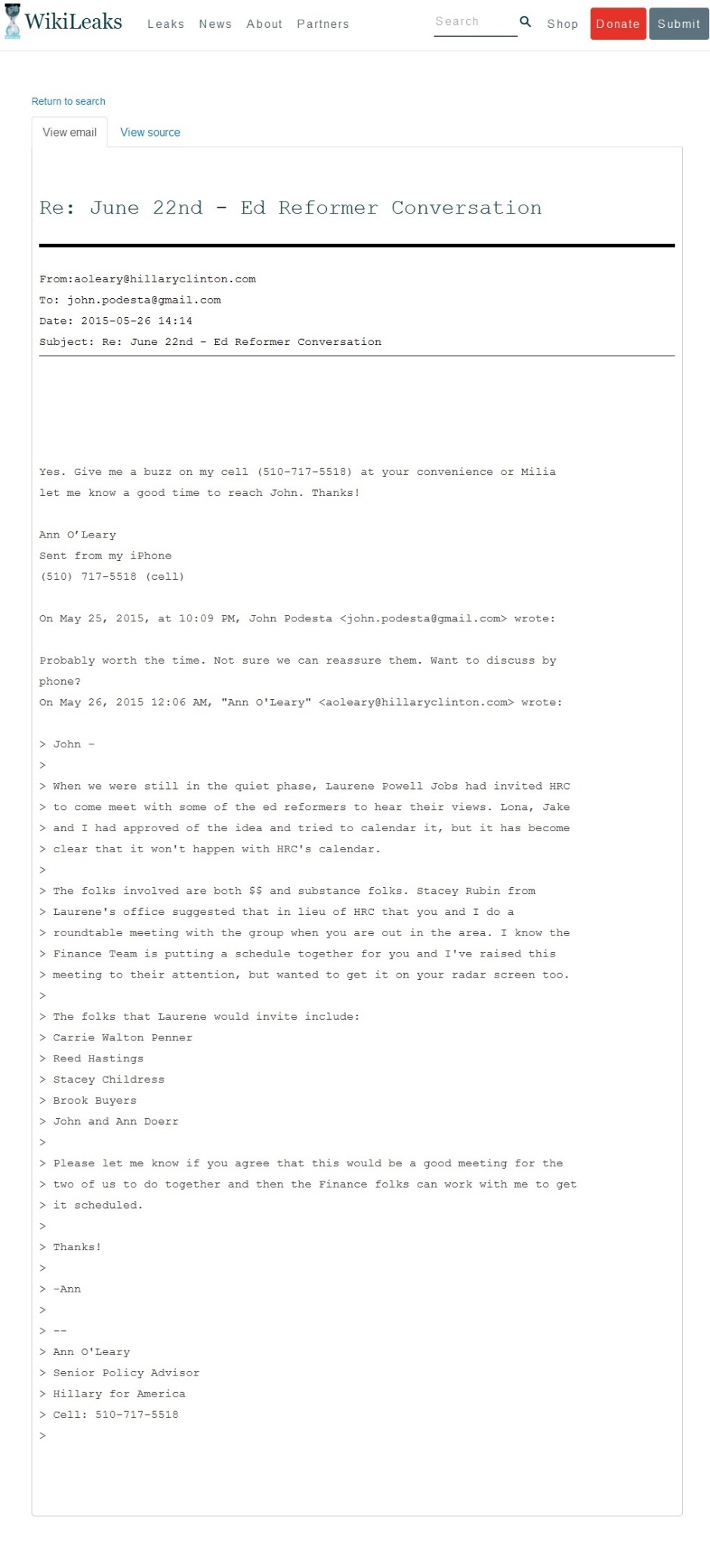
A proposed meeting with “education reformers” who are “$$ and substance.” My favorite line: Podesta: “Not sure we can reassure them.”
Question 2, which will appear on Massachusetts voters’ ballots on Nov. 8, claims that it will increase educational choice and improve educational standards across the state. In fact, it would do the opposite.
For the past decade, Massachusetts has led the nation in academic achievement. Our students have even been top ranked internationally in a time when the country’s educational outcomes have slid year by year. Massachusetts accomplished this by taking bold steps that impact all students, most importantly changing the state’s school funding system to invest more in schools in high need, low-income areas so that all students have a better opportunity to achieve. There is still critical work to be done to close persistent opportunity gaps in the system, but we won’t get there if we go in completely the wrong direction. This would be to allow state officials to give up on investing in improving a system that serves all students in need.
Saying “yes” to Question 2 would move the Commonwealth off the path towards great public schools for all students. Question 2 proposes to use taxpayer resources to increase, by 12 per year, the number of charter schools that can only be attended by a few in the state.
When charter schools, which now serve only 4% of the state’s public school students, were added to the Massachusetts model, they were never intended to be a comprehensive “education plan” for a state or locality, but rather an experiment that might provide sparks of innovation whose best practices would be integrated into the main system. It is in that system that the great majority—a full 96%—of Massachusetts students are educated. While it’s true that, like any educational system, we have a mixed record on innovation as well as achievement—there are exemplary as well as troubled charter schools—the bigger issues we need to examine go to the heart of our commitment to high quality public education for all children in the Commonwealth.
CALL 6: Thousands of Indiana teachers leaving the classroom
When teachers leave the classroom, it directly impacts student learning and can be costly for districts that spend money on recruiting and training.
In the state of Indiana, 12,426 educators, or 18 percent of Indiana's teachers and administrators, left their schools over a single school year period, according to the most recent data from the Indiana Department of Education.
Those numbers are among the worst in the nation, according to a recent study by the Learning Policy Institute.
When teachers remain in their schools, they get to know their students, families and their communities, which school leaders say is a huge factor in student achievement.
So what's causing the departure? Call 6 Investigates took a deep dive into the numbers, and found that there is no documentation state-wide on why teachers are leaving.
Why They Left
Taji Gibson was a teacher for 19 years with an enthusiasm so contagious, it won her an outstanding educator award.
“I loved the kids,” said Gibson. “I loved teaching. I wish I didn’t have to leave.”
Gibson said she left the classroom for numerous reasons including a lack of leadership opportunities and compensation.
“At the time I left, after 19 years of experience, I made maybe $54,000,” said Gibson.
“I loved the kids. I loved teaching. I wish I didn’t have to leave.”
Gibson said she had trouble juggling everything that comes along with being a teacher.
“On your days off, you’re grading, you’re making lessons, you’re trying to make things better for your students,” said Gibson.
Gibson worked at Warren Central High School and Bloomington High School North until her departure in May 2016.
She now works for the Center on Education and Lifelong Learning at Indiana University Bloomington.
Hoosier School Heist TV is Doug Martin's channel featuring videos of his book tour across Indiana speaking on the corporate takeover of public education. Order Hoosier School Heist at http://hoosierschoolheist.com/.
Sentencing set for April for ex-Chicago Public Schools CEO Byrd-Bennett
More than a year after Barbara Byrd-Bennett pleaded guilty to a multimillion-dollar bribery scheme, a sentencing date has been set for the former chief executive of Chicago Public Schools.
Byrd-Bennett, Mayor Rahm Emanuel's hand-picked schools leader, faces up to about 71/2 years in prison at her sentencing April 13 before U.S. District Judge Edmond Chang.
Last week's guilty plea by the final co-defendant, Gary Solomon, a co-owner of the SUPES Academy and Synesi Associates education consulting companies, cleared the way for Byrd-Bennett's sentencing to be set. He is to be sentenced March 24.
Thomas Vranas, also a co-owner of the companies, earlier pleaded guilty and is scheduled to be sentenced April 12.
In pleading guilty in October 2015, Byrd-Bennett admitted steering multimillion-dollar no-bid contracts to SUPES in exchange for the promise of up to $2.3 million in kickbacks.
The SUPES and Synesi companies also pleaded guilty last week to one count of wire fraud. Each company could face fines as high as $6.4 million, in addition to a total of $254,000 in restitution that Solomon and his co-defendants will collectively pay to the school district.
CPS said it would continue to pursue a lawsuit that seeks more than $65 million in damages and other penalties from Byrd-Bennett and her co-defendants.
(Calif.) California schools with only a quarter of their students coming from low-income households would be allowed to spend federal Title I money on schoolwide programs, under a waiver process pending before the state board of education.
The Every Student Succeeds Act, adopted by Congress last year, gives authority to states to decide how to evaluate Title I schoolwide programs as long as the system takes “into account how a schoolwide program will best serve the needs of the students in the school in improving academic achievement and other factors.”
The plan waiver process designed by the California Department of Education would allow schools to apply for the flexibility if one or more conditions exist on campus:
At least 25 percent or more students come from low income families.
Graduation rate is below state average.
School Site Council recommends that a SWP is the best way to serve the student population.
At least 30 percent or more of the student population are English learners.
School resides in high crime or gang-impacted community.
School has been identified for comprehensive or targeted support.
School has been identified in the lowest 5 percent of low performing schools
The proposed waiver criteria would provide a lot of spending flexibility to a large percentage of California schools – freedom that they didn’t enjoy under the No Child Left Behind Act. The restriction on such spending, before the ESSA, however, was that at least 40 percent or more of the students attending that school must come from low-income households.
The new waiver policy is included in a draft of California’s ESSA State Plan, portions of which were released in advance of next week’s state board meeting.
The ESSA Plan, which under federal law is now scheduled to be submitted to the U.S. Department of Education in July, sets up what might be another year of transition for K-12 schools before they are fully aligned with the new law.
Among the elements of the ESSA plan made public are details of how schools can apply for a waiver to allow flexibility in spending Title I money for all students; explanation of how California will conduct statewide assessments of English learners; and new standards for entrance and exit procedures for English learners.
Over the past quarter-century, charter schools have gone from an upstart education experiment to a prominent, promising, and disruptive innovation in K–12 education. Indeed, few observers present at the creation of the first charter schools could have predicted how rapidly this movement would spread or how thoroughly it would come to dominate the education-reform agenda. In Charter Schools at the Crossroads, authors Chester E. Finn, Jr., Bruno V. Manno, and Brandon L. Wright take stock of what chartering has (and hasn’t) accomplished thus far, how to address its present challenges, and what an ambitious and boldly different course for the next twenty-five years would look like.
From the role of philanthropy to the rise of no-excuses charter schools, they frankly examine the positive and negative consequences of policies and programs, and push sector leaders to do more, do better, and do it differently. They counter the often-oversimplified narrative of the movement’s origins, showing how multiple agendas and intentions led to a cacophony of results. And they address chartering’s many current dilemmas, including the roles of authorizers and operators, challenges in facilities and funding, and the balance between freedom and regulation. Informative and provocative, this book shows the tremendous work accomplished by the charter sector thus far—and how much still remains to be done.
Charter Schools at the Crossroads: Predicaments, Paradoxes, Possibilities is published by Harvard Education Press and is available for purchase on its website or Amazon.
Black children deserve the stability that their neighborhood schools can offer, despite studies that may indicate otherwise
School closure is a tactic we don’t have to take.
Under the new national education law, the Every Student Succeeds Act, states have been freed to employ strategies they deem fit just as long as they act on the bottom five percent.
When we’re talking about improving urban districts, though, we always seem to land on the “solution” of closing them.
Black communities are constantly losing the anchor institutions we actually need strengthened.
Within those very districts, there are schools that offer somewhat of a model. The elements that make those schools successful can be replicated in others if we valued the teachers and leaders enough to build their capacity. We build people’s capacity when we believe they can improve.
The study examined the effects of school closures in New Orleans and Baton Rouge, Louisiana from 2008 to 2014 to show that school closures can have positive effects on student outcomes.
“What gets measured gets done.” If research never leaves the confines of the “gap-closing” framework, “growth” will always burden black families – not the institutions that caused inequities in the first place. Being compared to whites, which gap-closing work and research constantly reinforces, insidiously assumes that white institutions and people are not problems to be solved.
Join the conversation later on Andre Perry’s radio show, “Free College,” hosted Tuesdays onWBOK1230in New Orleans at 3pm Central/4pm Eastern504.260.9265.
Many other urban districts including Newark, Oakland and Philadelphia have used school closure as an approach to improve overall performance while reducing the number of ineffective institutions.
The theory is if you close failing schools and move students into better ones you’ll get better educational options and eventually outcomes.
Part 12 of Work Hard, Be Hard . . . focuses on the last teacher interview that I did for this book. I am still interviewing, however, so if you are a former "no excuses" charter teacher or student or administrator who wants to share your story for future publication, please contact me: james.horn@cambridgecollege.edu.
Chapter 12
The Final KIPP Interview
My first interviews with former KIPP teachers began in 2011, and the last ones for this project were conducted in 2014. The very last one was with a young woman who contacted me to tell her KIPP story, which had ended just a few days before our interview. Like other former KIPP teachers, she stepped out of the darkness to speak, even though she feared reprisals and “harassment” from KIPP employees if her identity could be assigned to her words.
As with so many other former KIPP teachers who left damaged by their experience, she is a former Teach for America corps member who taught two years in a poor public school before coming to KIPP. She had suffered through her first TFA year finding out all that her college double major did not teach her about children and teaching, but by the second year she felt like she had hit her stride. She had, nonetheless, decided to leave teaching when her two-year TFA commitment was up, when she was contacted by KIPP.
KIPP had acquired her name as a prospective teacher from her first year teacher mentor, who previously had spent her first year as a teacher at a KIPP school. Her mentor, she explained, was looking to cash in on large finder fees for new teachers hired from his leads if the new hires stayed at KIPP for at least 30 days.
She was invited for an interview in an urban area large enough to have its own KIPP network, and she received a guided tour of the “most beautiful classrooms” and “perfectly-arranged classrooms.” She was taken to lunch and to dinner, and 24 hours later she was offered a teaching job. Since this KIPP school seemed to “have it together more” than the public school she was leaving, she took a risk and decided to give teaching one more try.
Following a post last month titled “New Empirical Evidence: Students’ ‘Persistent Economic Disadvantage’ More Likely to Bias Value-Added Estimates,” Matt Barnum — senior staff writer for The 74, an (allegedly) non-partisan, honest, and fact-based news site backed by Editor-in-Chief Campbell Brown and covering America’s education system “in crisis” (see, also, a prior post about The 74 here) — followed up with a tweet via Twitter. He wrote: “Yes, though [bias caused by economic disadvantage] likely applies with equal or even more force to other measures of teacher quality, like observations.” I replied via Twitter that I disagreed with this statement in that I was unaware of research in support of his assertion, and Barnum sent me two articles to review thereafter.
I attempted to review both of these articles herein, although I quickly figured out that I had actually read and reviewed the first (2014) piece on this blog (see original post here, see also a 2014 Brookings Institution article summarizing this piece here). In short, in this study researchers found that the observational components of states’ contemporary teacher systems certainly “add” more “value” than their value-added counterparts, especially for (in)formative purposes. However, researchers found that observational bias also exists, as akin to value-added bias, whereas teachers who are non-randomly assigned students who enter their classrooms with higher levels of prior achievement tend to get higher observational scores than teachers non-randomly assigned students entering their classrooms with lower levels of prior achievement. Researchers concluded that because districts “do not have processes in place to address the possible biases in observational scores,” statistical adjustments might be made to offset said bias, as might external observers/raters be brought in to yield more “objective” observational assessments of teachers.
For the second study, and this post here, I gave this one a more thorough read (you can find the full study, pre-publication here). Using data from the Measures of Effective Teaching (MET) Project, in which random assignment was used (or more accurately attempted), researchers also explored the extent to which students enrolled in teachers’ classrooms influence classroom observational scores.