Latest News and Comment from Education

Thursday, October 20, 2016

The US Department of Education’s Digital Promise to advance the ed-tech field and online learning in public schools | Seattle Education

The US Department of Education’s Digital Promise to advance the ed-tech field and online learning in public schools | Seattle Education:

The US Department of Education’s Digital Promise to advance the ed-tech field and online learning in public schools

screen-shot-2016-10-11-at-3-20-48-pm
Editor’s note: Cheri Kiesecker was a panelists for the Webinar: Stop the Ed Tech Juggernaut hosted by Parents Across America. Click here for links to the video recording and slides from the program.
-Carolyn Leith

The USDoE’s Digital Promise to advance the ed-tech field, CBE, and online education

In 2011 the US Department of Education (USDoE)  launched the nonprofit Digital Promise,  and Digital Promise helped create The League of Innovative Schools. (Click to see the map of Innovative Schools in your area).  Digital Promise and the League of Innovative Schools are involved with Relay Graduate School, Bloomboard, the use of standardized student hand gestures, real-time data from student white boards, data badges (micro-credentials) and Competencies. Click to see details.  According to former US Secretary of Education, Arne Duncan’s speech, the nonprofit marriage of Federal Government and Edtech, Digital Promise was created ” to advance the education technology field”.
“This is not a task for government alone. We can create the environment for innovation. But experts in schools, research labs, and entrepreneurs big and small will do the difficult work of developing new technologies, getting them adopted in homes, schools, and districts across the country.
Digital Promise will aid that work by bringing together people from business, education, and the research community to advance the education technology field.
Even as we’re launching this new effort, a group of school districts have stepped forward to lead this transformation. We’re calling them the League of Innovative Schools.
Digital Promise will be a truly collaborative effort across all sectors.”
However, launching  Digital Promise in the U.S. was not enough.  The nonprofit GLOBAL Digital Promise was  launched in 2013.  Global DP’s work “supports learner agency” and The US Department of Education’s Digital Promise to advance the ed-tech field and online learning in public schools | Seattle Education:


CURMUDGUCATION: John King's Civics Lesson

CURMUDGUCATION: John King's Civics Lesson:

John King's Civics Lesson


The e-mail from the charter-shilling group Center for Education Reform announced breathlessly that John King "joined the chorus of education leaders, elected officials and respected members of the African-American community in criticizing by the NAACP‘s decision to demand moratoriums on charter schools."

He didn't. He spoke in front of the National Press Club at a luncheon this week, said many things about civic education, and answered some questions, one of which may be my absolute favorite question asked of a federal official ever-- but we'll get to that along with some other things he did. But King did not go after the NAACP.

The full text is twenty pages long, and I've read it, but nobody really needs to. But I am going to compress severely. 

Jeff Ballou gives King an introduction that mentions his " emphasis on making sure all students are receiving the same level of education, regardless of race or zip code," and notes that he is today returning to "his roots as a social studies teacher" and I am reminded that as abused as the mantle of "Teacher" has become, lots of people sure do want to claim it based on the thinnest of experience (like say, teaching for just a year or two in a selective private charter school.

As always, King opens by invoking tales of Mr. Osterweiler, the gifted teacher who changed King's life and who would never be allowed to do half of what King credits him with doing in  today's climate. It remains the central irony of King's career that it rests on such a powerful story of 
CURMUDGUCATION: John King's Civics Lesson:


Donald Trump’s disregard for teachers

Donald Trump’s disregard for teachers:

Donald Trump’s disregard for teachers
The GOP nominee has long history of anti-teacher rhetoric.


In a 1997 legal deposition, Donald Trump argued that educators lack intelligence, saying that teachers are “very stupid.”
Trump’s attack on educators, which came to light in a recent examination of his views on education, come as the Republican nominee is still reeling from the fallout from his previous remarks, many of which have been decried as sexistracist, or simply intolerant.
Trump’s comments about teachers first appeared in a decades-old Los Angeles Times article and have not been reported upon since. At the time, Trump sued the Los Angeles School Board to obtain development rights to a piece of land in downtown Los Angeles.
During the deposition in Los Angeles, Trump said: “I assumed that the people essentially teaching the kids were not stupid. They turned out to be very stupid.” He also assailed the school board, describing the members as “fools,” and complained about the city, saying that the development rights were taken from him “as viciously as in Nazi Germany.”
These comments fit into a long-standing pattern of anti-teacher rhetoric from the Republican nominee.
Trump’s writings show that he has long viewed teachers as a type of societal punching bag. In at least one instance, Trump bragged about literally assaulting an educator, and in his 1987 book, Art of the Deal, Trump boasted about hitting his grade-school music teacher for not “knowing anything about music.”
In his book The America We Deserve, Trump goes further, blaming teachers unions for America’s education ills, arguing that the organizations are nothing more than self-interested monopolies that harm education with their anti-choice agenda.
Trump’s anti-teacher views are also reflected in his recent policy statements. On the campaign trail, Trump often promotes dismantling the nation’s public education system, which would result in significant educator job loss. Trump has also repeatedly called for the elimination of the Department of Education, which would spark the loss of almost half a million teacher jobs.
Some of Trump’s closest advisers have advocated similar views. New Jersey Donald Trump’s disregard for teachers:


Torlakson Recognizes Expanded Learning Leaders - Year 2016 (CA Dept of Education)

Torlakson Recognizes Expanded Learning Leaders - Year 2016 (CA Dept of Education):

State Schools Chief Tom Torlakson Recognizes Expanded Learning Leaders in Honor of National Lights On Afterschool


SACRAMENTO—State Superintendent of Public Instruction Tom Torlakson today congratulated the California Department of Education (CDE) 2016 California Expanded Learning Award winners.
“Expanded learning programs help students thrive academically and socially,” said Torlakson. “These awards acknowledge the daily work of those who foster environments that nurture, stimulate, challenge, and engage children.”
The awards ceremony is part of Lights On Afterschool, a nationwide event celebrating the role of afterschool programs in keeping kids safe, inspiring them to learn, and helping working families.
Improving and expanding afterschool and other learning programs outside regular school hours has been a top priority for Torlakson since he entered public service. Torlakson has fought for adequate funding of these programs and created the CDE’s Expanded Learning Division.
The awards are divided into two areas: California Expanded Learning Visionary Leadership and Emerging Leadership, with three winners selected for each category.
The six recipients were chosen based on their outstanding commitment to improving and enriching the lives of young people through their Expanding Learning programs.
The California Expanded Learning Visionary Leadership recipients are professionals who have dedicated their careers to creating innovative expanded learning programs for children and youth:
  • Randy Mehrten, Senior Director, Safe and Healthy Kids, Fresno County Office of Education
    Randy has dedicated his 30-year career to youth in Fresno County. He grew Expanded Learning programs from 30 to 143 and helped to develop a key partnership with the California Teachers Fellows Foundation and California State University, Fresno that today employs approximately 2,000 energetic college students in expanded learning programs.
  • Cindy Adams, Program Director, Lake County Office of Education
    For almost 20 years, Cindy has worked to improve the lives of youth and children in Lake County. Her advocacy was even more apparent after the Lake County fires left many families homeless and students without an afterschool program. Cindy tirelessly and successfully campaigned to secure funding so local kids have a safe place to learn and receive emotional support and nutritious meals.
  • Debe Loxton, Chief Operating Officer, LA’s Best
    Debe has been involved in the expanded learning community for over 30 years. She started as a playground staff person and moved up the ranks to COO of a large public/private partnership that serves close to 200 elementary schools with Los Angeles Unified School District.
The California Expanded Learning Emerging Leadership recipients have found innovative ways to engage and motivate their students and collaborate with the communities they serve.
  • Tiffany Knuckles, Program Coordinator, Oakland Leaf Foundation
    Based at Acension Charter School in Oakland, Tiffany is making a difference in the community where she was born and raised. Tiffany is dedicated to her students, encourages staff participation and ideas, and blends her professionalism with her passion.
  • Nate Houston, Expanded Learning Specialist, Center for Fathers and Families
    Nate is an innovative and dedicated specialist who has over a decade of experience working in expanded learning programs. He is always striving to improve upon processes and practices that will have a lasting impact on the young people he serves.
  • Jessy Tapia, Program Director, Oxnard USD
    In his three years as program director, Jessy has transformed Oxnard USD. His work with the students and engagement with employees has improved staff retention levels. He mentors, supports, and trains his staff with a level of passion for the kids they serve that is contagious.
Expanded learning programs provide afterschool and summer learning to nearly 500,000 California students at almost 5,000 sites. The National Afterschool Network ranked California as the best in the country for the 2014–15 school year.
The CDE Expanded Learning Division oversees all of the expanded learning school sites for the state. The division started the award ceremony in 2013 and receives nominations from county education offices that have expanded learning services.
Lights On Afterschoolwas launched in October 2000 with celebrations in 1,200 communities nationwide. Lights On Afterschoolis a project of theAfterschool Alliance, a nonprofit organization dedicated to ensuring that all children have access to quality, affordable afterschool programs. For more information about Lights On Afterschool, visit http://www.afterschoolalliance.org/loa.cfm
# # # #
Tom Torlakson — State Superintendent of Public Instruction
Communications Division, Room 5206, 916-319-0818, Fax 916-319-0100
 Torlakson Recognizes Expanded Learning Leaders - Year 2016 (CA Dept of Education):

Serious student privacy concerns with new Summit/Facebook platform | Seattle Education

Serious student privacy concerns with new Summit/Facebook platform | Seattle Education:

Serious student privacy concerns with new Summit/Facebook platform

Summit%20Basecamp%20Logo.jpg
Summit charter schools  opened a location in Seattle last year. The school calls what they do “blended” or “personalized” learning which means placing a student in front of a computer during most, if not all, of their learning time.
As of now, Summit has opted in Washington State to offer its services to homeschool students rather than be under the charter school umbrella. Charter schools have been legally challenged once again and a lawsuit is pending review by the court.
Summit charter schools has developed a platform with Facebook. The program is titled Summit Basecamp. Leonie Haimson and other parents have formed the Parent Coalition for Student Privacy and recently published an article on the issue of student privacy and the use of this platform.
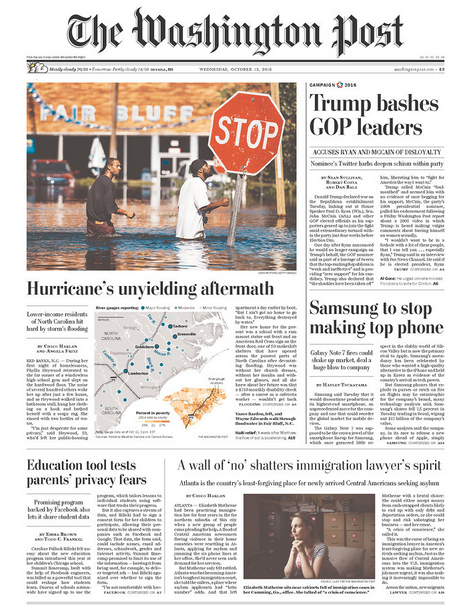
Our concerns about the open-ended data sharing of the  washington-post-front-page-10-12-16Summit/Facebook software platform was featured on the front page of today’s Washington Post. This software is in 100 schools nationwide, about two thirds of them public schools. The list is here. Two of the schools are in NYC: the Bronx Writing Academy in District 9; and J.H.S. 088 Peter Rouget in District 15 in Brooklyn.
Summit is sharing the student personal data with Facebook, Google, Clever and whomever else they please – through an open-ended consent form that they have demanded parents sign.  A copy of the consent form is here.
I have never seen such a wholesale demand from any company for personal student data, and can imagine many ways it could be abused.  Among other things, Summit/Facebook claims they will have the right to use the personal data “to improve their products and Serious student privacy concerns with new Summit/Facebook platform | Seattle Education:


Thousands of Seattle teachers wore Black Lives Matter shirts to school. Here’s what it looked like. | I AM AN EDUCATOR

Thousands of Seattle teachers wore Black Lives Matter shirts to school. Here’s what it looked like. | I AM AN EDUCATOR:

Thousands of Seattle teachers wore Black Lives Matter shirts to school. Here’s what it looked like.

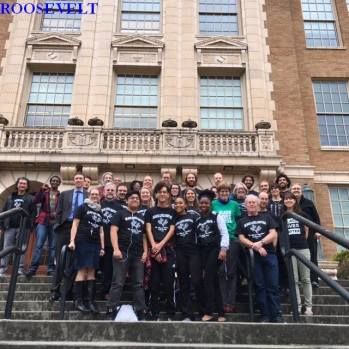
searoosevelt_blm
The #BlackLivesMatterAtSchool event in Seattle yesterday was breathtaking.
Never before in the country has an entire district of educators risen up to declare that Black lives matter. It’s hard to even put into words the power of this event. It has been reported that 2,000 teachers wore Black Lives Matter shirts to school across the district–in fact, the number was much larger than that.  That is the number of shirts that were ordered from the Social Equality Educators, however, many schools made their own shirts. Families made buttons and distributed them to schools.  Some parents set up informational booths in front of their school with resources for teaching about racism. There was a joyous atmosphere around the city.  Many educators around the city took the day to teach students developmentally appropriate lessons about institutional racism and hold dialogues about Black lives matter.
There is so much work left to be done to make Black Lives truly matter at school. But at the rally for Black lives at lunchtime at my high school, Garfield, something happened that let everyone know that change is already happening.
One of our teachers, Janett Du Bois, revealed to everyone in the middle of our rally that the police had murdered her son a few years ago. No one at our school knew about this. It was in that moment of seeing everyone wearing  Black Lives Matter shirts that she found the strength to tell her story. Her bravery to go public with this has changed Garfield forever.  I am so glad that she no longer has to suffer alone with the pain. Here is a short news story that doesn’t do her full speech justice, but will give you a glimpse: http://www.king5.com/news/local/seattle/2000-seattle-teachers-to-wear-black-lives-matter-shirts/338419052
ABC provided national news coverage of our day and the amazing evening rally: http://abcnews.go.com/US/video/seattle-teachers-bring-black-lives-matter-school-42942387
Here is a link to some of the best photos taken of the day from a Seattle Public Schools parent, photographer, and author Sharon Chang: https://sharonhchang.com/blacklivesmatteratschool/
Below are just some of the photos of schools from around Seattle who participated in #BlackLivesMatterAtSchool:Thousands of Seattle teachers wore Black Lives Matter shirts to school. Here’s what it looked like. | I AM AN EDUCATOR:
garfieldhs

Tonight – 7pm Norwich Bulletin’s 2nd Congressional District Debate - Wait What?

Tonight – 7pm Norwich Bulletin’s 2nd Congressional District Debate - Wait What?:
Tonight – 7pm Norwich Bulletin’s 2nd Congressional District Debate


I am proud to be participating in tonight’s Norwich Bulletin Debate with the other candidates running for Connecticut’s 2nd Congressional District seat.
The debate will begin at 7 p.m. at the Concert Hall in the new Fine Arts Instructional Center on the Eastern Connecticut State University campus.
The Norwich Bulletin will be live streaming the event via Facebook Live https://www.facebook.com/norwichbulletin
You’ll find my seat stage left – way stage left!
Please stop by if you have time or catch it on Facebook Live or watch for the video becoming available on the Norwich Bulletin website at: http://www.norwichbulletin.com/
The Bulletin will host a political debate 7 p.m. tonight for the candidates running for U.S. Congress in the 2nd District, which covers all of Eastern Connecticut.
The event will be held at the concert hall in Eastern Connecticut State University’s new Fine Arts Instructional Center.
All four candidates — incumbent Democrat Joe Courtney, Republican Daria Novak, Libertarian Dan Reale and Green Party candidate Jonathan Pelto — will participate. Bulletin Opinion Page Editor Brendan Cox will moderate the debate.
The debate will be streamed live on The Bulletin’s Facebook page: http://www.facebook.com/norwichbulletin
Parking is available in the Shakespeare and Cervantes parking garages: Enter the university via the 400 High Street entrance by the public safety building; go straight through three stop signs; take a left to enter one of the garages at the fourth or fifth stop sign. For those with limited mobility, parking is available at the FAIC lot: enter campus as described above; take a left at the first stop sign; at the next stop sign, take a right then a quick left into the lot.Tonight – 7pm Norwich Bulletin’s 2nd Congressional District Debate - Wait What?:

Join Parents Across America’s Poverty, Race and Education book club series with Jesse Hagopian and his book “More Than a Score” | Seattle Education

Join Parents Across America’s Poverty, Race and Education book club series with Jesse Hagopian and his book “More Than a Score” | Seattle Education:

Join Parents Across America’s Poverty, Race and Education book club series with Jesse Hagopian and his book “More Than a Score”

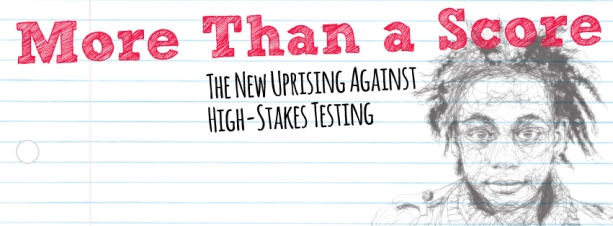
more than a score
Topic: Race, Poverty, and Education: Let’s get real about leveling the playing fieldTime: Nov 20, 2016 7:00 PM Eastern Time, 4 PM Pacific Time 
The guest for Parents Across America’s (PAA) next book club session in our Poverty, Race and Education series is Jesse Hagopian, Seattle teacher and editor of “More Than a Score: The New Uprising Against High-Stakes Testing.”
To prepare for this session titled “Let’s Get Real about Leveling the Playing Field,” you can:
  • Buy and read Jesse’s book
  • Watch his TedX Talk on alternatives to standardized testing, and/or
  • Read some of his articles here or here, for examples.
Jesse reframes education in a way that supports all students and addresses the inherent racism in so much of current school policy and practice, including standardized testing.
This webinar discussion will take place on Zoom, a free program that you will have to download prior to the session (it’s fast and easy). Details are below:
Join from PC, Mac, Linux, iOS or Android: https://zoom.us/j/461921348
Or iPhone one-tap (US Toll):  +14086380968,461921348# or +16465588656,461921348#
Or Telephone:
Dial: +1 408 638 0968 (US Toll) or +1 646 558 8656 (US Toll)
Meeting ID: 461 921 348
International numbers available: https://zoom.us/zoomconference?m=cNIvXyon0f19pCC4qOmSA7PLkOfvL3bm
 Join Parents Across America’s Poverty, Race and Education book club series with Jesse Hagopian and his book “More Than a Score” | Seattle Education:
C-Span: Lily talks about the "Trump effect" - Lily's Blackboard

C-Span: Lily talks about the "Trump effect" - Lily's Blackboard:

C-Span: Lily talks about the “Trump effect”


Lily was on C-Span and talked about education policy why the educators are saying that Republican presidential nominee Donald Trump’s 2016 candidacy is contributing to a rise in school bullying,the “Trump effect.” She responded to telephone calls and electronic communications. Check it out!


C-Span: Lily talks about the "Trump effect" - Lily's Blackboard:

Image result for Trump effect

Statewide arts ed database highlights gaps in hopes of spurring change | 89.3 KPCC

Statewide arts ed database highlights gaps in hopes of spurring change | 89.3 KPCC:

Statewide arts ed database highlights gaps in hopes of spurring change

97589 full

At first, the numbers don't seem so bad.
Last school year, 101,374 students attending California schools had no access to arts instruction at school, according to data released Thursday by a statewide arts education collaborative. That's just 3 percent of students who had not a single arts course offered at their school. 
But if you examine the data through the lens of the little-known part of the education code that references arts instruction, the picture is much more bleak.
While 97 percent of secondary students have access to some level of arts education (at least one course at school), only 26 percent have access to all four arts disciplines – music, theater, visual and dance – as required by state law. 
California’s education code requires schools to give students access to music, theater, dance and visual art from first to twelfth grade. In first through sixth grade, schools are required to teach all four disciplines every year. And for older students,districts are required to at least offer the classes. 
While 86 percent of schools provide at least one arts discipline, only 12 percent offer all four required by law.
But the law is not enforceable: many districts are unaware of it and there's no penalty for noncompliance.
"A lot of people will stand up and say we want all students to have access to participate in arts education, but they’re not really serious about it until we start counting," said Bob Morrison, chief executive officer of Quadrant Research, one of the research partners. "Because that’s the only way you’re going to know if you’re on your way to that goal or not."
The statewide arts coalition Create CA, in partnership with the California Department of Education and the nationwide Arts Education Data Project, released the findings Thursday along with a first-of-its-kind online database that slices arts instruction offerings by county, school district and individual school sites. The goal is to give school leaders, arts advocates and parents a clear picture of the state of arts education in California and hopefully increase access.
"We’ve known that having good data has been a challenge," said Craig Cheslog, chair elect of Create CA, the state's arts education coalition. "We knew that if we wanted to try to get better equity in arts education, the first step is knowing what students are receiving it and this gives us a baseline." 
The source of the data is student enrollment in arts courses at specific school sites for grades 6 to 12 submitted to the state's data system for the 2013-2014 and 2014-2015 school years. 
Elementary schools aren’t required to record courses in the same way, which is why those schools are not included. Community partnerships, teaching artist visits or Statewide arts ed database highlights gaps in hopes of spurring change | 89.3 KPCC:

MUST-SEE! Pasi Sahlberg on “The Inconvenient Truth about American Education” | Diane Ravitch's blog

MUST-SEE! Pasi Sahlberg on “The Inconvenient Truth about American Education” | Diane Ravitch's blog:

MUST-SEE! Pasi Sahlberg on “The Inconvenient Truth about American Education”


Pasi Sahlberg spoke at Wellesley College in a public lecture on October 13. The video has just been released.
As you will see, his presentation is an interactive performance, not a traditional lecture. He uses video, music, and data easily and flawlessly. He makes us think. He educates us.
The full video is an hour and a half. It includes not only Pasi’s presentation, but introductions by Barbara Beatty, the historian of early childhood education and chair of Wellesley’s education department; Dr. Paula Johnson, the 14th president of the College; me, introducing Howard Gardner; and Howard Gardner introducing Pasi.

Most US Syrians Arrivals Are Kids, Now Enrolling in School - ABC News

Most US Syrians Arrivals Are Kids, Now Enrolling in School - ABC News:

Most US Syrians Arrivals Are Kids, Now Enrolling in School


Syrian Refugee Students


 Seated at his desk at a suburban San Diego middle school, 12-year-old Abdulhamid Ashehneh tries not to let his mind wander to the painful memories of his life in civil war-torn Syria.

His father disappeared suddenly four years ago and, the family believes, was killed. Months later, Abdulhamid's mother boarded a bus with her six children, the youngest 2, and fled to Jordan, the sound of bombs ringing in the distance.
"I think about my Dad a lot," Abdulhamid said recently after practicing English at Cajon Valley Middle School, which has received an influx of Syrian children. "I wish he would come back."
Abdulhamid is like many of the Syrian refugees arriving today in the U.S. Nearly 80 percent of the more than 11,000 Syrian arrivals over the past year were children, according to the U.S. State Department.
That's a larger percentage than most refugee groups, in part because Syrians tend to have larger families and many have managed to stay together despite displacement, according to resettlement agencies helping the families acclimate to the U.S.
Many of those children are enrolling in public schools around the country, including Chicago; Austin, Texas; New Haven, Connecticut; and El Cajon, which received 76 new Syrian students the first week of school.
Syrian children face many of the same challenges as other young refugees — limited English, an interrupted education — but they are somewhat distinct in the level of trauma they have experienced, school leaders and resettlement workers said.
"The truth is, a lot of them have seen some pretty nasty stuff," said Eyal Bergman, a family and community engagement officer for the Cajon Valley Union School District. "But I also see incredible resilience."
In response to the influx, school districts are beefing up English instruction and making extra efforts to reach out to parents unfamiliar with the U.S. school system. In El Cajon, one-on-one orientations introduce families to the school's teachers and staff and show them basics like how to read the district's academic-year calendar.
Some refugee students are enrolled in "newcomer" classes where they are provided intense English instruction before being placed in mainstream classrooms. Others go directly into Most US Syrians Arrivals Are Kids, Now Enrolling in School - ABC News:

These states are spending less on education now than before the Great Recession - The Washington Post

These states are spending less on education now than before the Great Recession - The Washington Post:

These states are spending less on education now than before the Great Recession


When the Great Recession hit, states trimmed — and in some cases slashed — their budgets for public services, including for education. As the recession ended and the economy improved, some states began restoring funds to schools. But by 2014, 35 states were still spending less per student than they did in 2008, before the recession took hold, according to a report released Thursday.
Data for total state education spending in the current school year isn’t yet available. But looking just at general (or “formula”) funding, which comprises the bulk of education spending in most states, 23 states are continuing to spend less per student in the 2016-2017 school year than they were in 2008, according to the report by the Center on Budget and Policy Priorities, a left-leaning think tank.
In too many states, “public investment in K-12 schools, which are crucial for communities to thrive and the U.S. economy to offer broad opportunity, has declined dramatically in recent years,” said Michael Leachman, a co-author of the report.
Here are the states with the biggest declines in total state spending from 2008 to 2014, on the left, and 2008 to 2017, on the right:
 An obvious outlier is North Dakota, where a booming oil industry filled state coffers and made possible an enormous increase in per-pupil spending.

Why are states still spending less than they were in 2008? Some states have been slow to recover from the recession, and they have had to deal with rising enrollments and rising costs at the same time as federal education aid dipped, according to the report. But Leachman pointed out that several states with the largest decreases in school spending — such as Arizona, Kansas, North Carolina, Oklahoma and Wisconsin — also have cut income taxes in recent years, giving up revenue that could be used for education.
State tax dollars account for nearly half of education funding nationwide, so the decline in state funding has left many localities with a difficult choice: Raise local taxes, cut services and lay off teachers, or both. Leachman said that even when localities try to raise revenue, they often aren’t able to make up for lost state dollars.
Here is a chart showing changes in total state and local funding from 2008 to 2014:These states are spending less on education now than before the Great Recession - The Washington Post:

2,000 Seattle teachers wear ‘Black Lives Matter’ shirts to class | The Seattle Times

2,000 Seattle teachers wear ‘Black Lives Matter’ shirts to class | The Seattle Times:

2,000 Seattle teachers wear ‘Black Lives Matter’ shirts to class

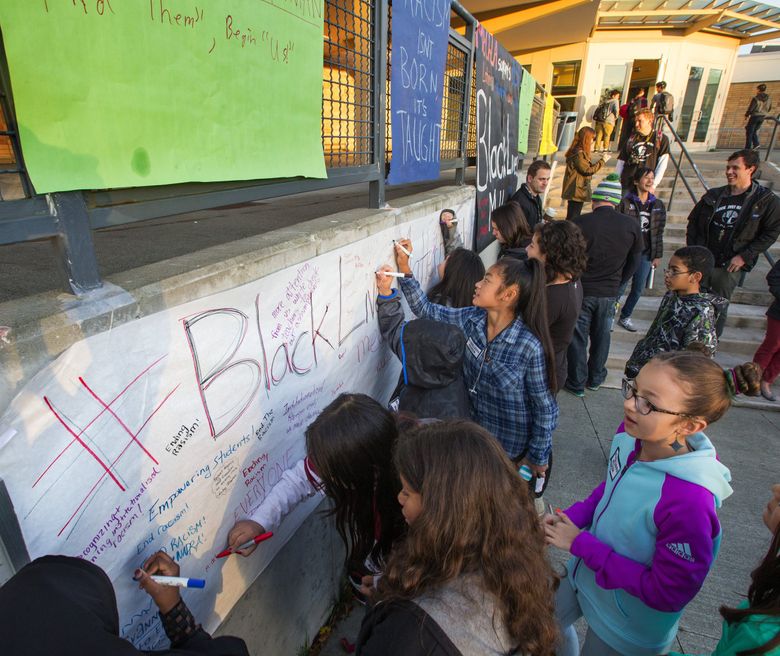
Chief Sealth International High School and Denny Middle School teachers and students hold a rally Wednesday morning to show their commitment to closing opportunity gaps and continuing the conversation on racial equity in their school. (Mike Siegel/The Seattle Times)
The “Black Lives Matter at School” rallies attracted hundreds of students, parents and teachers on Wednesday.


About 2,000 Seattle educators wore Black Lives Matter shirts at their schools Wednesday to call for racial equity in education.

Schools across the district held “Black Lives Matter at School” rallies before classes began for the day. Students, parents and teachers also wore stickers and buttons emblazoned with the “Black Lives Matter” slogan.

The purpose of the day was to affirm that “black lives matter in the public schools,” according to organizers, who are members of Social Equality Educators, a group of educators within the Seattle teachers union. Teachers also wanted to show their support for John Muir Elementary, which had its “Black Men Uniting to Change the Narrative” event canceled last month after receiving a threat over teachers’ plans to wear Black Lives Matter shirts.

Before school started Wednesday at Chief Sealth International High School, dozens of educators and students gathered outside the building and held up banners and signs.

 About 60 Chief Sealth educators had ordered the shirts beforehand. Some of the shirts said “Black Lives Matter” and “#say­hername,” a reference to Sandra Bland, a black woman who died in police custody in Texas. Those shirts had an image of a fist. Others wore shirts that said “Black Lives Matter” and “We Stand Together” with an image of a tree.


Teacher Diana Romero said she decided to wear a shirt “to support our black brothers and sisters in support for justice.” As a Latina, she said she has seen firsthand the unfair treatment of people of color by police officers.


A sixth-grade class from nearby Denny International Middle School, whose teacher brought them to the Sealth rally, wore Black Lives Matter stickers. Teacher Ben Evans said he wanted them to see how their voices can be heard. Many of his students are aware of racial inequities already, he added.


“Black Lives Matter At School” wasn’t sponsored by the school district, but it coincides with Seattle Public Schools’ “day of unity,” aimed at bringing more attention to racial equity in education. The district said in a statement that it has asked students, family, staff and community members to “engage and join the conversation in our united efforts to eliminate opportunity gaps.” As a public institution, the district doesn’t take official positions on social or political movements, district spokesman Luke Duecy said in a statement earlier this week.

Because Wednesday’s rally at Sealth was not an official district event, teachers were told to leave before students started arriving for school. But members of the Black Student Union (BSU) remained until the start of classes.

For BSU President Precious Manning, 17, the rally and shirts represented the international school coming together in solidarity. Black Lives Matter means making sure everyone is included, she said.

“Black Lives Matter means ‘don’t leave us out,’ ” she said.

Each school planned its own events for “Black Lives Matter at School” day. At Leschi Elementary, for example, participants taped notes on a banner that asked “What does Black Lives Matter mean at Leschi?” Lowell Elementary’s front sign read “Black Lives Matter at Lowell.”

In addition to Seattle schools, staff at Highline’s White Center Heights Elementary wore shirts.

Another “Black Lives Matter At School” rally is planned for Wednesday evening at Washington Hall, where activists and artists, including Grammy-award winning singer-songwriter Kimya Dawson, will perform and speak about racial equity. Seattle Seahawks defensive lineman Michael Bennett is also expected to attend.

The event is from 6-8 p.m. at Washington Hall, 154 14th Ave., in Seattle’s Central District.2,000 Seattle teachers wear ‘Black Lives Matter’ shirts to class | The Seattle Times:

Image result for 2,000 Seattle teachers wear ‘Black Lives Matter’ shirts to class