Latest News and Comment from Education

Sunday, March 6, 2016

John White Is Subsidizing Voucher Schools– and Being Called Out by BESE | deutsch29

John White Is Subsidizing Voucher Schools– and Being Called Out by BESE | deutsch29:

John White Is Subsidizing Voucher Schools– and Being Called Out by BESE


On September 01, 2014, the Baton Rouge Advocate published an article entitled, “Cristo Rey Considers Starting School in Baton Rouge.”
Cristo Rey is a national chain of Catholic high schools that cater to inner-city students, even arranging for students to find employment as a means of assisting with school tuition.
The writer of this September 2014 article, Charles Lussier, makes it sound like Cristo Rey Baton Rouge is not a done deal– even as he writes that if the school were to open, those directing the effort already know it would be in fall 2016 and that the school would launch with “about 125 ninth-graders.”
At the time of Lussier’s article, Baton Rouge nonprofit, New Schools for Baton Rouge, was already involved in trying to establish Cristo Rey Baton Rouge:
Cristo Rey caught the attention of New Schools for Baton Rouge, a 2-year-old group best known for recruiting and supporting a handful of charter schools that recently opened in Baton Rouge. …
Chris Meyer, president and CEO of New Schools for Baton Rouge, said his group supports a wide variety of schools. The organization’s focus is on expanding options for students in low-performing Baton Rouge public schools.
So, it seems that NSBR is prepared to financially assist Cristo Rey with establishing its Baton Rouge campus. Hold that thought.
Lussier reports that Cristo Rey Baton Rouge also has the attention of the Louisiana Department of Education (LDOE) as a school that might accept voucher students. In fact, LDOE is so excited about Cristo Rey that Lussier actually published LDOE’s John White Is Subsidizing Voucher Schools– and Being Called Out by BESE | deutsch29:

CURMUDGUCATION: Why This Teacher Supports Sanders for President

CURMUDGUCATION: Why This Teacher Supports Sanders for President:

Why This Teacher Supports Sanders for President

Every political cycle is a sad reminder that public education in general and teachers in particular are political orphans. Neither party even pretends to be interested in or supportive of traditional public education and the people who work in that sector. Where once upon a time, kissing a baby could be reliably followed by thanking America's teachers. Now both traditional parties just want to punch us in the face.

None of the 147 Presidential candidates at any point showed any concern about making nice with teachers or standing up to the institution to which we have devoted our lives, the institution which is the very foundation of our country, our democracy.


No, not even Bernie. We've been able to get him to cough up a couple of usable quotes that would suggest that he's a fan of teachers and public education, which puts him ahead of Hillary who bent over backwards to avoid letting one sentence worth of charter school criticism upset any of her deep pocketed backers. Pretty sure I missed the part where she dispatched Bill to reassure public school teachers that any of her zillion pro-charter comments were no cause for alarm. And the closest that any GOP candidate came to saying something nice about teachers was that time John Kasich said that he would abolish teacher lunch rooms, which sounds mean but, hey-- at least he didn't say he would abolish letting teachers have CURMUDGUCATION: Why This Teacher Supports Sanders for President:

The One Thing I Don't Do When I'm Assessing Students | The Jose Vilson

The One Thing I Don't Do When I'm Assessing Students | The Jose Vilson:

The One Thing I Don’t Do When I’m Assessing Students

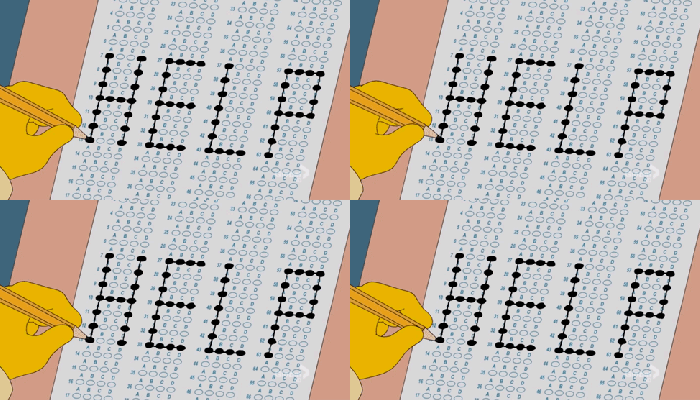
multiplechoicehelp
I’ve now taught almost 11 years, starting in the throes of overtesting and overstandardizing. I’ve given multiple forms of assessments over different periods of time. I’ve taught all of the middle school grades and tutored lower and higher grades. I’ve taken my own set of exams for teacher certifications, most of them different from the quizzes for one and only one specific reason.
I don’t do multiple choice quizzes.
I can’t stand multiple choice quizzes. A-B-C-D doesn’t work for J-O-S-E. One of my admins used to call multiple-choice a skill. The idea seems to be that being able to make the right choice takes a skill that some have and some don’t. This frame suggests that students should have to learn how to make choices when they’re presented in a predetermined format. Halfway between giggling and scoffing, I couldn’t get over the idea that having four and only four choices actually makes it easier, not harder, to pretend expertise. I suppose if a student knows what they’re doing, then they have a high probability of getting the answer correct, especially in a subject like math.
But even then, I’m less interested in their ability to choose (and eliminate choices) and more interested in their thought process. I’m interested in seeing how they approach the math in front of them and how they arrive at their conclusions. This way, we can open up a conversation both as a class and as individual students. Also, because they’re going to see so many multiple-choice questions The One Thing I Don't Do When I'm Assessing Students | The Jose Vilson:

Jersey Jazzman: The Myth of the Heroic Charter School - Part I

Jersey Jazzman: The Myth of the Heroic Charter School - Part I:

The Myth of the Heroic Charter School - Part I


 "Heroic" charter school stories are the stock-in-trade of the "reform" industry. These tales take the same basic form:

1) Present some a-contextual data point -- usually having to do with a score on some sort of standardized test -- as proof of a charter school's "success." 
2) Posit a causal relationship between the structure and/or practices of the charter school and the data point presented. 
3) Imply or state outright that the many factors outside of school classrooms that we know for a fact contribute to student outcomes can be overcome simply by following the model above.
There are two reasons these stories make me nuts. The first is the unwarranted braggadocio inherent in the genre: "We rock, you suck!" There's almost a twisted negative correlation between a charter school's leaders' humility and the unacknowledged factors -- attritionextra funding, peer effects -- that contribute to its "success."

But there's another, more pernicious effect that comes from telling tall tales about charter "success": they keep us from having the conversation we need to have about American schools as engines of social replication.

Case in point:

I think it’s time that the narrative in our country began a fundamental shift – away from “How is it possible to succeed amid all these challenges?” to “How is it possible to remain
- See more at: http://jerseyjazzman.blogspot.com/2016/03/the-myth-of-heroic-charter-school-part-i.html#sthash.QdIXr8QE.dpuf

CURMUDGUCATION: What Is the Charter Difference?

CURMUDGUCATION: What Is the Charter Difference?: "What Is the Charter Difference?"

What Is the Charter Difference?


 What exactly makes a charter school a charter school? What is it that charter supporters expect to get from a charter school that they cannot get from a public one?


Variety and choice? 

Some advocates say that parents and students need choices, a variety, a plethora, a cornucopia of educational options from which to choose. We should have a sciency school for science students and a musicky school for musicians and a welding school for welders.

But we have that. In smaller districts, the possibility of magnet schools and specialty schools is lessened, but even in my mostly-rural county, districts have a co-operative vocational school that prepares welders and auto mechanics and security guards. Large urban districts can have all manner of specialty magnet schools that give students plenty of variety and choice. We don't need charter schools to accomplish this.

Quality?

As I've argued before, people don't really want choice, anyway-- they want their children to go to one good school. Being "trapped in a zip code" never comes up when people have a school they like.

There's no arguing that some schools fail to live up to the promise of public education. But if you don't like the color of your house, do you paint the house, or do you buy a second house? If the school that I'm providing for my community's children is not doing a great job, sending some kids elsewhere will leave Sore Thumb High School still right where it is, doing poorly.

If I want it to be a better school, I can make it into a better school. This is what many communities 
CURMUDGUCATION: What Is the Charter Difference?: "What Is the Charter Difference?"

Small Self-Governing Schools of Choice Revisited | Deborah Meier on Education

Small Self-Governing Schools of Choice Revisited | Deborah Meier on Education:

Small Self-Governing Schools of Choice Revisited

Dear friends,
I spent three days last month in Texas with the North Dakota Study Group (NDSG) in its new form—much younger (maybe a dozen “oldsters” of whom I think I was the oldest), probably half or more people of color (more Hispanic than Africa-American this time).   While we were kept too busy to reflect together on our experiences than I would have liked, the conversations we did have were both reassuring and insightful. I came away bursting with questions to explore. And with new colleagues and friends.
One thing I was thinking about was how my views about “small, self-governing schools of choice” has held up since the early 1970s when the NDSG was formed.  I think I would exclude the last—choice. It is not that I am now opposed to choice, but I see that my position is really “it depends.” “It depends” is my latest position on many things. But small and self-governing remain—although self-governing has gotten more complicated.  Who are the constituents of that “self”? I have discovered a new word—subsidiarity—that Catholic friends introduced me to. It means that decisions should be made by those most affected by them!
My central purpose through it all has been figuring out what best supports democracy versus what makes it easier to undermine it—while simultaneously educating each other. Inequality of power is our greatest enemy.
It is on the firm ground of communal responsibility, in which all have had equal voice—that democracy rests. When community members know each other and share some critical common spaces—like schools, post offices, libraries, etc.—and some critical common interests—such as what happens to your kids happens to mine—that democracy has a fighting chance. Without such mutuality democracy can simply become a fight over who can win an advantage without regard for the losers.
Is this too idealistic?  Maybe, maybe not. We have to recapture, I believe, the spirit of democracy writ small until we can truly start re-installing it writ large. That is why I have always supported small schools. Small schools make easer that face-to-face communal spirit and realistic communal responsibility for those besides oneself (and Small Self-Governing Schools of Choice Revisited | Deborah Meier on Education:

Message to Pro-CCSS, ESSA Politicians: This is Why Taxpayers/Parents Are Furious. – Missouri Education Watchdog

Message to Pro-CCSS, ESSA Politicians: This is Why Taxpayers/Parents Are Furious. – Missouri Education Watchdog:

Message to Pro-CCSS, ESSA Politicians: This is Why Taxpayers/Parents Are Furious.


ct meeting
Jonathon Pelto describes recent Connecticut Board of Education meeting in which parents were ignored. Sound familiar?

 Savvy politicians might want to read an article from Jonathon Pelto in Connecticut which describes the arrogance of the Connecticut Board of Education and its disdain for the people who are funding its very existence: taxpayers who are not recognized as stakeholders in educational decisions, even though it is the group actually funding and providing their children to the State for the State’s educational endeavors.  These taxpayers (as in other states) are denied a chance to speak at public meetings, attacked for questioning/acting against educational reforms such as high stakes testing, and are initially not even invited to a meeting purported to foster ‘family and community engagement policies’.  That’s bureaucracy at its ugly fineness: pretend to promote family engagement but place a gag order on the people they purport to help.

Politicians should be cognizant of the intense anger such arrogance engenders in the voters.  Politicians should be introducing legislation holding bureaucrats accountable for their behavior and misuse of taxpayer funds in pursuing educational reforms that the taxpayers do not want: increased standardized testing, a one size fits all educational blueprint, and data tracking of their children cradle to grave. Politicians should also hold chief state school officers accountable for the *misinformation* they provide to parents.
Read about the Connecticut meeting which should cause serious parental disobedience and anger.  From Incredulous: Watching CT Department of Education officials lecture school administrators on how to mislead parents:

Just when I thought I had truly seen everything when it comes to the arrogance, elitism, audacity and contemptuousness of those associated with the corporate funded “Education Reform” effort, I witnessed something even more breathtakingly incredible this past Monday at the Connecticut State Department of Education.
It has taken the week to even begin to be able to put into words what I and a handful of other parents and 
Message to Pro-CCSS, ESSA Politicians: This is Why Taxpayers/Parents Are Furious. – Missouri Education Watchdog

Oregon Save Our Schools: Humans of Oregon Save Our Schools: Joanne Yatvin

Oregon Save Our Schools: Humans of Oregon Save Our Schools: Joanne Yatvin:

Humans of Oregon Save Our Schools: Joanne Yatvin


Welcome to our second post on the "Humans of Oregon Save Our Schools" to introduce our followers to some of the many people who also follow us!

This post features Joanne Yatvin, a co-founder of OSOS. 

Joanne  is a retired teacher and school principal. She is also a writer who has produced four books and more than fifty articles on education, including many featured by Valerie Strauss in Washington Post's Answer Sheet. At present she has an internet blog called "The Treasure Hunter" which aims at publicizing the good things in our public schools and invites submissions. Read more about Joanne and her distinguished history as an educatorhere on her "About" page


Thank you to Joanne Yatvin for dedicating a lifetime to public schools and students! 

If you would like your story about why you joined or follow Oregon Save Our Schools, what OSOS means to you, or why you think OSOS is important featured in a blog post, just send a short paragraph with your bio, a photo,  and tell us how and why you are involved!

Send your entries to: oregonsosinfo@gmail.com  
Oregon Save Our Schools: Humans of Oregon Save Our Schools: Joanne Yatvin:


Putting the Public Back in Our Public Schools!
 Oregon Save Our Schools: Humans of Oregon Save Our Schools: Joanne Yatvin:

LAUSD "TEACHER SHORTAGE"...CREATED BY LAUSD'S ATTACK ON EXPENSIVE SENIOR TEACHERS - Perdaily.com

LAUSD "TEACHER SHORTAGE"...CREATED BY LAUSD'S ATTACK ON EXPENSIVE SENIOR TEACHERS - Perdaily.com:

LAUSD "TEACHER SHORTAGE"...CREATED BY LAUSD'S ATTACK ON EXPENSIVE SENIOR TEACHERS


(Mensaje se repite en Español)

Someone once gave me an explanation of the Yiddish word chutzpah by saying, "It's like killing your mother and father and then throwing yourself on the mercy of the court on the grounds that you're an orphan." For another good example of chutzpah, one only need look at the present teacher shortage that in fact is only the logical result of a well organized and concerted attack on senior top-of-the-salary scale teachers who coincidentially??? make up 93% of teachers LAUSD continues to target with false morals charges under Education Code Section 44939- the assertion of which deprives them of grievance and arbitration through their union, before they are sent packing in a purposefully protracted process designed to financially and emotionally grind them down.

But this war on senior teachers could never have been "successful" enough to create a teacher shortage without the tacit collusion and outright support of a teachers' union UTLA that now has the chutzpah to ask for and receive a 30% dues rise, because it allowed thousands of senior teachers- and their dues- to be removed without lifting a finger to come to their aid as one would think is the union's obligation under Article V, section 1 et seq of the present LAUSD-UTLA Collective Bargaining Agreement.

With the attack on nationally acclaimed teacher Rafe Esquith and his $1 billion lawsuit brought by the Mark Geragos law firm on behalf of him and 2000 other similarly targeted teachers, the public is finally given a window into the invariable and completely fabricated process LAUSD and their co-conspirators at UTLA have used to remove thousands of completely innocent teachers in a reality where not one commercial or public media source has every published the fact that LAUSD saves approximately $60,000 in combined salary and benefits, when they replace these falsely targeted teachers with a fresh out of college "teacher" working on an emergency credential.

However, in going after senior teachers for the sole motive that they are expensive, it is important to note that neither LAUSD nor UTLA have the power on their own to accomplish LAUSD "TEACHER SHORTAGE"...CREATED BY LAUSD'S ATTACK ON EXPENSIVE SENIOR TEACHERS - Perdaily.com:

Education Lessons From A Sparkly District: The ESSA Negotiated Rulemaking Committee

Education Lessons From A Sparkly District: The ESSA Negotiated Rulemaking Committee:

The ESSA Negotiated Rulemaking Committee

This afternoon, the US Department of Education announced the participants (voting and non-voting) for the ESSA Title 1 negotiated rulemaking committee. I, and presumably everyone who had provided testimony to USDOE on January 11th, was invited to apply/be nominated. I wrote about the January 11th experience here and here

The parameters for the committee participants can be found on the Federal Register here. I found it odd that they asked for parents and students, but they also required you demonstrate your representation of others. Presumably, that meant USDOE would not be interested in a parent who was not connected to any large group in some way. 

Of course, I put my name in. I approached Save Our Schools New Jersey, for whom I am a volunteer organizer and Montclair Cares About Schools, an organization for whom I have a lot of respect. Both organizations came through with tremendous support. I also sought and received support from Dr. Chris Tienken, Assistant Professor of Education Administration at Seton Hall University and Dr. Mark Naison, Professor of African-American Studies and History at Fordham University.

I was not selected for the "Parents and students, including historically underserved students" slots.  Nor for the "Civil rights community, including representatives of students with disabilities, English learners, and other historically underserved students" slots. 

Who was? Well, let's just simply say that The Gates Foundation certainly spends its money well. The two parent slots went to the Immediate Past President of PTA Ohio and to the 
Education Lessons From A Sparkly District: The ESSA Negotiated Rulemaking Committee:

Marie Corfield: Gov. Christie how do you sleep at night?

Marie Corfield: Gov. Christie how do you sleep at night?:

Gov. Christie how do you sleep at night?


 Lost in all the hoopla over Gov. Christie dropping out of the POTUS race last week,debating "hand" sizes and Ted Cruz bad lip reading was this little gem that slipped from Christie's mouth during his monthly radio address:


I feel incredibly indebted to the people of New Jersey who gave me the opportunity to [run for president].

Ummm... which people would that be? 

One thing we here in New Jersey know about Chris Christie is that the man waits for no one. No one "gives" him anything. He takes. And he takes... and he takes... and he takes... Until he's taken so much, there's nothing left. 

Just look at our pension system, or the transportation trust fund, or the environment, or our credit rating, or public education, or funding for women's health care, or the $10 mil fee he's socked the state with for his Bridgegate legal bills, or the wasted and mismanaged Sandy relief funding, or any of the myriad programs and services he's slashed, burned and otherwise mismanaged in the name of "sharing the sacrifice".

No, the people of New Jersey feel no great wave of gratitude washing over us. And 
Marie Corfield: Gov. Christie how do you sleep at night?:

WARNING Connecticut – They are coming for your schools and your democratic rights! - Wait What?

WARNING Connecticut – They are coming for your schools and your democratic rights! - Wait What?:

WARNING Connecticut – They are coming for your schools and your democratic rights!


 A Breaking News Alert from Jonathan Pelto and Wendy Lecker

When it comes to public education in Connecticut, a new piece of legislation before the Connecticut General Assembly (H.B. 5551) would be the most far-reaching power grab in state history – a direct attack local control of schools, our democracy and Connecticut’s students, parents, teachers, local school officials and public school.
The legislation, would enable Malloy’s political appointees on the State Board of Education to takeover individual schools in a district, remove the control of the elected board of education, “suspend laws” and eliminate the role of school governance councils which are the parent’s voice in school “turnaround plans.
The bill is nothing short of an authoritarian maneuver by grossly expanding the Commissioner of Education’s powers under the Commissioner’s Network.  The bill destroy the fundamental role local control because it allows the state to indefinitely take over schools and even entire districts, without a vote of local voters.
The bill removes any time limit on Commissioner’s Network Schools. It removes the cap on how many Commissioner’s Network schools can be taken over by the state.  It removes the right of the local community to appoint their own turnaround committee.  It eliminates the WARNING Connecticut – They are coming for your schools and your democratic rights! - Wait What?:

What WALL-E Teaches Us About Adaptive and Personalized Learning (David Wiley) | Larry Cuban on School Reform and Classroom Practice

What WALL-E Teaches Us About Adaptive and Personalized Learning (David Wiley) | Larry Cuban on School Reform and Classroom Practice:

What WALL-E Teaches Us About Adaptive and Personalized Learning (David Wiley)


DAVID WILEY (@OPENCONTENT) IS CO-FOUNDER AND CHIEF ACADEMIC OFFICER OFLUMEN LEARNING. THIS POST APPEARED IN EDSURGE FEBRUARY 24, 2016.

 
One hundred years from now, Earth is an epic wasteland of French fry containers, water bottles and other remnants of mankind’s consumerism. Humans have evacuated on a starship, leaving behind an army of robots to clean up the planet.
So goes the plot of WALL-E, a lighthearted, animated film set in a post-apocalyptic future. While much of the movie’s screen time is dedicated to the exploits of our rusty bot hero, the film also makes some gentle commentary on the impact that living with advanced technology for centuries might have on people.
The starship that humans call home has fully automated systems designed to provide for all their needs—food, drinks, entertainment and even transportation around the intergalactic spacecraft. Although exercise is critically important for people in space to prevent bone loss and other deleterious effects of weightlessness, the humans are moved about by intelligent hovering chairs. They get even less exercise than their Earth-bound ancestors and the effect is, in a word, flab-bergasting.
Just at the moment when exercise is more important than ever, AI has stepped in to prevent the human characters from engaging in it. This sentence, perhaps more than any other, sums up my concerns about adaptive and personalized learning as currently imagined in today’s mainstream edtech marketplace.
Learning on Autopilot


Our world is awash in information. There is some disagreement over the exact amount, but reasonable estimates state that humanity records and transmits a little over three exabytes of information every day. Now, more than ever before, people are desperately in need of skills that will help them determine what is What WALL-E Teaches Us About Adaptive and Personalized Learning (David Wiley) | Larry Cuban on School Reform and Classroom Practice:

Stop Innovating in Schools. Please. — Medium

Stop Innovating in Schools. Please. — Medium:

Stop Innovating in Schools. Please.


 Too often when we talk about “innovation” in education, we point to that new set of Chromebooks or those shiny new Smartboards as examples of our efforts to change what we do in the classroom. That is, after all, what “innovation” is all about, to “make changes in something established, especially by introducing new methods, ideas, or products.” Over the last few years, many schools in the developed world have done a pretty good job on the new products front, earning billions of dollars for vendors who sell their gadgets or code under the guise of “innovation” of some degree or another. We’ve definitely got more stuff. And it’s arguable that our methods are changing, even if just a bit; the Maker Movement in schools, when fully embraced, is one such example of shifting roles in the classroom.

But on balance, is all of this “innovation” really changing us?
Not so much. Our efforts at innovating, regardless of method, idea, or product, have been focused far too much on incrementally improving the centuries old structures and practices we employ in schools, not on fundamentally rethinking them. And the vast majority of “innovation” I’ve seen in my visits to schools around the world doesn’t amount to much change at all in the area where we need it most: using those new methods, ideas, or products to shift agency for learning to the learner. To put it simply, innovation in schools today is far too focused on improving teaching, not amplifying learning.
That needs to stop, especially now when the ability to learn at a moment’s notice is increasingly more important than the knowledge we carry around in our heads. As we approach 4 billion people in the world with Internet access, there’s little question any longer that those who are learnerswill have more opportunities for growth and success than those who areStop Innovating in Schools. Please. — Medium:

With A Brooklyn Accent: Donald Trump and "Whiteness"

With A Brooklyn Accent: Donald Trump and "Whiteness":

Donald Trump and "Whiteness"

I have not been at a Donald Trump Rally, but from what I have been able to observe from photos and video cllps posted by both supporters and opponents, attendance at them has been overwhelmingly white. In a society which is increasingly multiracial, that cries out for explanation.Is that accidental, or does it reflect some underlying divisions in the society or the segregated nature of our social networks?
Please understand that this comment is not intended to demonize supporters of Donald Trump. I made the same comments about education activist events I have attended, ranging from the first big Save our Schools March, to the founding conference of the Network for Public Education, and have applied a similar critique to recruitment and admissions policies of my own university.
The big issue here is not the raw facts of this observation. but how Trump supporters deal with the "Whiteness" of their movement. Is this something they see as problematic, and want to change, or is it something that they draw strength from and is essential to the movement's appeal?
If Trump's support is driven by an affirmation of Whiteness,and an implicit if not explicit connection between Whiteness and Americanness, it is only a matter of time before the movement comes to grief. You cannot in this society, given its demographic composition, base a political movement on the solidarity, defiance and rage of a single racial group without increasing division and inciting people to violence.
White Trump supporters may in fact be more diverse than I am suggesting. I certainly hope so. But if they aren't. we are in for a very rough ride, and not only during this election cycle. We don't need another George Wallace unleashing the demons of White Racial Angst. We need leaders who understand the danger that path entails, even while they make sharp criticisms of how the country has been run.With A Brooklyn Accent: Donald Trump and "Whiteness":

Op-Ed by Author of New Book on Housing and Poverty in Milwaukee | Educate All Students: Larry Miller's Blog

Op-Ed by Author of New Book on Housing and Poverty in Milwaukee | Educate All Students: Larry Miller's Blog:

Op-Ed by Author of New Book on Housing and Poverty in Milwaukee


 The Eviction Economy

By MATTHEW DESMOND MARCH 5, 2016 NyTimes (Author of “Evicted: Poverty and Profit in the American City.”)
I FIRST met Larraine when we both lived in a trailer park on the far South Side of Milwaukee. Fifty-four, with silvering brown hair, Larraine loved mystery novels, “So You Think You Can Dance” and doting on her grandson. Even though she lived in a mobile home park with so many code violations that city inspectors called it an “environmental biohazard,” she kept a tidy trailer and used a hand steamer on the curtains. But Larraine spent more than 70 percent of her income on housing — just as one in four of all renting families who live below the poverty line do. After paying the rent, she was left with $5 a day.
Under conditions like these, evictions have become routine. Larraine (whose name has been changed to protect her privacy) was evicted after she borrowed from her rent money to cover part of her gas bill. The eviction movers took her stuff to their storage unit; after Larraine was unable to make payments, they took it to the dump.
Those of us who don’t live in trailer parks or inner cities might think low-income families typically benefit from public housing or some other kind of government assistance. But the opposite is true. Three-quarters of families who qualify for housing assistance don’t get it because there simply isn’t enough to go around. This arrangement would be unthinkable with other social services that cover basic needs. What if food stamps only covered one in four families?
America stands alone among wealthy democracies in the depth and expanse of its poverty. Ask most politicians what we should do about this, and they will answer by calling for more and better jobs. Paul Ryan, the Republican speaker of the House, thinks we need to do more to “incentivize work.” Hillary Clinton, the front-runner for the Democratic presidential nomination, thinks we should raise the minimum wage. But jobs are only part of the solution because poverty is not just a product of joblessness and low wages. It is also a product of exploitation.
Throughout our history, wage gains won by workers through organized protest were quickly absorbed by rising rents. As industrial capitalists tried to put down the strikes, landlords cheered workers on. It is no different today. When incomes rise, the housing market takes its cut, which is why a two-bedroom apartment in the oil boomtown Williston, N.D., was going last year for $2,800 a month and why entire capital-rich cities like San Francisco are becoming unaffordable to the middle class. If rents rise alongside incomes, what progress is made?
Poverty is no accident, an unintended consequence from which no one benefits. Larraine’s rent money went to Tobin (also a pseudonym). A second-generation landlord, Tobin was 71, Op-Ed by Author of New Book on Housing and Poverty in Milwaukee | Educate All Students: Larry Miller's Blog:

Rejecting Charter Takeover of Public Schools: A Reader – the becoming radical

Rejecting Charter Takeover of Public Schools: A Reader – the becoming radical:

Rejecting Charter Takeover of Public Schools: A Reader


The Post and Courier (Charleston, SC) has been documenting the rise of advocacy for charter takeover of public schools in South Carolina, paralleling a similar pattern in nearby states such as Georgia and North Carolina.
The problem with takeover models is that advocacy for the model is being strongly refuted by a growing research base showing that takeovers have not achieved the claims of success voiced by advocates and have often replicated the exact problems faced by traditional public schools, such as segregation and inequitable access to high-quality opportunities.
See this reader of research and analyses of that advocacy and evidence:

CURMUDGUCATION: The Obligations of Wealth + KY: Charter Salvation? + Involving Introverts + ICYMI: In like a lamb

CURMUDGUCATION: The Obligations of Wealth:

The Obligations of Wealth


This is not the blog piece you think it's going to be.

I am not going to write about how the Waltons or the Gates or the Kochs or the Rich Folks Whose Names I Don't Know should live their lives, spend their money, and generally behave themselves. It's not, mind you, that I don't have some thoughts about it. But those are not the wealthy people I'm going to write about today.

I'm going to write about me.

It's fun to focus righteous rage on Those People and condemn the profligate wealthy and their terrible use of their privilege and power and money. But years ago I needed to face up to something. I live in a rural/small town area, one that once upon a time has a decent industrial base, but has lost much of that over the past fifty years. We're not destitute. But we live among the residual pieces of an earlier wealth, the churches and homes and other fine buildings erected 150 years ago by oil barons and captains of industry. Want a beautiful Victorian home dirt cheap? We've got the places for you-- but you need to bring your own job.

As a teacher with thirty years in, I'm pretty well off. I make above the median pay for the county. Hugely above the per capita income for the county. I own my own home, and while it's neither large or without issues, it's also right up against the river and close to the center of town. I have reliable transportation (no small thing-- in the country homelessness isn't nearly as problematic as transportationlessness), and I'm only six minutes from work. I'm not rich in any absolute sense, and I have plenty of bills to pay with a paycheck that doesn't always stretch as far as would be handy. There are things I'd like to have that I can't afford, a level of security and insulation I'd love to provide my family, but can't. 

So, to be clear, I am not arguing that I am overpaid and that our next teacher contract should roll our pay back. Because it shouldn't. But that's not what I'm talking about.

It is not easy for me to talk about this. It's not easy to talk about possessing privilege. I don't
CURMUDGUCATION: The Obligations of Wealth: 


KY: Charter Salvation?


Kentucky is one of the few states without a charter law. But what they do have is a new governor, and Matt Bevin would love to bring Kentucky into the loving embrace of the charter industry.

Kentucky residents are getting a crash course in the charter biz. That includes all of the usual arguments, including Education Secretary Hal Heiner's call to put adult interests aside and Do It For The Children. Heiner is a long-standing charter booster and real estate developer who actually ran against Bevin in the governor's race; after defeating him, Bevin appointed him ed secretary.

Heiner and Bevin believe that the children of Kentucky need more choices, but Dr. Donna Hargens, superintendent of Jefferson County Public Schools, points out that the district offers 18 magnet schools and 52 magnet and optional programs.

Charter proponents have been pitching Indiana as a success story, including the Tindley schools of Indianapolis, and that turns out to underline the problem-- Tindley schools have just turned out to be in the middle of a financial mess, and their visionary leader will step down at the end of the year with some of his personal spending under attack. The school has been accused of having a high suspension rate, and there's also a case to be made that some Tindley charters have been the point of the spear for gentrification of neighborhoods.

But most of all, Indiana is one more place where it's becoming evident that you can't have a charter system without hitting the taxpayers up for more money. Tindley's charter company was itself begging just a few years ago when it took over Arlington High and found the finances insufficient for the job. Indiana is a bigger charter mess than we can get into here, but one thing they have 
KY: Charter Salvation?


I'm never a fan of embracing technology for technology's sake, but I do love a good technological solution to a teaching problem, and I have found some technology is an absolute boon to engaging introverts.

It helps, of course, to understand what the heck an introvert is. Introverts aren't necessarily shy, and don't hate all human contact. But interaction is work. The classic distinguisher for extroverts and introverts-- two people go to a party, where both mingle and talk and have a good time with all the folks in the room, but the extrovert comes out pumped up and ready to go do something else, and the introvert emerges wrung out and ready to settle into his own chair in his own room in his own home by his own self.

Some extroverts really don't get introversion and suffer from the notion that introversion is a problem that needs to be solved. This can be problematic in a classroom; many introverts can tell you a story of some extroverted teacher who decided to force the introvert to come out of her shell, or to get more engaged with the other students in the room.

When I take a test like, say, the Myers-Briggs inventory, I peg the introvert-o-meter. But I've been a performing amateur musician my whole life, and I was a union president. Your introvert students can do everything that your extroverts can; they just may approach it a bit differently.

Years ago I discovered Moodle, an open-source learning platform. One of its features was a discussion board that allowed threaded conversations. It was handy for any number of classroom 
Involving Introverts


Let's kick of March with some good readings, both new and old.

Why I'm Not Impressed with Effective Teachers

Timothy Shanahan makes an important distinction between effective teachers and effective teaching.

Shut Up and Sit Down

Joshua Rothman in the New Yorker looks at our dangerous leadership obsession, tracing it up through the current leadership industry which assumes that leadership and power can be decoupled.

21st Century Learning, Inc

From a couple of years ago, here's Tara Ehrcke's look at the business of 21st century learning, and why it is a bunch of hooey and a marketeer's drea.

Marc Tucker and Common Core Fuel Injection

You probably read this, and you definitely should have. Mercedes Schneider hoists Marc Tucker by his own badly constructed metaphorical fuel injector.

The ESSA Negotiated Rulemaking Committee

A breakdown of who, exactly, is on that committee to flesh out the details of ESSA.

A Bill of Rights for School Children

Russ Walsh has a book coming out soon. I've already read it, and I recommend it not just for your own reading, but as a gift for the civilian in your life who hasn't been paying close attention to what's going on in education. This short piece is a sort of preamble to the book. Check it out.