Latest News and Comment from Education

Saturday, December 5, 2015

Audit finds closed Kansas City charter was overpaid $4.3M | KSL.com

Audit finds closed Kansas City charter was overpaid $4.3M | KSL.com:

Audit finds closed Kansas City charter was overpaid $4.3M


KANSAS CITY, Mo. (AP) — A Kansas City charter school was overpaid at least $4.3 million in the two years before it closed because administrators falsified and inflated student attendance, according to a state audit released Friday.
State Auditor Nicole Galloway said that Hope Academy reported a 97 percent attendance rate when the actual rate was about 32 percent. She also noted that several students who had graduated were included in the perfect attendance records. The inflated attendance boosted the school's budget because charter schools, like traditional public schools, receive state funding based on student enrollment and attendance.
The audit also found students received credit for classes in which they weren't participating and for unapproved activities outside of the classroom, such as grocery shopping, house cleaning and dog walking.
"What we see is the school failed these kids," Galloway said. "It was the school's responsibility to provide these kids an education."
Hope Academy attorney Dana Cutler said the auditor's recommendations did not arrive until after the school was closed.
"The recommendations by auditor would have been considered and implemented had the school continued to be open but by time we got through with the audit process, there was not a lot of reason to say we would do these things because the board had no school at that point," she said.
The school, whose mission was helping dropouts and students at risk of dropping out, operated from 2009 to 2014. With its academic performance among the lowest in the state, it already had been placed on probation by its sponsor, the University of Missouri-Kansas City, when the state Department of Elementary and Secondary Education conducted a surprise visit in the fall of 2013.
Along with attendance issues, the state discovered that one student allegedly paid an employee $700 for academic credits, although the student was refunded after the impropriety was discovered. Administrators and some staff were immediately placed on leave, and the auditor's office began its investigation. The university announced in Dec. 2013 that it would no longer sponsor the school.
The problems led the state to withhold its final financial payments to the school, reducing the amount that was overpaid from $4.3 to $3.74 million. Galloway said the overpayment estimates are "low" because attendance records as far back as 2010 show unusually high attendance rates. But she said there weren't adequate records to place an estimate on the suspected overpayment for those earlier years.
Galloway said it appears that the school's leadership used the overpayments to help Audit finds closed Kansas City charter was overpaid $4.3M | KSL.com:

Sign our Petition: Tell the U.S. Senate to say NO to ESEA Reauthorization - UNITED OPT OUT

Sign our Petition: Tell the U.S. Senate to say NO to ESEA Reauthorization - UNITED OPT OUT: The Movement to End Corporate Education Reform:

Sign our Petition: Tell the U.S. Senate to say NO to ESEA Reauthorization


Sign our petition today at change.org.
It states:
Since 2002 when No Child Left Behind became law, students, parents, and teachers have been subjected to a national education policy written to benefit the education testing industry and politicians out to privatize public education in America. As a result, schools have been turned into testing factories and thousands of low-scoring public schools that serve the poorest students have been closed and replaced by corporate charter schools that, on average, perform no better than the underfunded schools they replace. Those charters with high test scores most often exclude low-scoring and problem students, while subjecting their students to punishing discipline systems that middle class parents would never allow for their own children.
Next week the U. S. Senate will vote on a rewrite of No Child Left Behind that greatly expands the “No Excuses” charter school system that has gone from a few hundred to almost 7,000 schools during the past decade. If the new legislation becomes law, annual high stakes standardized testing in grades 3-12 will continue unabated, and the expansion of publicly funded and intensely segregated reform charter schools will intensify without the benefit of public oversight.
By signing the petition, you can let the U. S. Senate know to say NO to an ESEA reauthorization plan that, if passed, will set education policy back by over 50 years.
We can do better, and Congress must take the time to hear from parents, students, and teachers, whose voices have been silenced by organizations pretending to represent their interests.
Please join me in saying NO to moving backwards and YES to moving forward toward humane, inclusive, and high quality public schools for all children. Please sign the petition and send this urgent message to Washington.Sign our Petition: Tell the U.S. Senate to say NO to ESEA Reauthorization - UNITED OPT OUT: The Movement to End Corporate Education Reform:

CURMUDGUCATION: PA: Tenure Attack Renewed

CURMUDGUCATION: PA: Tenure Attack Renewed:

PA: Tenure Attack Renewed


And while the latest round budget attempts was stirring up dust, that's about as much attention as anyone was paying this week when the Pennsylvania Senate Education committee sent this direct assault on seniority in Pennsylvania back out into the world.

I last wrote about this bill back at the end of June after the PA House passed. You can skip back and see what I said back then, but here are the highlights.

The bill takes aim at two main portions of the laws regarding teacher employment-- temporary (pre-tenure) teachers, and the business of getting rid of a teacher. As I said in June, there is a large-ish amount of strike-out and new language in this, and you are encouraged to go sift through the whole thing yourself. I've read it, but you probably ought to, too.

The Small Potatoes 

Pre-tenure employment used to be two years. More recently it was upped to three years. The new bill says that temporary teachers become professional employees after completing their third year. Yes, I know what I said and read before (four years), but I'm looking at the proposed language and it says that for anybody hired after June 30, 2015, "Whose work has been certified by the district superintendent to the secretary of the school district during the last four (4) months of the third year of such service ... as being satisfactory shall thereafter be a 'professional employe' within the meaning of this article."

However, the superintendent may extend that for a fourth year of temp-ness if it somehow seems that there's something to be learned about the temp teacher in a fourth year.

The Big Enchilada 

The more serious issues with the bill are in the section dealing with getting rid of 
CURMUDGUCATION: PA: Tenure Attack Renewed:teachers, 

Shhhh … Connecticut. It’s a secret budget deal … Don’t talk about it. - Wait What?

Shhhh … Connecticut. It’s a secret budget deal … Don’t talk about it. - Wait What?:

Shhhh … Connecticut. It’s a secret budget deal … Don’t talk about it.


Last summer the Connecticut General Assembly adopted, and Governor Dannel Malloy signed into law, a new state budget that policymakers knew, or should have known, wasn’t remotely balanced.
A few weeks later the Malloy administration begrudgingly admitted that a significant budget deficit had opened up and was expanding quickly.
Initially Malloy announced he series of controversial and major budget cuts to a variety of vital services, including programs that support the most vulnerable in our society.
Republican and Democrats legislators voiced their concerns about the cuts and the governor’s plans, but Malloy pledged to stay the course.
Then, as the magnitude of the fiscal crisis become more apparent, Malloy “invited” Democratic and Republican legislative leaders to sit down and “negotiate” a deal to balance the budget.
After weeks of behind closed door discussions, the bi-partisan negotiations amicably ended on Thursday with no “acceptable budget deal” in place and Malloy followed up by calling the General Assembly to Hartford next Tuesday to vote on a “Democratic budget deal” … a deal that doesn’t yet exist.
On Friday, the members of the House Democratic Caucus met, behind closed doors, but as Shhhh … Connecticut. It’s a secret budget deal … Don’t talk about it. - Wait What?:

More trouble for Rahm Emanuel: Chicago teachers to vote on strike authorization - The Washington Post

More trouble for Rahm Emanuel: Chicago teachers to vote on strike authorization - The Washington Post:

More trouble for Rahm Emanuel: Chicago teachers to vote on strike authorization

Chicago Mayor Rahm Emanuel is in hot water over his handling of a case involving the fatal shooting by a white police officer of a black teenager last year. Graphic video of the October 2014 shooting, kept secret until just recently, depicts Jason Van Dyke, a white 14-year veteran of the police force, drawing his weapon on Laquan McDonald, an African American teen carrying a knife. Emanuel was forced to fire his city’s police chief, and now he is hearing calls for his own resignation. He has said he won’t resign.
But this isn’t the only problem looming for Emanuel. The Chicago Teachers Union, which has a decidedly contentious relationship with the mayor, is planning to hold a vote among its members this coming week for strike authorization if contract negotiations, already troubled, fail. This isn’t an empty threat, given that the union staged a week-long strike in 2012 that was largely supported by the city’s residents.
The union’s contract with the city expired last summer, and talks have been deadlocked.
The union released a statement saying that its governing body would “encourage all 27,000 active members to vote ‘yes’ for strike authorization” during a three-day vote being held Dec. 9-11 in all Chicago public schools where members work.  State law requires that 75 percent of the entire union membership approve strike authorization. In 2012, the union reported that about 90 percent of members voted to authorize their leaders to call a strike.
If the union gets its vote — and it presumably will — it cannot take to the streets immediately; state law mandates a process that requires months before a strike can actually be called. But it does represent another stress point for Emanuel.
The union president, Karen Lewis, was seen a potential challenger to Emanuel in his reelection bid this past spring — in which he was forced into an unexpected runoff — until she became ill. The union’s press release quotes her as telling union leaders:
“Teachers, paraprofessionals and clinicians have told us they are tired of the contract stalemate facilitated by the Board. CPS has rejected all of our proposals, many of which have no cost associated with them. This is unacceptable and time to show them we are serious about fighting for our profession and for the students in our classroom.”
The Chicago Tribune quoted her as saying:
“The (school) board doesn’t want us to take an authorization because they’re in chaos, let’s face it,” CTU President Karen Lewistold reporters after Wednesday’s meeting of the union’s House of Delegates.


On Wednesday, the union’s House of Delegates also approved a resolution More trouble for Rahm Emanuel: Chicago teachers to vote on strike authorization - The Washington Post:

The Challenges of Mark Zuckerberg's Hope to Eradicate Poverty - The Atlantic

The Challenges of Mark Zuckerberg's Hope to Eradicate Poverty - The Atlantic:

The Shortcomings of Billionaire Philanthropy
Wealthy moguls have historically thwarted efforts to eradicate poverty despite their contributions. Will Mark Zuckerberg’s newly announced initiative suffer from the same pattern?


The Internet erupted this week when Facebook CEO Mark Zuckerberg and his wife, Priscilla Chan, published a letter to their newborn daughter, pledging to donate 99 percent of their Facebook shares (currently worth $45 billion) to charity.
Zuckerberg and Chan cover a lot of ground in their letter, including an inspiring desire to eradicate poverty. “If our generation connects [the world’s population], we can lift hundreds of millions of people out of poverty,” it reads. On this front, they’ve largely penned a manifesto in support of health and education. But wealthy moguls embraced similar priorities roughly a century ago—and Zuckerberg and Chan may very well be replicating their mistakes.

Magnates in the early 20th century were hardly crusaders for economic justice. Rather, wealthy businessmen opposed nearly every significant effort to ameliorate poverty, from relatively modest proposals to Franklin Delano Roosevelt’s wide-ranging New Deal. Indeed, history shows that one can champion health and education without addressing poverty at all.

The United States was still in the throes of the industrial revolution in the early 20th century. Factories were spreading rapidly, exploding in size and number. Wages were abysmally low, workdays gruelingly long, and factories incredibly dangerous. Bouts of unemployment remained commonplace for working-class Americans. So did destitution in old age. In urban America, the cauldron of industrialization, disease and overcrowding were rampant.


Americans famously worried that these trends were tearing the nation apart. Many of them fought to save the United States from the excesses of industrial capitalism. What is commonly overlooked, however, is that industrial capitalists themselves joined this fight with health and education among their main points of attack.

In Detroit, for example, automobile executives led the charge to build parks and playgrounds across the city in the years surrounding World War I. Detroit’s mayor at the time—a multimillionaire and former executive at Ford—appropriated large sums to fund the effort. In the minds of business leaders, parks and playgrounds promised to provide healthy, wholesome, and safe recreational outlets in a city filled with debasing temptations. Distraught that countless Detroiters were “huddled together in small rooms ... robbed of normal home life,” the wealthy mayor and his business-friendly administration made The Challenges of Mark Zuckerberg's Hope to Eradicate Poverty - The Atlantic:

Mark Zuckerberg Is Betting Tech Can Address Educational Equity. Is It That Simple? : NPR Ed : NPR

Mark Zuckerberg Is Betting Tech Can Address Educational Equity. Is It That Simple? : NPR Ed : NPR:

Mark Zuckerberg Is Betting Tech Can Address Educational Equity. Is It That Simple?

Arms poking out through holes in wall giving and taking money


As I'm sure you've heard by now, Facebook founder Mark Zuckerberg and his wife, Priscilla Chan, used the occasion of their daughter's birth to announce they'll be investing nearly all their fortune, some $45 billion, in good causes.
They announced this, of course, in a lengthy Facebook note. "Personalized learning" makes up the first item on their wish list: "Our initial areas of focus will be personalized learning, curing disease, connecting people and building strong communities."
The Chan Zuckerberg Initiative is making one main bet: Technology can broaden access to quality education. As the two write:
" ... students around the world will be able to use personalized learning tools over the internet, even if they don't live near good schools. Of course it will take more than technology to give everyone a fair start in life, but personalized learning can be one scalable way to give all children a better education and more equal opportunity."
Let's do a fact check. Personalized learning is a buzzword for software programs that act like automatic tutors: giving feedback, allowing students to go at their own pace and recommending lessons based on a student's previous work.
Some studies show that these programs can produce improvements in learning, up to half a grade level in some cases and for some subjects.
So far, so good. Just one problem. Over the last two decades, educational technologies, including personalized learning, have closed few divides, even when they're free. Instead, they've opened up a new one: the digital divide.
Zuckerberg and Chan, to their credit, acknowledge that "it will take more than technology" to increase equity.
But there's little existing evidence that "the ability to use tools over the Internet" can compensate for lack of access to good schools.
As an example, he cites free online college courses, often touted as a means of democratizing higher education. Reich has just published a paper in Science showing that teens and young adults who sign up for these courses are more affluent than the norm.
In fact, "Young students enrolling in HarvardX and MITx courses live in neighborhoods where the median income is 38 percent higher than typical American neighborhoods." And, more advantaged students tend to be more successful in these courses as well. "Those with a college-educated parent have nearly twice the odds of finishing compared to students whose parents did not complete college."
True, these free online courses have lots of users in developing countries. But even in India or China, other research has shown, those who succeed tend to be those with a lot of relative advantages. "The history of education technology shows emerging 

Seattle Schools Community Forum: Wild Conjecture about Charter Schools as ALEs

Seattle Schools Community Forum: Wild Conjecture about Charter Schools as ALEs:

Wild Conjecture about Charter Schools as ALEs


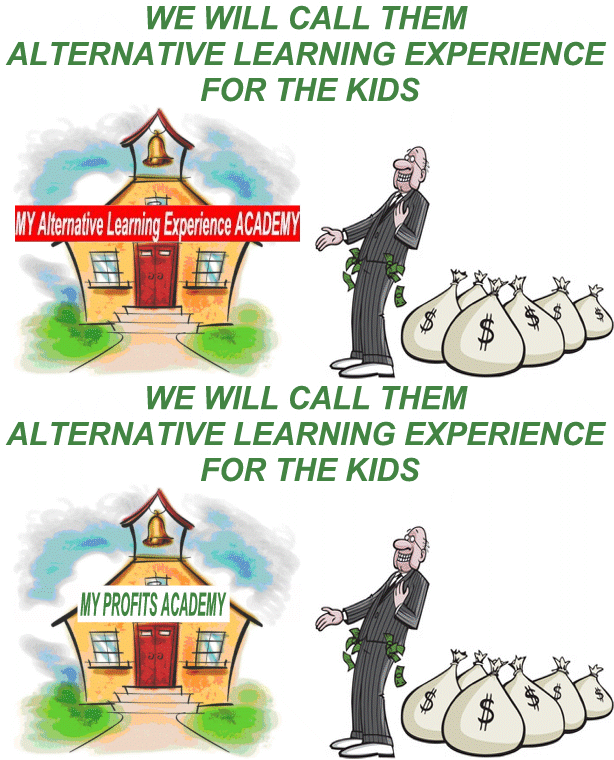
We don't really know how it would work if an urban charter school in Western Washington became an We don't really know how it would work if an urban charter school in Western Washington became an Alternative Learning Experience program of a rural school district in Eastern Washington.

Since we don't really know, let's make some wild conjecture about it.


State laws regulate schools pretty tightly - teacher:student ratios, the number of hours of planned instructional time each year, and lots more. But state law also allows for Alterntative Learning Experiences (ALEs). In an ALE, so long as the school can show that the students are learning what they are supposed to be learning, a whole lot of the regulations are off. So much for those who claim that innovative education isn't possible within public schools.

In particular, ALEs can allow for a lot of independent study. That's how online schools operate.

Seattle Public Schools has two of these: Cascade Parent Partnership Program and Interagency Academy. In the past, The NOVA Project and STEM at Cleveland have been ALEs, but they are no longer.

If a school district, even a small, rural school district such as Mary Walker School District, chose to do it, they could easily (and profitably) make charter schools, even those far outside the district's geographical boundaries, into ALE programs. Here's how:

After they get all of the students through the process of requesting a transfer from their home district to the new district, they enroll the students in an ALE program. The program can be essentially an independent study program. Now all of the students are responsible for educating themselves and the district is responsible for making sure that they do.

What does the district get out of this? Money. Lots of money. The state money allocated for each of the students. And their cost is the cost of administering an ALE which, if you don't work too hard at it, can be done very cheaply. They just have to fill out the paperwork and administer the state tests. They don't have to provide staff - no teachers, counselors, secretaries, principals, janitors, or program of a rural school district in Eastern Washington.

Since we don't really know, let's make some wild conjecture about it.


State laws regulate schools pretty tightly - teacher:student ratios, the number of hours of planned instructional time each year, and lots more. But state law also allows for Alterntative Learning Experiences (ALEs). In an ALE, so long as the school can show that the students are learning what they are supposed to be learning, a whole lot of the regulations are off. So much for those who claim that innovative education isn't possible within public schools.

In particular, ALEs can allow for a lot of independent study. That's how online schools operate.

Seattle Public Schools has two of these: Cascade Parent Partnership Program and Interagency Academy. In the past, The NOVA Project and STEM at Cleveland have been ALEs, but they are no longer.

If a school district, even a small, rural school district such as Mary Walker School District, chose to do it, they could easily (and profitably) make charter schools, even those far outside the district's geographical boundaries, into ALE programs. Here's how:

After they get all of the students through the process of requesting a transfer from their home district to the new district, they enroll the students in an ALE program. The program can be essentially an independent study program. Now all of the students are responsible for educating themselves and the district is responsible for making sure that they do.

What does the district get out of this? Money. Lots of money. The state money allocated for each of the students. And their cost is the cost of administering an ALE which, if you don't work too hard at it, can be done very cheaply. They just have to fill out the paperwork and administer the state tests. They don't have to provide staff - no teachers, counselors, secretaries, principals, janitors, or 
Seattle Schools Community Forum: Wild Conjecture about Charter Schools as ALEs:

Judge says charter group cannot interfere with unionization efforts - LA Times

Judge says charter group cannot interfere with unionization efforts - LA Times:

Judge says charter group cannot interfere with unionization efforts

A Los Angeles Superior Court judge this week issued a preliminary injunction barring administrators at the city’s largest charter group from hampering efforts to unionize its teachers.
The order is the latest action in a nine-month dispute between Alliance College-Ready Public Schools and United Teachers Los Angeles, which has launched a unionization effort with a group of teachers from the charter organization.
Charters are publicly financed but independently run. Most are nonunion.
In the order, Judge James C. Chalfant says that leaders of the charter group:


  • cannot post petitions on the charter’s website that solicit signatures against unionization.
  • cannot ask teachers their positions or intentions on collective bargaining.
  • must allow organizers after-school access to campuses.
  • cannot block emails from the union to teachers.
  • are required to stay 40 feet away from organizers inside buildings and 100 feet away in outside areas unless student safety is involved.
United Teachers Los Angeles has filed four unfair-practice claims against Alliance since launching a drive to unionize in March. The union alleges that the charter group is violating state law by intimidating employees, conducting surveillance on teachers and blocking organizers at school sites.
Charter leaders have denied wrongdoing.
The injunction will remain in place until California's Public Employment Relations Board, which enforces the collective bargaining laws for most public sector employees, completes a hearing process for all four complaints.
“We hope the injunction will lead Alliance managers to take responsibility for their behavior, repair the damage their unlawful campaign has done and allow us to reach an agreement for a fair process as we organize our union,” Xochil Johansen, a teacher at Alliance’s Stern Mass High School, said in a statement.
The charter group is required to provide employees a copy of the court’s order.
“The filing of unfair labor practices is a standard tactic in labor organizing, particularly Judge says charter group cannot interfere with unionization efforts - LA Times:

CURMUDGUCATION: ESSA Will Not Solve Anything

CURMUDGUCATION: ESSA Will Not Solve Anything:

ESSA Will Not Solve Anything


It's not that I don't appreciate the good parts or hate the bad parts. I'm not delighted to see social impact bonds tossed into the mix, nor am I pleased to see the doors opened here and there for performance based education. I take a bit of pleasure in seeing the ways in which the bill makes extra effort to spank the secretary of education (who has been weirdly trying to save face by repeatedly saying, "Oh yeah, this is what we wanted all along"), and I'm quite happy with the various piecesparts that defang the Big Standardized Test. It is a mixed bag, a shift of inches in mostly the right direction kind of. I think Jeff Bryant said it best with, "Go Ahead, Pass Every Student Succeeds Act, But Don't Celebrate It."

Because here's the problem. The ESSA won't actually solve a thing.

Yes, state leaders may very well say, "Thank God! Let's scrap the Common Core and replace them with real standards that we develop ourselves, and let's work up our own Big Standardized Test and let's design a way to evaluate teachers and public schools that uses authentic markers of excellence and not a bunch of BS Test baloney and let's even allow parents to opt out of testing and if the feds don't like it, they can try to sort it out in a courtroom. Screw 'em."

Or.

Or state leaders may say, "You know, all this stuff that we had to do under the Obama-Duncan-Bush-Page administrations is just fine with us, and it took a lot of time and money to get it all up and running, and some nice lobbyists tell us that it's all working great, so we're actually not going to change a single solitary thing."

Some state leaders might say, "We have a vision for truly excellent public schools in our state. Now that tests can be decoupled from the high stakes, we will embrace systems for evaluating our students, teachers and schools that support and reveal their many forms of excellence, building up a state system of education of which we are justly and deeply proud."

But state leaders might also say, "We actually share the vision of Arne Duncan and of Bill Gates and of our very most excellent good charter-operating friends over with the giant piles of money. We are pretty sure that our public schools suck with the suckage of a thousand black holes, and we look 
CURMUDGUCATION: ESSA Will Not Solve Anything:

Newark activists to feds: Help us achieve genuine community schools | Bob Braun's Ledger

Newark activists to feds: Help us achieve genuine community schools | Bob Braun's Ledger:

Newark activists to feds: Help us achieve genuine community schools

PULSELOGO


Just days after state-imposed schools superintendent Christopher Cerf and Newark Mayor Ras Baraka announced a joint, top-down program with the holders of what’s left of Mark Zuckerberg’s money to develop “community” schools in the city’s South Ward, a grass-roots organization based in the ward with a national focus–Parents United for Local School Education (PULSE-NJ)–wrote to  federal education secretary Arne Duncan to demand he help ensure genuine community schools are established. PULSE-NJ has filed a federal civil rights complaint against the state administration. PULSE-NJ’s letter follows:

Dear Secretary Duncan:
As you prepare to leave office after seven years, you are likely using your last few days to tie up loose ends and reflect on your tenure as the Secretary of Education for the United States of America. Perhaps you are even looking on your years with pride, and congratulating yourself for accomplishments. We are not sure if you have a performance review, but because you are charged to serve those in America’s public education system, we would like to provide you with a review of the effects your education policies have had on the people of Newark, New Jersey.

As parents in Newark, we would be remiss if we did not specifically speak to the devastating effects of policies like Race to the Top. Unfortunately, our children and community will be experiencing the residual effects of these policies for generations to come. The policies you supported caused harm in our community and your education experiment caused long-term trauma for our children.

The policies you supported caused harm in our community and your education experiment caused long-term trauma for our children.

A Newark parent stated, “Our children are anxiety-ridden. They have seen their neighborhood schools close down, and they do not know if the school they are currently attending will remain open. The children have had a hard time adjusting to new neighborhoods, new teachers and administrators. We try to calm their constant anxiety, but many of our children have been moved around two or three times and have seen the closures of the schools in their neighborhood. The lack of stability has contributed to the adverse childhood experiences of our children. This is how we define trauma.” There is plenty of research to support that the prevalence of traumatic life experiences in the first 18 years of a person’s life impacts not only brain development, but their overall well-being in their later years.
 Marginalized people in our country have been stripped of their agency, voice, dignity, and humanity. The state-sponsored and inflicted trauma on our people continues on through our education system.

In many ways, we should not be surprised. This is how we have come to know our United States of America; a country that experiments on its most marginalized, particularly Black, Native American, and Latino people. From the Tuskegee Syphilis Experiment, to the Contraceptive Trials of Puerto Rico, to the Indian Schools that Newark activists to feds: Help us achieve genuine community schools | Bob Braun's Ledger:

Wendy Lecker: Leaving math standards to politicians doesn’t add up - StamfordAdvocate

Wendy Lecker: Leaving math standards to politicians doesn’t add up - StamfordAdvocate:

Wendy Lecker: Leaving math standards to politicians doesn’t add up


At parents’ night this fall, a high school math teacher I know begged parents to teach their children long division “the old-fashioned way.” She explained that the new way students had learned long division impedes their ability to understand algebraic factoring. She lamented that students hadn’t been taught certain rote skills, like multiplication tables, that would enable them to perform more complex math operations efficiently.
It turns out that brain science supports this math teacher’s impressions. Rote learning and memorization at an early age are critical in developing math skills.
A study conducted by Stanford Medical school examined the role of a part of the brain, the hippocampus, in the development of math skills in children. The authors noted that a shift to memory-based problem solving is a hallmark of children’s cognitive development in arithmetic as well as other domains. They conducted brain scans of children, adolescents and adults and found that hippocampus plays a critical but time limited role in the development of memory-based problem solving skills.
The hippocampus helps the brain encode memories in children that as adults they can later retrieve efficiently when working with more complex math concepts. The hippocampal system works a certain way in children to help develop memory-based problem solving skills. Once the children pass a certain age, the processes change.
The study also found that “repeated problem solving during the early stages of arithmetic skill development in children contributes to memory re-encoding and consolidation.” In other words, rote repetition helps the development of this critical brain system so essential to later more complicated math work.
Those who developed the Common Core State Standards clearly ignored brain research in math, as they did in reading (http://bit.ly/1IeIgKm); The Common Core emphasizes conceptual understanding at every phase of math instruction. So, even young children are required not only to conduct a simple math procedure, but to also explain and justify every answer.
As education professor Katherine Beals and math teacher Barry Garelick wrote recently in the Atlantic, when certain Wendy Lecker: Leaving math standards to politicians doesn’t add up - StamfordAdvocate:

All Children Are Creative - Living in Dialogue

All Children Are Creative - Living in Dialogue:

All Children Are Creative 


This is the third in a series of blog posts focused on the value of art in our lives, and the role art can play in resisting the test and punish model of education.  See the intro and links to other posts in the series here.
By Clyde Gaw.
Eight year-old Frank helps five of his classmates select materials for a large floor sculpture. “Dude! We added new designs to it. Look we got things like new support beams!” Second grade classmate John watches the action, “How are you making this thing? Can I help you?” Frank replies, “You could. You could put something down here on it.” Working with wooden blocks, chairs and benches, Frank and six of his classmates are constructing a 20 square-foot version of the Tacoma Narrows Bridge. I had been observing the team from a distance working out their engineering problem and moved closer to ask them a question. “Aren’t you concerned about the safety of your bridge?” The boys respond, “It’s safe! It’s safe! It’s not that bad, you’ll only fall two thousand feet!” Eight-year old Ken offers new information to the story, “The Tacoma Narrows Bridge collapsed when it was 4 months old. It sadly collapsed while a poor dog was trapped inside a car. He later fell at the bridge. He did not make it out alive.”creative1 (1)
Fascinated by their collaborative spirit I asked the boys another question. “What a tragedy! What inspired you to build this bridge?” Ken explained, “This is the ‘new’ Tacoma Narrows Bridge. The old Tacoma Narrows bridge video is on the Internet. So we watched the video and we got inspired by it so we built this one.” The energetic builders continue stacking and weaving new parts into their structure. They fabricate trusses and columns out of chairs, wooden blocks and strips of recycled plastic. I congratulate the boys for initiating such a physically large project then document their progress with photographs. “You guys are something else!” I scan the room to observe the rest of the class.creative2 (1)
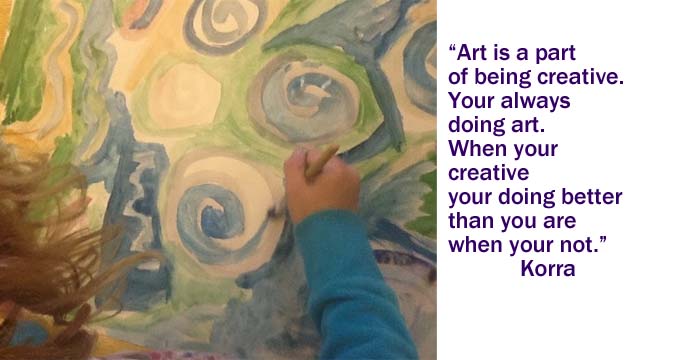
Moving about freely, the children have set up their own workspaces and engage in self-directed art projects. They communicate easily with each other, working with a variety of materials, tools and art making techniques. Best friends Kelli and Susan are drawing pictures of their neighborhoods from memory. Janine is painting images of people on a sheet of cardboard. Kaylee, who wants to be a veterinarian when she grows up, is drawing a giraffe. James, who is in competition with his brother to draw the most ferocious monster ever, renders a dragon with oil pastels. Emilee who is interested in fashion, knots yarn to create a bracelet while her best friend Korra is working on what appears to be an abstract All Children Are Creative - Living in Dialogue:

The disturbing provisions about teacher preparation in No Child Left Behind rewrite - The Washington Post

The disturbing provisions about teacher preparation in No Child Left Behind rewrite - The Washington Post:

The disturbing provisions about teacher preparation in No Child Left Behind rewrite


There has been loud applause in the education world for the new Every Student Succeeds Act, the successor to No Child Left Behind that has passed the House and is expected to become federal law soon. It has been hailed as a fix-it to the broken NCLB law, and it does indeed moderate some of NCLB’s biggest problems. But, perhaps because the legislation was only made public a few days before the House voted, there has been little time to look at the details in the bill.
In this post, Kenneth Zeichner, a professor of teacher education at the University of Washington at Seattle, does just that in regard to how the bill approaches teacher preparation programs — and he reveals some deep concerns. For example:
* Provisions in the legislation for the establishment of teacher preparation academies are written to primarily support non-traditional, non-university programs such as those funded by venture philanthropists.
* The legislation “oversteps the authority of the federal government” in several ways, including by declaring that
the completion of a program in an academy run by an organization other than a university results in a certificate of completion that may be recognized by states as “at least the equivalent of a master’s degree in education for the purpose of hiring, retention, compensation, and promotion in the state.”  The federal government absolutely has no business in suggesting what should and what should not count as the equivalent of a master’s degree in individual states.
* The legislation seeks to mandate “definitions of the content of teacher education programs and methods of program approval that are state responsibilities.” As a result, it lowers “standards for teacher education programs that prepare teachers for high-poverty schools … by exempting teacher preparation academies from what are referred to as ‘unnecessary restrictions on the methods of the academy.’ ”
Here’s the piece by Zeichner, who is a member of the National Academy of Education and professor emeritus in the School of Education at the University of Wisconsin-Madison, and who has done extensive research on teaching and teacher education.
By Kenneth Zeichner
The fundamental tenets of the Every Student Succeeds Act – the successor to No Child Left Behind – are now well known. It lessens the latter’s focus on standardized test scores and shifts much policy-making power from the U.S. Education Department back to the states. But many educators may be surprised to learn what it includes about teacher preparation. There are provisions in the bill  for the establishment of teacher preparation academies – and they are written to primarily support non-traditional, non-university programs.
In October 2013, I criticized a bill called the GREAT Teachers and Principals Act, known as the GREAT Act. It was initiated in March 2011 in conversations between leaders of the New Schools Venture Fund (NSVF); Norm Atkins, founder of the Relay Graduate School of Education; Tim Knowles of the University of Chicago; and several members of Congress.
The purpose of this bill was to provide public funds for promoting the growth The disturbing provisions about teacher preparation in No Child Left Behind rewrite - The Washington Post:

Why Should We Trust Tech Billionaires Like Mark Zuckerberg With the Future of Education? - Yahoo News

Why Should We Trust Tech Billionaires Like Mark Zuckerberg With the Future of Education? - Yahoo News:

Why Should We Trust Tech Billionaires Like Mark Zuckerberg With the Future of Education?

Why Should We Trust Tech Billionaires Like Mark Zuckerberg With the Future of Education?


The "Pass the Mic" series showcases voices, perspectives and ideas that spark interesting conversations. 

Steve JobsBill Gates, Eric SchmidtRupert Murdoch, and now Mark Zuckerberg have all announced their solutions to what's wrong with public schools. And they all support companies that promise to fix these schools. They are clever folks who know how to program computers, market products, entertain, advertise and make money. But they don't necessarily know to educate effective and responsible citizens.
Why should we trust these rich Silicon Valley entrepreneurs to influence educational policy?
Tech titans like Mark Zuckerberg, who has pledged most of his fortune to advancements in science and education, realize, as many responsible educators do, that the schools of today are not serving their students or the society very well. Schools are stuck in a 19th-century paradigm that prepares young people for a simple industrial economy and a static political community that no longer exist. These men suspect, as many responsible educators do, that the kinds of technologies that made them rich could contribute to a new form of schooling that better fits today's students, today's economy and today's political community.
But the solutions they choose to promote and fund seldom work. 
They treat public education as if it were just another commercial enterprise.
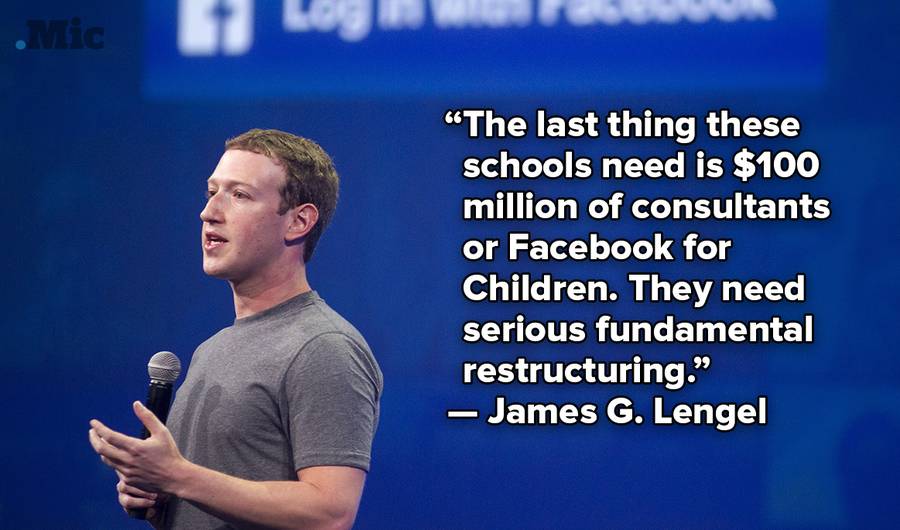
Witness the meager effects of Zuckerberg's $100 million gift to Newark schools, described in The Prize: Who's in Charge of America's Schools? by Dale Russakoff. 
Witness, as we have in our visits to schools all over the world, the thousands of now-vacant school computer labs once funded by Microsoft and Gates. 
Witness the failure of Murdoch's Amplify, which just wrote off half a billion dollars that was supposed to revolutionize education through personalized learning. 
Witness the exposure of Google's education platform as a ruse to market information gleaned from students' profiles. 
Witness the sad failure of online charter schools to serve their students. 
View gallery
.
Why Should We Trust Tech Billionaires Like Mark Zuckerberg With the Future of Education?
Students at KIPP Thrive Academy, a charter school in Newark, New Jersey Source: Mel Evans/AP

Why don't these initiatives work? For one, they fail to recognize why schools exist. They treat public education as if it were just another commercial enterprise. And they fail to listen to the folks who are truly interested in educating young people for effective citizenship.
That's what the public schools in the USA are supposed to do, and have done pretty well for the last two centuries: educate young people to be contributing workers, participating citizens and good neighbors. In some ways, these social purposes are exactly the opposite of the kinds of personalized learning that Zuckerberg and the others call for. 
Where technology isolates, good schools socialize. Silicon Valley tells students, Technology will tell you how you learn best, where you need to focus and what to do next. But good schools tell their students, Caring adults will help you learn most effectively and ensure that you are headed in the right direction
Schools' mission today is, more than ever, to counteract the selfish personalization made possible by new media and technologies. We don't need any more centripetal forces moving our young people into separate affinity groups or lonesome personal spaces. Since Google and Facebook make their millions by selling personalized entertainment and advertising, it's only Why Should We Trust Tech Billionaires Like Mark Zuckerberg With the Future of Education? - Yahoo News: