Latest News and Comment from Education

Saturday, November 21, 2015

House-Senate Conference Committee Approves Framework to Improve K-12 Education

Press Releases | Press | Chairman's Newsroom | Chairman | The U.S. Senate Committee on Health, Education, Labor & Pensions:

House-Senate Conference Committee Approves Framework to Improve K-12 Education


Image result for House-Senate Conference Committee Approves Framework to fix No Child Left Behind


Today, the House-Senate conference committee reached agreement on a proposal to improve K-12 education and replace No Child Left Behind. The agreement represents a compromise between the House-passed Student Success Act (H.R. 5) and the Senate-passed Every Child Achieves Act of 2015 (S. 1177). 
No Child Left Behind has been failing students, parents, teachers, and state and local education leaders for far too long, and today we took an important step in replacing this flawed law,” said Education and the Workforce Committee Chairman John Kline (R-MN). “But there is still work to be done. We now have to turn this framework into a final bill for our House and Senate colleagues to review. I am confident that once they do, they will see it as an opportunity to replace a failed approach to education with a new approach that will reduce the federal role, restore local control, and empower parents. We will continue to work with all of our colleagues in the House as we move this important process forward.”
"The winners today are 50 million children and 3 million teachers in 100,000 public schools,” said Senate Health, Education, Labor, and Pensions Committee Chairman Lamar Alexander (R-TN). “Our action would reverse the trend toward a national school board and restore to states, communities, and teachers the responsibility for improving student achievement. This is a bipartisan step forward to fix the No Child Left Behind law that everyone wants fixed. The United States Senate and House of Representatives should complete our work in December so that the president can sign it into law before the end of the year."
“With today's vote by the conference committee to reauthorize the ESEA, we have moved closer to advancing the principles of Brown v. Board of Education, which said that the opportunity for a public education 'is a right which must be made available to all on equal terms,'” said Education and the Workforce Committee Ranking Member Bobby Scott (D-VA). “This agreement ensures that when achievement gaps are found, meaningful action will be taken to intervene and support the needs of students. It ensures that funds will continue to be directed to communities and give teachers and schools the resources they need to support all students. I look forward to the vote by the House and Senate that will send President Obama a bill that is indeed worthy of his signature.”
“Taking this next step to finally fix the broken No Child Left Behind law is great news for students, parents, teachers, and communities in my home state of Washington and across the country,” said Senator Patty Murray (D-WA), Ranking Member of the Senate Health, Education, Labor, and Pensions Committee. “I am proud that our agreement includes strong federal guardrails to ensure all students have access to a quality education, reduces reliance on high-stakes testing, makes strong investments to improve and expand access to preschool for our youngest learners, and so much more. I appreciate the hard work that so many Democrats and Republicans have put into this agreement, and I am optimistic that it can pass both chambers of Congress and get signed into law to help more students across the country get the chance to learn, grow, and thrive in the classroom and beyond.”
A summary of the framework approved by the conference committee can be found here.


The reauthorization of the Elementary and Secondary Education Act (ESEA) is one step closer to becoming a reality.
On Thursday, November 19, a U.S. House and Senate joint conference committee fairly quickly negotiated language to reauthorize ESEA. 
handful of amendments were discussed at yesterday’s markup prior to passing the bill. Seven easily passed with bipartisan support, one was withdrawn by its author, and only two were voted down. The amendments that passed would authorize a study to examine changes to formula funding through Title I, review early childhood education programs, establish limits on aggregate time spent on assessments, provide funding for educating teachers on the appropriate use of student data, provide for dual or concurrent enrollment for English language learners, integrate arts in STEM education, and offer funding flexibility to carry out dropout prevention and re-entry programs.
The bipartisan conference committee overwhelmingly passed (39-1) the conference report (or the negotiated bill). 
Continue to follow MSBA Capitol Connections, we will alert you as the bill makes it way to the House and Senate floors for a full vote.
The full report/bill language is expected to become public on November 30. The House could vote on the bill December 2–3 and the Senate could vote as early as December 7.
View the ESEA Framework as approved by the conference committee which includes NSBA commentary.  The most substantive change from the House-and Senate-passed ESEA bills is enhanced accountability that has bipartisan support.
Several amendments were added to the bill with bipartisan support: 
Title I Funding:  The House-Senate ESEA Conference Committee adopted an amendment by voice vote that was offered by Rep. Glenn Thompson (R-PA) that would authorize the Institute of Education Sciences to study the Title I funding formula and report back to Congress.  This amendment reflects “formula fairness” efforts by Rep. Thompson as well as Senators Richard Burr (R-NC) and Michael Bennet (D-CO), to reform the Title I funding mechanisms to reflect greater parity (or equitable distribution of funds among eligible students in urban, rural and suburban areas).
“When the money does not follow the intended population, that’s broken,” Sen. Burr stated.  “Title I money no longer follows poor kids where they live.  When a program isn’t accomplishing what it was intended for, it is broken.”
Early Childhood Education Programs:  Senator Mike Enzi (R-WY) offered an amendment that was approved by a voice vote to study federal investments in early childhood education that would yield useful information on how to make early education more efficient and effective.  In his remarks about the amendment, Sen. Enzi stated that he and the late Sen. Edward Kennedy (D-MA) worked several years ago to consolidate and improve federal support for early childhood programs, and that more efforts are needed to improve efficiency in this area.
Integrated Curricula:  Rep. Susan Bonamici (D-OR) introduced an amendment that would expand the list of allowable activities in Title IV Academic Enrichment Grants (formerly 21st Century Schools) to improve integration of STEM subjects and the arts, such as music and math, to support efforts for a “well-rounded education.”  Conferees approved the amendment by a voice vote.
Testing/Assessments:  Sen. Michael Bennet (D-CO) offered an amendment that was approved by a voice vote to streamline testing, “where federal requirements collide with district and state assessments.” The amendment clarifies that states and districts may set a targeted limit on testing and eliminate unnecessary and duplicative assessments.  The measure would limit the overall amount of time students spend taking assessments and allow states and districts the flexibility to address what Chairman Lamar Alexander (R-TN) referred to as “the problem of over-testing.”
Education Technology/Student Data Privacy:  Rep. Luke Messer (R-IN) raised an amendment regarding the use of technology to improve education outcomes while protecting student data.  The amendment, which was approved by a voice vote, would amend Title IIA under ESEA on “preparing, training and recruiting high quality teachers and principals” to allow the use of professional development funds for training on the appropriate use of data.
Dropout Prevention:  Rep. Frederica Wilson (D-FL) offered an amendment that was approved by a voice vote to increase dropout prevention efforts and offer greater support for student re-entry programs.  The amendment would allow districts to use existing funds under the new Student Support and Academic Enrichment Grants program to address dropout prevention.
Dual and Concurrent Enrollment Programs: Rep. Jared Polis (D-CO) offered a measure to amend Title III on English Language Acquisition to facilitate opportunities for dual/concurrent enrollment as an allowable use of funds.  The measure would enhance the offering of community college courses to English Language Learners, allowing students to graduate in five years with a high school diploma and advanced credentials.  Rep. Polis stated that his amendment would provide more opportunities for such programs, giving students a “head start” on college completion.  Conferees approved the amendment by a voice vote.
Additional amendments were offered, but not approved: 
Authorized Funding Levels:  Rep. Glenn Grothman (R-WI) raised an amendment regarding the authorized funding levels in the proposed conference committee agreement, stating that they were “a little bit high.”  He cited additional reasons, including priorities for homeland security and international security (with the recent attack in France), as other priority areas within the federal budget.  Rep. Bobby Scott (D-VA) objected to the measure, stating that “our student population is growing and needs are growing.”  Rep. Scott added that, “I think it is inappropriate, at this point, to try to restrict the possible appropriation … and limit that debate.”  House conferees approved the amendment by a vote of 9 to 8.  Senate Health, Education, Labor and Pensions (HELP) Committee Chairman Lamar Alexander (R-TN) stated his opposition to the amendment, noting that the bill would authorize funding commensurate with the levels approved in the recent Bipartisan Budget Act of 2015 and in the Budget Control Act of 2011.  Sen. Patty Murray (D-WA) opposed the amendment as well, stating that, “Adopting this amendment would be a major step backward [from the Bipartisan Budget Act].”  Senate conferees did not agree to this amendment; and, it was not approved.
Teacher/Principal Evaluations:  Rep. Susan Davis (D-CA) offered an amendment that would direct the U.S. Department of Education to establish a clearinghouse of best practices for teacher and principal evaluations to help school districts learn about and exchange successful models of teacher and principal evaluation systems.  Rep. Todd Rokita (R-IN) and other House conferees objected to the amendment, asserting that teacher and principal evaluations should be managed at the discretion of states and school districts.  The amendment was not approved.
The following amendment was not voted on, but was discussed: 
Higher Education/Extension of Perkins Loan Program:  Sen. Tammy Baldwin (D-WI) introduced an amendment – but did not request a vote on this amendment – to extend the Perkins Loan program authorization for one-year, as it has recently expired.  In her remarks, she stated that the amendment is necessary and imminent to helping ensure that students can continue their education beyond high school.  “It’s critical that we not leave students and institutions in the lurch [while negotiating a reauthorization for the Higher Education Act],” Sen. Baldwin stated.
 Press Releases | Press | Chairman's Newsroom | Chairman | The U.S. Senate Committee on Health, Education, Labor & Pensions:
Remember Class Size? « pedagogyofthereformed

Remember Class Size? « pedagogyofthereformed:

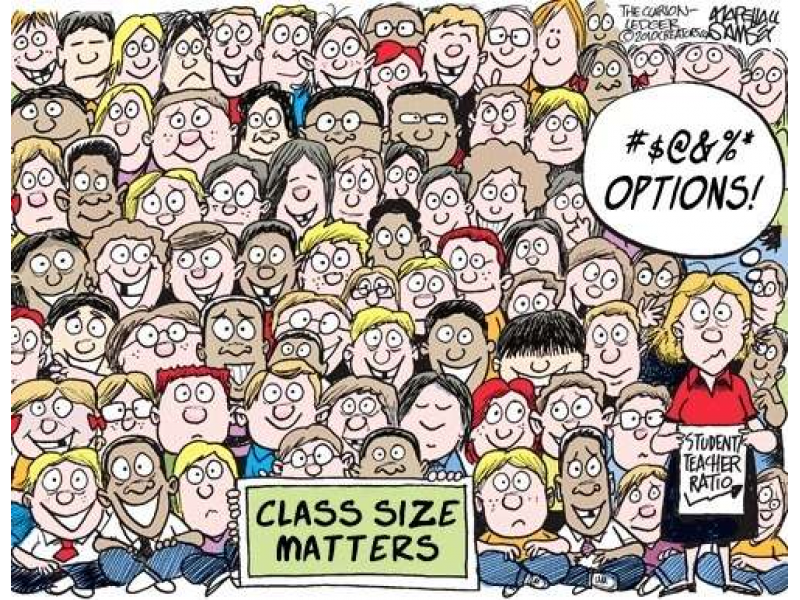
Remember Class Size?


School districts don’t want small classes because that means more teachers, more space, and of course, more money.  Funding in public schools in in short supply these days between sky high consultant fees, expensive test prep programs and deliberate underfunding by state officials, so class size has slipped out of the conversation.
Moreover, for  top down reformer zealots, large class sizes are a-ok because they fit right in with military style, teacher centered classrooms in which students passively recite, chant and fill out the latest quiz.
Small classes, on the other hand, allow teachers to foster independence, freedom, community, and trust- all hallmarks of progressive education. In this way, class size has the power to shape the way we teach and the culture of our classrooms.
We educators know that authentic, meaningful teaching and learning happens in small communities of learners that know each other very well, in communities in which every child can feel heard, in which students can explore and experiment, and in which children can make decisions for themselves.
I see the difference class size can make every day. Last year, the first grade  classes at my school had between 18-22 students. We had a fabulous year. We were able to get messy and do amazing things. We built towers out of recycled materials,  we mixed liquids and made slime, we created animal puppets, we planted seeds in the school garden and designed roller coaster tracks for marbles.
This year, I am teaching many of the same students and I want everything we do to be as fun, hands-on and child friendly. The thing is, this year, the second grade classes all have between 27 and 30 students.  The difference is palpable. What felt calm now feels chaotic, and what felt manageable now feels utterly exhausting. Just getting through a greeting or transition takes an extraordinary amount of strategic management.
And the kids are suffering. Students who made tremendous progress last year are now falling behind, because in a class of 30, teachers don’t get to work with every student daily, or even weekly. Similarly, students with learning disabilities who were able to shine and Remember Class Size? « pedagogyofthereformed:

Join thousands of CTU members and allies on Nov. 23 in Grant Park

November 23 Mass Rally:


Date: Monday, Nov. 23 
Location: Grant Park’s Butler Field 
Time: 5:30 p.m. to 7:00 p.m.  

Click here to view bus locations. 


If we don’t come together and fight for good schools and a fair contract, we will lose many of the rights we currently have. If we allow CPS to continue to disrespect our profession, they will pile even more demands on our schools without adequate resources. Every year, they take more and more—enough is enough. We are fighting to save public education!
Join thousands of CTU members and allies on Nov. 23 in Grant Park to fight for the contract we need, and for the schools Chicago’s students deserve.
WEAR YOUR CTU RED!November 23 Mass Rally:

Catching False Data: How Scientists Lies | Patch

Catching False Data: How Scientists Lies | Patch:

Catching False Data: How Scientists Lies

A pair of Stanford researchers has uncovered patterns in how scientists lie about their data.


Even the best poker players have “tells” that give away when they’re bluffing with a weak hand. Scientists who commit fraud have similar, but even more subtle, tells, and a pair of Stanford researchers have cracked the writing patterns of scientists who attempt to pass along falsified data.
The work, published in the Journal of Language and Social Psychology, could eventually help scientists identify falsified research before it is published.
There is a fair amount of research dedicated to understanding the ways liars lie. Studies have shown that liars generally tend to express more negative emotion terms and use fewer first-person pronouns. Fraudulent financial reports typically display higher levels of linguistic obfuscation – phrasing that is meant to distract from or conceal the fake data – than accurate reports.
To see if similar patterns exist in scientific academia, Jeff Hancock, a professor of communication at Stanford, and graduate student David Markowitz searched the archives of PubMed, a database of life sciences journals, from 1973 to 2013 for retracted papers. They identified 253, primarily from biomedical journals, that were retracted for documented fraud and compared the writing in these to unretracted papers from the same journals and publication years, and covering the same topics.
They then rated the level of fraud of each paper using a customized “obfuscation index,” which rated the degree to which the authors attempted to mask their false results. This was achieved through a summary score of causal terms, abstract language, jargon, positive emotion terms and a standardized ease of reading score.
“We believe the underlying idea behind obfuscation is to muddle the truth,” said Markowitz, the lead author on the paper. “Scientists faking data know that they are committing a misconduct and do not want to get caught. Therefore, one strategy to evade this may be to obscure parts of the paper. We suggest that language can be one of many variables to differentiate between fraudulent and genuine science.”
The results showed that fraudulent retracted papers scored significantly higher on the obfuscation index than papers retracted for other reasons. For example, fraudulent papers contained approximately 1.5 percent more jargon than unretracted papers.
“Fradulent papers had about 60 more jargon-like words per paper compared to unretracted papers,” Markowitz said. “This is a non-trivial amount.”
The researchers say that scientists might commit data fraud for a variety of reasons. Previous research points to a “publish or perish” mentality that may motivate researchers to manipulate their findings or fake studies altogether. But the change the researchers found in the writing, however, is directly related to the author’s goals of covering up lies through the manipulation of language. For instance, a fraudulent author may use fewer positive emotion terms to curb praise for the data, for fear of triggering inquiry.
In the future, a computerized system based on this work might be able to flag a submitted paper so that editors could give it a more critical review before publication, depending on the journal’s threshold for obfuscated language. But the authors warn that this approach isn’t currently feasible given the false-positive rate.
“Science fraud is of increasing concern in academia, and automatic tools for identifying fraud might be useful,” Hancock said. “But much more research is needed before considering this kind of approach. Obviously, there is a very high error rate that would need to be improved, but also science is based on trust, and introducing a ‘fraud detection’ tool into the publication process might undermine that trust.”Catching False Data: How Scientists Lies | Patch:

#TeachStrong? Brother, Here We Go Again… | Daniel Katz, Ph.D.

#TeachStrong? Brother, Here We Go Again… | Daniel Katz, Ph.D.:

#TeachStrong? Brother, Here We Go Again…


Education reformers in the 21st Century seem incapable of seeing any problem as something other than a marketing campaign.  Faced with growing grassroots opposition to the Common Core State Standards, the Thomas B. Fordham Institute, backed with fresh cash from the Gates Foundation, launched a #SupportTheCore event on social media to try to make CCSS support look genuine and natural.  As they felt control of the education reform narrative slipping from their grip, major corporate backers of standardized testing and school privatization handed $12 million to former Arne Duncan aide Peter Cunningham to launch The Education Post, a pro-reform blogging outpost, providing content for itself and editorial pages.  Needing to dress up hercampaign to destroy the collective bargaining and due process rights of our nation’s teachers as something more noble, former news anchor Campbell Brown set up her own web headquarters called The 74, referencing the estimated 74 million children under the age of 18 Brown claims she is defending from greedy unions.  It seems that whenever they want to tackle difficult and contentious issues, reform advocates turn immediately to the tools of viral advertising and public relations to create the imagery of genuine, natural support rather than bothering with the hard work of building it.
Cue #TeachStrong.
Let’s agree to set aside the choice of a name that inevitably invokes one of the#TeachStrong? Brother, Here We Go Again… | Daniel Katz, Ph.D.:
Embedded image permalink

Battling Broad's charter attack in LA

Battling Broad's charter attack in LA | SocialistWorker.org:

Battling Broad's charter attack in LA


ON THE heels of a big contract campaign that won a 10 percent raise, unprecedented caps on class sizes and other gains for our schools, the 31,000 members of United Teachers Los Angeles (UTLA) have another major battle on our hands over the future of public education in our city--a battle with national implications.
Last week, thousands of UTLA members walked picket lines in front of our schools, demanding that the school board for the Los Angeles Unified School District (LAUSD) condemn a plan hatched by local billionaire Eli Broad to raise $500 million to double the number of LAUSD students attending charter schools. Broad's stated goal is for charter schools to reach 50 percent "market share" of LAUSD students. In response, UTLA members declared, "Billionaires can't run our schools!"
Eli Broad made his fortune in the real estate and insurance industries and has no experience working as an educator. Yet he has leveraged his vast wealth to become one of the most influential educational policymakers in the U.S.
In 1999, Broad started a "venture philanthropy" organization, which he humbly named the Eli and Edythe Broad Foundation. Since then, the Broad Foundation has funneled over $600 million into education initiatives that conform to Broad's vision of "school reform": privatize and deregulate public education, run schools like businesses, and blame everything bad on teachers and our unions. Broad's plan for LA states that it will be a "proof point" for the privatization of schools nationwide.
Los Angeles already has over 150,000 children in charter schools, more than any other city in the nation. Charter schools are publicly funded schools that are run by private management organizations, the largest of which see the schools they run as direct competitors to neighborhood public schools in the "education marketplace."
Almost all charter-school teachers and staff have no union representation, are at-will employees, and have no protection against excessive workload mandates. As a result, charter schools have significantly higher teacher turnover rates than even LAUSD schools, where classrooms are overcrowded, and teachers aren't given nearly adequate resources to serve the needs of students suffering extreme poverty.
UTLA's contract gives its members a wide range of benefits and protections, including lifetime health benefits with no premiums, due process rights against arbitrary or retaliatory termination, duty-free lunch breaks and the right to a voice at school via shared decision-making councils.
If Broad's plan comes to fruition, 10,000 UTLA jobs could be destroyed and more teachers would be pushed into the unlimited workloads, lack of job security and substandard health benefits that prevail in most charter schools.
- - - - - - - - - - - - - - - -
OF COURSE, Broad isn't selling his plan as a way to dismantle a crucial public service, destroy thousands of stable union jobs, and push teachers out of the public sector into the abyss of market-driven precarious employment. Broad calls his proposal "Great Public Schools Now" and says its goal is to "ensure that every student can access a great public school." What could be bad about a man all the newspapers call a "philanthropist" raising half a billion dollars for "great public schools" for low-income students?
But take a closer look at the Broad plan--which was only revealed to the public when Los Angeles Times reporter Howard Blume started writing about it in August and published the Broad Foundation's 44-page internal report on the plan in September--and you find ON THE heels of a big contract campaign that won a 10 percent raise, unprecedented caps on class sizes and other gains for our schools, the 31,000 members of United Teachers Los Angeles (UTLA) have another major battle on our hands over the future of public education in our city--a battle with national implications.
Last week, thousands of UTLA members walked picket lines in front of our schools, demanding that the school board for the Los Angeles Unified School District (LAUSD) condemn a plan hatched by local billionaire Eli Broad to raise $500 million to double the number of LAUSD students attending charter schools. Broad's stated goal is for charter schools to reach 50 percent "market share" of LAUSD students. In response, UTLA members declared, "Billionaires can't run our schools!"
Eli Broad made his fortune in the real estate and insurance industries and has no experience working as an educator. Yet he has leveraged his vast wealth to become one of the most influential educational policymakers in the U.S.
In 1999, Broad started a "venture philanthropy" organization, which he humbly named the Eli and Edythe Broad Foundation. Since then, the Broad Foundation has funneled over $600 million into education initiatives that conform to Broad's vision of "school reform": privatize and deregulate public education, run schools like businesses, and blame everything bad on teachers and our unions. Broad's plan for LA states that it will be a "proof point" for the privatization of schools nationwide.
Los Angeles already has over 150,000 children in charter schools, more than any other city in the nation. Charter schools are publicly funded schools that are run by private management organizations, the largest of which see the schools they run as direct competitors to neighborhood public schools in the "education marketplace."
Almost all charter-school teachers and staff have no union representation, are at-will employees, and have no protection against excessive workload mandates. As a result, charter schools have significantly higher teacher turnover rates than even LAUSD schools, where classrooms are overcrowded, and teachers aren't given nearly adequate resources to serve the needs of students suffering extreme poverty.
UTLA's contract gives its members a wide range of benefits and protections, including lifetime health benefits with no premiums, due process rights against arbitrary or retaliatory termination, duty-free lunch breaks and the right to a voice at school via shared decision-making councils.
If Broad's plan comes to fruition, 10,000 UTLA jobs could be destroyed and more teachers would be pushed into the unlimited workloads, lack of job security and substandard health benefits that prevail in most charter schools.
- - - - - - - - - - - - - - - -
OF COURSE, Broad isn't selling his plan as a way to dismantle a crucial public service, destroy thousands of stable union jobs, and push teachers out of the public sector into the abyss of market-driven precarious employment. Broad calls his proposal "Great Public Schools Now" and says its goal is to "ensure that every student can access a great public school." What could be bad about a man all the newspapers call a "philanthropist" raising half a billion dollars for "great public schools" for low-income students?
But take a closer look at the Broad plan--which was only revealed to the public when Los Angeles Times reporter Howard Blume started writing about it in August and published the Broad Foundation's 44-page internal report on the plan in September--and you find Battling Broad's charter attack in LA | SocialistWorker.org:

CURMUDGUCATION: Resume Bombs

CURMUDGUCATION: Resume Bombs:

Resume Bombs


Here's the problem. You can't build a resume with the following:

I took over a program that was doing pretty well, so I just kept things humming along in the same general direction. I may have tweaked a few things here and there, but basically I just left well enough alone.

No, to really put some beef on the old resume, you need a sentence that starts with "Implemented..."

And so, the resume bomb.

Someone moves into a new administrative position and starts looking for a way to Make a Splash, Leave Their Mark, or Show They Are a Dynamic Change Agent.

They may consolidate power by taking over functions previously performed by staff or other offices. They will certainly create a new program. And they will develop and start the implementation of the policies and procedures needed to support the new program. Congratulations. You have your brand new resume bomb, and your new administrator will grab his brightly polished resume and get out the door to his next job before the bomb ever goes off.

Some bombs have a long fuse. The program gets up and running without too much incident, and it is only once you get further down the road that serious problems begin to emerge, that the new program begins to create some real problems for the district. But by then, the one person who knows exactly how it's supposed to work and how to keep it functioning and can answer questions about it-- that person is at his next job.

Some bombs have a short fuse, or are set off by the administrative departure itself. "We just need to rip up this system here, and I'm going to create a new policy with software support over here, and 
CURMUDGUCATION: Resume Bombs:

Peg with Pen: Harassment Lawsuit Anyone?

Peg with Pen: Harassment Lawsuit Anyone?:

Harassment Lawsuit Anyone?


When your school is being destroyed by the dictatorial advice of fake teacher programs (Relay) aided and abetted by the Colorado Department of Education all under absolutely fear mongering mandates that force you into silence what is one to do? Do you stay quiet and simply let it all go down as they have planned? Or, do you speak up, refuse to do as asked, and risk getting fired? And when you speak up, you do so knowing that there is absolutely no one there to stop this train as it has left the station. It's guaranteed you'll get knocked down and run over on the tracks. You will be a casualty. That's the hard cold truth facing many teachers today. And then, you'll be replaced. And will these replacements care for the children like you did? Or will they be products of fake teacher programs and will they force your children to walk in lines without moving their arms and spend days on end doing online test prep? Perhaps Dawn Neely Randall is on the right track here? Neely-Randall vs. State of Ohio? Peer Discriminatory Harassment?


Sounds damn good to me. Email me at writepeg@juno.com after reading this if it sounds good to you too. 

She writes:

Neely-Randall vs. State of Ohio

Peer Discriminatory Harassment:

This past week, as I was completing an online training module assigned by the Ohio Department of Education via a required harassment/bullying video (so we could know the state laws within the classroom context), the definition of harassment given included to 1) have an intent to harm; 2) be directed at a specific target; and 3) involve repeated incidents. I learned that legally, harassment focuses on how the behavior affects the victim.

As a teacher in the State of Ohio, I suddenly realized that I am being harassed by the Ohio Department of Education's own legal definition as well as from legislators who are passing harmful laws to hurt me as well as many harmful laws that hurt my students, which totally, unequivocally knock the wind right out of me.

The state is asking teachers to educate and test students in ways that many of us do not feel is morally correct or developmentally appropriate. For instance, very shortly, some districts will test 3rd graders (a test they must pass in order to pass third grade; another form of harassment) for three hours straight. So, eight year olds, will sit at a computer for THREE HOURS STRAIGHT taking a high-stakes (high-pressure situation) English Language Arts 
Peg with Pen: Harassment Lawsuit Anyone?:

No Power like the Power of the People - Lily's Blackboard

No Power like the Power of the People - Lily's Blackboard:

No Power like the Power of the People


Members of Concerned Student 1950, University of Missouri's Graduate Professional Council, faculty and student supporters gather at Mel Carnahan Quadrangle to rally in support of an ongoing protest to get UM System President Tim Wolfe to resign on Monday, Nov. 9, 2015. Tensions have been rising throughout the week following MU student Jonathan Butler's decision to hold a hunger strike Monday, Nov. 1. In response to today's protest and the Missouri football athlete strike, President Wolfe did announce his decision to resign. (Matt Hellman/Missourian via AP) MANDATORY CREDIT
Members of Concerned Student 1950, University of Missouri’s Graduate Professional Council, faculty and student supporters gather at Mel Carnahan Quadrangle to rally in support of an ongoing protest to get UM System President Tim Wolfe to resign on Monday, Nov. 9, 2015. Tensions have been rising throughout the week following MU student Jonathan Butler’s decision to hold a hunger strike Monday, Nov. 1. In response to today’s protest and the Missouri football athlete strike, President Wolfe did announce his decision to resign. (Matt Hellman/Missourian via AP) MANDATORY CREDIT


“If you are silent about your pain, they will kill you and say you enjoyed it.” – Zora Neale Hurston
“The impossible is the least that one can demand.” ― James Baldwin, The Fire Next Time
In cafeterias, student unions, dorms, classrooms, quads; through sit-ins, walkouts, and protests; across the country, students are taking action to expose racial injustice and demand change.
We know that when students of color are stereotyped and marginalized, it is far more difficult for them to learn and achieve. This is not up for debate. This is fact.
On a nearly daily basis, we hear disturbing stories: a student viciously beaten then arrested by campus police for underage drinking; racial slurs hurled at a student body president; a noose found hanging on a statue of a university’s first black student; a Halloween costume; a fraternity chant; indifference from school leaders and fellow students.
These experiences aren’t new. But we are witnessing students speaking out, demanding justice, recognition, and an end to these purposeful and inherent prejudices.
I am awed by their resolve.
A school should be a safe haven where young people have the opportunity to grow and thrive. Sadly, we know this is not true for all students.
But it can be.
We must stand with our students to end the stark racial disparities in school discipline practices, racial intimidation, threats and violence. We must support them as they press for justice in their schools and on their campuses
As the nations’ largest union, representing 3 million K-12 educators and faculty, we can be a force for change alongside our students.
No Power like the Power of the People
This past summer, our largest representative body called for actions to not only expand our own self-awareness, but to take action with the express goals of spotlighting systemic patterns of racism and educational injustice that No Power like the Power of the People - Lily's Blackboard:


Schools Matter: KIPP Administrator "choked and dragged" 16 Year Old Female Student in NOLA

Schools Matter: KIPP Administrator "choked and dragged" 16 Year Old Female Student in NOLA:

KIPP Administrator "choked and dragged" 16 Year Old Female Student in NOLA


A week after a St. Louis KIPP administrator was placed on leave, pending an investigation of abusing a kindergarten student whose head and neck showed clear signs of a physical assault, a New Orleans KIPP dean of students has been placed on leave, pending an inquiry into an incident involving a 16 year old female student on November 16.  

The story below from the Times-Picayune details how KIPP officials offered a very different story of a violent "disciplining" incident than the one told by video images from students at the scene.  

A 16 year old female KIPP student, who was lifted off the ground by the dean of students in a choke hold, was apparently dragged down the sidewalk in the same position.  She was later treated for what doctors described as "cervical strain."

Notice in the first photo below that the child's feet are off the ground as she is choked by KIPP Dean of Students, Wilfred Wright.


A New Orleans mother says her daughter's dean choked and dragged her down the street at KIPP New Orleans Leadership Academy Monday (Nov. 16).

In a photo of the incident, a staff member's arm is wrapped around the girl's neck. Her sweater vest has ridden up; her mouth is open and her feet appear to be slightly off the ground as she grabs at his arm with both hands.

KIPP spokesman Jonathan Bertsch said the staff member "was intervening in a fight between two students," and had been placed on leave pending an investigation.

Rebecca Solomon initially believed the school's account of the incident, she said Friday. She acknowledged that her seventh-grade daughter, 13, got into a social media spat with another girl over the weekend, and that they were on the verge of fighting physically when she got off 
Schools Matter: KIPP Administrator "choked and dragged" 16 Year Old Female Student in NOLA:

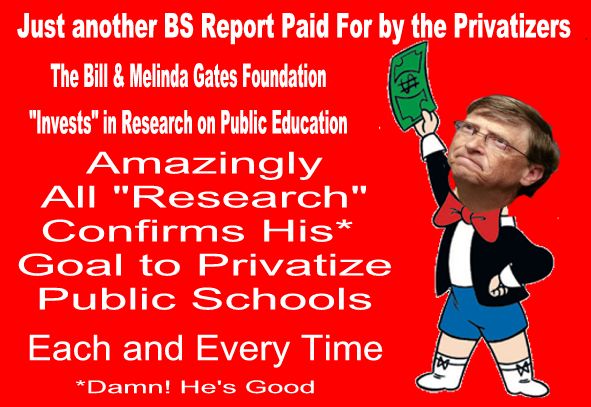
John Thompson: The Gates Foundation Never Listens to Teachers, Unless They Endorse the Gates’ Experiments | Diane Ravitch's blog

John Thompson: The Gates Foundation Never Listens to Teachers, Unless They Endorse the Gates’ Experiments | Diane Ravitch's blog:

The Gates Foundation Never Listens to Teachers, Unless They Endorse the Gates’ Experiments


John Thompson reviews here the report by the Network for Public Education on 15 years of Gates’ experiments on the lives of other people’s children and teachers.


“During the last fifteen years, we educators have each endured corporate school reform in our own way. It has not been fun. Sometimes competition-driven, data-driven micromanaging has been downright frightening. It has sometimes looked like our profession, our unions, and public education values were on the verge of being destroyed by market-driven, test-driven reform. The Network for Public Education (NPE) has just done us a great service in connecting the dots, and showing how many of the mandates we have endured are different verses of the Gates Foundation hymnal, and how they created the same discord.
“The NPE’s feature report, “Around the States with Bill Gates,” begins with the aptly titled “Gates Funding Elevates Teacher Voices that Sing Their Tune” by Anthony Cody. It ends with Carol Burris’s post mortem on the Gates’s “costly and ineffective adventure” with the Hillsborough, Florida teacher evaluation system. In between, ten contributors describe the Gates follies that have occurred in their postage stamp of the education world.
“In 2012, Anthony Cody engaged in a five-part exchange with representatives of the Gates Foundation. Cody presented a thorough, well-researched, review of the scientific evidence ignored by the foundation. The Gates participants largely repeated their same old talking points. Shockingly, the Gates debaters closed the series with atemper tantrum.

“Perhaps, they saw the debate as a high-stakes confrontation and they were embarrassed by the extent of their defeat. Or, maybe the foundation didn’t expect a mere teacher to assemble and concisely present such an overwhelming case against its policies.
“Back when Cody touched a nerve with the Gates Foundation, it was already clear that its ill-conceived teacher evaluation gamble would be extremely risky, but it was possible to believe that the foundation could learn how to listen to practitioners. That hope was shattered as $23 million of Gates grants were made to elevate “teacher voices.”

“Unfortunately, their scripted voices were elevated in order to counter ours.
“As the foundation explains, when Gates creates new organizations or funds existing ones that align with its clearly defined agenda, they “‘develop proposals that align with our strategic priorities and the organization’s focus and capabilities.'” For instance, Cody notes, “‘Teach Plus has received $17 million in Gates grants, and has worked to train teacher leaders, who then show up to testify before public hearings in support of the elimination of tenure, or the use of test scores for teacher evaluations.”
“Later, Carol Burris concludes with a review of the Hillsborough failure. Previously, there had been a close working relationship between district officials and the Hillsborough Classroom Teachers Association. Moreover, the national AFT has long been committed to rigorous 
John Thompson: The Gates Foundation Never Listens to Teachers, Unless They Endorse the Gates’ Experiments | Diane Ravitch's blog: