Latest News and Comment from Education

Friday, September 25, 2015

Thompson: Jack Jennings & the Insider's View of School Reform - This Week In Education:

This Week In Education: Thompson: Jack Jennings & the Insider's View of School Reform:

Thompson: Jack Jennings & the Insider's View of School Reform
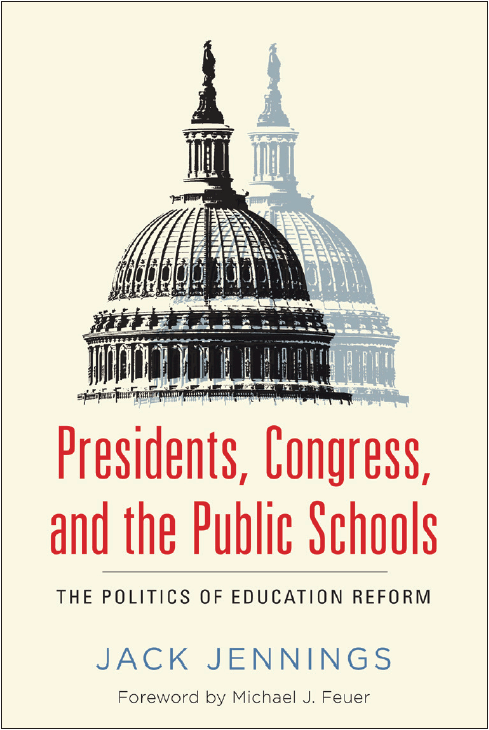


One reason why I loved Jack Jennings's Presidents, Congress, and the Public Schools is that it helped me grasp something that always perplexed me. NCLB, unlike Arne Duncan's test and punish agenda, had very little in terms of real sanctions for individuals.  Why didn't the normative education culture of compliance respond in the obvious manner - pocket the extra money and pretend to comply with the law? Why did systems actually impose test-driven accountability and juke the stats, rather than just play the numbers games and claim that they had really taken a pound of flesh out of educators?
 
Similarly, Jennings helps explain a phrase that became ubiquitous in my world. Our poor district desperately needed federal money, but it didn't dare spend it in the ways that would most benefit poor students. During years before and shortly after NCLB, I'd often hear the statement about Title I money: "Oh, that's just federal money." In other words, individual administrators wouldn't take risks in order to spend those modest funds more effectively; they’d stick with programs that were completely safe.
 
To his credit, Duncan subsequently spoke about flexibility in spending Title I. I'd cite his promises and suggest approaches focusing on the socio-emotional aspect of learning and invariably hear words of agreement from administrators. After all, our district was 90% low-income, so there was little chance that those researched-based approaches would unfairly benefit affluent kids. Then would come a statement like this: "But, what if some 25-year-old accountant disallowed it?" Often, the other administrators would offer the same few anecdotes about other districts that were burned by federal bureaucrats.
 
Jennings account of Title I is especially incisive. The ultimate insider with a half century of experience in edu-politics explains how Congress thought it was passing a general aid program with few strings attached. Reports of abuses prompted federal administrators in the 1970s to turn it into a categorical aid program, which led to regulations that could be burdensome. State and local administrators pushed back and gained some relief from the micromanaging. In return, the program became more focused on student achievement, as opposed to investing in the broader welfare of poor children.  
 
As Presidents, Congress, and the Public Schools unfolded, my big question was addressed. I had been unaware of the long complicated story of how Title I had become more focused on academic accountability.  On the ground in inner city schools, we would have had to have our heads firmly in the sand to miss the justified pressure from the civil rights community to produce concrete metrics of academic growth for poor children of color but I, at least, had missed the parts of the story that Jennings recounts. Systems had been fighting multi-faceted battles over accountability and I’d just been aware of the disputes over test scores. So, even though NCLB’s test score targets seemed so This Week In Education: Thompson: Jack Jennings & the Insider's View of School Reform:

Juvenile Court Student Work Group Members - Juvenile Court Schools (CA Dept of Education)

Juvenile Court Student Work Group Members - Juvenile Court Schools (CA Dept of Education):

Juvenile Court Student Work Group Members

The State Superintendent of Public Instruction (SSPI) has convened the Juvenile Court Student Transition Statewide Work Group pursuant to California Education Code Section 48648.


This all-volunteer, unpaid work group is composed of representatives from education and probation, advocacy organizations, and communities. The combined expertise of this group will gather evidence to support its policy recommendations to the SSPI and to the California State Legislature.

NameTitleOrganizationCounty
Valerie Amezcua
Supervising Probation Offices, currently adult probation, Santa Ana School Board
Orange County Probation Department, Santa Ana School Board
Orange
Romona Bishop
Superintendent
Vallejo City Unified School District
Solano
Pam Bowling-Coronado
Administrator Court Schools
Fresno County Office of Education
Fresno
Adam Chambers
Deputy Probation Officer/Liaison to San Luis Obispo County Office of Education
San Luis Obispo County Probation
San Luis Obispo
Lillian Chen
Statewide Education Rights Attorney
Public Counsel
Alameda/
Statewide
Jesus Corral
Senior Probation Director
Los Angeles County Probation Department
Los Angeles
Arturo Delgado
Superintendent
Los Angeles County Office of Education
Los Angeles
Fatinah Judeh
Program Specialist
Orange County Department of Education/Alternative, Community, and Correctional Schools and Services
Orange
Donna Quigley Groman
Supervising Judge, Los Angeles County Juvenile Delinquency Court
The Superior Court of Califonria, County of Los Angeles
Los Angeles
Shannon Hovis
Policy Analyst
Attorney General, Department of Justice
Statewide
Millisav (Mike) Ilic
Director, Instructional Support
Corona-Norco Unified School District
Riverside
Hailly Korman
Director of Special Projects
Center for Educational Excellence in Alternative Settings
Statewide
Sandra McBrayer
Chief Executive Officer
The Children's Initiative
Statewide
Sean Morrill
Senior Director of Teaching and Learning, Juvenile Court and Community Schools
San Diego County Office of Education
San Diego
Monique Morris
Director/Co-Founder
National Black Women's Justice Institute
Alameda/
Statewide
Elsbeth Prigmore
Principal Pioneer and Plus High Schools
Shasta Union High School District Pioneer and Plus High School
Shasta
Kathryn Rabun
Health Adocate
California State PTA
Contra Costa/
Statewide
Jina Reed
Program Specialist, English Learner/Alternative, Community, and Correctional Schools and Services
Orange County Office of Education/Alternative, Community, and Correctional Schools and Services
Orange
Erin Simon
Director, Student Support Services
Long Beach Unified School District
Los Angeles
Karen Stiles
Principal
Butte County of Education/Table Mountain School
Butte
Brad Strong
Senior Director
Children Now
Statewide
Mark Telles
Principal, Alternaitve Education Programs
Gateway Unified School District
Shasta
Erika Torres
Director, Pupil Services and Dropout Prevention and Recovery
Los Angeles Unified School District
Los Angeles
Karon Valdivieso
Learning Director, Court Schools
Tulare County Office of Education Court Schools
Tulare
Darryl White
Chief Executive Officer, Sacramento Independent Learning Center
Black Parallel School Board
Sacramento
Related Content
  • Juvenile Court Student Transition Work Group - Statewide work group required by statute to develop a model and study existing successful programs and policies affecting the transfer of pupils from juvenile court schools.

Weaponized Generosity: How Los Angeles’ 1% Use Philanthrocapitalism to Disrupt Democracy and Dismantle the City’s Public School System | The Progressive

Weaponized Generosity: How Los Angeles’ 1% Use Philanthrocapitalism to Disrupt Democracy and Dismantle the City’s Public School System | The Progressive:

Weaponized Generosity: How Los Angeles’ 1% Use Philanthrocapitalism to Disrupt Democracy and Dismantle the City’s Public School System 


On Sunday, September 20, 2015, the new Eli Broad museum opened in Los Angeles -- and nearly a thousand parents, students, and teachers seized the occasion to march against the “philanthrocapitalist’s” plan to groom 130,000 public school students in Los Angeles Unified to attend unregulated new charter schools in the district.
Philanthrocapitalism describes a certain kind of “weaponized generosity” where donors offer their self-interested charitable giving to remedy the very lack they create elsewhere. The cultural critic Slavoj Zizek has called this the “chocolate laxative” – the sweet treat that constipates is also the flavor of the cure.
Eli Broad is the city’s chief benefactor for numerous charities; his wealth comes from decades of real estate developments in the Midwest, Southern California, and from the insurance industry. He has particular interests in expanding charter schools in Los Angeles and nationwide.  He appears to invest a lot in the city of Los Angeles but when you look more closely, his giving defunds the public sector and Broad ends up with the better part of the deal. For example: originally, Broad wanted to lease the expensive downtown Los Angeles parcel the Museum sits on for $1 a year over 99 years. Said one county supervisor, “Instead of a project that generates sales and property taxes, we'll now have an art museum that generates no property or sales taxes and Mr. Broad will get the land for free."  It’s now leased for $7.7 million a year for 99 years, and the 501c3 Broad Foundation housed inside the museum still doesn’t put much by way of revenue back into the city .
A coalition of grassroots groups such as Schools L.A. Students Deserve, members of United Teachers of L.A. (UTLA), Vet the Supe, and students and parents spoke to local press about their concerns in a small public park adjoining the new downtown Los Angeles museum.
Alex Caputo-Pearl, head of UTLA, challenged Eli Broad’s largesse by pointing out how the wealthy Angeleno publicly backed Proposition 30, a ballot initiative that restored funding to California’s schools after the devastation of the Great Recession, but in private donated money to defeat Prop 30 and impose a separate union-busting ballot initiative targeting the state’s unions. Broad funded out-of- state groups that then funneled the money to anti-tax
- See more at: http://www.progressive.org/news/2015/09/188330/weaponized-generosity-how-los-angeles%E2%80%99-1-use-philanthrocapitalism-disrupt#sthash.tqSVujv5.dpuf


Banned Books Week: Protecting diversity in YA literature - NEA Today

Banned Books Week: Protecting diversity in YA literature - NEA Today:

Banned Books Week: Protecting diversity in YA literature

banned_books_week_2


Hundreds of books are either removed or challenged in U.S. schools and libraries each year, and a disproportionate number of them involve diverse characters or issues, according to an analysis by young-adult author Malinda Lo.
While only about one in 10 children’s books are by or about people of color, according to industry experts, Lo found that 52 percent of the most-often banned or challenged books from 2000 to 2014 either addressed issues of race, sexuality, or disability, or included characters who are non-White, LGBTQ, or have disabilities.
“It’s clear to me that books that fall outside the white, straight, abled mainstream are challenged more often than books that do not destabilize the status quo,” wrote Lo on the Diversity in YA website. “The message this sends is loud and clear: diversity is actually under attack. Minority perspectives are being silenced every year.”
As this year’s Banned Books Week approaches — it’s Sept. 17 to Oct. 3 — many NEA members are celebrating the voices, characters, and books that look at the issues that matter to students, and standing up against censorship. On their side is their union, whose governing documents clearly state: “NEA deplores prepublishing censorship, book-burning crusades, and attempts to ban books from school library media centers and school curricula,” and resolves that “Teachers and school library media specialists must have the right to select and use materials and techniques without censorship or legislative interference.”
And yet, it’s still a series of battles out there, every year, in public school classrooms and libraries. Take this summer’s challenge to the Immortal Life of Henrietta Lacks, for example. The book by journalist Rebecca Skloot tells the true story of Henrietta Lacks, an African-American mother whose cancerous cells were swiped from her cervix without her permission and used to develop the polio vaccine. With its careful exploration of medical ethics and racial inequality, it’s no surprise that the award-Banned Books Week: Protecting diversity in YA literature - NEA Today:

No Child Left Behind waiver extended for CORE districts | EdSource

No Child Left Behind waiver extended for CORE districts | EdSource:

No Child Left Behind waiver extended for CORE districts


The U.S. Department of Education has granted six California districts affiliated with the California Office to Reform Education, or CORE, a waiver from the No Child Left Behind law for another school year. The U.S. Department of Education announced the waiver extension in a letter on Friday.
Serving about a million students, the six CORE districts include three of the state’s four largest districts: Los Angeles, Long Beach and Fresno unified districts, along with San Francisco, Oakland and Santa Ana. A year ago, Sacramento City and Sanger unified districts dropped out of CORE, a nonprofit organization that member districts created to manage the waiver and share Common Core resources.
CORE’s waiver is the only one that the department has given to school districts; the others have gone to states. It exempts the districts from some of NCLB’s constraints and gives them flexibility to spend 20 percent of federal Title I funding – more than $100 million collectively – that they’d otherwise have to spend on hiring outside tutors and transporting students to better-performing schools. The districts also have latitude to create their own school accountability systems and decide how to turn around their lowest-performing schools.
U.S. Education Secretary Arne Duncan began issuing waivers three years ago, when Congress deadlocked over reauthorizing the Elementary and Secondary Education Act, as NCLB is formally known. With Congress still in a stalemate, 43 states and Washington, D.C., now operate with waivers.
California is not among them. Gov. Jerry Brown rejected the requirements that states use standardized test scores in evaluating teachers and No Child Left Behind waiver extended for CORE districts | EdSource:

The Boehner effect and No Child Left Behind - The Washington Post

The Boehner effect and No Child Left Behind - The Washington Post:

The Boehner effect and No Child Left Behind


After 13 years in office, House Speaker John A. Boehner is set to resign.


The politics of rewriting No Child Left Behind, the main K-12 federal education law that seemingly everyone has grown to hate but no one has been able to fix, just got more muddled.
House Speaker John Boehner’s decision to step down in October immediately complicates the fragile effort between House and Senate negotiators, who have been working to craft a compromise bill to replace No Child Left Behind.
Congress has been trying to update the 2002 law, widely recognized as broken and a burden to the nation’s 100,000 public schools, since 2007. In July, the Senate passed a bipartisan bill while House Republicans approved a GOP version. The two sides have been trying to come to terms ever since.
Boehner’s decision to step down came as conservative GOP members of the House Freedom Caucus were talking about a no-confidence vote in him - the same members who opposed the House bill to replace No Child Left Behind because it included a federal role in public education, which they believe is strictly a state and local function.
But to reach a deal with the Senate that could also win President Obama’s signature, House negotiators are going to have make their GOP bill more appealing - not less appealing - to Democrats, who insist the federal government must be able to exercise some oversight of K-12 education.
If Boehner is succeeded by a speaker more closely aligned with the Freedom Caucus, the chances for a compromise education bill plummet considerably, some observers said Friday.
“This brings passage of a bill that can get signed by Obama from ‘very likely’ to ‘somewhat doubtful’,” said Charles Barone, policy director at Democrats for Education Reform who helped negotiate No Child Left Behind as a Hill aide. “One reason is they’re going to need to pass this with Democratic votes and the reason Boehner got pushed out is because of his willingness to work with Democrats. He’s got 40 or so guys that never agree to any compromises.”
But Mary Kusler, the chief lobbyist for the National Education Association, which represents 3 million educators, said she thinks there is a window of opportunity to push a compromise bill through both houses and get it signed into law before Boehner gives up the gavel.
She noted that both chambers have already passed their bills. “I’m not willing to concede that this is over,” Kusler said. “Passing a conference bill that cannot be amended and passing a bill open to amendments are two different things,” she said. “It is much easier to move a conference report than a bill. This means it’s even more important to get this done before he leaves. And so The Boehner effect and No Child Left Behind - The Washington Post:

Why You Cannot Trust Common Core Advocacy | the becoming radical

Why You Cannot Trust Common Core Advocacy | the becoming radical:

Why You Cannot Trust Common Core Advocacy


I used to show my high school students a passage from Aristotle that was essentially a “kids today” rant, noting he wrote in the 300s BC. So I generally have little patience with anyone damning contemporary youth as if this generation is somehow quantifiably worse than the ones before. That is so much drivel.
Why Americans can’t write falls squarely in that sub-genre, but, alas!, that is just a mask for its real purpose: propagandize for the Common Core.
Before we look at the nonsense in this really bad piece of writing that claims kids today can’t write, we must note that the writer, Natalie Wexler, chairs the board of trustees for the Writing Revolution, self-described as “a national not-for-profit organization dedicated to teaching students from underserved school districts to think clearly and reflect that thinking in their writing.”
And here is the key bit of information: Who sits on the advisory board? David Coleman, grand architect of the ELA Common Core. Hmmmm.
So Wexler starts out by showing writing is in dire circumstances because of data from NAEP. The problem here is that in my own analysis of the writing section of NAEP, I have shown that the test is so badly constructed that we can draw no valid claims about writing at all.
If Wexler were credible on writing quality by American students, she would be aware that we have significant research on how students are being taught writing and what the Why You Cannot Trust Common Core Advocacy | the becoming radical:

Danny Glover And Steve Zeltzer On Charters & School Privatization 9 - 24 - 15 by WorkWeek Radio

Danny Glover And Steve Zeltzer On Charters & School Privatization9 - 24 - 15 by WorkWeek Radio:

Danny Glover And Steve Zeltzer On Charters & School Privatization


Danny Glover and Steve Zeltzer discuss school charters and privatization on San Francisco KPOO Judy Drummond's show "Connecting the Dots" on September 24, 2015.
Zeltzer and Glover talk about the affects of charters, privatization and union busting as well as the initiative campaign to repeal the 1992 California charter law that allowed for the introduction of charters in California. Danny Glover has endorsed the petition and initiative.
www.ipetitions.com/petition/repeal…92-in-ca-ballot


LISTEN HERE: Danny Glover And Steve Zeltzer On Charters & School Privatization9 - 24 - 15 by WorkWeek Radio:

The latest undemocratic effort to dismantle public education | NC Policy Watch

The latest undemocratic effort to dismantle public education | NC Policy Watch:

The latest undemocratic effort to dismantle public education

FF-CharterSchool-Funding


The formal budget fight may be over in the General Assembly but the battle over education funding and the crusade to dismantle traditional public schools continue in the session’s waning days.
Senate leaders unveiled a proposal in the Senate Finance Committee Monday afternoon that would divert more funding from the majority of local school districts across the state to charter schools, including federal support for transportation and school lunches that many charters don’t even provide.
The proposal appeared of out nowhere as a bill about school playgrounds was gutted and replaced with the controversial charter school funding provisions, a version of legislation that passed the Senate months ago but stalled in the House.
Very few people seemed to know the charter bill was coming, including public school officials and most of the committee members themselves.
A representative of the school administrators association, also blind-sided by the proposal, told the lawmakers that it would adversely affect their local schools and that their school officials would be strongly against it.
That didn’t deter supporters of the funding change, led by Senator Chad Barefoot, whose only answer to every question was that the “money should follow the child,” a talking point that is not only an oversimplification, but a statement that makes little sense if a charter school is receiving federal funding for services it doesn’t have to provide or if a student attends a school outside a special tax district.
Senate Majority Leader Harry Brown admitted he was confused by the effect of all the complicated provisions transferring money from school districts to charters and he wasn’t the only one.
Even Barefoot acknowledged that he wasn’t an expert on the legislation and was handling it because Senate The latest undemocratic effort to dismantle public education | NC Policy Watch:

OMG "I'm A Grown-Up Now": The Teen Who Accused Kevin Johnson Of Sexual Abuse Speaks Out

"I'm A Grown-Up Now": The Teen Who Accused Kevin Johnson Of Sexual Abuse Speaks Out:

"I'm A Grown-Up Now": The Teen Who Accused Kevin Johnson Of Sexual Abuse Speaks Out


"I'm A Grown-Up Now": The Teen Who Accused Kevin Johnson Of Sexual Abuse Speaks Out


There is a photograph of a pile of pink and white paper hearts atop Mandi Koba’s Facebook page. She cut the hearts out of hard copies of a 1996 police report from Phoenix, Ariz. The cops, according to the vintage report used in the arts and crafts project, were investigating “a celebrity involved in a reported child molestation.”
Kevin Johnson was the celebrity. These days he’s a politician, a national figure with aspirations to the governorship of California who’s proclaimed himself “Little Barack” and worked closely with the Obama administration. Married to Michelle Rhee, face of the charter-school movement, he’s positioned himself throughout his adult life as a sort of catcher in the rye for at-risk inner-city children through his work with a variety of charter schools and foundations, setting him up for his current run as the scandal-prone mayor of Sacramento, Calif. In 1996, though, he was one of the NBA’s top stars, at the very height of a career with the Phoenix Suns that saw him make three All-Star teams and earn tens of millions of dollars.
Mandi Koba, 15 years old at the beginning of the events described in the report, was the child.
In time, there would be a fair amount of public discussion of the allegations made in that report, which involved Johnson fondling the teenager, showering with her, rubbing his genitals against her bare thigh, suggesting they pray together and ask for forgiveness, and making the only child from a single-parent home give a “pinky promise” that she wouldn’t tell her friends or mother what he’d done. But the investigation produced no physical evidence that any crime had been committed, no criminal charges were ever filed against Johnson, and the accuser never spoke out.
A year after prosecutors decided not to indict, word about Koba’s molestation allegations got out around Phoenix. In May 1997, the Phoenix New Times reported that a lawyer representing the girl was trying to get money out of Johnson. Koba was not named—the pseudonym “Kim Adams” was used—but she took a beating in the story. Attorney Fred Hiestand, an advisor to Johnson at the time and to this day, told the paper "I'm A Grown-Up Now": The Teen Who Accused Kevin Johnson Of Sexual Abuse Speaks Out:

WTF? Principal for new Dyett High School reprimanded in previous job - Chicago Tribune

Principal for new Dyett High School reprimanded in previous job - Chicago Tribune:

Principal for new Dyett High School reprimanded in previous job


Hunger strikers
Hunger striker Jitu Brown, shown Sept. 4, 2015, says Chicago Public Schools’ proposal for reopening Dyett High School shows the district doesn’t respect the community’s voice. “Bronzeville is not satisfied,” he said. “We did not ask for an arts center.” (Zbigniew Bzdak / Chicago Tribune)
Chicago Public Schools on Thursday named a principal for the new Dyett High School, selecting an administrator who was reprimanded last year during an investigation into the theft of more than $870,000 from two city high schools.
Under pressure from residents who staged a weekslong hunger strike, the district decided to reopen Dyett as an arts-focused school next fall. The principal named Thursday, Beulah McLoyd, has been the principal at Clark High School in the South Austin neighborhood since 2010, and before that was an assistant principal at Gage Park High School.
Earlier this year, five men were charged with felony theft for alleged fraudulent billing for goods and services that were never delivered to Clark and Gage Park high schools. McLoyd was issued a "warning resolution" in August 2014, and the district said its investigation found she improperly handled her password.
CPS acknowledged the issue in its news release on McLoyd's appointment to Dyett, noting the investigation "did not conclude she committed any intentional wrongdoing."
"I know the inquiry was an important learning experience for Beulah that has made her a stronger and wiser leader, and that she has taken to heart the old saying: 'Trust, but verify,'" CPS Chief Education Officer Janice Jackson said in a statement.
Protesters who wanted to reopen Dyett as a green-technology school remain unhappy with the district's plans for Dyett. The district was prepared to close Dyett, on the northern edge of Washington Park, after years of declining enrollment and poor performance.
McLoyd, in a statement, said she was "fully committed to ensuring (Dyett) is the world-class success that the community deserves."

Join us at the Northwest Teaching for Social Justice Conference (NWTSJ) | Seattle Education

Join us at the Northwest Teaching for Social Justice Conference (NWTSJ) | Seattle Education:

Join us at the Northwest Teaching for Social Justice Conference (NWTSJ)


rethinking
Educators, students and parents are invited to attend the Northwest Teaching for Social Justice Conference
October 17, 2015
“We Still Need to Trouble the Water: Race, Revolution and the Struggle for Quality Education”
8AM to 4:30PM
Chief Sealth High School, Seattle
Sample Workshops:
A Human Face on War: Poetry and Art
Prison Labor Cycle: Players in a System
Building an Opt-Out Movement in Your Community
Papers Black Students’ Lives Matter Educating Activist Allies
Hashtag Essay Writing
OVER 60 Workshops in three different sessions
Register online at http://www.nwtsj.org
Hosted by: Puget Sound Rethinking Schools, Portland Area Rethinking Schools, Social Equality Educators, Oregon Writing Project at Lewis & Clark College, and Rethinking Schools magazine
Wayne Au, Jesse Hagopian and I (Dora Taylor) will be hosting a workshop titled:
Testing, Charters, and Strikes, Oh My! : Resisting Corporate Education Reform in Seattle and Beyond
The Seattle area has been a hotbed of education activism in recent months, including significant victories in the defense of democracy and public education. In this panel discussion and conversation, local education activists Dora Taylor, Jesse Hagopian, and Wayne Au will talk about the local movement to opt out of high-stakes testing, the political gains earned during the Seattle educators’ strike, and the recent Washington State Supreme Court ruling declaring charter schools unconstitutional here. Local strategies as well as implications and nation connections will be discussed.
I have found these conferences to be not only full of relevant information but also energizing and uplifting. It is a highly recommended event.


Seattle - What happens when teacher union leaders step up to support teachers, students, parents and public schools - Wait What?

Seattle - What happens when teacher union leaders step up to support teachers, students, parents and public schools - Wait What?:

Seattle – What happens when teacher union leaders step up to support teachers, students, parents and public schools


For those union members, education advocates and parents who are consistently frustrated by the fact that some union leaders spend more time maintaining their close relationship with the power elite than fighting for their members and public education, the recent teacher strike in Seattle, Washington is proof that real champions have been stepping up in Seattle, Chicago, at the state level in New York and Massachusetts, and elsewhere.  These teacher union leaders are making a fundamental difference in the fight to improve public schools and provide greater support for teachers, students and parents.
For an update on the Seattle Teacher Strike check out, The surprising things Seattle teachers won for students by striking.
The post appears on Valerie Strauss’s blog, The Answer Sheet.  Strauss is a reporter with the Washington Post and her bog is one of the most important resources in the nation for information about education policy and the unprecedented assault on public schools and public school teachers by the Charter School and Corporate Education Reform Industry.
If you don’t read Strauss’ blog you should book mark it and sign up for her regulator updates at: https://www.washingtonpost.com/blogs/answer-sheet/
Seattle teachers went on strike for a week this month with a list of goals for a new contract. By the time the strike officially ended this week, teachers had won some of the usual stuff of contract negotiations — for example, the first cost-of-living raises in six years — but also some less standard objectives.
For one thing, teachers demanded, and won, guaranteed daily 
Seattle - What happens when teacher union leaders step up to support teachers, students, parents and public schools - Wait What?:

Do the Rights Thing | EduShyster

Do the Rights Thing | EduShyster:

Do the Rights Thing


teenamarie


These Boston students are at the forefront of a movement to give students more voice. So help them speak up!

It’s time for something a little different, reader: a happy good news story! I’m shouting out to my fave Boston student activists, who are doing some of the best work in the country around student rights and voice. And best of all, this story comes with an action component—a *do now,* you might say. 
Here’s the deal
Youth on Board, which oversees a citywide body of elected student leaders from high schools across Boston, is up for a big cash money award from the Nellie Mae foundation. How much of a big cash money award? $100K, which would help this largely volunteer-run operation take its campaign to put students at the center of the conversation about schools to not just the next level, but the next three levels. I’m going to pause here so that you can cast your vote for Youth on Board. Wait. You’re still not done. Quick—go to your email and click on the confirmation link. Wait for it. Wait for it. There. You’ve just done the rights thing! Now alert your family, friends and colleagues and ask them to do the same thing.


Why I am such a huge fan of these students
BSACIt isn’t often that I suspend my steady volley of snark-filled diatribes against [insert current target here] in order to sing the praises of someone or a great many someones I admire. Which tells you that these Boston student activists must be pretty great. This summer they rolled out the first student rights app in the country, so that Do the Rights Thing | EduShyster:

The surprising things Seattle teachers won for students by striking - The Washington Post

The surprising things Seattle teachers won for students by striking - The Washington Post:

The surprising things Seattle teachers won for students by striking


Striking Seattle School District teachers and other educators walk a picket line, Thursday, Sept. 10, 2015, near Franklin High School in Seattle. (AP Photo/Ted S. Warren)


Seattle teachers went on strike for a week this month with a list of goals for a new contract. By the time the strike officially ended this week, teachers had won some of the usual stuff of contract negotiations — for example, the first cost-of-living raises in six years — but also some less standard objectives.
For one thing, teachers demanded, and won, guaranteed daily recess for all elementary school students — 30 minutes each day. In an era when recess for many students has become limited or even non-existent despite the known benefits of physical activity for children, this is a big deal, and something parents had sought.
What’s more, the union and school officials agreed to create committees at 30 schools to look at equity issues, including disciplinary measures that disproportionately affect minorities. Several days after the end of the strike, the Seattle School Board voted for a one-year ban on end suspensions of elementary students who commit specific nonviolent offenses, and called for a plan that could eliminate all elementary school suspensions.
Other wins for students in Seattle’s nearly 100 traditional public schools include:
Teachers won an end to the use of student standardized test scores to evaluate them — and now, teachers will be included in decisions on the amount of standardized testing for students. This evaluation practice has been slammed The surprising things Seattle teachers won for students by striking - The Washington Post: