Latest News and Comment from Education

Monday, September 14, 2015

The Education Reform Oligarchy & Their School Choice Conversation - The Crucial VoiceThe Crucial Voice

The Education Reform Oligarchy & Their School Choice Conversation - The Crucial VoiceThe Crucial Voice:

The Education Reform Oligarchy & Their School Choice Conversation


Wish I could just turn back the clock


The education reform oligarchy of the 80’s had a school choice conversation —at least one that is a matter of record.
It’s doubtful that the public can recall what was discussed. It’s doubtful that very many were really invited to listen. What is more likely is that most people are left asking, what school choice conversation?
So here’s how the story went
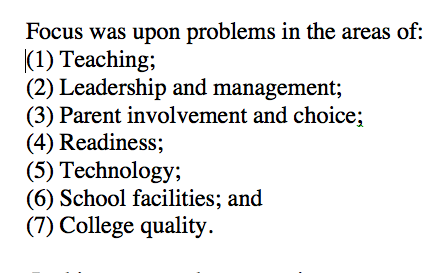
“At its meeting in August 1985, the members of the National Governors’ Association [NGA] formed seven task forces for the purpose of examining in-depth critical problem areas in American education.”
Time for Results?
Time for Results?
It’s unlikely that very many people would argue against the idea that parent involvement in education is critical. Then — now, forever, and always — parent, community, and national involvement and support for public schools is a problem in critical need of being addressed with real solutions. How exactly school choice came to be seen as a “critical” problem depends …
“Whether the push for school choice is driven by economic and political forces, or by parents and educators, depends on whom you ask.”
What we know for sure is now our history.
To be clear, since the development of free desegregated public school education, people The Education Reform Oligarchy & Their School Choice Conversation - The Crucial VoiceThe Crucial Voice:

Former challenger Garcia calls on Emanuel to meet Dyett protesters - Chicago Tribune

Former challenger Garcia calls on Emanuel to meet Dyett protesters - Chicago Tribune:

Former challenger Garcia calls on Emanuel to meet Dyett protesters


Cook County Commissioner Jesus "Chuy" Garcia called on Mayor Rahm Emanuel to meet with hunger striking Dyett High School protesters, saying it would help the mayor prove he's become a more inclusive leader following their hard-fought campaign this year.
With the protest in its 29th day, Garcia on Monday said he's convinced Emanuel can go a long way toward ending the impasse by sitting down with 15 protesters who say they have been going without solid food.
"I am very optimistic that can happen, and it will happen if the mayor decides this is going to be a different way of engaging communities in his second term," Garcia said while flanked by the hunger strikers and their supporters outside Emanuel's City Hall office. "I hope he finds the time to meet with them. They are reasonable people."
Emanuel met privately with several of the hunger strikers after they disrupted one of his public budget forums this month. But protester Jitu Brown said Chicago Public Schools undermined the talk by then going ahead with a plan to keep the Bronzeville neighborhood school open with an arts curriculum rather than the green technology focus the hunger strikers have proposed.
"We submitted a list of demands to Chicago Public Schools," Brown said. "We have a list of non-negotiables. I'll keep that to myself. But we do have a list of non-negotiables, and we're willing to talk, we're willing to negotiate (about other points). I would just like to say a compromise happens when two people come together and work out something that's agreeable to both parties. There was no compromise."
Emanuel's office did not respond to requests for comment.
In 2001, Garcia was aligned with protesters who staged a three-week hunger strike in the Little Village neighborhood and eventually convinced then-Mayor Richard M. Daley and CPS to build a new high school there. "It was cooler heads prevailing on both sides," Garcia said of the resolution of that protest.
This year, Garcia forced Emanuel into a runoff election before Emanuel won a second term in April, and throughout the campaign worked to portray the incumbent as an out-of-touch elitist who didn't value the opinions of the neighborhood residents whose lives his decisions affect. Emanuel eventually blanketed the airwaves with a TV ad in which he wore a sweater and spoke directly to the camera, acknowledging he "can rub people the wrong way or talk when I should listen. I own that."

CURMUDGUCATION: Core vs. BS Tests

CURMUDGUCATION: Core vs. BS Tests:

Core vs. BS Tests

Image result for Core vs. BS Tests


In US News, Robert Pondiscio of the Fordham thinky tank offers some reactions to the recentEducation Trust report on teacher assignments.

Pondiscio is no dummy-- he knows the report is essentially bunk, and he says so. The report, icymi, was a survey of assignments in six middle school classrooms in two urban districts, so not really a representative sample of much of anything. The report finds that mostly teachers are not giving assignments that "reflect the higher, more rigorous standards set by Common Core," and while the "research" is tissue-thin, the conclusion feels right to Pondiscio and others.

We could have a whole other discussion about whether or not the Core standards are higher or more rigorous (as well as a discussion about what those terms even mean). But for today, I'm going to let that go so that we can talk of why classrooms have not been transformed into the wonderland of higher order deep critical thinking that Core supporters were sure we'd have by now.

Pondiscio himself hits paydirt with this:

One veteran public school teacher and staff developer worries that we are paying the price for years of "de-professionalizing" the teacher work force. "'Do these things, use these moves and you'll be successful' – that's been the message to teachers for the past 15 years," she says. "Many teachers throw up their hands and say, 'Just tell me what you want me to do' or, 'Is this the right way?'" 

Well, yes. One of the Fellow Travelers of Common Core has been the notion that classrooms can be teacher-proofed, and so we've had giant pieces of poo like EngageNY and it's "If It's Tuesday, You Must Be on Page Twelve" tightly wound instructional pacing.


This has been exacerbated by the sales approach taken by Core promoters, which can be 
CURMUDGUCATION: Core vs. BS Tests:


Do No Excuses Affect Academics?


Last week at the Fordham blogsite, Kevin Mahnken touted some meta-research about "No Excuses" schools and their affect on the math and language scores on the Common Core Big Standardized Test. Well, actually they claimed to be researching “’No Excuses’ Charter Schools: A Meta-Analysis of the Experimental Evidence on Student Achievement,” but when we're looking at this kind of research, it's important to always remember that "student achievement" just means "test scores on that one high stakes test that narrowly covers a standardized test version of math and reading."

I took a swipe at the research paper itself, because you know I would do almost anything for you guys. But it is tough going for those of us not schooled in the subtle art of meta-research. But I did manage to pull out a few bits.

First, although the meta-researchers started with what I believe is technically known as "a whole buttload" of research papers, through a long and laborious process, they narrowed those down to ten papers. Of those ten, four were only about no excuses schools, two were about types of charters including no excuses, and four weren't about no excuses at all. So, six paper in the meta-analysis? I'm no meta-analyst, but that seems meta-thin.

What conclusions did they reach?

No excuse schools do better than other charters at raising math and reading test scores. They are 


Do No Excuses Affect Academics?


Why the Running Start argument should be a non-starter for reconsideration of Supreme Court’s charter school decision | Seattle Education

Why the Running Start argument should be a non-starter for reconsideration of Supreme Court’s charter school decision | Seattle Education:

Why the Running Start argument should be a non-starter for reconsideration of Supreme Court’s charter school decision


324177428_sour_grapes_make_the_best_whine


After the Washington State Supreme Court ruled in favor of the Plaintiffs in deciding charter schools are not Common Schools due to a lack of public oversight and therefore cannot receive public funding, the well financed proponents of charter schools decided to try another route by having the State Attorney General submit an argument to the State Supreme Court. His argument is as follows:
“The decision not only invalidates Initiative 1240, but also unnecessarily calls into question the constitutionality of a wide range of other state educational programs,” the statement said. “These important programs range from Running Start to Washington State Skills Centers that provide career and technical education to high school students.”
In regards to Running Start, this is not the case.
Running Start dollars go to school districts, under the supervision of an elected school board, and then the district transfers at least 93% of the funds to community colleges to pay for the district’s students who enroll there. What’s more, the school board has to approve an agreement with the community or technical college about the level of reimbursement for each student receiving Running Start services from that public institutions.
State Representative Gerry Pollet lays it out in his statement below.
Why Running Start argument should be a Non-Starter for reconsideration of Supreme Court’s Charter School Decision
Rep. Gerry Pollet, J.D.; 46th District (N and NE Seattle, Lake Forest Park and Kenmore)
The Washington Supreme Court decision striking down the charter school initiative as unconstitutional because it sends public school funding directly to unaccountable private charter schools does not jeopardize our state’s Running start program, under which high school students enroll for dual credit in local community and technical college courses.

Seattle Schools Community Forum: Latest Update from SPS on Teacher Contract Negotiations - NO SCHOOL ON TUESDAY

Seattle Schools Community Forum: Latest Update from SPS on Teacher Contract Negotiations - NO SCHOOL ON TUESDAY:

Latest Update from SPS on Teacher Contract Negotiations - NO SCHOOL ON TUESDAY


Update:  From SPS' Negotiation page, a long chart of the timeline of events and issues put forth.  Interesting reading.

end of update

West Seattle Blog Tweet:

District is studying new SEA offer, but NO SCHOOL TOMORROW, per district @ 3 pm briefing.

More from the West Seattle Blog: 

Because of the strike’s length, spokesperson Stacy Howard says, there’ll be some turnaround time whenever the strike finally ends. 

She is discussing a few other points such as special education – the topic of a demonstration here earlier in the day. 

As for “the strike impacts on the calendar” – the three snow days on the calendar will be used, for starters, one midyear, two at the end of the school year – “all additional makeup days” will be determined once the strike is over. Possible ideas: Saturdays, and/or part of the mid-winter break (which was scheduled for five days this year – alternating years have shorter breaks). 

Re: graduation days – Seniors are required to be in school 175 days before graduation, so graduation dates might have to change. 

As reported here yesterday, middle-school athletic events are postponed. High-school practices and games “continue to go on as usual – a lot of those employees are in different unions or not in unions at all,” says Howard. 

She says that by the time this news conference is over, the district expects to have a “timeline” posted online from negotiations to date.
Seattle Schools Community Forum: Latest Update from SPS on Teacher Contract Negotiations - NO SCHOOL ON TUESDAY:


Free Food for Striking Teachers

Via the Slog:

Teachers are no doubt building up an appetite marching on the picket line. In support of all the Seattle Public School teachers currently on strike, Li’l Woody’s is offering a free burger to teachers for each the day the strike continues. Burgers are available at both of Li'l Woody's locations on Capitol Hill and in Ballard
"Li’l Woody’s is glad to be able to help in some way by giving free burgers to those out there doing the hard work of educating kids in Seattle," says ownerMarcus Lalario


Here are the details: For each day the strike goes on, SPS teachers are eligible for one free burger. Each teacher must show SPS identification and be present to order (so, no "group" orders). Add-ons, substitutions—and fries—are extra. 

And Seattleites, if you'd like to throw a little love back at Lalario for this move, his latest restaurant, Fat's Chicken and Waffles, is now open in the Central District.

Free Food for Striking Teachers

Jeb Bush’s Florida Education Plan Created Corruption and Chaos

Jeb Bush’s Florida Education Plan Created Corruption and Chaos:

Jeb Bush’s Florida Education Plan Created Corruption and Chaos


“We’re making decisions just based on the money.”
That’s Rosemarie Jensen talking, a tone of exasperation creeping into her voice as she describes the influence of money on education policy in South Florida. “Some things should be run like a business,” she tells me in a coffee shop near Fort Lauderdale, Florida. “Education isn’t one of those things.”
Jensen lives in Broward County, just to the north of Miami-Dade. Broward is home to a diverse population of students, drawn from the state’s most exclusive gated communities as well as neighborhoods wracked by generational poverty. A former K-12 school teacher and current public school parent, Jensen is part of a growing movement of parents who believe they are being shut out of important decisions about public school governance, while those making the decisions too often have something monetary to gain.
As a leader of United Opt Out, an organization that advocates boycotting standardized tests in public schools, Jensen has opted her own son, a special education student in high school, out of the Florida state exam now known as the Florida Standards Assessments. But standardized testing isn’t the only thing that’s got her steamed.
Jensen recounts stories of her father, a first-generation immigrant and high school dropout, who cleaned out tankers so he could raise his daughter in a neighborhood with good public schools and eventually send her to college. Today, she sees that idealistic view of the American dream being undone in her community by an invasion of moneyed interests promoting charter schools.
In her view, charter schools — the privately managed, publicly funded entities that operate outside the oversight of democratically governed school systems — are not now what they originally claimed to be: centers of innovation created by teachers and parents. Jensen has taken note of the amount of money these schools spend on advertising and marketing. She complains that the middle school her children attended can’t get money to construct a safer point of entry, while the state steers funds to charters for new construction. She believes that making public schools compete with charter schools for money dilutes funding that should be paying for better education for all children. While she used to be open-minded about these Jeb Bush’s Florida Education Plan Created Corruption and Chaos:

“Efficiency” as a Constitutional Mandate for Texas’s Educational System | VAMboozled!

“Efficiency” as a Constitutional Mandate for Texas’s Educational System | VAMboozled!:

“Efficiency” as a Constitutional Mandate for Texas’s Educational System


The Texas Constitution requires that the state “establish and make suitable provision for the support and maintenance of an efficient system of public free schools,” as the “general diffusion of knowledge [is]…essential to the preservation of the liberties and rights of the people.” Following this notion, The George W. Bush Institute’s Education Reform Initiative  recently released its first set of reports as part of its The Productivity for Results Series: “A Legal Lever for Enhancing Productivity.” The report was authored by an affiliate of The New Teacher Project (TNTP) – the non-profit organization founded by the controversial former Chancellor of Washington DC’s public schools Michelle Rhee; an unknown and apparently unaffiliated “education researcher” named Krishanu Sengupta; and Sandy Kress, the “key architect of No Child Left Behind [under the presidential leadership of George W. Bush] who later became a lobbyist for Pearson, the testing company” (see, for example, here).
Authors of this paper review the economic and education research (although if you look through the references the strong majority of pieces come from economics research, which makes sense as this is an economically driven venture) to identify characteristics that typify enterprises that are efficient. More specifically, the authors use the principles of x-efficiency set out in the work of the highly respected Henry Levin that require efficient organizations, in this case as (perhaps inappropriately) applied to schools, to have: 1) Clear objective outcomes with measurable outcomes; 2) Incentives that are linked to success on the objective function; 3) Efficient access to useful information for decisions; 4) Adaptability to meet changing conditions; and 5) Use of the most productive technology consistent with cost constraints.
The authors also advance another series of premises, as related to this view of x-efficiency and its application to education/schools in Texas: (1) that “if Texas is committed to diffusing knowledge efficiently, as mandated by the state constitution, it should ensure that the system for putting effective teachers in classrooms and effective materials in the hands of teachers and students is characterized by the principles that undergird an efficient enterprise, such as those of x-efficiency;” (2) this system must include value-added measurement systems (i.e., VAMs), as deemed throughout this paper as not only constitutional but also rational and in support of x-efficiency; (3) given “rational policies for teacher training, certification, evaluation, compensation, and dismissal are key to an “Efficiency” as a Constitutional Mandate for Texas’s Educational System | VAMboozled!:

Teachers advocates for poor in Seattle fight with politicians | Cloaking Inequity

Teachers advocates for poor in Seattle fight with politicians | Cloaking Inequity:

Teachers advocates for poor in Seattle fight with politicians


The Seattle teachers are on strike. Before you get all huffy puffy about unions because it’s the popular thing to do. Don’t forget the 36 Reasons Why You Should Thank a Union.
  • Weekends
  • All Breaks at Work, including your Lunch Breaks
  • Paid Vacation
  • FMLA
  • Sick Leave
  • Social Security
  • Minimum Wage
  • Civil Rights Act/Title VII (Prohibits Employer Discrimination)
  • 8-Hour Work Day
  • Overtime Pay
  • Child Labor Laws
  • Occupational Safety & Health Act (OSHA)
  • 40 Hour Work Week
  • Worker’s Compensation (Worker’s Comp)
  • Unemployment Insurance
  • Pensions
  • Workplace Safety Standards and Regulations
  • Employer Health Care Insurance
  • Collective Bargaining Rights for Employees
  • Wrongful Termination Laws
  • Age Discrimination in Employment Act of 1967
  • Whistleblower Protection Laws
  • Employee Polygraph Protect Act (Prohibits Employer from using a lie detector test on an employee)
  • Veteran’s Employment and Training Services (VETS)
  • Compensation increases and Evaluations (Raises)
  • Sexual Harassment Laws
  • Americans With Disabilities Act (ADA)
  • Holiday Pay
  • Employer Dental, Life, and Vision Insurance
  • Privacy Rights
  • Pregnancy and Parental Leave
  • Military Leave
  • The Right to Strike
  • Public Education for Children
  • Equal Pay Acts of 1963 & 2011 (Requires employers pay men and women equally for the same amount of work)
  • Laws Ending Sweatshops in the United States
A quick personal perspective on unions: I didn’t realize it at the time, but the University of Texas at Austin was a worse deal for my budget because I wasn’t unionized. I didn’t know any better until I moved to California State and my health insurance went from costing me about $400 a month to free. You can do the math on the yearly savings. Also, everyone received a raise during my first year at California State, that hadn’t happened in about six years at UT Austin. Do I think unions are perfect? I discussed this at Edweek in Teacher Unions and the Future. 
Screen Shot 2015-09-14 at 10.11.10 AM
In Seattle, the teachers are striking. (This is the same state where the Supreme Court recently outlawed public money going to charter schools. Wow.) The strike is really about resources for schools in Seattle. The South Seattle Emerald writes,
Seattle Public Schools teachers haven’t had a cost of living adjustment in six years — and in that time, rents in Seattle have gone up about 40% in some places, meaning our educators are actively making less money than they were a few years ago, to do the same important job.
However, the strike is mostly about poverty,


So yes, they are asking for a raise. But they’re also asking for a lot more, and on behalf of a lot of other people. And it’s those additional demands that could have a huge impact on the cycle of poverty in some of Seattle’s lowest-income schools…
They’re the trusted adults that kids turn to when their homes are chaotic. They’re the professionals who can identify and address Teachers advocates for poor in Seattle fight with politicians | Cloaking Inequity:

Failing Students

Failing Students:

How We Fail Our Students


could just scream when I read about downward trends in California, let alone nationwide, when it comes to student-readiness for post-high school life. Not to be too simplistic, it seems to me that these latest dire predictions should be relatively easy to rebut and reverse.
Perhaps, first and foremost, let’s throw out altogether a majority of the “new-fangled” programs and strategies (with all their bells and whistles) and get back to the basics from which most of us benefitted a generation ago. I think a lot of the coursework today has been created only to justify the existence of a program or a person’s position in it and not, in the long run, for the common good of our children (the unfortunate results which we witness every day as our young people emerge from our currently imperfect, unevenly applied, dismally inadequate, and somewhat myopic educational system).
I consider myself a successful product of the broad foundation I acquired during the early days of my education, the basis from which I have ever since benefitted.   However, I have also been a teacher for nearly four decades and understand how the contrast between former and current strategies produces vastly and dramatically different results–outcomes that do not generally fulfill our reasonable hopes and expectations.
To be honest, as a teacher I did my best to skirt many State and District mandates which essentially wanted educators to teach to the tests—something which occurred so frequently that those incessant (and rather useless) exams often interrupted and, thus, prevented the natural flow of the curricular process. Consequentially, those testing regimens generally created constant setbacks to achieving, in a timely manner, the benchmarks that had been set.
What I tried to do was to review curricula from the previous grades and to create a foundation early in the school year in an attempt to get all my students up to speed. Thus, from day one of each new school year, I would begin (regardless of class level or academic ability—remedial to advanced) with a review of the basics [almost as if the students knew nothing—like the blank slates (tabula rasa) that they are, waiting to be imprinted with the skills that can and will inevitably lead to success].
Following those chiefly productive efforts, I would proceed in a systematic way. My methods would not only incorporate the skills that were necessary to be acquired in a sequential way but, in so doing, would also wind up addressing the subject matter covered on the many standardized tests that faced us.

Too many educators today are reticent about teaching the fundamentals that the natural progression of education-acquisition requires—in large part, because they avoided taking the classes which would teach those necessary skills.

Too many educators today are reticent about teaching the fundamentals that the natural progression of education-acquisition requires—in large part, because (for somewhat specious reasons) they avoided taking the classes which would teach those necessary skills. And, often, if they did select such classes to complete their degree requirements, many professors (inscrutably) were negligent by not teaching those skills.
In today’s search to find answers to all our current educational problems, too many have forgotten about what worked in the past. Yes, we are faced with many problems that overall were not an issue before, but such reality does not preclude us from working through those challenges.
Yes, we do have a large immigrant population whose needs must be addressed (but recall that only two generations ago, America witnessed a large influx of people from around the world who were able to assimilate more easily because that was the expectation held by both educators and parents–for themselves and for the children being schooled). Considering this circumstance, there Failing Students:

From Zero Tolerance to Restorative Justice: How School Districts Such as Los Angeles and New York Are Reforming Student Discipline - The Atlantic

From Zero Tolerance to Restorative Justice: How School Districts Such as Los Angeles and New York Are Reforming Student Discipline - The Atlantic:

Will School-Discipline Reform Actually Change Anything

Districts from Los Angeles to New York City are experimenting with new policies designed to eliminate zero-tolerance discipline. But the reality is often a lot different than the idea.


Damian Dovarganes / AP
Christine Rodriguez vividly recalls her early school years. A native of Brooklyn’sBushwick neighborhood, a working-class predominantly black and Latino section of New York City, her most vivid memories of elementary school consist of crammed classrooms with inadequate books, insufficient chairs, and the constant presence of the school-safety agent. (School Safety Agents, or SSAs, are New York Police Department officers assigned to K-12 campuses and charged with protecting students, campus staff, and visitors.) Now a college freshman at The New School studying education, Rodriguez rattles off with ease how school discipline shaped her K-12 education. 

“We go to schools where there are more SSAs than guidance counselors. For us, it makes us feel that they expect us to end up in jail rather than in college,” said Rodriguez, 17. “I’ve been to public school my whole life. I’ve experienced the school-to-prison pipeline”—a term commonly used to describe the trend in which largely disadvantaged students are funneled into the criminal-justice system—“and criminalization (of students). And I’ve questioned why all of these things happen to our communities.”
Policymakers and educators, among others, are beginning to question the harsh discipline policies and practices that have in recent decades became popular in certain districts, too. Research shows that the reliance on punitive school discipline like suspensions, expulsions, and school arrests—“school pushout”—deprives students of learning time and takes the greatest toll on nonwhite students, students with disabilities, LGBT youth and other vulnerable student groups. Suspensions can even harm the education of non-misbehaving students, according to some research.
The data on the shortcomings of zero-tolerance discipline is clear and overwhelming, and with increasing regularity and in increasing numbers school districts and states are responding to calls for reform. A wide range of approaches to address discipline concerns with new policies and laws are being tested across the country—including in New York City—with varying degrees of success and enthusiasm. Many of these efforts are spurred by grassroots activists, as well as a growing research base suggesting that suspensions—particularly for minor infractions—are a flawed discipline strategy. A 2011 analysis by the advocacy group and think tank Child Trends found that majority of school suspensions are for nonviolent offenses. The analysis cites a study on one large, unnamed urban school district in Florida showing that attendance violations and disrespect were the most common reason for suspensions in the jurisdiction, while another study, this one included in a DOE report, found 95 percent of out-of-school suspensionswere for slight infractions and misbehavior. 

The impetus for the emphasis on suspensions—which is still used in many districts and charter-school networks such as KIPP—didn’t have a strong research basis, explained Dan Losen, the director of the Center for Civil Rights Remediesat UCLA’s Civil Rights Project. Instead, schools took a cue from the 1970s War From Zero Tolerance to Restorative Justice: How School Districts Such as Los Angeles and New York Are Reforming Student Discipline - The Atlantic:

Seattle Schools Community Forum: Want to Know More About SPS Teacher Pay?

Seattle Schools Community Forum: Want to Know More About SPS Teacher Pay?:

Want to Know More About SPS Teacher Pay?


A former teacher has compiled so much data, she created a blog for called:

SPS Salary Info for Contract Negotiations 

Unfortunately, I don't know who this person is (see bio at end) but the material (and tone) is such that I believe this is another Meg Diaz-type person who likes being in the weeds. 

I present it for public information purposes but ask that if you see flaws/enhancements, etc. that you add them.  The first sentence below is indicative of the issue before us in how BOTH the district and the SEA have not clearly stated their salary issues. 

ALL of this is publicly available information, but it's not presented in an understandable form anywhere.

There are some additional minor "quirks" of calculating the salary tables, but I do not currently have the information to add those (TRI actually breaks down further into time (per diem) and responsibility). Based on the accuracy of the results I got from using these formulas to re-calculate the 2014-2015 
Seattle Schools Community Forum: Want to Know More About SPS Teacher Pay?:


What’s up with Illinois’ opt-out bill. | Fred Klonsky

What’s up with Illinois’ opt-out bill. | Fred Klonsky:

What’s up with Illinois’ opt-out bill.


11953340_840475826069537_514913170518513102_o (1)


State Representatives Will Guzzardi (left) and Laura Fine (right).

We invited State Representatives Will Guzzardi and Laura Fine to our Skokie Organization of Retired Educators luncheon at Zhivago’s restaurant last Wednesday.

Laura represents a north suburban district where many of our retirees live.

Will represents me and those who live in Logan Square and the north side of Chicago.

State reps run every two years and so Will is collecting signatures to run again.

Nobody has announced that they will run against him. But those opposed to the progressive electoral movement in the city have spent thousands of dollars on glossy mailers in the last few weeks targeting Will

When Will beat the Democratic Machine two years ago it gave a major shot in the arm to the progressive electoral movement in the City. 35th Ward Alderman Carlos Rosa built on the electoral base that supported Will to beat the pro-Rahm incumbent, even as the Mayor himself defeated progressive Chuy Garcia.

Rosa is now collecting signatures to run for Democratic Ward Committeeman.

Guzzardi impressed many when among his first acts in Springfield was to introduce and sponsor HB 306, a bill that strengthened the rights of parents to have their children opt out of PARCC and other state standardized tests.

The Bill passed the House but is now stalled in the Senate. Pretty much What’s up with Illinois’ opt-out bill. | Fred Klonsky:

When “school choice” leads families to trade one bad school for another - The Hechinger Report

When “school choice” leads families to trade one bad school for another - The Hechinger Report:

When “school choice” leads families to trade one bad school for another

Chicago study documents that fewer than 5 percent of students who transfer move to a high performing school


 In a perfect world, school choice is supposed work by allowing families to leave bad schools and enroll their children in better ones. The failing schools either close, or improve to attract students again.

But for such a system to operate smoothly, parents need information to figure out which schools are good and which are bad.

In Chicago, researchers had an unusual opportunity to study, over several years, how publicizing information about school quality influenced where families enrolled their children.  And they found that many families did pull their children out of failing schools. But they usually ended up in ones that were just as bad, or only slightly better. Astonishingly, more than 25 percent of the transfer students moved to another school that was also on the city’s probation list of failing schools.

“The reason is geography,” said Peter M. Rich, one of the study’s coauthors and a Ph.D. candidate in sociology at New York University. “The low-performing schools are clustered in high-poverty neighborhoods in the South and West Side of Chicago. They have fewer nearby options to choose from.”

Given the choice of commuting a long way to a high-performing school on the other side of town and transferring to a school in the neighborhood, low-income parents tend to choose the latter. Time-consuming travel is impractical for students with working parents. And no one wants to send elementary school children on public transportation by themselves through crime-ridden neighborhoods. But the choices closer to home are often little, if at all, better than poor students’ current schools.

While certain aspects of public transportation infrastructure, geographic segregation and neighborhood safety are unique to Chicago, Rich believes the lessons from his study, “Choice, Information, Constrained Options: School Transfers in a Stratified Education System,” published online in the American Sociological Review on Sept. 9, 2015, and slated to be printed in its October 2015 journal, are widely applicable.

“The overall lesson is that school choice policies that don’t provide transportation or, perhaps, housing subsidies for families to move to higher-income neighborhoods aren’t going to equalize educational opportunities,” Rich concluded.

Rich found that the low-performing schools were overwhelmingly When “school choice” leads families to trade one bad school for another - The Hechinger Report: