Latest News and Comment from Education

Monday, September 7, 2015

With A Brooklyn Accent: Do Teachers Unions Need to Fight Harder for Their Members? Labor Day Reflections by Dr Patricia Robinson-Linder

With A Brooklyn Accent: Do Teachers Unions Need to Fight Harder for Their Members? Labor Day Reflections by Dr Patricia Robinson-Linder:

Do Teachers Unions Need to Fight Harder for Their Members? Labor Day Reflections by Dr Patricia Robinson-Linder


On this Labor Day – and I am extremely grateful for it – I am collecting my thoughts with regard to my membership in labor unions. For the record, I have all my life held down two full-time careers, which necessitated my membership in eight labor unions. Most of them are part of the AFL-CIO. Two of my show business unions are affiliated with the Teamsters. Also, for the record, I belong to both of the teachers’ unions, the AFT and the NEA, as well as the professors’ union, the AAUP. I have been working in one of my careers since I was fifteen months old. At some point in my maturation, I decided that “the union can help you and the union can hurt you”. Clearly, I tried never to be naïve .Even so, in forty-five years of teaching, ten for the School District of Philadelphia, and more than sixty years in entertainment, there has been only one epic fail, and that was at the hands of the Philadelphia Federation of Teachers. First, allow me to say that I have no particular quarrel with the downtown, Chestnut Street representatives who connected with my schools. They were good, except in one way, and I now believe that that one tragic flaw was orchestrated somewhere on high and handed down through many layers of the American Federation of Teachers. Looking back, I believe I received no substantial warning from the teachers’ unions as to how the corporatization of education would affect us so negatively. I am referring to the advent and arrival of Common Core, the almost ridiculous and certainly obscure “newer” methods of teacher evaluation, the fervor of administrators to accept the garroting of highly-qualified, wonderfully-educated career faculty, including what I would call “smear campaigns,” and the bizarre and often pointless paperwork assignments (e.g. “back-mapping”) that kept us away from our preparation and execution of admirable classroom presentations, and our work with students, much of it individualized, that encouraged all students to internalize their lessons. Although I had been reading With A Brooklyn Accent: Do Teachers Unions Need to Fight Harder for Their Members? Labor Day Reflections by Dr Patricia Robinson-Linder:

Wayne Au: Washington’s charter ruling. | Fred Klonsky

Wayne Au: Washington’s charter ruling. | Fred Klonsky:

Wayne Au: Washington’s charter ruling.


Screen Shot 2015-09-04 at 7.25.34 PM


-By Wayne Au. Wayne Au is an Associate Professor of education at the University of Washington, Bothell and an editor for the social justice education magazine, Rethinking Schools. This originally appeared in the 2013 Washington State Kappan. Au was one of the named appellants in the suit overturning the Washington charter law.
After rejecting charter schools three times since 1996, Washington State voters approved Initiative 1240 (I-1240) by a 50.69% majority in November 2012, potentially paving the way for charter schools here. While there are several problems with I-1240, I have two major concerns.
First, it radically redefines the “public” in public education. Under I-1240, while locally elected school boards can be authorizers, the state board for authorizing charter schools is appointed, and the governing boards of the charter schools are appointed as well. This structure is complicated by the fact that charter schools in Washington State will be funded by public school dollars following the students into charter schools. This combination of appointed governance and state funds means that I-1240 functionally creates a separate charter school system, one using public monies but with no required mechanism for public accountability. This is a classic redefinition of public education vis-à-vis a business paradigm of school reform, and in this definition the public good equals consumption amidst deregulation. Thus, as the argument goes, charter schools will improve education through business-like production and competition.
There are, however, significant problems with this paradigm:
1. Students are not manufactured like products or assembled like cars. Humans are complex beings who develop unevenly and under a diverse array of conditions. Similarly, schools are not businesses where “productivity” can be easily measured when it comes to human learning and teaching;
2. The deregulation of public education and lack of public accountability Wayne Au: Washington’s charter ruling. | Fred Klonsky:

Peg with Pen: Relay Graduate School Indoctrination

Peg with Pen: Relay Graduate School Indoctrination:

Relay Graduate School Indoctrination


This blog, and many future blogs, are going to be focused on the Relay Graduate School indoctrination occurring in my school and many schools across the country this year, due to the Relay principal academy which occurred this past summer. Colorado folks should also know that Relay intends to set up a permanent campus here in Denver.  Relay Graduate School was created to support the needs of charter schools, specifically KIPP, Uncommon and Achievement First.  Many of the individuals who work with  Relay also publish books that detail scripted ways of teaching, disciplining and leading. If you start researching the leaders of Relay Graduate School you will see that they are ripe with all sorts of training and experience that ultimately does not equate to true experience within the field of education. And one cannot equate charter school experience (like KIPP for example) as teaching experience.  I'd call it school to prison pipeline training.

Carol Burris, in an article for The Answer Sheet states:

At the Relay Graduate School of Education (RGSE), teacher education that balances research, theory and practice has been replaced by ‘filling the pail’ training. Designed to serve the needs of three charter school chains — KIPP, Achievement First and Uncommon Schools— RGSE has no university affiliation, yet awards masters degrees in New York State.

In order to enroll in their program, one must teach, uncertified, in an affiliated school. Traditional public school teachers need not apply. Degrees are earned by online video and reading modules, attending discussion groups and by the uncertified teacher’s students’ Peg with Pen: Relay Graduate School Indoctrination:

Seattle Schools Community Forum: Latest Teacher Contract Updates

Seattle Schools Community Forum: Latest Teacher Contract Updates:

Latest Teacher Contract Updates


From the Times:

Also according to Seattle union officials, agreement was reached Sunday toincrease pay for certificated and classified substitutes, an attempt to address a general shortage of substitutes.


As well, a group of parents have started a support group for teachers, Soup for Teachers:

Soup for Teachers is a Facebook group that SPS parent Ljiljana Stanojevic Penuela started a few days ago to support striking teachers with food, cards from kids, and other necessities:https://www.facebook.com/groups/507823286040448/


The group has over 200 members.

They have money, kids’ cards and food and provided lunch to the SEA team. (And heard teachers are getting sick of pizza.)

 Today, they are providing a taco bar to the SEA bargaining team as well as also providing desserts, posters, and cards for the strike captains’ meeting tonight. Q13 Fox will be at Greenwood school to film and interview during their3:45 pm dessert drop off today. Some of the members don’t even have kids in SPS. and the turn-out from the community has been great. 

Twitter: @SoupForTeachers. Hashtag: #4MyTeacher

Email: soups4teachers@gmail.com.

Great work by parents and community in support of our teachers. Seattle Schools Community Forum: Latest Teacher Contract Updates:

The ax falls in Newark–Cerf is no longer Mr. Nice Guy. Charters spared. | Bob Braun's Ledger

The ax falls in Newark–Cerf is no longer Mr. Nice Guy. Charters spared. | Bob Braun's Ledger:

The ax falls in Newark–Cerf is no longer Mr. Nice Guy. Charters spared.


A budget ax costing Newark’s children $15 million has fallen on the city’s public schools–but not its pampered charter schools. Christopher Cerf, the new state-imposed schools superintendent, had his underlings tell public school principals the bad news late Friday to avoid disrupting Cerf’s smiling charm offensive in the mainstream media.
John Abeigon, the president of the Newark Teachers Union, called the sneak attack on school funding “the Labor Day Weekend” massacre and said it proves “Cerf is not just here to provide a smooth transition to local control–he’s here to finish the job Cami Anderson started.”
The unanticipated cuts to individual schools can be devastating. At East Side High School, for example, it will amount to $440,000 in unexpectedly loss revenue. Students and faculty at East Side rejected efforts by the state administration to have the school designated as a “turnaround” school–and their revolt helped bring down Cerf’s discredited predecessor, Cami Anderson.
“East Side is paying the price for standing up to the state,” Abeigon said.
Abeigon and other educators said cuts included: $250,000 at Wilson;  $110,000 at American History High; $100,000 at Central High school; Rafael Hernandez, $80,000; Roberto Clemente, $50,000; Ridge, $50,000.
Not all principals reported the amounts they were told to cut. The budget slashing The ax falls in Newark–Cerf is no longer Mr. Nice Guy. Charters spared. | Bob Braun's Ledger:

#FightForDyett Hunger strikers protest school closing | MSNBC

Hunger strikers protest school closing | MSNBC:

#FightForDyett Hunger strikers protest school closing


Hunger strikers protest school closing

A school in Chicago was forced to close due to low enrollment. Now parents and students are on a hunger strike. Protesters Jitu Brown and Jeanette Taylor Ramann talk to Melissa Harris-Perry about the strike. 


A Teacher's Labor Day Plea to School Reformers | John Thompson

A Teacher's Labor Day Plea to School Reformers | John Thompson:

A Teacher's Labor Day Plea to School Reformers


Even an oil field rookie, "a worm," knows that his life is in the hands of his tool pusher. So, in my first day as a roughneck in the oil patch, it was unnerving to hear Dwayne shout into the radio, "Frack after dark! Frack after dark! Call Western! Eddy Chiles (subsequently the owner of the Texas Rangers) loves to frack after dark!"
By today's terminology, we actually were being told to perforate a well after dark, but it still placed everyone's lives at risk. It meant we would be working with explosives that could be unknowingly detonated by a trucker 100 miles away as he spoke on his CB radio. That winter, had such an explosion occurred a few seconds earlier, our entire crew would have died; even so one roughneck was pronounced dead at the scene.
My tool pusher told me, "John, I'm a high school dropout so I'll do what I'm told. But, you have a future." If we have to frack after dark, Dwight told me to quit this job and hitchhike home.
This may be the single most unnerving of my experiences in the blue collar world, but it's hard to believe how many times the bosses, in so many different workplaces, gambled with our lives. Whether it was being required to handle explosives or radioactive materials without following procedures, unloading trucks full of toxic fumes, hefting too much weight around machinery without the legally-required security protectors, or just taking the risks required to deal up with a sped-up assembly line, our health, safety, and survival was unimportant to the big boys.
As a teacher, our real danger was stress. Gangbangers threated their classmates but not authority figures. The stress from counseling traumatized students, visiting them in the hospital, attending their funerals, and worrying over unconscious teens could threaten our health, but it was nothing compared to what our kids had to handle. My last couple of years in the regular classroom, I started to get sick at my stomach when A Teacher's Labor Day Plea to School Reformers | John Thompson:

BustED Pencils Trending News: UNCONSTITUTIONAL; Day 20; 100 Day Loophole | BustED Pencils

BustED Pencils Trending News: UNCONSTITUTIONAL; Day 20; 100 Day Loophole | BustED Pencils:

BustED Pencils Trending News: UNCONSTITUTIONAL; Day 20; 100 Day Loophole

newsboy_bustedpencils-logo_full color


Are we finally at the point where people realize “charter schools” are NOT public schools.

State Supreme Court: Charter schools are unconstitutional


BustEDstretch
Began August 17th and still going!  Chicago public schools DON’T respect the public.
Activists to continue hunger strike over Dyett High School’s fate

BustEDstretch

Parents find loophole to get public schools to pay for private school and all it takes is 100 days.
School choice that goes too far

Get BustED Pencils Trending News to come right to your in-box!
Enter your email under “SUBSCRIBE” on our Home or Trending News page atbustedpencils.com

2nd NPE Interview with #FightForDyett Hunger Striker Jitu Brown – The Network For Public Education

2nd NPE Interview with #FightForDyett Hunger Striker Jitu Brown – The Network For Public Education:

2nd NPE Interview with #FightForDyett Hunger Striker Jitu Brown


Jitu at USDOE for mp3

Audio Player


Partial Transcript:

“This privatization of Dyett calls into question the intention of the privatization movement. It’s really colonialism. It is removing the right of people to control the institutions that affect their lives. Our communities are defined by outside forces. And so the people, the interests that closed all those schools – Rahm Emanuel is not the leader of that. He’s just the trigger, he is the initiator of it.
They view our children through a lens that is based on profits and based on racism. They don’t see our children and see the genius and the strength that children growing up in the inner city have to have; or the resilience they have to have; the creativity that we have to have; the how to make something out of nothing that we have to have; the endurance that we have to have; the ability to reconcile unbelievable conditions and still look up and see the sun and smile.
That lens is a lens that loves our children.
But to see our children and to see inmates, to see our children and to see people that are less than you, or less than anyone else, has driven a lot of the policies that have us on a hunger strike for twenty days.
For Chicago Public Schools to have charlatans standing up there, talking about the new Dyett High School, has only fueled our resolve. And so we are very confident that we are going to win this fight, and we want this to energize people around the country to say that we don’t have to play by the privatizer’s rule, or the dominant culture’s rule.
They know we are going to do sit ins. We have to be willing to fight for our children. Peacefully, but we have to be able to use every resource within our abilities to say you’ve crossed the line.
Not one more child – not one more child.”
Jitu Brown – September 5, 2015
Day 20 of the #FightForDyett hunger strike
Interviewed by NPE Executive Director Robin Hiller
State of Education/1030 KVOI Arizona Radio


2nd NPE Interview with #FightForDyett Hunger Striker Jitu Brown – The Network For Public Education:

Where the US spends its money…and it’s not on education | Seattle Education

Where the US spends its money…and it’s not on education | Seattle Education:

Where the US spends its money…and it’s not on education


empire


We have neglected our schools financially to the point where they have become easily privatized.
Republican legislators in Washington State have continually fought against funding public schools adequately, particularly Ross Hunter, who recently moved over to the state’s Office of Early Learning (more on that later), and Representative Chad Magendanz, a big proponent of charter schools.
Nationally, our representatives in DC have ignored the financial requirements of funding public schools, what the real costs are, and instead are using our money to pay forendless, devastating and destructive wars that do not benefit our youth in any way, our communities, our disappearing middle class or our crumbling infrastructure.
To get a better perspective on what the priorities are of our elected officials, check out this article from the Business Insider:
As the US military continues to try to disengage from the Middle East and draw down, the country’s defense budget continues to fall.
In 2015, the US’ estimated military budget is expected to be $601 billion, down from $610 billion spent in 2014. However, even with the budgetary drawdown, the US still far outspends the next six highest spending nations. 
The following graphic shows the immensity of the US’ defense budget on the world Where the US spends its money…and it’s not on education | Seattle Education:

CURMUDGUCATION: River To Classroom

CURMUDGUCATION: River To Classroom:

River To Classroom


I've finished off my first two weeks with students, and as usual I'm pushing back against a combination of general chaos, the inertia that has to be overcome to get students moving again, and my own sense of urgency about What Must Be Done (in the time I don't have to do it).

So it's this time of year that I particularly appreciate my kayak.

I live in a small town, and my back yard butts right up against a river. I will throw in some pictures of the view at the end here so that you can be appropriately jealous. I'm also a short walk from a rails-to-trail bike path, but it's kayaking on the river that I find head-clearing.

Because I put in and take out in my back yard, and because I'm not crazy about physically and psychologically punishing myself, I always start by heading upriver. And at this time of year, every stroke reminds me of teaching and the work that I'm starting again.

I've done the trip a hundred times over now, and yet every trip is different. It's different both because, of course, the waters in a river are always new, so the river is never the same in that kind of deep thinky kind of way. But the river is also never the same from year to year in more specific ways-- sand bars appear and disappear, trees rise further above or collapse into the water. And the river changes from day to day as well, levels rising and dropping with the weather. This passage may be deep enough to move through today, but next week the water may be too low and the rough bottom bed will bar the way.

Because my small journey will be affected by the river and the weather and the wind, it's pointless to plan in any exactlingly careful way. Certainly the path is predictable in a general sort of way. I know I'm going that way, upriver. But hug the right bank, tack across the center, pass up the left bank and slip up in the quiet space below the island--?  I can't predict any of the steps with accuracy until I'm there, on the river. I may have a rough idea, and then change it when I see a barrier of 
CURMUDGUCATION: River To Classroom:


Why Dyett Still Matters

First, just in case you missed it in the PR flurry-- no, the Dyett hunger strikers did not "win," and yes, the hunger strike is still going on.

The twelve parents and community members who began going without solid foods over three weeks ago are still standing up for the same issues they were standing up for when this began. The Chicago school system, run by the mayor and not by any sort of elected school board, would like to close the school and replace it with one more privatized education. Or maybe they would really just like to replace it with a nice parking lot for the Coming Someday Obama Presidential Library.

What they don't want to do is listen to the community. So last week they announced that Dyett would stay open as a "compromise" school in a process that would continue to lock out community voices (which was aptly symbolized at the big press conference when the strikers were literally locked outside). This is a loose definition of "compromise," like a mugger who says, "Well, if you don't want to give me all your money, let's compromise and you can just give me most of your money."

The hope was that the public would listen as far as "Dyett will remain open..." and then just stop paying attention, which is the kind of cynical bullshit that gives Chicago politics a bad name. But it was at least marginally successful for five or ten minutes. Supporters were posting links to the news and tagging them "Victory." Eric Zorn, who unleashed a Trib column's worth of asshattery on the strikers, followed up with a non-retraction retraction that declared the strikers victorious and advising them to enjoy their big win and go home, which pretty well exemplified the reaction that Chicago Big Cheeses were angling for.

In retrospect, it seems likely that school chief's hint earlier that Dyett wasn't even necessary was a bargaining tactic, a set-up so that taking the school away from the community instead of flat-out 

Why Dyett Still Matters

Schools Matter: FIRE fascists save campus kooks' Howard Roark devotional cult

Schools Matter: FIRE fascists save campus kooks' Howard Roark devotional cult:

FIRE fascists save campus kooks' Howard Roark devotional cult

“There are two novels that can change a bookish fourteen-year old’s life: The Lord of the Rings and Atlas Shrugged. One is a childish fantasy that often engenders a lifelong obsession with its unbelievable heroes, leading to an emotionally stunted, socially crippled adulthood, unable to deal with the real world. The other, of course, involves orcs.” — John Rogers


Any wonder why Foundation for Individual Rights in Education (FIRE) staffers consistently conflate hate speech with free speech? Note the glaring lack of diversity—may be a melanin deficiency issue, no?

Any wonder why Foundation for Individual Rights in Education (FIRE) staffers consistently conflate hate speech with free speech? Note the glaring lack of diversity—may be a melanin deficiency issue, no?


Write about education and other public policy issues long enough and you'll end up on everyone's press release (PR) list. To be sure I receive PR from right-of-center organizations like Center for American Progress (CAP) and National Council on Teacher Quality (NCTQ), all the way to fringe-right outfits like the Friedman Foundation for Educational Choice. Unlike "reporters" employed by the corporate media, I occasionally call the contact persons on the PR and ask fairly innocuous questions like "is the study you mention in your PR actually juried research, or is this just a policy paper?" The response is inevitably the latter, and I've documented such encounters with CAP and NCTQ in previous Schools Matter installments. Too bad "journalists" from organs like the Broad Foundation Newslett… uh, I mean the Los Angeles Times don't question these groups' PR before publishing their misinformation uncritically to the public.
One of the more lamentable groups sending me PR is the Foundation for Individual Rights in Education (FIRE). Somewhere on the political scale between Randian libertarians and unapologetic fascists, FIRE champions the "rights" of bigots, racists, nativists, misogynists, and other assorted reactionaries to spew various forms of hate speech unabated on college campuses across the nation. Their press releases typically celebrate victories over policies that would prevent exercising of oppressions over those whose educational experience is stifled by said oppressions. FIRE sends press releases celebrating calls to eliminate co-ed mandates, gushing defenses of rape culture, and apologetics for arch-reactionaries Karl Rove and war criminalCondoleezza Rice.
Late August FIRE sent me a PR that simultaneously caused me to retch and laugh — they were able to rescue the Ayn Rand Cult, I mean Club, at The University of California, Davis (UC Davis). The near vomiting experience is natural for any educated person having to hear Rand's name or of her associated "works." The laughing reaction came from the notion that any college Schools Matter: FIRE fascists save campus kooks' Howard Roark devotional cult:

Late Friday surprise: Supreme Court says charter schools initiative is unconstitutional - Strange Bedfellows

Late Friday surprise: Supreme Court says charter schools initiative is unconstitutional - Strange Bedfellows — Politics News:

Supreme Court says charter schools initiative is unconstitutional


The Washington State Supreme Court, in a late Friday surprise, delivered a ruling that the state’s voter-passed, billionaire-backed charter school initiative is unconstitutional.
The high court’s 6-3 ruling found that the independently organized schools do not pass muster as common public schools and therefore cannot receive public funding.
Melinda and Bill Gates (STRDEL / AFP/Getty Images)
Bill and Melinda Gates: $3 million in support for 2012 charter schools initiative, just ruled unconstitutional by the state Supreme Court.
“We hold that provisions of Initiative 1240 that designate and treat charter schools as common schools violate article IX, Section 2 of our state Constitution and are void,” Chief Justice Barbara Madsen wrote in the majority opinion.
“This includes the Act’s funding provision, which attempts to tap into and shift a portion of moneys allocated for common schools to the new charter schools authorized by the Act. Because the provisions designating and funding charter schools as common schools are integral to the Act, such void provisions are not severable …”
In short, I-1240 goes down, although supporters said last night they would weigh legal options.
The ruling was greeted with surprise.  The state has nine charter schools set to operate this fall in Seattle, Spokane, Tacoma, Kent and Highline.
“We need to understand what this means for the children who would start at the three impacted schools in Seattle,” Mayor Ed Murray said via Facebook upon learning of the ruling.
John Zilavy, a Seattle parent, lamented on his Facebook page that the court’s ruling puts in “serious jeopardy” an educational took that “seems to be working.”
“Our experience so far with the new Summit Sierra Charter School in the International District is that it has really found a way to make both teachning and learning more effective for a diverse group of students,” Zilavy wrote.
I-1240 passed by a 1 percent margin in 2012, after charter schools had previously been rejected three times by Washington voters.  Ninety-eight percent of its $10 million-plus war chest came from just 21 individuals.  Bill Gates put up $3 million, Wal-Mart heiress Alice Walton gave $1.7 million, Vulcan Inc. (Paul Allen’s development company) was good for $1.6 million, and liberal entrepreneur Nick Hanauer donated $1 million. The father of Amazon CEO Jeff Bezos gave $500,000.
The state’s influential teachers’ unions opposed I-1240, as did low-income groups, arguing that charter schools would skim money and take talented students from the public school system.  The court challenge to the initiative was brought by the Late Friday surprise: Supreme Court says charter schools initiative is unconstitutional - Strange Bedfellows — Politics News:


Last Week Tonight with John Oliver: Back To School (Web Exclusive)


Last Week Tonight with John Oliver: Back To School (Web Exclusive)


John Oliver gives students a crash course in everything they will learn — or not learn — in school this year.

Connect with Last Week Tonight online...
Subscribe to the Last Week Tonight YouTube channel for more almost news as it almost happens: www.youtube.com/user/LastWeekTonight

Find Last Week Tonight on Facebook like your mom would:
http://Facebook.com/LastWeekTonight

Follow us on Twitter for news about jokes and jokes about news:
http://Twitter.com/LastWeekTonight

Visit our official site for all that other stuff at once:
http://www.hbo.com/lastweektonight

Dyett Hunger Strike - Living in Dialogue

Dyett Hunger Strike - Living in Dialogue:

Dyett Hunger Strike


Filmmaker Bill Baykan documents the Dyett hunger strike in Chicago.


School choice that goes too far - The Washington Post

School choice that goes too far - The Washington Post:

School choice that goes too far


SOME PARENTS of students who attend private and parochial schools in Nevada are debating whether to pull their children out of their current schools and have them attend public schools for 100 days. It is not that they are dissatisfied; instead, the temporary switch would make the students eligible to return to the private schools with their costs underwritten by public tax dollars. That such an opportunity exists goes to the heart of what is wrong with Nevada’s new voucher program. By subsidizing families who do not need aid, the state wastes public money that would be better directed to low-income students in academically struggling schools.
Republicans who control both the legislature and the governor’s mansion in Nevada passed the unprecedented voucher program, which will allow all parents of public school students — no matter their income — to use state funding earmarked for their children to pay for a private education, including even home schooling. The money — about $5,000 annually per student — would be deposited into an education savings account that can be used for state-approved expenses, with unspent money allowed to roll over and be saved to pay for college tuition. The only requirement is enrollment for 100 consecutive days in a public school; some parents see even that as too onerous and are pushing for workarounds that would allow children in private and parochial schools to qualify.
The law is being challenged in court on grounds the state constitution bans use of public funds for sectarian purposes. Its supporters meanwhile hail it as the ultimate in school choice, allowing education funding to follow students to the schools that work best for them. We believe in school choice, and we have strongly supported the federally funded voucher program that helps poor, mostly minority children in the District attend private or parochial schools. But a universal voucher program that gives precious education funding (Nevada is among the nation’s worst when it comes to support for education) to middle- and high-income families who on their own would choose and can afford private education is neither sensible nor sustainable.
There is also the worry the program could worsen the existing gap between poor and well-off students. Low-income students will get a slightly higher subsidy, and a separate tax credit program provides additional resources, but it is unclear if that will be enough to help them get into competitive, high-quality private schools. If they do not, they may well be faced with attending under-resourced public schools or private schools with cut-rate tuition and quality. That is not much of a choice.

New institute in Palo Alto aims to help shape state, national K-12 policy | EdSource

New institute in Palo Alto aims to help shape state, national K-12 policy | EdSource:

New institute in Palo Alto aims to help shape state, national K-12 policy


SOURCE: CALIFORNIA COMMISSION ON TEACHER CREDENTIALING WEBCAST
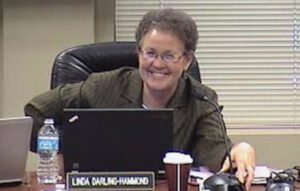
Linda Darling-Hammond shares a light moment during a meeting of the California Commission on Teacher Credentialing.
A prominent scholar from Stanford University will direct a new education institute in Palo Alto whose mission is to influence K-12 policies in both California and the nation.
Linda Darling-Hammond, an emeritus professor at the Stanford University Graduate School of Education, is the president and CEO of the Learning Policy Institute, which formallyannounced its opening Wednesday. Along with headquarters in the San Francisco Bay Area, the institute has an office in Washington, D.C., an initial budget of $5 million and a staff of 30 that may grow to 50 within a year.
The new position will take most of Darling-Hammond’s time, although she will continue to teach occasionally as an emeritus professor at Stanford and to serve as chair of the California Commission on Teacher Credentialing. Patrick Shields, who managed research at SRI Education for two decades with a focus on California’s teaching force, will be the new institute’s executive director.
The San Francisco-based Sandler Foundation is the lead funder with the Atlantic Philanthropies, the S.D. Bechtel, Jr. Foundation, the Ford Foundation, the William and Flora Hewlett Foundation and the Stuart Foundation also providing initial support for the institute.
The institute has opened during a critical period for education policy nationwide and in California. Along with implementing the Common Core State Standards, California is transitioning to a new school accountability system and a financing system that targets substantially more money to high-needs students and shifts control over spending from the state to local school districts.
In Washington, Republicans and Democrats are struggling with aspects of the rewrite of the No Child Left Behind law. But their overall compromise would return more authority over education policy and accountability to the states. That will make it all the more important, Darling-Hammond said, for communities “to know what works and act based on that knowledge. States and the federal government need to be in the knowledge-sharing business,” and the institute will be a forum and conduit for that information, she said.
Independent and nonpartisan, the Learning Policy Institute will differ from most research institutions, Darling-Hammond said, in that it will combine original and existing research to focus on “pressing policy questions” and then will translate the findings so that federal, state and local policymakers and practitioners can adopt the recommendations and bring them to scale. A large focus of  the institute’s work will be on California, she said.
She said the institute’s policy agenda will include:
  • Examining effective designs for new schools with structures, curriculum and types of learning that young people will need to thrive in a “radically different, knowledge-based world economy.”
  • Sharing early education programs with strong outcomes so that they can be brought to scale. There is an emerging bipartisan recognition nationally of the importance of early education, she said.
  • Making recommendations and sharing research on how to attract, train and effectively retain the next generation of teachers; California and other states are already experiencing a diminishing supply of prospective teachers.
  • Helping to shape an “equity agenda” that draws attention to the United States’ high rates of child poverty and homelessness and unequal school funding and staffing, compared with other industrialized nations.
The timing may be right for a new institute focusing on these issues and for Darling-Hammond. An early education adviser to President New institute in Palo Alto aims to help shape state, national K-12 policy | EdSource: