Latest News and Comment from Education

Sunday, August 16, 2015

When A Budget Motel Is 'Home,' There's Little Room For Childhood : NPR

When A Budget Motel Is 'Home,' There's Little Room For Childhood : NPR:

When A Budget Motel Is 'Home,' There's Little Room For Childhood


Ian opens the door to the motel room he shares with his mother, Karen. Their living situation has exposed the 5-year-old to conditions most students his age don't have to confront. "He saw way too much in the last few weeks," Karen says.
Tess Vigeland/NPR


Just a couple of blocks off the 210 Freeway in San Bernardino, Calif., about an hour east of LA, rest a whole row of cheap, run-down motels. Some people stay for a night or two, others just by the hour.
But some rooms house families with kids — and they're not just stopping in.
This is home for them, at least for now. They've run out of other options for a roof over their heads.
California ranks third in the U.S. — behind only Kentucky and New York — in the percentage of children who don't have a home, according to the National Center on Family Homelessness. And the evidence of this is clear in San Bernardino, which is littered with dilapidated neighborhoods and abandoned blocks, even in the city's center.
Here, budget motels have become a last refuge for desperate people with nowhere else to go. Joe Mozingo, the Los Angeles Times staff writer behind the series San Bernardino: Broken City, says that kids who live in these motels get exposed to some troubling conditions.
"Drug addicts and prostitutes, people with severe mental illness," he explains. "It's just kind of a crazy place for a child to grow up in."
For instance, Eddie, the 14-year-old at the heart of one of Mozingo's pieces, had to cope with bullying, the death of his cousin and a mother who was usually strung out on meth — before she got arrested.
The Golden Star Inn, in San Bernardino, Calif. Karen and her son moved in here after they left the last motel they were living in --€” a place she says was "like summer camp for meth addicts."
Tess Vigeland/NPR
"So he was just totally left alone with his mom's boyfriend, who's also a meth user," Mozingo says. "And he just didn't know what to do. I've just never seen a kid look so lost and in need of guidance."
At the Golden Star Inn, one of the motels just off a juncture in San Bernardino, Karen lives with her 5-year-old son, Ian. (She asked that we not use her last name to protect her and her son.) The morning Mozingo and I spoke with her, she had just filed a restraining order against her husband; she says he's addicted to meth. She and Ian have lived in a shabby, dimly lit room for nearly three months.
In the room, there are signs of an effort to create something resembling a home. Stuffed animals and Disney pillows lie strewn on the bed, and laundry is hanging out When A Budget Motel Is 'Home,' There's Little Room For Childhood : NPR:

What Vaccines Your Child Needs to Start School | Rosemont, CA Patch

What Vaccines Your Child Needs to Start School | Rosemont, CA Patch:

What Vaccines Your Child Needs to Start School

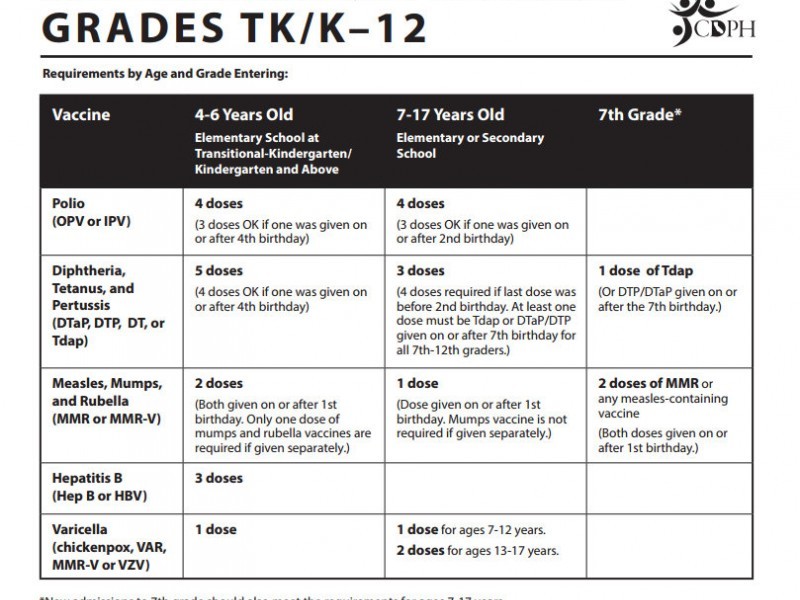
Under California law, children must be fully immunized before starting school.


What Vaccines Your Child Needs to Start School


As the school year starts, public health officials are reminding parents to get their children vaccinated before starting school.
Under California law, children must be vaccinated against a host of diseases, such as polio and chicken pox, before starting school. The requirement differs depending on the age and grade of the child.
August is National Vaccination Month, and public health officials are using that to remind people about the importance of vaccination.
“Vaccines are the most effective tools there are to prevent children from getting sick,” San Diego County public health officer Dr. Wilma Wooten said. “When children are not vaccinated, not only are they at increased risk for disease, they can also spread illness to others in classrooms, households and communities.”
Currently there is a movement against vaccination based on a debunked study that linked vaccines to a rise in autism in children. The cause gained prominence through high-profile supporters such as former Playboy Playmate Jenny McCarthy, among others.
Starting in June 2016, however, California parents will no longer be able to use personal belief to exempt their children from vaccination.
This past June, Gov. Jerry Brown signed SB 277 eliminating personal belief exemptions into law -- only allow exemptions for medical reasons.
The bill, inspired by a measles outbreak in California that started at Disneyland in December, triggered heated debate and passionate testimony on both sides.
So which vaccine does your child need in order to start school?
For children who are 4 to 6 years of age, health officials recommend getting shots for DTaP (diphtheria, tetanus and pertussis -- whooping cough), chickenpox, MMR (measles, mumps and rubella) and polio
Older children need a booster shot for DTaP. The The Centers for Disease Control and Prevention also recommends teenagers get vaccinated against human papilloma virus.
Vaccination is not just for students K-12, students entering college need to get vaccinated as well. The CDC recommends college freshmen get vaccinated against Meningococcal meningitis. Freshmen are seven times more likely to contract Meningococcal meningitis than the general population, according to the Journal of the American Medical Association.
Most county public health departments offer vaccinations for little to no cost for low-income people or people lacking medical insurance.
--Photo courtesy of the California Department of Public Health What Vaccines Your Child Needs to Start School | Rosemont, CA Patch:

Blame attacks on public education for teacher shortages, Percy Brown and Tim Slekar say : Ct

Blame attacks on public education for teacher shortages, Percy Brown and Tim Slekar say : Ct:

Blame attacks on public education for teacher shortages, Percy Brown and Tim Slekar say


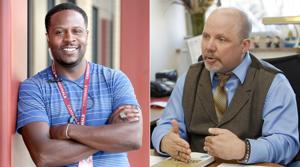
Percy Brown (left), the director of equity and student achievement at Middleton High School, and Tim Slekar, the dean of Edgewood College's School of Education.


Some Wisconsin school districts have reported problems filling teaching positions as the school year approaches.
It's not a mystery why, local education leaders Percy Brown and Tim Slekar said in an interview aired on WKOW-TV's "Capitol City Sunday."
Brown, the director of equity and student achievement at Middleton High School, and Slekar, the dean of Edgewood College's School of Education, pointed to what they called a sustained war on teachers and attacks on public education.
Education policies in both Republican and Democratic presidential administrations have contributed, Brown said.
"The accusations or the blame are being placed on teachers for failure in academic achievement when we look at comparisons to other developed countries," he said. "But I see that attack as not addressing the real issues that our educational institutions are actually dealing with. We really have to look at the focus on issues of race, class and mental health issues. To put the blame on teachers does not make the profession look very attractive."
Teacher shortages in Portage and La Crosse have been covered locally, while a Washington Post blog last week described similar problems in Indiana.
"What's going on?" Post education reporter Valerie Strauss wrote. "Pretty much the same thing as in Arizona, Kansas and other states where teachers are fleeing: a combination of under-resourced schools, the loss of job protections, unfair teacher evaluation methods, an increase in the amount of mandated standardized testing and the loss of professional autonomy."
That struck a chord with Slekar, who said the applicant pools for students at education schools like his have dropped by at least a third.
"That's an exit strategy to get your best teachers out of the profession," Slekar said. "At a time when we supposedly are saying we want our best people to be stepping up to become teachers, we are pushing those people away more and more and more."
Last week, the Wisconsin Budget Project reported on the
Read more: http://host.madison.com/news/local/writers/todd-milewski/blame-attacks-on-public-education-for-teacher-shortages-percy-brown/article_07e59142-f8f1-51e0-a797-0532a7b42ebf.html#ixzz3j1J1ENpt


LETTER TO THE EDITOR OF EBONY MAGAZINE - UNITED OPT OUT

LETTER TO THE EDITOR OF EBONY MAGAZINE - UNITED OPT OUT: The Movement to End Corporate Education Reform:

LETTER TO THE EDITOR OF EBONY MAGAZINE


The recent article “What Happened to All Schools in New Orleans?”written by R.L. Hill presents a false and incomplete picture of the K-12 schools in New Orleans, La.  To quote: “And despite  nationwide concerns over what seems to be an educational realignment with charter school principles, current signs indicate it’s working in the Big Easy.”   The article cites the only criticisms of and concerns for the Recovery School District of New Orleans (RSDNO) are the mass firings and the decision making process that failed to include the community of stake-holders who reside in New Orleans. This could not be further from the truth.  The RSD is riddled with problems inclusive of poor academic performance, inadequate funding, poor teacher quality, test -driven curriculum at the expense of quality pedagogy, and a racist and militaristic approach to discipline for the majority of the non-White populace that attends RSDNO schools.
The article claims that the schools are doing better than prior to Hurricane Katrina because high school graduation rates and standardized test performances are better.  According to the a recent report by Charles Hatfield, M.S. and Barbara Ferguson, Ed.D , “…the ninth grade cohorts show a consistent gap between the RSDNO and the Orleans Parrish School Board (OPSB) regarding the success of the state takeover. Yet this gap is often omitted because other researchers combine the achievement and graduation results of both RSDNO and OPSB. The failure of those RSDNO’s 9th grade enrolled cohorts to graduate within 4 years reflects adversely on the ability of a school district to address the educational needs of all of its students. It suggests the non-existence of vital support mechanisms needed to address the myriad of educational, psychological and social needs of all students enrolled in the 9th grade.”  The report goes on to say: “Unfortunately, the LDOE refused to provide ROR with these enrollment files that would have been necessary to complete the four year analyses of each of the missing cohorts, i.e., 2012-13, 2013-14, and 2014-2015; thereby, limiting the scope of this study and depriving the public and researchers of vital raw data by which to objectively assess the effectiveness of the state’s takeover. This is a blatant example of the LDOE’s lack of transparency with respect to accountability.”
Sadly, any success that can be claimed is the result of misleading manipulations such as the change in the school grading formula from 2012 to 2013, which “raised” the RSD district score from a D to a C., or as LETTER TO THE EDITOR OF EBONY MAGAZINE - UNITED OPT OUT: The Movement to End Corporate Education Reform:

Russ on Reading: Is First Grade Ready for Your Child?

Russ on Reading: Is First Grade Ready for Your Child?:

Is First Grade Ready for Your Child?


If you are a parent of a six-year-old about to enter first grade, you are sure to be wondering if your child is “ready for first grade.” You may have already had this discussion with a kindergarten teacher, school administrator or your Aunt Janet who taught school for a while thirty years ago. Everybody seems to have an opinion on first grade readiness and after all if your child is not ready for first grade and “falls behind” at the very start of his/her schooling, what are the chances that s/he will be “college and career ready” in 12 years?

Google “first-grade readiness” and you will get dozens of hits for websites that provide you with checklists, some of them a hundred items long that purport to tell you if your child is ready. Just go through the list, check off the benchmarks and there you have it, concrete evidence that your child is ready – or not. You can find one of these lists here. These lists contain items related to social skills, like the ability to work, play and share with others and to resolve conflict with words; language skills, like the ability to listen to and comprehend instructions and distinguish fact from fiction; number sense, like counting to 30 and estimating quantities using blocks and paper clips; social studies, like the ability to understand history as stories of what has happened in the past; and science, such as the recognition of how people impact life on earth.

Ultimately, these lists are an exercise in futility. The real question a parent should be asking is not if my child is ready for first grade, but is first grade ready for my child. It is not a child’s responsibility to be ready for first grade, it is the professional responsibility of the adults at the school to make sure that first grade is ready for your child. Six year-old children come in all shapes, sizes and levels of physical, social and intellectual development and schools need to be prepared to accommodate them all and provide an appropriate education for them all.

Thirty years ago I faced a difficult decision. My son, a bright, but very active (some said hyperactive) child, had just turned 6 in July and his kindergarten teacher had suggested he was not ready for first grade. The school offered a “transitional” first grade designed for Russ on Reading: Is First Grade Ready for Your Child?:

Fake Report: No relationship between teacher pay, student results

Report: No relationship between teacher pay, student results:

Report: No relationship between teacher pay, student results


A new report looking at the salaries of the 75 largest school districts in California alleges there is no correlation between teacher compensation and higher student test scores.
Transparent California posted the report on their website’s blog on Wednesday morning. The report looks at teacher salaries in the state’s 75 largest school districts and compares them to the district’s 2013 Academic Performance Index scores, which are based on a combination of scores on various standardized tests. (That’s the last year that API scores are available, as the state has overhauled its standardized testing system to match up with the new Common Core State Standards.) API scores range from 200 to 100, with a target of 800 for all schools.
“The average full-time teacher compensation was $94,796 and the average API score was 795,” the report reads in part. “Compensation is defined as wages plus the employer-cost of health and retirement benefits. The average total employee cost per enrolled student was $6,946 and was negatively correlated against the district’s API scores.”
Transparent California is a website operated by the Tustin-based California Policy Center, a conservative think tank affiliated with the State Policy Network, which works to “limit government and advance market-friendly public policy at the state and local levels,” according to the SPN website.
“I guess you could say we’re a center-right organization,” said Ed Ring, executive director of the California Policy Center. “Those terms are becoming very muddled and we, frankly, try to stay as non-partisan as we can, because the issues we care about, we since believe should concern left-wing citizens as much as right-wing citizens.”
He’d rather look at the report’s conclusion: “There’s zero correlation between how much teachers make and how the students are doing,” he said. “How long a teacher works and how many credentials a teacher acquires has no relationship to how students do.”
Transparent California looked at the employee compensation records of more than 740,00 K-12 employees, who account for nearly 80 percent of educators statewide.
The Ontario-based Chaffey Joint Union High School District is called out in the report for having the highest average compensation package for teachers in the districts examined — $119,942 — but having a sub-800 API score of 777. In contrast, San Ramon Valley Unified in northern California had a 923 API score in 2013, with an average teacher compensation of $88,638.
“Something’s really wrong when schools are delivering API scores that low,” Ring said. “Why are we still paying teachers based on how long they show up, or on how many credentials they get that they can turn around and take back to the payroll department?”
Mat Holton, Superintendent of the Chaffey Unified High School District, is not a fan of the Transparent California report.
“This is a flawed comparison on many levels,” a written response from Holton begins. “API is an obsolete metric that was suspended unanimously by the California Board of Education earlier this Report: No relationship between teacher pay, student results:

Common Core: A Real Test For Pearson - Pearson plc (NYSE:PSO) | Seeking Alpha

Common Core: A Real Test For Pearson - Pearson plc (NYSE:PSO) | Seeking Alpha:

Common Core: A Real Test For Pearson


Summary

  • Common Core education requirements are controversial and expensive.
  • Pearson is the market leader but suffering recent setbacks.
  • Demographics provide a rising tide in Education.
The Common Core State Standards Initiative provides a framework for standardized testing in English and Mathematics for school children. It is designed to ensure students graduating from high school are prepared for college and for careers. And it has become a highly debated and contested issue.
Common Core has been adopted by 46 states, but 3 have recently withdrawn and several more may withdraw. One issue of the Common Core standardized tests has been criticism of the teaching methodology and of the testing questions. Another issue is the poor student results. Only one third of the New York State third to eighth graders taking the tests this year had a passing grade, and that is an improvement over 2014.
There is a lot of money involved. States implementing Common Core teaching materials and testing have awarded large multi year contracts to both not-for-profit and for-profit companies. In 2012, the Thomas B Fordham Instituteestimated Common Core implementation would cost US schools between $3 and $12 billion nationally.
Interestingly, the market leader in US educational standardization has been is not a US company. Pearson PLC (NYSE:PSO) from the UK trades in New York with ADR's. Pearson is an international media company becoming more and more focused on the education segment after recent divestitures. In July, Pearson announced the sale of the Financial Times to Nikkei. And this month, they announced the sale of their stake in the Economist. The other major non-educational asset, Penguin Books, has been merged with Bertelsmanns' Random House. While Pearson retains 47% of the combined entity, they may look to reduce the stake.
In July the US Senate passed a bipartisan bill that gave most the control over testing and curriculum to the individual states. The bill also reconfirmed the commitment to standardization and the annual testing schedule. Even if Common Core is discarded in favor of individual State standardization programs, States will need many more investments in materials, equipment and testing. Although a market leader, headwinds over the last year have hurt Pearson. Pearson lost the large California testing contract to Education Testing Service which has a tentative 3 year $240 deal. ETS also took a multi year testing contract in Texas, where Pearson had been incumbent for decades. A six year standardized assessment system contract for $220 million in Florida was awarded to American Institute of Research over Pearson. And in New York State, Questar Assessment Inc took a five year $44 million testing contract from Pearson.
A recent win for Pearson was a contract in Minnesota where they took the business from the American Institute of Research. On the Q2 2015 earnings call, Pearson CEO John Fallon tried to put the loss of GBP100 million of annual revenue from US State testing contracts in perspective:
In the political fallout from all that we've lost as you've known and would have seen a number of high profile testing contracts worth towards around £100 million in sales this year that we won't have in 2016. Obviously, we hate losing any business in any circumstances, but context here is important. First point, the state and assessment services, which this related to account for around 7% of Pearson's total annual sales, we will still lead the market in state -- a national assessment service next year with a share of around 30%, that's slightly lower, but only slightly lower than it was before we started the shift from no child left behind to common core back in 2012.
It is important to consider that although Pearson gets 61% of revenues and 64% of adjusted operating profit from its North American businesses, operations in other regions are also important. Revenues from operations in the UK, Italy and Australia together account for 24% of revenues. And operations in growth regions including South Africa, Brazil, India and China account for 15% of revenues.
PSO Chart
PSO data by YCharts
On July 24, Pearson released first half revenue of GBP2.16 billion which is an increase of almost 6% year to year. Most of the annual increase when reported in pounds is from favorable currency exchange. The earnings for first half are not very significant in such a back half loaded industry, but showed an 6% decrease year to year. Pearson reiterated full year earning guidance of $1.17 to $1.25 per ADR. The mid year dividend was paid at 28 cents per ADR. Note, following UK company practice, the mid year dividend is a normally minor, and the full year dividend paid in March can be expected to be as much as twice the amount of the midyear.
CONCLUSION: Pearson is focusing on education, where it has been a dominant player despite some recent missteps. Based on the last 12 months, it is paying a 4.3% dividend which has no UK withholding tax for US holders of the ADR. The education testing market is poised to grow, and Pearson can benefit if Common Core: A Real Test For Pearson - Pearson plc (NYSE:PSO) | Seeking Alpha:

The war on North Carolina’s public schools | Salisbury Post

The war on North Carolina’s public schools | Salisbury Post:

The war on North Carolina’s public schools


I am no fan of hyperbole, but I mean it when I say this: North Carolina is waging war against public education.
The pathway that brought us here has been paved with underfunded budgets, tactical strikes against public school teachers, fundamental changes in charter school operations, the diversion of public funds to private or religious schools, and the erosion of our hallowed University of North Carolina system. Here’s what’s happened.
Big budget target
When North Carolina Republicans took control of the state government in 2012, they quickly set into motion a sweeping agenda to enact conservative social reforms and vastly change how the state spends its money. It was the first time in more than a century that Republicans enjoyed such political dominance in our state.
What brought them all to town? A good reason: in the 2011-12 budget year, North Carolina projected a multi-billion dollar deficit, enough to rank the state among the worst budget offenders in the country and bring a new slate of elected legislators to Raleigh. So Republicans, with a clear mandate to clean up the fiscal mess in November 2012, set to work righting the ship.
On what does a state like ours spend money? Public education, including higher education, consumes about a third of North Carolina’s budget. Health and Human Services, including the state’s Medicaid and unemployment programs, composes an even larger slice, about 37.5 percent.
Other state programs make up little bits and pieces: nearly 8 percent on transportation and highways, 5.5 percent on public safety, 9 percent on natural and economic resources.
In other words, if you want to make big cuts, public education is one of two really big targets.
After that landslide election in 2012, legislators began sharpening their knives.
A fury of budget cuts
Among their first targets: reductions in unemployment benefits, cuts to public schools, including laying off thousands of teachers, and a massive, nearly half-billion dollar slash from the University of North Carolina system.
Two years later, in the last budget cycle, 2014-15, the legislature provided roughly $500 million less for education than schools needed.
Later in the 2013 session, though, the most radical changes in state financing fell into place. Republicans reconstructed the state’s tax code, relieving the burden on corporations and wealthy residents. They continued to take aim at other parts of the education budget, cutting More at Four program dollars and decreasing accessibility for poor families. The state lost thousands more teacher and teacher assistant positions. The bloodletting was fierce. More on that in a minute.
Across the state, local education districts were faced with budget deficits of considerable proportion after legislators hacked away their funding. School systems raided fund balances, rainy day funds set aside for things like natural disasters, not political ones. Elsewhere, employees were furloughed, teachers were laid off, teacher assistants were forced to take other jobs or lose their classroom positions, and so forth. Non-personnel funding disappeared. Textbooks stayed in circulation another year. Buildings were patched together instead of replaced. Education Week called ours “The Most Backward Legislature in America.”
Republicans defended these austerity measures by saying that lower taxes would eventually yield fiscal growth. And they were right. This year, the government is enjoying a $445 million surplus–a clear victory in light of those multi-billion dollar deficits of yore–but still a statistically small number in light of the state’s $21 billion budget (about two percent), especially after considering that our state budget is still smaller than it was in 2011.
In fact, by 2014-15, North Carolina was still spending $100 million less on public education than it had before the economic recession. And over the past ten years, public schools added more than 150,000 additional students. No Republican legislator can honestly say that per pupil expenditures across the state have increased in the last six years.
Taking aim at teachers
Curiously, the Republican-held capital didn’t stop at defunding education. They also took aim at teachers.
N.C. teachers are prohibited by law from unionizing, but they did have a common advocacy group in the North Carolina Association of Educators. In 2011, the legislature passed a law targeting how the group collects dues from member teachers. Then-Gov. Beverly Purdue vetoed it. In 2012, the law made its way back to Purdue, who vetoed it again — but the House overrode it during a sneaky, late-night vote. (The law was later found to be discriminatory, retaliatory, and a violation of free speech and thrown out by state courts.)
But with teachers’ main advocacy group effectively muzzled, the legislature was free to run rampant, and teachers quickly came under fire.
Teacher salaries fell to near the bottom among all states in the nation and worst in the South after five years with zero pay increases. And when Republicans finally acted to increase teacher pay, they claimed to make the biggest pay hike in state history — but in reality only bumped up paychecks by an average of $270 per year. When you factored inflation into the mix, teachers were losing money.
Meanwhile, Texas and Virginia started actively recruiting North Carolina teachers to go work in their states. It didn’t take much to convince Tarheel teachers to flee–especially after some teachers discovered they earned substantially less money than when they started thanks to inflation.
In case pitiful paychecks weren’t enough to deter teachers from returning to work, the legislature next took aim at teacher tenure. The Republican-led proposal initially was to eliminate tenure altogether, but eventually they came up with a plan that would grant teachers pay raises for giving up their career status. It was, as I wrote then, a clever way of getting rid of veteran teachers.
Eventually, that compromise became law, and teachers state-wide began the effort of figuring out if their career status or their retirement pension was more important–and once again, the court stepped in and overturned the law. Another legislative overreach corrected by the courts.
- See more at: http://www.salisburypost.com/2015/08/16/the-war-on-north-carolinas-public-schools/#sthash.MLkdNQZS.dpuf


Teacher Age Discrimination During a So-Called Teacher Shortage

Teacher Age Discrimination During a So-Called Teacher Shortage:

Teacher Age Discrimination During a So-Called Teacher Shortage


Positivity. Happy Funny Senior Woman Showing Symbol of Heart


Jeb Bush is 62. Hillary Clinton is 67. Donald Trump is 69 and Bernie Sanders is 73. If these individuals were teaching in a public school, and not famous politicians, what would you bet that they’d still be working?
How many older teachers do you know who are still teaching? While there is much gnashing of teeth in the news about a teacher shortage, I don’t see any effort to bring elderly teachers back to the classroom. And by elderly I’d start at age forty. They’d rather put someone in charge of a class who hasn’t  earned credentials!
Older teachers face the “do not apply” signs wherever they go. For years, efforts have been underway to get rid of veteran teachers through faulty teaching evaluations, the elimination of tenure, school closures and outrageous early retirement plans. This phenomenon appears to be happening in many places.
In 2013, The Guardian’s anonymous “Secret Teacher” column titled “There’s an Insidious Prejudice Against Older Teachers” describes a veteran teacher’s unsettling fear that Teach First, which sounds eerily like England’s version of Teach for America, was being highlighted as the answer to education problems—older teachers were cast as culprits.
We often seem to be unfairly perceived as unmalleable or even as troublemakers, instead of as a rich asset. Over the last 18 months, a tsunami of change driven by fear seems to have invisibly swept over many schools and classrooms. Mistakes in some schools are not tolerated and have frightening repercussions. These days I am Teacher Age Discrimination During a So-Called Teacher Shortage:

CURMUDGUCATION: Backpacks for Clueless Parents + 10 Things Smart Teachers Don't Do

CURMUDGUCATION: Backpacks for Clueless Parents:
Backpacks for Clueless Parents


Over at Getting Smart, a website devoted to selling educational product, guest writer Aimee Rogstad Guidera makes her case for more data collection for each student-- because it's what parents want.

Parents are eager for information about their child’s education. As a mom, I want to know if my daughter is struggling in math before she comes home in tears. I need information to support my child’s learning at home, and to support my child and her teacher in making the best decisions for her learning in the classroom.

Maybe I just don't get it, but I'm inclined to think that if you didn't know your child was having trouble in math before the coming-home-in-tears part, you're just not paying attention. I have heard this pitch enough times to make me occasionally wonder if there is, in fact, some place where teachers keep every scrap of information carefully hoarded, students never speak to their parents about school, parents never ask about school, and all parent requests for conferences and information are denied by all school personnel. Maybe there is some place where parents are so deeply clueless and helpless that they have no idea how their students are doing.


Or maybe Guidera is the CEO and President of the Data Quality Campaign, a group interested in student data and funded by the Gates Foundation, the Waltons, the Dells, and the Ford Foundation. They do have some rules about how such data should be kept in a safe lockbox, but they are clearly Big Data fans.

Guidera is advocating for student data backpacks-- little (or not so little) bundles of data that just follow students around, providing parents with all sorts of longitudinal data (because, again, parents don't know much about their own children).

Guidera says the backpack should be available, timely, portable, secure and understandable, and 
CURMUDGUCATION: Backpacks for Clueless Parents:


10 Things Smart Teachers Don't Do


Over at the Inc website, contributing editor Jeff Haden last week contributed "10 Things the Smartest People Never Do." It's business-oriented, but it actually translates well into the teaching world as well. Here's the teacherfied version of the list of things that smart people never do.

1. Thoughlessly waste other people's time.

This doesn't just apply to our colleagues-- it applies to our students as well. I actually make this explicit promise to my students every fall, and if they demand an explanation of why something I've asked them to do is not a waste of their time, I give them one. It is easy to view our students as essentially trapped in school, and so it doesn't matter how we spend their time because they never had any control over their schedule anyway. Wrong. We're talking about minutes of fellow human beings' lives. Don't waste them.


2. Ignore people "beneath" your level.

Every beginning teacher gets that important advice-- make friends with the office secretary and the janitor for your hall. But the word "ignore" is key here. For many of our students, the worst thing about life is that they are invisible to their peers and to much of the world they encounter. Haden advises to see people, and I believe that applies to students as well. It doesn't necessarily take a huge fifteen-minute interaction with them-- just a quick exchange that translates as, "I actually see you." It is one of the most powerful things we can do.


3. Ask for too much (especially too soon).

Do not be the teacher who depends on all other teachers to take care of your business for you. Do not require everyone else on staff to cover your butt. Take care of your business and more people will be more inclined to give you more help.


4. Ignore people in genuine need.

This includes colleagues and students. This can be hard because we are always tight on time and genuine need never arrives at a convenient moment. Haden offers this observation:


Though I don’t necessarily believe in karma, I do believe good things always come back to you, in the form of feeling good 

10 Things Smart Teachers Don't Do


ICYMI: This Week's Great Reads


In case you missed it, here are some of the more important reads from the last week. Happy Sunday!


The Costs of Accountability by Jerry Z. Muller
If you are only going to get to one item on this list, this should probably be it. Muller puts the cult of accountability in a historic and cultural context, shows how it slammed into education, and reminds us that schools are not the only ones to suffer from accountability's heavy and not very bright hand.

Schools are more segregated than they were in 1968
Article in particular looks at how the Supreme Court has not exactly been a big help in working on the issue.

Testing in kindergarten
Okay, if you read here, you likely read Diane Ravitch, but just in case you missed this among the gazillion posts, here's a must read account of what kindergarten testing actually looks like on the classroom level. 

Pinellas Failure Factories
Okay, maybe this is the one piece you must read. A hard-hitting, thorough look at how racism and school district mismanagement can turn successful schools into a disaster. And all, I am sorry to note, in the name of neighborhood schools. 

Education's Merchant of Doubt
Whenever you find the assertion that spending money on schools is just a waste of time and makes no difference, you'll find the work of Eric Hanushek. This is a great and thorough takedown of who he is, what his work says, and why it's all bunk.

Alfie Kohn on growth mindset 
Alfie Kohn takes on the idea of growth mindsets and shows why they've turned from a potentially useful tool into one more educational baloneyfest.

Man, these are all must reads this week. I hope you have a few extra minutes to sit and check them out today! 
ICYMI: This Week's Great Reads

Glen Brown. More on teacher Social Security theft. | Fred Klonsky

Glen Brown. More on teacher Social Security theft. | Fred Klonsky:

Glen Brown. More on teacher Social Security theft.

glen-brown


– By Glen Brown. Glen blogs at Teacher/Poet/Musician/Watch Cat. This is a post from 2012 with current updates.
The Windfall Elimination Provision (WEP) “was enacted as part of the 1983 Social Security Refinancing Act, designed to shore up the financing of the Social Security Trust Fund. That Act was signed into law by President Ronald Reagan” (Mass Retirees).
 
“The Windfall Elimination Provision primarily affects [a public employee who has] earned a pension in any job where [he or she] did not pay Social Security taxes and also worked in other jobs long enough to qualify for a Social Security retirement or disability benefit” (Social Security website).
WEP reduces any earned Social Security in other jobs because of a state pension benefit. “…Reduction in [a] Social Security benefit cannot be more than one-half of the amount of [one’s public] pension that is based on earnings after 1956 on which [he or she] did not pay Social Security taxes…
“The Windfall Elimination Provision may apply if [the public employee reaches 62] after 1985; or [if he or she] became disabled after 1985; and [if he or she] first became eligible for a monthly pension based on work where [he or she] did not pay Social Security taxes after 1985…” (Social Security website).
According to Mass Retirees, “the WEP affects members who apply for their own (not spousal) Social Security benefits and fail to satisfy certain exceptions. A major exception is that members, who were eligible for their public pension before January 1, 1986 (i.e., 20/more years of service under age 55, or 10/more years over 55) or have at least 30 years of substantial coverage under Social Security, are exempt from the WEP. (There is some relief for those with 20-30 years of SS coverage.”
The Government Pension Offset (GPO) is “a provision in the 1977 Social Security Amendments signed into law by President Jimmy Carter” (Mass Retirees).
“The GPO affects members who apply for Social Security spousal benefits, based Glen Brown. More on teacher Social Security theft. | Fred Klonsky:


Karl Gabbey: They’re not nuts. It’s the Tribune.

11072065_10153687856082067_3294444669979719143_n


– By Karl Gabbey. Karl is Democratic Precinct Committeeman, Precinct 56, Bloomingdale Township.
Sorry, Fred, that it took until this morning to weigh in on this one. I found it difficult to restrain myself…
I‘m no fan of Chicago’s news sources, broadcast, online. or print. My criticism of our local media has grown exponentially over the years. The Chicago Tribune is at the top of my s#*t list. Shallow reporting and commentary reflect mostly ideologically conservative and corporate influences which are contrary to the interests of 99% of Chicagoans and are just plain irrational, or in common parlance: “Nuts.”
I once had a subscription to the Trib for quite some years which ended abruptly when its editorial board supported Al Salvi over Dick Durbin in the 1996 U.S. Senate race. Al Salvi was a misogynist teabagger; actually, just a teabagger ahead of his time. That was the final blow. I dropped my subscription immediately. Then came a call from the Trib to urge me to continue, but I told the sales rep that I was fed up with the “nutty” content of its editorials plus its habitually pathetic endorsements of some of the most retrograde political candidates imaginable. Don’t these people ever do serious homework? I suppose if one is so ideologically immersed in a conservative/ libertarian/ corporate cesspool as the Trib’s editorial board is, there’d be no need for homework because its members like Kristen McQueary already have the answers to everything. Inconvenient facts just get in the way of their sacred Karl Gabbey: They’re not nuts. It’s the Tribune.