Latest News and Comment from Education

Wednesday, July 22, 2015

Education Reform Is Malpractice | Steve Nelson

Education Reform Is Malpractice | Steve Nelson:

Education Reform Is Malpractice


Irony is often amusing. When the future of millions of children is at stake -- not so much.
The tragic irony in education is that the policies and practices enacted in response to concerns over low achievement will further disable a generation of children already hobbled by poverty. Education reform is educational malpractice and is disproportionally affecting young girls and boys of color in the least privileged communities.
Many others (and I) have revealed the perils of privatization, fraud in public schools, the deception of the charter movement, the massive influence of Pearson and other profiteers, and the negative effects of the testing and accountability era on most children and teachers. Nonetheless, I think we underestimate the deeper damage being done to poor children of color in the service of so-called reform.
Political rhetoric about an education crisis has gone on unabated since the 1983 publication, A Nation at Risk. That "call to action" has been fully discredited in subsequent years, but has driven horrible policy ever since. It is as though we have administered chemotherapy to a generation of kids who actually didn't have cancer. It has, as you might expect, made them sick.
For privileged kids the effect is less grave. Affluent communities have richer resources, more early childhood opportunities and have been able to resist the incessant pounding of reform either explicitly or subversively. Parents in these communities have social and political capital. Many schools have resisted testing and test prep. Pre-school and kindergarten programs have remained play-based and joyful. While the overall impact of education reform has been irritating and distracting, it has not significantly changed daily life in most schools in privileged communities.
The real target of education reform is the so-called achievement gap between white and black, rich and poor. On various measures, particularly the National Assessment of Educational Progress (NAEP), the gap in test scores has been relatively consistent for more than 20 years. But rather than respond to the poverty and racism that surely account for this gap, reformers have prescribed some stern educational medicine: Rigor, early academics, strict discipline, high expectations, "no excuses," longer school Education Reform Is Malpractice | Steve Nelson:

This is where your child is most likely to get suspended from school - The Washington Post

This is where your child is most likely to get suspended from school - The Washington Post:

This is where your child is most likely to get suspended from school


States in the Southeast suspend K-12 students at the highest rates in the country, according to new data released Wednesday by the U.S. Department of Education as part of a daylong White House conference on ways to approach school discipline.
“Creating and sustaining safe, supportive schools is absolutely essential to ensuring students can engage in the rich learning experiences they need for success in college, work and life — that’s why rethinking school discipline is critical to boosting student achievement and improving school outcomes,” Education Secretary Arne Duncan said.
Suspended students are less likely to graduate on time and they are more likely to repeat a grade and enter the juvenile justice system, data show. More than 3 million of the nation’s 50 million K-12 students are suspended or expelled annually, a rate administration officials call “staggering.”
Students with disabilities are frequently given out-of-school suspensions, and that is true across the country, as described in a second map the department released:
The conference is part of a joint effort by the U.S. Justice and Education departments to examine school discipline, particularly racial disparities that result in students of color facing suspensions and expulsions at rates far This is where your child is most likely to get suspended from school - The Washington Post:

With A Brooklyn Accent: Why Charter Schools Resemble FEMA Trailers- How School Reform Promotes Gentrification by Dr Lori Martin

With A Brooklyn Accent: Why Charter Schools Resemble FEMA Trailers- How School Reform Promotes Gentrification by Dr Lori Martin:

Why Charter Schools Resemble FEMA Trailers- How School Reform Promotes Gentrification by Dr Lori Martin


The greatest threats to these communities--many of which are majority minority--are gentrification and school choice.

Gentrification occurs in distressed communities, which receive an influx of investment from private and/or public sources, that often results in higher real estate costs, among other things, and leads to the racial, ethnic, and economic transformation of the area. As the saying goes, Build it and they will come. However, few people, particularly middle class families and working class families seeking to join their ranks, are willing to come to a neighborhood where most, if not all schools, are deemed “failing.” While more affluent families can opt-out of the public school system, middle and upper class families often times, cannot.

What we are seeing in many areas that are undergoing gentrification is a flood of charter schools, and other so-called school choice options. What is happening in many school districts throughout the country is akin to a mandatory evacuation of public schools. Fewer and fewer students are attending designated neighborhood schools. Students--a disproportionate among of which are students of color--are being displaced and relocated to other schools after their schools are forced to close, or stigmatized by the designation of a grade. The assignment of the letter grade is frequently arbitrary, and a poor reflection of how, what, and from whom, students are learning.

Many of these displaced students never return. Still other students are provided with what could be considered temporary placements within their neighborhoods. These schools, some of which are charter schools, are sometimes mistaken for community schools because of their geographical locations. Charter schools are anything but neighborhood-centered; rather, charter schools may best be understood as the FEMA trailers for the victims of the present educational reform storm and the “gold rush” on selected distressed communities.

Like FEMA trailers, which are meant to provide temporary With A Brooklyn Accent: Why Charter Schools Resemble FEMA Trailers- How School Reform Promotes Gentrification by Dr Lori Martin:

Walking 400 miles, activist stops in Mount Airy on mission to reform education - The Frederick News-Post : Policy

Walking 400 miles, activist stops in Mount Airy on mission to reform education - The Frederick News-Post : Policy:

Walking 400 miles, activist stops in Mount Airy on mission to reform education


Jesse Turner, Walker for education
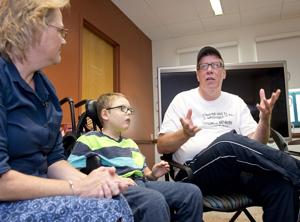
Jesse Turner, right, also known as the Walking Man, chats with Cindy Rose and her son, Ben, during a stop Tuesday afternoon at the Mount Airy Library during his walk from Connecticut to Washington.


Jesse Turner walked into the library in Mount Airy on Tuesday, his baseball cap cocked forward, and a T-shirt that read: “Someone has to tell Washington, D.C. children are more than just a test score.”
Turner, also known as the Walking Man, was making a pit stop during his near 400-mile route from his home state of Connecticut to the nation’s capital. He walks to make a statement about the contemporary education system in the United States, hoping that his trek captures the attention of the public in the same way as marches led by civil rights activists such as Martin Luther King Jr.
On Tuesday, Turner met with an education activist in her own right. Frederick resident Cindy Rose will appeal to the Frederick County Board of Education in late August to argue that her children should be able to opt out of state standardized tests, or allow her to do so on their behalf. One of Rose’s children, Ben, has severe cerebral palsy, Rose said. Part of his brain is missing, and he possesses no verbal function.
As Turner walked into the library for his meeting, he shed an orange vest he wears so drivers can spot him from the road, and set aside his wooden walking stick.
“These people are the story,” he said as he knelt in front of 10-year-old Ben, who sits in a wheelchair. “Not me.”
Turner, by his own count, has taught for more than 40 years, both in the New Jersey public school system and in higher education. After a slew of federal education reforms, namely No Child Left Behind, which Turner said was purely testing-focused, Turner said he embraced the role of an education advocate.
He referred to the contemporary education policies handed down by the government and the state legislatures as a “regime.” These policies are “abusive” to students, who expend too much energy learning a curriculum geared toward standardized tests, he said as he looked over test questions that Ben was asked on the state Alternate Maryland School Assessment. The alt-MSA is the test administered to some special education students.
Even the rewrite of the Elementary and Secondary Education Act being tossed around in Congress does not solve the problem, Turner said.
Parents should be able to opt out of these tests without a fight, he said. He rattled off a laundry list of initiatives the federal government could have explored rather than the enormous check they wrote to support the reforms.
“We could have hired a quarter of a million literacy specialists, a quarter of a million math specialists,” he said. “We could have done things so differently.”
Turner, now the director of the literary center at Central Connecticut State University, is in the midst of his second walk, which he started on his 60th birthday, June 11. His first walk, back in 2010, helped catapult the issue of Walking 400 miles, activist stops in Mount Airy on mission to reform education - The Frederick News-Post : Policy:

FAME’s Demise: Lessons from a Failed Charter School | Nonprofit Quarterly

FAME’s Demise: Lessons from a Failed Charter School | Nonprofit Quarterly:

FAME’s Demise: Lessons from a Failed Charter School


On June 30th, Alameda County’s FAME School (Families of Alameda for Multicultural/Multilingual Education Public Charter) closed its doors for the last time. The decision of the Alameda County Office of Education to deny the school’s request to renew its charter, a decision that was upheld when FAME then sued for a reversal in state court, brings FAME’s 15-year educational experiment and its management’s learning experience to an end. While FAME will not be teaching students when a new school year begins this fall, there are lessons here to be learned, lessons that policy makers and those responsible for chartering and overseeing charter schools can learn.
California, along with 41 other states and the District of Columbia, include charter schools in their formula for providing quality public education. First seen as laboratories where local school districts could develop new programs, charter schools have been widely adopted in response to the belief that the public school systems in many areas fail to prepare children for a successful future. Charter schools allow parents to choose their child’s school from a competitive marketplace that offers an array of options. To encourage a variety of providers to enter the market, charter operators are given significant latitude in their approaches to education and are freed from many of the rules and regulations that govern traditional public school systems.
While each state’s approach to chartering is different, all result in numerous independent organizations, for-profit and nonprofit, being given franchises to operate one or more publically funded schools, each in its own unique way. The burden of ensuring each of these schools provides an effective educational experience, uses public funds appropriately, and is a viable operation falls on the various bodies that are allowed to grant charters. FAME’s story illustrates how this process can go wrong. And since charter schools will remain a significant part of our public education system, FAME’s story can help us see where we can make improvements.
FAME was launched as the Bay Area School for Independent Study (BASIS) in an effort to support the growing number of home-schooled children. The FAME website describes how in 2001 its founders decided to begin a charter school:
“Before the enactment of the California Charter School Act in 1992, parents seeking alternative educational opportunities for their children had few options. With the establishment of charter schools, California opened the door for new and innovative schools such as ours to open. Parents and students were already learning at home and BASIS became an anchor and support for many families who were seeking validation, collaboration, and connectivity within their chosen educational model. BASIS offered two enrollment options. One allowed students to receive daily instruction through classes taught at our Oakland Resource Center. The other allowed students to work at home with their parent educators monitored by a credentialed BASIS teacher. Our method, now known as Personalized Learning, relied on the empowerment of parents to partner in the educational process and work closely with teachers and other support staff to ensure that students made appropriate academic and social progress.”
With a location in Oakland, one might think that the Oakland School Board would have responsibility for deciding upon the creation of a new school in their district. But in California, like most states permitting charters, local districts are only one of a number of potential authorizers. In fact, by 2012, more than 60 percent of charters issued nationally were coming from a body other than a local school district. The purpose of this open system is to overcome the resistance of local school districts to charters entering their turf. But there is a danger in this approach, as the FAME story well illustrates: The chartering authority may not have the competence or the resources to effectively evaluate the applicants or supervise these schools once they are in operation. And by chartering in this manner, these new schools cannot be well integrated into an overall plan for the needs of any particular population or geography.
FAME’s founders took advantage of this flexibility and sought their initial charter from the Sunol Glen (CA) USD, a district with a total enrollment of 250 K-12 students. Located more than 30 miles from the Oakland home of FAME, it was a district in which two of FAME’s founders had political clout.
With the granting of this charter, Sunol Glen’s school board and staff took on oversight responsibility for a school that in its first year would serve nearly twice as many students as they did in their own school, with a program that was introducing a new format of education and which was distant from their offices. How much support to this new organization could they provide? How much resources were they able to devote to ensuring that this startup met all of the requirements of a public charter school? Who was responsible for assessing Sunol Glen’s ability to meet its responsibilities as the issuer of a charter?
What seemed to have not troubled Sunol Glen’s reviewers was the total lack of school experience that BASIS leadership had. Over a decade later, a 2012 grand jury looking into allegations of serious management failings found the BASIS board and its founder/CEO were not competent to run the school.
But with their charter in hand, FAME was in business and the school was launched. Their charter gave them access to a level of state funding based on the number of children enrolled in their programs. With this source of funding now secured and with no limits placed on the school’s ability to grow, BASIS took advantage and let demand set their course.
And they were successful in attracting students. Their program included direct support for homeschoolers, an approach they called “personalized education,” and a more FAME’s Demise: Lessons from a Failed Charter School | Nonprofit Quarterly:

Contradictions arise linking union, Buffalo PTO - City & Region - The Buffalo News

Contradictions arise linking union, Buffalo PTO - City & Region - The Buffalo News:

Contradictions arise linking union, Buffalo PTO


The parent-teacher group that led last week’s rally against a Buffalo School Board member and the president of the local teachers union both denied the group is funded by the union.
But that contradicts press releases issued last year by New York State United Teachers and the Buffalo Parent-Teacher Organization.
Now, leaders of the organizations are trying to explain the discrepancy as questions arise about who is behind the campaign to pump up the troubled school district and go after one its loudest critics.
Meanwhile, the target of last week’s protest – Board Member Carl Paladino – is being supported Wednesday on the steps of City Hall. According to an email flyer promoting the “PRO-CARL Rally” – which Paladino widely forwarded – the demonstration was organized by “people that know and love Carl.” The flyer attributes last week’s protest and other criticisms of Paladino to people trying to “undermine the Buffalo Schools Reform Movement.”
The dueling rallies are the latest skirmishes between school unions and the School Board’s reform faction, represented most stridently by Paladino, who calls the BPTO a “smokescreen” for a teachers union resistant to change.
That led both the BPTO and union leaders last week to deny that the parent-teacher group was funded by teacher unions.
Yet a 2014 union press release heralding the “Buffalo Schools: Believe!” effort to promote the district said the $500,000 “BPTO campaign is being funded through grants from NYSUT, the Buffalo Teachers Federation and the National Education Association.”
In its own press release about the multi-media effort, the BPTO said it “secured a grant for the communications campaign from the National Education Association, with assistance from New York State United Teachers and the Buffalo Teachers Federation.”
However, that’s not the impression BPTO Co-chairman Larry Scott and BTF President Philip Rumore gave last week following the rally by BPTO and other groups denouncing Paladino for what they labeled “racist and adverse” behavior. Scott said his organization is not funded by the BTF and has no connection with Rumore, who later concurred by saying “BTF has made no financial contributions to the BPTO.”
Scott, when asked specifically about the $500,000, said “The BTF has not directly received those funds, to my knowledge, so they have not had any control over those funds in any way, to my knowledge.”
When asked this week about the contradiction, NYSUT Regional Director Mike Deely – who also was BPTO treasurer until May, shortly before his son graduated from Olmsted 156 – said the union and BPTO press releases were wrong and that the parent-teacher group was never the recipient of the grant.
As Deely now explains it, NYSUT received an NEA grant of $300,000 – not $500,000 – to do PR supporting the Buffalo Public Schools. After NYSUT won the grant, staff contacted district administrators, board members and community members - including BPTO - to get involved.
The idea resonated with BPTO members and the 2014 press release inaccurately gave the impression that BPTO owned the campaign, Deely said, when in fact it was a collaboration.
The campaign to persuade the public that good things are happening in Buffalo’s schools – ostensibly run by the BPTO – included a web site, two billboards, radio and TV ads, as well as T-shirts, buttons and yard signs. The shirts, buttons and yard signs were provided to BPTO, Say Yes and other organizations from NYSUT through the $300,000 grant, Scott said.
Scott said the BPTO has not received any of the money directly and that the group was not set up to receive funds because it had not secured its non-profit status until January of this year. That is why the group did not file a Form 990 with the IRS detailing its activities.
“There was no direct spending BPTO made,” Scott said. “This coming year, we will be required to file the proper paperwork on donations and spending.”
This is not the first time NYSUT has appeared to try to hide its spending or its efforts to Contradictions arise linking union, Buffalo PTO - City & Region - The Buffalo News:

ALEC Admits School Vouchers Are for Kids in Suburbia | PR Watch

ALEC Admits School Vouchers Are for Kids in Suburbia | PR Watch: "ALEC Admits School Vouchers Are for Kids in Suburbia"

ALEC Admits School Vouchers Are for Kids in Suburbia


School vouchers were never about helping poor, at-risk or minority students. But selling them as social mobility tickets was a useful fiction that for some twenty-five years helped rightwing ideologues and corporate backers gain bipartisan support for an ideological scheme designed to privatize public schools.
But the times they are a-changin'. Wisconsin is well on its way towards limitless voucher schools, and last month, Nevada signed into law a universal "education savings account" allowing parents to send their kids to private or religious schools, or even to homeschool them—all on the taxpayers' dime. On the federal level, a proposed amendment to the Elementary and Secondary Education Act that would have created a multi-billion-dollar-a-year voucher program was only narrowly defeated in the U.S. Senate.
The American Federation for Children (AFC), chaired by Amway billionaire Betsy DeVos, estimates that vouchers and voucher-like tax-credit schemes currently divert $1.5 billion of public money to private schools annually. But that is not enough. By expanding "pro-school choice legislative majorities" in state houses across the country the organization hopes that $5 billion a year will be siphoned out of public schools by 2020 and applied to for-profit and religious schools.
With vouchers gaining momentum nationwide, the American Legislative Exchange Council (ALEC), which is meeting in San Diego today, has decided to drop the pretense that vouchers have anything to do with social and racial equity, and is now pushing vouchers for the middle class—a project which, if pursued enough in numbers, will progressively erode the public school system and increase the segregation of students based on race and economic standing.

ALEC Comes Clean, Vouchers Are for the Middle Class

The agenda for this week's ALEC meeting includes a presentation entitled: “Problems in Suburbia: Why Middle-Class Students Need School Choice, Digital Learning and Better Options.”
Perhaps more importantly, ALEC's revisions to three of its "model" voucher bills make clear that it is changing focus from underserved inner-city schools to middle-class suburbia. The talking points at the end of the bills state:
  • "Legislators … should keep in mind the financial burden many middle-class families face in paying for private schools."
  • “The authors believe that all children from low- and middle-income families should receive public support for their education regardless of whether they are attending a public or private school."
  • “The authors do not adjust the amount granted to an ESA [Education Savings Account] student based upon the student's income because states do not adjust the public investment for a student attending a traditional public school or a charter based upon their household income.”
As if to further nail down the point that school vouchers are not about equity, ALEC also advises legislators against including language “banning discrimination in hiring.” But if they choose to do so, they should “take care not to interfere with the ability of religious institutions to hire individuals who share their religious beliefs.”

"Abolishing the Public School System"

ALEC is not the only organization coming clean on vouchers.
At the American Federation for Children’s National Policy Summit held in New Orleans, lobbyist Scott Jensen—who, before being banned from Wisconsin politics for violating the public trust served as chief of staff to governor Tommy Thompson, and was a prime mover behind the first voucher program in the nation—admitted that vouchers were really
- See more at: http://www.prwatch.org/news/2015/07/12869/alec-school-vouchers-are-kids-suburbia#sthash.11OuF3sZ.dpuf

KIPP charter schools and the behavior modification of…teachers | Seattle Education

KIPP charter schools and the behavior modification of…teachers | Seattle Education:

KIPP charter schools and the behavior modification of…teachers

“The No-Nonsense Nurturer Program has transformed the lives of thousands of students by transforming the practices of their teachers… It is simply a must-learn set of new skills for every teacher in America.”
Dave Levin
Co-Founder, KIPP Schools
Remember that quote while you read this edushyster post:
Why are urban teachers being trained to be robots?
By Amy Berard
*Give him a warning,* said the voice through the earpiece I was wearing. I did Tom Bradyas instructed, speaking in the emotionless monotone I’d been coached to use. But the student, a sixth grader with some impulsivity issues and whose trust I’d spent months working to gain, was excited and spoke out of turn again. *Tell him he has a detention,* my earpiece commanded. At which point the boy stood up and pointed to the back of the room, where the three classroom *coaches* huddled around a walkie talkie. *Miss: don’t listen to them! You be you. Talk to me! I’m a person! Be a person, Miss. Be you!*
Meet C3PO
Last year, my school contracted with the Center for Transformational Training or CT3 to train teachers using an approach called No Nonsense Nurturing. It c3powas supposed to make us more effective instructors by providing *immediate, non-distracting feedback to teachers using wireless technology.* In other words, earpieces and walkie talkies. I wore a bug in my ear. I didn’t have a mouthpiece. Meanwhile an official No Nonsense Nurturer, along with the KIPP charter schools and the behavior modification of…teachers | Seattle Education:


Ohio Charter Schools Weren't Reporting Failing Grades | The Progressive

Ohio Charter Schools Weren't Reporting Failing Grades | The Progressive:

Ohio Charter Schools Weren't Reporting Failing Grades 


The Ohio State Board of Education, dominated by appointees of Republican Governor John Kasich, met and discussed why, as Ohio began to evaluate the sponsor-authorizers of Ohio’s charter schools, the test scores of students at online charters were quietly omitted.
The act is a violation of state law, as Republican chair of the state senate’s education committee, Peggy Lehner, and Republican state auditor, Dave Yost, have both confirmed.  
When underlings of David Hansen, the department's director of school choice, could not adequately answer the questions of Senator Peggy Lehner, who had come to the meeting of the State Board to ask questions, she demanded their boss come downstairs to the meeting room to address her concerns.
On Saturday, Hansen resigned from his post overseeing charter schools for the Ohio Department of Education.
This is all a huge embarrassment for Governor John Kasich.  David Hansen’s wife, Beth, has served as Kasich’s chief of staff for some time, but she recently left the position to chair Kasich's campaign staff, as he plans to soon announce his candidacy for president.
Before coming to the Ohio Department of Education in 2013, David Hansen led the extremely conservative Buckeye Policy Institute, which is part of the far-right State Policy Network.  
The Plain Dealer noted in a recent editorial: “A 2012 state law on evaluating charter schools clearly mandated ODE (Ohio Department of Education) to include the grades of all online charter schools when grading their sponsors—agencies with oversight over the charter schools.  Lawmakers hoped the pressure on sponsors would force them to provide better oversight of their schools… However, Plain Dealer education reporter Patrick O’Donnell recently revealed that ODE quietly ignored that law, a revelation that shocked the state Board of Education among others.”  Because Hansen excluded the performance of online schools from his rating of sponsors, one sponsor, “the Ohio Council of Community Schools… earned the highest grade—exemplary—even though its online schools including OHDELA, which is run by the politically connected White Hat Management, earned the lowest–Fs.”
Patrick O’Donnell, an education reporter in Cleveland, reported: “The evaluations of charter school sponsors, also called authorizers—the agencies that help create and oversee charter
- See more at: http://www.progressive.org/news/2015/07/188231/ohio-charter-schools-werent-reporting-failing-grades#sthash.NYh5wdX3.dpuf


Who’s actually running America’s charter schools? | School Finance 101

Who’s actually running America’s charter schools? | School Finance 101:

Who’s actually running America’s charter schools?


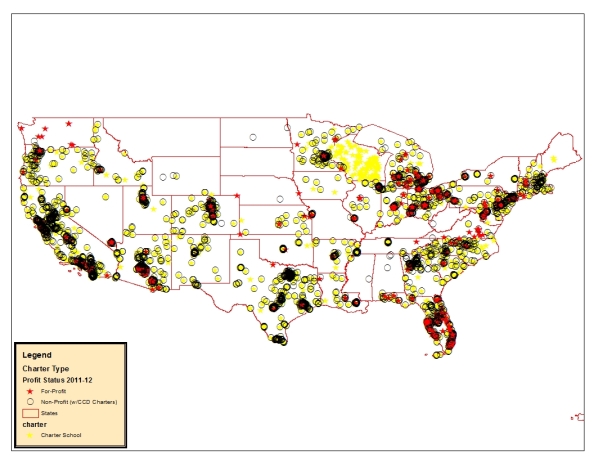
National Map


Education policy research and the rhetoric emergent from that research typically fails to represent the realities – the real distribution – of schooling across our nation. We focus extensively on urban schooling most often ignoring what might or might not work in the suburbs or rural areas. We focus on development of reading and math/STEM skills but far less on other content, knowledge or skills. We focus on measuring teacher/teaching quality through estimates of student gains in reading and math, but often ignore the contextual factors that may influence teacher effectiveness, or other less commonly measured outcomes.
These foci aren’t necessarily problematic. After all, there’s only so much we can research at any given time. The problem lies in our desire – specifically in translation to policy recommendations – to broadly extrapolate the meaning of these findings.  Sometimes, it’s a mere extrapolation problem, where researchers and well-meaning policymakers simply wish to project one finding onto an entirely different situation.
Other times, it’s a straight up bait-and-switch, where self-interested actors or advocates point to one great success, and then swap it for a cheap imitation in their own policy recommendations/proposal. It’s like holding up Exeter or Andover as examples of great private schooling to advance a voucher argument, and then providing a voucher sufficient for children to attend their local evangelical school housed in a double-wide on a vacant lot. [private school cost/spending data here]
Charter school research is, in my view, one of the most problematic areas of education policy research, especially in its translation to policy recommendations. The most extreme version of the pro-charter unregulated expansion argument goes something like this:
Look at the research on those massive gains created by KIPP schools, especially those studies done byMathematica researchers, as well as the work of Dynarski and colleagues in Boston. And hey, look at Fryer’s stuff on NYC’s ‘no excuses’ charters! This is incredible. We must move forward with all deliberate speed to replicate this!
And how must we do that – well, we really need to take the lid off this movement – no caps. Increase subsidies. Have more authorizers available to fast-track the flood of new applications from these great providers! That’s it. Move… and move now! From Arizona, to Ohio, Michigan, Florida and beyond – authorizers will ensure accountability. The few… and let me emphasize that… few… bad actors will be shut down, and these amazing providers will flourish across our great nation!
Okay… so maybe I’m overdoing it a bit. Certainly some, even those at TB Fordham institute have now admitted problems in the Ohio charter accountability process. And the folks at Brookings have raised questions about the quality of Arizona charter schools.
At least a handful of studies on high profile charter operators have yielded substantive, positive results, at Who’s actually running America’s charter schools? | School Finance 101:


Must Parents Go to Night School to Help Children with Common Core Math? - Living in Dialogue

Must Parents Go to Night School to Help Children with Common Core Math? - Living in Dialogue:

Must Parents Go to Night School to Help Children with Common Core Math?


By Anthony Cody.
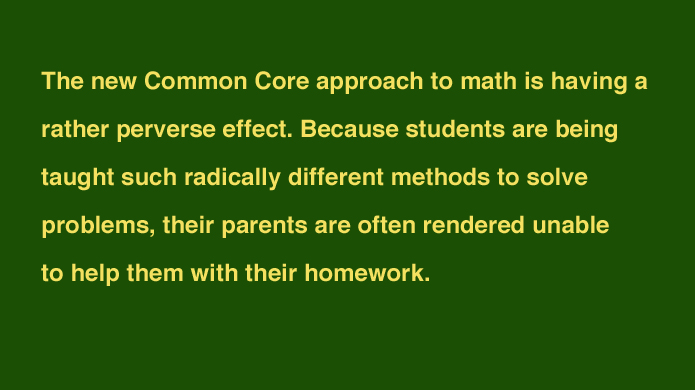
For years teachers have heard about the crucial role parents have in supporting their children’s academic progress. Extensive research shows that increased parental involvement translates into success for students. However, the new Common Core approach to math is having a rather perverse effect. Because students are being taught such radically different methods to solve problems, their parents are often rendered unable to help them with their homework. The algorithms most of us learned have been replaced. Students are taught to “decompose” numbers in order to add or subtract. Parents are now flummoxed by even second grade math work, and feel inadequate — even stupid — as a result. Some have posted math problems on Facebook or Twitter, expressing their frustration.
These methods may help students develop a better sense of the numbers they are working with, but there is a real cost – and this may result in greater inequities. Students who need help with their work are unable to get it from the people who should be their greatest source of support — their parents.
In the suburbs of Suffolk County, New York, one community college is now offering a special four-week course called “Common Core School Mathematics for Parents and Guardians.” Any guesses as to the socioeconomic status of the parents who will find the time to take special courses like this?
A classroom teacher I asked about this said,
My students’ parents work at night or they don’t have a car or they have seven kids and no way to get a babysitter. Those parents are not going to have access to something like this course, but the school across town that’s primarily white and upper-middle-class — every one of those parents are going to sign up and go. It just furthers the gap.
Most parents will not be taking these classes, and will be helpless – even embarrassed, when their Must Parents Go to Night School to Help Children with Common Core Math? - Living in Dialogue:

Thompson: Rick Hess's (& My) Lessons from Race to the Top This Week In Education:

This Week In Education: Thompson: Rick Hess's (& My) Lessons from Race to the Top:

Rick Hess's (& My) Lessons from Race to the Top 


 Some academics persist in a strange ritual - gauging greatness by the effects that government office holders have on the political process, as opposed to the results of their policies for flesh and blood human beings. Andrew Jackson and Teddy "the Big Stick" Roosevelt have been categorized as "great" because they were so effective in stealing Indians' land and leaping into imperialism. Ronald "the Great Communicator" Reagan gets high marks for the transformative nature of his politics, as the Central American death squads he supported and the destruction of blue collar jobs are forgotten.

Now, some proclaim Arne Duncan as a great transformer because he completely changed the nature of education policy. Those who celebrate Duncan's political victories, like William Howell and Joanne Weiss, remain curiously silent about the possible benefits and the costs of his school improvement experiments.
Fortunately, conservative Rick Hess's contribution to the discussion in Education Next, Lofty Promises but Little Change for America's Schools, offers a real world critique of Duncan's gambles. Hess recounts the results that matter, concluding "the breakthrough wins touted so avidly by Race to the Top enthusiasts in 2010 and 2011 now look much more like pyrrhic victories—shot through with design flaws, tainted by federal compulsion, and compromised by half-hearted follow-through." 
The lessons Hess draws from the RttT include: #2 "Execution, Not Action, Is the Goal." The first step in doing so is realizing, #7 "Paper Pledges Are Not 'Buy-In.'" The second step is #3 "Reward Pioneers, Not Groupies." All three serve as a reminder that, "The public imagination is often captured by the fact of a federal program, but what matters in schooling is how programs actually work."
One would have thought that #4 "Build Reliable Infrastructure" would have been the most obvious lesson.  Hess graciously notes, "It was no fault of the Obama administration, but the infrastructure to do Race to the Top well simply didn't exist." But, I wonder if we would be so forgiving of an engineer who built a $4 billion skyscraper without bothering to lay a foundation?
Neither can I understand why even non-educators don't pay more attention to #6 "Beware of Opportunity Costs." Hess likely would have invested in different policies than I would have, but now the money is gone, and since so few tangible improvements were produced by the RttT (and the SIG, and the rest of Duncan's gold-plated innovations), how do we make the case that more science-based education policies should be funded?
My second-favorite of Hess's lessons is #5 "Seek to Eliminate Impediments, Not to Secure New Promises." But, it may resonate better with practitioners than policy wonks, and it brings us to the point where I apparently disagree with Hess, and believe he should remain more committed to his conservative philosophy.  Some may see the lifting charter caps and removing data firewalls that prohibit the linking of test scores with individual teacher's evaluations as impediments. But, it should be local governments that decide how many charters they can authorize and still pay their utility bills and maintain their essential overhead.
Similarly, when the federal government coerced states into using value-added models - that were invalid and unreliable for evaluating individuals - it opened the door to the new tsunami of teach-to-the-test that wrecked the push for college readiness standards. I wonder if Hess had been in Duncan's shoes whether he would have accepted a compromise where the federal government knocked down those data firewalls in order to gain information about increases in student performance but without demanding that those guess-timates be used to hold individuals accountable.  
Hess's best lesson is #1 "First, Do No Harm."  Understandably, Hess focuses on policy from a macro perspective, noting that "the pressure to pursue proposals like Common Core testing and testThis Week In Education: Thompson: Rick Hess's (& My) Lessons from Race to the Top:

Anti-Bullying School Policies Continue to Fail LGBT Students - NEA Today

Anti-Bullying School Policies Continue to Fail LGBT Students - NEA Today:

Anti-Bullying School Policies Continue to Fail LGBT Students


bulliedstudent-copy


Research has consistently shown that schools with strong, inclusive policies for lesbian gay, bisexual and transgendered (LGBT) youth create safer learning environments. Designing and implementing effective anti-bullying policies are obviously key to this effort, but, according to the Gay, Lesbian, and Straight Education Network (GLSEN), most school districts have been falling short.
In the new report, Statehouse to Schoolhouse: Anti-Bullying Policy Efforts in U.S. States and School Districts, GLSEN examined anti-bulling policies in more than 13, 000 districts and found that the vast majority do not have policies that explicitly protect LGBT students.
“The report illustrates the gap that can emerge between the intentions of a law and the actual implementation – arguably the most critical component of the passage of any law,” explains GLSEN Executive Director Dr. Eliza Byard. “There remain far too many school districts that have failed to institute policy protections, even in states which require them by law.”
Although most districts have anti-bullying school policies on the books, their effectiveness is undermined by a number of factors. According to GLSEN, a successful program must include specific protections for all individual groups (based on race, gender, ethnicity, actual or perceived sexual orientation, and gender identity/expression), strong accountability provisions and professional development for school staff.  GLSEN found that only 3 percent of district anti-bullying policies included all three elements.
LGBT_bullying
Although the majority of districts with policies enumerate at least one group of protection to students, less than half include specific protections for students based on sexual orientations, and only 14 percent did so for students based on gender identity/expression.
In addition, less than one-third mandated reporting requirements to the district and/or states, and only a quarter required professional development for staff on Anti-Bullying School Policies Continue to Fail LGBT Students - NEA Today:

Child Poverty Among Blacks and Hispanics Persists as U.S. Fails to Address Its Causes | janresseger

Child Poverty Among Blacks and Hispanics Persists as U.S. Fails to Address Its Causes | janresseger:

Child Poverty Among Blacks and Hispanics Persists as U.S. Fails to Address Its Causes


Two new reports document very troubling rates of high poverty among children in the United States. As a society we ought to be ashamed that we tolerate devastating child poverty and residential economic segregation without concerted policy strategies to ameliorate challenges for the children.  African American children are most seriously affected.
In the NY Times, Sabrina Tavernise summarizes new data from the Pew Research Center:  “Black children were almost four times as likely as white children to be living in poverty in 2013, a new report has found….  (T)he poverty rate has remained stable for black children, while it fell for Hispanic, white and Asian children, a sign of just how pervasive and stubborn poverty has been for African American children…. About 38.3 percent of black children lived in poverty in 2013, nearly four times the rate for white children, at 10.7 percent.  About 30.4 percent of Hispanic children and 10.1 percent of Asian children live in poverty.  For the first time since the federal government started collecting the data, the number of black children in poverty appears to have overtaken the number of poor white children, even though white children far outnumber black children in the American population…”  The federal poverty rate is currently $23,624 for a family of four.
Reporting that the economy is finally rebounding but that child poverty remains alarmingly high for African American and Hispanic families, the Annie E. Casey Foundation explores the same problem in its 2015 Kids Count Data Book, released earlier this week: “Although new job growth has occurred at all wage levels, it has been disproportionate in low-wage sectors, such as retail and food services, and in some of the lower-wage positions within health care and home care.  And a stagnating federal minimum wage has exacerbated low wages.  During the last three months of 2014, the unemployment rate for whites and Asian Americans was roughly 4.5 percent, compared with a devastating 11 percent for African Americans and 6.7 percent for Latinos…  As of April 2015, 17.6 percent of African American workers and 14.4 percent of Latino workers were jobless or working only part time when they wanted full-time work.” “Compounding this issue, low-wage hourly jobs are increasingly subject to unpredictable and irregular schedules, which makes it difficult for parents to arrange child care and transportation; erratic schedules also lead to volatile incomes.”
The Annie E. Casey Foundation advocates a “two-generation approach” to helping America’s poorest children.  “The best way to facilitate optimal outcomes for today’s children is to address their needs, while providing tools and assistance to their parents.”  Parents need jobs that pay a living wage: “State and federal programs that boost income, including the Earned Income Tax Credit and Supplemental Nutrition Assistance Program (SNAP), help individual families a great deal.  But ultimately, we cannot sustain a healthy national economy without more jobs that pay higher wages… Individuals who are willing to work hard should be able to provide for their families.  We don’t need to accept the current proliferation of low-quality Child Poverty Among Blacks and Hispanics Persists as U.S. Fails to Address Its Causes | janresseger