Latest News and Comment from Education

Friday, June 19, 2015

Proposed Law in California Could Expand Ethnic Studies Electives - Living in Dialogue

Proposed Law in California Could Expand Ethnic Studies Electives - Living in Dialogue:

Proposed Law in California Could Expand Ethnic Studies Electives



By Anthony Cody.
In California, legislators will soon have a chance to approve AB 101, a new law that would task the state superintendent with developing a plan to promote the creation of elective courses in ethnic studies across the state.
Ethnic studies is clearly important for students of color, who find themselves marginalized in society, and in our curriculum as well. Students need to see themselves and their ancestors represented in the history they learn. This is a basic human right – not to be made invisible, but instead to be seen and have their stories told. Ethnic studies is also of great potential benefit to all of society, in that learning about systemic racism allows us to confront it directly. Research has shown that ethnic studies and diversity courses benefit students of color and whites as well.
Jose Lara, vice president of the El Rancho Board of Education, explained this:
Studies show that Ethnic Studies empowers students to preform academically and think critically. It is an educational justice demand teachers and students have been making since the modern civil rights movement. It is our duty as board members to listen to the people and follow the research that says Ethnic Studies improves academic achievement and a more equitable society.
Some of the research that Lara is referencing was done in Tucson, Arizona, where a strong program in Mexican American Studies (MAS) was dismantled a few years ago by Republican state leaders (as Iwrote about in 2010). Four University of Arizona professors investigated the program to determine its impact, and what they found was remarkable. Their report, available here, discovered that the program had a strong positive effect on students:
The MAS students had significantly lower 9th- and 10th-grade GPAs as well as 10th-grade AIMS scores than their non-MAS peers. However, they had significantly higher AIMS passing and graduation rates than their non-MAS peers, which seems counterintuitive. Decades of findings from education research would lead us to expect higher 9th- and 10th-grade GPAs and higher 10th-grade standardized test scores to be positively correlated with higher graduation rates (Alexander, Entwisle, & Horsey, 1997; Rumberger, 2011). Instead, we found the MAS students outperformed their non-MAS peers in terms of AIMS passing and graduation despite having 9th- and 10th-grade 
Proposed Law in California Could Expand Ethnic Studies Electives - Living in Dialogue:


 Embedded image permalink

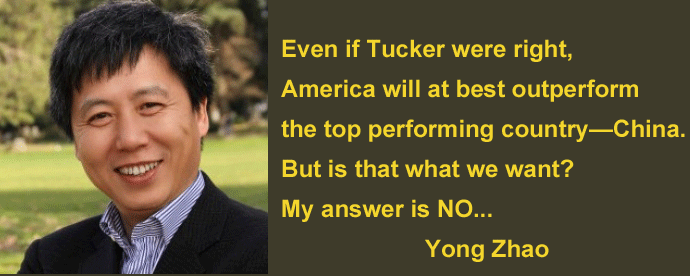
Yong Zhao What should we learn from Asia’s school systems?

Education in the Age of Globalization » Blog Archive » Lessons that Matter: What should we learn from Asia’s school systems?:

 What should we learn from Asia’s school systems?


Executive Summary [full report]

Interest in learning from Asia’s high-performing education systems has grown rapidly in recent years. A flurry of research reports, media stories, and personal accounts of how Asia’s best education systems achieved their superb rankings on international league tables has been produced in the quest to improve education systems around the world (OECD, 2011) (Tucker, 2011) (Tucker, 2014) (Jensen, 2012) (Barber, Donnelly, & Rizvi, 2012). However, most of the popular observations and suggestions fail to point out the most important lessons to be learned from Asia.
The lessons from Asian education systems do not relate to what helped them achieve their high scores on international comparative tests, but to the efforts they have engaged in over the past few decades to transform their educational practices. These efforts are often mistaken for policies and practices designed to produce the high academic performances indicated by international tests, while in reality they are intended to create a different kind of education, an education deemed necessary for cultivating citizens in the twenty-first century.
In other words, what Asia’s high-performing systems have to offer the world is not their past, but the future they intend to create. It is their vision of a new education and the courage to make changes to long-held traditions and cultural practices.
This report is based on studies of reform efforts in Asia’s high-performing education systems, specifically in Hong Kong, Korea, Singapore, and Shanghai, which have been undertaken over the past three decades. This report is not about ‘catching up’ to the Asian school systems in international rankings, for even if we could learn everything and take 10 years to do so (which is next to impossible), in that time the world will have changed so much that a new order of education will be required.
Over the past few decades, these four Asian education systems have engaged in massive reform efforts. Although these efforts have had varying degrees of success, and some have resulted in consequences opposite to their intentions, they represent a strong desire to create education systems that are more fitting for the future. The reform efforts have been characterised by the following:

Expanding definition of education outcomes

All four East Asian systems have been implementing reforms that expand the definition of education outcomes beyond academic performance in a narrow set of subjects. They are targeting skills commonly known as twenty-first century skills such as creativity, communication, collaboration, and higher order thinking skills are what they are after. They are also interested in student social-emotional and physical health.

Improving equity of educational opportunities

All these systems have been working on major reforms to improve equity of opportunity, not just in terms of curriculum and pedagogy, but also and perhaps more important in resources and access.
They are removing regulations and laws that previously purposefully created inequity, challenging the tradition of meritocracy and creating new opportunities.

Loosening central control

These systems (except for Hong Kong) are traditionally centralised, but in recent years they have been gradually loosening central control. Local governments and schools have been granted more autonomy in curriculum, pedagogy and assessment.

De-emphasising testing

These systems have all recognised the dangers of over-testing students and have enacted policies and efforts to reduce the importance of standardised and centrally administered testing.

Transforming pedagogy from knowledge transmission to inquiry-based and constructivist

The Asian systems have engaged in massive efforts to transform pedagogy, to move away from their traditional approach of direct instruction that emphasises knowledge transmission and rote-memorisation toward a constructivist approach that is more student-centred and inquiry-based.

Capitalising on technology

The East Asian education systems have strong future orientation. They are employing emerging information and communication technologies for improving education and developing digital literacies.

Broadening the curriculum

The systems have enacted curriculum reforms to broaden students’ education experiences beyond the traditional academic subjects, while strengthening the core subjects. Stressing moral education, the arts, physical education, and social skills are a common theme of reforms in these systems.

Reducing the academic burden

Policies and actions have been implemented to reduce student academic burdens, to reduce the amount of time devoted to school subjects outside school, and to reduce the pressure of schoolwork.

Obama Admin Pressures Colleges to Adopt Unconstitutional Speech Codes | CNS News

Obama Admin Pressures Colleges to Adopt Unconstitutional Speech Codes | CNS News:

Obama Admin Pressures Colleges to Adopt Unconstitutional Speech Codes


Under the Obama administration, the Education Department has pressured schools and colleges to restrict speech, including off campus speech, even when it is protected by the First Amendment, and is not severe and pervasive. It claims this is required by federal anti-discrimination laws such as Title IX and Title VI. It also expects colleges to investigate off-campus sexual misconduct by students, even though most federal appellate court rulings say schools have no such duty under Title IX. 
As I recently noted in The Wall Street Journal, “the Education Department, where I used to work,” is
“pressuring colleges to adopt unconstitutional speech codes in the name of fighting sexual harassment. It has disregarded many court rulings in doing so.
“For example, the Education Department has wrongly ordered schools to regulate off-campus speech and conduct. That contributed to the harassment charges against Prof. Laura Kipnis, who was accused over a politically incorrect essay she wrote in the Chronicle of Higher Education and statements she made on Twitter. Court rulings like Roe v. Saint Louis University (2014) reject Title IX claims over off-campus conduct, but the Education Department ignores them. It also ignores court rulings like Klein v. Smith (1986) emphasizing that the First Amendment usually bars public schools from restricting off-campus speech. For example, the Education Department told schools to regulate comments ‘on the Internet’ in an October 2010 letter. In 2014, it demanded that Harvard regulate off-campus conduct more.”
At Northwestern University, Professor Laura Kipnis was subjected to a bizarre Title IX investigation over an essay in the Chronicle titled “Sexual Paranoia Strikes Academe” (which hypersensitive students claimed offended them and constituted sexual harassment) and her subsequent statements defending herself on Twitter (which the students claimed constituted “retaliation” in violation of Title IX, even though she did not identify them by name). Kipnis was ultimately found not guilty.
Although it eventually became clear that nothing Kipnis did violated Title IX, Northwestern probably felt obligated to subject Kipnis to that chilling, lengthy, and extensive investigation due to improper mandates issued by the Education Department’s Office for Civil Rights (OCR), which make it hard to summarily dismiss weak or baseless Title IX complaints.  
As I have discussed earlier, OCR issued such mandates in violation of the Administrative Procedure Act’s notice-and-comment provisions, a disturbing practice frequently committed by the Education Department. A federal appeals court in a different part of the country ruled in White v. Lee (2000) that lengthy, speech-chilling civil rights investigations by government officials can violate the First Amendment even when they are eventually dropped without imposing any fine or disciplinary action. But Northwestern is a private university.
OCR’s mandates wrongly extend Title IX to off-campus speech and conduct, and pressure colleges to investigate even if the speech or conduct alleged is not severe and pervasive. The Supreme Court's 1999 decision in Davis v. Monroe County Board of Education requires proof that conduct was severe andpervasive to violate Title IX, emphasizing five times that it must be “severe, pervasive, and objectively offensive.”  
OCR, to the contrary, deems colleges liable for sexual harassment based on conduct that is merely “persistent” or “severe” or “pervasive.” Professor Kipnis may have been “persistent” in expressing her views, but there was nothing "severe" and "pervasive" about them, or the way she expressed them.
OCR sometimes expects colleges to nip harassment in the bud by taking draconian measures against speech that does not legally amount to sexual harassment, such as when it told the University of MontanaObama Admin Pressures Colleges to Adopt Unconstitutional Speech Codes | CNS News:

Schools Matter: Four of Memphis's Worst Charters with the Best Political Connections Will Remain Open

Schools Matter: Four of Memphis's Worst Charters with the Best Political Connections Will Remain Open:

Four of Memphis's Worst Charters with the Best Political Connections Will Remain Open


Since Gates and the oligarchs put Supt. Dorsey Hopson in charge of the charterization of public schools in Memphis, Shelby County Schools has been in a lather to close as many "low-performing" schools as possible.

Early in 2014, Hopson was adamant that it all comes down to poor student achievement and that the children have suffered long enough.  The emergency had been declared, and no one could wait another year or another month for low-scoring schools to improve.

Early in 2013, eleven public schools were targeted for conversion, and in in 2014, thirteen more were put on the list for closure.

Memphis now has over 40 corporate reform charter schools that are bleeding the public schools' budget dry each year.  More terminations, more cutting of services, more shrinkage of teacher benefits and retirement plans. 

Increasing austerity is required in order to benefit the politically connected corporate welfare kings who run the charter chain gangs. As a result, the remaining public schools are further weakened, demoralized, and made ready for charter conversion.

Now suddenly we find that the achievement emergency has been put on hold, at least for the worst charter schools in Memphis that are owned by Senator Cory Booker's brother and his crony pals.  Without warning, the Shelby County School Board has decided not to close the four charters at the bottom of the achievement barrel in Memphis, and to give them at least three more years to miseducate children.  

In order to keep the revenue stream flowing into the pockets of the the politically connected crooks who run these segregated fake schools, the children of unwitting parents must continue in these hellholes, where they are psychologically abused and educationally cheated. 

In case you are wondering, this moratorium on closing low scoring schools does not apply to the public schools on the priority list, even if those schools are improving.  From Chalkbeat Indiana:


The same month they were slated to close their doors forever due to low academic performance, three Memphis charter operators received notice from Shelby County Schools that their schools will remain open for the upcoming school year.

City University School Boys Preparatory, Southern Avenue Middle School, and Omni Prep Academy Lower and Middle Schools are on the priority list of the state’s 5 percent of worst performing schools, making their closure mandatory this summer under a 2014 state law. However, a new law passed this year by the legislature gave districts discretion in deciding whether the schools should remain open for now.

“In light of the recent change in legislation that amended [the 2014 law], this letter is to notify you that district will Schools Matter: Four of Memphis's Worst Charters with the Best Political Connections Will Remain Open:

Teachers: Who’s on your side? Where can you go for people dedicated to truth-telling for democracy? | Reclaim Reform

Teachers: Who’s on your side? Where can you go for people dedicated to truth-telling for democracy? | Reclaim Reform:

Teachers: Who’s on your side? Where can you go for people dedicated to truth-telling for democracy?

There are times when a teacher needs to have the facts, simple or complex. For complex information, very often there are multiple facets that need to be examined from different points of view. Who can you turn to when faced with the overwhelming problems that surround you? Who has no personal power base or money to gain from the information? What group of people will offer you unbiased facts and their experienced perspectives for you to consider?
EdBlogNet
The EduBloggersNetwork, a group of over 200 individual bloggers with solid education backgrounds and unique perspectives from schools across the country, are respected for their varied experiences and focus. They do not march in lock-step nor are they paid by billionaires and their tax-free mega-wealthy foundations which are heavily invested (for profit) in corporate education reform.
During one of the online conversations that questioned each blogger’s reasoning for blogging in support of teachers against incredible pressures backed by billionaire investors, one blogger’s comment in particular touched the heart of the subject.
“I read many blogs on education and many of the articles that hit the alternative mainstream opinion media, such as Huffington Post and Salon. And yet when I talk to well-educated progressive public school parents in the Bay Area, I find myself explaining the corporate takeover of public schools from square one. People are fascinated, yet almost cannot stomach yet one more terrible thing going on in our world- and something so deeply personal 
Teachers: Who’s on your side? Where can you go for people dedicated to truth-telling for democracy? | Reclaim Reform:


Bernie Sanders and Martin O'Malley Talk Testing, Equity With Teachers Union Chief - US News

Bernie Sanders and Martin O'Malley Talk Testing, Equity With Teachers Union Chief - US News:

Chasing Clinton, Sanders and O'Malley Court Teachers Unions

Both candidates say teachers need flexibility to take a more holistic approach to education.


NEA President Lily Eskelsen García met with U.S. Senator Bernie Sanders June 18, 2015, as part of the association’s recommendation process for the 2016 presidential campaign.
National Education Association President Lily Eskelsen García talks with Sen. Bernie Sanders on Thursday at the association's headquarters in Washington.


The nation's two largest teachers unions are in the thick of their 2016 presidential endorsement processes, having met with the three major Democratic candidates who have announced their candidacies.
On Thursday, Sen. Bernie Sanders – an independent from Vermont running for the Democratic nomination – and former Maryland Gov. Martin O'Malley met with Lily Eskelsen Garcia, president of the National Education Association. Both the NEA and the American Federation of Teachers – the nation's largest teachers union after the NEA – now have heard from O'Malley, Sanders and front-runner Hillary Clinton at a time when the party each hopes to represent in the White House is divided over how to improve K-12 education in America. 
"We are asking the tough questions that get to the heart of the issues that educators, their students and families are facing every day. They see what is happening in their schools and communities. They know that all students deserve the support, tools and time to learn," Eskelsen Garcia said in a statement. "But are politicians willing to commit to the success of every student regardless of his or her ZIP code? That is the key question that educators will ask over and over again."
So far, all three candidates have focused on framing education as an economic imperative that creates the clearest path to the middle class. They've also put a focus on the needs to reduce standardized testing in schools and empower teachers – desires the unions share – while staying away from more controversial topics such as teacher tenure and evaluation systems, school choice and Common Core.
Sanders is the only candidate so far to focus on problems with No Child Left Behind in his remarks to the unions, according to excerpts provided by the NEA and AFT.
Sanders, who serves on the Senate education committee, said there are few others as opposed as he is to the sweeping education law – which Congress is attempting to update – and to "this absurd efforBernie Sanders and Martin O'Malley Talk Testing, Equity With Teachers Union Chief - US News:

Over 100 Holyoke teachers to leave by choice or otherwise, including union president Gus Morales | masslive.com


Over 100 Holyoke teachers to leave by choice or otherwise, including union president Gus Morales | masslive.com:

Over 100 Holyoke teachers to leave by choice or otherwise, including union president Gus Morales


HOLYOKE -- As the end of the school year approaches, more than 100 of Holyoke Public Schools teachers are on the market looking for new work or choosing to retire.
Across the district, 78 teachers have been asked not to return to Holyoke schools next year. 54 are teachers with non-professional status, meaning they haven't held their position for more than three years, were non-renewed. Four teachers with professional status were also let go.
When asked why many were non-renewed, Jackie Reis, media relations coordinator for the Massachusetts Department of Elementary and Secondary Education, spoke generally. "Districts don't need to give a reason when a teacher lacks professional status. Some don't have the right license, others may have a one-year contract filling in for another teacher." 
Open positions are expected to be filled by the start of the school year. 
Another 20 teachers worked in the district without accreditation but were hired for their work experience. They were hired with a waiver that allowed them to get around the accreditation process. Many of the teachers working with a waiver were at Dean Technical High School. Their waivers expire this summer and have not been renewed. Reis said there's a chance they could re-apply to work within the district.
These teachers are 16 percent of the total district teaching staff in 2015. 
Holyoke Teachers Association President Gus Morales said another 30 teachers have announced plans to retire or leave the district for other teaching opportunities. He said many have chosen to take early retirement with a pension cut and others will move to another district because of uncertainty under state receivership. 
15707044-mmmain.jpg

"We're losing some fantastic teachers," Morales said. "I thought morale was low last year but it is lower this year." 
He added that he expects more teachers to resign during the summer as they're hired to work in other districts. 
The number of teachers non-renewed this year is lower than last summer when 87 were let go. The number of teachers between 2014 and 2015 decreased from 575 to 488. Student enrollment has remained stagnant, at 5573 for the past two years. Cuts were made last year to close a $4.5 million budget deficit
Members of the state receivership team will host a meeting on Monday to discuss the upcoming school year's budget, which is expected to discuss closing another budget Over 100 Holyoke teachers to leave by choice or otherwise, including union president Gus Morales | masslive.com:

FOM: A “New” CCS (Coalition for Community Schools) | commoncorediva

FOM: A “New” CCS (Coalition for Community Schools) | commoncorediva:

FOM: A “New” CCS (Coalition for Community Schools)


It's Friday, you know what that means! Time to measure what's truth, what's fallacy/fib or what's in between.


The “Fib-o-Meter” is back and ready to bust open the fallacies, fibs, half truths, or whole truths about the OTHER CCS (Common Core Standards). Today’s look is into the IEL (Institute for Educational Leadership) and its CCS (Coalition for Community Schools). Is it tied to the Common Core? If so, how? Is it part  of the plan to have aligned communities like those in the ‘cradle to career’ movement of ‘Strive Together’? (*Note: ST is associated with the Chief Council of State School OfficersKnowledgeWorks, and other pro CCSS Machine members). Let’s crank up the “Meter” and see what we can find!
IEL, Institute for Educational Leadership:
Its website: http://iel.org/
If you visit their website, be sure to head directly to the “About Us” page and click on the word “Staff” to find the “Total Truths” of current or former associations with other groups each member has. You’ll find organizations like the NEP (National Education Policy), Workforce Development, education reformers, and a more than healthy dose of social justice causes. You still with me? I hope so. Let’s see what else “Fib-o-Meter” can find…
Their Board of Directors is a big dose of “Total Truth” or more like a who’s who among some of the CCSS Machine members. For example, Dr. June Atkinson (the president of the Council of Chief State School Officers as well as the NC State Superintendent for Public Schools), The IEL website only uses  her NC title as her employer. “Total Truth”? No way! (If you missed Dr. A’s presidency, see: http://www.ccsso.org/News_and_Events/Press_Releases/CCSSO_Welcomes_New_President_and_Board_of_Directors-x2650.html )
Other pro CCSS represented groups: Data Quality Campaign, Harvard University, Scholastic Books, Learning Matters, and many others. To find the entire “Total Truth” for yourselves, go to the “About Us” tab, and click on “Board of Directors”.
Well, are you ready to see what else “Fib-o-Meter” has uncovered about the Coalition  for Community School’s parent organization? I am!
The Gates Foundation has granted IEL many dollars from ‘before 2009′ to 2011. “Fib-o-Meter” found this “Total Truth” on the Gates Foundation Grants Page. You can too. See:
http://www.gatesfoundation.org/How-We-Work/Quick-Links/Grants-Database#q/k=IEL
Another “Total Truth” about IEL is that it is working to ensure key points are embedded inFOM: A “New” CCS (Coalition for Community Schools) | commoncorediva: 

When Charters Go Union

When Charters Go Union:

When Charters Go Union

Most charter school funders hate unions and unions generally hate charters. But more and more charter teachers want to unionize, and labor is helping them do it. 


This is a sneak peek at an article set to run in the upcoming Summer 2015 issue. 
The April sun had not yet risen in Los Angeles when teachers from the city’s largest charter network—the Alliance College-Ready Public Schools—gathered outside for a press conference to discuss their new union drive. Joined by local labor leaders, politicians, student alumni, and parents, the importance of the educators’ effort was not lost on the crowd. If teachers were to prevail in winning collective bargaining rights at Alliance’s 26 schools, the audience recognized, then L.A.’s education reform landscape would fundamentally change. For years, after all, many of the most powerful charter backers had proclaimed that the key to helping students succeed was union-free schools.
One month earlier, nearly 70 Alliance teachers and counselors had sent a letter to the administration announcing their intent to join United Teachers of Los Angeles (UTLA), the local teachers union that represents the 35,000 educators who work in L.A.’s public schools. The letter asked Alliance for a “fair and neutral process”—one that would allow teachers to organize without fear of retaliation. The administration offered no such reassurance. Indeed, April’s press conference was called to highlight a newly discovered internal memo circulating among Alliance administrators that offered tips on how to best discourage staff from forming a union. It also made clear that Alliance would oppose any union, not just UTLA. “To continue providing what is best for our schools and our students, the goal is no unionization, not which union,” the memo said.
The labor struggle happening in Los Angeles mirrors a growing number of efforts taking place at charter schools around the country, where most teachers work with no job security on year-to-year contracts. For teachers, unions, and charter school advocates, the moment is fraught with challenges. Traditional unions are grappling with how they can both organize charter teachers and still work politically to curb charter expansion. Charter school backers and funders are trying to figure out how to hold an anti-union line, while continuing to market charters as vehicles for social justice.
Though 68 percent of K-12 public school teachers are unionized, just 7 percent of charter school teachers are, according to a 2012 study from the Center for Education Reform. (And of those, half are unionized only because state law stipulates that they follow their district’s collective bargaining agreement.) However, the momentum both to open new charter schools and to organize charter staff is growing fast. 

IRONICALLY, THE FIRST MAJOR PROPOSAL to establish charter schools came from the nation’s most famous teacher union leader. At the National Press Club in 1988, Albert Shanker, the president of the American Federation of Teachers (AFT), gave a speech outlining a “new type of school.” Shanker envisioned publicly funded but independently managed schools, which would be given the space to try out new educational approaches and would continue to receive public dollars so long as their approaches proved to be effective. These schools would act as educational laboratories, testing grounds of new and better practices that could then be adopted by traditional public schools. A few months after his speech, Shanker dubbed his idea “charter schools,” in a reference to explorers who received charters to seek new land and resources. Later that year, the 3,000 delegates at the national AFT convention endorsed When Charters Go Union:

Jerry Brown and CA Legislature Demonstrate Support for Public Education in State Budget | janresseger

Jerry Brown and CA Legislature Demonstrate Support for Public Education in State Budget | janresseger:

Jerry Brown and CA Legislature Demonstrate Support for Public Education in State Budget


Summer weather is being intensified by the heat of the state budget season—a time when, in too many places, the cost of tax cutting and privatization of the public schools is being represented clearly in dollars and cents.  And today’s attack on the common good is bipartisan.
new report shows that New York’s Democratic governor, Andrew Cuomo, and the NY legislature have been the target of $13 million in lobbying in the past year to push the expansion of charters and a tuition tax credit voucher program—both hot topics in NY’s budget debate—with Cuomo leading the charge for privatization and vouchers.
Another report explores the impact of pro-charter school lobbying on the Democratic governor of Connecticut, Dan Malloy—money from people like Jonathan Sackler, who made his fortune producing Oxycontin at Purdue Pharma, and who is the founder of ConCAN (which is part of a nationwide, Sackler supported, coalition of far-right privatizers, 50-CAN). In an opinion piece in the Stamford Advocate, Wendy Lecker explains: “Governor Malloy’s tenure has been characterized by denigrating teachers, vigorously opposing adequate funding of public schools and vastly increasing financial support for privately run charter schools…. Why would Malloy favor these questionable privately run schools over underfunded public schools?… The web of charter money is so thick it must have blinded Malloy to the needs and wishes of constituents from Stamford and Bridgeport.”
And  in the middle of the country, Kansas Governor Sam Brownback, a Republican and radical income-tax slasher, was forced to raise sales and cigarette taxes to keep the state from going broke—the predictable result of his deep income tax cuts enacted last year.  No matter that regressive sales and cigarette taxes eat up a larger percentage of the income of poor people, Brownback had bragged about his adherence to far-right orthodoxy, in his belief that the income tax cuts that have left his state on the verge of bankruptcy will eventually grow the economy.  John Hanna explains in an Associated Press report: “Kansas found itself in such a deep budget hole because the tax cuts implemented in 2013 initially led to a steep fall in revenue that has still not reversed as much as Brownback had hoped.  For the fiscal year beginning next month, the state estimated in mid-April that it would face a shortfall of 12 percent of its general fund budget.”  Hanna explains further: “Brownback and his GOP allies managed to avoid backtracking on past reductions on income tax rates… Instead,  Jerry Brown and CA Legislature Demonstrate Support for Public Education in State Budget | janresseger:

CURMUDGUCATION: Monsters + Sweden vs. Nevada

CURMUDGUCATION: Monsters:

Monsters


When somebody does something awful, my most immediate response is to wonder what was going on in their head that made that action seem okay. See, I believe that the vast majority of people try to do what they believe is right, what is in line with the rules for how the world is supposed to work. Even the most horrible acts are somehow, in their perpetrator's mind, okay.

Sometimes it's because that person's mind really is broken. When someone starts taking orders from the voice of Satan speaking through a dog, his perception of reality is so twisted that it's hard to imagine how he ended up in that dark and distorted place where it's okay to kill people you don't even know. But Son of Sam type killers are not the norm.

I don't think I believe in monsters. At least, I don't believe that monsters are somehow fundamentally different from the rest of the non-monstrous population. I think monsters are people who have found a way to see doing something monstrous as okay. And while I believe that each of us is ultimately responsible for our own choices, I also believe that as a culture, we grease the downward path to certain dark conclusions.

Humans are hardwired against killing other humans, and so the first step toward killing someone else is to see that person as not-a-person, not really human. A person, of course, is someone like me, someone who thinks, feels, reacts, believes as I do. Not-persons act out of some other set of impulses and motivations that I cannot comprehend.

Our culture is depressingly adept at labeling not-persons. Our entertainment narratives repeatedly hammer home that persons are white guys, and women and not-white guys are persons to the extent that they come close to the white guy. Our politics have become heavily infected with the idea o
CURMUDGUCATION: Monsters:

Sweden vs. Nevada
Folks who are excited about Nevada's joyful embrace of choice-on-steroids might want to take a look at Sweden.

As my esteemed colleague Edushyster reminds us, the all-choice system experiment has been tried. Sweden has been creating an all-choice, all-privatized system for decades, and it has not gone well.

"It was in the early 2000s that the Swedish school system somehow seems to have lost its soul. Schools began to compete no longer on delivering superior quality but on offering shiny school buildings in shopping centres, and I think that’s the issue we are really seeing." Andreas Schleicher, OECD.

I am going to keep repeating this line until it starts to sink in:

The free market does not foster superior quality; the free market fosters superior marketing.

We have our own free-market education laboratory-- post-secondary education. As you may have heard, the cost of college has expanded like a hamster clamped onto a helium tank. There are a variety of suspects, all instructive.

One theory is that costs are driven up by the amount of money people have to spend. Student aid has been climbing, which has had the same effect on costs that you could expect if you went to a used car lot and announced, "Oh, I though I only had ten grand to spend on a car, but it turns out I actually have fifteen." (Hint: the salesman does not say, "Oh, put that extra five K away-- you won't need it for anything.")

Some analysts blame frills, like Schleicher's "shiny school buildings." Parents who drop their children off at schools far nicer than their own add anecdotal punch to this idea. Why do schools add frills? Because a frill is good, easy marketing, and because not all customers in the marketplace are driven by rational consideration of educational quality.

Other analysts have noted the increase in administrators. More money, more students, more facilities, more marketing = more people in charge.

All of this is predictable by the what I'm going to call the Jobs Effect, from an interview with Steve Jobs in which he observed that past a certain point, improving your product does not make you more 

Sweden vs. Nevada

Is Teaching a Profession, an Occupation, a Calling, or a Job? | Taking Note

Is Teaching a Profession, an Occupation, a Calling, or a Job? | Taking Note:

Is Teaching a Profession, an Occupation, a Calling, or a Job?


“So, are they quitting because they’re fed up with their heavy-handed union bosses?” The hostility of the question took me by surprise. I was explaining to my dinner companion, a veteran lawyer, that 40% of teachers leave the field within five years, and right away he jumped to his anti-union conclusion disguised as a question.
No, I explained. Unions don’t seem to have anything to do with it; it’s most often related to working conditions: class size, discipline policies, and how much control and influence they have over their daily activities.
“It’s not money?” he asked, aggressively suspicious. Not according to surveys, I explained.
I described what I’d seen of a teacher’s daily work life. He interrupted, “How can it be a profession if you can’t take a leak when you need to?”
While that’s not a criterion that social scientists use to define a profession, my cut-to-the-chase acquaintance might be on to something.
Can teaching be a true profession if you can’t take a bathroom break when nature calls?
Certainly, teachers and their supporters want teaching to be seen as a profession. They’ve won the linguistic battle. If you Google ‘the teaching profession,’ you’ll get 153,000,000 references, while ‘teaching as an occupation’ and ‘the teaching occupation’ produce only 67,000,000.
Social scientists have no doubt about status of teaching, according to Richard Ingersoll of the University of Pennsylvania. “We do not refer to teaching as a profession. It doesn’t have the characteristics of those traditional professions like medicine, academia, dentistry, law, architecture, engineering, et cetera. It doesn’t have the pay, the status, the respect, the length of training, so from a scientific viewpoint teaching is not a profession.”
He carefully refers to teaching as an occupation, noting that it’s the largest occupation of all in the USA. And growing at a faster rate than the student population.
Jennifer Robinson, a teacher educator at Montclair State University in New Jersey, disagrees with Ingersoll. She believes our familiarity with teachers and schools breeds disrespect for teaching. “We don’t treat teaching as a Is Teaching a Profession, an Occupation, a Calling, or a Job? | Taking Note:

Study: Educators in Columbus, other urban districtsget lower marks than rest of state

Study: Educators in Columbus, other big districts get lower marks than rest of state | The Columbus Dispatch

Study: Educators in Columbus, other big districts get lower marks than rest of state


 Ohio’s new teacher-evaluation system offers a positive picture in its first year: About 90 percent of teachers were rated “accomplished” or “skilled” — the top two ratings of a system that relies on student test scores.

But looking at the data across districts, a two-year study by the Ohio Education Research Center found that evaluation ratings varied, notably in urban districts compared to rural and suburban ones.
Nearly 19 percent of teachers in the state’s Big 8 districts (Akron, Canton, Cincinnati, Cleveland, Columbus, Dayton, Toledo and Youngstown) were rated as either “ineffective” or “ developing,” compared to only 8 percent of their colleagues in other districts in the 2013-14 school year.
Similar gaps were also pronounced among principals: Roughly 28 percent were either “ineffective” or “developing,” compared to only 9 percent of their colleagues in suburban and rural districts.
Teachers and administrators in charter schools were also more likely to receive lower ratings than their peers in school districts; 25 percent of teachers and 18 percent of administrators were given “ineffective” or “developing” ratings.
Districts with higher student poverty tend to have higher proportions of educators rated “ ineffective” or “developing” — an area that warrants further examination, said Marsha Lewis, a lead researcher on the study, “Ohio’s Student Growth Measures: A Study of Policy and Practice.”
She said one year’s worth of data is not enough to explain the link, whether it is poor-performing teachers or disadvantaged students not making enough progress.
“We wanted to look at the first year of the transformational change in the way the state of Ohio evaluates its teachers and principals,” said Lewis, an assistant professor at Ohio University’s Voinovich School of Leadership and Public Affairs. “It helps illuminate what the key research questions are going to be in the next couple of years.”
Lewis noted another area of interest among researchers: Teachers in non-core academic areas that relied on district-created assessments to measure growth had higher ratings than their peers who taught reading and math and whose results were based on state tests.
The difference was not lost on teachers: 76 percent of teachers surveyed for the study felt the variety of assessments didn’t make for Study: Educators in Columbus, other big districts get lower marks than rest of state | The Columbus Dispatch