Latest News and Comment from Education

Friday, April 24, 2015

In a time of austerity, Title I changes cause consternation in schools | Philadelphia Public School Notebook

In a time of austerity, Title I changes cause consternation in schools | Philadelphia Public School Notebook:

In a time of austerity, Title I changes cause consternation in schools

Trying to target more resources to the neediest schools, officials recalculated poverty levels and allocations. As a result, some schools gain and others lose funds.


Photo: School District of Philadelphia
The School District has a new system for calculating school poverty rates and a new set of break points for determining how much federal Title I funding per pupil each school receives.
Superintendent William Hite has made it clear that he wants to target the most money he can to the neediest schools in the Philadelphia – those with very high poverty and low academic performance.
Doing this is crucial to improving achievement and giving underserved students better opportunities, Hite has said. Schools with the highest concentrations of poverty, he reiterates, need extra resources to overcome the toughest challenges.
But in Philadelphia, where all schools have been operating for the last several years in a mode of punishing austerity, need is a relative term.  And recent moves to change how the District distributes Title I dollars, its largest chunk of federal money, have left several schools protesting that they are unfairly being left worse off than before. 
Most of these schools are the “less poor,” which in Philadelphia means half the students are in poverty, instead of four-fifths.
Parents from Fox Chase Elementary School in the Northeast held a rally earlier this month in front of their school, asking to “get back the money” that they have lost. In March, Robin Dominick, a parent from Powel Elementary School in Powelton, told the School Reform Commission said that loss of Title I funds made it difficult for the school to provide extra help to its neediest students, including some who are homeless.
But the school that probably has the most right to be upset is Carnell Elementary in the Northeast. About two-thirds of the roughly 1,000 students at the K-5 school fall under the poverty level, but Carnell will nevertheless lose $393,000 next year, by far the biggest hit in the city.  
Carnell's poverty rate for next year is calculated as 65.61 percent; if it were 65.60 percent -- the point at which a steep drop-off in aid occurs under the District's tiered system for distributing aid -- it would get about $360,000 more. That is a difference of one or two students at most.
District Chief Financial Officer Matthew Stanski says that he sympathizes: The choices are tough and the cutoffs must occur somewhere.
The Title I situation “is shining a light on the lack of resources that all schools are facing,” he said. The upset parents “are looking for alternatives to offset a basic lack of services every school has in the city, and they are looking at something they had a couple of years ago, and this is just another thing that has been taken from them.”
In most districts, Stanski agrees, Fox Chase and Powel would be considered high-poverty schools. "Philadelphia is unique," he said. "Here, 40 to 50 percent poverty is low."
Title I, the federal education aid program targeted to poor and low-achieving schools, is meant to supplement other funding sources and address resource inequities that result from state and local taxing policies. While the federal goverment sets the funding levels, states and districts have discretion how to allocate the money.
 
Schools in Philadelphia have used the funds for a variety of purposes. They help pay for full-day kindergarten, for instance, which is not state-mandated. Most schools use Title I funding to hire extra teachers and support staff, to reduce class size, or provide extra tutoring.
Historically, Philadelphia has gone back and forth on how to allocate its share. At one time, it simply set a cutoff – at times, any school with a poverty rate below 80 percent got nothing.
What's changed over the last several years is the steep decline in funds, not just in general, but in the Title I program. In 2013-14, federal stimulus money disappeared, blowing a huge hole in the School District's budget because the state of Pennsylvania did not replace the money.
But Title I funds shrank as well, the result of "sequestration," the federal policy to cut the federal budget across the board absent congressional votes on specific cuts. Philadelphia's share of the Title I funds went from around $240 million to about $130 million today. 
That has been coupled with decisions to substantially revise how the money is distributed and how poverty is measured.
First, the District last year ended the practice of giving all schools, regardless of their poverty level, at least a guaranteed baseline level of $125,000. Schools like Powel and Fox Chase saw their big drop in funds then as a result of this practice.
"We looked at what schools were impacted if we kept the $125,000 floor," Stanski said. "We realized that schools with very high poverty took heavy losses."
So they removed the floor and divided schools into five tiers based on their poverty level, allocating a different per-student amount to each tier, a method modeled after federal guidelines. On top of that, the District revamped how it calculates poverty rates. It now matches enrolled students with eligibility for public assistance, food stamps, and Medicaid. The old system extrapolated poverty rates based on census data in the school attendance zone.
Under the new system, all schools have seen their poverty rates go down -- the range changed from 46 to 97 percent this year to 19 to 84 percent for next year. But some have gone down more than others. 
Combined, these changes are resulting in huge swings in Title I aid for some schools projected for the coming year. 
Schools like Fox Chase and Powel with relatively low poverty levels -- anything less than 57.14 percent -- will get $150 in aid per student. Those in the next highest tier, with a poverty rate up to 65.60 percent, will get $200 per student. Above that, the amount zooms to $560 per student, then $570 – and all the way to $670 per student for the most impoverished schools, those with a poverty rate of 76.61 percent or above.
In addition, for most schools, there is a multiplier of 1.6 to account for poverty concentration.
Plus, the District has set aside 20 percent of its allocation for "focus," and "priority" schools, those deemed low-performing by the Pennsylvania Department of Education's school rating system. The priority schools get an additional $473 per student and focus schools an additional $363. The dwindling group of Promise Academies, now numbering 12, get $150 more per student.
All this means that a high-needs school can get 20 times the amount of Title I aid as a In a time of austerity, Title I changes cause consternation in schools | Philadelphia Public School Notebook:

Bill Ayers to University Students: America’s ‘Game Is Over’ and ‘Another World’ Is Coming | Video | TheBlaze.com

Bill Ayers to University Students: America’s ‘Game Is Over’ and ‘Another World’ Is Coming | Video | TheBlaze.com:

Bill Ayers to University Students: America’s ‘Game Is Over’ and ‘Another World’ Is Coming


Bill Ayers spoke at the University of Oregon last week on the subject of teaching and organizing for “social justice.”  His speech was not free of the radical sentiments he is well-known for espousing (especially in the company of America’s youth). Case in point: he spoke of the end of America, a new world, and what our role ought to be in all of it.
Almost as interesting as Ayers’ speech itself, perhaps, was how the leftist radical was introduced by the university students.  One girl, who described herself as a doctoral student at the university, spoke of the privilege they would have with their honored guest, in an “evening [of] radical imagination.”
Two others, an associate professor at the university and a graduate student, remarked: “Most of us have in one way or another acknowledged the sovereign authority of the U.S. government– or the state of Oregon– in order to be here tonight, either admission to the university, applying for a job, or just paying the parking meter.  We have not, however, asked permission of the [Native Americans] whose ancestral home this is, and to fail to acknowledge that this remains disputed territory would in effect be taking sides, [and] reinforce the erasure of indigenous history and indigenous peoples.”
Bill Ayers Tells University of Oregon Students that Americas Game is Over and a New World is Coming
When Ayers spoke, it was largely of how the “American Empire” is over, and what this means for her citizens (though there was a fair amount of “the wasteful American” theme throughout as well):
The great challenge for our generation [is] to find a way not just to live differently as individuals, but to find a way to think differently about what work means, to think differently about citizenship means, to think differently about what it means to be a ‘citizen of the world.’  One of the great dangers that we live in right now, is I don’t think there’s any question, and I don’t think any of you would question, that the American Empire is in decline–that economically, and politically, and in  some ways culturally, that we are in decline.  And yet, the United States remains the most powerful, weaponized military system the Earth has ever known.
That’s a treacherous combination.  A declining economic power, and an expanding military power.  And we are going to have to find ways to re-imagine what it means to live in this coun–in this world.  And here we are 4% of the world’s population, 4.5% of the world’s population, consuming vast amounts of natural resources, consuming vast amounts of finished goods, and no politician will say that the empire is declining and that the game is over. 
It’s over.  Now what?  [Emphasis added]
Perhaps we will transform into a Euro-style state, though that was not a peaceful transition for Europeans, Ayers noted:
And you know, my optimistic friends say: “Oh boy, we’re going to look like Germany, or England, or France,” and I think “Jeese.”  I mean, first of all, for England and France and Germany to become non-empires it took the deaths of millions and millions of people, so let’s remember that.


On a less chilling, and far more familiar note, Ayers called Republicans racist militants:
But let’s also remember that as power shifts, and as people feel something changing, they can either embrace it as a possible good thing in the world, or they can hold on to and become more, you know, reactionary.  More racist, more militaristic, and that’s happening too.  So it shouldn’t surprise us to see the Republican primaries.
I don’t know about you but I watch the debates as if watching a train wreck, I mean I was just fascinated with it– my wife is just sickened by it– but, I thought it was interesting and also telling that that is a tendency that we’re going to see more and more of.
But how does the leftist radical see the world from here?  With all of the protests and the great changes throughout the world, what does Bill Ayers see for our future?
And that means, for me that means, that it’s our responsibility to fight here and now for a little more democracy, a little more participation, a little more peace, and keep putting our shoulder on that wheel because the opposition is fighting for– you know, another world is definitely comingbut that doesn’t mean it’s going to be a better world, and it’s our responsibility to jump in. [Emphasis added]
Bill Ayers to University Students: America’s ‘Game Is Over’ and ‘Another World’ Is Coming | Video | TheBlaze.com:


NPE 2015 Annual Conference Current List of Panels & Keynotes #‎NPEChicago‬

Speakers/Panels/Panelists – The Network For Public Education:


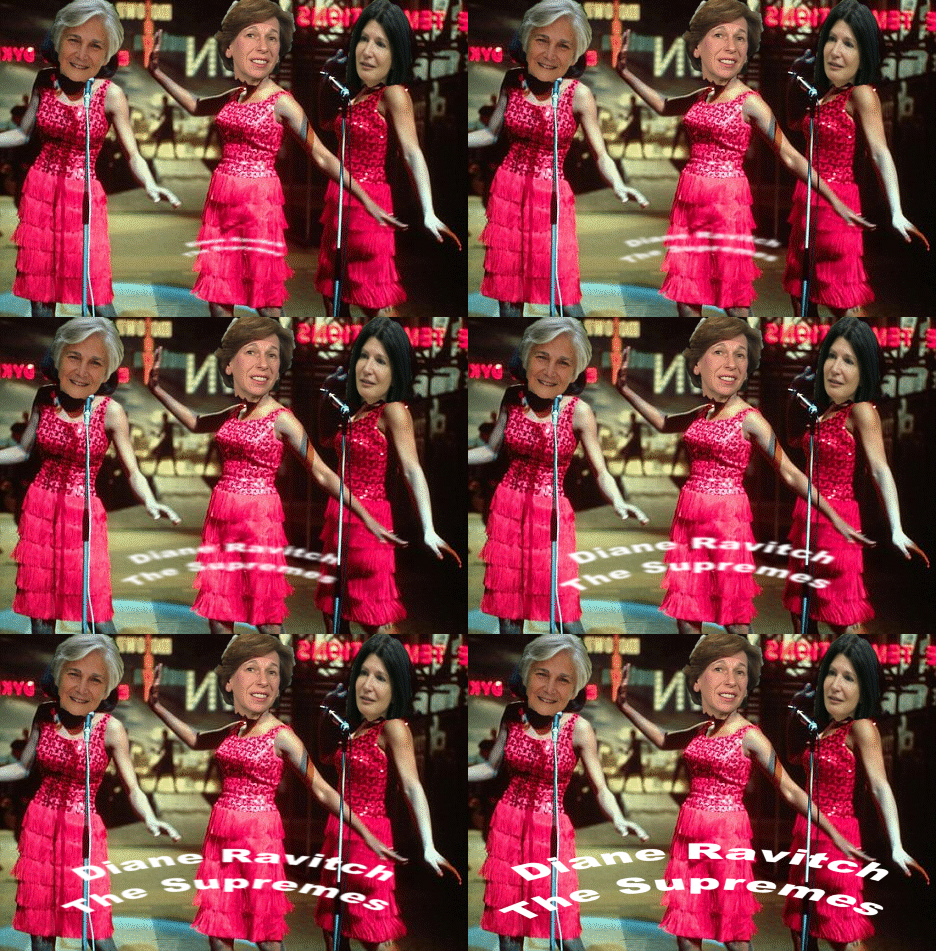
The Queen of Soul and The Supremes at the NPE Conference In Chicago


Karen Lewis 
The Queen of Soul


Diane Ravitch and The Supremes

Evening Schedule TBA


Speakers/Panels/Panelists

The Network for Public Education has put together an impressive lineup for the 2nd Annual Conference. You can download the NPE Conference Schedule or you can view it here.
Check this page often for more details on the speakers, panels, and panelists that will make this an unforgettable weekend!

KEYNOTE SPEAKERS

Saturday, April 25th

Opening Keynote
Jitu Brown, National Director of Journey for Justice & NPE Board and Tanaisa Brown, Secretary, Newark Student Union
imageimage (4)
Afternoon Keynote
Yong Zhao, author of “Who’s Afraid of the Big, Bad Dragon?”
image (2)

Sunday, April 26th

Morning Keynote
Diane Ravitch in Conversation with AFT’s Randi Weingarten and NEA’s Lily Eskelsen García
image (1)
Closing Keynote and Call to Action
Chicago’s Very Own, Karen Lewis

image (3)


PANEL DESCRIPTIONS

Student Panel – Tanaisa Brown, Kristin Towkaniuk, Amina Henderson, and Devonta Boston
If you’re coming to this conference you care about our students and probably have your own ideas on how to help. This is your chance to hear directly from some of our nation’s leading student leaders. Tanaisa, Kristin & Hannah will talk about what life is like for students today, how they feel about all of these so-called reforms, and what they’re doing to take back their schools.
BATs and Social Justice – Dr. Denisha Jones, Aixa Rodriguez and Kristin Vogel 
Looking to grow your understanding on the connection between race, inequity in education funding and what’s happening in your classrooms? Then join these three prominent voices from the Badass Teachers Association who are committed to social justice and equity in the schools and communities in which we work and live. The conversation starts here.
Perils of Ed Tech: Student Privacy and Corruption: Leonie Haimson, Cynthia Liu, Rachael Stickland, and Nathan Ringo
Want to know what’s happening in the world of student privacy? Three leading national activists will bring you up to speed. Between these three women, they have lead the movement to stop inBloom, built a national Student Privacy Coalition, and exposed the iPad scandal in LA Unified School District leading to the downfall of LAUSD Superintendent Deasy. Their workshop will focus on ways to strengthen federal protections, outline strategies for successful coalitions that lobby state & federal officials, and discuss how to expose the fraud and waste inherent in these systems.
Defending the Early Years – Nancy Carlsson-Paige and Geralyn Bywater McLaughlin
Concerned about what’s happening to our youngest children? Join leading national experts as they discuss their work pushing back against the current ed reform climate where academic skills and tests are replacing experiential, play-based learning. This interactive workshop will bring you into full participation by sharing experiences of what has worked and what has not as the group develops concrete actions steps for moving forward to Defend the Early Years.
More Than A Score; Black Student Lives Matter – Jesse Hagopian
The achievement gap is often used by corporate reformers to justify their policies. Are you looking for a way to respond to them that is both respectful of the experiences of communities of color, but does not accept high stakes testing is the way to close the achievement gap? Then join teacher and author Jesse Hogapian as he explores this topic. Jesse will share his experience in leading the successful MAP boycott in Seattle, discuss examples of gaining support from civil rights groups, and talk about how we can all help build a multicultural, anti-racist movement to support all students.

Meet the Authors at #NPEChicago

Meet the Authors
The Second Annual NPE Conference is your chance to hear directly from some of the thought leaders in the movement to reclaim the promise of public education. #NPEChicago is where the authors of some of the most celebrated books in recent years will deliver keynote addresses and participate in panel discussions.
If you’re coming to the event, don’t forget to leave room in your suitcase for a few autographed copies! If you can’t join us in Chicago you can follow the excitement on Twitter and interact with participants by using the hashtag #NPEChicago. Our media partner School House Live will also be live streaming the keynote addresses and select panels with a live chat feature where you can be a part of the conversation. Stay tuned for more details and which panels will be available.

Reign-of-ErrorDiane Ravitch Reign of Error: The Hoax of the Privatization Movement and the Danger to America’s Public Schools


NPE President Diane Ravitch’s most recent book spent four weeks on the New York Times bestseller list. Reign of Error not only lays bare what is wrong with the policies favored by the privatization movement, it clearly delineates a positive agenda to reclaim teaching and learning. At #NPEChicago Diane will participate in a keynote conversation with NEA’s Lily Eskelsen Garcia and AFT’s Randi Weingarten which is sure to be a highlight of the conference.

The Educator and the OligarchAnthony Cody The Educator And The Oligarch: A Teacher Challenges The Gates Foundation


Noted educator and author Jonathan Kozol said The Educator and the Oligarch is “A powerful and important book by one of the most courageous advocates for sanity and simple justice in our public schools.” NPE co-founder and Board Member Anthony Cody will participate in three panel discussions, including a panel titled Getting Your Book Published. If you’ve ever thought you have a book inside you just waiting to be written, don’t miss this panel.

On the Same TrackCarol Burris On the Same Track: How Schools Can Join the Twenty-First-Century Struggle against Resegregation


Carol Burris, NPE Board Member and 2013 NYS High School Principal of the Year, just announced that she is retiring early stating, “I will retire early and dedicate all of my energies to fighting the assault on our public schools and our teachers.” Burris will be at #NPEChicago participating in a panel titled Schools of Opportunity. Her latest book,On the Same Track, was called “An important book that should be required reading for educators, parents and school boards.”

Who's AfraidYong Zhao Who’s Afraid of the Big Bad Dragon?: Why China Has the Best (and Worst) Education System in the World


In a review for the New York Review of Books, Diane Ravitch called Yong Zhao’s Who’s Afraid of the Big Bad Dragon “the book that Barack Obama, Arne Duncan, members of Congress, and the nation’s governors and legislators need to read”. Don’t miss Zhoa’s inteview with Edushyster’s Jennifer Berkshire, where Zhoa makes it very clear that while the test scores of students in China are touted as the standard to meet, the Chinese system is not one we want to copy. Zhoa will deliver a keynote address titled, Fatal Attraction: America’s Suicidal Quest for Educational Excellence.

More than a scoreJesse Hagopian More Than a Score: The New Uprising Against High-Stakes Testing

More Than a Score is a collection of essays, poems, speeches, and interviews—accounts of personal courage and trenchant insights—from frontline fighters who are defying the corporate education reformers, often at great personal and professional risk, and fueling a national movement to reclaim and transform public education. Hagopian, an inspiring leader of the 2013 MAP testing boycott at Garfield High School in Seattle, will be at #NPEChicago where he will present a panel titled More Than a Score; Black Student Lives Matter.

This is not a testJose Vilson This Is Not A Test: A New Narrative on Race, Class, and Education


José Vilson writes about race, class, and education through stories from the classroom and researched essays. His rise from rookie math teacher to prominent teacher leader takes a twist when he takes on education reform through his now-blocked eponymous blog, TheJoseVilson.com. He calls for the reclaiming of the education profession while seeking social justice. Vilson will join Anthony Cody on the Getting Your Book Published panel.

Chonicle of EchoesMercedes Schneider A Chronicle of Echoes: Who’s Who in the Implosion of American Public Education and the upcoming Common Core Dilema – Who Owns Our Schools?


The ever prolific teacher, researcher, blogger, and author Mercedes Schneider will hold a panel at #NPEChicago about writing and publishing her first book, A Chronicle of Echoes. In a review for EdWeek, Anthony Cody said Schneider’s first book “is a sort of handbook for understanding all the players in the corporate reform “movement.” She takes them on one by one, and leaves none unscathed.” Schneider’s second book, Common Core Dilema, is due for publication June 12, 2015.

Fear and LearningJohn Kuhn Fear and Learning in America – Bad Data, Good Teachers, and the Attack on Public Education


Superintendent John Kuhn of the Perrin-Whitt Independent School District in Texas delivered a stirring keynote speech at last year’s NPE Conference. In that speech Kuhn reminded attendees that we have the power to determine the future of public education in the United States. Diane Ravitch said his book “is packed with more wisdom than any 10 books that I have read about American education. It is the wisdom born of experience.” John Kuhn will also participate in the not to be missed panel Getting Your Book Published with Anthony Cody.


 I know not everyone can make it to Chicago this weekend -- but you can still be part of the action via the Livestream that will broadcast on as many as three channels. All the keynotes and many of the workshops will be available live, starting Saturday at 8:30 am central time at   www.schoolhouselive.org

 Please tweet with the hashtag ‪#‎NPEChicago‬ and help us trend #1 again like we did twice last year.

LIVE FROM CHICAGO, APRIL 25-26
CHECK OUT ALL THREE CHANNELS!