Latest News and Comment from Education

Friday, February 27, 2015

House Republicans put off No Child Left Behind vote - Maggie Severns - POLITICO

House Republicans put off No Child Left Behind vote - Maggie Severns - POLITICO:


House Republicans put off No Child Left Behind vote


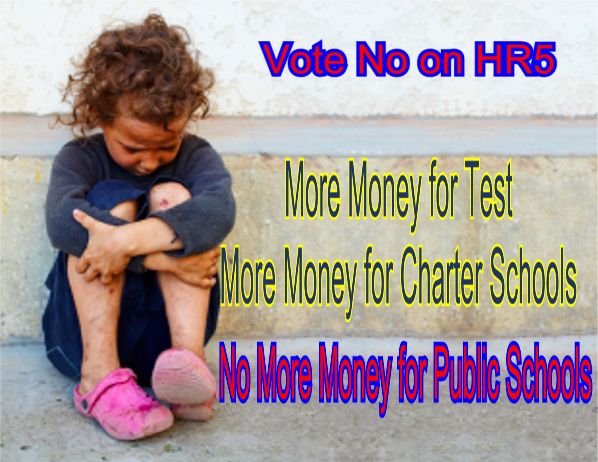
Call and Tweet your House Rep and ask him/her to vote ‪#‎NOonHR5‬ http://bit.ly/17s6O1b


House Republicans decided not to vote Friday on their proposed rewrite of the No Child Left Behind law, the Student Success Act, after House leadership struggled to lock down support for the bill and debate over Department of Homeland Security funding eclipsed education plans.
The House passed a nearly identical bill in 2013, but discontent with the Common Core academic standards and concerns about federal government intrusion have grown, and conservatives have said they want to get more out of an education bill in the newly Republican-controlled Congress. That left House leadership facing new criticism from the right because the GOP bill omits school vouchers, radical reductions to federal mandates and other right-wing proposals.
Story Continued Below
“My district doesn’t like it. They just feel that we’re moderating No Child Left Behind. They hate No Child Left Behind,” Rep. John Fleming (R-La.) said.
It’s not clear when a vote on No Child Left Behind will take place.
And that’s not to say the Student Success Act didn’t have issues of its own: On Thursday night, House leadership was still trying to shore up support for the bill, several GOP aides and lawmakers said. At a Friday morning press conference held by House Majority Leader Kevin McCarthy and others at a charter school in the Anacostia neighborhood of D.C., lawmakers didn’t talk about the Student Success Act and didn’t hold scheduled press availability. House Education and the Workforce Committee Chairman John Kline didn’t even attend, though he was originally listed to be there: He was on Capitol Hill whipping votes for his bill.
Despite anger that has built up over the law’s far-reaching scope, the politics constrained how far to the right Republicans pushing the Student Success Act could go.
Kline needed a bill that would pass the House with support from moderates. He has made clear that a bill with private school vouchers would not have the votes to pass the chamber and would not fly with President Barack Obama, who has


Read more: http://www.politico.com/story/2015/02/no-child-left-behind-vote-house-republicans-115594.html#ixzz3SygeTY9w

Charter schools do not equal education reform - Baltimore Sun

Charter schools do not equal education reform - Baltimore Sun:


Charter schools do not equal education reform


 As Philadelphia's Superintendent of Schools, I recommended the approval of more than 30 charter schools because I thought it would improve educational opportunity for our 215,000 students. The last 20 years make it clear I was wrong.

Those advocating change in Maryland's charter law through proposed legislation are equally committed to educational improvement. They are equally wrong. New policy should not build on current inequities and flawed assumptions, as the proposed charter law changes would do.

Mixed academic results: Charters, on the whole, do not result in significant improvement in student performance. It's mixed at best. In some evaluations, charter schools overall actually underperform regular public schools.

Funding and unequal opportunity: Charter funding is also negatively affecting regular public schools. Charter advocates rely on the premise that as money flows from a regular school to a charter school, the costs of the regular school go down proportionately. Sounds good; it's just not true. Costs in schools sending students to charters cannot shift as fast as students and revenue leave. The costs for the principal, heating, lights, building debt and many other things remain; thus, the remaining children face the prospect of larger class sizes and cuts to core academic programming, music, art and other inequities. Opportunity for the 13,000 charter school students in Baltimore City is in part funded by the loss of opportunity for the remaining 70,000 students without a commensurate performance improvement by charter school students.

 According to Moody's Investors Service, charter schools pose the greatest credit challenge to school districts in economically weak urban areas and may even affect their credit ratings.

Further, the proposed legislation also assumes all students cost the same to educate. Again, not true. It costs more to provide a quality education to some, such as those with severe disabilities, who are rarely served by charter schools, leaving traditional schools to disproportionately bear this cost at the expense of all students.

States with "stronger" charter laws are not doing better: Advocates say we need a "stronger" charter law, noting that Maryland ranks near the bottom. Pennsylvania's law is ranked much higher, yet its charter growth is contributing significantly to a funding crisis that includes draconian cuts to teachers, nurses, arts, music and counselors in Philadelphia.

We need the best and brightest teachers: The proposed "stronger" law undermines collective bargaining that protects teachers from politics and favoritism and has been crucial to improvement in compensation and benefits. It would create a two-tiered system in which charter teachers would have to organize and bargain separately with each charter opting out of the larger system's contract. Unionization is not the problem. There are no unions in many of the nation's worst educational performing states. All schools, charter or traditional, must pay competitive salaries and benefits to attract experienced, skilled teachers who can succeed with all children.

Charters do not serve students with the greatest challenges: Charters will be quick to point out they enroll high percentages of low-income students. Some do. However, the citywide charter lottery inherently skims. Every student chosen has someone (parent, Charter schools do not equal education reform - Baltimore Sun:

Georgia’s education chief has some words for Arne Duncan - The Washington Post

Georgia’s education chief has some words for Arne Duncan - The Washington Post:


Georgia’s education chief has some words for Arne Duncan


 Richard Woods became the State School Superintendent of Georgia last month after spending 22 years in public education in various roles: teacher, teacher mentor, assistant principal, principal, curriculum director, testing coordinator, pre-K director and alternative school director.  He is also a former small business owner and was a purchasing agent for a multi-national laser company. This week, Woods wrote a letter to U.S. Secretary of Education Arne Duncan and sent it, too, to members of Georgia’s delegation in the U.S. Congress and to the House and Senate education committees, which are currently working on legislation to rewrite No Child Left Behind. One of the key issues is whether annual standardized testing, as mandated in NCLB for grades 3-8 and once in high school, will continue in a new education law.

Woods, in his letter to Duncan, urges changes to federal mandates on standardized testing, saying in part:
Our broken model of assessment is too focused on labeling our schools and teachers, and not focused enough on supporting our students. Our current status quo model is forcing our teachers to teach to the test. We need an innovative approach that uses tests to guide instruction, just as scans and tests guide medical professionals. Oftentimes, we hear teachers called professionals because they have the knowledge and skill set to reach the needs of their individual students, yet in our accountability measures we have not supported or given value to diagnostic tools and tests that teachers need to fully utilize that knowledge or those skills. We must find a balance between accountability and responsibility.
Here’s the letter, which was first published in the Atlanta Journal-Constitution, and which I am republishing with permission from Woods.
Dear Secretary Duncan,
With the reauthorization of the Elementary and Secondary Education Act (ESEA) comes an opportunity to address the valid concerns of students, parents, teachers, and communities regarding the quantity and quality of federally mandated standardized tests.
As Georgia’s School Superintendent, I have a constitutional duty to convey those concerns and provide ideas on how to move my state and our nation forward. Georgia recently entered into a $108 million contract to deliver federally mandated standardized tests to our students. That figure does not include the millions of dollars spent to develop and validate test questions and inform the public about the new tests.
This adds to the need for an audit to provide information on the number of tests and loss of instructional time our children 
Georgia’s education chief has some words for Arne Duncan - The Washington Post:


Call and Tweet your House Rep and ask him/her to vote ‪#‎NOonHR5‬ http://bit.ly/17s6O1b

Passage of GOP-Backed NCLB Rewrite Could Be Delayed, Amid Conservative Backlash - #NOonHR5

Passage of GOP-Backed NCLB Rewrite Could Be Delayed, Amid Conservative Backlash - Politics K-12 - Education Week:


Passage of GOP-Backed NCLB Rewrite Could Be Delayed, Amid Conservative Backlash

UPDATED
By Lauren Camera and Alyson Klein
House leaders may hold off until next week on a final vote on a Republican-backed bill to rewrite the No Child Left Behind law, amid pushback from powerful GOP lobbying groups who may have succeeded in convincing enough Republicans that the measure is not conservative enough, according to several sources.
Not helping matters: House GOP conservatives are unhappy with their leadership's handling of a bill that would temporarily continue funding for the Department of Homeland Security, which administers a controversial immigration program created through executive authority by the Obama administration.
House leaders had initially hoped to have the bill over and done with Friday. But a morning notice from Majority Whip Steve Scalise, R-La., who keeps track of how many members of his party support measures as they come to the floor, did not specify a final vote for the bill, which he normally would have if it were to occur during a series of votes scheduled for later this morning.
And while Republicans have the procedural ability to vote on bill as soon as amendment debate is over, the notice from Scalise did not specify that.
Congressional education leaders did not confirm that the vote would be delayed.
"We are moving forward and expect to continue debating the bill later today," said Brian Newell, communications director for education committee Chairman John Kline, R-Minn., the author of the bill. 
But a congressional aide with knowledge of the proceedings said, for now, the final vote on the NCLB rewrite appears likely to be bumped to next week. At that point, Republican leaders will probably be able to muster the neccesary votes to get the bill through the chamber, sources say. But if not, the bid to update the NCLB law this year could be in serious trouble. 
Ahead of the Thursday debate, the Club for Growth and Heritage Action, two powerful conservative lobby organizations, blasted out emails to House Republicans in opposition to the bill. They warned that if members voted in favor of the measure, it would count against them in a scoring rubric the organizations use to rate which members are most faithful to conservative principles and the GOP Party. The groups' problem with the NCLB overhaul? It's not conservative enough.
Among other things, the groups wanted to see legislation that knocks the federal government entirely out of education, which they view as strictly a state and local responsibility. They also hoped to see provisions in the bill that would have allowed federal funds for low-income students to be used at private schools.
Part of the problem here is timing, sources say. Conservative Republicans are angry at House leaderships's handling of immigration legislation—and they are taking their frustration out on what some see as a relatively moderate education bill. 

Get ready for Election Day on April 7 #Chuy2015

I will vote - Jesus "Chuy" Garcia for Mayor of Chicago:


Get ready for Election Day on April 7

You can call the Chicago Board of Elections at 312-269-7900 with any further questions or concerns.
I will vote - Jesus "Chuy" Garcia for Mayor of Chicago:


Big Education Ape: Chicago Inc. Rahm Emanuel Dances for Corporate Money - Vote for Chuy!!! http://bit.ly/1AaLZT1

Dems May Want to Watch What Duncan Is Wishing for - Rick Hess Straight Up - Education Week

Dems May Want to Watch What Duncan Is Wishing for - Rick Hess Straight Up - Education Week:


Dems May Want to Watch What Duncan Is Wishing for

Gosh. With the White House issuing preemptive veto threats and Secretary of Education Duncan attacking House Republicans, it's almost like the Obama administration isn't all that eager to reauthorize ESEA. It's almost as if they like the status quo and are content to let Duncan keep enjoying his NCLB waivers. If I didn't know better (and if the administration hadn't so often explained its desire to reauthorize the law and its frustration with "congressional inaction"), I'd think that Duncan would rather continue to impose his agenda than compromise with Congress.
Whatever Duncan's preferences, though, other Democrats just might want to contemplate the possibility that Hillary won't win in 2016—and that a Republican might occupy the White House. Should that happen, it might be worth revisiting a possible future that I forecast back in 2011:
---
The Obama administration steadfastly refuses to acknowledge the problems with ED's "backdoor blueprint" waiver strategy or the ugly precedent that it's trying to set. But those with even a glimmer of imagination can see where this is going...
Embedded image permalink

 #NOonHR5
#STOPHR5 #NOonHR5 US Representatives on Twitter Find your Member Hit them with a Vote No on HR5 Tweet http://bit.ly/17s6O1b

Big Education Ape: This so-called “Student Success” Act should be named the “Student Regress” Act #NOonHR5 http://bit.ly/1GyeuLy

Transcript from Fox News Channel
January 13, 2013
Chris Wallace: First off, congratulations Congresswoman Bachmann on being named U.S. Secretary of Education by President-elect Perry.
SecEd Nominee Bachmann: Thanks very much. It's a big job, and I'm looking forward to tackling it.
Chris Wallace: Last November, the Democrats narrowly retained control of the Senate and the Republicans enjoy only a modest majority in the House. Are you worried you'll be unable to make the legislative changes that you and the President think necessary?
SecEd Nominee Bachmann: Once upon a time, that might've been a concern. Happily, the Obama administration provided a path for driving educational change even when you don't have the votes. That's why we've promised that, come inauguration day, we'll be ditching the Obama administration's requirements for waivers from No Child Left Behind and substituting our own. They'll be drawn from the President's plan that we've been calling the Freedom Blueprint.
Chris Wallace: What do you have in mind?
SecEd Nominee Bachmann: We'll be employing the Obama administration's notion that we can provide states waivers from federal law so long as they promise to do stuff that we like. We'll impose a few conditions for states seeking to maintain their NCLB waivers or obtain new ones. They'll have to adopt certain elements of our Freedom Blueprint if they want their Dems May Want to Watch What Duncan Is Wishing for - Rick Hess Straight Up - Education Week:

Vote Against the Student Success Act - Campaign For Children #NOonHR5

Vote Against the Student Success Act - Campaign For Children:


Vote Against the Student Success Act

Embedded image permalink

 #NOonHR5
#STOPHR5 #NOonHR5 US Representatives on Twitter Find your Member Hit them with a Vote No on HR5 Tweet http://bit.ly/17s6O1b
 Education

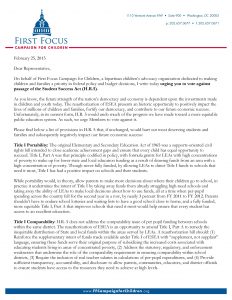
FFCC ESEA Comments House Floor Markup 2-25-2015 (2)_Page_1On February 25, 2015, FFCC sent this letter regarding the the House of Representatives markup of the Student Success Act (H.R. 5). This legislation, sponsored by Representative Kline, would reauthorize the Elementary and Secondary Education Act (ESEA). First Focus Campaign for Children sent this letter regarding the markup, highlighting the opportunity that reauthorization of ESEA presents to positively impact the lives of millions of children and families and contribute to our future economic success. It also highlights FFCC’s serious concerns with H.R. 5.

DOWNLOAD ATTACHMENTS

Report Slams Virtual Charter Schools That Graduate Just 36% Of Students - BuzzFeed News

Report Slams Virtual Charter Schools That Graduate Just 36% Of Students - BuzzFeed News:


Report Slams Virtual Charter Schools That Graduate Just 36% Of Students

California Virtual Academies, a chain of 11 online charter schools with 14,000 students, is the subject of a critical new report from In The Public Interest, an advocacy group.

One of country’s largest chains of for-profit online charter schools has seen almost a decade of declining academic results, mounting structural problems, and potential self-dealing by its operator, according to a report released today by In The Public Interest. California Virtual Academies, which has 14,000 students at 11 schools strung out across the state, is run by the giant K12 Inc., a publicly traded company that has attracted strong criticism in the past for its management of virtual charters. 

Even in the face of controversy, K12 has been in the business of rapidly expandingvirtual education across the country; in the past month alone, it won drawn-out legal battles to open new online schools in Maine and North Carolina, and it now enrolls 123,000 students nationwide. But In The Public Interest’s report could deal a blow to that growth.
Virtual charter schools like California Virtual Academies, or CAVA, are public schools that exist entirely online: Taxpayer dollars pay for students in kindergarten through 12th grade to take classes from home, communicating with their teachers via computer.
CAVA, the report says, has been plagued by years of slumping academic results: its graduation rate over the past four years has been 36%, meaning it had more dropouts than graduates, and its academic performance has declined steadily since 2005. Though K12 Inc. has consistently blamed poor academic results at virtual schools on the student population it serves, the report shows that even compared to demographically similar schools, CAVA falls short.
Katrina Abston, the head of California Virtual Academies who is an employee of K12 Inc., called In the Public Interest’s report “inaccurate and deeply flawed,” alleging it was based on misinformation supplied by the teachers’ union that is helping CAVA teachers with an effort to unionize, which K12 has opposed.
“Our schools provide families a public school option for children who need alternatives to traditional public school,” Abston said. “Efforts by powerful special interests opposed to charter schools and parent choice will not deter us from that commitment.”
A representative for K12 Inc. said that the school’s graduation rates should be put into context, saying that virtual charters enroll many students who are not on track to graduate when they enroll in the school. The company has previously said that students who stay in K12 schools for all four years graduate at much higher rates.
Though the schools themselves must technically be nonprofits, K12 and the company’s main competitor, Pearson’s Connections Academy, have transformed them into a booming business by taking over virtual schools’ management, administration, curriculum, and even budget. K12, which is publicly traded, takes in just under half of the tens of millions in taxpayer money that flows into CAVA’s 14 schools, according to the report; the rest goes to teacher and staff salaries.
The report takes aim at the “troublesome” relationship between K12, its school boards, and the districts that approve the schools. Control of schools is effectively Report Slams Virtual Charter Schools That Graduate Just 36% Of Students - BuzzFeed News:

My Newest NY Times Post For ELLs Is On “Teaching and Learning About Animals” | Larry Ferlazzo’s Websites of the Day…

My Newest NY Times Post For ELLs Is On “Teaching and Learning About Animals” | Larry Ferlazzo’s Websites of the Day…:


My Newest NY Times Post For ELLs Is On “Teaching and Learning About Animals”


animals
Ideas for E.L.L.s | Teaching and Learning About Animals is my latest New York Times Learning Network post, and it’s filled with ideas and multimedia resources for teachers of English Language Learners.
I’m adding it to:

CURMUDGUCATION: Teaching: Too Hard for Teachers

CURMUDGUCATION: Teaching: Too Hard for Teachers:


Teaching: Too Hard for Teachers


What exactly is a teacher's job? I have generally felt that I know the answer, but in these reformy times I have moments when I wonder.

I had one such moment today, reading this piece from The Hechinger Report entitled "Common Core's Unintended Consequence." The subheading of this piece by Jonathan Sapers tells us what that dreadful, unintended, potentially tragic consequence might be-- "More teachers write their own curricula." Clearly an unexpected tragic side effect of Common Core is that some teachers have forgotten what their proper place is.

OMG! How did such a terrible thing happen!!

According to many teachers, experts and advocates of the Common Core, traditional curriculum sources haven’t been meeting the demands of the new set of math and English standards that have been rolled out in more than 40 states in the past few years. More and more teachers are scrapping off-the-shelf lessons and searching for replacements on the Internet or writing new curriculum materials themselves.

Yes, it's true. Because of a failure of the education materials publishing industry, teachers out there are being forced to find their own teaching materials. Some are even-- choke-- designing teaching materials all by themselves! Oh, the humanity!!

The Center on Education Policy (CEP), a nonpartisan research group, reports that in roughly two-thirds of districts in Common Core states, teachers have developed or are developing their own curricular materials in math (66 percent) and English Language Arts (65 percent). In more than 80 percent of districts, the CEP found that at least one source for curriculum materials was local — from teachers, the district itself or other districts in the state.

Local materials!?! Good heavens! How can teachers hope to create teaching materials?! Don't they understand that they are only teachers?? Do they imagine that just because they went to college and got a degree and completed student teaching and have spent some amount of time in a classroom with students-- I mean, do they think all that qualifies them to create instructional materials?!

Whose fault is this?

Authorities (by which, of course, I mean people other than teachers, who are clearly not authorities
 CURMUDGUCATION: Teaching: Too Hard for Teachers:

Angry Andy’s Failing Schools & the Finger of Blame | School Finance 101

Angry Andy’s Failing Schools & the Finger of Blame | School Finance 101:


Angry Andy’s Failing Schools & the Finger of Blame


 NY Governor Andrew Cuomo’s office has released a report in which it identifies what it refers to in bold type on the cover as “Failing Schools.”

Presumably, these are the very schools on which Angy Andy would like to impose death penalties – or so he has opined in the past.
The report identifies 17 districts in particular that are home to failing schools. The point of the report is to assert that the incompetent bureaucrats, high paid administrators and lazy teachers in these schools simply aren’t getting the job done and must be punished/relieved of their duties. Angry Andy has repeatedly vociferously asserted that he and his less rabid predecessors have poured obscene sums of funding into these districts for decades. Thus – it’s their fault – certainly not his, for why they stink!
Slide3Slide4
I have addressed over and over again on this blog the plight of high need, specifically small city school districts under Governor Cuomo.
  1. On how New York State crafted a low-ball estimate of what districts needed to achieve adequate outcomes and then still completely failed to fund it.
  2. On how New York State maintains one of the least equitable state school finance systems in the nation.
  3. On how New York State’s systemic, persistent underfunding of high need districts has led to significant increases of numbers of children attending school with excessively large class sizes.
  4. On how New York State officials crafted a completely bogus, racially and economically disparate school classification scheme in order to justify intervening in the very schools they have most deprived over time.
I have also written reports on New York State’s underfunding of the school finance formula – a formula adopted to comply with prior court order in CFE v. State.
  1. Statewide Policy Brief with NYC Supplement: BBaker.NYPolicyBrief_NYC
  2. 50 Biggest Funding Gaps Supplement: 50 Biggest Aid Gaps 2013-14_15_FINAL
Among my reports is one in which I identified the 50 districts with the biggest state aid shortfalls with respect to what the state itself says these districts require for providing a sound basic (constitutional standard) education.  Districts across NY state have funding gaps for a variety of reasons, but I have sAngry Andy’s Failing Schools & the Finger of Blame | School Finance 101:

What is the standardized test opt-out movement? Take the quiz | PennLive.com

What is the standardized test opt-out movement? Take the quiz | PennLive.com:


What is the standardized test opt-out movement? Take the quiz

Parents Can Opt Out - United Opt Out National

Click Here to go to United Opt Out National: 


Click Here to go to the WebsiteUnited Opt Out Team


 PennLive's Candy Woodall reported this week that in 2010, nearly 230 Pennsylvania students opted out of state assessments in reading, math and science.

That's a small percentage of the 1.8 million students enrolled in public schools that year.
The numbers have grown dramatically since.
As more parents learn that they can "opt out" of having their children take the state assessments, that number continues to climb and the national opt-out movement is gathering steam.
The stories have garnered much attention on PennLive this week. Take our quiz to see how much you know about the opt-out movement.
App users: to take the quiz, click here.

OPT OUT MOVEMENT