Latest News and Comment from Education

Saturday, January 24, 2015

Is Standardized Testing a Pediatric Disease? -e-Literate

Is Standardized Testing a Pediatric Disease? -e-Literate:


Is Standardized Testing a Pediatric Disease?

In my last post, I wrote about the tension between learning, with the emphasis on the needs and progress of individual human learners, and education, which is the system by which we try to guarantee learning to all but which we often subvert in our well-meaning but misguided attempts to measure whether we are delivering that learning. I spent a lot of time in that post exploring research by Gallup regarding the workplace performance of adults, various dimensions of personal wellbeing, and the links of both to each other and to college experiences. One of Gallup’s findings were that workers who are disengaged with their work are less healthy. They are more likely to get clinically depressed, more likely to get heart conditions, and more likely to die young. I then made a connection between disengaged adults and disengaged students. What I left implicit was that if being disengaged as an adult is bad for one’s health, it stands to reason that being disengaged as a child is also bad for one’s health. We could be literally making our children sick with schooling.
I am in the midst of reading Anya Kamenetz’s new book The Test. It has convinced me that I need to take some time making the connection explicit.
In that previous post, I wrote,
Also, people who love their jobs are more likely to both stay working longer and live longer. In a study George Gallup conducted in the 1950s,
…men who lived to see 95 did not retire until they were 80 years old on average. Even more remarkable, 93% of these men reported getting a great deal of satisfaction out of the work they did, and 86% reported having fun doing their job.
Conversely, a 2008 study the company found a link between employee disengagement and depression:
We measured their engagement levels and asked them if they had ever been diagnosed with depression. We excluded those who reported that they had been diagnosed with depression from our analysis. When we contacted the remaining panel members in 2009, we again asked them if they had been diagnosed with depression in the last year. It turned out that 5% of our panel members (who had no diagnosis of depression in 2008) had been newly diagnosed with depression. Further, those who were actively disengaged in their careers in 2008 were nearly twice as likely to be diagnosed with depression over the next year. While there are many factors that contribute to depression, being disengaged at work appears to be a leading indicator of a subsequent clinical diagnosis of depression.
Which is obviously bad for employer and employee alike.
In some cases, Gallup went all in with physiological studies. For example, they “recruited 168 employees and studied their engagement, heart rate, 
Is Standardized Testing a Pediatric Disease? -e-Literate:

Bait and Switch with "Parent Choice"?

Bait and Switch with "Parent Choice"?:


BAIT AND SWITCH WITH “PARENT CHOICE”?

JANUARY 24, 2015 BRETT DICKERSON


A sweeping charter school bill was defeated last year in the Oklahoma Legislature. If passed, they would have allowed investor-owned charters to spring up in direct competition to public schools everywhere, even in the smallest of towns.

The “reform” argument was the same as it has always been when selling “education reform”: (Said with big, sincere eyes) We cannot allow poor children to continue to be trapped in under-performing schools. So, we have to have competition to help these kids break out.

But the actual concern is not for the poor. It’s about the poor and the liberty of more powerful people to remove their children from the presence of poor children.

A mechanism for letting this happen is “parent choice” or “school choice”. And since bills that would just muscle in charters state-wide were defeated last year in the Oklahoma Legislature, the “choice” attack on public schools is back.

“Choice” bills already being filed in Oklahoma Legislature

From the looks of bills already being filed in the Oklahoma legislature, there will be a reset of strategies. A big push for “parent choice” through vouchers will be the approach this year.

In other states where “choice” was sold and passed, the introduction of for-profit investor-owned charters soon followed.

It’s proven to be a winning strategy for getting investor charters into states that have been resistant to direct attempts to charterize the state.

Scholarship opens the door for “choice”

The first opening for “choice” in Oklahoma was to allow parents of children who were on an IEP (Individualized Education Plan) to receive scholarships from the state to transfer their child to a private school if they believe that she/he will receive a better education. (IEPs are developed to make accommodation for particular measured learning or physical disabilities that a student may have.)

It is important to note two things about the application process for the scholarship, called the Lindsey Nicole Henry Scholarship for Children with Disabilities:

The public school is where the effort and expense of testing and developing the IEP takes place.

There is no provision for determining the income of the parents.

So, once the large effort is made in the public school to do the assessments and then write a quite lengthy IEP that meets all federal requirements, the student is then paid state funds to transfer to a private school that may or may not even have a teacher who is trained to deal with a child with that particular disability.

In addition, the parents can be wealthy and plenty able to pay for a private education.

One problem with allowing this is to set the precedent that parents can just individually take their tax money with them to whatever school they want. And we know that isn’t the way that schools are paid for. Any per student figure set for portability is arbitrary since the whole of education expense flows at different levels from year to year even for the same student.

But, the biggest problem with allowing the wealthy to take advantage of this is that the measure was sold, as are all “choice” bills, as a way to keep the poor and people with little means from being “stuck in a low-performing school.”

It turns out that the poor are not the primary beneficiaries of this Bait and Switch with "Parent Choice"?:

Washington State Democratic Party Committee Votes to Reject Common Core - Living in Dialogue

Washington State Democratic Party Committee Votes to Reject Common Core - Living in Dialogue:


Washington State Democratic Party Committee Votes to Reject Common Core


 By Anthony Cody.

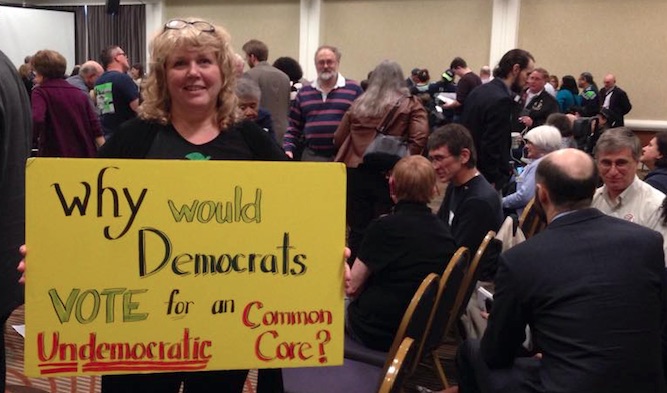
The Central Committee of the Washington State Democratic Party has passed a resolution that roundly condemns the Common Core standards. This is the first time a statewide Democratic Party committee has taken a public position against the Common Core, and it happened in the back yard of the Gates Foundation, which has provided the funding that made the national standards project possible. This could signal a sea-change for the beleaguered standards, because up until now, political opposition has been strongest in the Republican party.
About 150 delegates representing 49 legislative districts, from 29 counties, gathered at the Red Lion Inn in the state capital, Olympia on Saturday, Jan. 24, where there was a showdown between “new Democrats” and a scrappy coalition of education and labor activists. Activists mixed in with the delegates, and carried homemade signs expressing their opposition to the Common Core. They also arrived early and made sure there were flyers on each chair carrying their message.
David Spring is a leader of the Democratic Party for East King County near Seattle. He helped organize for the vote, and says,
This was a huge victory for the children, parents, and teachers of Washington State to have the Washington State Democratic Party – the first Democratic Party in the nation to vote against Common Core. It is our hope is that this is the beginning of the end for Bill Gates in the Common Core scam. This was the grassroots – the rank and file of the Democratic Party – who said NO to Common Core. They deserve all the credit, along with you teacher activists.
Senator Marilyn Chase, reached at her home during the legislative session in Olympia, said she supports the resolution. She explained, “I love kids. I don’t like high stakes testing and I don’t like Common Core.” David Spring said her support was of great value. “Marilyn Chase is a leader of the Washington Democratic Party and she represents North Seattle in the Washington State Senate and this was huge to have Marilyn supporting a resolution.”
Seattle area teacher Susan DuFresne describes how teachers organized for the vote:
We got to speak to the members before the meeting adjourned. We carried our signs around and spoke to members who were on the fence. We also handed out copies of Common Core: Ten Colossal Errors, with “what to do” on the other side. This tipped the scales in our favor.
Three delegates spoke in favor of the resolution, and three against. Brian Gunn, state committee man from 31st legislative district and chair of the Progressive Caucus, speaking to the assembly, said,
We have to take into account corporations are looking at our children as commodities. This is a moral issue. We’re allowing corporations that produce these materials and sponsor these tests to treat our children as sources of income. So I think it is very important that we look at that aspect of this, because everything that is part of the commons — things that everyone needs — is looked at to a large extent as a source of profit. And that source of profit is our own children. What is at stake is their education and their opportunity to have a good life — to make a decent standard of living in their future lives.  We have to see that as a moral issue, and not cede that responsibility away from the place where it belongs, which is hopefully our state schools and our state teachers — and allow THEM to make the choices about what the standards should be (applause).
When the vote was taken, roughly three fourths of the delegates voted in favor of Resolution 707. Below is the text of the resolution that was passed, in its entirety.

Resolution Opposing Common Core State Standards

WHEREAS the copyrighted (and therefore unchangeable) Common Core State Standards (CCSS) are a set of Washington State Democratic Party Committee Votes to Reject Common Core - Living in Dialogue:

“Response to Intervention”—An Excuse to Deny Services to Students with Learning Disabilities? - Living in Dialogue

“Response to Intervention”—An Excuse to Deny Services to Students with Learning Disabilities? - Living in Dialogue:


“Response to Intervention”—An Excuse to Deny Services to Students with Learning Disabilities?


 By Nancy E. Bailey.

Response to Intervention (RTI), the program to identify children with learning disabilities early, was recently described by the Chalkbeat in Tennessee as having problems with implementation. In many places, like Tennessee, RTI has replaced —a model which has been used for years to identify students with learning disabilities, the “discrepancy” model.
The discrepancy model compares a student’s IQ test score (e.g. the WISC-IV) with achievement scores (e.g.,Woodcock-Johnson Achievement Test). A learning disability is thought to exist if the student’s IQ scores are at least two standard deviations (30 points) higher than scores on the achievement test. This indicates a significant discrepancy between the two tests. Consideration of the student’s work in the classroom is also given. All of this usually comes about when the teacher, and/or parent, observes a student experiencing difficulty in school and requests school psychological testing.
RTI uses what’s called a multi-tiered approach to identify students. All students are screened in a serious effort to keep students from special education classes. School districts might use different kinds of formats with RTI, and parents are supposed to be able to request a formal evaluation at any point in the program. Students remain in each tier for a specified amount of time.
Tier 1: Involves regular classroom instruction, repeated screening, and group interventions. Students who do well here go back to doing all regular classwork.
Tier 2: Students, who do not do well in Tier 1, get interventions and repeated screening with small group instruction. This is mostly in reading and math for younger children. Students still get regular class work along with the interventions.
Tier 3: Students get this instruction if they don’t do well in Tier 2. It is more individualized and if they don’t do well at this level they are referred to special education using the information gathered in Tiers 1, 2, 3.
RTI raises many concerns. Some parents worry that RTI winds up denying children with learning disabilities services. One fear is that some parents don’t think they can request an evaluation, or they are led to believe it isn’t necessary.
Two quotes the Chalkbeat provides, by Douglas Fuchs, a respected researcher from Vanderbilt, sum up the controversy surrounding RTI, as I see it.
RTI was introduced to the educational mainstream in 2004, when the Individuals with Disabilities Education Act IDEA—a law meant to protect students with disabilities— was reauthorized. For the first time, RTI could be used to identify learning disabilities. Before that, students were often identified as having a learning disability if there was a large discrepancy between a child’s academic performance and his or her’s (sic) IQ, or “potential.”
First, was IDEA devised to protect students with disabilities? Or, were IDEA re-authorizations more about cutting costs to special education and creating one-size-fits-all schooling? Much of IDEA surrounds concerns that there is an “over-identification” of students for special education. Students in special education are said to cost twice as much as those not in special ed. By putting all students with special needs into the regular classroom (largely what IDEA is all about) special education services for children cost less.
Second, many would say the discrepancy model served students well. So, before foisting RTI on school districts, why weren’t these two methods compared more in serious randomized studies, with small groups in select schools? Such studies take time, but a review of the literature shows few studies before RTI was implemented. Like Common Core, it seems RTI was pushed into school districts before it was proven to be better than the discrepancy model.
Another quote the Chalkbeat uses, also by Fuchs, demonstrates quite clearly the effects of school reform on special education.
This [old] method [he is talking about the discrepancy model] of identifying learning disabilities has always had many critics, and one of the main concerns has “Response to Intervention”—An Excuse to Deny Services to Students with Learning Disabilities? - Living in Dialogue:

Five key questions to ask now about charter schools - The Washington Post

Five key questions to ask now about charter schools - The Washington Post:


Five key questions to ask now about charter schools


You can tell that National School Choice Week is nearly upon us — it runs from Jan. 25- 31 — by the number of announcements coming forth hailing the greatness of school choice.
Jeb Bush’s Florida-based Foundation for Excellence in Education put out an announcement that it would participate in a march next week in Texas to support school choice (with one of the speakers being Texas Land Commissioner George P. Bush, Jeb’s son). There’s a new poll by the pro-choice American Federation for Children showing (I bet you can guess) that most Americans support school choice.  Etc., etc.
There is other school choice news too, but you won’t hear it from the pro-choice folks. This comes from 10th Period blog, by Steven Dyer, a lawyer who is the education policy fellow at Innovation Ohio and who once served as a state representative and was the chief legislative architect for Ohio’s Evidence Based Model of school funding:
In a disturbing new report from State Auditor David Yost, officials found that at one Ohio charter school, the state was paying the school to educate about 160 students, yet none, that’s right, zero, were actually at the school. And that’s just the worst of a really chilling report, which, if the results are extrapolated across the life of the Ohio charter school program, means taxpayers have paid more than $2 billion for kids to be educated in charter schools who weren’t even there.  Here are the takeaways:
  • Seven of 30 schools had headcounts more than two standard deviations below the amount the school told the state it had.
  • Nine of 30 schools that had headcounts at least 10% below what the charter told the state it had, though it was less than two standard deviations.
  • The remaining 14 had headcounts that weren’t off by as much.
  • However, 27 of 30 schools had fewer students at the school Five key questions to ask now about charter schools - The Washington Post:


Join NPE’s letter writing campaign to Sen. Alexander and the HELP Committee The Network For Public Education |

The Network For Public Education | Join NPE’s letter writing campaign to Sen. Alexander and the HELP Committee:


Join NPE’s letter writing campaign to Sen. Alexander and the HELP Committee

Join NPE’s letter writing campaign to Sen. Alexander and the HELP Committee

Urge Sen. Lamar Alexander and the Health, Education, Labor and Pensions (HELP) Committee to put an end to annual standardized testing


Friday, January 23, 2015

Gates Foundation. Good Charity or Bad Charity? Part 1 | Education Under Attack

Gates Foundation. Good Charity or Bad Charity? Part 1 | Education Under Attack:


Gates Foundation. Good Charity or Bad Charity? Part 1

Big Education Ape: Bill Gates Claims Foundation Does R & D Only, Stays Out of "Political Process" - Living in Dialogue http://bit.ly/1ySqTqK

Ying_yang_sign
My wife and I had a great discussion after my last postabout the Gates Foundation’s instance that U.S. poverty could be overcome by better schools and teachers instead of a broad-based approach (like the Foundation uses overseas).  She led off by saying, “Isn’t Gates a good guy?  He’s giving away his money trying to help people.”  My response was that putting money into bad ideas doesn’t necessarily help people.  With all the publicity about philanthropy lately this has been a topic of discussion (see the New York Times Op-Ed piece “Good Charity, Bad Charity“).  To be fair, I really couldn’t tell my wife if all the K-12 education projects the Gates Foundation funds are good or bad ideas.
To their credit, the Gates Foundation maintains a list of all the projects they have funded on their website.  I cut and pasted information about the 128 “College Ready” (K-12 education) projects they funded in 2014 into a spreadsheet (ironically a MicroSoft product).  Note: K-12 education projects are not limited to public schools, as will be discussed in Part 2.
So to start with, Wow!  $93.3 million was given out in support of K-12 education projects in one year.  That’s a lot of money but let’s look at it in context.  According to Wikipedia the Gates Foundation has a $42.3 billion endowment ($28 billion from Gates Foundation. Good Charity or Bad Charity? Part 1 | Education Under Attack:

Badass Teachers Association: LA Times Report on Teacher Evaluations Incorrect

Badass Teachers Association: LA Times Report on Teacher Evaluations Incorrect:


LA Times Report on Teacher Evaluations Incorrect

Yesterday, The LA Times reported that, “Major California school districts are failing to comply with a state law that requires them to evaluate teachers in part by how much their students have learned.” This claim is completely incorrect. In fact, California is one of the few states where most districts do NOT tie test scores to Teacher Evaluation.
California Ed Code states:
44660. It is the intent of the Legislature that governing boards
establish a uniform system of evaluation and assessment of the
performance of all certificated personnel within each school
district of the state, including schools conducted or maintained
by county superintendents of education. The system shall involve the development and adoption by each school district of objective evaluation and assessment guidelines which may, at the discretion of the governing board, be uniform throughout the district or, for compelling reasons, be individually developed for territories or schools within the district, provided that all certificated personnel of the district shall be subject to a system of evaluation and assessment adopted pursuant to this article.
(emphasis my own)

This article does not apply to certificated personnel who are
employed on an hourly basis in adult education classes.
This simply states that each school district can come up with their own, objective evaluation system for teachers. Perhaps later in the Ed Code it mentions test scores? Nope.
44661.5. …a school district
may, by mutual agreement between the exclusive representative of the
certificated employees of the school district and the governing board
of the school district, include any objective standards from the
National Board for Professional Teaching Standards or any objective
standards from the California Standards for the Teaching Profession
if the standards to be included are consistent with this article….
So, districts can use standards from the National Board for Professional Teaching Standards or from the California Standards for Teaching Profession. No mention of test scores…hmmmm…
Here, Ed Code states:
44662. (a) The governing board of each school district shall
establish standards of expected pupil achievement at each grade level
in each area of study.
(b) The governing board of each school district shall evaluate and
assess certificated employee performance as it reasonably relates
to:
(1) The progress of pupils toward the standards established
pursuant to subdivision (a) and, if applicable, the state adopted
academic content standards as measured by state adopted criterion
referenced assessments.
(2) The instructional techniques and strategies used by the
employee.
(3) The employee’s adherence to curricular objectives.
(4) The establishment and maintenance of a suitable learning
environment, within the scope of the employee’s responsibilities.
So, there are expectations of achievement for students at each grade level, and the progress of students toward the expectations can be used in evaluation. Where does it say TEST SCORE? It doesn’t. In fact, I would argue that it is AGAINST California Ed Code to tie Badass Teachers Association: LA Times Report on Teacher Evaluations Incorrect:

No Child Left Behind May End, But The Industry It Spawned Is Here To Stay - BuzzFeed News

No Child Left Behind May End, But The Industry It Spawned Is Here To Stay - BuzzFeed News:


No Child Left Behind May End, But The Industry It Spawned Is Here To Stay

George W. Bush’s signature education reform turned standardized testing into a multi-billion dollar industry. But with change approaching, those making money from the system say the good times will continue.


At the center of what is gearing up to be the biggest political battle over American education in decades, leaders across the political spectrum are calling loudly for the end of the test as we know it. Standardized testing was shaped by George W. Bush’s No Child Left Behind Act into a central pillar of the American education system — a federal mandate on which the fate of low-performing schools rested.
But the 13-year-old No Child Left Behind is in the process of being dismantled, and lawmakers’ first priority is to to change the standardized testing regime. They plan to remove many of the high stakes attached to tests, slash the number of exams students must take each year, and even, under some proposals, eliminate No Child Left Behind’s central mandate, that students must be tested every year.
But the testing industry — a multibillion-dollar market built, in large part, on the shoulders of No Child Left Behind — isn’t worried.
Thirteen years after the law was enacted, widespread testing is so ingrained in the American education system the companies who profit from it see little threat from plans to remake elementary assessment. No matter what the federal government decides, experts say, states are likely to keep annual testing around in some form or another, likely with high stakes attached to them.
For the companies that rule the testing world — Pearson, which has a 40% market share in the industry, McGraw-Hill, and a handful of large nonprofits — No Child Left Behind is already an afterthought. They are riding the high of the huge revenue boost created by implementation of the Common Core standards, and expect demand to increase in 2015 as states and school districts look to develop new and innovative types of assessments and tools to analyze their students’ results.
Some experts said they even saw potential for the testing industry to see a boost from a new version of No Child Left Behind.
“I don’t see things changing for us much in terms of the size of our business,” said John Oswald, the vice president of Educational Testing Service, a large nonprofit test maker. With No Child Left Behind’s mandates over, Oswald said, “People are just going to be moving towards other kinds of testing.”
In 2002, when it was signed into law by George W. Bush, No Child Left Behind was unarguably a boon for testing companies. The law required new, different tests, and lots of them: enough for students to take a test every year from grades three through eight, and once in high school. The federal government pumped tens of millions of dollars into each state’s budget — from 2002 to 2008, annual state spending on tests rose from $423 million to $1.1 billion, according to the Pew Center on the States.
The money was used to develop a battery of data-rich tests that would be used to measure how many students in each grade were “proficient” in reading and math. Unlike in the years before No Child Left Behind, those tests suddenly carried consequences: Schools were graded based on whether they brought enough students up to proficiency each year, and could face increasingly dire consequences if they did not, including possibly being shut down.
A new version of No Child Left Behind would almost certainly remove the federal sanctions that made NCLB’s tests high-stakes for schools, which some see as a potential threat to large education and testing companies like Pearson and McGraw-Hill.

Lily Eskelsen García, the president of the National Education Association, the country’s largest teachers union, said that education companies have long relied on the threats posed to schools that fail tests in order to sell test-aligned curriculum No Child Left Behind May End, But The Industry It Spawned Is Here To Stay - BuzzFeed News:

School Choice Is A Problem, Not a Solution For Education | The Sacramento Coalition to Save Public Education

School Choice Is A Problem, Not a Solution For Education | The Sacramento Coalition to Save Public Education:


School Choice Is A Problem, Not a Solution For Education


Ugh. The Bee editorial page has trotted out its conservative bull dog Ben Boychuk again. Just days after Martin Luther King Day, Boychuk is writing about his own dream--school choice.(1)

It seems that next week is National School Choice Week and the kickoff event is being held in southern California. This will serve as a show case for what we're missing says Boychek, because California only offers five kinds of school choice: neighborhood public school; charter schools; magnet schools; home schooling and private schools. That is not enough! What California really needs is vouchers or the tax credit equivalent, so that students may take their school dollars where ever they want.

Never mind that school choice exists only for those parents with the means to get their child to the school of their choice (provided of course, that the school chooses them). Forget that California rejected vouchers multiple times in statewide initiatives. Ignore that we have almost no accountability for the tax dollars that already go to charter schools. Pretend that vouchers haven't been the well rounded success that Boychuk claims they are.(2) Vouchers are the Holy Grail for school choice advocates, and that's what he's asking for, no, dreaming about in School Choice Is A Problem, Not a Solution For Education | The Sacramento Coalition to Save Public Education:

The Education of Jeb Bush - The New Yorker

The Education of Jeb Bush - The New Yorker:


Testing Time

Jeb Bush’s educational experiment.

BY 


In December, Jeb Bush posted an update on his Facebook page which began by reporting that, over Thanksgiving, he and his family had “shared good food and watched a whole lot of football.” He added, “We also talked about the future of our nation. As a result of these conversations and thoughtful consideration of the kind of strong leadership I think America needs, I have decided to actively explore the possibility of running for President of the United States.”
The wording of the announcement was oddly diffident. It was widely known that Bush had been “actively exploring” the possibility of a campaign at least since the spring, when he started showing up at the gym in the grand Biltmore Hotel in Coral Gables, where he keeps his office, with a personal trainer and new workout gear. But there had been as yet no signs of a commitment. “It’s the telegraph people have been waiting for,” Jim Nicholson, a former Republican National Committee chairman and Cabinet secretary under President George W. Bush, said.
The announcement inevitably renewed questions about the desirability of political dynasties and about whether Jeb was being propelled to run, in part, by fraternal rivalry. “There’s always been a friendly competition among the siblings in the family, and that’s just human nature, I suppose,” George P. Bush, Jeb’s older son, told me. As Jeb, who was the governor of Florida for two terms, has followed his brother’s career, he has also stood apart from it. “There is kind of George W.’s world, and then there’s Jeb’s world, and frankly there’s not a lot of intersection,” Mark McKinnon, who was a senior adviser to George W.’s Presidential campaigns, said. Jeb is more introverted and more ideological than both his father, George H. W. Bush, whose politics are driven more by personal associations than by doctrine, and his brother, whose conservatism is more instinctual than considered. It was Jeb who signed the nation’s first “Stand Your Ground” self-defense law, and fought to keep Terri Schiavo on life support.
Now, though, as a result of the rightward shift in the Republican Party, Bush is being viewed as a moderate in the emerging Presidential field. He has strong support among the Party’s establishment and donor class, but his popularity among the current conservative rank and file is difficult to gauge. Since he left office, Bush has maintained a national profile through his work on the issue with which, as governor, he had sought to make his biggest mark: education reform. But, after leading the way in pushing a conservative vision for America’s schools, Bush is now caught in the midst of an unexpected upheaval on the issue within his own party.
His level of enthusiasm for running has also been difficult to assess. He has often cited worries about the effect that a campaign would have on his family, especially on his wife, Columba, who dislikes the role of political spouse. George P. Bush told me that it would be hard for his father to relinquish the life in business that he has led since leaving office, in 2007. “People forget that before he went into public service he was in real estate and has always had a business mind,” his son said.
The family that, over three generations, has served in the White House (twice), the Senate, the House of Representatives, and the governors’ mansions of two states is also a family of businessmen. Prescott Bush was a partner at the investment bank Brown Brothers Harriman, but, even as he thrived on Wall Street, with a house in Greenwich, Connecticut, and three live-in maids, he declined to run for a vacant House seat in 1946, because he didn’t think he could afford it. He was finally elected to the Senate in 1952, at the age of fifty-seven. His son George H. W. Bush didn’t enter politics until he had become a millionaire in the Texas oil industry; he was elected to Congress in 1966, when he was forty-two. Doug Wead, who served as an adviser to both Presidents Bush, told me, “I don’t think it’s about money for money’s sake. It’s a way of defining who I am and where I sit in the history of the family: ‘Can I do it? Can I be a real man?’ Just imagine the pressure. The first step in life in the Bush family is: Can I make a million?”
After college, Jeb worked for the Texas Commerce Bank in Venezuela before returning to join his siblings—George; their younger brothers, Neil and Marvin; and their sister, Dorothy—on their father’s 1980 Presidential The Education of Jeb Bush - The New Yorker:

Is ‘The Test’ failing American schools?

Is ‘The Test’ failing American schools?:


Is ‘The Test’ failing American schools?


TRANSCRIPT

GWEN IFILL: As Congress begins to tackle a new federal education law that would succeed No Child Left Behind, one of the major dividing lines is already clear. What is the proper role and use of testing?
It’s a question that has long touched a raw nerve among parents and educators.
A new book explores that controversy and testing’s possible future.
Hari Sreenivasan has our conversation from our New York studios.
HARI SREENIVASAN: On the one hand, parents know their children’s talents can’t be quantified by multiple choice tests. At the same time, they often want their children to do well on high-stakes exams.
A new book explores those issues and a growing backlash against testing in many circles. It’s called “The Test: Why Our Schools are Obsessed with Standardized Testing, But You Don’t Have to Be.”
The author and NPR’s lead education blogger, Anya Kamenetz, joins us now.
So, it’s been, what, a dozen years since No Child Left Behind, several years since the Race to the Top. Now we’re starting to roll out Common Core. And as soon as I say these phrases, there are parents that are just already bracing themselves. But our kids are not at the competencies that were the goal. And your book really says, in part, testing is contributing to the problem.
ANYA KAMENETZ, Author, The Test: Why Our Schools are Obsessed with Standardized Testing, But You Don’t Have to Be: Yes, you know, it really is a case of big unintended consequences because tests were imposed to have some kind of system of equity and objective measures of how students were doing.
But because of the high stakes attached to them, districts and schools are increasingly spending more and more time prepping for the tests and also giving benchmark and interim exams up to a high of about 113 by the time students graduate.
HARI SREENIVASAN: Well, 113 tests just seems mind-boggling.
But we have done several stories about testing on the program. What is it in your research that you have found that most surprised you? Is it about the — sort of the industry that’s grown up around it? Is the variance in different states?
ANYA KAMENETZ: I think it’s — you know, considering the stakes, again, that we attach to these tests and the amount of stock that people seem to put in them, when we talk about data-driven decision-making and outcomes, as though this were some measure.
But, in fact, the psychometricians will tell you that the tests are being used in ways that they were never designed for, and that proficiency, which is dictated in the law, No Child Left Behind, doesn’t really have a single scientific definition.
And so there’s a real gap there, I think, between the level of science that we’re working with and then the decisions we’re making based on those measurements.
HARI SREENIVASAN: It seems the intention was noble, to try to figure out a way to measure the problem. You know, one of — the advocates for testings will say, if you can’t measure it, you can’t manage it. Right?
So how do you know which schools are failing if you don’t know how the students are doing inside those classrooms?
ANYA KAMENETZ: Right.
HARI SREENIVASAN: So, what happened from that noble goal to where we are now?
ANYA KAMENETZ: Well, the problem is exactly that.

There is so much that we don’t measure within schools, starting with subjects that aren’t math and reading. Right? These tests are math- and reading-based only. They don’t even test writing very much. So, there’s all this — besides all the other school Is ‘The Test’ failing American schools?: