Tuesday, June 17, 2014

Explained Variation Is Not A Measure of Importance | Paul Bruno

Explained Variation Is Not A Measure of Importance | Paul Bruno:


Explained Variation Is Not A Measure of Importance

246717376_aa7e238d67Back in early April the American Statistical Association put out a “Statement on Using Value-Added Models for Educational Assessment“.
Last month, Raj Chetty, John Friedman, and Jonah Rockoff issued a response, in part because so many commentatorsseemed to misunderstand the ASA statement and in part because the ASA seemed not to have incorporated some of Chetty et al.’s most recent research.
Diane Ravitch’s unimpressed follow-up involves a few all-too-common misconceptions:
What do Chetty, Friedman, and Rockoff say about the ASA statement? Do they modify their conclusions? No. Did it weaken their arguments in favor of VAM? Apparently not. They agree with all of the ASA cautions but remain stubbornly attached to their original conclusion that one “high-value added (top 5%) rather than an average teacher for a single grade raises a student’s lifetime earnings by more than $50,000.” How is that teacher identified? By the ability to raise test scores. So, again, we are offered the speculation that one tippy-top fourth-grade teacher boosts a student’s lifetime earnings, even though the ASA says that teachers account for “about 1% to 14% of the variability in test scores…”
The argument is that if teachers account for only a small fraction of the variation in student test scores, teacher quality is probably not a useful lever by which we can improve education outcomes.
This is wrong for at least three reasons.
First, to know whether 1%-14% is a lot of variation to account for we have to compare teachers to something else. It’s not entirely clear from her post, but Ravitch1 seems to want to compare teachers to all other factors put Explained Variation Is Not A Measure of Importance | Paul Bruno:

AFT’s Weingarten Supports Malloy, and Likely, Cuomo | deutsch29

AFT’s Weingarten Supports Malloy, and Likely, Cuomo | deutsch29:


AFT’s Weingarten Supports Malloy, and Likely, Cuomo

June 17, 2014
On June 16, 2014, I wrote a post in which I wondered what American Federation of Teachers (AFT) President Randi Weingarten would say on June 17 at the official AFL-CIO endorsement of the re-election of blatantly-anti-teacher, Connecticut Governor Dannel Malloy.
Here is what the Connecticut Mirror had to offer by way of Weingarten’s participation in endorsing an undeniably public-education-destroyer Malloy:
Randi Weingarten, national AFT president, makes a plea for Malloy.
Wow.
But there’s more.
After endorsing Malloy for re-election, AFT-CT takes this lame, tepid, incredibly sad action by way of a feeble effort to pacify the CT rank-and-file it just sold out with its Malloy endorsement:
Before formally endorsing Malloy, the statewide labor federation adopted a resolution Tuesday calling for a requirement that an education commissioner hold the same credential as a school superintendent, a standard that Pryor does not meet.
“We’re hoping the governor’s listening,” said Melodie Peters, the president of AFT-Connecticut, one of the state’s two major teachers’ unions.
The resolution drawn up by the AFT, which separately endorsed Malloy ahead of the AFL-CIO convention, was a message to a Democratic governor and to labor’s rank-and-file. It was meant as a gentle rebuke to Malloy, not a rejection; a way to soothe educators, not provoke them. [Emphasis added.]
Peters “hopes” the governor is listening?? She just endorsed the anti-teacher, anti-traditional-public education, pro-charter man for a second term as CT governor.
And there is Weingarten, cheering.
In February 2014, I wrote a post in which I piece together events and predict that Weingarten will have an active hand in offering the AFL-CIO endorsement to another anti-teacher governor, New York’s Andrew Cuomo, for the upcoming democratic presidential nomination.
Some folks think I am really far off in my prediction.
I’m thinking some of those same folks would not have thought Weingarten would be in Connecticut on June 17, 2014, enthusiastically endorsing Governor Dannel Malloy for AFT’s Weingarten Supports Malloy, and Likely, Cuomo | deutsch29:

empathyeducates – Guest Post By Peter Smagorinsky: Response To The New NCTQ Teacher Prep Review

empathyeducates – Guest Post By Peter Smagorinsky: Response To The New NCTQ Teacher Prep Review:


    Guest Post By Peter Smagorinsky: Response To The New NCTQ Teacher Prep Review

    Sandy Coan does paperwork in her Van Asselt Elementary School classroom. Photo: Dan DeLong/Special To The Post-Intelligencer
    By Guest Post by Peter Smagorinsky, The University of Georgia c/o Paul L. Thomas, Ed.D. | Originally Published at The Becoming Radical. June 17, 2014

    Response to the new NCTQ Teacher Prep Review

    National Council on Teacher Quality [NCTQ’s] announcement of its new edition of its Teacher Prep Reviewpredictably exalts its own role in improving public education by requiring colleges of education to raise students’ test scores through the instruction of its teacher candidates once they are members of school faculties. I will briefly respond to a few of the claims that they make, which rely on rhetorical characterizations about “success” and “achievement” that spuriously elevate their belief that standardized tests reflect the whole of learning, a claim that few teachers or teacher educators endorse. In contrast, most teachers and teacher educators believe that the NCTQ’s narrow focus on standardized “achievement” tests undermine an authentic education that prepares students for work or life.
    The report claims that “The training that teachers receive has to set them up for success.” Well, who doesn’t want successful teachers and students? The question that many of us within the profession ask is this: How is success defined here? For NCTQ, teacher educators are successful when graduates of their programs teach students who do well on standardize tests. But it’s pretty well documented that the best way to have students get good test results is to teach kids from affluent families. The best way to be a successful teacher educator, then, is to encourage teacher candidates to teach the wealthiest kids possible, rather than those residing in impoverished communities. Given that social justice is inscribed in the mission statement of just about every college of education in the nation, being successful according to NCTQ means betraying the values to which we are committed as educators.
    The recent judicial decision to eliminate teacher tenure in California may well negate the claim that tenure decisions will now include data from “student achievement.” NCTQ overlooks the fact that in many “Right to Work” states do not have tenure, collective bargaining, unions, or other job protection rights. In any case, the idea that the only measure of “student achievement” is standardized tests overlooks other ways in whicempathyeducates – Guest Post By Peter Smagorinsky: Response To The New NCTQ Teacher Prep Review

    6-17-14 Larry Ferlazzo’s Websites of the Day… | …For Teaching ELL, ESL, & EFL

    Larry Ferlazzo’s Websites of the Day… | …For Teaching ELL, ESL, & EFL:


    The Best Resources, Articles & Blog Posts For Teachers Of ELLs In 2014 – So Far
    Another day, another  “The Best…” list….. You might also be interested in: The “All-Time” Best Resources, Articles & Blog Posts For Teachers Of English Language Learners The Best Resources, Articles & Blog Posts For Teachers Of ELLs In 2013 – Part Two The Best Resources, Articles & Blog Posts For Teachers Of ELLs In 2013 – So Far The Best Resources, Articles & Blog Posts For Teach

    “Interactive Time-Lapse Map Shows How the U.S. Took More Than 1.5 Billion Acres From Native Americans”
    Interactive Time-Lapse Map Shows How the U.S. Took More Than 1.5 Billion Acres From Native Americans is the headline of a useful article in Slate that gives details about the impressive interactive called The Invasion of America: How the United States Took Over an Eighth of the World. It’s a “must-see” and “must-use” site when teaching U.S. History, and is an excellent illustration of our country


    The Best Theory Of Knowledge Resources In 2014 – So Far
    As regular readers know, I teach an International Baccalaureate “Theory of Knowledge” class (and, next year, I’ll teach two of them!). Our school structures our IB program a bit differently from many others by having a whole lot of students take individual IB classes; we have relatively few who are taking all IB classes in order to get the IB diploma. I really like this set-up, and it opens up my


    6-16-14 Larry Ferlazzo’s Websites of the Day… | …For Teaching ELL, ESL, & EFL
    Larry Ferlazzo’s Websites of the Day… | …For Teaching ELL, ESL, & EFL: Two Good Links About CurationA lot has been written recently about the importance of “curation” in this age of information “overload.” In fact, I’ve previously posted The Best Posts & Articles About Curation. Here are two new additions to that list: Sue Waters has written a very helpful post, including lots of suggestio

    ACT’s Dan Wright on a Simple VAM Experiment |

    ACT’s Dan Wright on a Simple VAM Experiment |:


    ACT’s Dan Wright on a Simple VAM Experiment


     A VAMboozled! folllower, Dan Wright, who is also a statistician at ACT (the nonprofit company famously known for developing the college-entrance ACT test), wrote me an email a few weeks ago about his informed and statistical take on VAMs. I invited him to write a post for you all here. His response, with my appreciation, follows:

    “I am part cognitive scientist, part statistician, and I work for ACT, Inc.  About a year ago I was asked whether value-added models (VAMs) provide good estimates of teacher effectiveness.  I found lots of papers that examined if different statistical models gave similar answers to each other and lots showing certain groups tended to have lower scores, but all of these papers seemed to bypass the question I was interested in: do VAMs accurately estimate teacher effectiveness?  I began looking at this and Audrey invited me to write a guest blog post describing what I found.
    The difficulty is that in the real world we don’t really know how effective a teacher, that is in “objective” terms, so that we do not have much with which to compare our VAM estimates. Hence, a popular alternative/way for statisticians to decide if an estimation method is good or bad is to simulate data using particular values, and then see if the method produces estimates that are similar to the values expected.
    The trick is how to create the simulation data to do this. It is necessary to have some model for how the data arise. Hence, I will use a simple model to demonstrate the ACT’s Dan Wright on a Simple VAM Experiment |:

    Russ on Reading: Tom Barclay: A Tribute to a Great Teacher

    Russ on Reading: Tom Barclay: A Tribute to a Great Teacher:


    Tom Barclay: A Tribute to a Great Teacher

    Tom Barclay with Cindy Mershon
    One of the finest educators I have ever known is retiring this month. I had the pleasure of working closely with Tom Barclay for the last 12  years of my career and I have been fortunate to call him a friend for nearly 25 years. I met Tom through my wife Cindy Mershon, who was Tom's colleague and close friend for many years.

    This post is for the many friends and colleagues of Tom's who were not able to attend Tom's retirement party, but it is also for all of us in education who have known a great teacher. We need to celebrate these folks in this time of teacher bashing and evaluating teachers by labeling them with numbers. (One of Tom's teacher friends at the party shared that she was a 3.65!)

    Cindy and I were pleased to be asked to speak at Tom's retirement party this past week. In her talk, I believe Cindy captured the essence of Tom as teacher and person.

    One of the things I value most about Tom, and what I believe makes him most appealing to people and most successful in his life and his career, is his ability to be a good listener.  Nobody does it better.  My conversations with Russ on Reading: Tom Barclay: A Tribute to a Great Teacher:

    A labor embrace for Malloy, with a jab over education | The CT Mirror

    A labor embrace for Malloy, with a jab over education | The CT Mirror:


    A labor embrace for Malloy, with a jab over education

    Share Print
    Randi Weingarten, national AFT president, makes a plea for Malloy.
    CT MIRROR
    Randi Weingarten, national AFT president, makes a plea for Malloy.
    New Haven – The Connecticut AFL-CIO’s biennial political convention was a two-day infomercial promoting the re-election of Gov. Dannel P. Malloy, with one carefully choreographed note of discord: A rebuke to the Democratic governor’s choice of Stefan Pryor as commissioner of education.
    Before formally endorsing Malloy, the statewide labor federation adopted a resolution Tuesday calling for a requirement that an education commissioner hold the same credential as a school superintendent, a standard that Pryor does not meet.
    “We’re hoping the governor’s listening,” said Melodie Peters, the president of AFT-Connecticut, one of the state’s two major teachers’ unions.
    The resolution drawn up by the AFT, which separately endorsed Malloy ahead of the AFL-CIO convention, was a message to a Democratic governor and to labor’s rank-and-file. It was meant as a gentle rebuke to Malloy, not a rejection; a way to soothe educators, not provoke them.
    Pryor never was mentioned by name, but he has become a pressure-relief valve for labor, which acknowledges a need to draw anger away from the governor. Peters agreed when asked if the resolution was a second-term message to Malloy about a need for a new commissioner.
    “I would say so,” she said.
    Teachers have been unhappy with the Malloy administration over its perceived friendliness to the charter-school movement, which Pryor symbolizes as a charter-school founder. More damaging were words uttered by the governor in a major address outlining education reform in 2012, when he suggested that tenure could be won just by showing up.
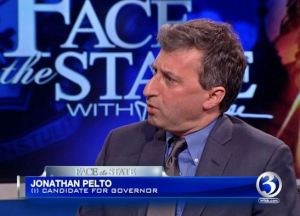
    Teacher unrest has given Jonathan Pelto, an education blogger and former Democratic state legislator, an opening to try to organize a third-party run for governor.
    Malloy told the delegates Monday in a well-received speech that he’s made mistakes, but he stopped far short of apologizing for what teachers still say was a gratuitous and deliberate insult.
    The task for union leaders has been to manage the anger of the rank-and-file, sharply contrasting the overall labor record of Connecticut’s first Democratic governor in a generation with the hostility to labor and collective bargaining by GOP governors in once-union friendly states like Wisconsin and Michigan.
    Another complication has been a local fight over control of the public schools in Bridgeport, an overwhelmingly Democratic city A labor embrace for Malloy, with a jab over education | The CT Mirror:

    When a pro-teacher, pro-pubic school, pro-union candidate for governor in one state is blocked from speaking to AFL-CIO delegates… by Jonathan Pelto | Reclaim Reform

    When a pro-teacher, pro-pubic school, pro-union candidate for governor in one state is blocked from speaking to AFL-CIO delegates… by Jonathan Pelto | Reclaim Reform:


    When a pro-teacher, pro-pubic school, pro-union candidate for governor in one state is blocked from speaking to AFL-CIO delegates… by Jonathan Pelto

    A final word about the AFL-CIO’s decision to block my speech to delegates

    By Jonathan Pelto
    “We are not afraid to entrust the American people with unpleasant facts, foreign ideas, alien philosophies, and competitive values. For a nation that is afraid to let its people judge the truth and falsehood in an open market is a nation that is afraid of its people.” – President John F. Kennedy
    Yesterday the delegates to the 2014 AFL-CIO political endorsing convention heard from Republican Tom Foley and Democrat Dannel “Dan” Malloy.
    In response to a question about why the leadership of the AFL-CIO decided to prevent Jonathan Pelto, the gubernatorial candidate for the Education and Democracy Party, from addressing the delegates who are charged with endorsing candidates in this year’s election, the head of the AFL-CIO said,
    “The reality is I don’t like that we have a two party system. I wish it was different. But the playing field is what it is. The fact is, it’s going to be a major party that wins. Until that changes, we have some change in that electorate, then I am perfectly comfortable with how we decided to invite the candidates to come to this convention.,” – Lori Pelletier
    So it came to pass that Governor Dannel “Dan” Malloy went unchallenged when he told the delegates;
    “I stand with labor, I always have, I always will. It goes back to who I am and what I am,” – Governor Malloy
    Banned from speaking at the AFL-CIO convention, I was unable to point out the following…
    • Malloy is the only Democratic Governor in the nation to have introduced legislation eliminating teacher tenure and repealing collective bargaining for teachers working in schools “turnaround schools.”  While we rightfully fight to prevent a so-called 

    AG Abbott: Texas schools cannot use Common Core standards - K-12 Zone

    AG Abbott: Texas schools cannot use Common Core standards - K-12 Zone:


    AG Abbott: Texas schools cannot use Common Core standards


    Texas Attorney General Greg Abbott confirmed Tuesday in a ruling that the state’s public school districts cannot adopt controversial national curriculum standards called common core.
    State lawmakers passed a law prohibiting the use of the standards, but state Sen. Dan Patrick, the bill’s sponsor and chairman of the Senate Education Committee, asked Abbott for a ruling to eliminate any confusion over the meaning. Some had expressed concerns that the state’s own curriculum requirements (known as the Texas Essential Knowledge and Skills) overlap with the common core standards — adopted by nearly all states besides Texas, though some have since dropped their support or delayed the rollout.
    “That concern is baseless,” wrote Abbott, the Republican gubernatorial nominee. “To use a simple example, if TEKS requires teaching that 2+2=4, the bill plainly does not prevent this instruction simply because Common Core also teaches that 2+2=4. The Legislature was aware of the frequent overlap between the TEKS and the Common Core Standards, as evidenced by the bill author’s explanation that it was not his intent ‘to prevent the use of materials where the two standards may overlap.’”
    The common core standards, which had bipartisan support nationwide, have since spawned a revolt from some Republicans over concerns that the federal government has too much sway over local education policy.
    http://www.scribd.com/doc/230107173/AG-ruling-on-common-core


    Shaky Methods, Shaky Motives: A Recap of My Critique of the NCTQ’s Review of Teacher Preparation Programs | A "Fuller" Look at Education Issues

    Shaky Methods, Shaky Motives: A Recap of My Critique of the NCTQ’s Review of Teacher Preparation Programs | A "Fuller" Look at Education Issues:


    Shaky Methods, Shaky Motives: A Recap of My Critique of the NCTQ’s Review of Teacher Preparation Programs

    Posted on June 17, 2014


    Rate This


    Preface
    The following is based on my complete study published in the Journal of Teacher Education. This version leaves out some examples, technical points, and suggestions for an approach to evaluating preparation programs. Sage Journals has been kind enough to make the complete study available for free to the public for a one month period. The study can be found at:http://tinyurl.com/mhqjyn6
    Introduction
    After last year’s release of the NCTQ’s ratings of teacher preparation programs, headlines and leading remarks about US teacher preparation programs proclaimed: “Teacher prep programs get failing marks” (Sanchez, 2013); “University programs that train U.S. teachers get mediocre marks in first-ever ratings” (Layton, 2013); and, “The nation’s teacher-training programs do not adequately prepare would-be educators for the classroom, even as they produce almost triple the number of graduates needed” (Elliot, 2013).
    Critics of traditional teacher preparation have used the report as evidence that US teacher preparation is completely broken and we need to radically change traditional university-based programs and/or abandon traditional programs in favor of marketplace of a wide array of providers. For example, Arthur Levine (2013) wrote:
    The NCTQ described a field in disarray with low admission standards, a crazy quilt of varying and inconsistent programs, and disagreement on issues as basic as how to prepare teachers or what skills and knowledge they need to be effective. The report found few excellent teacher-education programs, and many more that were failing. Most were rated as mediocre or poor.
    While the NCTQ critiques are not substantially different than many previous calls for reform, the current calls for reform come at a time of increased belief that public schools have failed, partially as a result of traditional teacher preparation programs and “we need to end the effective monopoly that education schools have on teacher training. Policymakers must foster a robust marketplace of providers from which schools and school districts can choose candidates” (Kamras & Rotherham, 2007).
    NCTQ’s efforts have raised a number of concerns by researchers such that a wide array of critiques were posted and published after last year’s report, Even before the report was released, the concern was so great among teacher preparation personnel that most programs refused to Shaky Methods, Shaky Motives: A Recap of My Critique of the NCTQ’s Review of Teacher Preparation Programs | A "Fuller" Look at Education Issues:

    Video: For New Orleans students, Katrina was just the beginning | National Opportunity to Learn Campaign | Education Reform for Equity and Opportunity

    Video: For New Orleans students, Katrina was just the beginning | National Opportunity to Learn Campaign | Education Reform for Equity and Opportunity:


    Video: For New Orleans students, Katrina was just the beginning

    Posted on: Tuesday June 17th, 2014

    The world watched in horror as Hurricane Katrina devastated New Orleans and much of the Gulf Coast in 2005. But for New Orleans’ public school students, parents, and teachers, the tragedy of Katrina was just the beginning.


    While people in Orleans Parish were still underwater, and on rooftops, there was a plan being formed to take away the schools...
    "A Perfect Storm: The Takeover of New Orleans Public Schools," the first in series of short videos, shows the inside story of how the recovery from Katrina gave education officials and corporate reformers the perfect opportunity to make drastic changes to New Orleans’ public schools with virtually no community input or accountability.
    It’s a story that all Americans concerned for the future of our children’s education need to know. As filmmaker Phoebe Ferguson put it:
    "It was important to make this series of short videos because, although there have been many attempts to get the truth out about the realities the failed education reforms in New Orleans, film can often reach a far greater number of people and have a more immediate impact than even the most in-depth research papers. Now I, along with my co-producer Raynard Sanders, and education colleagues have the opportunity to use these videos to help make the public aware and to reclaim public education 
    Video: For New Orleans students, Katrina was just the beginning | National Opportunity to Learn Campaign | Education Reform for Equity and Opportunity: