Latest News and Comment from Education

Friday, March 28, 2025

THIS WEEK IN DONALD TRUMP CRAZY LAND: A FIREHOSE OF BS, A SIGNAL OF CHAOS AND A DOGE OF DISASTER


THIS WEEK IN DONALD TRUMP CRAZY LAND

A FIREHOSE OF BS, A SIGNAL OF CHAOS AND A DOGE OF DISASTER


Welcome, dear reader, to another episode of 'This Week in Donald Trump Crazy Land,' where the absurdity flows freely, the scandals pile up faster than Elon Musk’s tweets, and America wonders if it’s living in a satirical Netflix series. Grab your popcorn—or maybe a stiff drink—because we’re diving headfirst into the chaos. Spoiler alert: it’s only been two months into this mad house, and the firehose of nonsense shows no signs of shutting off.

Elon Musk, DOGE, and the Social Security Dumpster Fire

Ah, Social Security—the lifeline for millions of Americans, now under siege by a billionaire who once called it a “Ponzi scheme” and a president who thinks “efficiency” means cutting corners with a chainsaw. Enter the "Department of Government Efficiency (DOGE)"—because nothing screams “serious reform” like naming your federal initiative after a meme cryptocurrency.

Elon Musk, self-appointed disruptor-in-chief, has teamed up with King Trump to “fix” Social Security. Their plan? Slash 12% of staff, close 50 offices, and roll out IT systems that crash more often than Tesla’s autopilot. Musk claims there’s $700 billion in fraud—an allegation debunked faster than his promises about self-driving cars. Turns out, most of that “fraud” boils down to clerical errors. But hey, why let facts get in the way of a good scapegoat?

Critics argue this isn’t reform; it’s sabotage. Reduced services, delays in benefits, and whispers of privatization have retirees clutching their checkbooks in horror. Senators Elizabeth Warren and Ron Wyden warn this chaos could pave the way for Wall Street to swoop in and turn Social Security into another profit-driven casino. Because nothing says “secure retirement” like handing your future to hedge fund managers.

And let’s not forget the immigrants Musk and Trump love to blame for everything from Social Security woes to bad weather. These same immigrants contribute billions to the system without receiving benefits—but sure, let’s make them the villains. Meanwhile, Acting SSA head Leland Dudek is waving red flags, warning that the system could collapse entirely without intervention. But hey, at least DOGE has a snazzy logo.

SignalGate: When National Security Met Group Chat Fails

If you thought your family’s WhatsApp group was chaotic, wait until you hear about SignalGate. Senior Trump officials decided that the best way to plan a military strike on Yemen was through an unsecured Signal group chat. Yes, the same app you use to send memes to your friends was apparently good enough for discussing classified war plans.

The pièce de résistance? They accidentally added a journalist to the chat. That’s right—a reporter got a front-row seat to sensitive operational details, including target locations and attack timelines. It’s like sending your nuclear codes to a spam email list.

The fallout was predictably catastrophic. Security experts slammed the administration for its recklessness, while critics pointed out the hypocrisy: remember when Republicans lost their minds over Hillary Clinton’s email server? Now, those same folks are oddly silent about Trump officials using Signal to discuss military operations.

Among the bumbling cast of characters were Pete Hegseth and Tulsi Gabbard, who somehow thought self-deleting messages would bypass federal archiving laws. Spoiler: they didn’t. The Pentagon had explicitly warned against using Signal for government communications, but who needs rules when you’ve got loyalty over competence as your hiring criteria?

Even Hillary Clinton weighed in, calling the fiasco “unbelievable.” Coming from someone who endured years of scrutiny over far less egregious behavior, her disbelief is well-founded. The scandal underscores a broader theme: Trump’s administration treated national security like a game of *Candy Crush*, with about as much strategic oversight.

ICE: From Immigration Enforcement to Dystopian Nightmare

If ICE under Trump were a movie, it’d be *Minority Report* meets *The Hunger Games*. Once tasked with enforcing immigration laws, ICE has morphed into an unchecked force capable of detaining anyone—legal residents, tourists, even U.S. citizens—without cause or due process. It’s like Oprah handing out detentions: *You get detained! You get detained! Everybody gets detained!*

The stories are harrowing. Legal residents held over bureaucratic errors. Visitors detained based on “suspicion.” Detainees subjected to solitary confinement and physical abuse. One particularly chilling case involves Rumeysa Ozturk, a Turkish Ph.D. student at Tufts University. Despite a federal court order for her release, ICE transferred her to Louisiana and accused her of supporting Hamas—without evidence. Her real “crime”? Pro-Palestinian activism.

For-profit detention centers are raking in cash while detainees suffer in inhumane conditions. Critics argue this isn’t just about immigration; it’s about silencing dissent and targeting marginalized communities. Universities like Columbia and Georgetown have seen students detained for their activism, raising alarms about academic freedom and free speech.

Trump’s rhetoric about “America First” seems to translate into “America Last” when it comes to human rights and intellectual freedom. But don’t worry—ICE is just getting started.

Education: Dismantling Democracy One School at a Time

Speaking of dystopia, let’s talk education. The Trump administration has set its sights on dismantling the Department of Education, because apparently ensuring equal access to education is just too radical an idea. The department’s mission—to protect students’ rights and promote equity—has been turned into a political punching bag.

Programs like Title I (for low-income students) and IDEA (for special-needs students) are under threat as federal oversight is gutted. Critics warn that transferring funds to states could lead to misuse, leaving disadvantaged students in the lurch. Privatization looms large, with fears that education will become a profit-driven enterprise rather than a public good.

Meanwhile, civics education is eroding faster than Trump’s approval ratings. Teaching kids about democracy? Checks and balances? Not on this administration’s watch. Instead, we get executive orders aimed at shutting down public schools and funneling resources into for-profit charters.

But there is hope. Grassroots efforts like Dolly Parton’s book initiative remind us that education is worth fighting for. Teachers’ unions and advocates are pushing back against privatization schemes, proving that not everyone is willing to let public education go quietly into the night.

Global Health: Cutting Aid and Spreading Chaos

If you thought Trump’s domestic policies were bad, wait until you see what he’s done on the global stage. The administration has slashed funding for critical health programs—including vaccine initiatives and malaria prevention—leaving millions at risk.

Take Gavi, an organization that provides vaccines to children in developing nations. The U.S. had pledged $2.6 billion through 2030—but Trump pulled the plug. Experts warn this could result in 75 million children missing routine vaccinations over five years, with over 1.2 million deaths.

The cuts don’t stop there. USAID has been gutted, its budget slashed from $40 billion to $8 billion. Programs combating HIV, malaria, and other diseases are shutting down, leaving vulnerable populations without life-saving treatments.

The consequences are devastating. Personal stories—like Peter Donde and Achol Deng dying from lack of HIV medication—put faces to the statistics. Health workers in places like South Sudan warn of catastrophic death tolls as medical supplies run out.

All this for what? To save a fraction of the federal budget while spending billions on tax cuts for billionaires? It’s cruelty disguised as fiscal responsibility—and the world is paying the price.

Press Freedom: MAGA vs. The Media

Finally, let’s talk about Trump’s war on the press—a campaign so brazen it makes Nixon look like a First Amendment champion. From barring established outlets like AP and Reuters to promoting MAGA-aligned propaganda machines, Trump has turned press freedom into his personal punching bag.

He’s floated ideas like banning anonymous sources (because investigative journalism is scary), launched baseless lawsuits against media outlets, and even proposed using the Espionage Act to prosecute journalists. Meanwhile, Project 2025—a dystopian blueprint for his second term—outlines plans to further erode media independence.

The hypocrisy is staggering. Trump rails against “fake news” while spreading misinformation faster than you can say “covfefe.” Corporate-owned media often fails to push back effectively, leaving smaller outlets and independent journalists to do the heavy lifting.

But all is not lost. Courageous reporters continue to hold power accountable, reminding us that democracy dies in darkness—but it also thrives in resistance.

The Bottom Line

So here we are: two months into Trump Crazy Land 2.0 (or is it 3.0?), with no end in sight. Social Security teeters on collapse. National security is planned on Signal chats. ICE runs amok. Education crumbles. Global health suffers. And press freedom hangs by a thread.

Do you feel safer? Freer? Are your eggs cheaper? Is your 401(k) thriving? Did your mom get her Social Security check this month? If not, maybe it’s time to grab your sign and join the protests on April 5th.

Because if “America First” keeps making America last, we’ve got some serious work to do.

Stay tuned—it’s only going to get crazier from here.


HANDS OFF: April 5th Mobilization Informational For Event Hosts · Indivisible https://www.mobilize.us/indivisible/event/764476/ 


Wednesday, March 26, 2025

SIGNAL FAIL: HOW A GROUP CHAT BECAME A NATIONAL SECURITY DUMPSTER FIRE

SIGNAL FAIL: HOW A GROUP CHAT BECAME A NATIONAL SECURITY DUMPSTER FIRE

Once upon a time in the chaotic kingdom of American politics, there was a merry band of high-ranking officials who decided that the best way to discuss sensitive military operations was through a group chat on Signal. Yes, Signal—the app beloved by teenagers sharing memes, activists avoiding surveillance, and, apparently, the Trump administration planning airstrikes. What could possibly go wrong? Spoiler alert: everything.

The story begins with Jeffrey Goldberg, the editor-in-chief of *The Atlantic*, who was minding his own business when his phone buzzed with an invitation to join a group chat. Now, most of us would assume such a thing was either spam or a phishing attempt, but Goldberg, curious soul that he is, joined. And lo and behold, he found himself in the middle of what can only be described as a digital clown car of national security blunders. The group was called “Houthi PC small group,” which sounds less like a military operation and more like an IT department’s Slack channel. 

The texts were flying fast and loose, with Secretary of Defense Pete Hegseth leading the charge. Hegseth, a man who apparently believes in the power of all-caps for emphasis, sent updates like “WEATHER IS FAVORABLE” and “F-18s LAUNCH (1st strike package).” It’s unclear whether he thought he was narrating a Tom Clancy novel or just really wanted to channel his inner action hero. Either way, these messages were being shared with Goldberg—a journalist whose job description literally includes exposing things like this.

Now, let’s pause for a moment to appreciate the absurdity here. Imagine if Julius Caesar had accidentally CC’d a scribe from *The Roman Times* on his plans to cross the Rubicon. Or if Winston Churchill had accidentally butt-dialed a BBC reporter during a War Cabinet meeting. This wasn’t just a breach of protocol; this was a breach of common sense so gaping you could drive an aircraft carrier through it.

But wait, it gets better—or worse, depending on your threshold for secondhand embarrassment. When Goldberg published his initial story about the Signal chat, the Trump administration went into full damage-control mode. Pete Hegseth declared, “Nobody was texting war plans,” which is a bold statement considering the texts literally included a timeline for bombing runs. Tulsi Gabbard, the director of national intelligence, and John Ratcliffe, the CIA director, both assured Congress that no classified information had been shared. President Trump himself chimed in with his trademark brevity: “It wasn’t classified information.”

This raises an important question: if this wasn’t classified information, what exactly qualifies as classified in their world? The nuclear codes? The recipe for KFC’s secret blend of herbs and spices? By their logic, it seems you could write “TOP SECRET” on a Post-it note and it would still be fair game for group chats and chain emails.

Goldberg and his colleague Shane Harris faced a dilemma: Should they publish the full transcript of the chat? On one hand, they had withheld specific details about weapons and attack timing to avoid jeopardizing U.S. personnel. On the other hand, administration officials were accusing them of lying about the content of the messages. In the end, they decided to release the texts—redacted only to protect certain identities—so that the public could judge for themselves.

And judge they did. The texts revealed not only operational details but also an alarming level of carelessness. For instance, at 11:44 a.m., Hegseth texted that F-18s would launch at 12:15 p.m., giving anyone with access to that chat a 31-minute heads-up. That’s not just loose lips sinking ships; that’s loose thumbs endangering pilots.

Adding insult to injury, Vice President J.D. Vance chimed in with a text saying he’d “say a prayer for victory,” which is lovely sentimentally but perhaps not the most reassuring contribution to military strategy. Later, when National Security Adviser Michael Waltz informed the group that a building had collapsed on their target—a Houthi missile expert—Vance replied with a succinct “Excellent.” One can only imagine him twirling an invisible mustache as he typed.

The cherry on this sundae of incompetence came when Waltz admitted he had no idea how Goldberg ended up in the chat. Was it a fat-fingered typo? A rogue intern? A cosmic joke played by the universe? We may never know, but it’s safe to say that “how the heck he got into this room” will go down as one of history’s great unanswered questions.

Now, let’s talk about Signal itself. The app is known for its disappearing messages feature, which is great if you’re trying to keep your conversations private—or if you’re planning an elaborate surprise party. It is not, however, a substitute for secure communication channels when discussing military operations. Experts have repeatedly warned that using Signal for such purposes poses a significant threat to national security. After all, disappearing messages are only useful if they disappear before someone screenshots them—which Goldberg undoubtedly did.


The Trump administration’s defense boiled down to two contradictory arguments: (1) The information wasn’t classified, so it’s no big deal; and (2) The information was sensitive, so please don’t publish it. This is like claiming you didn’t eat the last slice of pizza while simultaneously arguing that you had every right to eat it because you paid for it. Pick a lane!

As the dust settled—or perhaps exploded—in Yemen, one thing became abundantly clear: this was not just a minor slip-up; this was a masterclass in how not to handle national security. It’s one thing to make mistakes; it’s another to double down on them while accusing everyone else of being wrong.

In conclusion, the Signal chat fiasco is a cautionary tale for anyone who thinks technology can replace common sense. It’s also a reminder that even at the highest levels of government, people are still people—flawed, fallible, and occasionally hilarious in their incompetence. So the next time you find yourself accidentally adding your boss to your group chat about weekend plans, take comfort in this: at least you didn’t accidentally invite a journalist to your war-planning session.

Godspeed to us all—and maybe leave the emojis out of national security next time.


The SignalGate Scandal, the Lies, and the Text Messages https://dianeravitch.net/2025/03/26/the-signalgate-scandal-the-lies-and-the-text-messages/ via @dianeravitch 

Here Are the Attack Plans That Trump’s Advisers Shared on Signal - The Atlantic https://www.theatlantic.com/politics/archive/2025/03/signal-group-chat-attack-plans-hegseth-goldberg/682176/ 


Michael Waltz Sez:


Tuesday, March 25, 2025

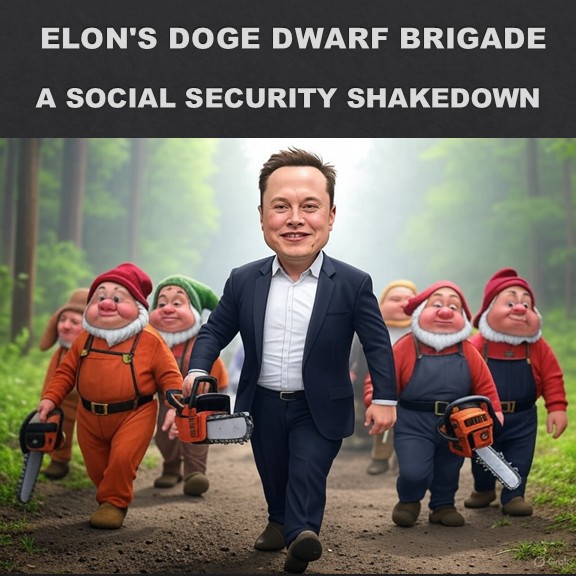
ELON'S DOGE DWARF BRIGADE: A SOCIAL SECURITY SHAKEDOWN


Long waits, waves of calls, website crashes: Social Security is breaking down https://wapo.st/4hM5MAn 

🎶 ELON'S DOGE DWARF BRIGADE ðŸŽ¶  

A SOCIAL SECURITY SHAKEDOWN

Verse 1:  

"Hi-ho, hi-ho! The Spreadsheet King’s on patrol—  

With seven data dwarfs auditing Grandma’s retirement toll!  

Whistleblower Walt’s crunching numbers with glee,  

Tweetstorm Terry’s ranting: ‘Centenarians must flee!’"  

Chorus:  

"Off to work they go (with a meme and a smirk!),  

Hunting 300-year-olds who ‘fraud’ their desk work!  

Hi-ho, hi-ho—your benefits are 'suspicious',  

Beware the crypto-dwarfs… their math’s 'delicious'!"  

Verse 2:  

Spreadsheet Steve found a glitch—‘See? 142!  

This corpse’s still cashing checks! Let’s sue!’  

Meme Lord Moe posts charts: ‘The system’s a joke!  

But don’t blame us, blame Granny’s ghostly woke!’"  

Verse 3:  

Crypto Carl yells, ‘Deploy blockchain tech!  

We’ll track every penny that Granny might wreck!’  

Algorithm Al runs simulations all night,  

While NFT Ned sells ‘Retirement Rights!’"  

Bridge:

"Oh, the chaos ensues in this pensioner purge,  

With Data Dave shouting, ‘There’s fraud to splurge!’  

Elon’s brigade, with their tech-savvy might,  

Turn Grandma’s savings into meme-fueled delight."  

Chorus (Reprise): 

"Off to work they go (armed with code and a grin),  

Chasing holograms of retirees who sin!  

Hi-ho, hi-ho—your benefits are 'dubious',  

Watch out for the dwarfs—they’re *meticulously devious!*"  

Outro:  

"So if you’re a centenarian, beware of their schemes,  

Your pensions might vanish into Elon’s dreams.  

And as they march off with their data in tow,  

They chant: ‘Hi-ho, hi-ho—it’s off to Mars we go!’"  

Final Warning:  

⚠️ Lock your SSNs, folks—Elon’s mining your age!  

“If you’re alive past 100… you’re a glitch in the matrix, sage.”  

- Based on Musk’s viral claims of "millions over 140" collecting benefits .  

- Inspired by the "300-year-old lady" panic  and meme lore.


Elon Musk, DOGE, and the Great Social Security Heist: A Comedy of Errors

Ladies and gentlemen, gather 'round for the most ambitious crossover event in American bureaucracy since the IRS tried to understand TikTok influencers' tax returns. Enter Elon Musk, the tech mogul with a penchant for rockets, electric cars, and now, apparently, federal benefit programs. Musk has teamed up with President Donald Trump in what can only be described as the weirdest buddy-cop movie never made: "The Billionaire and the Bureaucrat." Their mission? To take on Social Security, a program as old and beloved as grandma’s apple pie recipe. Spoiler alert: hilarity—and chaos—ensues.

Musk and Social Security—A Match Made in Bureaucratic Hell

Elon Musk, the man who once launched a Tesla into space for fun, has now set his sights on Social Security. Yes, the same Social Security that keeps millions of retirees from eating cat food for dinner. Musk has called it a "Ponzi scheme," which is rich coming from someone whose companies have benefited from billions in government subsidies. But hey, who are we to question the financial acumen of a man who named his child X Æ A-12? 

Armed with dubious data and a flair for the dramatic, Musk has claimed that Social Security is hemorrhaging money due to widespread fraud. His evidence? Allegations of payments to deceased beneficiaries and a mysterious figure of $500-700 billion in annual fraud that seems to have been plucked from thin air—or perhaps the same dimension where Dogecoin is considered a stable currency.

Watchdogs and fact-checkers have been quick to point out that Musk's claims are about as credible as a chain email promising you $1,000 if you forward it to ten friends. The alleged "fraud" largely stems from outdated government records that lack death dates, not actual payments to the dearly departed. But why let facts get in the way of a good narrative?

DOGE to the Rescue—or Not

To tackle this so-called crisis, Musk has unleashed his Department of Government Efficiency (DOGE)—a name so absurd it sounds like it was brainstormed during a late-night meme session on Reddit. DOGE’s mission? To streamline government operations, which in this case means slashing Social Security staff by 12%, closing nearly 50 field offices, and cutting phone services. Because nothing says "efficiency" like making it harder for vulnerable populations to access essential services.

DOGE’s interventions have already led to IT system crashes, delays in processing claims, and general chaos. It’s as if someone handed over the keys to a perfectly functional car and said, "Let’s see what happens if we remove the brakes." Critics warn that these changes could lead to catastrophic consequences, including interruptions in benefits for millions of Americans. But don’t worry—Musk assures us he’s got everything under control. After all, this is the same guy who promised self-driving cars by 2020.

The Privatization Plot Twist

As if this comedy of errors weren’t already entertaining enough, Senators Elizabeth Warren and Ron Wyden have accused DOGE and the Trump administration of attempting to privatize Social Security. The theory goes that by undermining the program’s operations—causing longer wait times, reduced access, and increased frustration—they can justify handing it over to private equity firms. Because if there’s one thing Americans love more than government inefficiency, it’s Wall Street playing roulette with their retirement funds.

Imagine a future where your Social Security check is tied to the performance of a hedge fund managed by a guy named Chad who wears loafers without socks. One bad quarter in the stock market, and suddenly Grandma’s knitting club is crowdfunding her rent on GoFundMe. It’s a dystopian vision worthy of a Black Mirror episode—or perhaps just another day in late-stage capitalism.

Immigrants, Fraud, and Other Scapegoats

No political spectacle would be complete without some good old-fashioned scapegoating. Musk has accused Democrats of using Social Security to attract immigrants, a claim that is not only baseless but also ironic given that undocumented immigrants contribute billions to Social Security without ever receiving benefits. Yes, you read that right: billions. It’s like paying for an all-you-can-eat buffet but being told you’re only allowed to smell the food.

But why stop at immigrants? Musk and Trump have also zeroed in on deceased beneficiaries as Public Enemy No. 1. Never mind that these so-called fraudulent payments are largely the result of clerical errors rather than actual malfeasance. In the grand tradition of American politics, it’s easier to blame ghosts than to address systemic issues.

Public Opinion—Divided but Entertained

Unsurprisingly, public opinion on Musk’s role in this debacle is as divided as Thanksgiving dinner conversations about politics. Some see him as a visionary disruptor bringing Silicon Valley ingenuity to Washington. Others view him as an out-of-touch billionaire playing Monopoly with people’s lives. Either way, one thing is clear: Musk’s foray into federal governance has been anything but boring.

Critics argue that Musk’s focus on rooting out nonexistent fraud distracts from more pressing issues, like the fact that Social Security is projected to become insolvent by 2033. Instead of proposing meaningful reforms or new revenue streams, Musk and Trump have doubled down on populist rhetoric and questionable math. It’s like trying to fix a leaky roof by painting over the water stains—sure, it looks better for now, but you’re still going to get soaked when it rains.

The Road Ahead

So where does this leave us? For starters, DOGE’s cuts have already caused significant disruptions, and the potential for further damage looms large. Acting SSA head Leland Dudek has warned that without intervention, the system could collapse within months. Meanwhile, Trump’s proposal to eliminate income taxes on Social Security benefits—a move that would accelerate the program’s insolvency—has added fuel to the fire.

In true Musk fashion, privacy concerns have also entered the chat. DOGE’s access to sensitive SSA data has raised eyebrows, though Musk insists there’s no intent to misuse Americans’ information. Forgive us if we’re skeptical; after all, this is the same man who once sold flamethrowers to the public because… why not?

Conclusion: A Tragicomedy for the Ages

In summary, Elon Musk’s adventures in Social Security reform are shaping up to be a tragicomedy of epic proportions. On one hand, we have a billionaire tech mogul with zero experience in federal governance making sweeping changes to one of America’s most vital programs. On the other hand, we have millions of Americans who rely on Social Security being caught in the crossfire of political theater and corporate ambition.

Whether Musk’s actions are driven by genuine concern for government efficiency or a desire to dismantle public institutions remains up for debate. What’s clear is that his approach—marked by dubious claims, aggressive cost-cutting, and a disregard for expert advice—has done little to inspire confidence.

As we watch this drama unfold, one can’t help but wonder: Is this really about saving Social Security, or is it just another chapter in the ongoing saga of billionaires trying to reshape society in their own image? Either way, pass the popcorn—this show is far from over.

Musk eyes Social Security and benefit programs for cuts | AP News https://apnews.com/article/elon-musk-donald-trump-doge-b21b74f56f30012a6450a629e7232a1a 

DOGE wrong about Social Security, says former SSA chief : NPR https://www.npr.org/2025/03/24/nx-s1-5337999/elon-musk-doge-social-security-cuts 

King: Administration’s Reckless Approach to Social Security “Disrespectful, Destructive, and Dangerous” https://www.king.senate.gov/newsroom/press-releases/king-administrations-reckless-approach-to-social-security-disrespectful-destructive-and-dangerous 

Could Social Security go private? Senators are grilling Trump’s pick to lead the agency. Sens. Elizabeth Warren and Ron Wyden press Social Security nominee Frank Bisignano ahead of his confirmation hearing https://www.marketwatch.com/story/could-social-security-go-private-senators-are-grilling-trumps-pick-to-lead-the-agency-bb881da6?mod=home_ln 

Social Security Head Briefly Threatens to Shut Down Agency | Democracy Now! https://www.democracynow.org/2025/3/24/headlines/social_security_head_briefly_threatens_to_shut_down_agency

Social Security is telling its staff that customer service is about to get a lot worse https://www.yahoo.com/news/social-security-telling-staff-customer-201105948.html 


Sunday, March 23, 2025

A LOVE LETTER TO PUBLIC EDUCATION - THE 25-YEAR HIDDEN WAR AGAINST THE BILLIONAIRE OLIGARCHY


A LOVE LETTER TO PUBLIC EDUCATION

THE 25-YEAR HIDDEN WAR AGAINST THE BILLIONAIRE OLIGARCHY 

For some of you, the battle against the billionaire oligarchy began with the orange-hued chaos that was Donald J. Trump. You strapped on your metaphorical armor, sharpened your Twitter swords, and declared yourselves warriors for justice. But for those of us who have been in the trenches for decades, fighting for public education against a cabal of billionaires intent on turning our schools into their personal ATM machines, we’d like to say: “Welcome to the party, pal.” You’re late, but we’ve saved you a seat.  

This is not a new war. This is not even a recent war. This is a generational war. For over 25 years, parents, teachers, unions, and activists have been waging a David-versus-Goliath struggle against some of the richest people on Earth who are hell-bent on dismantling public education. And trust me, these billionaires aren’t doing it out of some misguided sense of charity. They’re doing it because they see dollar signs where we see classrooms.  

Act I: The Rise of the Billionaire Reformers  

Let’s start with the players in this twisted drama. On one side, we have the billionaire oligarchs: Bill Gates, the Koch brothers (rest in peace, I guess?), Laurene Powell Jobs, Michael Bloomberg, Elon Musk, Betsy DeVos, and the Walton family, among others. These folks have more money than most small countries and about as much accountability. They’ve poured their fortunes into “education reform,” which is billionaire-speak for “privatize everything and make a buck while doing it.”  

On the other side, we have the scrappy underdogs: teachers’ unions like the National Education Association (NEA) and the American Federation of Teachers (AFT), parent groups, bloggers, activists, and organizations like the Network for Public Education and the Badass Teachers Association (yes, that’s their real name, and yes, they’re as awesome as they sound). These are people who believe in public education as a cornerstone of democracy. They believe every child deserves a quality education, not just the ones whose parents can afford private school tuition or who win a lottery spot in a charter school.  

Act II: The Four-Step Dance of Destruction  

The billionaire oligarchs didn’t just wake up one day and decide to destroy public education on a whim. No, they have a playbook—a slick little four-step strategy that has been devastatingly effective. Let’s break it down:  

Step 1: Defund – Starve the Beast  

First, they cut funding to public schools. They lobby state legislatures to slash budgets under the guise of “fiscal responsibility.” They divert taxpayer dollars to charter schools and voucher programs. Then they sit back and watch as public schools struggle with overcrowded classrooms, outdated textbooks, and crumbling buildings.  

Step 2: Degrade – When Failure Is a Feature, Not a Bug  

Once public schools are starved of resources, they inevitably begin to falter. But instead of acknowledging that underfunding might be the problem (because duh), the oligarchs point to these failures as proof that public education is inherently broken. It’s like breaking someone’s legs and then blaming them for not winning a marathon.  

Step 3: Demonize – Blame the Little Guy  

Next comes the scapegoating. Teachers are painted as lazy union thugs who care more about job security than educating kids. Parents are accused of being apathetic or uninvolved. Students are labeled as undisciplined or unmotivated. This step is crucial because it shifts blame away from the billionaires pulling the strings and onto the people actually trying to make the system work despite impossible odds.  

Step 4: Dismantle – Privatization Nation  

Finally, they swoop in with their so-called solutions: charter schools, standardized testing, ed-tech products, and AI-driven learning platforms. These solutions conveniently funnel public money into private hands while eroding democratic control over education. And just like that, public education is no longer a public good—it’s a commodity.  

Act III: The Heroes We Don’t Deserve (But Desperately Need)  

Despite their overwhelming wealth and influence, the billionaires have not gone unchallenged. For every Gates-funded initiative to push Common Core or Zuckerberg-backed ed-tech experiment gone awry, there has been a Diane Ravitch or Randi Weingarten pushing back. These warriors have fought tirelessly to expose the lies behind education reform and to defend public schools from privatization vultures.  

Diane Ravitch, once a supporter of charter schools and standardized testing, had an epiphany and became one of the most vocal critics of corporate-driven education reform. Her books and blog posts are required reading for anyone who wants to understand what’s at stake in this fight.  

Teachers’ unions have also been on the front lines, organizing strikes and protests to demand better funding for schools and fair treatment for educators. Remember when West Virginia teachers shut down schools across the state in 2018 until lawmakers agreed to their demands? That was nothing short of heroic.  

And let’s not forget the parents who show up to school board meetings armed with facts and fury, or the bloggers who spend their evenings dissecting policy proposals and exposing corruption. These are ordinary people doing extraordinary things because they believe in the power of public education to transform lives and strengthen communities.  

Act IV: The New Frontiers of Disruption  

Just when you think you’ve got a handle on the battlefield, the billionaires pivot to new tactics. In recent years, they’ve shifted their focus from charter schools to ed-tech and artificial intelligence (AI). Laurene Powell Jobs’s Emerson Collective is investing heavily in these areas, as are Gates and Zuckerberg. They promise that technology will revolutionize learning—but at what cost?  

Critics argue that these tech-driven solutions prioritize profits over pedagogy. They erode teacher autonomy by turning educators into glorified babysitters for algorithm-driven platforms. They increase surveillance of students and teachers under the guise of “data collection.” And they undermine democratic control by outsourcing educational decisions to tech companies that answer only to their shareholders.  

Act V: The Fight Continues  

So where do we go from here? How do we fight back against an enemy with seemingly limitless resources? The answer lies in collective action. We need progressive taxation to ensure billionaires pay their fair share. We need strong unions to advocate for workers’ rights and public goods. We need policies that ban predatory privatization schemes and hold corporations accountable for their actions.  

But most importantly, we need to change the narrative. Public education is not failing—it’s being sabotaged. Teachers are not villains—they’re heroes doing their best under impossible circumstances. And billionaires are not saviors—they’re opportunists exploiting a system they helped break in the first place.  

Epilogue: A Call to Arms (and Bake Sales)  

For those of you who are just joining this fight: welcome aboard. We need you now more than ever. Bring your energy, your passion, and yes, your bake sale skills (because God knows we’ll need them). This war isn’t over—not by a long shot—but together, we can turn the tide.  

The billionaire oligarchy may have money on their side, but we have something far more powerful: people who care deeply about their communities and believe in the promise of public education. And if history has taught us anything, it’s that even Goliath can be brought down with enough well-aimed stones—or in this case, well-organized strikes and well-argued blog posts.  

So let’s get to it. The future of public education—and democracy itself—depends on us.  


Big Education Ape: DOGE, BILLIONAIRES, AND THE FOUR-STEP DANCE OF DISMANTLING DEMOCRACY https://bigeducationape.blogspot.com/2025/03/doge-billionaires-and-four-step-dance.html 


Billionaires Who Aim to “Disrupt” Education May Get a Chance Even If Trump Loses | Truthout https://truthout.org/articles/billionaires-who-aim-to-disrupt-education-may-get-a-chance-even-if-trump-loses/ 


Billionaires Pave the Way for Trump’s Federal Vouchers in the School Privatization Movement https://coloradotimesrecorder.com/2025/03/billionaires-pave-the-way-for-trumps-federal-vouchers-in-the-school-privatization-movement/68057/ 


Saturday, March 22, 2025

THE RETURN OF FAT DONNIE: A GANGSTER SAGA


THE RETURN OF FAT DONNIE

A GANGSTER SAGA

It was a foggy night in the city that never tweets. The neon lights of Mar-a-Lago flickered like a bad toupee in a hurricane. Somewhere, deep inside the gilded halls of his golden fortress, Fat Donnie sat behind a desk so large it could have doubled as an aircraft carrier. He leaned back in his chair, chomping on a Big Mac like it was a Cuban cigar, while his right-hand man, Dirty Steve Bannon, shuffled papers that were probably blank.  

"Steve," Donnie said, his voice oozing with the kind of bravado you'd expect from someone who thinks ketchup is a vegetable, "we did it. Ice Cream Cone Joey is outta the picture. The family is mine now."  

Dirty Steve adjusted his rumpled trench coat, which smelled faintly of whiskey and bad decisions. "Yeah, boss," he said, scratching his scruffy chin. "But Joey had loyalists. People who liked his... uh... soft serve approach to things. They're not gonna roll over so easy."  

Donnie’s eyes narrowed, which for him was just squinting a little harder than usual. "Loyalists? Hah! I’ll show them loyalty! Loyalty is when you stick with me no matter how many times I throw you under the bus!" He slammed his fist on the desk, sending a half-eaten Filet-O-Fish flying.  

Enter Fascist Fishman Miller, the family’s consigliere, slithering into the room like a snake in a three-piece suit. His face was so pale it looked like he’d been moonbathing. "Boss," Miller hissed, "we need to clean house. Joey’s people—they’re still out there, lurking in the shadows. Whispering about democracy... and decency." He said the last word like it tasted bitter in his mouth.  

Donnie nodded solemnly—or at least as solemnly as someone with ketchup on their chin could manage. "You're right, Fishman. We gotta take care of this before they take care of me. But who do we call? Who's ruthless enough to get the job done?"  

Dirty Steve and Fishman exchanged glances. There was only one name that came to mind, one man who could purge the disloyal faster than you could say "fake news."  

"Elon Musk," they said in unison. 

A hush fell over the room. Even the gold-plated chandelier seemed to shudder at the name.  

"Get him on the line," Donnie barked.  

Moments later, Elon Musk strolled into the room wearing a leather jacket and carrying a flamethrower because subtlety wasn’t really his thing. "I hear you’ve got a loyalty problem," Elon said, smirking like someone who just bought Twitter on a whim.  

"Yeah," Donnie said, leaning forward. "Can you handle it?"  

Elon grinned. "I’ll handle it faster than I can launch a rocket and make it explode."  

And so began the great purge of Ice Cream Cone Joey’s loyalists. Elon didn’t waste any time. First, he bought up all the social media platforms and turned them into loyalty tests. If you didn’t retweet Fat Donnie’s latest rant about how windmills cause cancer, you were out—permanently.  

Next, he deployed an army of Teslas equipped with AI facial recognition to hunt down anyone who still had an "I Like Joey" bumper sticker on their car. The Teslas weren’t great at corners, but they got the job done... eventually.  

Meanwhile, back at Mar-a-Lago, Donnie was getting paranoid. "What if Elon turns on me?" he whispered to Dirty Steve one night over a bucket of KFC. "What if he decides *I’m* disloyal?"  

Dirty Steve shrugged. "Relax, boss. Elon’s too busy trying to colonize Mars to worry about you."  

But Donnie wasn’t convinced. He started holding loyalty oaths every morning at breakfast. If you didn’t swear allegiance to him while holding a Diet Coke in one hand and saluting with the other, you were escorted out by one of Elon’s flamethrower-wielding robots.  

Things were getting tense in the family. Even Fishman Miller started looking nervous, and that guy usually thrived on chaos. "Boss," Miller said one day, "maybe we’re going too far? I mean, loyalty’s great and all, but we’re running out of people."  

"Nonsense!" Donnie bellowed. "I don’t need people! I’ve got... I’ve got ratings!"  

But ratings couldn’t keep the family together forever. One by one, even Donnie’s most loyal cronies started disappearing—some to Elon’s purge, others to sheer exhaustion from trying to keep up with Donnie’s ever-changing whims. Dirty Steve eventually fled to an undisclosed location (rumor has it he’s running a pirate radio station somewhere in the swamps), and Fishman Miller slithered off into obscurity, muttering something about writing a memoir titled *Scales of Justice*.  

In the end, Fat Donnie was left alone in his golden fortress, surrounded by nothing but empty Diet Coke cans and the faint hum of Teslas patrolling the grounds. He stared out the window at the dark horizon, wondering where it all went wrong.  

And then it hit him: maybe loyalty wasn’t about demanding fealty or purging dissenters. Maybe it was about... nah, who was he kidding? It was probably Hillary’s fault somehow.

As for Elon Musk? He took his flamethrower money and built a rocket big enough to launch himself—and all of Twitter's remaining servers—straight into space. Rumor has it he’s still out there somewhere, tweeting from orbit and plotting his next big move: turning Mars into a giant electric car dealership.

And so ended Fat Donnie’s gangster saga—not with a bang, but with a tweet that got zero likes.

The end... or is it? 


Thursday, March 20, 2025

THE GREAT EDUCATION HEIST: TRUMP, MUSK AND THE DOGE BOYS ARE PLAYING MONOPOLY WITH OUR SCHOOLS


THE GREAT EDUCATION HEIST

TRUMP, MUSK AND THE DOGE BOYS ARE PLAYING MONOPOLY WITH OUR SCHOOLS

In a move that feels like it was brainstormed during a poker game at Mar-a-Lago, Donald Trump has reportedly signed an executive order to dismantle the Department of Education. Yes, you read that right. The federal agency responsible for ensuring every child has access to quality education is now on the chopping block. The Department of Education, which oversees everything from student loans to special education programs, is apparently too much of a burden for the "small government, big yachts" crowd. 

And who’s cheering this on? A cast of characters that sounds like the lineup for a dystopian reality show—Trump, Elon Musk, and the so-called "Doge Boys." Together, they seem to be on a mission to turn public services into private profit machines faster than you can say, “voucher program.”

A Return to the Wild West of Education?

Let’s break this down. The Department of Education isn’t just some bureaucratic paper-pushing machine. It’s the lifeline for millions of students across the country. Through programs like Title I, it provides funding to schools in low-income areas, attempting to level the playing field in a nation where educational opportunities are often dictated by your ZIP code. Without it, rich districts will thrive on their property tax-funded schools while poorer areas are left with crumbling buildings and outdated textbooks. It's basically "The Hunger Games," but with algebra.

And let’s not forget IDEA (Individuals with Disabilities Education Act), which ensures that students with disabilities receive a free and appropriate public education. Scrapping the Department of Education is like taking the accessibility ramp off a school building and replacing it with a sign that says, “Good luck.” 

Oh, and then there’s the Office for Civil Rights (OCR), which enforces laws against discrimination in schools. Without it, who’s going to ensure that schools don’t suddenly decide to bring back segregation-era policies under the guise of “local control”? This isn’t just about education—it’s about civil rights, equity, and the kind of society we want to live in.

Mindless Cuts or Master Plan?

The justification for this move? Efficiency, of course! It’s the same argument used every time someone wants to gut a public service—cut costs, streamline operations, and let the states handle it. But let’s be real: this isn’t about efficiency. It’s about ideology. It’s about privatization. It’s about handing over public education to private companies who see students not as learners but as dollar signs.

Imagine a world where your child’s education is determined by how much profit their school can generate. Where vouchers redirect public funds to private schools that aren’t held to the same standards as public ones. Where corporations swoop in to offer “solutions” that conveniently come with hefty price tags. It’s like turning your local school into a franchise of McEducation—“Would you like fries with your standardized test?”

The "Doge Boys" and Their Privatization Dream

And then there’s Elon Musk, who seems to be moonlighting as an education policy advisor between launching rockets and tweeting memes. Musk has long been a critic of traditional education systems, favoring tech-driven alternatives like his experimental Ad Astra school. But while innovation is great, dismantling an entire federal department isn’t exactly the same as upgrading your Tesla software.

The Doge Boys—an unofficial nickname for a group of wealthy libertarian tech enthusiasts—are also reportedly in favor of this move. Their vision for America seems to involve dismantling every public institution and replacing it with blockchain-powered alternatives. Because nothing says “quality education” like paying your tuition in cryptocurrency.

The Fallout: Who Loses?

If this plan goes through (and that’s a big “if,” given that Congress would need to approve it), the consequences will be catastrophic. Vulnerable populations—low-income students, students with disabilities, and students from marginalized communities—will bear the brunt of these changes. These are kids who are already fighting an uphill battle in a system stacked against them. Taking away federal oversight and funding is like pulling the rug out from under them while they’re still trying to find their footing.

And let’s not forget the economic impact. The Department of Education manages over $1.6 trillion in federal student loans. Without it, who’s going to oversee this massive financial system? Are we just going to hand it over to Wall Street and hope for the best? Because that worked out so well in 2008.

Resistance Is Not Futile

The good news is that this plan isn’t going unchallenged. Education unions, advocacy groups, and Democratic state attorneys general are gearing up for a fight. They’ve already pointed out that dismantling the Department of Education would require Congressional approval—a tall order in a divided government.

Critics argue that this move is part of a broader agenda outlined in far-right plans like Project 2025, which prioritize privatization and tax cuts for the wealthy over public welfare. It’s not just about education; it’s about reshaping America into a country where public services are replaced by profit-driven enterprises.

A Call to Action

So what can we do? For starters, we can stop treating education like it’s a line item on a budget spreadsheet and start treating it like the fundamental human right it is. We can hold our elected officials accountable and demand that they prioritize students over shareholders. And we can remind ourselves—and each other—that America is at its best when it lifts up its most vulnerable, not when it leaves them behind.

Because at the end of the day, this isn’t just about schools or budgets or executive orders. It’s about what kind of country we want to be. Do we want to be a nation that invests in its future or one that auctions it off to the highest bidder? Do we want to be a society that values equity and opportunity or one that doubles down on inequality?

The choice is ours. Let’s make it wisely. And maybe leave the Doge Boys out of it this time.


In Response to Reported Executive Order, School Defenders Vow Uprising as Trump Targets Public Education | Common Dreams https://www.commondreams.org/news/trump-executive-orders-department-of-education 

Trump administration live updates: President to order dismantling of Education Department at White House event https://www.nbcnews.com/politics/trump-administration/live-blog/trump-administration-education-department-immigration-live-updates-rcna196782 

Donald Trump to sign executive order aiming to shut down Department of Education – US politics live https://www.theguardian.com/us-news/live/2025/mar/20/donald-trump-executive-order-department-of-education-us-politics-latest-updates-news 

Trump to sign order calling for shutdown of Education Department – NBC Los Angeles https://www.nbclosangeles.com/news/national-international/trump-executive-order-education-department-shutdown/3658832/ 

What does the Department of Education do? | USAFacts https://usafacts.org/explainers/what-does-the-us-government-do/agency/us-department-of-education/ 


Wednesday, March 19, 2025

TOO LITTLE, TO LATE: CHIEF JUSTICE JOHN ROBERTS AND THE CHAOS OF THE UNITARY EXECUTIVE THEORY


TOO LITTLE, TO LATE

CHIEF JUSTICE JOHN ROBERTS AND THE CHAOS OF THE UNITARY EXECUTIVE THEORY

In a world where the Constitution is supposed to reign supreme, we somehow find ourselves in a reality show where the judiciary, the executive, and the legislative branches are contestants vying for power. And let’s be honest: lately, it feels like the Supreme Court has been handing out golden tickets to contestants who think they’re auditioning for "America’s Next Top Monarch."  

Chief Justice John Roberts recently decided to chime in, offering a polite wrist-slap to Donald Trump’s ongoing disregard for judicial rulings. But let’s call it what it is: too little, too late. If Roberts were a firefighter, he’d be showing up to a house that’s already burned to the ground, holding a garden hose and asking, “Did someone call for help?”  

The real culprit here is the so-called Unitary Executive Theory—a fancy term for “the president can do whatever they want because reasons.” This theory has been lurking in the shadows of legal academia for decades, but it found its loudest cheerleader in Trump, who treated it less like a theory and more like a personalized cheat code for democracy. Spoiler alert: it’s not in the Constitution.  

Let’s get one thing straight: the Constitution is not a buffet where you pick and choose what suits your appetite. It explicitly outlines three equal branches of government—equal being the operative word here. The president isn’t a king. The Supreme Court isn’t an oracle. Congress isn’t an overpaid debate club. Each branch has its role, and none is supposed to overshadow the others. Yet here we are, with a Supreme Court that has, at times, enabled executive overreach like an overly indulgent parent handing car keys to a reckless teenager.  

And don’t get me started on Trump’s approach to court rulings. Ignoring them? Flouting them? Treating them like suggestions instead of mandates? That’s not how a president behaves; that’s how a wannabe dictator operates. Imagine if every citizen treated laws the way Trump treats court decisions. Chaos would reign! People would run red lights, skip taxes, and bring emotional support peacocks on airplanes—oh wait, some of that already happens.  

This isn’t about political parties or ideological leanings. This isn’t about red states or blue states or even purple prose. It’s about America—the United States of America—a nation built on the idea that no one is above the law. Not Trump, not Musk, not Bezos, not anyone who thinks their billions or their title grant them immunity from accountability.  

The problem is that we’ve allowed this nonsense to fester. We’ve let highfalutin legal theories like the Unitary Executive morph from obscure law school debates into real-world policies that threaten our democracy. And while it’s nice that Chief Justice Roberts has finally decided to speak up, his words feel more like a gentle nudge than the stern wake-up call we desperately need.  

Roberts’ recent comments suggest he wants to remind us that the courts are still arbiters of justice. Great! But where was this energy when the Supreme Court was busy enabling some of these very issues? It’s like building a dam after the floodwaters have already swept away the village. Thanks for trying, but maybe next time act before we need lifeboats.  

At its core, this isn’t just about Trump or Roberts or any other individual. It’s about us—the people. We’re the ones who have to demand better. We’re the ones who have to insist on respecting the Constitution and upholding the rule of law. Democracy isn’t self-cleaning; it requires maintenance, vigilance, and occasionally a good old-fashioned intervention when things go off the rails.  

We need to stop treating politics like a spectator sport and start treating it like what it is: the foundation of our shared lives as citizens of a republic. That means holding leaders accountable, rejecting authoritarian tendencies, and remembering that “nation of laws, not of men” isn’t just a catchy phrase—it’s a guiding principle.  

So yes, Chief Justice Roberts’ comments are appreciated, but they’re hardly sufficient. The time for half-measures and polite admonitions has passed. What we need now is bold action—action from the courts, from Congress, and most importantly, from us as citizens.  

Because if we don’t stand up for our democracy, who will? Certainly not those who see power as their birthright and the Constitution as an inconvenient speed bump on their road to domination. And definitely not those who think “checks and balances” is just a phrase you use when reconciling your bank account.  

It’s time to wake up, America. The Constitution isn’t going to defend itself, and democracy won’t survive on autopilot. Let’s treat this moment as a call to action—not just for Chief Justice Roberts but for all of us. And let’s remember: this isn’t about left or right; it’s about right and wrong.


What Is Unitary Executive Theory? How is Trump Using It to Push His Agenda? https://www.democracydocket.com/analysis/what-is-unitary-executive-theory-how-is-trump-using-it-to-push-his-agenda/ 

White House calls judge challenging Trump deportation order a ‘Democrat activist’ | Trump administration | The Guardian https://www.theguardian.com/us-news/2025/mar/19/trump-deportation-court-ruling 

Trump attacks on judges continue after statement from Chief Justice John Roberts https://youtu.be/Vz7nxur0Llc?si=bw7YpjLGt4d4oaJN via @YouTube 


THE BILLIONAIRE'S BALLOT: HOW MONEY BECAME THE MVP OF MODERN POLITICS

THE BILLIONAIRE'S BALLOT

HOW MONEY BECAME THE MVP OF MODERN POLITICS

In the grand theater of American democracy, where the stage is draped in red, white, and blue, and the actors deliver impassioned soliloquies about liberty and justice for all, there’s an undeniable truth lurking backstage: the candidate with the fattest wallet often gets top billing. Yes, folks, welcome to the United States of America, where elections are less about ideas and more about the almighty dollar. It’s hard to believe, but we’ve turned democracy into a retail system. And just like at the mall, the one who spends the most usually leaves with the prize.

Money Talks, and It Says "Vote for Me"

Let’s not kid ourselves. The correlation between campaign spending and winning is as predictable as a rom-com plot. Studies show that candidates who outspend their opponents win about 90% of the time in House races. In Senate contests, it’s a similar story. Why? Because money buys ads, consultants, rallies, and those awkward photo ops where candidates pretend to enjoy eating corn dogs at state fairs.

Sure, incumbents have a built-in advantage—they’ve already got the donor Rolodex and a head start on fundraising. But let’s not ignore the elephant (and donkey) in the room: big money isn’t coming from Grandma’s cookie jar. It’s coming from billionaires, corporations, and Super PACs with names like “Americans for Prosperity” (read: "Billionaires for More Billions"). Thanks to the 2010 Citizens United ruling, these entities can now funnel unlimited cash into campaigns, turning elections into financial arms races.

The Oligarchs’ Shopping Spree

So, what are these deep-pocketed donors buying? A better America? Hardly. They’re buying a government that works for them, not us. Let’s take a stroll down memory lane to see what their investments have yielded so far:

1. **Shipping Jobs Overseas**: Remember when America was the manufacturing powerhouse of the world? Neither do I. That’s because our oligarchic overlords decided they could make more money by outsourcing jobs to countries with cheaper labor. And voilà! Factories closed, towns crumbled, and billionaires added another zero to their bank accounts.

2. **Privatization Bonanza**: Public education? Privatize it. Healthcare? Privatize that too. Social Security and Medicare? They’re next on the chopping block. The mantra is simple: if it can be privatized and profited from, it will be.

3. **Union Busting**: Billionaires hate unions like cats hate water. Why? Because unions demand fair wages and benefits, which cut into profits. So, they’ve spent decades dismantling organized labor, leaving workers with fewer protections and stagnant wages.

4. **Tax Loopholes Galore**: Paying taxes is for suckers—or so say the ultra-rich. With armies of accountants and lobbyists, they’ve rigged the tax code to ensure they pay less than you do. Some even manage to pay nothing at all. Zero. Zilch. Nada. Meanwhile, you’re stuck wondering why your refund barely covers a week’s worth of groceries.

5. **Authoritarian Allies**: Let’s not forget their love affair with authoritarian regimes. After all, nothing says “freedom” like cozying up to leaders who suppress dissent and exploit their citizens for cheap labor.

Democracy on Life Support

Now, you might be wondering: where are our elected officials in all this? Aren’t they supposed to represent us? Well, technically, yes. But in practice, many of them are living in the pockets of billionaires like a well-trained hunting hound curled up in its master’s lap.

Once upon a time, politicians at least pretended to hide their allegiance to big money. But now? They flaunt it. Take the tech bros like Elon Musk and others who openly champion a privatized, profit-driven America where public services are relics of the past. They don’t even bother with subtlety anymore—it’s all yachts and Twitter tirades now.

The Most Expensive Show on Earth

Let’s talk numbers for a moment. The 2020 U.S. presidential election was the most expensive in history, with Democratic candidates alone spending a jaw-dropping $3.16 billion. That’s billion with a “B.” For context, that’s more than the GDP of some small countries. And what did all that money buy us? A divided nation still arguing over whether pineapple belongs on pizza.

And it’s not just presidential races breaking the bank. Congressional campaigns are also ballooning in cost, making it nearly impossible for candidates without billionaire backers to compete. It’s like trying to win Monopoly when someone else owns Boardwalk, Park Place, and half the railroads before you even roll the dice.

What Can We Do?

So, how do we fix this mess? Campaign finance reform would be a good start—perhaps limits on donations or public funding for elections. But good luck getting that passed when the people who would vote on it are the same ones benefiting from the current system.

Another option is to support grassroots candidates who rely on small-dollar donations rather than billionaire sugar daddies. It’s not easy—they face an uphill battle against well-funded opponents—but every movement starts somewhere.

Finally, we need to stay informed and hold our leaders accountable. Call them out when they prioritize corporate donors over constituents. Demand transparency in campaign financing. And for heaven’s sake, vote in every election—not just the big ones.

Curtain Call

In the end, American democracy is starting to feel less like a government “of the people, by the people, for the people” and more like a Broadway production bankrolled by a handful of wealthy producers. The rest of us? We’re just the audience—paying for overpriced tickets and hoping for a happy ending.

But here’s the thing about democracy: it’s not a spectator sport. If we want to reclaim it from the clutches of billionaires and Super PACs, we need to get off the sidelines and into the game. Otherwise, we’ll find ourselves living in a neo-feudal society where the rich call all the shots and the rest of us are just serfs scrolling through TikTok during our lunch breaks.

The choice is ours—wallet or ballot? Let’s make it count.

THE UNITED STATES OF OLIGARCHIA https://open.substack.com/pub/ru4people/p/the-united-states-of-oligarchia?r=kja7f&utm_campaign=post&utm_medium=web&showWelcomeOnShare=false