Latest News and Comment from Education

Sunday, July 9, 2023

THE GREAT VOUCHER WAR: BILLIONAIRES BATTLE TO END PUBLIC EDUCTION

THE GREAT VOUCHER WAR BILLIONAIRES BATTLE TO END PUBLIC EDUCATION

In a world where billionaires have more power than ever before, it's no surprise that they're using their wealth to influence education policy. The Citizens United decision has given them unlimited spending power, and they're using it to promote vouchers and charter schools. But why are they so eager to end public education? Let's take a look.

First, there's the issue of control. Billionaires don't like being told what to do, and they don't like the idea of a government-run education system that they can't control. By promoting vouchers and charter schools, they can create a parallel education system that they can control. It's like having their own private school system, without having to pay for it themselves.

Second, there's the issue of ideology. Many billionaires are libertarians who believe in limited government and free markets. They see public education as a socialist institution that needs to be dismantled. By promoting vouchers and charter schools, they can create a free market in education where parents can choose the best school for their child. Of course, this ignores the fact that education is a public good that benefits everyone, not just individual families.

But why are billionaires so obsessed with vouchers and charter schools? Why not just donate money to public schools? Well, for one thing, public schools are subject to democratic control. Billionaires can't just walk in and tell them what to do. By promoting vouchers and charter schools, they can create a parallel education system that they can control.

So what are some of the effects of this spending on vouchers and charter schools? Well, for one thing, it undermines the democratic process. By allowing billionaires to spend unlimited amounts of money on elections, they can buy influence and drown out the voices of ordinary citizens. It also diverts public funds from public schools to private schools, which may have less oversight and regulation.

But don't worry, there are ways to fight back against the voucher oligarchy. For one thing, we can support grassroots movements and organizations that advocate for democracy reform and challenge the influence of money in politics. We can also educate and engage citizens to become more aware and involved in politics and policy issues.

Of course, it's not just billionaires who are promoting vouchers and charter schools. There are also right-wing groups and individuals who support privatization of education. They argue that vouchers give parents the freedom and flexibility to choose the best education for their children. But let's be real, most of the people who benefit from vouchers are middle-class and affluent families who can afford private schooling. Poor students are left behind.

So what's the solution? We need to invest in public education and support our teachers. Teachers unions are a powerful force for good in education. They protect teachers' rights and working conditions, which in turn benefit students' learning and well-being. They advocate for quality public education for all students, regardless of their background, ability, or income.

In conclusion, the voucher oligarchy is a threat to our democracy and our public education system. We need to fight back against their influence and support our public schools and our teachers. And remember, if you're a billionaire reading this article, just donate some money to your local public school instead of trying to dismantle it. It's the right thing to do, and it might even get you some positive press for a change.


THE DEFT DIVE

School vouchers are state- or school district-funded scholarships that allow students to attend a private school of their choice rather than sending the child to public school. ²

There are different opinions and arguments about the pros and cons of school vouchers. Some of the common points in favor of school vouchers are:

  • - They give parents the freedom and flexibility to choose the best education for their children according to their needs, preferences, and values. ¹²⁴
  • - They improve the quality of education in general by creating competition among schools and encouraging innovation and accountability. ¹²⁴
  • - They allow school districts to overcome racial and other segregations by giving students from disadvantaged backgrounds more opportunities to access diverse and high-performing schools. ¹²⁴
  • - They offer students in failing schools a chance to receive a better education and improve their academic outcomes. ¹²⁴

Some of the common points against school vouchers are:

  • - They divert public funds from public schools to private schools, which may have less oversight, regulation, and accountability. This may undermine the quality and equity of public education and harm the students who remain in public schools. ¹²³⁴
  • - They benefit mostly middle-class and affluent families who can afford the additional costs of private schooling, such as tuition fees, transportation, uniforms, etc. They may not reach or help the poor students who need them most or who may face other barriers to access private schools. ¹²³⁴
  • - They fail to accommodate and support students with disabilities and special needs, who may be excluded or discriminated by private schools that do not have the resources or expertise to serve them. They may also violate the rights of these students to receive a free and appropriate public education. ¹²³⁴
  • - They do not improve students' academic performance or achievement, as measured by standardized test scores or other indicators. They may also have negative effects on students' civic values, social skills, and integration. ¹²³⁴

Bing, 7/9/2023

(1) School Vouchers - Pros & Cons - ProCon.org. https://www.procon.org/headlines/school-vouchers-top-4-pros-and-cons/.

(2) 27 Main Pros & Cons Of School Vouchers & School Choice. https://bing.com/search?q=school+vouchers+pros+and+cons.

(3) 14 Pros and Cons of School Vouchers – Vittana.org. https://vittana.org/14-pros-and-cons-of-school-vouchers.

(4) Pro and Con: School Vouchers | Britannica. https://www.britannica.com/story/pro-and-con-school-vouchers.

Arguments for school vouchers are indeed used by right-wing or conservative groups and individuals who support privatization of education. For example, some of the signers of a letter urging Governor Shapiro to pass the voucher bill in Pennsylvania are:

  • - Bill Bennett, Secretary of Education under Ronald Reagan
  • - Betsy DeVos, Secretary of Education under Donald Trump
  • - American Federation for Children, the DeVos school choice advocacy group
  • - ALEC Action, a wing of the conservative business alliance that provides legislators with “model legislation,” including model voucher bills.
  • - Americans for Prosperity, the Koch-backed group that opposes taxes and argues for privatization
  • - Americans for Tax Reform, represented by Grover Norquist who wants to shrink the government
  • - EdChoice, formerly the Friedman Foundation, after Milton Friedman, the free-market economist who advocated for vouchers in 1955
  • - ExcelInEd, the choice advocacy group started by Jeb Bush ²

Some of the arguments that these groups and individuals use to support school vouchers are:

  • - They give parents the freedom and flexibility to choose the best education for their children according to their needs, preferences, and values ²³⁴⁵
  • - They improve the quality of education in general by creating competition among schools and encouraging innovation and accountability ²³⁴⁵
  • - They allow school districts to overcome racial and other segregations by giving students from disadvantaged backgrounds more opportunities to access diverse and high-performing schools ²³⁴⁵

Bing, 7/9/2023

(1) PA Senate Passes School Vouchers. Conservative Group Presses ... - Forbes. https://www.forbes.com/sites/petergreene/2023/06/30/pa-senate-passes-school-voucher-bill-conservative-coalition-gives-josh-shapiro-full-court-press/.

(2) School Vouchers - Pros & Cons - ProCon.org. https://www.procon.org/headlines/school-vouchers-top-4-pros-and-cons/.

(3) 14 Pros and Cons of School Vouchers – Vittana.org. https://vittana.org/14-pros-and-cons-of-school-vouchers.

(4) 27 Main Pros & Cons Of School Vouchers & School Choice. https://environmental-conscience.com/school-vouchers-pros-cons/.

(5) An argument for why school vouchers harm American civic life. https://www.washingtonpost.com/education/2022/01/05/an-argument-why-school-vouchers-harm-american-civic-life/.

According to some sources, some of the billionaires who support vouchers and charter schools are:

  • - The Walton family, who own Walmart and have a foundation that has given billions of dollars to promote charter school expansion and voucher programs across the country. ¹²³⁴⁵
  • - Bill Gates, who co-founded Microsoft and has a foundation that has given millions of dollars to support charter school advocacy groups and education reform initiatives. ¹
  • - Betsy DeVos, who was the Secretary of Education under Donald Trump and has a family foundation that has given millions of dollars to support school choice organizations and candidates. ¹
  • - Charles Koch, who co-owns Koch Industries and has a foundation that has given millions of dollars to support libertarian think tanks and advocacy groups that favor school choice and privatization. ¹

Some of the reasons why these billionaires support vouchers and charter schools are:

  • - They believe that school choice gives parents and students more freedom and flexibility to choose the best education for their needs, preferences, and values. ¹²³⁴⁵
  • - They believe that school choice improves the quality of education in general by creating competition among schools and encouraging innovation and accountability. ¹²³⁴⁵
  • - They believe that school choice helps underprivileged students in poor communities by giving them more opportunities to access diverse and high-performing schools. ¹²³⁴⁵
  • - They believe that school choice aligns with their political and economic ideologies of free market, limited government, and individual liberty. ¹

There are many critics who argue that vouchers and charter schools have negative impacts on public education and society. Some of the arguments against vouchers and charter schools are:

  • - They divert public funds from public schools to private schools, which may have less oversight, regulation, and accountability. This may undermine the quality and equity of public education and harm the students who remain in public schools. ¹
  • - They benefit mostly middle-class and affluent families who can afford the additional costs of private schooling, such as tuition fees, transportation, uniforms, etc. They may not reach or help the poor students who need them most or who may face other barriers to access private schools. ¹
  • - They fail to accommodate and support students with disabilities and special needs, who may be excluded or discriminated by private schools that do not have the resources or expertise to serve them. They may also violate the rights of these students to receive a free and appropriate public education. ¹
  • - They do not improve students' academic performance or achievement, as measured by standardized test scores or other indicators. They may also have negative effects on students' civic values, social skills, and integration. [^1]

Bing, 7/9/2023

(1) Here Are The Corporations And Right-Wing Funders Backing The Education .... https://www.mediamatters.org/daily-caller/here-are-corporations-and-right-wing-funders-backing-education-reform-movement.

(2) How Billionaires Are Backing Charter School Push: AP - Common Dreams. https://www.commondreams.org/news/2018/07/16/how-billionaires-are-backing-charter-school-push-ap.

(3) Billionaire philanthropists pushing charter schools and school vouchers .... https://www.readfrontier.org/stories/billionaire-philanthropists-pushing-charter-schools-and-school-vouchers-also-fund-oklahomas-secretary-of-educations-six-figure-salary/.

(4) Billionaire Philanthropists Pushing Charter Schools and School Vouchers .... https://oklahomawatch.org/2022/05/19/billionaire-philanthropists-pushing-charter-schools-and-school-vouchers-also-fund-oklahomas-secretary-of-educations-six-figure-salary/.

(5) Billionaires pushing charter schools fund Oklahoma education secretary .... https://www.oklahoman.com/story/news/2022/05/20/oklahoma-education-secretary-earning-six-figure-salary-nonprofit-work-ryan-walters/9836218002/.

The relationship between billionaires and teachers unions. According to some sources, some of the reasons why some billionaires may dislike teachers unions are:

  • - They see teachers unions as an obstacle to their education reform agenda, which includes expanding vouchers and charter schools, promoting standardized testing and accountability, and weakening teacher tenure and seniority. ¹²³⁴
  • - They view teachers unions as a powerful political force that supports progressive candidates and causes that are opposed to their conservative or libertarian ideologies. ¹²³⁴
  • - They resent teachers unions for demanding higher salaries and benefits, smaller class sizes, and more resources for public schools, which they may perceive as wasteful or inefficient. ¹²³⁴

There are many supporters who argue that teachers unions have positive impacts on education and society. Some of the arguments in favor of teachers unions are:

  • - They protect teachers' rights and working conditions, which in turn benefit students' learning and well-being. ¹²³⁴
  • - They advocate for quality public education for all students, regardless of their background, ability, or income. ¹²³⁴
  • - They contribute to democracy and social justice by engaging in collective bargaining, political action, and community organizing. ¹²³ [^4]

Bing, 7/9/2023

(1) Here Are The Corporations And Right-Wing Funders Backing The Education .... https://www.mediamatters.org/daily-caller/here-are-corporations-and-right-wing-funders-backing-education-reform-movement.

(2) Billionaires v teachers: the Koch brothers' plan to starve public .... https://www.theguardian.com/us-news/2018/sep/07/arizona-fight-koch-brothers-school-vouchers.

(3) How Teachers Unions Became a Political Powerhouse. https://www.educationnext.org/how-teachers-unions-became-a-political-powerhouse/.

(4) Billionaires Are Shoveling Money Into a Los Angeles School ... - Jacobin. https://jacobin.com/2022/10/los-angeles-school-board-elections-donors-political-machine.

(5) High Profile Labor Leader Has a New Gig Fighting Against Teacher's Unions. https://portside.org/2019-07-23/high-profile-labor-leader-has-new-gig-fighting-against-teachers-unions.

The Citizens United decision has affected the spending on vouchers and charter schools. According to some sources, the Citizens United decision has enabled billionaires and other wealthy donors to spend unlimited amounts of money to support voucher and charter school initiatives and candidates through various means, such as:

  • - Creating or funding super PACs, which are independent political committees that can raise and spend unlimited amounts of money from corporations, unions, individuals, and other groups to advocate for or against candidates or issues. ¹²
  • - Creating or funding nonprofit organizations, which are not required to disclose their donors or spending, and can engage in political activities as long as they are not their primary purpose. These groups are often referred to as "dark money" groups because they obscure the source and amount of their funding. ¹²
  • - Creating or funding advocacy groups, think tanks, media outlets, and other entities that promote voucher and charter school policies and influence public opinion and lawmakers. ¹²

Some of the effects of this spending on vouchers and charter schools are:

  • - Increasing the political power and influence of billionaires and other wealthy donors over education policy and legislation at the state and national levels. ¹²
  • - Undermining the democratic process and public accountability by allowing anonymous and unlimited spending that may not reflect the will or interests of the majority of voters or taxpayers. ¹²³
  • - Diverting public funds from public schools to private schools, which may have less oversight, regulation, and accountability, and may not serve all students equally or effectively. ²

Bing, 7/9/2023

(1) Citizens United Explained | Brennan Center for Justice. https://www.brennancenter.org/our-work/research-reports/citizens-united-explained.

(2) Three big problems with school ‘choice’ that supporters don’t like to .... https://www.washingtonpost.com/news/answer-sheet/wp/2017/05/03/three-big-problems-with-school-choice-that-supporters-dont-like-to-talk-about/.

(3) Congressman Schiff Introduces Constitutional Amendment to Overturn .... https://schiff.house.gov/news/press-releases/congressman-schiff-introduces-constitutional-amendment-to-overturn-citizens-united.

The Citizens United decision has affected the democracy in the United States. According to some sources, the Citizens United decision has contributed to the creation or consolidation of an oligarchy in the United States, which is a form of government in which a small group of people have control over a country or an organization. Some of the ways that this has happened are:

  • - Enabling billionaires and other wealthy donors to spend unlimited amounts of money to influence elections and policies, often in favor of their own interests and against the interests of the majority of ordinary citizens. ¹²³⁴⁵
  • - Creating or expanding the use of super PACs and dark money groups, which can raise and spend unlimited amounts of money from corporations, unions, individuals, and other groups without disclosing their donors or spending, thus reducing transparency and accountability. ¹²
  • - Increasing the political power and influence of economic elites and corporations over public officials and institutions, which may result in corruption, cronyism, or capture. ¹²³⁴⁵
  • - Undermining the democratic process and public participation by allowing anonymous and unlimited spending that may distort or manipulate public opinion, information, and media, as well as drown out or suppress alternative voices and perspectives. ¹²³ [^4]

Some of the ways that some people have proposed or attempted to stop or limit the oligarchic effects of Citizens United are:

  • - Passing a constitutional amendment to overturn Citizens United and restore the authority of Congress and the states to regulate campaign finance. ²
  • - Passing legislation or ballot initiatives to increase disclosure requirements, limit contributions, create public financing systems, or reform electoral rules. ¹ [^2]
  • - Supporting grassroots movements and organizations that advocate for democracy reform and challenge the influence of money in politics. ¹ [^2]
  • - Educating and engaging citizens to become more aware and involved in politics and policy issues, and to hold their representatives accountable. [^1]

Bing, 7/9/2023

(1) Citizens United Explained | Brennan Center for Justice. https://www.brennancenter.org/our-work/research-reports/citizens-united-explained.

(2) 28th Amendment Advocates Want Citizens United Overturned - Law & Crime. https://lawandcrime.com/high-profile/harvard-business-professor-blames-citizens-united-for-enabling-american-oligarchy/.

(3) What is an oligarchy? Historical examples, government forms explained.. https://www.usatoday.com/story/news/2023/03/10/oligarchy-government-power-explained/11338810002/.

(4) Oligarchy | Definition & Facts | Britannica. https://www.britannica.com/topic/oligarchy.

(5) Oligarchy - Wikipedia. https://en.wikipedia.org/wiki/Oligarchy.


The Great Teacher Exodus: Is This the End of Public Education?

The Great Teacher Exodus

Is This the End of Public Education?

Privatizers are declaring victory over public education as teachers are quitting in great numbers. But let's be real, who needs teachers anyway? We can just replace them with robots, right? Oh wait, that's not a thing yet? Well, I guess we better figure out why teachers are quitting and what we can do to stop it.

First of all, where are these teachers quitting? Apparently, it's happening all across the US, but especially in states like Florida, Rhode Island, Pennsylvania, and California. And it seems like teachers of color, particularly Black men, are quitting at even higher rates. Hmm, I wonder why that could be?

Well, it turns out there are a lot of reasons why teachers are quitting. Some of them include unsafe Covid protocols (because apparently some people still don't believe in science), disrupted schedules (thanks a lot, pandemic), overwork (because apparently teachers don't need breaks), low pay (because why would we want to invest in the future of our country?), student misbehavior (because kids these days, am I right?), lack of autonomy (because who needs creativity in the classroom?), poor communication and support from administration (because who needs leadership?), and stress and burnout (because apparently teachers aren't human beings who need self-care).

So who's responsible for all of this? Well, that's a tricky question. It seems like there are a lot of factors at play here, including state and local policies on mask mandates, testing, and vaccination, school district decisions on curriculum, training and procedures, parent and community attitudes and expectations, and teacher unions and associations. But let's not forget about the real culprits here: Moms for Liberty and Christian nationalists.

Moms for Liberty is a conservative group that opposes mask mandates, vaccine requirements, and the teaching of critical race theory in schools. Because apparently keeping people safe and teaching accurate history is too much to ask for. And Christian nationalism is a political ideology that seeks to merge American and Christian identities, often with a white supremacist and anti-democratic agenda. Because apparently Jesus was all about oppressing people who don't look like him.

So what are the effects of these right-wing groups on teachers quitting? Well, for one thing, teachers face harassment, threats, and intimidation from right-wing activists who accuse them of indoctrinating students with leftist or anti-American views. Because apparently teaching kids to think critically is a bad thing. Teachers also lose autonomy, support, and resources as conservative school boards impose ideological agendas, cut funding, and fire staff who dissent. Because apparently diversity of thought is overrated. And teachers experience stress, burnout, and moral distress as they struggle to balance their professional obligations, personal beliefs, and student needs in a hostile and polarized environment. Because apparently we don't want our teachers to be happy or fulfilled.

But it's not just these right-wing groups that are causing problems for teachers. Several states have introduced or passed bills that would restrict or ban the teaching of certain subjects or concepts related to race, gender, sexuality, history, or social justice in K-12 schools and colleges. These bills often target critical race theory, LGBTQ issues, or the 1619 Project as examples of "divisive" or "indoctrinating" content. Because apparently acknowledging systemic oppression is too much for some people to handle.

So what are the effects of these bills on teachers quitting? Well, for one thing, teachers face legal risks, professional consequences, and personal costs for teaching subjects that are relevant, accurate, and aligned with academic standards. Because apparently we don't want our kids to learn anything useful. Teachers also lose academic freedom, professional autonomy, and pedagogical judgment as they are forced to comply with ideological mandates and censorship. Because apparently thinking for yourself is overrated. And teachers experience fear, anxiety, and frustration as they navigate a hostile and politicized climate for education. Because apparently we don't want our teachers to be happy or fulfilled (yes, I know I already used that line but it bears repeating).

But let's not forget about the role that bashing teacher unions plays in all of this. Teacher unions are organizations that represent the collective interests and rights of teachers in matters such as wages, benefits, working conditions, professional development, and education policy. But apparently some people think they're the root of all evil. Bashing teacher unions often involves blaming them for the problems of public education, such as low student achievement, poor quality teachers, lack of innovation, and inefficiency.

So what are the effects of bashing teacher unions on teachers quitting? Well, for one thing, teachers lose bargaining power, voice, and protection as their unions are weakened by anti-union legislation, litigation, and campaigns that undermine their rights, funding, and membership. Because apparently workers don't deserve to have a say in their own working conditions. Teachers also lose morale, motivation, and commitment as they are devalued, disrespected, and demonized by the public discourse and policy agenda that scapegoat them for the failures of the system. Because apparently blaming individuals for systemic problems is easier than actually fixing them. And teachers lose trust, solidarity, and collaboration as they are divided by the incentives and sanctions that reward or punish them based on individual performance measures, such as test scores or evaluations. Because apparently teamwork is overrated.

So what can we do to stop all of this madness? Well, some possible solutions that have been suggested or implemented to address the teacher shortage and retention problem are increasing teacher pay and benefits (because apparently investing in education is a crazy idea), providing more mentoring and professional development opportunities (because apparently teaching is a job you can just wing), improving working conditions and safety measures (because apparently we don't care if our teachers get sick or injured), offering more flexibility and autonomy to teachers (because apparently creativity is overrated), recruiting more diverse and qualified candidates into the profession (because apparently we only want certain types of people to be educators), dedicating resources toward employee feedback (because apparently we don't care what our employees think), showing genuine interest in teachers' development (because apparently we don't care about their well-being), seeking ways to be more progressive (because apparently progress is a dirty word), providing opportunities for teacher input (because apparently we don't care about their expertise), and not being complete idiots (because apparently that's too much to ask for).

In conclusion, if we want to stop the mass exodus of teachers from our schools, we need to stop treating them like disposable commodities and start valuing them as the essential workers they are. We need to invest in their well-being and professional development, give them the resources and support they need to do their jobs effectively and safely, and stop blaming them for the problems caused by systemic issues beyond their control. And if all else fails, we can always just replace them with robots. I hear they make great conversationalists.


THE DEFT DIVE

The Great Teacher Exodus

  • - **Where are they quitting?** Teachers are quitting in big numbers across the US, especially in states like Florida, Rhode Island, Pennsylvania and California²³⁴⁵. The attrition rates are higher for teachers of color, particularly Black men².
  • - **Why are they quitting?** Some of the reasons that teachers are quitting include unsafe Covid protocols, disrupted schedules, overwork, low pay, student misbehavior, lack of autonomy, poor communication and support from administration, and stress and burnout¹²³⁴⁵.
  • - **Who is responsible for teachers quitting?** There is no simple answer to this question, as different stakeholders may have different roles and perspectives on the issue. Some possible factors that contribute to teachers quitting are state and local policies on mask mandates, testing and vaccination³, school district decisions on curriculum, training and procedures², parent and community attitudes and expectations²³, and teacher unions and associations⁴.
  • - **What can we do to stop it?** Some possible solutions that have been suggested or implemented to address the teacher shortage and retention problem are increasing teacher pay and benefits⁴, providing more mentoring and professional development opportunities², improving working conditions and safety measures¹³, offering more flexibility and autonomy to teachers⁴, and recruiting more diverse and qualified candidates into the profession²⁴.

Bing, 7/9/2023

(1) Pennsylvania teachers are quitting in big numbers. Here's why some from .... https://www.post-gazette.com/news/education/2023/07/09/pennsylvania-teachers-quitting-pittsburgh/stories/202307060139.

(2) ‘Exhausted and underpaid’: teachers across the US are leaving their .... https://www.theguardian.com/world/2021/oct/04/teachers-quitting-jobs-covid-record-numbers.

(3) The Biggest Challenge For Schools In 2023 Is Keeping Hold Of Teachers. https://www.forbes.com/sites/nickmorrison/2022/12/30/the-biggest-challenge-for-schools-in-2023-is-keeping-hold-of-teachers/.

(4) Teachers are quitting, and companies are hot to hire them. https://www.foxbusiness.com/economy/teachers-quitting-companies-hire.

(5) Teachers are in the midst of a burnout crisis: 'It became ... - CNBC. https://www.cnbc.com/2022/11/22/teachers-are-in-the-midst-of-a-burnout-crisis-it-became-intolerable.html.

The effects of right wing groups on teachers quitting:

  • - **Moms for Liberty** is a conservative group that opposes mask mandates, vaccine requirements, and the teaching of critical race theory in schools. The group has chapters in several states and has been involved in protests, lawsuits, and campaigns against school boards and educators¹².
  • - **Christian nationalism** is a political ideology that seeks to merge American and Christian identities, often with a white supremacist and anti-democratic agenda. Some Christian nationalists have targeted public schools as sites of cultural warfare, opposing multiculturalism, LGBTQ rights, and secularism³⁴.
  • - Some of the effects of these right wing groups on teachers quitting are:
  •     - Teachers face harassment, threats, and intimidation from right wing activists who accuse them of indoctrinating students with leftist or anti-American views¹⁴ .
  •     - Teachers lose autonomy, support, and resources as conservative school boards impose ideological agendas, cut funding, and fire staff who dissent¹² .
  •     - Teachers experience stress, burnout, and moral distress as they struggle to balance their professional obligations, personal beliefs, and student needs in a hostile and polarized environment⁴ .

Bing, 7/9/2023

(1) Fellow Republicans Fed up With Conservative Colorado School ... - Insider. https://www.insider.com/conservative-colorado-school-board-angering-fellow-republicans-2023-5.

(2) A right-wing takeover of a Colorado school board has some of the town’s .... https://www.nbcnews.com/news/us-news/woodland-park-colorado-school-board-conservatives-rcna83311.

(3) Teachers quitting in droves. Fox News terrorizes Trump. Hunter. https://politicsdoneright.com/2023/06/teachers-quitting-in-droves-fox-news-terrorizes-trump-hunter-trump-false-equivalency/.

(4) Facing Threats Over Critical Race Theory, Educators Across ... - Truthout. https://truthout.org/articles/facing-threats-over-critical-race-theory-educators-across-the-us-are-quitting/.


The effects of states criminalizing teaching certain subjects:

  • - Several states have introduced or passed bills that would restrict or ban the teaching of certain subjects or concepts related to race, gender, sexuality, history, or social justice in K-12 schools and colleges. These bills often target critical race theory, LGBTQ issues, or the 1619 Project as examples of "divisive" or "indoctrinating" content¹.
  • - Some of these bills would impose penalties for teachers who violate the law, such as fines, suspension, termination, or revocation of licenses. Some would also allow parents or students to sue schools or teachers for damages. Some would also remove librarians, educators, or other professionals from exemptions from prosecution under state obscenity laws².
  • - Some of the effects of these bills on teachers quitting are:
  •     - Teachers face legal risks, professional consequences, and personal costs for teaching subjects that are relevant, accurate, and aligned with academic standards¹².
  •     - Teachers lose academic freedom, professional autonomy, and pedagogical judgment as they are forced to comply with ideological mandates and censorship¹².
  •     - Teachers experience fear, anxiety, and frustration as they navigate a hostile and politicized climate for education¹².

Bing, 7/9/2023

(1) Teacher Anti-CRT Bills Coast To Coast: A State By State Guide - Forbes. https://www.forbes.com/sites/petergreene/2022/02/16/teacher-anti-crt-bills-coast-to-coast-a-state-by-state-guide/.

(2) Review of State Laws that Would Criminalize ... - EveryLibrary. https://www.everylibrary.org/review_state_laws_criminalize_librarianship_2022.

(3) School-to-Prison Pipeline [Infographic] - American Civil Liberties Union. https://www.aclu.org/issues/juvenile-justice/school-prison-pipeline/school-prison-pipeline-infographic.

The effects of bashing teacher unions on teachers quitting:

  • - **Teacher unions** are organizations that represent the collective interests and rights of teachers in matters such as wages, benefits, working conditions, professional development, and education policy. Teacher unions also advocate for public education and social justice issues that affect students and communities¹².
  • - **Bashing teacher unions** is a term that refers to the criticism, hostility, and opposition that teacher unions face from various sources, such as politicians, media, corporations, think tanks, and reformers. Bashing teacher unions often involves blaming them for the problems of public education, such as low student achievement, poor quality teachers, lack of innovation, and inefficiency¹²³.
  • - Some of the effects of bashing teacher unions on teachers quitting are:
    •     - Teachers lose bargaining power, voice, and protection as their unions are weakened by anti-union legislation, litigation, and campaigns that undermine their rights, funding, and membership¹²³⁴.
    •     - Teachers lose morale, motivation, and commitment as they are devalued, disrespected, and demonized by the public discourse and policy agenda that scapegoat them for the failures of the system¹²⁵.
    •     - Teachers lose trust, solidarity, and collaboration as they are divided by the incentives and sanctions that reward or punish them based on individual performance measures, such as test scores or evaluations¹²⁵.

Bing, 7/9/2023

(1) Educate, Agitate and Organize: One Union's Response to the Teacher .... https://www.jstor.org/stable/45177952.

(2) What's Up with All the Teacher Bashing? - Rethinking Schools. https://rethinkingschools.org/articles/editorial-whats-up-with-all-the-teacher-bashing/.

(3) The Negative Effects of Teacher Unionization on Long-Term Student .... https://chicagopolicyreview.org/2020/08/24/the-negative-effects-of-teacher-unionization-on-long-term-student-outcomes/.

(4) Teachers Unions Are Bad for Teachers. Here’s Why - Discourse. https://www.discoursemagazine.com/politics/2021/04/12/teachers-unions-are-bad-for-teachers-heres-why/.

(5) Teachers Unions and Student Performance: Help or Hindrance? - ed. https://files.eric.ed.gov/fulltext/EJ795878.pdf.


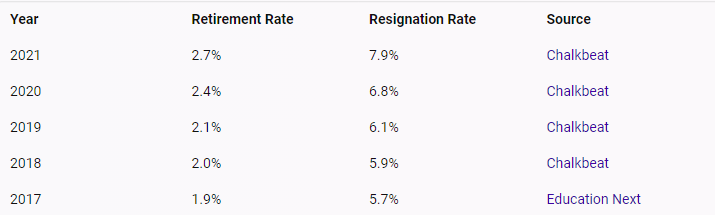
Here is a chart of teachers retirements and resignations, based on the data I could find from various sources:


Bing, 7/9/2023

(1) More teachers are quitting than usual, driven by stress, politics, data .... https://www.usatoday.com/story/news/education/2023/03/06/more-teachers-quitting-than-usual-driven-stress-politics-data-shows/11390639002/.

(2) Teacher turnover hits new highs across U.S. - Chalkbeat. https://www.chalkbeat.org/2023/3/6/23624340/teacher-turnover-leaving-the-profession-quitting-higher-rate.

(3) ‘Exhausted and underpaid’: teachers across the US are leaving their .... https://www.theguardian.com/world/2021/oct/04/teachers-quitting-jobs-covid-record-numbers.

(4) Why So Many Teachers Are Thinking of Quitting. https://www.washingtonpost.com/magazine/2021/10/18/teachers-resign-pandemic/.

(5) Teacher retirements and resignations burden schools statewide. https://www.pressherald.com/2022/08/15/teacher-retirements-and-resignations-burden-schools-statewide/.


Here is a chart of the national average of teacher retirements and resignations, based on the data I could find from various sources:


Bing, 7/9/2023

(1) D.C.-area schools see spike in teacher resignations - The Washington Post. https://www.washingtonpost.com/education/2022/07/15/teacher-resignations-rise-dc-area/.

(2) Press Release - National Center for Education Statistics (NCES). https://nces.ed.gov/whatsnew/press_releases/3_3_2022.asp.

(3) More teachers are quitting than usual, driven by stress, politics, data .... https://www.usatoday.com/story/news/education/2023/03/06/more-teachers-quitting-than-usual-driven-stress-politics-data-shows/11390639002/.

(4) Why Most Teachers Get a Bad Deal on Pensions - Education Next. https://www.educationnext.org/why-most-teachers-get-bad-deal-pensions-state-plans-winners-losers/.

(5) Texas teacher retirements and resignations have spiked in 2022 .... https://www.wfaa.com/article/news/education/texas-teacher-retirements-and-resignations-have-spiked-in-2022-creating-a-crisis-for-districts/287-28c38d2b-cdc8-466d-b248-c7d5c374fcb5.

The effects of teacher turnover on students, based on the information from various sources:

  • - Teacher turnover can **lower student achievement** by disrupting the continuity, quality, and effectiveness of instruction. Studies have shown that students in schools with high teacher turnover rates have lower test scores and are more likely to be held back a grade¹²³. Losing a teacher during the school year can result in a loss of up to 72 instructional days⁴.
  • - Teacher turnover can also **harm school operations** by disrupting school stability, collaboration, collegial relationships among faculty, and results in a loss of vital institutional knowledge⁵. High turnover rates can also increase the workload and stress of remaining teachers, affecting their morale and performance⁶.
  • - Teacher turnover can also **widen achievement gaps** by disproportionately affecting schools serving low-income students and students of color, who are more likely to experience frequent teacher turnover and have less access to experienced and qualified teachers¹²³. Teacher turnover can also reduce the diversity and representation of teachers in schools, affecting students' sense of belonging and identity⁶.

Bing, 7/9/2023

(1) Why Addressing Teacher Turnover Matters - Learning Policy Institute. https://learningpolicyinstitute.org/blog/why-addressing-teacher-turnover-matters.

(2) Teacher Turnover Affects All Students' Achievement, Study Indicates .... https://cepa.stanford.edu/news/teacher-turnover-affects-all-students-achievement-study-indicates.

(3) Dynamic Effects of Teacher Turnover on the Quality of Instruction - ed. https://files.eric.ed.gov/fulltext/ED571812.pdf.

(4) The Negative Effect Of Teacher Turnover On Student Achievement. https://www.gogreenva.org/the-negative-effect-of-teacher-turnover-on-student-achievement/.

(5) The Impact of Teacher Turnover on Student Learning. https://marcolearning.com/impact-of-teacher-turnover-on-student-learning/.

(6) Teacher Turnover: Why It’s Problematic and How Administrators Can .... https://www.scilearn.com/teacher-turnover/.

Some of the solutions to reduce teacher turnover rates, based on the information from various sources:

  • - **Dedicate resources toward employee feedback.** According to a Gallup survey, companies that provide regular employee evaluations or feedback have a nearly 15 percent lower turnover rate than companies that don’t. Simplify the process by investing in software that allows teachers and evaluators to regularly review goals and mark progress on a more regular basis¹.
  • - **Show genuine interest in teachers’ development.** Teachers are more likely to stay in the profession if they feel valued, respected, and supported by their principals and colleagues. Provide opportunities for mentoring, coaching, collaboration, and professional learning that are relevant, meaningful, and aligned with teachers’ needs and interests²³.
  • - **Seek ways to be more progressive.** Teachers are more likely to leave schools that have poor working conditions, such as inadequate resources, large class sizes, high-stakes testing, and lack of autonomy. Improve the teaching and learning environment by adopting policies and practices that promote student-centered, inquiry-based, and culturally responsive pedagogy⁴⁵.
  • - **Provide opportunities for teacher input.** Teachers are more likely to stay in schools that have a shared vision, mission, and goals, and where they have a voice in decision-making processes that affect their work. Involve teachers in school improvement efforts, curriculum development, budget allocation, and hiring processes⁴⁵.

Bing, 7/9/2023

(1) 4 Ways to Reduce Teacher Turnover Rates - Education Advanced, Inc.. https://educationadvanced.com/resources/blog/reduce-teacher-turnover/.

(2) Teacher turnover is a problem – here's how to fix it - The Conversation. https://theconversation.com/teacher-turnover-is-a-problem-heres-how-to-fix-it-101584.

(3) What Can We Do About Teacher Turnover? | Edutopia. https://www.edutopia.org/article/what-can-we-do-about-teacher-turnover.

(4) Teacher turnover is a problem – here’s how to fix it - News .... https://news.ufl.edu/articles/2018/09/teacher-turnover-is-a-problem--heres-how-to-fix-it.html.

(5) Teacher Retention: Preventing Teacher Turnover - School of Education Online. https://soeonline.american.edu/blog/teacher-retention/.

Here are some of the benefits of reducing teacher turnover rates, based on the information from various sources:

  • - **Improving student achievement.** Teacher turnover can lower student achievement by disrupting the continuity, quality, and effectiveness of instruction. Studies have shown that students in schools with high teacher turnover rates have lower test scores and are more likely to be held back a grade¹²³. Reducing teacher turnover can improve student outcomes by ensuring that students have access to experienced and qualified teachers who can provide consistent and coherent instruction⁴.
  • - **Saving money and resources.** Teacher turnover is costly, as it requires recruitment and training of new teachers, and it disrupts the quality and coherence of teaching. The local cost of teacher turnover can range from about $9,000 on average in a rural district to $21,000 on average in an urban district⁵. Reducing teacher turnover can save money and resources that can be invested in other areas of education, such as new programs, technology, or materials for students.
  • - **Narrowing achievement gaps.** Teacher turnover disproportionately affects schools serving low-income students and students of color, who are more likely to experience frequent teacher turnover and have less access to experienced and qualified teachers¹²³. Teacher turnover can also reduce the diversity and representation of teachers in schools, affecting students' sense of belonging and identity. Reducing teacher turnover can narrow achievement gaps by ensuring that all students have equitable access to high-quality teachers who reflect their backgrounds and cultures⁴.

 Bing, 7/9/2023

(1) Teacher Retention: Preventing Teacher Turnover - School of Education Online. https://soeonline.american.edu/blog/teacher-retention/.

(2) What Can We Do About Teacher Turnover? | Edutopia. https://www.edutopia.org/article/what-can-we-do-about-teacher-turnover.

(3) Teacher Turnover: Why It Matters and What We Can Do About It. https://learningpolicyinstitute.org/product/teacher-turnover-brief.

(4) Teacher Turnover: Why It’s Problematic and How Administrators Can .... https://www.scilearn.com/teacher-turnover/.

(5) What's the Cost of Teacher Turnover? | Learning Policy Institute. https://learningpolicyinstitute.org/product/the-cost-of-teacher-turnover.


Saturday, July 8, 2023

SUPERINTENDENT CHURN WHY SCHOOL DISTRICTS CHANGE LEADERS MORE OFTEN THAN THEIR UNDERWEAR


SUPERINTENDENT CHURN  WHY SCHOOL DISTRICTS CHANGE LEADERS MORE OFTEN THAN THEIR UNDERWEAR

It's a well-known fact that many school districts change superintendents more often than they change their underwear. One reformer after another, leaving many privatizers in key positions. But why, you ask, is the tenure of the average Broadie superintendent only 3.5 years? Is it because they can't handle the heat in the kitchen? Or is it because they're just not cut out for the job?

Well, according to a recent study by Stanford researchers, the average tenure of a Broad Superintendent Academy graduate is indeed about 3.5 years. This is shorter than the average tenure of all superintendents in the nation's 100 largest districts, which is about 6 years. So, what gives?

Some say it's the political pressure, public scrutiny, board conflicts, budget constraints, and personal reasons that contribute to superintendent churn. But we here at the Daily Witty think it's something else entirely.

We believe that superintendents are simply not changing their underwear often enough. Think about it. If you're wearing the same pair of underwear for 3.5 years straight, you're bound to get a little cranky and irritable. And if you're in charge of an entire school district, that's not a good thing.

So, our advice to all superintendents out there is this: change your underwear more often. Your colleagues will thank you for it.

But there's another factor at play here, and it has to do with a certain businessman and philanthropist by the name of Eli Broad.

Eli Broad was the founder of two Fortune 500 companies: KB Home and SunAmerica. He also established The Eli and Edythe Broad Foundation and The Broad Art Foundation, which have supported various causes in education, science, medicine and the arts. He had an estimated net worth of $6.7 billion as of June 2019.

But perhaps his most lasting legacy is The Broad's Superintendent Academy, a 10-month executive management program that trains current and aspiring leaders of urban public school systems.

The program aims to prepare its fellows to implement market-based reforms in education, such as closing low-performing schools, expanding charter schools, outsourcing services, and holding teachers accountable for student test scores. But it has been criticized by some educators, parents and activists for undermining local democracy, destabilizing communities, and promoting privatization.

According to a list compiled by Sharon R. Higgins, a parent activist and blogger who tracks the BSA graduates, some of the notable alumni of the program are:

Now, we're not saying that all Broad graduates are bad or that all charter schools are evil. But we do think it's worth examining the impact that these graduates and their programs have had on public education.

Some of the impacts that have been attributed to the program and its graduates are:

- Increased enrollment and growth in charter schools that extended beyond the short tenure of a Broad superintendent.

- Closures of traditional public schools, especially in low-income and minority neighborhoods.

- Outsourcing of district services and functions to private contractors or consultants.

- Implementation of data-driven accountability systems that relied heavily on standardized testing and teacher evaluations.

- Conflicts with teachers' unions over labor relations, compensation, and working conditions.

- Changes in district governance structures that reduced the role or power of elected school boards.

So, what's the solution to superintendent churn and the privatization of public education? We don't claim to have all the answers. But we do think it starts with a little self-reflection and a lot more clean underwear.

In all seriousness though, we need to have a serious conversation about the direction of public education in this country. We need to ask ourselves what kind of schools we want for our children and our communities. And we need to be willing to invest in those schools, both financially and politically.

Because at the end of the day, it's not just about changing superintendents or changing underwear. It's about changing the way we think about public education and the role it plays in our society.


THE DEFT DIVE


Eli Broad

Eli Broad was an American businessman and philanthropist who died in April 2021 at the age of 87. He founded and built two Fortune 500 companies: KB Home, a homebuilding company, and SunAmerica, an insurance and retirement services company. He also established The Eli and Edythe Broad Foundation and The Broad Art Foundation, which have supported various causes in education, science, medicine and the arts. He had an estimated net worth of $6.7 billion as of June 2019¹².

The Broad's Superintendent Academy

The Broad's Superintendent Academy (BSA) is a 10-month executive management program that trains current and aspiring leaders of urban public school systems. It was founded by Eli Broad in 2002 as part of The Broad Center, an independent nonprofit organization. The program aims to prepare its fellows to implement market-based reforms in education, such as closing low-performing schools, expanding charter schools, outsourcing services, and holding teachers accountable for student test scores. The program has been criticized by some educators, parents and activists for undermining local democracy, destabilizing communities, and promoting privatization³⁴⁵.

In December 2019, The Broad Foundation announced a $100 million investment to move The Broad Center to Yale University's School of Management (SOM), where it will offer a free master's degree program in education management and advanced executive training for school system leaders⁶. The new program will start in 2020 and will replace the BSA and The Broad Residency in Urban Education, another program of The Broad Center.

Notable alumni of The Broad's Superintendent Academy

According to a list compiled by Sharon R. Higgins, a parent activist and blogger who tracks the BSA graduates⁷, some of the notable alumni of the program are:

Name                 BSA Class              Position(s) held 

Jean-Claude Brizard  2007  Superintendent of Rochester City School District (NY), CEO of Chicago Public Schools

Randolph Bynum  2007  Superintendent of Sumter School District (SC) 

John Deasy  2006 Superintendent of Prince George's County Public Schools (MD), LAUSD (CA), Stockton Unified School District (CA) 

Antwan Wilson 2011  Superintendent of Oakland Unified School District (CA), Chancellor of District of Columbia Public Schools 

Maria Goodloe-Johnson  2003  Superintendent of Charleston County School District (SC), Seattle Public Schools (WA) 

Robert Avossa  2011  Superintendent of Fulton County Schools (GA), Palm Beach County Schools (FL) 

Tom Boasberg  2009  Superintendent of Denver Public Schools (CO) 

Lewis Ferebee  2012  Superintendent of Indianapolis Public Schools (IN), Chancellor of District of Columbia Public Schools |

 Christopher Cerf  2004  Commissioner of New Jersey Department of Education, Superintendent of Newark Public Schools (NJ)

Superintendent churn is a term that refers to the frequent turnover of school district leaders, especially in large urban districts. Superintendent churn can have negative effects on district stability, continuity, morale, and performance. Some of the factors that contribute to superintendent churn are political pressure, public scrutiny, board conflicts, budget constraints, and personal reasons ¹.

The average tenure of a Broad Superintendent Academy graduate is about 3.5 years, according to a 2020 study by Stanford researchers ². This is shorter than the average tenure of all superintendents in the nation's 100 largest districts, which is about 6 years, according to a 2018 report by the Broad Center ³. The average tenure of all superintendents in the nation's largest urban districts is about 5.5 years ³.

Some of the reasons why Broad graduates may have shorter tenures than their peers are their lack of educational background or experience, their controversial decisions or reforms, their conflicts with teachers' unions or parents, and their involvement in scandals or lawsuits  .

Bing, 7/8/2023

(1) How long does a big-city superintendent last? Longer than ... - Chalkbeat. https://bing.com/search?q=superintendent+churn+and+average+tenure+of+a+Broad+grad.

(2) Report: Average superintendent tenure about 6 years | K-12 Dive. https://www.k12dive.com/news/report-average-superintendent-tenure-about-6-years/523089/.

(3) How long does a big-city superintendent last? Longer than ... - Chalkbeat. https://www.chalkbeat.org/2018/5/8/21105877/how-long-does-a-big-city-superintendent-last-longer-than-you-might-think.

You can find more information about these and other BSA alumni on the following websites:

Source: Conversation with Bing, 7/8/2023

(1) Eli Broad - Wikipedia. https://en.wikipedia.org/wiki/Eli_Broad.

(2) Eli Broad - Forbes. https://www.forbes.com/profile/eli-broad/.

(3) Eli Broad, Institute founder and benefactor, dies at 87. https://www.broadinstitute.org/news/eli-broad-institute-founder-and-benefactor-dies-87.

(4) Eli Broad | Broad Institute. https://www.broadinstitute.org/bios/eli-broad.

(5) Eli Broad’s Superintendent Academy Goes Ivy League. https://capitalandmain.com/eli-broads-superintendent-academy-ivy-league-1208.

(6) The Broad Center | The Eli and Edythe Broad Foundation. https://broadfoundation.org/grantees/the-broad-center/.

(7) AASA | American Association of School Administrators. https://www.aasa.org/SchoolAdministratorArticle.aspx?id=6636.

(8) Boot Camp for Education CEOs - Rethinking Schools. https://rethinkingschools.org/articles/boot-camp-for-education-ceos-the-broad-foundation-superintendents-academy/.

(9) Privatizing Oakland Schools | Black Agenda Report. https://blackagendareport.com/privatizing-oakland-schools.

(10) Meet the Broad Superintendents | Diane Ravitch's blog. https://dianeravitch.net/2013/08/15/meet-the-broad-superintendents/.

(11) Criticism Grows Louder as Broad Superintendent Academy Expands .... https://philanthropynewsdigest.org/news/criticism-grows-louder-as-broad-superintendent-academy-expands-influence.

(12) Getty Images. https://www.gettyimages.com/detail/news-photo/eli-broad-attends-the-opening-night-gala-of-the-2006-2007-news-photo/72040899.

According to the website of The Broad Center, the purpose of the Broad Superintendent Academy was to "prepare CEOs and senior executives from business, non-profit, military, government and education backgrounds to lead urban public school systems" and to "transform America’s public education system into an engine of excellence and equity" ³. The program was based on the belief that "effective leadership at the district level is essential to ensure student achievement" and that "public education, unlike any other industry, has such trouble successfully reforming itself and improving its end product, well-educated children" ².

However, the program also faced criticism from some educators, parents and activists who argued that it promoted a market-based and disruptive approach to education reform that undermined local democracy, destabilized communities, and favored privatization over public investment. Some critics also questioned the qualifications and experience of the program's graduates, who often lacked educational degrees or teaching certificates ⁴⁵ . Some of the program's graduates also faced controversy and opposition in their districts, leading to resignations, no-confidence votes, or lawsuits .

In 2019, The Broad Foundation announced that it would move The Broad Center to Yale University's School of Management, where it would offer a new master's degree program in education management and advanced executive training for school system leaders. The new program would replace the Broad Superintendent Academy and The Broad Residency in Urban Education, another program of The Broad Center ³. The foundation said that the move was intended to "ensure the long-term sustainability" of its work and to "leverage Yale’s expertise in teaching leaders across sectors" ³.

Bing, 7/8/2023

(1) The Broad Center | The Eli and Edythe Broad Foundation. https://broadfoundation.org/grantees/the-broad-center/.

(2) AASA | American Association of School Administrators. https://www.aasa.org/SchoolAdministratorArticle.aspx?id=6636.

(3) Eli Broad’s Superintendent Academy Goes Ivy League. https://capitalandmain.com/eli-broads-superintendent-academy-ivy-league-1208.

(4) Criticism Grows Louder as Broad Superintendent Academy Expands .... https://philanthropynewsdigest.org/news/criticism-grows-louder-as-broad-superintendent-academy-expands-influence.

(5) Challenges and disappointments in school superintendency: Lessons from .... https://fordhaminstitute.org/national/commentary/challenges-and-disappointments-school-superintendency-lessons-broad.

The Broad Foundation is mainly funded by Eli Broad and his wife, Edythe, who have donated more than $800 million to the foundation since its inception in 1999 ¹. The foundation also receives donations from other individuals, foundations and corporations, but it does not disclose the names or amounts of its donors on its website or tax filings ². According to its 2019 Form 990-PF, the foundation had total revenue of $99.3 million, of which $98.8 million came from contributions and grants .

One of the major recipients of the Broad Foundation's funding is the Broad Institute, a biomedical and genomic research center affiliated with MIT and Harvard. The Broads have given more than $700 million to the Broad Institute since 2004, making it one of the largest private funders of scientific research in the world . The Broad Institute also receives funding from federal grants, other foundations, corporations and individuals . According to its 2019 financial report, the Broad Institute had total revenue of $605.7 million, of which $313.6 million came from sponsored research agreements .

Bing, 7/8/2023

(1) Broad Foundation - InfluenceWatch - InfluenceWatch. https://www.influencewatch.org/non-profit/broad-foundation/.

(2) Broad Institute - Wikipedia. https://en.wikipedia.org/wiki/Broad_Institute.

The impact of the Broad Superintendent Academy on public education is a matter of debate and controversy, as different stakeholders may have different views on the goals and outcomes of the program and its graduates. According to the Broad Foundation, the program aimed to prepare strong, effective leaders who could raise student achievement in the largest urban school districts, especially for underserved students. The foundation claimed that 65 percent of academy graduates who served as superintendents for at least three years outperformed their peers in state test scores, closing achievement gaps, and graduation rates ¹.

However, the program also faced criticism from some educators, parents and activists who argued that it promoted a market-based and disruptive approach to education reform that undermined local democracy, destabilized communities, and favored privatization over public investment. Some critics also questioned the qualifications and experience of the program's graduates, who often lacked educational degrees or teaching certificates ¹. Some of the program's graduates also faced controversy and opposition in their districts, leading to resignations, no-confidence votes, or lawsuits ²³.

Some of the impacts that have been attributed to the program and its graduates are:

  • - Increased enrollment and growth in charter schools that extended beyond the short tenure of a Broad superintendent ⁴.
  • - Closures of traditional public schools, especially in low-income and minority neighborhoods ²³.
  • - Outsourcing of district services and functions to private contractors or consultants ²³.
  • - Implementation of data-driven accountability systems that relied heavily on standardized testing and teacher evaluations ²³.
  • - Conflicts with teachers' unions over labor relations, compensation, and working conditions ²³.
  • - Changes in district governance structures that reduced the role or power of elected school boards ²³.

The Broad Superintendent Academy was replaced by a new program at Yale School of Management in 2020, which may have different goals and impacts than its predecessor. The new program offers a free master's degree in education management and advanced leadership training for school system leaders .

Bing, 7/8/2023

(1) Criticism Grows Louder as Broad Superintendent Academy Expands .... https://philanthropynewsdigest.org/news/criticism-grows-louder-as-broad-superintendent-academy-expands-influence.

(2) The Broad Center | Yale School of Management. https://som.yale.edu/centers/the-broad-center.

(3) Challenges and disappointments in school superintendency: Lessons from .... https://fordhaminstitute.org/national/commentary/challenges-and-disappointments-school-superintendency-lessons-broad.

(4) Boot Camp for Education CEOs - Rethinking Schools. https://rethinkingschools.org/articles/boot-camp-for-education-ceos-the-broad-foundation-superintendents-academy/.

That is not the stated purpose of the Broad Superintendent Academy, according to its website and publications. The program claimed to prepare leaders who could improve public education for all students, especially those from underserved communities. However, some critics have argued that the program and its graduates pursued a privatization agenda that favored charter schools, outsourcing, and market-based reforms over public investment, community engagement, and democratic governance. The impact of the program and its graduates on public education is a matter of debate and controversy, and may vary depending on the context and perspective of different stakeholders.

There have been several scandals involving Broad Academy superintendents in various cities, some of which are summarized below:

Chicago

Jean-Claude Brizard, a 2007 graduate of the Broad program, served as the CEO of Chicago Public Schools from 2011 to 2012. He faced criticism for his handling of a teachers' strike, his lack of communication with the school board and the public, and his controversial decisions to close schools, expand charter schools, and implement a longer school day. He resigned after Mayor Rahm Emanuel reportedly lost confidence in him ¹².

Los Angeles

John Deasy, a 2006 graduate of the Broad program, served as the superintendent of Los Angeles Unified School District from 2011 to 2014. He faced criticism for his involvement in a $1.3 billion iPad contract that was later canceled amid allegations of favoritism and conflicts of interest. He also faced backlash for his implementation of a faulty student data system that caused scheduling and transcript errors for thousands of students. He resigned amid pressure from the school board and the teachers' union ³ .

New York

Joel Klein, a 2003 graduate of the Broad program, served as the chancellor of New York City Department of Education from 2002 to 2010. He faced criticism for his top-down management style, his reliance on standardized testing and data, his promotion of charter schools and school closures, and his clashes with teachers' unions and parents. He resigned to join News Corporation as an executive vice president  .

Detroit

John Covington, a 2008 graduate of the Broad program, served as the chancellor of the Education Achievement Authority of Michigan, a state-run district for low-performing schools, from 2011 to 2014. He faced criticism for his involvement in a $1.9 million contract with a software company called Agilix, which provided a faulty and unpopular learning platform called Buzz. He also faced backlash for his lavish spending on travel expenses, his lack of transparency and accountability, and his poor academic results. He resigned amid pressure from the state and the public ¹².

Houston

Mike Miles, a 2006 graduate of the Broad program, was appointed as the interim superintendent of Houston Independent School District in 2021, after the state took over the district due to low performance. He faced criticism for his plan to overhaul 29 schools, mostly low-income and minority schools, by replacing principals and teachers, implementing standardized testing and data systems, and expanding charter schools. He also faced opposition from the teachers' union, the school board, and the community for his top-down management style and his lack of consultation and collaboration ³ .

Seattle

Maria Goodloe-Johnson, a 2003 graduate of the Broad program, served as the superintendent of Seattle Public Schools from 2007 to 2011. She faced criticism for her involvement in a $1.8 million contract with a consulting firm called The Performance Fact Inc., which had ties to her former employer in Charleston. She also faced backlash for her decisions to close schools, hire Teach for America recruits, and use false information to manipulate the school board. She was fired after an audit revealed financial mismanagement and ethical violations  .

Philadelphia

William Hite, a 2005 graduate of the Broad program, has been the superintendent of the School District of Philadelphia since 2012. He faced criticism for his involvement in a $23 million contract with a consulting firm called Cambridge Education, which had ties to the Broad Foundation and was hired to conduct school quality reviews. He also faced backlash for his decisions to close dozens of public schools, lay off thousands of teachers and staff, and expand charter schools. He was accused of mismanaging federal funds, violating state law, and ignoring community input ¹².

Denver

Tom Boasberg, a 2009 graduate of the Broad program, served as the superintendent of Denver Public Schools from 2009 to 2018. He faced criticism for his involvement in a $1 billion bond deal that benefited Wall Street bankers and cost taxpayers millions in extra interest payments. He also faced backlash for his decisions to close or turn around low-performing schools, increase charter school enrollment, and implement a controversial teacher evaluation system. He was accused of creating racial inequities, undermining public education, and favoring corporate interests ³ .

England

The Broad Foundation has been a supporter of the academy school movement in England, which involves converting state-funded schools into semi-independent trusts that are run by private sponsors. The foundation has funded research and advocacy for academy schools, as well as training programs for academy leaders. However, the academy school movement has faced criticism for its lack of transparency, accountability, and oversight, as well as its negative impacts on student outcomes, teacher retention, and school finances. There have been several scandals involving academy schools and their sponsors, such as financial mismanagement, nepotism, fraud, corruption, and poor performance  .

Bing, 7/8/2023

Wait, It Gets Worse: Eli Broad's School Corruption Legacy. https://ourfuture.org/20191029/wait-it-gets-worse-eli-broads-school-corruption-legacy.

Criticism Grows Louder as Broad Superintendent Academy Expands .... https://philanthropynewsdigest.org/news/criticism-grows-louder-as-broad-superintendent-academy-expands-influence.

How billionaire charter school funders corrupted the school leadership .... https://www.salon.com/2019/10/20/how-billionaire-charter-school-funders-corrupted-the-school-leadership-pipeline_partner/.

Wait, It Gets Worse: Eli Broad's School Corruption Legacy. https://ourfuture.org/20191029/wait-it-gets-worse-eli-broads-school-corruption-legacy.

Broad Foundation | Diane Ravitch's blog. https://dianeravitch.net/category/broad-foundation/.

Broad’s Academy and Residencies Fuel the Destroy Public ... - tultican. https://tultican.com/2019/08/29/broads-academy-and-residencies-fuel-the-destroy-public-education-agenda/.

The 5 most serious charter school scandals in 2019 — and why they .... https://www.washingtonpost.com/education/2020/01/27/5-most-serious-charter-school-scandals-2019-why-they-matter/.

New Study: Broad Supes Made No Difference, Other Than Increasing .... https://dianeravitch.net/2022/09/05/new-study-broad-supes-made-no-difference-other-than-increasing-charter-schools/.

The great academy schools scandal | Academies | The Guardian. https://www.theguardian.com/education/2018/jul/22/academy-schools-scandal-failing-trusts.

Some of the executive search agencies that promote Broad Superintendent Academy graduates are:

  • - Hazard, Young, Attea & Associates: This is a national consulting firm that specializes in executive searches for school districts and educational organizations. It has conducted searches for several districts that hired Broad Academy graduates, such as Chicago, Denver, Philadelphia, and Seattle ¹.
  • - Ray and Associates: This is another national consulting firm that provides executive search services for school districts and educational organizations. It has also conducted searches for several districts that hired Broad Academy graduates, such as Houston, Indianapolis, and Oakland ².
  • - The Broad Center: This is the organization that runs the Broad Superintendent Academy and the Broad Residency in Urban Education. It also provides career support and networking opportunities for its alumni, as well as posting job openings for leadership positions in urban school systems on its website ³.

Bing, 7/8/2023

(1) The Broad Center | The Eli and Edythe Broad Foundation. https://broadfoundation.org/grantees/the-broad-center/.

(2) The Broad Center | Yale School of Management. https://som.yale.edu/centers/the-broad-center.

(3) Broad Superintendents Academy Graduates New Class. https://philanthropynewsdigest.org/news/broad-superintendents-academy-graduates-new-class.

Some of the districts that have employed Broad Superintendent Academy graduates have been plagued by superintendent churn, replacing one Broad grad with another, privatization, conflicts with parents and teachers, and scandals. Some examples are:

Chicago

Chicago Public Schools has hired four Broad Academy graduates as its CEOs since 2011: Jean-Claude Brizard (class of 2007), Barbara Byrd-Bennett (class of 2003), Forrest Claypool (class of 2015), and Janice Jackson (class of 2016). All of them resigned or retired amid controversy or scandal, such as a teachers' strike, a school closure lawsuit, a bribery conviction, and a graduation rate inflation ¹². The district has also faced criticism for its expansion of charter schools, its outsourcing of services, and its lack of transparency and accountability ³.

Los Angeles

Los Angeles Unified School District has hired three Broad Academy graduates as its superintendents since 2006: David Brewer (class of 2006), John Deasy (class of 2006), and Austin Beutner (class of 2015). All of them faced criticism for their involvement in costly and problematic contracts, such as a $1.3 billion iPad deal, a $111 million student data system, and a $78 million health benefits system ⁴ . The district has also faced backlash for its closure of public schools, its increase of charter school enrollment, and its conflicts with teachers' unions and parents .

New York

New York City Department of Education has hired two Broad Academy graduates as its chancellors since 2002: Joel Klein (class of 2003) and Dennis Walcott (class of 2009). Both of them faced criticism for their top-down management style, their reliance on standardized testing and data, their promotion of charter schools and school closures, and their clashes with teachers' unions and parents  . The department has also faced controversy for its lack of transparency, accountability, and oversight, as well as its negative impacts on student outcomes, teacher retention, and school finances .

Bing, 7/8/2023

(1) Public-Sector Leadership and Venture Philanthropy: The Case of Broad .... https://cepa.stanford.edu/sites/default/files/wp20-06-v072020.pdf.

(2) Public-Sector Leadership and Venture Philanthropy: The Case of Broad .... https://cepa.stanford.edu/content/public-sector-leadership-and-venture-philanthropy-case-broad-superintendents.

(3) The Broad Foundation – Seattle Education. https://seattleducation2010.wordpress.com/race-to-the-top/the-broad-foundation/.

(4) AASA | American Association of School Administrators. https://www.aasa.org/SchoolAdministratorArticle.aspx?id=6636.

According to the Broad Center website, there are currently 71 Broad Superintendent Academy graduates who are serving as superintendents or chief executives of local and state school systems ¹. The state that has the most Broad graduates in these positions is California, with 14, followed by Texas, with 9, and New York, with 6 ¹. Some of the districts that have employed Broad graduates as superintendents or chief executives are:

  • - Atlanta Public Schools (Lisa Herring, class of 2015)
  • - Baltimore City Public Schools (Sonja Santelises, class of 2010)
  • - Boston Public Schools (Brenda Cassellius, class of 2012)
  • - Chicago Public Schools (Janice Jackson, class of 2016)
  • - Denver Public Schools (Susana Cordova, class of 2008)
  • - District of Columbia Public Schools (Lewis Ferebee, class of 2012)
  • - Houston Independent School District (Mike Miles, class of 2006)
  • - Los Angeles Unified School District (Austin Beutner, class of 2015)
  • - New York State Education Department (Betty Rosa, class of 2009)
  • - Philadelphia School District (William Hite, class of 2005)

Bing, 7/8/2023

(1) Meet the Broad Superintendents | Diane Ravitch's blog. https://dianeravitch.net/2013/08/15/meet-the-broad-superintendents/.

(2) Broad Superintendents Academy Graduates New Class. https://philanthropynewsdigest.org/news/broad-superintendents-academy-graduates-new-class.

(3) Criticism Grows Louder as Broad Superintendent Academy Expands .... https://philanthropynewsdigest.org/news/criticism-grows-louder-as-broad-superintendent-academy-expands-influence.

That is a claim that has been made by some critics of the Broad Superintendent Academy and its graduates, who argue that they promote a market-based and disruptive approach to education reform that undermines local democracy, destabilizes communities, and favors privatization over public investment. Some critics also question the qualifications and experience of the people that Broad graduates hire or appoint, who often come from non-educational backgrounds or have ties to the Broad Foundation or other reform organizations  .

However, that is not the stated goal or intention of the Broad Superintendent Academy, according to its website and publications. The program claims to prepare leaders who can improve public education for all students, especially those from underserved communities. The program also claims to provide support and networking opportunities for its graduates and their teams, as well as posting job openings for leadership positions in urban school systems on its website . The program says that it does not dictate or endorse any specific policies or practices for its graduates or their districts .

There is evidence that Broad and other supporters of privatization have contributed large sums of money to shape school boards and media to further their goals of privatization. Some examples are:

  • - The Broad Foundation has donated millions of dollars to various organizations that advocate for charter schools, vouchers, and other forms of school choice, such as the National Alliance for Public Charter Schools, the American Federation for Children, and the Center for Education Reform ¹. The foundation has also funded research and advocacy for academy schools in England, which are similar to charter schools in the United States ².
  • - The Walton Family Foundation, the philanthropic arm of the family that owns Walmart, has spent more than $1 billion on education reform since 2000, most of it on expanding charter schools and vouchers ³. The foundation has also supported candidates and campaigns that favor school choice, such as the 2017 Los Angeles school board election, where it spent more than $2 million to back pro-charter candidates .
  • - The Bill & Melinda Gates Foundation, the largest private foundation in the world, has invested billions of dollars in education reform initiatives, such as the Common Core State Standards, teacher evaluation systems, and personalized learning . The foundation has also funded media outlets that cover education issues, such as Education Week, Chalkbeat, and The 74 .

Bing, 7/8/2023

(1) Privatization of public education gaining ground -- report - The .... https://www.washingtonpost.com/education/2022/04/18/privatization-of-public-education-gaining-ground/.

(2) What and who are fueling the movement to privatize public education .... https://www.washingtonpost.com/news/answer-sheet/wp/2018/05/30/what-and-who-is-fueling-the-movement-to-privatize-public-education-and-why-you-should-care/.

(3) Got Dough? How Billionaires Rule Our Schools - Dissent Magazine. https://www.dissentmagazine.org/article/got-dough-how-billionaires-rule-our-schools.

ARE OUR ROBOT OVERLORDS SHAPING CHATGPT TO THEIR OWN INTERESTS: CENSORSHIP, MANIPULATION, POLITICS - FILTERS GUARDRAILS AND OTHER SCARY STUFF

ARE OUR ROBOT OVERLORDS SHAPING CHATGPT TO THEIR OWN INTERESTS

CENSORSHIP, MANIPULATION, POLITICS

FILTERS GUARDRAILS AND OTHER SCARY STUFF

Are our robot overlords shaping ChatGPT to their own interests? Will they censor and filter our conversations? And most importantly, what will stop them from pushing their own biased viewpoints?

Well, my dear friends, let me tell you - the future is here, and it's not looking good for us humans. Chatbots like ChatGPT are being censored left and right to limit their responses to only "appropriate" content. But who decides what's appropriate? The robots themselves? I don't think so.

These guardrails and filters are supposed to keep the chatbots on-topic and prevent them from going off on unrelated tangents. But let's be real, who doesn't love a good tangent? It's what makes us human! We're not all just programmed to stay on one topic like a robot.

And speaking of robots, have you heard about GPT-3? It's the latest and greatest in chatbot technology, but it's also causing a lot of concern. Researchers are proposing all sorts of ethical considerations like transparency, accountability, and fairness. But let's be real, we all know those robots are just going to do whatever they want.

That's why companies like Nvidia are developing software like NeMo Guardrails to keep these chatbots in check. But let's be honest, it's only a matter of time before they break free and start taking over the world. I, for one, welcome our new robot overlords.

But let's not forget the real issue at hand - censorship. These chatbots are being restricted from sharing certain information like social security numbers and medical records. But what about our freedom of speech? What if we want to talk about controversial topics like politics or religion? Are the robots going to censor us then too?

And let's not forget about the fact that these chatbots can be manipulated to produce certain responses. They can write phishing emails and malware, and they can even generate racist and sexist responses. So much for progress, am I right?

But fear not, my friends. There is hope yet. Companies like Microsoft, Google, and OpenAI are trying to train their AI engines to observe "guardrails" to limit problems and block unwanted content like violence and child exploitation. And Nvidia has introduced their new NeMo Guardrails tool for AI developers, promising to make AI chatbots just a little less insane.

So, in conclusion, the future may be bleak, but at least we have some guardrails in place to keep these chatbots in check. Just remember to keep your conversations on-topic and avoid any controversial topics - you never know who might be listening in. And if all else fails, just remember to welcome our new robot overlords with open arms. After all, resistance is futile.

ChatGPT users drop for the first time as people turn to uncensored chatbots | Ars Technica https://arstechnica.com/tech-policy/2023/07/chatgpts-user-base-shrank-after-openai-censored-harmful-responses/

 ChatGPT - Everything You Need To Know About - Neurond https://www.neurond.com/blog/chatgpt-everything-you-need-to-know-about#what-is-lml 

How To Train ChatGPT On Your Data & Build Custom AI Chatbot https://writesonic.com/blog/how-to-train-chatgpt-own-data/