Latest News and Comment from Education

Thursday, December 31, 2020

Celebrating Kwanzaa: Day Six Gives Us Kuumba, Creativity

Celebrating Kwanzaa: Day Six Gives Us Kuumba, Creativity
Creativity and Craftsmanship: Celebrating Kuumba, the Sixth Night of Kwanzaa


Black-owned businesses breathe creativity. The sixth day of Kwanzaa, Kuumba, represents creativity and is a time for celebrating the radical Blackness that comes from multiple countries and cultures across different platforms. The following Black-owned businesses show their creative instincts in their hand-made and hand-picked products that represent the beauty of Blackness and cultural backgrounds.


Website Created by Gates Foundation Leaves Open Personal Data of Hundreds of Thousands of Students | Diane Ravitch's blog

Website Created by Gates Foundation Leaves Open Personal Data of Hundreds of Thousands of Students | Diane Ravitch's blog
Website Created by Gates Foundation Leaves Open Personal Data of Hundreds of Thousands of Students


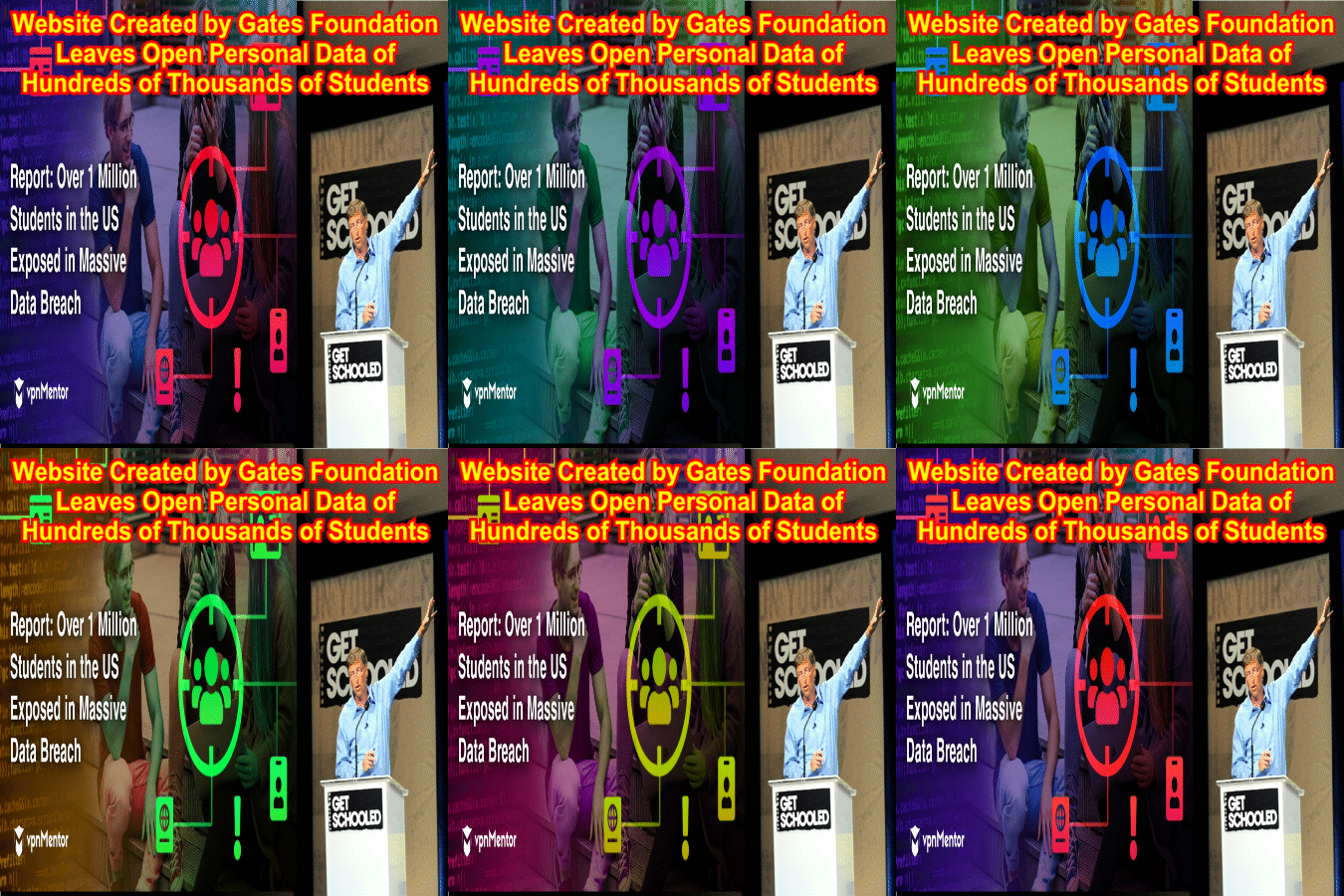
The Financial Times reported a major data breach of personally identifiable student data on a website funded by the Gates Foundation. Bill Gates, as we know, is a data aficionado. Several years ago, he created an ill-fated project called InBloom with the intent of gathering the personal data of millions of students. Fortunately it was killed off by parent activists Leonie Haimson and Rachel Stickland, who created the Parent Coalition for Student Privacy. The “cloud” is not secure.

The personal details of hundreds of thousands of US students were exposed to hackers after a database was left unsecured by Get Schooled, an education charity set up by the Bill & Melinda Gates Foundation and Viacom. Get Schooled was set up a decade ago to help students CONTINUE READING: Website Created by Gates Foundation Leaves Open Personal Data of Hundreds of Thousands of Students | Diane Ravitch's blog


Choosing Democracy: Ethnic Studies Model Curriculum

Choosing Democracy: Ethnic Studies Model Curriculum
Ethnic Studies Model Curriculum


Ethnic Studies Curriculum SBE

At its November 18–19, 2020, meeting, the Instructional Quality Commission (IQC) recommended the revised draft Ethnic Studies Model Curriculum to the State Board of Education (SBE) following a 45-day public comment period. The IQC incorporated edits, including those recommended by the California Department of Education (CDE), that strengthen the content and honor the four traditional disciplines of African American, Native American, Asian American, and Chicana/o/x and Latina/o/x studies and better reflect the diversity of experiences and contributions of groups that have been marginalized and understudied. Additionally, the IQC updated and expanded an existing set of resources—where all sample lessons are housed—to further explore communities and raise the voices of identities whose experiences intersect with the core disciplines of ethnic studies, such as Arab Americans, Armenian Americans, Jewish Americans, and Sikh Americans.

This revised draft of the Ethnic Studies Model Curriculum is in alignment with state law (Education Code Section 51226.7) and the State Board of Education-adopted guidelines, which can be found on the CDE’s Ethnic Studies Model Curriculum Guidelines web page.

The model curriculum draft has been posted for a final 45-day public review period. State law requires the SBE to take final action on the model curriculum by March 31, 2021.

More information on the Ethnic Studies Model Curriculum can be found on the CDE Model Curriculum Projects web page. Individuals or groups may submit public comment on the Ethnic Studies Model Curriculum 


Rick Hess Interviews Betsy DeVos As She Heads for the Exit | Diane Ravitch's blog

Rick Hess Interviews Betsy DeVos As She Heads for the Exit | Diane Ravitch's blog
Rick Hess Interviews Betsy DeVos As She Heads for the Exit


Rick Hess conducts an “exit interview” with Betsy DeVos, which was published at Education Week. Rick is a fellow at the conservative American Enterprise Institute, which is funded in part by DeVos.

DeVos came to Washington to destroy public education, and she failed. She bitterly dismisses the “entrenched interests” and bureaucrats who frustrated her ambitions to turn billions of public dollars over to religious and private schools and to extinguish teachers’ unions altogether. During her confirmation, she was unable to answer direct questions about education policy, and she was ultimately confirmed only when Vice-President Pence cast a tie-breaking vote. This had never happened before. In poll after poll, DeVos was characterized as the most unpopular member of Trump’s Cabinet. She did her best to skewer the Department’s Office of Civil Rights, to abandon college students who were defrauded by for-profit colleges, to divert COVID funding to elite private schools. Fortunately, most of the changes–maybe all of them–will be reversed by the Biden administration. Here CONTINUE READING: Rick Hess Interviews Betsy DeVos As She Heads for the Exit | Diane Ravitch's blog

St. Louis Public Education Theft Accelerates | tultican

St. Louis Public Education Theft Accelerates | tultican
St. Louis Public Education Theft Accelerates


By Thomas Ultican 12/30/2020

A proposal to close 11 more public schools in St. Louis came before the school board on December 15. Based on Superintendent Kelvin Adams’ recommendation the final decision was postponed until January. It is not clear why Adams pulled back his own recommendation, but it is clear that public education in St. Louis is being dismantled.

In 1967, St. Louis’s school population peaked at 115,543. It was by far the largest school district in the state of Missouri. In 2020, total enrollment sank below 20,000 to for the first time to 19,222 and St. Louis Public Schools (SLPS) is no longer the state’s largest K-12 district.

From 1967 to 2000 there was an enrollment decline of over 71,000 students. In a 2017 article, Journalist Jeff Bryant took an in depth look at the forces undermining St. Louis and its schools. He noted three defining events that turned St. Louis into the World’s most incredible shrinking city.

An 1876 home rule law enacted by city business leaders to keep control of the city’s economic engines created and locked in city boundaries. Today, there are over 90 municipalities surrounding St. Louis. After World War II, federal housing policies and racists lending practices created white flight to the burgeoning adjacent communities. Finally Bryant explains,

“Legislation passed in the 1970s, 80s, and 90s deregulating a number of key industries – including airlines and banking – put large St. Louis employers at a disadvantage. Then, new laws lifting anti-trust enforcement, passed during the Ronald Reagan and Bill Clinton presidential administrations, subjected St. Louis’s leading industries to corporate takeover or rendered them uncompetitive.

“Consequently, St. Louis went from hosting 23 Fortune 500 headquarters in 1980 to hosting just nine in 2015.”

The Attack on Public Schools CONTINUE READING: St. Louis Public Education Theft Accelerates | tultican

THE MOST READ DAD GONE WILD PIECE FROM 2020 – Dad Gone Wild

THE MOST READ DAD GONE WILD PIECE FROM 2020 – Dad Gone Wild
THE MOST READ DAD GONE WILD PIECE FROM 2020


As we approach the end of a tumultuous year, things are starting to kick forth in the education world. Yesterday, Governor Lee announce a special session of the General Assembly to focus on education issues. The five areas to be considered are teacher salaries, accountability, BEP, learning loss, and literacy. I’ll dive deeper into the special session, along with changes in priority for the COVID vaccination tomorrow, but I do think there are a couple things that can’t be left unsaid until then. 

First, there is a great deal of chatter around the importance of accuracy in reporting. It’s something that can not be understated. Reporting, and the language used, let the norms for the discussion of policy issues going forth. When the language isn’t accurate, it’s impossible to have a productive conversation. Case in point, in reporting on the literacy bill to be considered at the upcoming special session, Chalkbeat included this passage,

In early 2020, the legislature appeared to be on track to approve a major literacy package. However, the spreading coronavirus and a related economic slowdown sidelined the $36.5 million proposal in June.

A reader not familiar with last year’s battle over the literacy bill might reasonably come to the conclusion that the bill was a good one and on;y sidetracked due to the pandemic. If CONTINUE READING: THE MOST READ DAD GONE WILD PIECE FROM 2020 – Dad Gone Wild

New York State is currently a rising COVID outlier in the United States | JD2718

New York State is currently a rising COVID outlier in the United States | JD2718
New York State is currently a rising COVID outlier in the United States


COVID-19 case rates rose across the country this fall. And, in most cases, those rates peaked. In some states the peak was in mid-November. In others it was late November In others it was early December. In others it was mid-December.

But in New York State the case rate continues to rise.

Right before Thanksgiving Andrew Cuomo held a press conference. He went on and on about how well New York was doing. The big problems, he claimed, were in North Dakota and Wyoming. He said Wyoming three, four, five times. He dragged out the “O” to make it a four syllable word. To make it sound strange. He enjoyed making fun of other people.

At that moment Wyoming had a case rate of about 130 per 100,000, while New York’s was about 25 per 100,000. Now, 25 is not good. NPR has a Coronavirus by the numbers page, and draws data from Johns Hopkins and Harvard. I went to that page, and looked at the heatmap, where they indicate that 25+ indicates unchecked community spread.

It’s a good map, right? But there is a difference between 25 and 130. I made my own map, which I CONTINUE READING: New York State is currently a rising COVID outlier in the United States | JD2718

A VERY BUSY DAY Larry Ferlazzo's Websites of the Day... The latest news and resources in education since 2007

Larry Ferlazzo's Websites of the Day... | The latest news and resources in education since 2007


My Most Popular Tweets Of The Month
PhotoMIX-Company / Pixabay I used to post weekly collections of my best tweets, and used Storify to bring them together. Unfortunately, Storify went under. Fortunately, however, Wakelet was a new tool that was able to import all of a person’s Storifys. So you can see all those previous Twitter “Best” lists here . You might also be interested in MY MOST POPULAR TWEETS OF THE YEAR and RECOMMENDATIO
Around The Web In ESL/EFL/ELL
BiljaST / Pixabay Six years ago I began this regular feature where I share a few posts and resources from around the Web related to ESL/EFL or to language in general that have caught my attention. You might also be interested in THE BEST RESOURCES, ARTICLES & BLOG POSTS FOR TEACHERS OF ELLS IN 2020. Also, check out A Collection Of My Best Resources On Teaching English Language Learners. In additi
A Look Back: Animated Video I’ve Done With Ed Week: “What Is ‘Transfer of Learning’ and How Does It Help Students?”
I thought that new – and veteran – readers might find it interesting if I began sharing my best posts from over the years. You can see the entire collection here . This post originally appeared in 2017. You can see other videos, including a series Katie Hull and I did on differentiated instruction, and another on student motivation, here . In preparation for a series I did for them, I worked with
Thursday’s Must-Read Articles On School Reopenings
USA-Reiseblogger / Pixabay Here are new additions to THE BEST POSTS PREDICTING WHAT SCHOOLS WILL LOOK LIKE IN THE FALL : Newsom to announce plan to encourage in-person instruction in elementary grades is from Ed Source. Newsom to promise $2 billion in hopes of reopening schools beginning in February is from The L.A. Times. *Ten* paragraphs down into the Post story it says this https://t.co/P55W9g
Here’s Info On “Public Domain Day”
geralt / Pixabay This is from Duke’s Center for the Study of the Public Domain : On January 1, 2021, copyrighted works from 1925 will enter the US public domain, 1 where they will be free for all to use and build upon. These works include books such as F. Scott Fitzgerald’s The Great Gatsby, Virginia Woolf’s Mrs. Dalloway, Ernest Hemingway’s In Our Time, and Franz Kafka’s The Trial (in the origin
Wednesday’s Must-Read Articles & Must-Watch Videos On School Reopenings
MIH83 / Pixabay Here are new additions to THE BEST POSTS PREDICTING WHAT SCHOOLS WILL LOOK LIKE IN THE FALL Covid testing plans leave England’s school leaders guessing is from The Guardian.

 Larry Ferlazzo's Websites of the Day... | The latest news and resources in education since 2007