


NEWS FROM THE CALIFORNIA DEPARTMENT OF EDUCATION


If you are like me, you know family members and close friends who have had to school their children (and grandchildren) since March. According to the U.S. Census Bureau, 93 percent of people living in households with school-age children reported some form of distance instruction is occurring. The pandemic has tattooed remote instruction onto the bodies of millions of students and their families. No one asked for the tattoo but there it is.
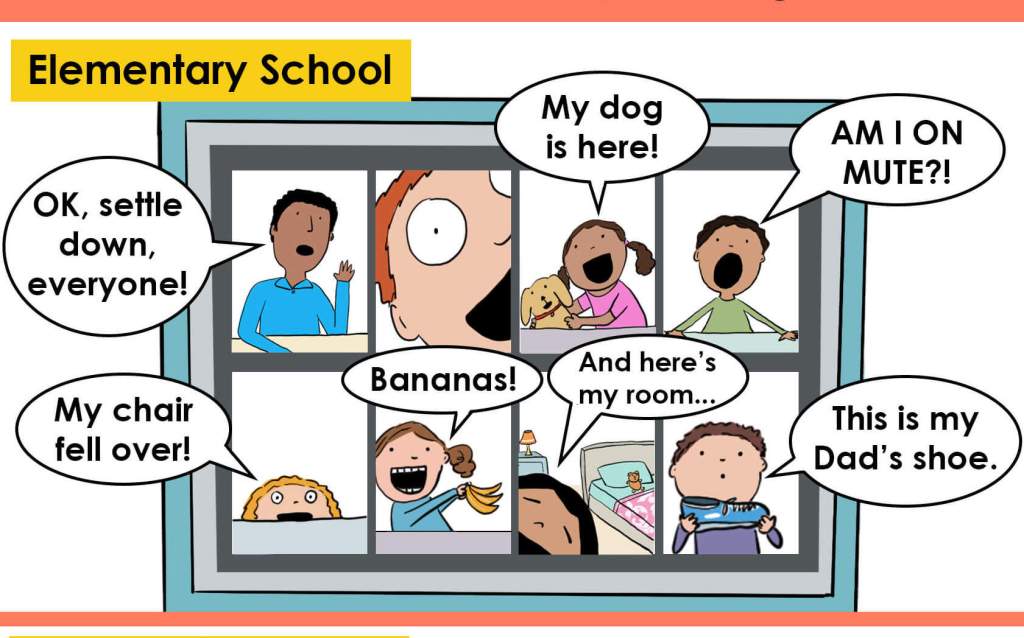
I have collected cartoons about parenting during the pandemic. Enjoy!




Oakland has been a playground for the privatization industry for many years. The state took control of Oakland in 2003 because of a budget deficit and removed its school board. Billionaire Eli Broad selected its new superintendent (and his successors), and reformers took charge, opening charter schools and promising revolutionary improvement. Their goal was to turn the public schools into a “free market.” Five years after the takeover, Oakland had 32 charter schools and 111 regular public schools. Needless to add, there was no dramatic improvement in Oakland. Today, Oakland has the highest proportion of students in charter schools of any city in California.

Tom Ultican wrote here about the saturation of Oakland by billionaire privatizers, who just can’t leave the district alone and are determined to pour in more resources until there are no public schools left.
Four advocates of public schools are running for the school board.
They are: Sam Davis (District 1), VanCedric Williams (District 3), Mike Hutchinson (District 5) and Victor Valerio (District 7).
Tom Ultican posed this question: Oakland, California: Elect a Slate of Pro-Public School Candidates! | Diane Ravitch's blog



Evidently, high achieving students don't need guidance from live humans in Carranza's fantasy world. Remote learning is something we developed to deal with an emergency, not a Carranza innovation. When we were pushed into this back in March, Carranza offered us no support whatsoever. He dragged us into buildings for three days and told our administrators, none of whom had or have experience with remote learning to somehow train us.
Furthermore, rather than prepare or support us for this school year, he pursued an outlandish hybrid program that depended on 25-50% more teacher than actually exist. The only possible good that could come out of this would be a buyout, so that the new teachers aren't discarded when and if this emergency passes us by. Remote learning is a stopgap, and Carranza has failed to support it, us, or our students. For him to embrace it now is the height of hypocrisy.
As bad as he is, he's got nothing on the subordinates in "legal." This is a group of lawyers Bloomberg put together to make sure principals could do any goshdarn thing they pleased. They sit around somewhere and tell principals to ignore the contract so that chapter leaders waste an enormous amount of time before finally winning grievances CONTINUE READING: NYC Educator: Why Have a Chancellor When a Rubber Stamp Will Do?


Joe Biden needs to have a talk with his policy director Stef Feldman. During the campaign, Biden made specific commitments to reduce the mandates for standardized testing and to reduce the stakes attached to testing. But Stef Feldman met with the Education Writers Association and she didn’t seem to know anything about what Biden had repeatedly said about the misuse and overuse of standardized testing. She said the question should be left to the transition team and the new administration. What?
Feldman refused to commit to granting waivers to the states to bypass the federal mandate for annual testing in spring 2021. DeVos granted waivers in 2020 after almost every school closed down due to the pandemic but said she would not do it again in spring 2021 (hopefully by then she will be back in one of her mansions or on one of her yachts).
It is now late October and the pandemic is still surging. Why not grant universal waivers to the states so that CONTINUE READING: Calling Joe Biden: You Promised to Cut Back Federal Testing Mandates, Remember? | Diane Ravitch's blog


Back in May, school funding experts predicted a looming financial disaster for the nation's K-12 schools.
"I think we're about to see a school funding crisis unlike anything we have ever seen in modern history," warned Rebecca Sibilia, the founder of EdBuild, a school finance advocacy organization. "We are looking at devastation that we could not have imagined ... a year ago."
But those warnings, like everything else that happened in May, feel like a lifetime ago. Where do things stand now? First, a little good news:
"So we're not looking at a disastrous year this year," says Michael Griffith at the Learning Policy Institute. He says the CARES Act, signed in March, helped states avoid a short-term school funding disaster.
Remember: Schools get about half their funding from state tax revenues, which have taken a big hit in the pandemic. States were facing budget cuts in the 20-30% range, Griffith says. But thanks, in part, to those federal CARES Act dollars, it's just "a bad year," he explains — "between 15 and 20%."
The bad news is: Those cuts are still pretty deep.
"There are about 570,000 fewer local education jobs" this year compared to the start of the previous school year, says Michael Leachman, who studies state fiscal policy at the Center on Budget and Policy Priorities. "Those are teachers, bus drivers, cafeteria workers, secretaries, librarians, counselors."
Sibilia says one reason we haven't seen even more cuts is "because all of our elected leaders are putting their head in the sand."
Many politicians are wary of making big, unpopular cuts before the election, Sibilia explains, and instead are draining their rainy day funds or hiding the pain with CONTINUE READING: Audio: America's School Funding Crisis: Budget Cuts, Rising Costs And No Help In Sight | 89.3 KPCC


In response to the COVID-19 pandemic, the U.S. Department of Agriculture (USDA) issued nationwide federal waivers and approved state specific requests intended to provide temporary flexibilities to certain regulatory requirements of the Child Nutrition Programs (CNP). The CNPs referenced are the National School Lunch Program (NSLP), School Breakfast Program (SBP), Seamless Summer Option (SSO), School Food Service Program (SFSP), and the Child and Adult Food Program (CACFP). The California Department of Education (CDE) is assisting Program Operators of the CNP by posting policy guidance and waivers, providing information on how to operate the programs during the pandemic, directions on how to claim for reimbursement and COVID-19 funding, providing bi-monthly Townhall webinars for questions and answers and best practices, connecting program operators with resources, answering Frequently Answered Questions (FAQ), and providing contact information for additional assistance. The CDE is striving to continue to support and protect access to nutritious meals for children and adults in California.
For the latest announcements and updates, visit the CDE Nutrition What’s New Disaster Tab web page.
Governor Gavin Newsom issued Executive Order N-26-20 on March 13, 2020, regarding the physical closure of schools by local educational agencies (LEA) in response to the COVID-19 pandemic. The order provides that even if schools close temporarily because of COVID-19, LEAs will continue to receive state funding so that they can:
This guidance provides a framework for how LEAs can continue to deliver high-quality educational and meal opportunities to students when the school site is physically closed and the LEA has suspended onsite instruction. In providing this instruction, it is critical that LEAs take steps to ensure that these opportunities are available to all students, especially disadvantaged students. On March 16, 2020, the California Legislature on approved an initial $100 million for LEAs and child care centers to cover school cleaning expenses to help ensure the safety of staff and students.
President Trump signed into law H.R. 6201, Title II, on March 18, 2020, the COVID-19 Child Nutrition Response Act. This law modifies USDA food assistance and nutrition programs to allow certain waivers to requirements for all federal CNP, which includes, NSLP, SBP, CACFP, SFSP, and SSO.
As the pandemic continues, the USDA Food and Nutrition Service continues to release waivers and guidance to state agencies and program operators. Please refer to the CNP COVID-19 Policy web page for updated information.
COVID-19 Guidance in the Child Nutrition Programs - Nutrition (CA Dept of Education)


McKeesport Area School District (MASD) has been rocked with nine positive cases of COVID-19 in a little more than a week.
According to guidelines from the Center for Disease Control (CDC) and the Pennsylvania Department of Education, affected schools should be closed for somewhere between 5 days and two weeks.
Superintendent Dr. Mark Holtzman says the district ignored these guidelines on the recommendation of the Allegheny County Health Department.
“The County Health Department is the local governmental agency responsible for the school districts in [the] County,” Holtzman said at last night’s school board open agenda meeting.
“So their determination of what next steps to take is their primary responsibility. So at this particular time, they have recommended to us that we not follow the CDC guidelines because those guidelines have been created before the start of school and are outdated. So they’re currently working on new guidelines to direct schools.”
The response was in answer to citizens comments.
Greg Kristen and I went to the board meeting hoping CONTINUE READING: McKeesport Superintendent: Keeping District Open During COVID Outbreak is Following Recommendation of County Health Department | gadflyonthewallblog


Key Facts About Proposition 15, California’s Commercial Property Taxes, and Revenue for Schools and Local Communities
Local tax revenue reflects a community’s shared effort to support vital public services that all Californians need to thrive in our cities and counties. This ranges from education for students in K-12 schools and community colleges to access to housing, health care, public parks, and libraries. These vital public services are supported by tax revenues from commercial and industrial properties – many of which are still taxed based on purchase prices that are more than four decades old. California voters will be asked in fall 2020 to vote on a measure known as Proposition 15,
an amendment to the state Constitution that would change how commercial and industrial properties are taxed and provide more revenue for schools and local communities to support services Californians rely upon. This report outlines key facts about how Prop. 15 would change taxes for commercial and industrial properties and increase revenue for local communities.

Local tax revenue reflects a community’s shared effort to support vital public services that all Californians need to live in our cities and counties, such as education for students in K-12 schools and community colleges, housing, health care, public parks, and libraries. When tax breaks provide advantages to some taxpayers over others, it not only creates inequities but can also lead to revenue losses that compromise the ability of schools and local communities to provide essential services for Californians. This is the case with commercial and industrial property taxes across California, and why voters will be asked in fall 2020 to vote on Proposition 15, an amendment to the state Constitution that would change how commercial and industrial properties are taxed to provide more revenue for schools and communities.
Under Prop. 15, commercial and industrial properties would be taxed based on their market value rather than their purchase price. By moving from a property tax system based on purchase value to one based on market value, Prop. 15 would raise an estimated $6.5 billion to $11.5 billion annually in property tax revenues for K-12 schools and community colleges, counties, cities, and special districts, according to the Legislative Analyst’s Office.

https://calbudgetcenter.org/wp-content/uploads/2020/09/CA_Budget_Center_Key-Facts-Prop-15.pdf
https://calbudgetcenter.org/resources/understanding-proposition-15-inequitable-taxes/
Prop 15. Overturning Austerity 101
https://www.labornotes.org/2020/08/overturning-austerity-101-californias-prop-15-will-tax-rich
