Latest News and Comment from Education

Friday, August 7, 2020

Connecting School Leaders to Available Devices - Year 2020 (CA Dept of Education)

Connecting School Leaders to Available Devices - Year 2020 (CA Dept of Education)

State Superintendent Tony Thurmond and Digital Divide Task Force Connect School Leaders to Available Devices as Learning Resumes
SACRAMENTO—State Superintendent of Public Instruction Tony Thurmond and the Closing the Digital Divide Task Force held a special webinar today to connect school districts to available technology during a time when most schools are starting the school year in distance learning and many are experiencing a shortage of computing devices.
The task force, co-chaired by Senator Connie Leyva (D-Chino), also provided an update on one-time funding available immediately to school districts to purchase devices. State law requires that schools have a plan for ensuring access to devices and connectivity for all students whenever distance learning occurs.
“We know that up to 1 million students still need devices for distance learning, and we’re in a race against the clock as most schools plan to begin the next school year virtually,” Thurmond said. “We are proud to have provided this opportunity for all school districts in California to learn about the public-private partnerships available that can help us accelerate our efforts to meet the urgent needs of our most vulnerable students.”
During today’s webinar, panelists provided more details about a landmark collaboration with Apple and T-Mobile to fulfill orders from districts—which could reach 100,000 students during the back to school period and up to 1 million students by the end of 2020—with discounted iPads already equipped with high-speed internet connectivity.
The Governor’s Office also offered additional guidance for school districts regarding the $5.3 billion in one-time funding in the state budget for schools to strengthen distance learning heading into the same year. These funds—a rare opportunity for districts to make short and long-term investments in student technology—can be used immediately for purchasing needed devices.
An archived broadcast of today’s task force meeting can be found on the California Department of Education (CDE) Facebook page.


# # # #
Tony Thurmond — State Superintendent of Public Instruction
Communications Division, Room 5602, 916-319-0818, Fax 916-319-0100
Connecting School Leaders to Available Devices - Year 2020 (CA Dept of Education)

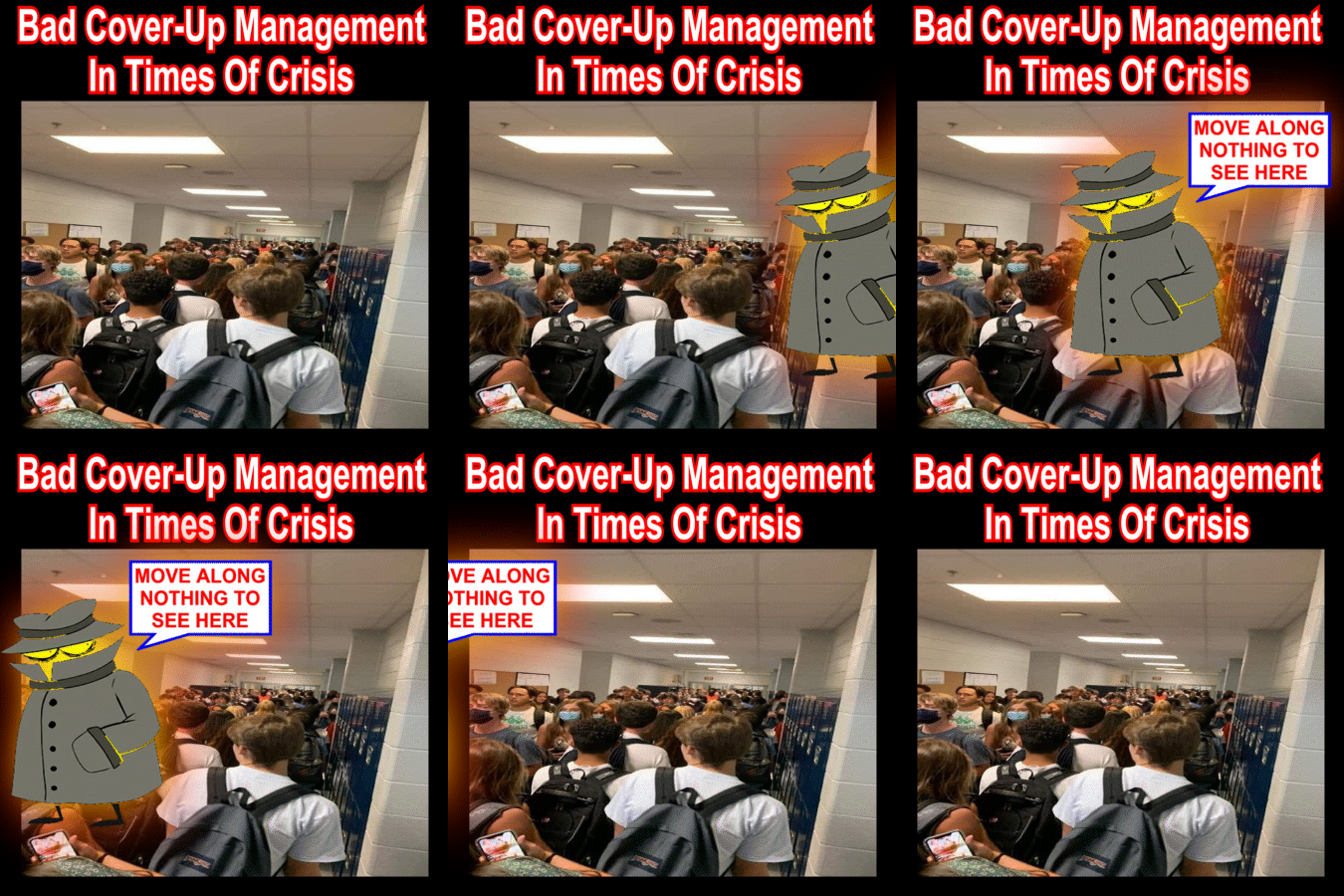
CURMUDGUCATION: GA: Bad Cover-Up Management In Times Of Crisis

CURMUDGUCATION: GA: Bad Cover-Up Management In Times Of Crisis

GA: Bad Cover-Up Management In Times Of Crisis
For years, I worked for an administration whose philosophy about any problematic or controversial issue was, "If we don't talk about it, the public won't notice and this will all blow over in a while."

It was a terrible management philosophy, not just because it was dishonest and unfair, but because it failed. It failed hard. Every. Single. Time.


See? Doesn't everything look better now?
People always found out, and they always got upset about the exact things administration was afraid they'd get upset about. And on top of that, they were upset that administration had been trying to hide problems instead of solve them or share them with the affected parties, which in turn meant that they had zero trust in leadership moving forward. It just always ended poorly, and yet, administration never learned.

We're seeing some of that already with the news out of Georgia, where a couple of photos of unmasked students crowded wall to wall in the hall made Paulding County schools look pretty--well, not good. Buzzfeed (yes, you really have to start taking them seriously as a news outlet) has the whole story so far.

The school's nurse had already quit over the policy. Football players at North Paulding had already tested positive. And the first day of school was a scary mess. The superintendent responded to the CONTINUE READING: 
CURMUDGUCATION: GA: Bad Cover-Up Management In Times Of Crisis


A VERY BUSY DAY Larry Ferlazzo's Websites of the Day... The latest news and resources in education since 2007

Larry Ferlazzo's Websites of the Day... | The latest news and resources in education since 2007


A VERY BUSY DAY
Larry Ferlazzo's Websites of the Day...
The latest news and resources in education since 2007


“Now Is the Time to Address Education’s ‘Most Pressing Equity Issues'”
Now Is the Time to Address Education’s ‘Most Pressing Equity Issues’ is the headline of my latest Education Week Teacher column. Two educators call for schools to use this time of crisis to focus on equity issues like desegregation and community involvement. Here are some excerpts:
I’m Becoming More & More Positive About Nearpod & This Tutorial Shows You How To Use It For Interactive Videos
I’ve spent several hours this week becoming familiar with Nearpod , and I’m liking what I see. And I’m particularly liking that it looks like our district might purchase a license for its use. It really is sort of an all-in-one tool, and they’ve recently added the ability to create interactive videos like those in EdPuzzle. Teacher Sam Kary has a nice YouTube Channel called New EdTech Classroom ,
Guest Post: “All About Me” Activity To Begin The School Year
Editor’s Note: I think Donna’s activity is a great one to start the first day of school! Using Kahoot can be fun, though the sentence starters and the idea of using them to write an essay about the class can be used with or without the game site. I’m adding this post to Answers To “What Do You Do On The First Day Of School?” Donna DeTommaso – Kleinert Ed.D. is a retired ESL teacher from the North
Video: “Online Discussions in Google Classroom”
422737 / Pixabay Many of us are brushing up on tech tools that we might not have tried before the pandemic. I’ve never used Google Classroom for an asynchronous class discussion before, I plan to try it out this year. Here’s a good video explaining it. I’m adding it to A Beginning List Of The Best Resources For Learning About Google Classroom .
Friday’s Seven “Must-Read” Articles On Reopening Schools In The Fall
kaboompics / Pixabay Here are new additions to THE BEST POSTS PREDICTING WHAT SCHOOLS WILL LOOK LIKE IN THE FALL : How Safe Is Your School’s Reopening Plan? Here’s What To Look For is from NPR. Congress’s Ideological Divide Has Stymied Aid for Pandemic-Stricken Schools is from The NY Times. I’m Tired of Hearing That Teachers Are Only Thinking About Ourselves Right Now is from Slate. What will it
Video: Parkland Students Unveil New Ad – “Our Power: Next Time”
13smok / Pixabay March For Our Lives, the anti-gun violence group begun by Parkland students, are putting this new add on the airwaves (you can read more about it at the Washington Post article, March for Our Lives marches toward November with new campaign ad ). I’m adding it to The Best Resources For Learning About “The March For Our Lives”
How Many Hours Can Our Students Be Expected To Be “Doing School” This Fall?
OpenClipart-Vectors / Pixabay As we enter a pandemic-shaped school year, one of many questions we teachers will need to deal with is “What are we NOT going to cover this year?” We’re clearly not going to have as much live classroom time with our students, and we need to resist the urge to load-up our students with homework to “make-up” all that lost time. Let’s look at things realistically. Based
Classroom Instruction Resources Of The Week
Each week, I publish a post or two containing three or four particularly useful resources on classroom instruction, and you can see them all here. Of course, this is a crazy time for “classroom” instruction…. You might also be 


Larry Ferlazzo's Websites of the Day... | The latest news and resources in education since 2007

Thursday, August 6, 2020

NPE Releases New Report on Astonishing Charter School Closure Rates | Diane Ravitch's blog

NPE Releases New Report on Astonishing Charter School Closure Rates | Diane Ravitch's blog

NPE Releases New Report on Astonishing Charter School Closure Rates


Today, the Network for Public Education released a new report on the astonishing rate at which charter schools close. The period covered in the report was 1999-2017, using data collected by the U.S. Department of Education. The findings were researched by Ryan Pfleger, Ph.D., and written by Carol Burris, executive director of NPE.
Contact: Carol Burris
Phone: 516 993 2141
Email: cburris@networkforpubliceducation.org
A new report shows that half of the nation’s charter schools fail during their first fifteen years. The report concludes that nearly one million students have been stranded by charters that closed.
A newly released report by the Network for Public Education (NPE) tracked the longevity of charter schools that opened during the same year in order to determine the rate and progression of charter school failure. Analyzing a database that tracks charter schools over two decades, the report documents an astounding 50% failure rate by the close of year 15.
Commenting on the report’s analysis and findings, NPE Executive Director, Carol Burris, said, “We asked education researcher Ryan Pfleger, Ph.D. to analyze the U.S. Department of Education’s Common Core of Data to determine charter school failure rates at the 3, 5, 10 and 15-year marks. We were shocked to find that even by year 5, less time than it takes for a child to complete elementary education, 27% of charter schools are gone.”
Pfleger analyzed charter schools in the United States as far back as possible given the data available. Using enrollment numbers from the final year that the charter school was open, he documented that more than 867,000 students were enrolled in charters that closed between 1999 and 2017. “If we added closures prior to 1999 and subsequent to 2017, it is likely that one million students have been displaced,” he observed.
The study also found that charter closures were most likely to occur in the poorest neighborhoods of America’s poorest cities.
Dountonia Batts, an NPE Board member, and former Indiana charter school teacher concurred with the findings of the report, “I had students whose high school experience was completed at three different schools because of closing after closing. The marketing to the broader community is that charters are better for vulnerable students, which likely eases the collective conscience of those who benefit from the voluntary re-segregation of schools by choice. The students who often feel the hurt first are in black and brown communities where the charter product is peddled as a civil rights solution.”
Commenting on the report, historian of education Diane Ravitch concluded, “The public school should be a stable institution in every community, always there for children and families. Unfortunately, as this report shows, charter schools are inherently unstable. Charters fail for a variety of reasons, mainly because they are a market mechanism, like shoe stores or restaurants. Here today, gone tomorrow.
The report, Broken Promises: An Analysis of Charter School Closures 1999-2017, and an animated map that shows the accumulation of failures across the United States can be found at https://networkforpubliceducation.org/brokenpromises.

NPE Releases New Report on Astonishing Charter School Closure Rates | Diane Ravitch's blog

NAACP launches new civil rights and education initiative with University of Kentucky - The Washington Post

NAACP launches new civil rights and education initiative with University of Kentucky - The Washington Post

NAACP launches new civil rights and education initiative with University of Kentucky
The NAACP, the oldest and largest civil rights organization in the United States, is launching a new education initiative with the University of Kentucky that will provide a home for Black faculty to conduct and disseminate research on the community in a new way.
The enterprise marks the first time that the NAACP has joined with university-based education scholars to help address racial inequities that for decades have plagued public schools around the country.
“It’s a brand new paradigm,” said Julian Vasquez Heilig, dean of the University of Kentucky’s College of Education who has served on the NAACP executive committee and as the education chair for the NAACP’s California Hawaii State Conference. “There is no playbook.”
Vasquez Heilig, who is the initiative’s mastermind, said research will be done not by finding topics in the halls of academia, as is usually done, but rather in African American communities.
“The idea here is to go to communities and understand what research they think needs to be done,” he said in an interview. “Instead of going to communities in the colonial way and taking research, we are asking what research they think is important to do.”
The focus of the initiative’s work will be to advance and protect education for students from preschool through higher education — with an emphasis on race-based discrimination. Special attention will be paid to students from underserved communities in Kentucky, which reflects many around the country.
The initiative will also seek to understand the challenges of students who are marginalized in the CONTINUE READING: NAACP launches new civil rights and education initiative with University of Kentucky - The Washington Post

Unsanitized: Randi Weingarten On What It Would Take to Make Schools Safe - The American Prospect

Unsanitized: Randi Weingarten On What It Would Take to Make Schools Safe - The American Prospect

Unsanitized: Randi Weingarten On What It Would Take to Make Schools Safe
Plus, Congressional maneuvering. This is The COVID-19 Daily Report for August 5, 2020.

First Response

In many parts of the country, the school year has already begun, either for teachers setting up classrooms, or in a few cases, for students. They are returning to a patchwork of different procedures, ranging from in-person schooling (in close to 20 states) to online-only learning to hybrid models. Parents report frayed nerves having to deal with managing work and children at home, and desperately want schools to reopen. Student learning is also sacrificed, especially with the digital divide, without in-person instruction. It’s a terrible situation.
Fortunately it’s being planned for in the most chaotic, unprofessional way. While relative safety in childcare shows that in theory you could execute schooling safely, the experience of some summer camps and schools in Israel show that dangers exist, not just for kids in school but the entire surrounding community. But the planning has been haphazard, and runs up against an immutable fact: just about everything associated with school safety costs money.
If the classroom is half the size you have to hire more teachers. HVAC systems have to be overhauled to prevent recirculated air. Everyone needs PPE, from masks to plexiglass shields. You need mass testing capacity and hand-washing stations. Some schools have no on-site nurses, so you have to add those. You might need to double school bus routes to maintain distancing on transportation. Remote learning has ongoing costs attached, especially if students need to be outfitted with technology. None of that money has been authorized yet at the federal level, and state budgets are completely strapped.
How much are we talking? The American Federation of Teachers did the math on this a couple weeks ago. “We figured out you needed $116 billion” for the extra safety measures, said AFT President Randi Weingarten in an interview. That’s on top of $93 billion to deal with reduced state support for schools.
The Democratic plans approach that level. Nancy Pelosi added $100 billion for schools in the Heroes Act, but it included a “maintenance of effort” clause, which would have required states taking the school money to backfill K-12 shortfalls with part of the $1 trillion reserved for state CONTINUE READING: Unsanitized: Randi Weingarten On What It Would Take to Make Schools Safe - The American Prospect

Mitchell Robinson: A Teacher's Advice to Nurses in a Pandemic | Eclectablog

A Teacher's Advice to Nurses in a Pandemic | Eclectablog

A Teacher’s Advice to Nurses in a Pandemic

Since you took the time to offer your advice, as a nurse, on how teachers should do their jobs, I thought I’d return the favor and share my thoughts on how nurses should do their jobs.
Except the truth is that I don’t have the faintest idea how to advise you how to be a nurse. Because I have never studied nursing, and have never worked as a nurse in any setting. Yes, I’ve administered first aid to my children, and even to some of my students in emergency situations over the years—but since I don’t really have any knowledge or background in nursing, I don’t really have any business telling you how to do your job.
Because that’s how reasonable adults should behave, isn’t it? I’m a teacher, so even though I’ve been in a hospital and seen what nurses do, it would be the height of arrogance for me to presume I knew the first thing about the complexities that nurses deal with on a daily basis. I just don’t. And I’d be a total jerk to think I could offer you, or any other nurse, any sort of professional advice about nursing based on my experience in a completely different profession. Wouldn’t I?
Just like when I buy a plane ticket I don’t think that qualifies me to jump into the co-pilot’s seat and tell the pilot how to fly the plane.
Or when I paid the handyman to put on our new storm door last week I didn’t think that somehow made it ok for me to instruct him how to measure and install the door.
Because part of being a functioning member of society, and just a decent person in general, CONTINUE READING: A Teacher's Advice to Nurses in a Pandemic | Eclectablog