Latest News and Comment from Education

Wednesday, August 5, 2020

Ashley McCall: What If We Radically Reimagined School? | Diane Ravitch's blog

Ashley McCall: What If We Radically Reimagined School? | Diane Ravitch's blog

Ashley McCall: What If We Radically Reimagined School?


Ashley McCall is a bilingual third-grade teacher of English Language Arts in Chicago Public Schools. She asked in a recent post on her blog whether we might seize this opportunity to reimagine schooling for the future, to break free of a stale and oppressive status quo that stifles both children and teachers.
She writes:

“What if?” I thought. What if we did something different, on purpose? What if we refused to return to normal? Every week seems to introduce a new biblical plague and unsurprisingly, the nation is turning to schools to band-aid the situation and create a sense of “normalcy”–the same normalcy that has failed BIPOC communities for decades.


In her memoir, When They Call You a Terrorist, Patrisse Khan-Cullors states that “our nation [is] one big damn Survivor reality nightmare”. It always has been. America’s criminal navigation of the COVID-19 pandemic further highlights the ways we devalue the lives of the most CONTINUE READING: Ashley McCall: What If We Radically Reimagined School? | Diane Ravitch's blog

Sarah Lahm: The Hijacking of Police Reform by Wealthy Opportunists Resembles the Harm Done to Public Schools | Ed Politics

Sarah Lahm: The Hijacking of Police Reform by Wealthy Opportunists Resembles the Harm Done to Public Schools | Ed Politics

SARAH LAHM: THE HIJACKING OF POLICE REFORM BY WEALTHY OPPORTUNISTS RESEMBLES THE HARM DONE TO PUBLIC SCHOOLS


The Minneapolis City Council voted to disband the city’s police department on June 26, a little more than a month after George Floyd died after a white police officer, Derek Chauvin, knelt on his neck for almost nine minutes. Chauvin, along with three other officers who were there when Floyd was killed, has since been fired from the force and is now awaiting trial for Floyd’s death.
The city council vote does not automatically mean Minneapolis will no longer have a police department, of course. After a series of steps, the public will be asked to vote in November on an amendment regarding whether or not this course of action is the right one.
n June, a competing vision of police reform had been on the table in Minneapolis. Just as community-led initiatives were gaining traction, Minneapolis Police Chief Medaria Arradondo announced in June that his department would be using “real-time data” to overhaul its operations.
The work would be driven not by local grassroots groups, but instead by a Chicago-based company called Benchmark Analytics. Chief Arradondo announced on June 10 that the Minneapolis Police Department “would contract with Benchmark Analytics to identify problematic behavior early,” according to local NBC affiliate KARE 11.
Red flags flew up instantly, however, when this arrangement was made public.
For one thing, Benchmark Analytics is a private firm that promises to deliver an “all-in-one solution to advance police force CONTINUE READING: Sarah Lahm: The Hijacking of Police Reform by Wealthy Opportunists Resembles the Harm Done to Public Schools | Ed Politics

NYC Educator: Be a Role Model. Risk Your Lives and Those of Your Students to Set an Example

NYC Educator: Be a Role Model. Risk Your Lives and Those of Your Students to Set an Example

Be a Role Model. Risk Your Lives and Those of Your Students to Set an Example


You may or may not have noticed that I don't write about nursing here. I once had a girlfriend who was a nurse, though. Sometimes she'd bring me a stack of magazines and books and have me write a term paper for her. I got As on my nursing papers.

Still, you wouldn't want me as a nurse. I don't know nursing. This notwithstanding, The Atlantic had no problem having a nurse write a column on what educators ought to be doing during a raging pandemic.

My issues with this article begin with the title:


I’m a Nurse in New York. Teachers Should Do Their Jobs, Just Like I Did.

As far as I know, teachers in New York worked straight through April, May and June. Not only that, but we worked an entire week we were supposed to be off. You'd think someone writing an article about us would know that. I suppose being a nurse was her first qualification, or it wouldn't be right there in the title. Let's look at her second:


....my husband, a public-school teacher in New York City...

I sat through a Presidential forum in Pittsburgh last year. Candidate after candidate was married to a public school teacher, had a mom who was a public school teacher, or knew a CONTINUE READING: 


Biden Offers Hope for Turning Around Awful DeVos Education Policy | janresseger

Biden Offers Hope for Turning Around Awful DeVos Education Policy | janresseger

Biden Offers Hope for Turning Around Awful DeVos Education Policy


This summer some people have said it seems like deja vu all over again. In 2009, right after Barack Obama was elected President, Education Secretary Arne Duncan used over $4 billion of the public education dollars Congress had appropriated as part of a huge federal stimulus package and attached rules that made states adopt Duncan’s own pet programs in order to qualify for the money.  Now Betsy DeVos and the Trump administration have distributed CARES Act dollars in a way that favors DeVos’s favorite charter schools and private schools at the expense of what she calls “government” schools—the ones our society counts on to serve 50 million of our children.
The Secretary of Education—and in the case of Payroll Protection Program dollars, the Small Business Administration—can control the distribution of education stimulus dollars, because dispersing relief money is administered by the administration without direct Congressional oversight unless prohibitions for particular practices are written into the enabling legislation.
You will remember that as part of the American Recovery and Reinvestment Act of 2009, Arne Duncan administered a $4.3 billion Race to the Top Program, a $3.5 billion School Improvement Grant program, and a $650 million Innovation Grant program. Duncan and  the U.S. Department of Education conditioned these grants on getting states to change their own laws to adopt what were later recognized as the most controversial priorities of Arne Duncan’s Department of Education. To qualify for Race to the Top, for example, states had to promise to evaluate teachers based on students’ test scores, agree to controversial turnaround plans that included school closure and privatization, and adopt “college-and-career-ready” standards, which, in practice, meant they were agreeing to adopt what became the overly constrictive, unwieldy and expensive Common Core and accompanying tests.  Underneath all of these programs was also a big change in the philosophy underneath federal education policy. Despite that races with winners always create losers, Duncan modeled his trademark education programs on the way philanthropies award funds: through competition. As the CONTINUE READING: Biden Offers Hope for Turning Around Awful DeVos Education Policy | janresseger

Is Re-Opening Schools a Political, Science-Driven or an Emotional Decision? | Ed In The Apple

Is Re-Opening Schools a Political, Science-Driven or an Emotional Decision? | Ed In The Apple

Is Re-Opening Schools a Political, Science-Driven or an Emotional Decision?


* “If we don’t re-open schools another generation of students will be doomed to a life of poverty and the poorest, must vulnerable parents will burdened with childcare expenses; if our economy doesn’t revive a depression paralleling the Great Depression is inevitable.”
* “We have to follow where science leads us, testing, contact tracing, social distancing, masks, and not allow politics or emotions to dissuade us.”
* “I’m afraid, I know too many people who died or who spent weeks recovering and months later are still suffering, until there’s a vaccine I’m not going back to work or allowing my children to go to school.”
*”I go to work every day, I have no other options, I have to pay my rent and feed my family; teachers say they love our kids; not enough to be willing to go to work, as I do.”
School opening opinion varies widely.
As tropical storm Isaisis blows by torrential rain interrupted by glaring sunlight flashes by, sort of like the school opening discussions of the moment.
For weeks the Board of Regents, the Governor Cuomo and Mayor de Blasio CONTINUE READING: Is Re-Opening Schools a Political, Science-Driven or an Emotional Decision? | Ed In The Apple

glen brown: “I think that reopening schools would be (alas, will be) an unprecedented catastrophe… Clearly, if we are to depend on remote learning, we must address some serious issues” by Bob Shepherd

glen brown: “I think that reopening schools would be (alas, will be) an unprecedented catastrophe… Clearly, if we are to depend on remote learning, we must address some serious issues” by Bob Shepherd

“I think that reopening schools would be (alas, will be) an unprecedented catastrophe… Clearly, if we are to depend on remote learning, we must address some serious issues” by Bob Shepherd


“A new article by Dale Chu, on the Fordham Institute website, describes remote learning as being like the ‘security theatre’ that we got in response to 9/11. I found that quite interesting.
“Oddly, the question about whether we should reopen schools has some folks in Deformist/Disrupterist organizations arguing that remote learning stinks and some members of the Resistance to arguing that it’s what we have to do given the circumstances. These positions are exactly the opposite of those for which they usually advocate.
“I’m definitely of the second camp, though I have long defined remote learning as a purported educational system in which there is a remote chance that learning is taking place.
“Alas, we now know, from recent studies, that while children under ten are less likely than adults to show overt symptoms of SARS-CoV-2 infection, they have 10 to 100 times as much viral load in their upper respiratory CONTINUE READING: glen brown: “I think that reopening schools would be (alas, will be) an unprecedented catastrophe… Clearly, if we are to depend on remote learning, we must address some serious issues” by Bob Shepherd

Tennessee: Plaintiffs File Amicus Brief in Voucher Case | Diane Ravitch's blog

Tennessee: Plaintiffs File Amicus Brief in Voucher Case | Diane Ravitch's blog

Tennessee: Plaintiffs File Amicus Brief in Voucher Case


This news just in from the Education Law Center about resistance to vouchers in Tennessee. Vouchers are a huge waste of public money. Studies in recent years have converged on the conclusion that students who use vouchers fall behind their peers who remain in public school. Meanwhile, the public schools lose money that is diverted to subpar voucher schools. Why do politicians like Governor Lee of Tennessee want to spend public dollars on low-quality religious schools?
Here is a press release from the Education Law Center:
The plaintiffs in McEwen v. Lee, a case challenging Tennessee’s unconstitutional Education Savings Account voucher law passed in 2019, have filed an amicus curiae (friend of the court) brief in an appeal of a companion challenge to the law.
In Metropolitan Government of Nashville & Davidson County v. Tennessee Department of Education, Shelby and Davidson Counties – the two counties targeted by the voucher law – obtained an injunction blocking the voucher program while the case is on appeal. Because the law applies only to students in those counties, the CONTINUE READING: Tennessee: Plaintiffs File Amicus Brief in Voucher Case | Diane Ravitch's blog

Academic Freedom, Pedagogy, White Privilege, and Racism in Higher Education – radical eyes for equity

Academic Freedom, Pedagogy, White Privilege, and Racism in Higher Education – radical eyes for equity

Academic Freedom, Pedagogy, White Privilege, and Racism in Higher Education


“Reckoning” is an imposing word for those with power and privilege; for white people in the U.S. the threat or possibility of a reckoning is often terrifying, triggering what has now been identified as white fragility.
For those abused, assaulted, or marginalized by racism, sexism/misogyny, homophobia, transphobia, xenophobia, etc., the possibility of a reckoning is exhilarating—although tinted with at least skepticism if not cynicism about any reckoning coming to fruition.
Amidst a pandemic, however, the murder of George Floyd at the knee of a police officer seems to have reignited with a renewed stamina the #BlackLivesMatter movement.
Professional sports, including even the ultra-conservative NFL, have blinked finally against the call for police reform and racial reform across all aspect of the U.S.
Like the symbolism now being allowed and celebrated in the NBA and WNBA, the diversity and inclusion initiatives in U.S. higher education remain mostly CONTINUE READING: Academic Freedom, Pedagogy, White Privilege, and Racism in Higher Education – radical eyes for equity

CURMUDGUCATION: Viral Overconfidence

CURMUDGUCATION: Viral Overconfidence

Viral Overconfidence


Well, this is an interesting piece of research.

A new paper in the Journal of Experimental Psychology suggests that overconfidence can be transmitted socially, that being around overconfident people rubs off on other folks.

As with most psycho-social research, the experimental designs leave room for considerable debate, and there are plenty of needles to thread. I find it interesting that the transmission only appears to occur within people in your own tribe.


The research reminds me of a not-uncommon phenomenon in the world of student performance-- the group founded and led by somebody who's not very qualified, but who is absolutely confident in their awesomeness, and the group itself is filled with students who are vocal in their belief that Beloved Leader is awesome and the group itself is also awesome. These kinds of groups are aided and abetted by an entire industry of "competitions" that let them earn medals and awards.

The power of overconfidence is under-discussed in education, probably because the problems of confidence gaps loom so much larger in classrooms. But the effects are similar. A student who lacks confidence will not try, because not trying is the only tactic they believe they have for avoiding CONTINUE READING: 
CURMUDGUCATION: Viral Overconfidence


Contact tracing is hard – harder if you don’t know how high school works | JD2718

Contact tracing is hard – harder if you don’t know how high school works | JD2718

Contact tracing is hard – harder if you don’t know how high school works


The NYC DoE wrote this about contact tracing:
Tracing: In the event of a confirmed COVID-19 case in a school, NYC Test + Trace and NYC Health will investigate to determine close contacts within the school. All students and teachers in the classroom with the confirmed case are assumed close contacts and will be instructed to self-quarantine for 14 days since their last exposure to that case. In older grades where students may travel between classes, this applies to all classes that the confirmed case was in.
In older grades where students may travel between classes, this applies to all classes that the confirmed case was in.
Help me out here. “all classes that the confirmed case was in” – what do they mean? The rooms? Did they mean to say “all students who shared a class with the person with a confirmed case?” + “all teachers who taught that person?”
Why am I convinced that no one working on the NYCDoE plans has ever been to a high school?
Contact tracing is hard – harder if you don’t know how high school works | JD2718

Mr. G for District 3: Chris Guerrieri's Education Matters: The District's unacceptable plan to keep us all in the dark

Mr. G for District 3: Chris Guerrieri's Education Matters: The District's unacceptable plan to keep us all in the dark

The District's unacceptable plan to keep us all in the dark


Last week the district announced it would not disclose cases until an outbreak causes a class or school to close. Well, friends, do you know how you get an outbreak that will cause a school or class to close? By keeping cases secret. The District willingly keeping people in the dark is dangerous, reckless, and unacceptable.

So I heard about a case at a school, and I asked, mind you I didn't need to know any names. People should be allowed to keep their privacy, I just wanted to see if it happened and then what the school did to keep people going forward safe, and then this is what the district said.


Hey Chris,

Appreciate you reaching out, but I’ll have to refer you to what we shared on our website regarding medical/health information.  See it below:

Students and staff have a right to privacy with respect to any medical condition they might be encountering, including COVID-19. 

General announcements about infected individuals will not be made. However, if instances of COVID-19 impact campus operations in any way, we will make appropriate announcements through the school.

Medical professionals from the Department of Health determine who needs to know about specific COVID-19 CONTINUE READING: Mr. G for District 3: Chris Guerrieri's Education Matters: The District's unacceptable plan to keep us all in the dark

Tuesday, August 4, 2020

Demand that Our Nation’s Leaders ‘Commit to Kids’ | by Bruce Lesley | Voices4Kids | Aug, 2020 | Medium

Demand that Our Nation’s Leaders ‘Commit to Kids’ | by Bruce Lesley | Voices4Kids | Aug, 2020 | Medium

Demand that Our Nation’s Leaders ‘Commit to Kids’


Our nation’s children deserve the very best we have to offer them. Their best interests should be at the forefront of every decision made by our nation’s leaders at the federal, state, and local levels of government.
To achieve that goal, we have launched with other child advocates a campaign to urge our nation’s leaders to #Commit2Kids. Between now and the November 3 election in less than 100 days, we are challenging candidates and elected officials nationwide to tell us exactly what they will do for our country’s children.
Unfortunately, some politicians pay lip service to the needs of children because, after all, they are cute and polls consistently show that the American people are wildly supportive of improving the lives of children.
However, at key moments when children need politicians to step up or speak out to promote or protect their needs or best interest, kids are far too often treated as an afterthought, used as a bargaining chip in political negotiations, or shockingly, intentionally harmed.
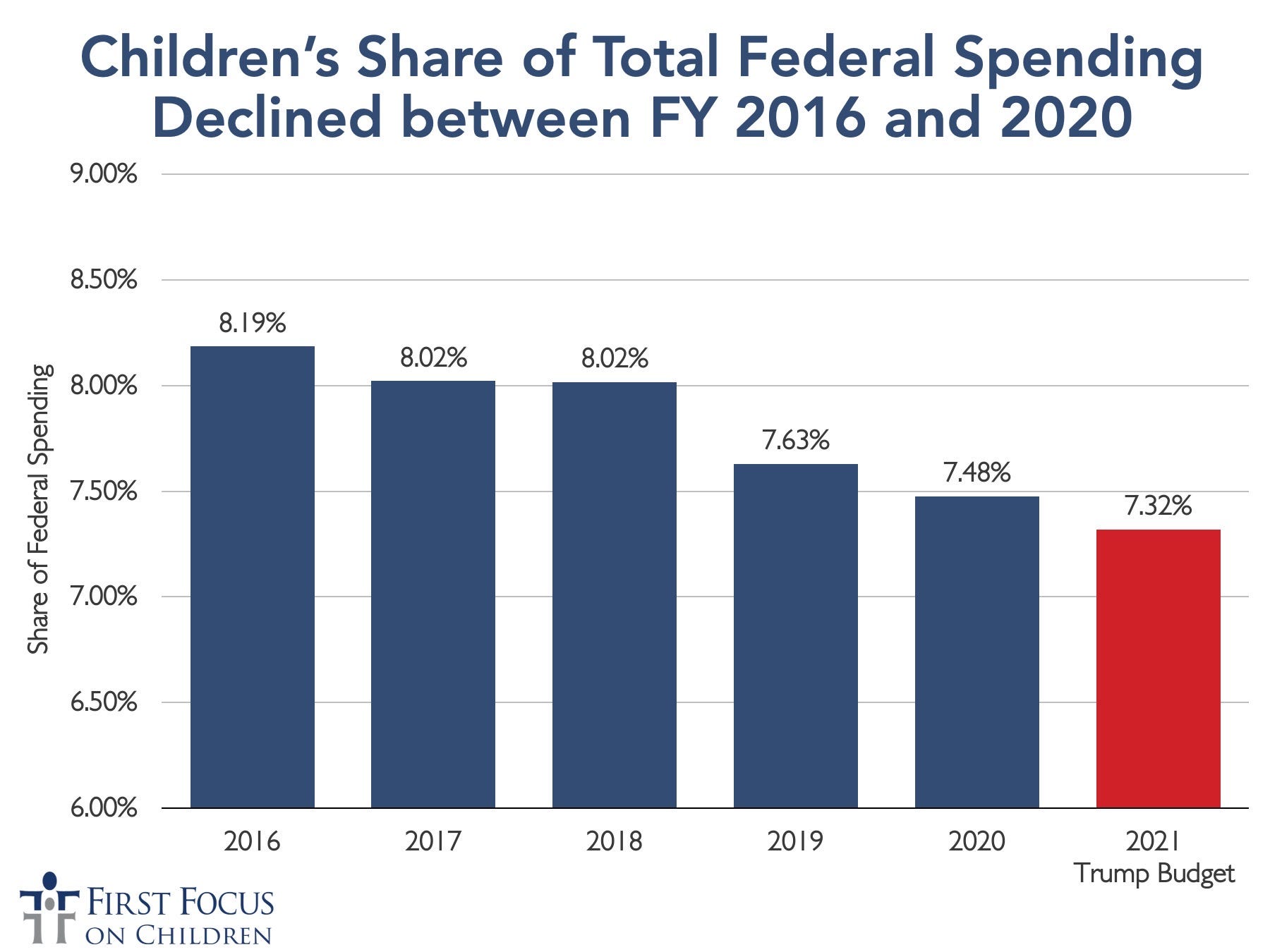
In a preview of the forthcoming release of Children’s Budget 2020, First Focus on Children’s analysis finds that the domestic share of the federal budget dropped from 8.19 percent in President Obama’s last year in office in 2016 to just 7.48 percent in 2020 — a 9 percent reduction.
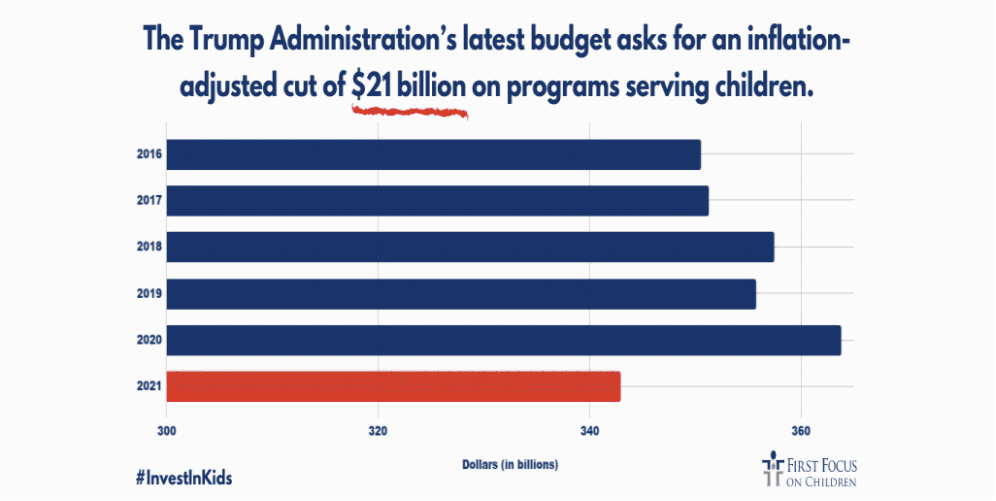
Furthermore, if President Trump’s proposed FY 2021 budget had been enacted, federal investments in children would have declined by another $21 billion on an inflation-adjusted basis.
Image for post
Source: First Focus on Children, “Children’s Budget 2020” (to be released in September).
Image for post
Source: First Focus on Children, “Children’s Budget 2020” (to be released in September).
If you really want to “make America great again,” you would invest in our children — our future.
The problem, of course, is that kids don’t vote. They don’t have paid CONTINUE READING: Demand that Our Nation’s Leaders ‘Commit to Kids’ | by Bruce Lesley | Voices4Kids | Aug, 2020 | Medium

Russ on Reading: What's In a Name Chart?

Russ on Reading: What's In a Name Chart?

What's In a Name Chart?


Sylvia Ashton-Warner's book, Teacher, first published in 1963, is a chronicle of her experience teaching Maori children in her native New Zealand in the 1940s and 50s. A major insight that Warner discusses in the book is the concept of "key vocabulary." She approached the literacy instruction of her children through the words that had special resonance for them, through their own experience, much of it fraught with poverty and violence. Warner had each child come to her each day with a word they wanted to learn and led the children though various activities to make sure they learned them. These words, drawn from the "inner life" of the child, were powerful to that child and, therefore, more easily learned.


We have all had similar experiences, I'm sure, with children who can read a word like "dinosaur" before they can read the word "they", simply because "dinosaur" is a powerful word for that child, a "key vocabulary" word, if you will. As Invernizzi and Buckrup (2018) put it, "The effects of experience are personal and profound" (p 92).

Over the years, research has demonstrated the efficacy of Warner's ideas. Perhaps none more so than the research of  Treiman and Broderick (1998) who demonstrated that the identity and characteristics of the first letter of a child's name has a significant effect on the child's knowledge of letter names. If we think about it, this makes perfect sense. What vocabulary is more key to the child than that child's own name. Children's strong attachment to their own names may help them in understanding how letters work in CONTINUE READING: Russ on Reading: What's In a Name Chart?

Mitchell Robinson: An Open Letter to Teachers as the Fall of Covid Approaches | Eclectablog

An Open Letter to Teachers as the Fall of Covid Approaches | Eclectablog

An Open Letter to Teachers as the Fall of Covid Approaches


Dear Teachers,
As your school districts’ “return to school” plans are being released, remember that you are going to hear mostly from the folks in your communities who are angry–angry that classes are being offered online, angry at the lack of child care availability, angry at teachers for not putting themselves in danger.
In fact, many of these persons may be angry about things that have nothing to do with schools. They might be angry about the poor condition of the roads in their community, or erratic trash pickup in their neighborhood. Or they could be angry about things happening nationally–stressing about job security, worried the possibility of being infected with the Covid virus, or anxious about the racial unrest in our society.
In short, they are angry about things they can’t control.
And for many of us, one of the only places we feel we can exert any modicum of control is over our public schools…

CURMUDGUCATION: Don't Waste Time

CURMUDGUCATION: Don't Waste Time

Don't Waste Time


This is personal. You may want to move on. But I need to write this out because one of the people I would ordinarily talk it out with is not here.

Merrill and I taught together for just under thirty years. We were the same age, but she had gotten a late start on her career, having first worked in the world of newspaper advertising, just one of the many parts of her biography that hinted at the toughness that backed up her magnolia-sweet proper belle exterior.


A love story (that is not mine to tell, but which has inspired me at many points in my own life) brought her here, far from South Carolina, with a young daughter from an earlier marriage. We were looking for someone to fill a new gap. Merrill came with impeccable credentials, an impressive background of knowledge, and a recommendation from a local giant in teaching English.

Over the years, we settled into regular spots-- I taught the juniors, and she taught the seniors, and so we often worked as a team. In a district that didn't always provide a lot of curricular direction, we had to make sure we were hitting the right bases with our students.

And she knew all of the bases. Her knowledge and love of literature was huge, and it just kept getting huger over the years she taught. The great headline-making showpiece of her classroom was the annual end-of-year unit for the 12th grade honors (later AP, after Merrill made the extra effort to get the official upgrade for the course) for which she first taught Paradise Lost, and then had the class split into two groups to put John Milton on trial for either whether or not he successfully made CONTINUE READING: 
CURMUDGUCATION: Don't Waste Time


Is the Demand to Reopen Schools Really a Plot to Dismantle Them? | Diane Ravitch's blog

Is the Demand to Reopen Schools Really a Plot to Dismantle Them? | Diane Ravitch's blog

Is the Demand to Reopen Schools Really a Plot to Dismantle Them?


Floridians, and everyone else, want to know the answer to this question. Some believe that keeping schools open during a pandemic will destroy them; some fear that opening them during a pandemic will destroy them. Take your pick.
Thanks to Peter Greene, I discovered a Florida blog called Accountabaloney, written by two savvy Floridians who are fed-up with their state’s absurd education policies. Sue and Suzette, welcome!
They write here about a podcast by Jennifer Berkshire and Jack Schneider, questioning whether Betsy DeVos’s newfound enthusiasm for opening real public schools is another front in her war to destroy them.
Listening to the “In the Weeds” podcast, they realized that another con was happening:
Some will read the title and dismiss it as a conspiracy theory. That is exactly what we used to hear if we equated “ed reform” with privatization five or so years ago, when the education reformers were still hiding their desire to privatize public education. In Florida, they now make few attempts to conceal their mission. We hope you will read this summary, subscribe at Patreon, listen to the entire “In the Weeds” segment, and draw your own CONTINUE READING: Is the Demand to Reopen Schools Really a Plot to Dismantle Them? | Diane Ravitch's blog

Protesters across country oppose ‘unsafe’ school openings during covid-19 - The Washington Post

Protesters across country oppose ‘unsafe’ school openings during covid-19 - The Washington Post

With coronavirus cases reported at some reopened schools, protesters take to the streets with fake coffins


With some public schools reopened and coronavirus cases already being reported, protesters in at least three dozen school districts across the country took to the streets Monday to demand that science and health concerns rule decisions about when and how to resume in-person learning.
Late Monday, in what could have been a response, President Trump repeated his call for schools to open by tweeting: “OPEN THE SCHOOLS.”
Trump’s demands that schools reopen while coronavirus infection rates are increasing in most states have politicized reopening decisions being made at the local and state levels. Many district leaders, including in Republican-led states, have said they are starting the school year virtually because it is too dangerous to reopen school buildings and risk the spread of the coronavirus.
Still, some districts have already begun the 2020-2021 academic year by reopening school buildings, and already coronavirus cases have been reported in some of them.
In Georgia’s Gwinnett County, some 260 employees tested positive or had possibly been exposed to the coronavirus a day after teachers returned to work last week and were told to stay home. Alcoa City Schools in Tennessee recently opened, but a few days later a student tested positive for the virus. At Corinth High School in Mississippi, in-person classes started last week and within days three students tested positive for the coronavirus and others went into quarantine as a result of contact tracing, according to a statement by the school district.
In New York, Chicago, Los Angeles and other cities across the country on Monday, teachers, students, parents and others protested in car caravans and street marches, demanding that health concerns and CONTINUE READING: Protesters across country oppose ‘unsafe’ school openings during covid-19 - The Washington Post