Latest News and Comment from Education

Friday, June 19, 2020

SPECIAL EDITION PROTEST AND EDUCATION Larry Ferlazzo's Websites of the Day... The latest news and resources in education since 2007

Larry Ferlazzo's Websites of the Day... | The latest news and resources in education since 2007


SPECIAL EDITION PROTEST AND EDUCATION
Larry Ferlazzo's Websites of the Day... 
The latest news and resources in education since 2007


MANY New Resources For Learning About Juneteenth
Here are many new additions to The Best Resources For Learning About Juneteenth : Why Juneteenth Matters is from The NY Times. Five myths about Juneteenth is from The Washington Post. Usher: Why it’s so important that Juneteenth become a national holiday is from The Washington Post. Original ‘Juneteenth’ order found in the National Archives is from The Washington Post. Juneteenth celebrates ‘a mo
Stop The Presses! NY Times Columnist David Brooks Finally Gets Something Right About Education!
Even though I believe that New York Times columnist David Brooks actually does write a good column now-and-then, his track record on when he writes about education issues is absolutely abysmal . Today, though, he finally got one right when he wrote about the fallacy that better education leads to economic and social equality. I’m adding it to The Best Resources On Why Improving Education Is Not T
“Q&A Collections: Race & Racism in Schools”
is the headline of my latest Education Week Teacher column. All Classroom Q&A posts talking about Race & Racism in education (from the past nine years!) are described and linked to in this compilation post. Here’s an excerpt from one of them:
10 Tips to Steal From Millionaires
Want to be a millionaire? Follow the advice of these people.
Around The Web In ESL/EFL/ELL
BiljaST / Pixabay Six years ago I began this regular feature where I share a few posts and resources from around the Web related to ESL/EFL or to language in general that have caught my attention. You might also be interested in THE BEST RESOURCES, ARTICLES & BLOG POSTS FOR TEACHERS OF ELLS IN 2019 – PART ONE and THE BEST RESOURCES, ARTICLES & BLOG POSTS FOR TEACHERS OF ELLS IN 2019 – PART TWO. A
Ed Tech Digest
Eight years ago, in another somewhat futile attempt to reduce the backlog of resources I want to share, I began this occasional “” post where I share three or four links I think are particularly useful and related to…ed tech, including some Web 2.0 apps. You might also be interested in THE BEST ED TECH RESOURCES OF 2019 – PART TWO , as well as checking out all my edtech resources . Here are this
RIP Anders Ericsson – Researcher Of “Deliberate Practice” & “10,000 Hour Rule”
johnhain / Pixabay Anders Ericsson, well-known researcher of “deliberate practice” and the “10,000 hour rule,” died yesterday, sadly. I interviewed him a while back for Education week ( ‘Peak’: An Interview With Anders Ericsson & Robert Pool ) and you can see quite a bit of info on his work at The Best Resources For Learning About The 10,000 Hour Rule & Deliberate Practice . You could start with
Supreme Court Upholds DACA! Here’s What It Means
StartupStockPhotos / Pixabay You’ve probably already heard the good news, but I thought I’d pull together some tweets and videos that provide a little more substance to it (including how it affects education): The U.S. Supreme Court on Thursday blocked the Trump administration's plan to end DACA. Here’s what to know about the policy, where it stands, and how it reached the Supreme Court. https://
Simplistic, But Useful, New USA Today Video: “How to achieve a successful protest”
OpenClipart-Vectors / Pixabay This new USA Today video is simplistic, but it’s useful because it’s short and highlights info and research I have in text on two “Best” lists. I’m adding it to those lists: The Best Sites For Learning About Protests In History The Best Posts & Articles On Building Influence & Creating Change
Saturday Is The Summer Solstice – Here Are Teaching & Learning Resources
G4889166 / Pixabay Saturday will be the longest day of the year. You might be interested in The Best Resources For Learning About The Summer Solstice .
Larry Ferlazzo's Websites of the Day... | The latest news and resources in education since 2007

Thursday, June 18, 2020

Police Reform and School Reform (Part 2) | Larry Cuban on School Reform and Classroom Practice

Police Reform and School Reform (Part 2) | Larry Cuban on School Reform and Classroom Practice

Police Reform and School Reform (Part 2)


Public schools and police departments are core community institutions. Locally controlled, there are 18,000 police departments and over 13,000 school districts in the U.S. State legislatures and city councils levy taxes to fund these institutions. One is charged to protect and serve; the other to make responsible citizens, prepare the young for the workplace, and gain success in life. Both are crucial to the political, economic and social life of their communities.
Yet well-intentioned reformers ignore obvious similarities and differences between the two. There are, for example, historical similarities. While both tax-supported police departments and public schools began in the early decades of the 19th century and became mired in the political patronage of post-Civil War decades, the early 20th century saw Progressive reformers ending political appointments and pushing for professionalized policing and teaching.
The commonalities end there, however. The model to which police chiefs in those decades aspired to was a command-and-control organization similar to the military. Hierarchical and bureaucratic, orders flowed from the top down to the ranks of patrolmen. While police officers had street-level discretion to, say, give a warning or arrest an errant driver of a car, they had sergeants and captains who supervised their conforming to regulations.
Not so for public schools and teachers. With the move to professionalize teaching an individual medical model of helping and caring, of turning children into healthy adults became the lodestar. A well-trained and autonomous doctor CONTINUE READING: Police Reform and School Reform (Part 2) | Larry Cuban on School Reform and Classroom Practice

Diane Ravitch in conversation with Julian Vasquez Heilig | Cloaking Inequity

Diane Ravitch in conversation with Julian Vasquez Heilig | Cloaking Inequity

DIANE RAVITCH IN CONVERSATION WITH JULIAN VASQUEZ HEILIG


Last night I had a chance to sit down with Diane Ravitch on Zoom and discuss what should be next for the US public education system.
 

A ponderous Diane Ravitch
Please Facebook Like, Tweet, etc below and/or reblog to share this discussion with others.
Check out and follow my YouTube channel here.
Twitter: @ProfessorJVH
Click here for Vitae.
Diane Ravitch in conversation with Julian Vasquez Heilig | Cloaking Inequity


NYC Public School Parents: Send a letter TODAY to NYC Council Speaker & leaders that school budgets must be increased, not cut

NYC Public School Parents: Send a letter TODAY to NYC Council Speaker & leaders that school budgets must be increased, not cut

Send a letter TODAY to NYC Council Speaker & leaders that school budgets must be increased, not cut


Please send a letter to the Speaker Johnson today and the Education and Finance Council chairs to say that the DOE budget should NOT be cut next year, as the Mayor has proposed; but instead, school funding should be increased so they can hire more teachers, counselors, nurses, custodial staff as well as purchasing the supplies to ensure that our children can go back to school safely next year and with the full academic and social-emotional support they will need.

The City Council is in the final stretches of negotiating a city budget for next year. Meanwhile, the Mayor proposed a 3% cut in the overall DOE budget next year, with more than $280 million of cuts directed towards schools. And yet it is clear that schools will need more funding not less next year to create the health and safety precautions, as well as the smaller classes needed for social distancing and enhanced instruction.

A recent cost analysis from the School Superintendents Association and the Association of School Business Officials shows that school districts can expect to spend an additional $490 per student just to purchase hand sanitizer, disinfectant wipes and other cleaning supplies, gloves, masks and other personal protective equipment, and hiring additional custodial staff and nurses to ensure health and safety. Given that NYC has more than one million public school students, that means that nearly $490 million alone may be required.

And that’s not counting the additional teachers necessary to provide instruction either remotely or in-person, and extra counselors to offer the emotional support, so critical given the disruption and distress that so many students have experienced during the Covid pandemic.

While Council members announced that while they are intent on negotiating a $1 billion cut to the police budget, they hadn’t yet decided where the savings would go. Clearly a big chunk will be directed to restore cuts to the summer youth jobs, but a large portion should go directly toward schools to pay for additional teachers, counselors and other staffing, as well as health and safety measures that will be critical for NYC school children next year.

Please send a letter now by clicking here, before it’s too late.

Thanks!


NYC Public School Parents: Send a letter TODAY to NYC Council Speaker & leaders that school budgets must be increased, not cut


In the Public Interest: Charter Schools in Oakland Are Tapping into Coronavirus Relief Funds | Diane Ravitch's blog

In the Public Interest: Charter Schools in Oakland Are Tapping into Coronavirus Relief Funds | Diane Ravitch's blog

In the Public Interest: Charter Schools in Oakland Are Tapping into Coronavirus Relief Funds


The nonprofit, nonpartisan “In the Public Interest” joined forces with Parents United for Public Schools in Oakland to investigate whether charter schools in that city were double-dipping, taking public school money and also taking federal funds intended for small businesses. Their conclusion: Oakland charters have collected close to $19 million that was intended for small businesses.
Their joint report begins:
The COVID-19 pandemic has caused immense job loss, social isolation, and economic hardship. Despite falling short of what’s truly needed, both the federal government and state governments have provided relief through a number of programs, such as the federal Paycheck Protection Program (PPP), which is directed at small businesses in an effort to maintain employment.
Other programs have provided relief to public entities, including public schools. However, some charter schools—which are publicly funded but privately managed—have applied for and received PPP loans despite having no loss in public funding.1 This data brief examines PPP funding within the boundaries of just one public school district in California, the Oakland Unified School District (OUSD), and finds that Oakland’s charter schools have received a total of at least $18,909,300 in loans from the PPP.

What we do — and don’t — know about schools reopening for fall - The Washington Post

What we do — and don’t — know about schools reopening for fall - The Washington Post

It’s mid-June and schools still aren’t sure how they will open for 2020-21. Here’s why — and what’s likely to happen.


It’s mid-June and most school district superintendents still haven’t announced exactly what schools will look like when they open for the 2020-21 school year. In many places, reopening will be in August, which doesn’t give them a lot of time to decide and put the plans in motion.
But we do know that just about every aspect of schooling will be different than it has been in the past. Protective measures will be in place to prevent the spread of the novel coronavirus, and a “hybrid” model of in-person and remote learning will become commonplace in many, if not most, districts.
In California, for example, the state Education Department recently issued guidance calling for the implementation of a hybrid, or blended, instructional model in all K-12 districts.
Virginia Education Secretary Atif Qarni said recently that he envisions some combination of remote and in-school learning, with in-school learning most necessary for students with special needs, young children, English-language learners and other at-risk students.
In Ohio, some districts have informed the state they plan to use blended learning.
And many colleges and universities throughout the country that have declared that they are welcoming students back to campus envision a hybrid model, with students doing some classes in their dorms and others in front of a teacher.
According to a new survey by AASA, the School Superintendents Association, 94 percent of K-12 superintendents nationwide indicated that they are not ready to announce when schools will reopen and exactly how they will do it.
Part of the holdup in making decisions is uncertainty about how serious the coronavirus crisis will be in their communities when it is time for school to start — especially with infection rates rising now in a significant number of states. Reported coronavirus cases have topped 2.1 million in the United States. CONTINUE READING: What we do — and don’t — know about schools reopening for fall - The Washington Post

Staff at Success Academy Complain about Eva Moskowitz’s Insensitivity to Racism | Diane Ravitch's blog

Staff at Success Academy Complain about Eva Moskowitz’s Insensitivity to Racism | Diane Ravitch's blog

Staff at Success Academy Complain about Eva Moskowitz’s Insensitivity to Racism 


A teacher at the acclaimed Success Academy charter chain in New York City publicly complained about Eva Moskowitz’s silence after the murder of George Floyd.
Alex Zimmerman of Chalkbeat reported:
Four days after the killing of George Floyd by the Minneapolis police, a Brooklyn Success Academy teacher emailed her network’s CEO, one of the nation’s most prominent charter school leaders, asking why she hadn’t said anything publicly.
“I am deeply hurt and shocked by your lack of words on the topic that affects so many of your employees, children and families in communities that you serve,” first-year Success Academy Flatbush teacher Fabiola St Hilaire wrote to Eva Moskowitz. “All of your black employees are paying attention to your silence.”
 Moskowitz responded about an hour later, thanking St Hilaire for reaching out but also brushing her aside. “I actually opined on this subject early this am. Please take a look,” Moskowitz wrote, referring to a tweet sent the same morning. “I hope you can understand that running remote learning in the middle of a world economic CONTINUE READING: Staff at Success Academy Complain about Eva Moskowitz’s Insensitivity to Racism | Diane Ravitch's blog

Arrested Development: How Police Ended Up in Schools – Have You Heard

Arrested Development: How Police Ended Up in Schools – Have You Heard

Arrested Development: How Police Ended Up in Schools


Have You Heard had a question: how did cops end up in US public schools in the first place? To find the answer, we head to Boston, Los Angeles and Chicago. With the aid of a trio of experts—historians Matt Kautz, Judith Kafka, and Louis Mercer—we learn about what prompted the entry of police into each city’s schools. And some common themes emerge, including the criminalization of student demands for racial justice and equity, and an increasing antagonism between white teachers and Black and Brown students in 1960’s America.  Complete transcript available here. The financial support of listeners like you keeps this podcast going. Subscribe on Patreon or donate on PayPal.


Arrested Development: How Police Ended Up in Schools – Have You Heard

Leaders of the New School - LA Progressive

Leaders of the New School - LA Progressive
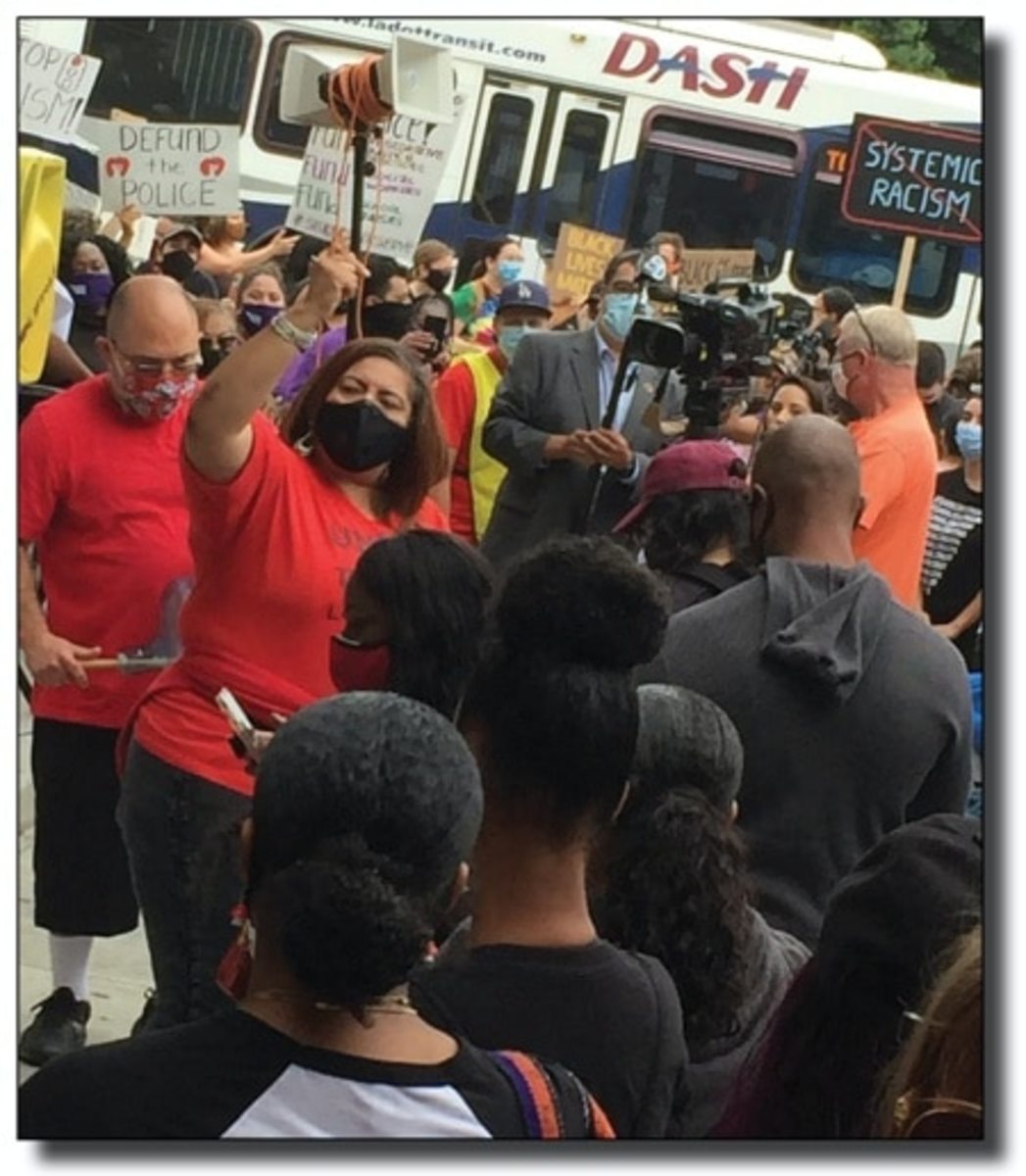
Leaders of the New School


Photo: Courtesy Wade Kyle
Tuesday marked the first day of summer vacation and I took to the streets to march for student rights. I drove to Miguel Contras Learning Center in Los Angeles, expecting to hear UTLA’s new president, Cecily Myart Cruz, speak on defunding the police. Something entirely different took place.
I saw people of all ages in the crowd—Whites, Blacks, LatinX, old and young, crowding the downtown streets on a muggy Tuesday. Many came with homemade signs calling for social change. A sea of homemade art flooded the street with progressive messages: “Defund the Police,” “Black Lives Matter,” “End Systematic Racism.” UTLA president Cecily Myart Cruz and former UTLA president Alex Caputo Perl, both great public speakers in their own rights, were in attendance; however, it was Sarah who stole the show. (UTLA is the United Teachers of Los Angeles, an increasingly progressive and powerful teachers union.)

While many adults with fancy job titles and credentials argue over how to defund police programs in schools, these students and the stories they had to tell most clearly articulated the issue.

Sarah Djato is a 16-year-old Dorsey High graduate. Let me say it again: Sarah Daito is a 16-year-old high school graduate. She and many other students came from LA’s Crenshaw district—the heart of Black LA—to speak about their experiences in high school. While many adults with fancy job titles and credentials argue over how to defund police programs in schools, these students and the stories they had to tell most clearly articulated the issue.
Sarah spoke about a time when a fight broke out on her campus last year. The school police responded with pepper spray that hit her friends on their way to class. She said the police sprayed everyone in the area, regardless of who was actually fighting. In fact, the Los Angeles School Police Department (LASPD) confirmed the incident in a report to the Los Angeles Unified School District (LAUSD). A LAUSD spokesperson said there were 34 documented uses of pepper spray out of 188 total use-of-force incidents over the last three years. This overly aggressive approach demonstrates why we cannot trust police to shape the lives of our youth.
Sarah stated, “There are many other ways to take care of situations like fights that happen on our CONTINUE READING: Leaders of the New School - LA Progressive

‘It’s just way too much to take on’: School systems struggle with the politics of reopening - POLITICO

‘It’s just way too much to take on’: School systems struggle with the politics of reopening - POLITICO

‘It’s just way too much to take on’: School systems struggle with the politics of reopening
Governors promise to put kids back in class in a matter of weeks, but school officials are largely stuck navigating the messy details.


School superintendents and principals are staring at an impossible equation.
Governors are promising to put kids back in classrooms in a matter of weeks, but it’s mostly school officials stuck navigating the messy details of how to keep students and teachers safe and win over skeptical parents, while dealing with a budget crisis that is forcing layoffs and other cuts.
In California, six major school districts warned state lawmakers that proposed budget cuts could delay the fall semester. And in New Jersey, superintendents are trashing the state’s “inappropriate” guidance for in-person summer programs. The head of the Massachusetts Teachers Association said the governor’s plan to require children to bring their own masks will punish low-income students and communities of color.
“I mean, it’s like it's a lose-lose situation,” said Dan Domenech, who runs AASA, The School Superintendents Association. ”You have parents that are demanding the schools to open. And then you have parents that are saying, we're not going to send our kids to school. You have teachers that are saying we're not going to go back to work. Districts that are saying, with these budget cuts, we're going to have to lay off teachers.
“It's just, this is unbelievable.”
Most principals understand they’ll be opening with a mix of in-person and remote learning, but they don’t have a clear idea of how that will happen, said Bob Farrace, of the National Association of Secondary School Principals. “Right now, principals are flying blind with only very high, top-level guidance on what the reopening of school is going to look like,” he said.
Economic recovery in large part depends on kids returning to school so parents can get back to work. President Donald Trump has repeatedly said he expects a full reopening of schools in the fall, though his Education Secretary Betsy DeVos concedes some classes may have to remain online — even though virtual classes have been a bust in many places.
Other countries don’t offer a clear direction. Austria, Denmark and Germany CONTINUE READING: ‘It’s just way too much to take on’: School systems struggle with the politics of reopening - POLITICO

Russ on Reading: Instruction for the Vulnerable Reader: Assessment

Russ on Reading: Instruction for the Vulnerable Reader: Assessment

Instruction for the Vulnerable Reader: Assessment


In order to help a child become better at reading, a teacher needs to have a handle on what the child knows and is able to do. All learning builds on prior learning, so a good clear idea of a child's understanding at the point where instruction begins is clearly a priority. This information is not readily available from standardized tests, inventories, checklists, speed reading trials, nonsense word lists, or anything else that purports to tell us what students know about reading. This information is available to us from listening to a child read, watching the child write, and talking with the child about books and reading.

To the extent that we can set up our classroom so that there are frequent opportunities to interact with children around text, we are setting up a classroom to formatively assess children. As teachers then, we can design instruction that builds on students strengths, using those strengths to help them improve on their weaknesses. The teacher is constantly asking, "What can this child do? What does this child need to be able to do next? How can what the child can already do help us get there?

This is what assessment for reading improvement is about. Assessment is not some abstract score on a DIBELs scoresheet or Big Standardized Test, it is the formative assessment that takes place daily in the classroom. In the CONTINUE READING: 
Russ on Reading: Instruction for the Vulnerable Reader: Assessment

CURMUDGUCATION: Rebecca Friedrichs Still Hates The Teachers Unions

CURMUDGUCATION: Rebecca Friedrichs Still Hates The Teachers Unions

Rebecca Friedrichs Still Hates The Teachers Unions


In 2014, Rebecca Friedrichs, after twenty-some years in the classroom, decided to go ahead and be the face of a lawsuit that would be derailed when Justice Scalia died. The court would eventually get to take their shot at unions with the Janus case. But while Friedrichs may have lost a lawsuit, she did manage to launch a career as a far-right Christianist spokesperson. She has done plenty of work for other folks, while pushing her own group, For Kids and Country.

If you want to catch a full catalog of the many people she objects to, you can catch her latest op-ed in the Washington Times, the right-wing outlet.


Yeah, this lady.
She's casting a wide net here, and she's come up with more old boots than actual fish. She starts by going after the 1619 Project and Black Lives Matter. She does the standard nod to black lives while still All Lives Mattering it ("Again, don’t get me wrong. Black lives do matter! Indeed, every human life is sacred.") At the same time, she wants you to know that Black Lives Matter are Very Naughty:

But the organization named Black Lives Matter is not what it claims to be. Like the unions, it’s a Trojan horse of anti-American, anti-family beliefs masquerading as defenders of good.

Friedrichs needs to bring up the union because they are part of this whole anti-American plot. She notes that some historians disputed the project, but not the NEA.

Instead, the NEA coordinated directly with The New York Times, the Pulitzer Center, Southern CONTINUE READING: 
CURMUDGUCATION: Rebecca Friedrichs Still Hates The Teachers Unions