Friday, May 15, 2020

SPECIAL CORONAVIRUS UPDATE Larry Ferlazzo's Websites of the Day... The latest news and resources in education since 2007

Larry Ferlazzo's Websites of the Day... | The latest news and resources in education since 2007


SPECIAL CORONAVIRUS UPDATE
Larry Ferlazzo's Websites of the Day... 
The latest news and resources in education since 2007


New MSNBC Video: “Why It’s So Difficult To Safely Reopen Schools In The Era Of COVID-19”
PIRO4D / Pixabay I’m adding this new video to THE BEST POSTS PREDICTING WHAT SCHOOLS WILL LOOK LIKE IN THE FALL :
New National Geographic Video: “Lockdown Around the World”
priyampatel4 / Pixabay Here’s how National Geographic describes this new video: In March 2020, many cities and countries around the world went into lockdown, restricting movement and encouraging social distancing in an attempt to combat the COVID-19 pandemic. Five filmmakers, Nick Moir, Veda Shastri, Alexia Webster, Felix Gaedtke, and Guglielmo Mattioli documented their cities under lockdown in 3
May 21st Is The “World Day for Cultural Diversity for Dialogue and Development” – Here Are Teaching & Learning Resources
kreatikar / Pixabay The United Nations has designated May 21st at the World Day for Cultural Diversity for Dialogue and Development . You might be interested in a massive “Best” list: The Best Sites For Learning About The World’s Different Cultures .
“Social Studies Instruction in the Age of the Coronavirus”
Social Studies Instruction in the Age of the Coronavirus is the headline of my latest Education Week Teacher column. Five social studies teachers discuss their online instructional strategies, including emphasizing relevancy and maintaining high standards. Here are some excerpts:

YESTERDAY

New Resources On Race & Racism
I’m adding these new resources to various “Best” lists. You can find links to all of those many lists that relate to race and racism at “Best” Lists Of The Week: Resources For Teaching & Learning About Race & Racism: Asian Americans is the PBS site for the series of the same name. I’m adding it to The Best Sites For Asian Pacific American Heritage Month . Improving Teacher Workforce Diversity is
CDC Releases Guidelines For Reopening Schools – I Don’t Think Our Districts Are Going To Find Them Much Help
The Centers For Disease Control released guides for reopening different sectors of society called Communities, Schools, Workplaces, and Events: Guidance for Where You Live, Work, Learn, Pray, and Play. One part of it was Interim Guidance for Administrators of US K-12 Schools and Child Care Programs . I might be missing something, but I’m not sure most districts are going to find it very helpful.
New NBC News Video: “The History (And Uncertain Future) Of The Handshake”
geralt / Pixabay I’m adding this new video to A BEGINNING LIST OF THE BEST RESOURCES FOR LEARNING ABOUT THE CORONAVIRUS .
New TED-Ed Video & Lesson Is On “What is a coronavirus?”
TheDigitalArtist / Pixabay The latest TED-Ed lesson and video is on “What is a coronavirus?” I’m adding it to A BEGINNING LIST OF THE BEST RESOURCES FOR LEARNING ABOUT THE CORONAVIRUS .
Ed Tech Digest
Eight years ago, in another somewhat futile attempt to reduce the backlog of resources I want to share, I began this occasional “” post where I share three or four links I think are particularly useful and related to…ed tech, including some Web 2.0 apps. You might also be interested in THE BEST ED TECH RESOURCES OF 2019 – PART TWO , as well as checking out all my edtech resources . Here are this
Schools Are Going To Have A BIG Problem Getting Substitute Teachers Next Year
qimono / Pixabay Schools are obviously going to have lots of challenges during the next school year (see A teacher predicts what his classroom (and others) will look like in the fall) . An additional issue is going to be getting 
Larry Ferlazzo's Websites of the Day... | The latest news and resources in education since 2007

Injustice: The Disparate Impact of EdChoice Vouchers Across Ohio School Districts | janresseger

Injustice: The Disparate Impact of EdChoice Vouchers Across Ohio School Districts | janresseger

Injustice: The Disparate Impact of EdChoice Vouchers Across Ohio School Districts


Ohio Governor Mike DeWine just announced large, recession-driven cuts in statewide funding for public education at the same time more and more students in 140 of Ohio’s 610 school districts will be carrying EdChoice vouchers out of their local school district budgets to pay for private school tuition. Ohio’s EdChoice voucher program is funded through a local school district deduction, which sucks education program dollars out of local school district budgets.  At this time when Ohio faces a sudden and serious revenue shortfall due to Covid-19 job losses and business closures, the Legislature must immediately protect extremely vulnerable local school districts by merging EdChoice and another Ohio voucher program—EdChoice Expansion, which is fully state funded. The EdChoice voucher program was created by the state legislature. The Legislature ought to pay for the vouchers out of the state budget for which the Legislature is responsible.
In February, the Ohio House passed legislation which would begin collapsing the two programs into a fully state funded Buckeye Opportunity Scholarship voucher program. While the Ohio Senate did not concur with the plan, the pandemic-driven fiscal emergency has now radically reshaped Ohio’s school funding calculus. The growth of EdChoice vouchers next year in the school districts shouldering the burden of the EdChoice program will catastrophically reduce local school budgets. The burden falls unevenly, because the state has designated only 140 of the state’s 610 school districts for the punitive EdChoice program, and 40 of those EdChoice districts will suffer the greatest impact.
Last week Ohio Governor Mike DeWine announced an immediate state budget reduction before the end of the fiscal year (ending June 30, 2020) of $775 million, with $300 million of the cuts to be absorbed across the state’s K-12 public school districts. The Covd-19 pandemic has led to business shutdowns and job losses, which reduced Ohio’s state tax revenue through April by $776.9 million below fiscal year estimates.
The EdChoice voucher program is particularly burdensome for public school districts because the vouchers are funded by a method called “school district deduction.”  Before the current school year, only 255 individual public schools had been designated for the EdChoice voucher program, but for the 2019-2020 school year, the state doubled the size of the program, for a total of 517 EdChoice Designated Schools. Legislators had been scheduled to designate 700 additional EdChoice school buildings for the program for the 2020-2021 school year. However, at the end of March,—under pressure to shut itself down due to Covid-19—the Legislature CONTINUE READING: Injustice: The Disparate Impact of EdChoice Vouchers Across Ohio School Districts | janresseger

SPI Issues Statement in Response to May Revise - Year 2020 (CA Dept of Education)

SPI Issues Statement in Response to May Revise - Year 2020 (CA Dept of Education)

State Superintendent Tony Thurmond Issues Statement in Response to Governor Newsom's Updated Budget Proposal


SACRAMENTO—State Superintendent of Public Instruction Tony Thurmond today issued the following statement in response to Governor Gavin Newsom’s revised budget for the fiscal year 2020–21:
“The COVID-19 crisis has had a disastrous impact on the state’s economy, and the updated projections today offer sobering details of that reality. I want to thank Governor Newsom for working hard to prioritize and preserve public education as one of the vital, core services we must protect as we weather this economic downturn. Today’s updated budget proposal includes a variety of measures designed to avoid permanent cuts to education, which otherwise could have lasting impacts on a generation of students.
“While the measures outlined in today’s proposal are far from what our schools need, we also understand that our state is facing impossible choices under impossible circumstances. I will continue to advocate on behalf of our students and educators through each step of the Legislature’s budget adoption process in the coming weeks.
“We are grateful for the Governor’s proposal to direct $4.4 billion in federal aid to education, a move that recognizes the increased demands on schools and the equity issues and other challenges posed by COVID-19 school closures this spring. Schools are a critical driver of the health and vitality of our communities, and these funds can be used to make necessary modifications so that schools are better prepared to open their doors in the fall.
“We also strongly echo the Governor’s call for Congress to act swiftly and pass the HEROES Act, which will provide immediate financial relief and help us avoid many of the reductions proposed today. Now, more than ever, California needs support from the federal government so that our schools can deal with the unavoidable costs they face as they plan to reopen. 
“I want to thank our educators, students, and families who have worked hard to keep learning going during this pandemic. These are extraordinary times, and we will get through this together. We must rise to this challenge and work together to keep services intact for our students as we navigate this crisis.”
Thursday’s revised budget illustrates just how quickly and dramatically COVID-19 has impacted California’s economy. In January, Governor Newsom proposed increasing K-12 education spending by $3 billion, the largest per-pupil allocation in state history. 
By last week, however, revised revenue forecasts estimated $19 billion less in Proposition 98 funding, the minimum guarantee to public schools under state law.
Governor Newsom’s updated K-12 budget proposal includes:
  • A 10 percent reduction to the Local Control Funding Formula for 2020–21, with a trigger for increases pending additional federal funding for education.
  • Allocation of $4.4 billion in federal funding to address learning loss and equity issues exacerbated by the COVID-19 school closures this spring. These funds can be used by districts to run summer programs and other programs that address equity gaps that were widened during the school closures. These funds also can be used to make necessary modifications so that schools are prepared to reopen in the fall.
  • Reallocation of $2.3 billion in funds previously dedicated to paying down schools’ unfunded liability to CalSTRS and CalPERS to instead pay the school employers' retirement contributions.
  • A new obligation of 1.5 percent of state appropriation limit revenues starting in 2020–21 to avoid a permanent decline in school funding that grows to $4.6 billion in additional funding for schools and community colleges by 2023–24.
View the Governor’s May Revise budget summaryExternal link opens in new window or tab. (PDF) on the Department of Finance budget website.
# # # #
Tony Thurmond — State Superintendent of Public Instruction
Communications Division, Room 5602, 916-319-0818, Fax 916-319-0100
SPI Issues Statement in Response to May Revise - Year 2020 (CA Dept of Education)

HOW TO SAFELY REOPEN SCHOOL BUILDINGS - THE MOVIE: Diane Ravitch in Conversation with Randi Weingarten - Network For Public Education

Diane Ravitch in Conversation with Randi Weingarten - Network For Public Education

Diane Ravitch in Conversation with Randi Weingarten


In this video conference NPE President Diane Ravitch’s guest was AFT President Randi Weingarten. Watch and listen to a wide ranging conversation between Diane and Randi, including how to safely reopen school buildings.


Diane Ravitch in Conversation with Randi Weingarten - Network For Public Education

CURMUDGUCATION: Fordham Advises Conservative Board Members In Parallel Universe

CURMUDGUCATION: Fordham Advises Conservative Board Members In Parallel Universe

Fordham Advises Conservative Board Members In Parallel Universe


It's a curious little piece in the Fordham Institute's blog, this "Conservative Agenda for School Board Members." The co-authors are Michael Petrilli and Chester Finn, the current and former head honchos of the right-leaning thinky tank (though I will say-- and I'm just guessing here--the level of pearl-clutching in this piece sounds a lot more like Finn than Petrilli to me).

The stock photo is a couple of cute little white kids holding a flag and walking out into sun-dappled greenery. That.... well, sets a tone.

First, they acknowledge that they have sometimes in the past been "dismissive, even hostile" to school board members, mostly because they "often seemed willing to protect the status quo and resist changes intended to overhaul the jalopy we call American public schooling" (that jalopy line does sound like Petrilli).

But we’re ready to look afresh, mindful that it’s unfair to view anything in the sprawling K–12 sector as a monolith.

Cool. I'll be happy if reformsters decide to stop referring to public education as a monopoly. The writers have decided to think of school boards as one of "society's little platoons" in rebuilding overstressed communities. In fact, the duo sees school board members as "best positioned to push back against so much of the nonsense that courses through our schools and our society." That nonsense list is actually pretty short and not very inclusive-- "history emphasizing the nation’s shortcomings, antipathy toward strict discipline, and on and on..."

They admit that board members can't change everything single-handedly, and that in many places conservatives are outnumbered but they don't want to just "cede public schooling to the CONTINUE READING: 
CURMUDGUCATION: Fordham Advises Conservative Board Members In Parallel Universe

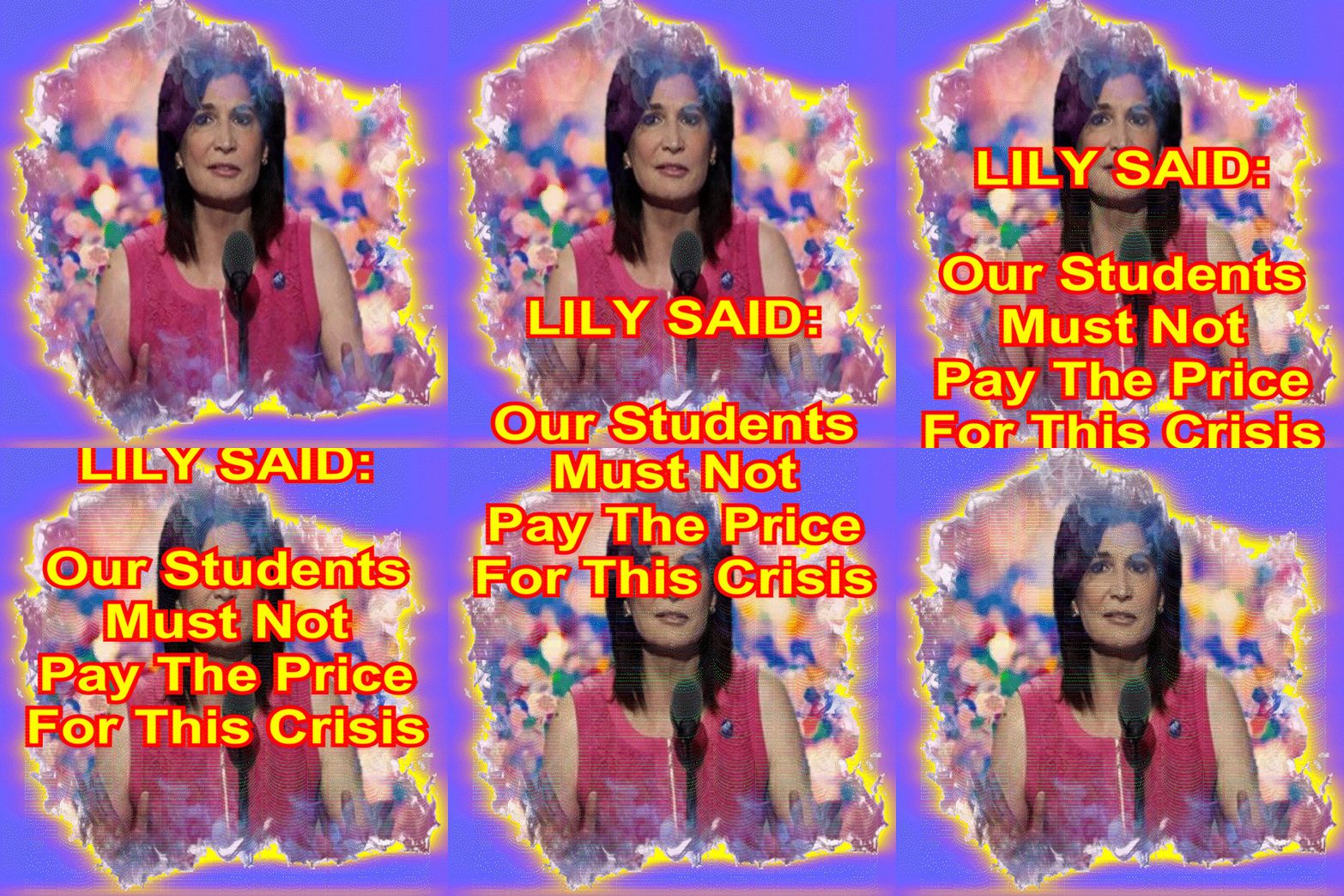
NEA President: Our Students Must Not Pay The Price For This Crisis

NEA President: Our Students Must Not Pay The Price For This Crisis

NEA President: Our Students Must Not Pay The Price For This Crisis


Two months after the coronavirus pandemic forced schools across the country to close their doors, educators and students remain hunkered down in their homes teaching and learning remotely. Everybody is doing the best they can, but the challenges around distance learning are formidable – and will likely remain so until school re-opens. But what “back-to-school” this year will actually look like to students, educators and parents is shrouded in uncertainty.
What is clear is that the COVID-19 pandemic has exposed and exacerbated the inequities facing our most vulnerable students. According to a just-released National Education Association (NEA) survey, more than 80% of NEA members say that “providing the same level of education to all students” is a serious problem. Educators in high-poverty schools report lower class attendance, feel distance learning will be less effective for their students, and believe that closing the digital divide should be a top priority.
Compounding the current anxieties over distance learning and staying healthy is the widespread apprehension over what comes next. This week, as states begin to relax stay-at-home policies, the question of when and how to re-open schools took center stage. Dr. Anthony Fauci, in testimony to Congress, urged extreme caution in moving too quickly, reminding lawmakers that children are not immune from COVID-19.
The health and safety of students, their parents, and educators has to be main driver of any plan to re-open schools, said NEA President Lily Eskelsen Garcรญa. “That is the first, second, and third priority.”
“Educators want to go back to school.  They’re desperate to be in the same CONTINUE READING: NEA President: Our Students Must Not Pay The Price For This Crisis

Mike Klonsky's Blog: Reckless reopening and universal guaranteed income

Mike Klonsky's Blog: Reckless reopening and universal guaranteed income

Reckless reopening and universal guaranteed income


UAW President Walter Reuther (shaking hands at right) presided
at the opening of the new Local 879 Union Hall in 1955
Political Economy lesson for these times: The story goes that Henry Ford II once boasted to UAW leader Walter Reuther that he could build cars without workers.

 “Walter, how are you going to get those robots to pay your union dues." Without skipping a beat, Reuther replied, “Henry, how are you going to get them to buy your cars?”
Reuther won that one on points but the robots and offshoring production prevailed in the end. The current pandemic which has put millions out of work and driven many millions more into poverty is driving some deep questioning about the inequities in current society and new thinking about life in a post-pandemic world. Isn't it time to start talking seriously about universal basic income and health insurance?


Ameya Pawar
Brother Fred and I will be doing just that in upcoming editions of Hitting Left with the Klonsky Brothers. On Friday, May 22nd, 11-noon CT, we will be joined by former Chicago Alderman Ameya Pawar. After leaving office, Ameya joined the Economic Security Project as a senior fellow and is working on narrative change efforts around guaranteed income and public options, including public banks. It should be an interesting show. Tune in to lumpenradio.com

Look at these numbers...As Trump and his right-wing band of media whores open fire on Dr. Fauci and the medical and scientific community, we take note of the fact that the overwhelming majority of Americans oppose their reckless "reopening" policies that place profit above human life.

According to this week's Washington Post-University of Maryland poll, a huge majority (78% to 22%) of Americans, believe it is “necessary” for people in their communities to stay at home as much as possible.


The spread is very similar among those of incomes below $50,000 (82-18), those of CONTINUE READING: Mike Klonsky's Blog: Reckless reopening and universal guaranteed income