Latest News and Comment from Education

Wednesday, February 26, 2020

Is the NYC School System Idling in Neutral? | Ed In The Apple

Is the NYC School System Idling in Neutral? | Ed In The Apple

Is the NYC School System Idling in Neutral?


Have you ever coached a kid sports team? a dance group? a band or orchestra?  Kids vary widely in talent and the effort they put into getting better. As a coach, you try and hone your coaching skills; maybe you use the camera on your phone to show the kids their footwork or instrument fingering.  You may take a coaching course; what are the most effective exercises for the kids to practice?   I coached soccer and took a US Soccer Federation Coaching License course; each session was 1.5 hours in the classroom with film and 1.5 hours in the gym or on a field, it was rigorous; and only for the “D” license.
We played in the Metropolitan Soccer League; we were the only “American” team, the only non-ethnic team. We probably got cursed at in many, many different languages; our kids played hard, they were pretty good. Some kids went on to play in high school and college, for most it was just fun, and, our parents weren’t as passionate as the GottcheeGreek AmericansGjoa or the Brooklyn Italian parents.
God, in her wisdom didn’t distribute talent equally, to kids, or, coaches.
Some kids weren’t the most gifted but they made up for it in effort; conversely other kids with “natural” talent never responded to coaching.
On the other hand I didn’t go beyond the “D” license, I’d like to think my CONTINUE READING: Is the NYC School System Idling in Neutral? | Ed In The Apple

Michael Bloomberg’s Disastrous Public Education Legacy | The Indypendent

Michael Bloomberg’s Disastrous Public Education Legacy | The Indypendent

Michael Bloomberg’s Disastrous Public Education Legacy


As of mid-February, Michael Bloomberg has spent over $400 million on his presidential campaign, including blanketing the air waves with ads and is on track to spend more than a billion dollars. As a result, he has risen sharply in the polls, and in turn, begun to receive critical attention regarding his record on certain issues, such as racial profiling and his stop-and-frisk policies.
However, Bloomberg’s record on education has been glossed over. When it is mentioned at all, he has been vaguely praised, as in a recent Thomas Friedman column, for championing  “virtually every progressive cause” including “education reform for predominantly minority schools.”
But the reality is that Bloomberg’s education record is far from progressive. In fact, when I heard that he was running for president, it felt like the return of a bad dream that for many of us had begun to fade away long years ago.
Aggressive Free-Market Ideology
For voters who do not live in New York City or never sent their children to public school here,  you might not be aware that Bloomberg embodied an aggressive free-market ideology with policies that were contrary to research and hugely disruptive — in the worst sense of the word. Far from the benevolent, pragmatic centrist his campaign likes to portray,  Bloomberg and his chancellors reigned over NYC public schools for 12 years with an iron fist, autocratically imposing destructive reforms with little concern for how they upended the lives of communities, students and teachers.
In many respects, his policies contradicted his campaign promises. When he first ran for Mayor in 2002, he didn’t mention the wrecking-ball he later deployed on the school system, but instead pledged to implement a proven reform: to lower class sizes in all schools to 20 students or less in grades K-3. Class-size reduction has been shown to benefit all kids but especially students of color, who make up the majority of kids in New York City schools.
Instead of following through on this promise, subsequent audits from the state and city comptrollers showed, his administration misused hundreds of millions of state dollars meant for class-size reduction. As a result, class sizes stagnated and then rose sharply in his second term.  
 In 2011, at a speech at the Massachusetts Institute of Technology, Bloomberg announced that if he had his way, he would double class sizes by firing half the teachers. He would “weed out all the bad ones” and pay the rest more. It would be “good deal for the students,” he insisted. What he didn’t mention, of course, is that his own daughters attended a private school where class sizes averaged 14-18 student CONTINUE READING: Michael Bloomberg’s Disastrous Public Education Legacy | The Indypendent

Stalemate: Ohio’s Senate and House Reach Impasse on EdChoice Vouchers | janresseger

Stalemate: Ohio’s Senate and House Reach Impasse on EdChoice Vouchers | janresseger

Stalemate: Ohio’s Senate and House Reach Impasse on EdChoice Vouchers


According to what is logical, what is constitutional, and what is moral, you would think members of Ohio’s legislature could come together to resolve Ohio’s voucher crisis and provide some relief for school districts going broke because that same legislature (in the final hours of the budget conference committee last summer) surreptitiously and explosively expanded EdChoice Vouchers paid for out of local school districts’ budgets.  But you would be wrong, because in the Ohio Senate, ideology trumps logic, constitutional protection of school funding, and basic morality.
Ohio’s EdChoice Voucher program has created a crisis for Ohio school districts. Here’s why:
  • EdChoice Vouchers are awarded to students in so-called “failing” schools.  The school ratings are based on what everyone—Republican and Democratic legislators alike—agrees are flawed algorithms in the state report card.  Schools are rated in six categories, and if a school scores D or F for two years running in any one of the categories, it becomes an EdChoice Designated School, where students can qualify for a voucher paid for by a local school district budget deduction. The number of EdChoice Designated public schools increased from 255 last school year (2018-2019) to 517 this year (2019-2020), and that number is due to explode to over 1,200 schools for next school year (2020-2021). Two-thirds of all the state’s school districts will have at least one EdChoice Designated school next school year.
  • Each EdChoice voucher is based on a school district deduction—$4,650 for K-8 students and $6,000 for each high school student.  A student is counted as enrolled in the local school district, and the district receives state basic aid for that student, but for many districts, the voucher extracts more than the state’s basic aid per-pupil.  And in an added twist this school year, the state froze basic formula aid for all public schools at last year’s amount.  There is no extra money coming into the school district to pay for any additional vouchers this school year.
  • While previously a student had to have been enrolled in a public school in order to carry a voucher out of that school, in the state budget bill, the Legislature changed that requirement.  This year, any high school student living in the zone of a Designated EdChoice high school qualifies for a voucher even if that student has never attended a public school in the district.
All this means that during this 2019-2020 school year, thousands of students previously CONTINUE READING: Stalemate: Ohio’s Senate and House Reach Impasse on EdChoice Vouchers | janresseger

State Level Educational Outcomes of Foster Youth

State Level Educational Outcomes of Foster Youth


Students in foster care represent one of the most vulnerable and academically at-risk student groups enrolled in California schools. The California Department of Education (CDE) monitors the educational outcomes for foster youth and partners with multiple state agencies and non-profit organizations to ensure these students receive the supports and services they need. This web page provides information and resources on the educational outcomes for foster youth. Select one of the tabs below to access information on the educational rights of foster youth among other resources and documents to learn more about the needs of these students and some of the different ways CDE is working to support counties, school districts, and schools to meet these needs..

State Level Educational Outcomes of Foster Youth

The outcomes for foster students, outlined below, are published annually. These outcomes and more can be accessed on DataQuest. DataQuest is the California Department of Education’s online, public reporting system that provides reports about California’s schools and school districts. To find out how to access reports specifically for foster youth on DataQuest, view these Instructions on Accessing Data(DOCX).
2018-2019 Percent of Students Chronically Absent
The graph below displays the 2018-2019 school year chronic absence rates for foster and non-foster students. Chronic absence rate is calculated as the percent of students who miss ten percent or more of the days they are expected to attend.
Bar chart showing chronic absence rate for foster as 28% and for non-foster as 12%.
2018-2019 Suspension Rate
The graph below displays the 2018-2019 school year suspension rates for foster and non-foster students. Suspension rate is calculated as the percent of all students who were suspended one or more times during the school year for an in-school or out-of-school suspension.
Bar chart showing suspension rate for foster as 15% and for non-foster as 3%.
Percent of Students Meeting or Exceeding Standards - 2018-2019 Smarter Balanced Assessment in English Language Arts
The graph below displays the 2018-2019 school year percent of students meeting or exceeding standards on the Smarter Balanced Assessment in English Language Arts for foster and non-foster students.
Bar chart showing percent of foster meeting or exceeding standards in English Language Arts as 24% and 51% for non-foster.
Percent of Students Meeting or Exceeding Standards - 2018-2019 Smarter Balanced Assessment in Mathematics
The graph below displays the 2018-2019 school year percent of students meeting or exceeding standards on the Smarter Balanced Assessment in Mathematics for foster and non-foster students.
Bar chart showing percent of foster meeting or exceeding standards in Mathematics as 15% and 40% for non-foster.
2018-2019 Four- Year Cohort Graduation Rate
The graph below displays the 2018-2019 school year four-year cohort graduation rates for foster and non-foster students. The four-year cohort graduation rate is calculated as the percent of students who graduate high school within four years from the time they enter ninth grade with a traditional high school diploma.
Bar chart showing graduation rate for foster as 56% and for non-foster as 85%.
Questions:  


State Level Educational Outcomes of Foster Youth

Unannounced Active Shooter Drills Scaring Students Without Making Them Safer

Unannounced Active Shooter Drills Scaring Students Without Making Them Safer

Unannounced Active Shooter Drills Scaring Students Without Making Them Safer

Although they account for only 0.2 percent of the approximately 36,000 annual gun deaths in the United States, school shootings have traumatized the nation and driven much of the gun violence debate. While the public has demanded action from lawmakers to protect students, school districts have too often resorted to measures that offer the appearance of decisiveness, but do little to increase safety.  In fact, they may be doing considerable harm.
Soon after the shooting at Columbine High School in April 1999, schools began implementing active shooter drills. Soon, districts across the country followed suit. By the 2005-06 school year, 40 percent of public schools drilled students on lockdown procedures. By the 2015-16 school year – three years after the Sandy Hook shooting – that number had skyrocketed to 95 percent. In the 2017-18 school year, more than 4.1 million students endured at least one lockdown.
Comprehensive safety plans are of obviously of paramount importance to every school, but the proliferation of these drills – many of which are unannounced or actually simulate gun violence – has prompted concerns from educators, parents and mental health professionals.
According to a new report by Everytown for Gun Safety, the National Education Association (NEA) and the American Federation of Teachers, unannounced active shooter drills are a detrimental and unproven school safety tactic.
“Everywhere I travel, I hear from parents and educators about active shooter drills CONTINUE READING: Unannounced Active Shooter Drills Scaring Students Without Making Them Safer


Tuesday, February 25, 2020

Mike Bloomberg was in charge of the country’s largest public school district. Here are 8 key questions for him. - The Washington Post

Mike Bloomberg was in charge of the country’s largest public school district. Here are 8 key questions for him. - The Washington Post

Mike Bloomberg was in charge of the country’s largest public school district. Here are 8 key questions for him.


Mike Bloomberg, the former New York mayor, recently showed up for the first time on a debate stage with other leading candidates for the Democratic presidential nomination, and there were exactly no questions asked of him about education. It seems like a subject ripe for exploration, given that:
  • Bloomberg alone among the Democratic candidates has been in charge of a public school system, in this case the country’s largest.
  • Education was a central focus of his three-term tenure as mayor.
  • His education overhaul was, if nothing else, highly controversial.
In this article are some questions that could be asked of the billionaire Bloomberg, who was mayor from 2002 to 2013. But first, some background informing the questions.

Shortly after becoming mayor, Bloomberg persuaded the New York legislature to strip power from the district’s Board of Education and give it to him. Believing employing business practices in the operation of schools would improve student performance, he selected a non-educator, Joel Klein, as chancellor of the 1.1 million-student district.
Klein was a corporate executive and former head of the Justice Department’s antitrust division. He and Bloomberg insisted bad teachers were the biggest cause of low performance by students — not outside influences — and said they believed they could use students’ standardized test scores to identify “bad” teachers.
Bloomberg and Klein believed in operating schools as if they were businesses. They closed nearly 100 low-performing schools and opened small ones; fueled the expansion of charter schools, which are publicly funded but privately operated; gave principals more autonomy, and raised pay for teachers but attacked teacher tenure and union-backed due process.
They also elevated the primacy of student standardized tests, using the scores to evaluate teachers and CONTINUE READING: Mike Bloomberg was in charge of the country’s largest public school district. Here are 8 key questions for him. - The Washington Post

At the World Zionist Congress, election is a family affair

At the World Zionist Congress, election is a family affair

At the World Zionist Congress, election is a family affair


Running as delegates to the World Zionist Congress is a family affair for a handful of American Jewish activists and leaders, with immediate family members and spouses running on opposing slates.
At least three are from the Ellenson family, and two are a married couple: American Federation of Teachers President Randi Weingarten and Rabbi Sharon Kleinbaum of Manhattan’s Congregation Beth Simchat Torah.
Family Ties: Reform Rabbi Jacqueline Ellenson, former director of the Women’s Rabbinic Network, and her son Rafi Ellenson are running on the Vote Reform slate, which includes Reconstructionist rabbis like Kleinbaum and her daughter, Hannah Ellenson, is running on the Hatikvah slate. Also happening this year, Nicole Berner-Kadish is running on the Hatikvah slate and her son, Mattan Berner-Kadish, is running on the Vote Reform slate.
By the numbers: With less than three weeks to go before polls close on March 11, 60,498 votes had been cast by Sunday evening, according to American Zionist Movement Executive Director Herb Block, whose organization administers the CONTINUE READING: At the World Zionist Congress, election is a family affair

CURMUDGUCATION: Montana and the Wall Between Church and State

CURMUDGUCATION: Montana and the Wall Between Church and State

Montana and the Wall Between Church and State


Sarah Vowell is a fave of mine, with a fabulous grasp of US history and that special gift of being able to illuminate big ideas with the perfect specific detail, plus she has the gift of balance, of being able to recognize the god and the not-so-good, and most of, the gift of recognizing the humanity of the people she writes about. Her writing about colonial US history is excellent-- if you need a place to start, I'd go with The Wordy Shipmates, a look at the Puritans in America. For an extra treat, get her audiobooks-- she does her own reading and it's great. I would be quite happy if I grew up to be Sarah Vowell.

Sarah Vowell
I bring Vowell up because she was born in Oklahoma, but grew up and attended college in Montana. Last week, she wrote a piece for the New York Times about the Espinoza case, the case that will allow the Supreme Court to legitimize the use of public tax dollars for private religious schools (or not-- the Supremes could totally surprise me and go the other way).

If you are able to get past the paywall, you should go read the piece, because there's a whole  chunk of background that virtually every commenter on the case has simply missed.

Do Mr. Roberts and his eight co-workers fully appreciate the public-spirited grandeur of the winter of 1971-72, when 100 Montanans, including housewives, ministers, a veterinarian and a beekeeper, CONTINUE READING: 
CURMUDGUCATION: Montana and the Wall Between Church and State

The More Things Change … – radical eyes for equity

The More Things Change … – radical eyes for equity

The More Things Change …


As I have previously recommended Jeff McQuillan’s work on reading from the 1990s, I want to highlight briefly another example of the more things change, the more they stay the same.
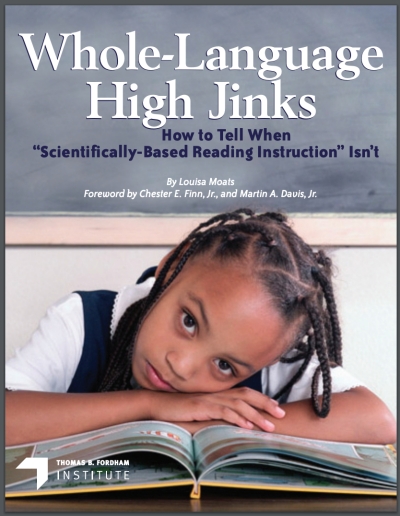
In 2007, the Thomas B. Fordham Institute released Whole-Language High Jinks: How to Tell When “Scientifically-Based Reading Instruction” Isn’t by Louisa Moats. This report includes on the cover a despondent looking Black girl with her head down near a book, reminding me of the manipulative imaging used in the documentary Corridor of Shame.
Fordham cover
Moates is touted as a “renowned reading expert” and “author of the American Federation of Teachers’ Teaching Reading Is Rocket Science and an earlier Thomas B. Fordham Foundation report, Whole Language Lives On: The Illusion of “Balanced” Reading Instruction.”
The Executive Summary makes a case that may sound familiar to anyone paying attention to media coverage of the “science of reading” since 2018:
While the field of reading has made enormous strides in recent years—especially with the publication of the National Reading Panel’s landmark report and enactment of the federal Reading First program—discredited and ineffectual practices continue in many schools. Although the term “whole language” is rarely used today, programs CONTINUE READING: The More Things Change … – radical eyes for equity

Education Law Center Challenges Charter Expansion in New Jersey | Diane Ravitch's blog

Education Law Center Challenges Charter Expansion in New Jersey | Diane Ravitch's blog

Education Law Center Challenges Charter Expansion in New Jersey

The Education Law Center is suing in New Jersey Supreme Court to challenge the negative effects of charter schools on public schools in Newark.
ELC is asking the court to review the fiscal impact and segregating effects of charters on public schools. The bottom line is whether the state can afford to support two different school systems.
The New Jersey Supreme Court has granted a petition filed by Education Law Center (ELC) to review the State Commissioner of Education’s 2016 decision approving an enrollment increase of 8500 students in KIPP, Uncommon and other charter operators’ schools in the Newark Public School (NPS) district.
In accepting In Re Team Academy Charter School, the Supreme Court will now decide several consequential issues raised by the State’s push to rapidly grow charter school enrollments in NPS over the last decade. Under former Governor Chris Christie, Newark charter enrollments grew 320% from 4,559 in 2009, to 19,152 in 2020. NPS payments to charter schools increased from CONTINUE READING: Education Law Center Challenges Charter Expansion in New Jersey | Diane Ravitch's blog

Dehesa says Inspire charter schools corporation appears to be skirting transparency laws - The San Diego Union-Tribune

Dehesa says Inspire charter schools corporation appears to be skirting transparency laws - The San Diego Union-Tribune

Dehesa says Inspire charter schools corporation appears to be skirting transparency laws 

If the Inspire schools fail to remedy several issues, Dehesa says it may consider revoking the schools’ charters


The Dehesa School District says a corporation that has been managing the Inspire charter schools across California appears to have been skirting transparency and conflict of interest laws.
Dehesa says the corporation, called Inspire District Office, is a charter management organization and therefore is subject to such laws. The corporation, which has ties to charter schools around the state serving more than 36,000 students, denies that.
Dehesa’s Acting Superintendent Rich Thome recently sent letters to two Inspire schools that Dehesa oversees, saying that the Inspire District Office has been given too much control over what should be local school matters — such as maintaining student records, monitoring student performance and setting school board agendas.
Dehesa authorizes and oversees two Inspire schools: Pacific Coast Academy and Cabrillo Point Academy. Both schools are projected to each receive $39 million of state funding this year, based on how many students they enroll, according to their latest interim financial reports.
Inspire District Office collects 15 percent of all state tax dollars sent to Inspire schools and it is involved in what may be all of Inspire schools’ operations, Thome said in his letters.
Yet Inspire District Office has refused to release details of its finances or operations to the San Diego Union-Tribune in response to public records requests.
And when Dehesa requested invoices between the district office and its schools, Inspire said it has no invoices for the services it has provided the schools.
Thome wrote that if the Inspire schools fail to remedy several issues noted in its letters, Dehesa “will consider all available options,” including revoking the two schools’ charters. CONTINUE READING: Dehesa says Inspire charter schools corporation appears to be skirting transparency laws - The San Diego Union-Tribune

CURMUDGUCATION: Call for Federal Charter Transparency Law

CURMUDGUCATION: Call for Federal Charter Transparency Law

Call for Federal Charter Transparency Law


We've been here before. For instance, in 2015 while Congress was wrestling with what would eventually become ESSA, Sherrod Brown introduced the Charter School Accountability Act, which had some modest goals-- require greater charter transparency, mandate some reporting from charter authorizers, and compel charter operators to talk to the community before opening up. The bill was promptly sent to the Senate Health, Education, Labor and Pensions committee, to never be heard from again.

But Congress has yet an other chance to get it right.

Representative Rashina Tlaib (D-Michigan) is introducing the Charter Oversight, Accountability, and Transparency (COAT) Act (how many person-hours do you suppose are used up trying to give bills names that spell something cute?).

This bill is pretty simple, and is asking for, well, transparency about what happens to public taxpayer dollars once they disappear into the charter school system. To keep their ESSA money, states would have to insure that every contract between a charter school and a charter management organization (the businesses that charter schools hire to actually run the schools) would have to require the following:

* How much of the money is being used to actually operate the school (by amount and percent)

* How much of the money is being used to run the CMO (by amount and percent)

* Salaries for CONTINUE READING: 
CURMUDGUCATION: Call for Federal Charter Transparency Law


TFA Is Expanding Its “Pipeline of Philanthropists.” Interested? | deutsch29

TFA Is Expanding Its “Pipeline of Philanthropists.” Interested? | deutsch29

TFA Is Expanding Its “Pipeline of Philanthropists.” Interested?

Teacher temp org, Teach for America (TFA), is adding two “leadership gifts officers,” or fundraisers focused on enlisting more “seven- and eight-figure” philanthropic donors, or “ensur[ing] that Teach For America’s pipeline of philanthropists is ever-expanding and increasingly diverse.”
Interestingly, TFA’s corresponding “VP, Leadership Gift Officer” position requires “at least 10+ years of fundraising experience.” TFA specializes in tossing inexperienced college grads with degrees outside of education into America’s classrooms in the name of “building champions of education and equity,” but when it comes to schmoozing high-dollar donors, 10+ years of experience required.
Below is the job posting, in full.

Vice President, Leadership Gifts Officer

TEAM: National Development
REPORTS TO: Vice President of Individual Giving
LOCATION(S): Flexible; NY/NJ/CT, Houston, Dallas, Chicago, Philadelphia, Washington D.C., and Boston are highly preferred
THE ROLE
Teach For America is expanding our Leadership (seven- and eight-figure) Gifts portfolio.  We are hiring two new Leadership Gifts Officers, in thriving philanthropic markets across the country, to help grow the CONTINUE READING: 
TFA Is Expanding Its “Pipeline of Philanthropists.” Interested? | deutsch29

A very odd visit to a Shanghai preschool | GFBrandenburg's Blog

A very odd visit to a Shanghai preschool | GFBrandenburg's Blog

A very odd visit to a Shanghai preschool

Would you believe…
A class of twenty or so 2-year olds in Shanghai who are bilingual, AND reading, BOTH in Mandarin Chinese AND in English?
Who, at circle time, understand and read the days of the week and of the month?
Yes, two year olds.
Is this for real?
My wife taught pre-school for about four decades. She tells me she has had some two-year olds who could read and do worksheets, but they generally could not transfer that apparent knowledge to other situations. Paraphrasing her words: at that age, we teachers are mostly trying to make sure these toddlers poop and pee appropriately, and avoiding biting or accidentally bumping into each other. Playing nicely, talking clearly, listening and sharing are also top goals. Some really want to learn how to write or read, some don’t really care. Yet; they will later.
The writer is an American pediatrician and author whose own CONTINUE READING: A very odd visit to a Shanghai preschool | GFBrandenburg's Blog

antiracismdsa: Compare Candidates on Immigration Policy

antiracismdsa: Compare Candidates on Immigration Policy

Compare Candidates on Immigration Policy


antiracismdsa: Compare Candidates on Immigration Policy