Latest News and Comment from Education

Friday, February 14, 2020

Charter School Support Fades: the Network for Public Education Deserves Much of the Credit | janresseger

Charter School Support Fades: the Network for Public Education Deserves Much of the Credit | janresseger

Charter School Support Fades: the Network for Public Education Deserves Much of the Credit


Earlier this week, this blog explored what Betsy DeVos hopes will be a major restructure in the U.S. Department of Education. That she is considering the restructure of the department became clear in the President’s FY21 budget proposal, which collapses Title I into a huge block grant with 28 other programs, and cuts funding for these combined programs by $4.7 billion. Title I is the Department’s largest program and the centerpiece of the federal government’s primary role in public education—ensuring that whatever happens in the states, the federal government will supplement programming to assist schools serving concentrations of very poor children. In a related responsibility (through the Department’s Office for Civil Rights), the U.S. Department of Education’s mission is also to protect the educational rights of children our society has historically marginalized. These programs, begun in the 1960s, grew out of the Civil Rights Movement and the War on Poverty.
Congressional failure to enact President Trump’s budgets over the past three years suggests that passage of the  President’s proposed federal budget for the 2021 fiscal year is also unlikely.  However, a budget proposal is a statement of an administration’s priorities. The idea that Trump and DeVos want to mess with Title I should alert Congress to be very careful.
There is another shocker in Trump’s federal FY21 federal budget proposal that we ought to notice: The President and the Secretary of Education propose to end the federal Charter Schools Program as a stand alone funding line. Since 1994, the Department of Education has spent billions of dollars to startup and expand the number of charter schools across the states. Why is an Education Secretary who insistently promotes school choice proposing a budget that phases out the Charter Schools Program?  Some are speculating that DeVos prefers vouchers, and she is putting all of her effort in the fourth year of this administration into CONTINUE READING: Charter School Support Fades: the Network for Public Education Deserves Much of the Credit | janresseger

School Reforms That Are Persistent and Admired But Marginal (Part 2) | Larry Cuban on School Reform and Classroom Practice

School Reforms That Are Persistent and Admired But Marginal (Part 2) | Larry Cuban on School Reform and Classroom Practice

School Reforms That Are Persistent and Admired But Marginal (Part 2)


After Minnesota authorized charter schools in 1991, a group of veteran teachers founded City Academy in St. Paul. It became the first publicly funded charter school in 1992. A quarter-century later 43 states and Washington, D.C. permit charter schools to operate. Charters are innovative ways to govern, fund, and organize public schools.
Using public monies and free of many state and district regulations, these schools have grown in a quarter-century from a handful to nearly 7000 across the U.S (there are about 100,000 public schools in the nation); they serve about 3 million students (over 50 million attend public schools). Largely found in urban districts (57 percent of all charter schools), these schools enroll mostly Hispanic and black students (total of 59 percent) charters.
Charters have separate boards of directors who have to design a new school, find space for it, recruit parents to send their sons and daughters to it, hire a director and teachers, decide on the curriculum and manner of instruction, and make scores of other decisions in getting the school up and running. In many cases, charters have to raise additional monies over and above the state’s allocation for public school students attending district schools.
Most charter (over 75 percent ) are stand-alone schools. One-quarter of charters belong to Charter Management Organizations (CMO) such as Kipp, Success Academies, Aspire, and Summit Schools. With stable funding (often from private donors), an ideology, and an existing infrastructure of support, CMOs provide CONTINUE READING: School Reforms That Are Persistent and Admired But Marginal (Part 2) | Larry Cuban on School Reform and Classroom Practice

TN Supt. Penny Schwinn Bypasses Legislature with No-Bid Voucher Contract | deutsch29

TN Supt. Penny Schwinn Bypasses Legislature with No-Bid Voucher Contract | deutsch29

TN Supt. Penny Schwinn Bypasses Legislature with No-Bid Voucher Contract


Teach for America (TFA) alum Penny Schwinn is Tennessee’s education commissioner, a post that she has held for a year as of this writing.
Within ten months of Schwinn’s arrival as Tennessee ed commissioner, the Tennessee Department of Education experienced 250 resignations, including “people with decades of institutional knowledge,” which the November 15, 2019, Tennessee Chalkbeat characterized as “not typical.”
It might not be typical for an education commissioner who does not hail from TFA, but Schwinn’s purgative effect on Tennessee’s ed department is a familiar story to those of us in Louisiana, where another TFA alum, John White, had the same effect on the Louisiana Department of Education (LDOE). (For an inside peek of LDOE chaos under White, see this 2014 post by former LDOE employee, Jason France.)
I first wrote about Schwinn in her previous role as Texas Education Agency (TEA) deputy commissioner of academics in connection to the wrongful termination of Texas special education director, Laurie Kash, who blew the whistle on TEA’s no-bid contract with special education data company, SPEDx. One of Kash’s concerns was an alleged personal relationship between Schwinn and a SPEDx leader.
On February 12, 2020, Schwinn was again in the news related to a no-bid contract controversy, this time in connection with Tennessee’s school voucher program CONTINUE READING: TN Supt. Penny Schwinn Bypasses Legislature with No-Bid Voucher Contract | deutsch29

A geometry lesson inspired by a silvering company – and a rant about computerized learning programs | GFBrandenburg's Blog

A geometry lesson inspired by a silvering company – and a rant about computerized learning programs | GFBrandenburg's Blog

A geometry lesson inspired by a silvering company – and a rant about computerized learning programs


Here is some information that teachers at quite a few different levels could use* for a really interesting geometry lesson involving reflections involving two or more mirrors, placed at various angles!
Certain specific angles have very special effects, including 90, 72, 60, 45 degrees … But WHY?
This could be done with actual mirrors and a protractor, or with geometry software like Geometer’s Sketchpad or Desmos. Students could also end up making their own kaleidoscopes – either with little bits of colored plastic at the end or else with some sort of a wide-angle lens. (You can find many easy directions online for doing just that; some kits are a lot more optically perfect than others, but I don’t think I’ve even seen a kaleidoscope that had its mirrors set at any angle other than 60 degrees!)
I am reproducing a couple of the images and text that Angel Gilding provides on their website (which they set up to sell silvering kits (about which I’ve posted before, and which I am going to attempt using pretty soon, on a large astronomical mirror I’ve been polishing for quite some time)).

At 72º you see 4 complete reflections.

When two mirrors are parallel to each other, the number of reflections is infinite. Placing one mirror at a slight angle causes the reflections to curve.

===========

Marie Corfield: The Fight For Our Children

Marie Corfield: The Fight For Our Children

The Fight For Our Children


The number of suicides among people ages 10 to 24 nationally increased by 56 percent between 2007 and 2017, according to a new federal report showing the tragic consequences of an emerging public health crisis.

An NJ Advance Media report... highlighted New Jersey’s rising suicide rate among teens and young adults amid a mental health crisis.


Photo by Dan Meyers on Unsplash

In the last three years, three Hunterdon Central Regional High School students and two former students have died by suicide: sophomore Alison Vandal in December 2017; senior Eden Carrera Calderon in October 2019; freshman Joseph Drelich, Jr in January 2020; graduate Jared Yazujian in January 2020; graduate, Christopher Soldano in July 2018. These tragic deaths have rocked our community to its core. In a county of only about 125,000 people, it seems everybody knows somebody who has been affected by them.

Suicide is the second leading cause of death among people between the ages of 10 and CONTINUE READING: 
Marie Corfield: The Fight For Our Children

Enrollment and Equity Report; Charter School Facilities Issues in Ward 8 – Education Town Hall Forum

Enrollment and Equity Report; Charter School Facilities Issues in Ward 8 – Education Town Hall Forum

ENROLLMENT AND EQUITY REPORT; CHARTER SCHOOL FACILITIES ISSUES IN WARD 8
The Feb 13 Education Town Hall included one segment on issues with charter school facilities and one on the DC auditor’s report on enrollment and equity.
Segment 1 begins at 10:26 mark
Segment 2 begins at 45:00 mark
For our first segment, Ward 8 residents Tina Batchelor and Camille Joyner were in studio to discuss their experience of how a charter school, Eagle Academy, located in their neighborhood and how the ensuing construction and neighborhood opposition has resulted in their advocacy and activism around issues that in DC are common concerning school siting and construction—and illuminate what the public can do.
The neighbors around the school, at 2345 R SE, have worked together to follow through with many civic failings in its development, including a lack of permits,  CONTINUE READING: Enrollment and Equity Report; Charter School Facilities Issues in Ward 8 – Education Town Hall Forum

Letter to Interim Commissioner Tahoe on Testing on Earth Day | Class Size Matters

Letter to Interim Commissioner Tahoe on Testing on Earth Day | Class Size Matters Letter to Interim Commissioner Tahoe on Testing on Earth Day | A clearinghouse for information on class size & the proven benefits of smaller classes

Letter to Interim Commissioner Tahoe on Testing on Earth Day


Below is the letter sent out on February 13, 2020 to NYSED about Earth Day and the state middle school math test. Class Size Matters, Senator Jackson’s office, Teachers for the Future, and various other organizations and officials signed off on this letter to reschedule the math exams and support student climate strikes, as well as teach-ins on Earth Day 50 for those students who cannot participate in strikes.
At a moment when our students’ futures hang in the balance, New York should be  ensuring that all students have an opportunity to learn about the causes of and solutions to climate change on Earth Day. If you think kids shouldn’t spend the 50th anniversary of Earth Day taking a standardized test, sign our petition in support of the letter sent to State and City government officials, asking them to reschedule and hold climate teach-ins instead. Sign the petition here


Letter to Interim Commissioner Tahoe on Testing on Earth Day | Class Size Matters Letter to Interim Commissioner Tahoe on Testing on Earth Day | A clearinghouse for information on class size & the proven benefits of smaller classes

CURMUDGUCATION: FL: BEST Standards To Roll Back The Calendar

CURMUDGUCATION: FL: BEST Standards To Roll Back The Calendar

FL: BEST Standards To Roll Back The Calendar


Somewhere Jeb! Bush is drowning his tears in his sarsparilla. His beloved Florida, the state that launched a thousand bad ed reform ideas, has tried to roll back one-- the Common Core./ Governor Ron Desantis  dispatched a task force to drive a stake through the heart of the unbeloved standards and replaced them with B.E.S.T.-- Benchmarks for Excellent Student Thinking. No, it's not a name whose natural poetry inspires trust.

Ten Selling Points

I haven't ploughed through the entire many-paged actual standards yet. I will. I promise. But for the moment, let's just peruse the state's announcement trumpeting the major Points Of Awesometude, because they are plenty to digest, and they help give an overall impression (spoiler alert:.the impression is that Florida wants to go back several decades in time).  There are two Top Ten lists (one for ELA and one for math), but I'm going to stick to the ELA list. Here are the Top Ten reasons that the new ELA standards are BEST. (Get it? Get used to it, because apparently the plan is to milk that BEST thing until all the swampland in Florida is developed.)


1) Florida-Created. Okay, I think it's cute that Florida thinks they're the best at this sort of thing, but I get that the selling point here is the "created by Florida teachers for Florida students" part. The task force used edcredible to help do thew work, plus listening tours. The committee member listing has so far evaded me, but given the administrations lack of love for actual public school teachers, I have my doubts here.

2) Skills for Lifelong Learning. This is exceptionally vague. Create great thinkers, communicator and researches. Bolder, brighter future! A booklist. "Skills," it should be noted, is a Common Core buzzword. And foundations for struggling readers. We'll get back to that.

3) Embedded civics. Florida is going to lead the nation in establishing civics literacy, including a CONTINUE READING: 
CURMUDGUCATION: FL: BEST Standards To Roll Back The Calendar

Educators and Students Have Privatizers on the Run, Says Ravitch

Educators and Students Have Privatizers on the Run, Says Ravitch

Educators and Students Have Privatizers on the Run, Says Ravitch


Diane Ravitch, former assistant secretary of education in President George H.W. Bush’s administration and NEA Friend of Education in 2010, has written a new book that she wants every public school educator to read.
In “Slaying Goliath: The Passionate Resistance to Privatization and the Fight to Save America’s Public Schools,” [Knopf: 2020] Ravitch explores how profit-minded billionaires like Sam Walton or Eli Broad—she calls them “disrupters,” never “reformers”—are behind large-scale efforts to squeeze public money out of public schools through a relentless focus on standardized test scores and failure. For many decades, it looked like they were winning. Not anymore. From West Virginia to Los Angeles, Ravitch’s book celebrates the growing rebellion of educators, parents and community members who are fighting for students and educators—and winning. Recently, she spoke with NEA Todayabout this work.
Let’s start with the title, “Slaying Goliath: The Passionate Resistance to Privatization and the Fight to Save America’s Public Schools.” Who here is Goliath?
Diane Ravitch: Goliath represents the people who have embarked on these really disastrous policies and funded them. You have to start with the government officials, and that means every president since George H.W. Bush, including Obama. They had this idea that you test and you test, and everybody will be proficient if you just test some more.
It really has changed little since Bush. Obama bought into it and [his Secretary of Education] Arne Duncan was an enthusiastic supporter. It’s been a bipartisan mess with Democrats equally implicated, including Rahm Emanuel in Chicago and Andrew Cuomo in New York. This has been the status quo for 20 years. They became infatuated with the notion that just measuring the problem will fix the problem. With this kind of thinking, the measure is the goal—when the goal really is a healthy, civic-minded, participatory citizenry.
You write in the introduction that you sat down to write this book at a pivotal time in public school history. What was going on, and how did it inform your approach to the book?
DR: I had no intention of writing this book. I write my daily blog  and that’s very satisfying. But then the West Virginia walkout happened, and I kept reading about it with absolute fascination.
I had long been encouraging people, saying ‘we have to keep fighting,’ but I didn’t CONTINUE READING: Educators and Students Have Privatizers on the Run, Says Ravitch

Thursday, February 13, 2020

Relationships | Blue Cereal Education

Relationships | Blue Cereal Education

Relationships


Distance LearningGood morning. Welcome to our first back-to-school faculty meeting. We have several important items on the agenda today, then we’re going to fill the afternoon with pointless activities we found online because the district says we have to professionally develop until at least 3:00 whether we need it or not.
As some of you know, we had a bit of unpleasantness last spring which we’d like to avoid happening again this coming year. A teacher who is no longer with us crossed a few boundaries and before you knew it, we were leading off the local evening news – and unfortunately it wasn’t for our horrible test scores this time.
With that in mind, I’d like to draw your attention to the pink handout in front of you. These are some of this year’s revised guidelines for teacher-student interactions. I won’t read it all to you (it’s not PowerPoint), but I would like to point out a few highlights.
First and foremost, no touching. If you need to get a student’s attention, use your words. If you wish to encourage them... well, it’s best if you avoid that altogether. Some of you have fallen into a very bad habit of putting a hand on a shoulder or patting a student on the back as you walk by. You may intend this as an innocent gesture or believe that young people need some sort of positive physical contact in their lives, but the risk is simply too great.
This also applies to handshakes as they walk in the door, whether you’re in clear view of dozens of other faculty members or not. Also, several of you have asked about CONTINUE READING: Relationships | Blue Cereal Education

A response to the Boston Police Union Attack on Black Lives Matter at School: “This is a movement for equity, inclusion, and the uplifting of Black students” – Black Lives Matter At School

A response to the Boston Police Union Attack on Black Lives Matter at School: “This is a movement for equity, inclusion, and the uplifting of Black students” – Black Lives Matter At School

A response to the Boston Police Union Attack on Black Lives Matter at School: “This is a movement for equity, inclusion, and the uplifting of Black students”


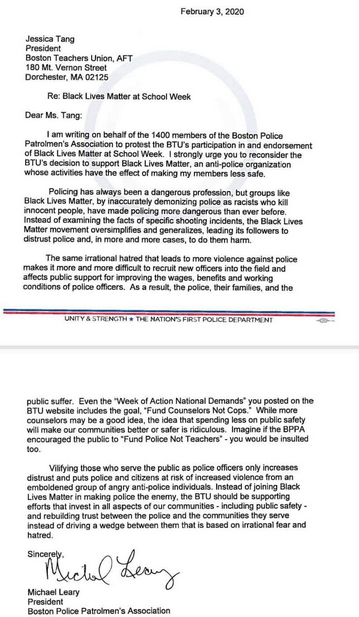
We, the organizers of the Black Lives Matter at School movement, strongly condemn the shameful attack on Boston educators launched by Boston Police Patrolmen’s Union President Michael Leary. During the first week of February, 2020, thousands of educators in over 40 cities and towns around the country organized the third annual Black Lives Matter at School Week of Action. Leary wrote a letter on behalf of the 1,400 members of his association attacking the Black Lives Matter at School movement and strongly urged that Boston Teacher’s Union President Jessica Tang withdraw her union’s participation from the national Black Lives Matter at School Week of Action.


In his letter, Leary wrote that Black Lives Matter has made policing more dangerous— without sighting any examples or statistics—and claimed, “Vilifying those who serve the public as police officers only increases distrust and puts police and citizens at risk of increased violence from an emboldened group of angry anti-police individuals.”
This attack on educators who seek to support the lives of Black students is shameful, misguided, and harmful to Black students and educators.  The suggestion that uplifting and affirming Black students in school—the true purpose of the Black Lives Matter at School movement—is putting police and citizens at risk of increased violence is shocking and reprehensible.

What Gives You the White of Way? How Seattle Public Schools Educators of Color Are Fighting Back – I AM AN EDUCATOR

What Gives You the White of Way? How Seattle Public Schools Educators of Color Are Fighting Back – I AM AN EDUCATOR

What Gives You the White of Way? How Seattle Public Schools Educators of Color Are Fighting Back


The below statement was written by Ethnic Studies Advisory Group in Seattle in an urgent defense of their program.
This group, comprised of a majority of womxn of color, has been doing vital work to create Ethnic Studies curriculum and guide the implementation of Ethnic Studies for the Seattle Public Schools. And yet Ethnic Studies hasn’t been given the support it needs. The district only hired one person for entire program and now they are now full on attacking Ethnic Studies by placing Ethnic Studies Program Manager, Tracy Castro-Gill, on administrative leave based on false accusations.
Please read and share this statement from the Ethnic Studies Advisory Group and consider donating to support Tracy.


Seattle Public Schools, home of some of the most egregious racial disparities in the country, a district who claims to “unapologetically” serve “students furthest from educational justice” in their Strategic Plan, “Seattle Excellence”, is apparently trying to CONTINUE READING: What Gives You the White of Way? How Seattle Public Schools Educators of Color Are Fighting Back – I AM AN EDUCATOR

Let’s pause the charter school experiment in Newark: NAACP - nj.com

Let’s pause the charter school experiment in Newark: NAACP - nj.com

Let’s pause the charter school experiment in Newark: NAACP


The Newark NAACP supports Newark Superintendent Roger León who has requested closure of four low performing charter schools and a halt to the expansion of charters in Newark based on the tremendous strain on the district’s budget and their failure to serve a greater cross section of the city’s children.


The charter schools were first permitted as an experiment to create “greater flexibility for innovation” and advancing education within public schools in the 1980s. Initially, they were a success and special policies were put in place to accommodate low rents for co-locations within existing schools. Extensive renovations by investors divided buildings into two cities. One part of the building with the newest resources and the other side deprived of some of the basics.
Charter schools are also taking fewer students with special needs and fewer students who don’t speak English as their first language, according to the Rutgers’ Bloustein School of Planning and Policy. The percentage of students with special needs in Newark District schools is approximately 40% higher than in the city’s charter schools and the percentage of students identified as English language learners is approximately 11 times greater in district schools than in charter schools. CONTINUE READING: Let’s pause the charter school experiment in Newark: NAACP - nj.com

Jackie Goldberg: Lies the Billionaires Tell | Diane Ravitch's blog

Jackie Goldberg: Lies the Billionaires Tell | Diane Ravitch's blog

Jackie Goldberg: Lies the Billionaires Tell


Jackie Goldberg is running for re-election to the Los Angeles Unified School Board. She is an experienced public official who has supported public schools for decades as a school board member and state legislator. A rightwing billionaire dumped nearly half a million into her low-budget race to try to stop her in the March 3 election (early voting has already started.)
Jackie was endorsed by the UTLA along with Scott Schmerelson, George McKenna, and Patricia Castellanos. Vote for them if they are candidates in your district.
Jackie sets the record straight here:

 Dear Friends, Families, and Board District 5 Voters,
By now, you may have received a number of mailings telling you to “Vote ‘No’ on Jackie Goldberg”, all of which are being sent by a man named Bill Bloomfield, who lives in Manhattan Beach, CA.
Bloomfield is extremely wealthy and was a Republican until 2011 when he became an “Independent.”  He avidly supports charter school candidates and opposes all progressive Democrats.  So far this election cycle, he has spent almost $130,000— on “hit” pieces against me.  But this is far from his first rodeo.  He was part of the $13 million worth of lies that were used in 2017 against then-Board President Steve Zimmer, and he helped bankroll part of the $10 million spent to spread lies about Board Member Bennett Kayser in 2015.
In 2019, Bloomfield’s contributions to the California Republican Party totaled $445,000.  He also spent $7,583,806 to try to elect Marshall Tuck to be State Superintendent of Public Instruction.  Tuck ran on a platform of increasing support for the state’s charter schools.  Bloomfield not only supports charter schools over district public schools, he also opposes raising taxes on the wealthy to increase funding for public schools.
This very, very rich financier has never met me, never interviewed me as to my views, and has repeatedly distorted the truth to send you bald-faced lies about me and my 22-year record of public service.  His goal is to defame me to stand in the way of my quest to raise taxes on the rich and to make charter schools more transparent, equitable, and accountable.
Let me respond specifically to some of the many lies Bloomfield has been peddling about me in his monstrously misleading mailers.

  • LIE:  Bloomfield’s mailers attempt to paint me as a racist.
  • TRUTH:  I have lived in Echo Park for the last 40 years.  My son went to LAUSD schools that were primarily composed of Latino students.  I taught high school in the Compton Unified School District for 17 years and was one of two teacher-leaders to define plans that raised the reading of our students from the bottom of state testing in reading to the State average.
  • Among my campaign endorsers are Dolores Huerta, co-founder of the United Farmer Workers, County Supervisor Hilda Solis, State Senator Maria Elena Durazo, La Opinion, Maywood City Councilmembers Elizabeth Alcantar and Eddie de la Riva, Bell City Councilmembers Fidencio Gallardo and Alicia Romero, Padres Unidos in South Gate, and Congressmembers Maxine Waters and Judy Chu, among others.
  • These leaders and community organizations, as well as La Opinion, do not endorse racists!
  • LIE:  Bloomfield claims my “agenda is too extreme and too dangerous for kids!”  He attacks me for removing funding for DARE, an anti-drug program for which the district paid millions of dollars to the Los Angeles Police Department.
  • TRUTH:  The LAUSD Board of Education discontinued funding for DARE after a study revealed that, in spite of great intentions, the program was a complete failure in reducing student drug use.
  • LIE:  Bloomfield, remarkably, suggests that the National Rifle Association (“NRA”) loves me.
  • TRUTH:  I have a lifetime “F” grade from the NRA because when I was on the Los Angeles City Council, I wrote and passed a measure that outlawed sales of cheap “Saturday Night Specials” in Los Angeles.  While on the Public Safety Committee in the State legislature, I helped kill major legislation that would have made gun ownership more protected, and thus increase the chance for all of us and our children to be victims of gun violence.  What I actually voted against that Bloomfield’s mailer attempts to misrepresent was a bill that would have automatically expelled a student for bringing to school a toy gun that may look like a real gun.  Though I do think this would be a dangerous and foolish thing for a student to do, I believe that all students should have a right to a hearing before being expelled.
  • LIE:  In one of his most insidious smears, Bloomfield claims that I support sexual predators.
  • TRUTH:  I voted against a bill that included so many limitations for where a convicted sex offender could live that there literally would be nowhere left for them to go.  And I did so because I knew that the California courts would overrule the bill and we would be left with noprotections on where sex offenders could live after being released from prison.  Sure enough, after its passage, the California Supreme Court did just that, ruling that the law was unconstitutional because the state could not have a law that left people with no place to live.  The following year, my Assembly colleagues and I passed a law preventing sex offenders from living near schools, parks, and other places where children might be.
  • LIE:  Bloomfield attacks me for the terrible crisis at Miramonte school.
  • TRUTH:  I was not even on the Board at that time of the Miramonte crisis.
  • LIE:  Bloomfield suggests voters have to choose between me and President Obama, claiming that I voted to shut down Teach for America.
  • TRUTH:  I did not vote to shut down Teach for America.  What I did do is raise the issue that a great many Teach for America teachers leave our District in two or three years.  I said that the District should recruit people who want to be teachers, not build their resumes—and I still believe that to be true.
  • LIE:  Bloomfield misleadingly claims that I cut programs for students of color.
  • TRUTH:  In the 2001-2002 school year, the state legislature was facing a huge budget shortfall.  The state was in a deep recession.  Yes, I voted for the budget.  In those days, it took a 2/3 vote to pass a budget, so allAssembly Democrats had to vote for the budget, or else the state’s services—including funds for schools—would be shut down.  Did I have to vote on a budget that took $9.8 billion from schools and public universities?  Sadly, I did.  But that was after fighting and winning the battle to avoid larger cuts of $14 billion.
  • LIE:  Bloomfield claims that I “forced Latino students to attend academically inferior and dangerous schools.”  He then points to a 1985 U.S. Department of Justice investigation of the District.  Notably, his source relates to issues in South Gate and Watts.
  • TRUTH:  The boundaries of the Board Districts that each School Board member represents were not the same in 1985 as they are today.  Though South Gate is currently in my Board District, I did not represent either South Gate or Watts during my first time on the Board when the Department of Justice’s investigation began, and I had nothing to do with the issues that brought upon the investigation.
  • LIE: Bloomfield claims that in my first tenure on the Board, student scores dropped.
  • TRUTH:  Student test scores were low in the 1980’s.  Why?  Because when Proposition 13 passed, the District literally lost 25% of its General Fund money due to big corporations and the wealthy no longer having to pay their fair share in property taxes.  Schools became overcrowded.  Most were on multi-track, year-round schedules, and funding to build new schools was rigged against the District.  It was because of my work and the leadership of then-Speaker of the State Assembly Robert Hertzberg, however, that the Assembly and Senate finally set aside several billion dollars for LAUSD and other severely overcrowded districts, which resulted in 131 new schools being built.
  • My record of support for public education is long, significant, and well-documented.  That is why UTLA, the teachers’ union, SEIU Local 99, the union representing teacher aides, cafeteria workers, CSEA Local 500, which represents library aides, the Teamsters AND the union representing school principals and administrators have all endorsed my campaign.
  • So, I urge you not to believe the vicious lies that this conservative, anti-public school millionaire is spreading about me in order to try to stop my work trying to tax the great wealth in this state and get our state legislators to invest in our children and youth again.  My mother taught in LAUSD for 40 years.  I grew up committed to public education, and I have never wavered in my support for full and adequate funding for public schools—from pre-school through college.  I was a youth activist in the civil rights movement, and I continue to spend my life working to improve the lives of the next generation.
  • I often remind people that our children are not part of the future—they are our entire future.  We must all work together to improve our state and federal governments’ investment in our children and youth.  California, if it were a separate nation, would be the fifth richest nation in the entire world.  While New York spends $29,000 per student in their schools, California only spends $16,500 per student.  Great change is needed.  I ask you to join me in this fight for FULL FUNDING for our public schools.  The time is NOW!  Please honor me with your vote on or before March 3.
Thank you,
Jackie Goldberg
Board Member, LAUSD Board of Education, Board District 5
Jackie Goldberg: Lies the Billionaires Tell | Diane Ravitch's blog

RQILA Passes A Marker: Launching The Los Angeles Education Examiner – redqueeninla

RQILA Passes A Marker: Launching The Los Angeles Education Examiner – redqueeninla

RQILA Passes A Marker: Launching The Los Angeles Education Examiner


Welcome to the Los Angeles Education Examiner, your new source for news on public education in Los Angeles! We will address questions surrounding education in the vast LA region hoping to raise public consciousness about how things-educational matter to everyone here, day to day. We will host stories from other writers, do a weekly news roundup (this week’s was published yesterday) and produce our own original works around LAUSD, our teachers and our schools.
As it happens more public monies and control is exerted by the seven board members of the Los Angeles Unified School District (LAUSD) from its downtown Los Angeles “Beaudry” headquarters than from across the 110/Harbor Freeway in LA’s City Hall. Join us for considerations ranging from what you need to know about simply “going to school” today, to analysis of why it all matters on a local and statewide level, whether you are student, parent or taxpayer.
The largest school district in California is the Los Angeles Unified School District (LAUSD), but the entirety of Los Angeles County (LAC) enrolls nearly two-and-a-half times as many students as attend LAUSD. There are 88 school districts within LAC, ranging in size from one school of 196 pupils (in 2018/19) to the giant LAUSD with over a thousand schools and well over a half-million students. Its largest (Granada Hills Charter High) school alone enrolls nearly 4700 pupils. See figure 1 to trace LAUSD’s overall enrollment in graded and “traditional” schools (see below for definitions) since 1981. Enrollment has declined steadily since 2003/04 with a high of 747K students. Current enrollment of approximately 600K approaches that of three decades past.


Figure 1:  LAUSD long-term enrollment in graded and traditional school types from 1981-2019
Many “fingertip facts” about LAUSD can be found here, including a list of CONTINUE READING: RQILA Passes A Marker: Launching The Los Angeles Education Examiner – redqueeninla