Latest News and Comment from Education

Wednesday, February 12, 2020

NewBlackMan (in Exile) TODAY

NewBlackMan (in Exile)

NewBlackMan (in Exile) TODAY


Rappers are ‘Products Made to Crumble’: A Review of Rap on Trial: Race, Lyrics and Guilt in America

by Tyler Bunzey |@t_bunzey | NewBlackMan (in Exile) Hip-hop has changed quite a bit since its early years as a small cultural movement in the South Bronx. Almost half a century old, hip-hop is now a massive international cultural force with multiple subgenres , a force that informs the layout of the recording industry, fashion, marketing, the American vernacular, and, hell, even U.S. diplomatic

YESTERDAY

Actor-Comedian Tommy Davidson Dives Into His New Memoir, 'Living In Color: What's Funny About Me'

'In his new memoir, Tommy Davidson shares his unique perspective on making it in Hollywood, being an integral part of TV history with the pioneering sketch show, In Living Color , and on living a life that has never been black and white. Told with humor and hard-won honesty by a singular voice whose family and friendships help him navigate a life of personal and professional highs and lows, Livin
Class Incarceration: A New Understanding of Prison and the American Population

'Sociologist Adaner Usmani advances a new explanation for mass incarceration in America - not as an elite-driven tool of racialized social control, but as a wide-scale punitive response to the growing crime and violence of an unequal society with no social democratic push for redistributive policies. Usmani wrote the article "The Economic Origins of Mass Incarceration" with John Clegg for Catalys
Jessie Reyez On The Power Of Sad Songs

'The 28-year-old Colombian-Canadian singer Jessie Reyez makes emotional music that has connected deeply with fans. She recently received her first Grammy nomination for best urban contemporary album for her EP, Being Human in Public .' -- Weekend Edition Saturday
How Black Women Were 'Skimmed' By Infant Formula Marketing

'Here & Now 's Tonya Mosley speaks with Andrea Freeman — whose book Skimmed: Breastfeeding, Race, and Injustice looks at how formula was marketed to black women in the late 20th century.'
Writer Danez Smith Discuses New Collection 'Homie'

Photo by Hieu Minh Nguyen. Danez Smith joins All Of It to discuss their work and latest book, Homie: Poems .
NewBlackMan (in Exile)

Redefining Reading Achievement Creates Reading Problems in Children!

Redefining Reading Achievement Creates Reading Problems in Children!

Redefining Reading Achievement Creates Reading Problems in Children!

A critic who charges that children aren’t reading well and teachers need to learn about the Science of Reading, also says children must read sooner than they did in the past. This new ideological construct promotes standards that many children will not be capable of achieving. It also sets children and their teachers up to fail.
The idea that children need to be reading sooner is not new. Common Core State Standards are about this new reading reality.
The Fordham Institute is no friend to teachers or public education. Their recent report “Why is it so Hard to Improve Reading Achievement?” by Timothy Shanahan is not kid friendly either and raises concerns.
Shanahan, is a literacy specialist and a leading critic of how reading is taught. He introduces us to an imaginary teacher who is succeeding at teaching her students to CONTINUE READING: Redefining Reading Achievement Creates Reading Problems in Children!

Trump’s Proposed Education Budget Would Slash Title I and Establish Vouchers. It is Likely Dead on Arrival. | janresseger

Trump’s Proposed Education Budget Would Slash Title I and Establish Vouchers. It is Likely Dead on Arrival. | janresseger

Trump’s Proposed Education Budget Would Slash Title I and Establish Vouchers. It is Likely Dead on Arrival.


President Trump released his Fiscal Year 2021 federal budget proposal on Monday. A president’s February budget proposal describes federal appropriations the President would like to see enacted for the next fiscal year, which begins on October 1st. Congress will deliberate on the President’s budget proposal and, if recent years are any indication, delay enacting a budget by passing a series of continuing resolutions. Then, if the past three years are any indication, Congress will appropriate federal funding for a different set of priorities than the ones proposed by President Trump. It is a good thing that President Trump’s new budget proposal is largely a fantasy designed to appeal to his base in an election year. Taken seriously, it would be a nightmare.
Nobody believes Congress will enact a budget that reflects the priorities expressed in the President’s budget proposal—slashing domestic spending on Medicaid and the Affordable Care Act over ten years by $1 trillion, cutting food stamps and Temporary Assistance to Needy Families, reducing funding for public housing by 43 percent below its FY 2020 level, and eliminating the Social Services Block Grant. The Center on Budget and Policy Priorities describes these proposals in more detail.
Alarmingly, the budget for the U.S. Department of Education would slash funding and, at the same time, restructure the purpose and operation of Title I, the Department’s largest and most essential program to support school districts serving concentrations of children in poverty. The proposed budget would collapse 29 programs, including Title I, into a single Elementary and Secondary Education for the Disadvantaged Block Grant (ESED).  Education Week‘s Andrew Ujifusa and Evie Blad report that the proposal “would cut the Education Department’s budget by $5.6 billion, reducing it to $66.6 billion, a 7.8 percent decrease. Its new Elementary and Secondary Education for the Disadvantaged Block Grant, meanwhile, would represent a $4.7 billion cut from the current funding levels for the 29 programs that would be merged.”

The Total Neoliberal Misrepresentation of the Recent History of Indianapolis K12 Education | Cloaking Inequity

The Total Neoliberal Misrepresentation of the Recent History of Indianapolis K12 Education | Cloaking Inequity

THE TOTAL NEOLIBERAL MISREPRESENTATION OF THE RECENT HISTORY OF INDIANAPOLIS K12 EDUCATION

Is a total neoliberal misrepresentation coming to K12 Education in a public district near you?
A recent article in the pro-charter, pro-neoliberal “magazine,” called Education Next, is a thorough misrepresentation of the recent history of Indianapolis K12 education (see the article at https://www.educationnext.org/hoosier-way-good-choices-for-all-indianapolis/).  I know because, as a university professor and a community activist, I have spent the last seven years working against the pro-charter, pro-neoliberal efforts in Indianapolis, mainly through the IPS Community Coalition, a citywide grassroots organization, and through an activist research group of doctoral students, community members, and university faculty.  Below, I am going to point out ten ways this Education Next “story” is distorted and deceptive.
  1. The real cause of the “schooling crisis” in Indianapolis was racism and desegregation as many whites who could afford to do so moved out of the city, as did much business and capital, along with the ongoing effects of local, long-term racist policies and practices.
 In the Education Next (EN) article, there is not a single reference to race, desegregation, and racism.  Indeed, these words are never used (except as labels in one chart) even though the history of Indianapolis schooling cannot be accurately and fairly storied without these. In addition, there is no mention of the ongoing racism in law enforcement and imprisonment, housing, education, medicine, employment, banking, and the media, which exists in all cities and is well documented in social science research. These exclusions are a loud absence that is unquestionably remarkable and certainly a mark of weak and/or distorted scholarship.  Why would anyone who wanted to tell an honest “Hoosier” education story leave these out?  At a minimum, it certainly makes one wonder about the real nature and agenda of this EN story.
  1. No mention of the pro-charter neoliberal movement that has “Mind Trust” and “Stand for Children” like organizations in every major city and several smaller ones in the U.S.
 The Mind Trust and Stand for Children in Indianapolis like to keep their “story” local so those who work for them and the Indianapolis public remain ignorant about their true nature.  The Mind Trust and Stand for Children never discuss that they are part of a national neoliberal movement largely funded by conservative and right-wing individuals, organizations, and corporations.  They never discuss the wider agenda of this movement, which includes low taxes for the wealthy, decreased funding for social supports, the privatization of and profiteering off of public services (like public education), efforts to decrease the voting power of people of color, the end of unions (esp. teachers unions) and the benefits unions have developed, among other ways that decrease the quality of life for everyone but the 1% and those who serve them.  Also, Mind Trust and Stand for Children never discuss the strongly anti-democratic nature of the neoliberal movement.  To begin to educate yourself on this national movement, read these highly respected books, in this order, MacLean’s Democracy in Chains, Mayer’s Dark Money, and Lipman’s The New Political Economy of Urban Education.
  1. No mention of the key role of ALEC (American Legislative Exchange Council) in the Mind Trust/Stand for Children story.
 ALEC is a conservative-rightwing organization that creates model state-level neoliberal legislation to assist in institutionalizing the state-level neoliberal agenda discussed above in #2.  ALEC considers Indiana to be one of its favorite states, as Indiana Republicans and some Democrats have implemented so much ALEC developed legislation.  The result has been that Indiana consistently ranks high in business-friendly policies and effects and among the lowest in quality of life policies and effects.  Lengthy discussions and critiques of ALEC and its agenda are widely available, but there is no doubt ALEC is pushing a radical agenda that would not be supported if voted on by the general public.
  1. No mention of the “dark money” funding of Mind Trust/Stand for Children supported school board members.

 Since the 2012 board election in Indianapolis, the Mind Trust and Stand for Children have covertly used a Stand for Children 501c4 headquartered in Oregon to funnel national money into the Indianapolis school board race.  Before this, any everyday citizen who could put together funding of $3-5,000 to win election to the school board.  Starting in 2012, we know that the Mind Trust and Stand for Children started providing around $65,000 to each of their chosen candidates with all of them winning as no one was expecting or prepared for this infusion of such large amounts.  In the next election, 2014, they did the same and took majority control of the board, even though one of their chosen candidates, Gayle Cosby, turned against them once she realized what their real agenda was.  We call this “dark money” because a 501c4 does not have to report where the funds came from or how they were spent and not one of their candidates have publicly admitted this support.  In fact, it took the IPS Community Coalition shouting loudly about this for some time before the local news media paid any attention and still do not sufficiently attend to this, especially since in the last election, our best guess is that they spent over $500,000 on a district wide seat (more on this below).  Recently, the head of Stand for Children, who is widely praised in the EN article, said on social media that the Indianapolis Stand for Children has no relationship to the 501c4 in Oregon, leaving us puzzled as to how the Oregon folks know whom to support.
  1. Even though the “Innovation” schools (stealth charters inside the district) are widely praised, there is no discussion of constant reports to the IPS Community Coalition that the district leadership uses deception, misrepresentations (to put it politely), and threats to stop resistance and garner parent and teacher support for converting a traditional school to an “innovation” school.
Either lots of teachers and parents are lying to the IPS Community Coalition, or the districts is using strong arm tactics to institute “innovation” schools.  Indeed, many teachers report to us that they feel afraid of the district leadership, given the district’s rough shod ways of getting what the district wants.  Also, there is no mention of the fact that for their first three years, the “innovation” schools are under easier state accountability rules.  Thus, the Mind Trust and Stand for Children often brag that the “innovation” schools are doing “better” even though traditional schools, which are under the full accountability rules, are actually doing better.  Might we call this dissembling?
  1. No mention of the utter failure to successfully educate Black children, who are the majority of IPS students, and no mention of the use of home schooling and high discipline rates to push out Black children.
 Despite that we know that testing experts say we cannot use state accountability exams in the way we do, it is a harsh fact that less than 6% of Black 10th graders recently passed both the state’s language arts exam and the math exam.  If any business (the favorite neoliberal model) had this terrible outcome, that business would be shut down or all the leadership fired.  This is totally appalling—and never mentioned.  In addition, an intrepid local Chalkbeat reporter found compelling evidence that some schools have been counseling the parents of primarily Black students to choose to home school instead of facing a discipline incident result, a move that takes this student off the school’s roles and improves the school’s standing.  That this has the high potential to negatively impact the entire life of these Black students does not seem important to the decision makers, even though local Black activists, like Diane Daniels, have been pointing this out for years.  Furthermore, other schools, sometime called “no excuses” schools, use really high levels of discipline to push out primarily Black students that they see as potentially hurting their schools’ state grade, even though local education activists, like John Harris Loflin, have been making this point for years.  That all of this is totally disastrous for Black students, their families, their communities, and all of Indianapolis does not seem important enough to mention in the EN story.
  1. Substantial problems with the CREDO and Indiana University (IU) research cited in the EN article and not addressed.
 There is no mention of the deep critique of the CREDO report and its methodology, even though the University of Colorado’s National Education Policy Center (neps.colorado.edu) has published more than one critique of the CREDO methodology and their reports.  Also, no mention that the CREDO reports are done by a center that receives large pro-charter funding.  Furthermore, the IU research has been cited locally and nationally but never publicly released, as far as I have been able to determine.  I was able to get a copy of it, but since others have ownership, I cannot release it.  I did a thorough, indepth critique of it, showing it to be flawed in multiple ways but cannot publish since the research continues not to be public.  I mentioned that publicizing but not publishing results was against social science practice and ethics. I even asked that it be released, but they have stopped communicating with me even though I am part of the same university system.
  1. Nothing on the persistent incompetency of the Ferebee administration. (Ferebee left last year to go to Washington, DC. Fight hard, everyday DC folks!)
 The examples of incompetency are many and large.  First, closing of high schools is almost always a fraught endeavor.  Nonetheless, there are good superintendents around the country who have figured out how to have authentic, transparent conversations with their communities and arrive at collaborative decisions.  I have met and talked to some of these folks.  It is never easy, and some community people are not happy in the end, but overall the community can feel it was done fairly and transparently.  That was not the case in Indianapolis.  Second, without consulting even with their friends and natural allies, like the Chamber of Commerce and the Board of Realtors, Ferebee went public with little time left before the vote with a nearly one billion-dollar bond proposal.  Even their friends and allies said, “NO!”  After an inappropriate Chamber study of cost cutting for the district, the district cut to around a quarter of the original amount to get Chamber and other elite support.  In addition, good superintendents know that it takes one to one and a half years of hard work to prepare for a successful bond election, and even that is no guarantee.  Ferebee seemed not to know this.  He did though get his quarter million because he committed most of it to raising teacher salaries, which even his critics supported.  Third, the district’s public budget document was opaque and confusing, even after having been critiqued by a non-political national organization that examines such documents nationwide.  After two years of pushing, we got some improvements.  Fourth, busing has consistently been a mess, which they now think they are solving by privatizing it. Fifth, teachers districtwide have become very afraid of raising any issues because they believe they will be fired.  Sixth, even though there is a large amount of research nationally as to what it takes to create successful urban schools for all children, regardless of race and ethnicity, family income, sexuality, disability status, and immigration status (some of which I have published), the Ferebee administration did not seem to know any of this.  Instead, initiating “innovation” schools and supporting charter schools that replaced district schools seemed to be his only choices.
  1. Chaos is the nature of the educational landscape as charters open and close and as neo-liberal-controlled IPS school board closes and opens schools and supports charters that open and close.
Since charters became legal in Indiana, 2001, 44% of charters have closed or been converted to a different school.  If we just count charters that closed, it is 40%.  This creates a very chaotic k12 educational landscape for students and their families.  After a family picks a charter, the odds are nearly half that the charter will close sooner or later.  Not surprisingly, many Indianapolis parents, especially low-income Black parents, are having to regularly move to a different school within their children’s elementary years.  What kind of a school system has nearly half of its schools closing over the last 20 years?  It is almost like the schools are more like hamburger joints than dependable public educational spaces.
  1. Choice does not really exist working class and low-income families
 Choice is a deceptive charade in Indianapolis public education, despite the school lottery, which includes both traditional and charters, run by “Enroll Indy” and originally funded by the Mind Trust. If you are a low income family of color, your real “choice” is to attend one among several low scoring schools dominated by the children of other low income families of color or “no excuses” schools that have very high discipline rates so that they can readily remove any student who will not help their state assessment grade.  The so-called “good” schools are overwhelmingly the ones with majority or near majority white students from educated, upper middle-class families.  These schools were created and are still being created to serve white families so they will move to Indianapolis or move their children to Indianapolis school district.  Though this is certainly a form of racism, some white school board members have publicly admitted this and/or recommended to their white friends to not send their children to the “diverse” schools.  However, these “good” schools are not readily accessible to the low-income families of color or even middle-class families of color.  This is not to say that there are not any “improving” schools or moderately successful schools serving low income families, but there are only a few.  Enroll Indy claims to be the district’s response to this racial segregation even though racial segregation in the district is increasing (nationwide research indicates that an increase in charters leads to an increase in racial segregation).  Importantly, the public cannot get access to Enroll Indy’s algorithm or their data set as they claim to be a private company, though their office is in the district administration’s building. Thus, they are able to conceal their process and their outcomes from the public
The neoliberal, so-called education “reform” movement is weaker than they seem despite their millions of dollars and their PR machine. 
The IPS Community Coalition is a multi-race, multi-class citywide coalition of everyday Indianapolis folks and local organizations (see us on Facebook) who started a little over three years ago.  We began with less than eight people sitting in a room together, and now we have over 250 members.  We are very active on Facebook and sometimes have over 6,000 eyes on our posts.  We have no money, and many of our members have little. We do support teachers’ unions and work with the local teachers’ union.  In the 2018 school board election, we defeated two of the Mind Trust and Stand for Children incumbents.  The only race they won was due to the candidate being a non-incumbent.  In our best understanding, they spent over a half million dollars on their districtwide candidate, Mary Ann Sullivan, while the person we supported, Susan Collins, defeated their candidate on less than $10,000.  Because of their losses in the last election, now they are bringing back some of the most well-known local founders of their so-called education “reform” movement, and they are trying to fake the community engagement that we authentically do.  They do have millions of dollars, many fulltime and part-time employees, and a large PR machine that falsely uses civil rights language, but they can be defeated.
Study what neoliberalism is doing in education and other public areas of your community. 
 An activated people can defeat money and power.
Dr. Jim Scheurich, Urban Education Studies Doctoral Program
Indiana University – Indianapolis (IUPUI) Professor
President, IPS Community Coalition
(This was previously published on Diane Ravitch’s blog, but points #9 and #10 have been added. )
The Total Neoliberal Misrepresentation of the Recent History of Indianapolis K12 Education | Cloaking Inequity

John Thompson: Diane Ravitch's Slaying Goliath Documents Decades of Disruption - Living in Dialogue

John Thompson: Diane Ravitch's Slaying Goliath Documents Decades of Disruption - Living in Dialogue
John Thompson: Diane Ravitch’s Slaying Goliath Documents Decades of Disruption


By John Thompson.
Part Two of two.
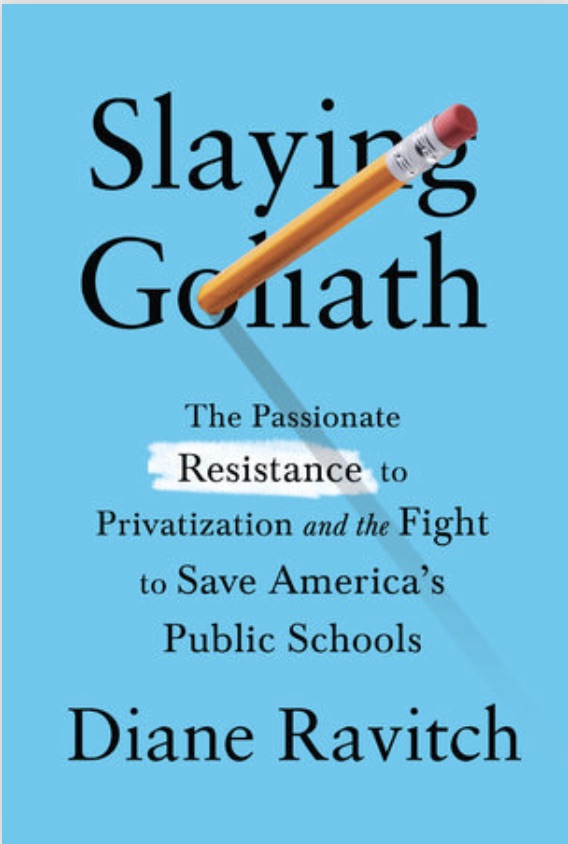
Diane Ravitch’s Slaying Goliath: The Passionate Resistance to Privatization and the Fight to Save America’s Public Schools is the history of the rise and fall of test-driven, competition-driven school reform. As in her two previous, ground-breaking books, Ravitch changes the terms of debate over public education. She previously reframed the battle over the “Billionaires Boys Club” which drove “corporate reform,” and “privatization.” Ravitch now characterizes data-driven, choice driven reformers as “Disrupters,” and the grassroots anti-“Goliath” movement as the “Resisters.” She also tells the stories of that social movement, contrasting it with the faux-movement funded by the Disrupters.
The debacles produced by the Disrupters resulted from high-stakes testing, combined with competition with charters (and vouchers), as well as the hurried, untested, manner that they imposed value-added teacher evaluations; mass closures of schools; Common Core standards; behaviorist methods i.e. “No Excuses;” digital technology known as “personalized learning;” and expensive public relations campaigns that demonized teachers.
This second post will focus on Ravitch’s analysis of the research which predicted the defeat of accountability-driven, charter-driven policies. Perhaps the most striking pattern documented in Slaying Goliath is how they failed in the way that scholars and practitioners anticipated.
Decades of Disruption-driven reform began with the false claim “that American education was failing and the only way to fix it was with standards, tests, competition, and accountability.” As Arne Duncan’s public relations officer and Walton-funded reformer Peter Cunningham said, “We measure what we treasure.”
Ravitch’s response was, “I was taken aback because I could not imagine how to measure what I treasure: my family, my friends, my pets, my colleagues, my work, the art and books I have collected.” And that foreshadows the victory of the Resistance over Goliath. Most educators, patrons, and students agree that children are more than a test score.
No Child Left Behind and the Race to the Top set impossible test score targets. They were based in large part on the weird idea that “no-excuses” behaviorist pedagogies could be quickly “scaled up,” providing poor children of color a ladder to economic equality. Drawing on the tradition of Edward Thorndike and B.F. Skinner, reformers “rigidly prescribed conditioning via punishments and rewards.” Previewing their fatal flaw, Ravitch observes, CONTINUE READING: John Thompson: Diane Ravitch's Slaying Goliath Documents Decades of Disruption - Living in Dialogue

Tuesday, February 11, 2020

Why charter school leaders are now furious at Trump and DeVos - The Washington Post

Why charter school leaders are now furious at Trump and DeVos - The Washington Post

Why charter school leaders are furious at Trump and Betsy DeVos


The charter school world was certain it had faithful supporters in President Trump and Education Secretary Betsy DeVos. After all, the pair made “school choice” their No. 1 education priority. DeVos has spent decades working to expand the charter sector. And Trump and DeVos repeatedly proposed boosting charter school funding, without giving a hint that federal funding of charters would be in danger under their watch.

Now, some leaders in the charter world, including the head of the nation’s largest charter school organization, are furious at them.
On Monday, the Trump administration released its 2021 budget proposal, and there was a gargantuan surprise in the Education Department’s plan for charter school funding.
It calls for the effective elimination of the federal Charter Schools Program (CSP), which has funded the expansion of charter schools since 1994 to the tune of $3.3 billion. Forty percent of operational charter schools — which are publicly funded but privately operated — were created with money from this program.
Instead of maintaining CSP as a discrete program, the administration is proposing it be lumped with nearly 30 other Education Department programs — including support for homeless students, civics education, magnet schools and school safety — into a single $19 billion block grant for states to use as they want on programs most important to them. The administration said it wants to give states more control of how they spend federal money while reducing the federal education footprint. States could use grant funding to expand charter schools, but other priorities would compete with it.
The administration’s main education priority doesn’t even show up in the Education Department’s proposed budget. Instead, it appears as a line item in the Treasury Department as a tax expenditure: $5 billion to give tax breaks for a program called the Education Freedom Scholarships, which would use CONTINUE READING: Why charter school leaders are now furious at Trump and DeVos - The Washington Post

Big Education Ape: Betsy DeVos Personally Saves Philly Student from a Government… Charter School(?) | deutsch29 - http://bigeducationape.blogspot.com/2020/02/betsy-devos-personally-saves-philly.html


FOON RHEE: Kids count, but can adults? • SN&R Extra

Editor's note: Kids count, but can adults? • SN&R Extra

Editor’s note: Kids count, but can adults?


Should taxpayers trust Sac City schools with more money?
Children deserve everything they need for a chance to succeed in school, including well-equipped classrooms, labs and libraries.
But what if the adults in charge are terrible at math—specifically, balancing the budget?
That’s the difficult choice facing voters March 3 on Measure H, Sacramento City Unified School District’s $750 million bond issue to upgrade classrooms, labs, libraries and technology; build career training centers; and to provide music and arts facilities.
To repay the bonds, the measure would cost property owners 5 cents per $100 of assessed value, which the district says will amount to $88 more a year for the typical homeowner and raise $35 million a year.
Measure H requires at least 55% of the vote to pass.
The district says there’s a dire need because most of its schools are more than 50 years old, don’t meet current safety and instructional standards and cost more to  CONTINUE READING: Editor's note: Kids count, but can adults? • SN&R Extra

JEFF BRYANT: How corporations are forcing their way into America’s public schools | Salon.com

How corporations are forcing their way into America’s public schools | Salon.com

How corporations are forcing their way into America’s public schools
A story unfolding in Virginia reveals how big corporations  want to control schools right down to the curriculum


In the expanding effort to privatize the nation's public education system, an ominous, less-understood strain of the movement is the corporate influence in Career and Technical Education (CTE) that is shaping the K-12 curriculum in local communities.
An apt case study of the growing corporate influence behind CTE is in Virginia, where many parents, teachers and local officials are worried that major corporations including AmazonFord and Cisco — rather than educators and local, democratic governance—are deciding what students learn in local schools.
CTE is a rebranding of what has been traditionally called vocational education or voc-ed, the practice of teaching career and workplace skills in an academic setting. While years ago, that may have included courses in woodworking, auto mechanics, or cosmetology, the new, improved version of CTE has greatly expanded course offerings to many more "high-demand" careers, especially in fields that require knowledge of science, technology, engineering, and math (STEM).
Education policy advocates across the political spectrum, from Education Secretary Betsy DeVos to former First Lady Michelle Obama, have praised expansions of CTE programs in schools. Fast-tracking federal funds for CTE programs in schools has become the new bipartisan darling of education policy. CTE lobbyists and advocates have successfully pressed for expanded funding of their programs at federal and state levels. And a 2019 study by the American Enterprise Institute, a right-wing advocacy group based in Washington, D.C., found that since 2004, mentions of CTE in U.S. media outlets "have grown over tenfold, and they have doubled since 2012."
According to a September 2019 analysis from Brookings, "more than 7 million secondary school students and nearly 4 million postsecondary students were enrolled in CTE programming." And a CONTINUE READING: How corporations are forcing their way into America’s public schools | Salon.com

Bill and Melinda Gates have spent billions to shape education policy. Now, they say, they’re ‘skeptical’ of ‘billionaires’ trying to do just that. - The Washington Post

Bill and Melinda Gates have spent billions to shape education policy. Now, they say, they’re ‘skeptical’ of ‘billionaires’ trying to do just that. - The Washington Post

Bill and Melinda Gates have spent billions to shape education policy. Now, they say, they’re ‘skeptical’ of ‘billionaires’ trying to do just that.


You won’t believe what Bill and Melinda Gates are saying makes them “skeptical.”
For years, they have spent a fortune trying to shape public education policy, successfully leveraging public funding to support their projects, but never having the kind of academic success they had hoped for. That never stopped them from continuing to fund pet projects.


Now, in the newly released 2020 annual letter of the Bill & Melinda Gates Foundation, Melinda Gates says that lack of success is no reason to “give up,” and then, she says this:
We certainly understand why many people are skeptical about the idea of billionaire philanthropists designing classroom innovations or setting education policy. Frankly, we are, too. Bill and I have always been clear that our role isn’t to generate ideas ourselves; it’s to support innovation driven by people who have spent their careers working in education: teachers, administrators, researchers, and community leaders.
She seems to be attempting to make a distinction between a billionaire personally “designing classroom innovations or setting education policy” and a billionaire pouring so much money into existing ideas and projects they like that it has the effect of shaping public policy. The couple’s investments in public projects are so huge that public money invariably follows, and, thus, their pet projects get implemented.
But such a distinction is lost on, say, a teacher who is evaluated through a badly flawed assessment system that exists because the Gateses funded it. That teacher doesn’t care whether Bill and Melinda Gates sat down and designed it themselves or, rather, chose to ignore the advice of assessment experts who had warned against it.
In their 2020 annual letter, the two take turns talking about their unprecedented philanthropy in health projects around the world and education reform in the United States. They are among the most generous philanthropists on the planet, spending more on global health than many countries do and more on U.S. education reform by far than any of the other wealthy people who are making K-12 a cause.
Yet over the years, while they have certainly funded worthwhile projects, questions have been raised about the power they have to dictate social policy because of their enormous investments, as well as whether the targets of some of their philanthropy are the most deserving of attention. Why should CONTINUE READING: Bill and Melinda Gates have spent billions to shape education policy. Now, they say, they’re ‘skeptical’ of ‘billionaires’ trying to do just that. - The Washington Post