Latest News and Comment from Education

Sunday, December 15, 2019

CATCH UP WITH CURMUDGUCATION + ICYMI: Ed Forum Weekend Edition (12/15)

CURMUDGUCATION


Ed Forum Weekend Edition (12/15)

Yesterday I spent the day in Pittsburgh at the ed forum, then decorating at my in-laws, then banging out a summary. But I still have a few things for you to read from the week. Remember to share!

Common Core: The Rest of the Story

Blogger and ed historian Adam Laats fills in some gaps in the NYT history of everyone's favorite standards.

GRE Fails To Identify Successful PhD Students  

Shocked. I am shocked. But the GRE isn't a great predictor of grad school success.

New Filipino Grad Requirement

Well, here's an actual cool idea. Filipino students now need to plant trees in order to graduate.

I Taught At a For-Profit College. They're Predatory Disasters. 

From the Guardian, a look inside the world of for-profit higher ed. It is not pretty.

No New Charter Applications In Chicago   

If you had any doubts that the charter boom is over, here's a look from Chalkbeat Chicago at a new development-- a year without any charter applications.

An Outright Lie

Remember that Ohio law that says students can't be dinged for getting facts wrong? Turns out that's part of the infamous Project Blitz, as is the legislator who proposed it. The Guardian has the story.

Mayor Pete and Charter Backers

Not from an education site, but Vice. Here's how charter money is bolstering Buttigieg.

Kentucky Ed Commissioner Resigns 

Kentucky governor-elect promised to clean house in th education department and replace the old charter-loving crew. He's done it. It's a new day in Kentucky.

DeVos Defends Restricting Debt Relief 

Erica Green at NYT with some great coverage of DeVos's latest visit to Congress, and her deep desire not to actually do debt relief.

The $191 Million Settlement with University of Phoenix  

Who finally nailed these bunco artists? Not the ed department-- the FCC.

Word Pedometers   

From the not-the-onion terrible idea file.


CURMUDGUCATION

CATCH UP WITH CURMUDGUCATION


A Look At The Democratic Education Forum

After live-tweeting the day, I've worked up a summary, which you'll find over at my Forbes spot. Sorry to bait and switch, but that's where you can find my take on the day...

DEC 13

When Betsy DeVos Tells You Who She Is, Listen

Yesterday, Erica Green did a masterful job of covering Betsy DeVos's appearance before the House Education Committee to defend her continued efforts to resist any sort of debt relief for students bilked by for-profit schools. The New York Times article isn't accessible to everybody, and that's too bad, because the hearings are a perfect little picture of what values drive DeVos through her work at

DEC 12

Fordham: Teachers Are Downloading Junk

Fordham Institute, the right-tilted thinky tank and tireless ed reform advocacy group, just released a new study that actually raises some interesting questions. " The Supplemental Curriculum Bazaar " takes a look at the materials teachers are downloading, and it finds them, well, not delightful. While I'm only going to argue with their findings a little, there are aspects of their methods that I

DEC 11

Privatization Is Their North Star

Remember when ed reform was complicated, when it felt as if the whole business was a perfect storm of hydra heads, and it was all a public school supporter could do to try to track all the heads, let alone the body of the beast to which they were all attached? Things have changed. And the change tells us a lot about the body of the beast, as the many heads of the hydra have become neglected or eve

DEC 10

Can Rich Content Improve Education?

Modern high-stakes testing really kicked into gear with No Child Left Behind, and then got another huge boost with the advent of Common Core. All through that era, teachers pushed back against the fracturing of reading instruction , the idea that reading is a suite of discrete skills that can be taught independent of any particular content . The pendulum has begun its swing back. Content knowledg

DEC 09

Kristen Bell, Celebrity Charity, Flaming Possums

Sigh. I was already thinking about this, about how Dana Goldstein's Common Core retrospective for the New York Times collapsed a lot of history, but still had room for that time that pre-disgraced Louis CK made a crack about Common Core math. A great reminder of how a gazillion teachers and parents can comment on the quality of the Core, but a celebrity makes a comment and suddenly people listen.

DEC 08

Next Saturday: Dem Education Forum in Pittsburgh (Yes, I'll Be There)

Next Saturday, December 14, some assortment of Democratic Presidential hopefuls will offer their two cents about education . The crowd will be an invitation-only group of about a thousand public education stakeholders, including yours truly. The Network for Public Education kindly gave me the chance to attend this event, and I am looking forward to it. If you are not among the thousand invitees, y


ICYMI: New Car Edition (12/8)

So yesterday we replaced my wife's car, which has lost an argument with an errant deer. Used car shopping is a pain, but if you want to talk about something that has truly and completely been disrupted by technology. Little browsing, because everyone does that on line. Little haggling compared to the old says because everyone can go online and see what the car is worth. Few tremendous bargains, bu
CURMUDGUCATION

Sharing the history of Illinois’ pension fight with teachers in Kentucky. We need a national strategy. – Fred Klonsky

Sharing the history of Illinois’ pension fight with teachers in Kentucky. We need a national strategy. – Fred Klonsky

SHARING THE HISTORY OF ILLINOIS’ PENSION FIGHT WITH TEACHERS IN KENTUCKY. WE NEED A NATIONAL STRATEGY

I was asked by Randy Wieck of the Kentucky Teacher Retirement Legal Fund to write a brief history of Illinois’ public pension battle, published on their Facebook page: https://www.facebook.com/permalink.php?story_fbid=2583633375065710&id=597407450354989
—————————-
National education blogger FRED KLONSKY, retired from Illinois public education, and long a hardened warrior in the public education, pension-plunder battle – responds to TRELF’s invitation to relate Illinois’ teachers’ pension destruction, VERY similar to Kentucky’s. There is a pattern here.
FRED KLONSKY RELATES:
For decades Illinois politicians have failed to make the annual required contributions to the state’s pension systems. Hamstrung by constitutional limits on revenue sources, they took the path of least resistance by paying for services and for their “pet projects” without raising taxes and by pension underfunding. In 1995 they invented a flawed re-funding schedule, a funding ramp that only made matters worse. They refused to re-amortize the pension systems’ unfunded liabilities. Favoring corporate interests rather than the interests of retirees or the state’s over-taxed working families, the unfunded liability has continued to grow. It now has climbed to $130,000,000,000, with no end in sight. Seventy cents on the dollar goes to interest on the debt.
In 2013, Democratic Governor Pat Quinn and the Democratic controlled General Assembly passed a bill cutting benefits to current and future state employees. Illinois passed a pension reform bill which reduced retiree cost of living increases, raised the retirement age, limited pensionable salaries, lowered the amounts current employees CONTINUE READING: Sharing the history of Illinois’ pension fight with teachers in Kentucky. We need a national strategy. – Fred Klonsky

EdAction in Congress December 15, 2019 - Education Votes

EdAction in Congress December 15, 2019 - Education Votes

EdAction in Congress December 15, 2019


House to vote soon on doubling educator tax deduction

The full House could vote this Tuesday on NEA-endorsed legislation that doubles the educator tax deduction and lifts the $10,000 cap on the state and local tax (SALT) deduction for two years to help ensure adequate funding for public education and other essential services. The Restoring Tax Fairness for States and Localities Act (H.R. 5377) would increase the annual educator tax deduction from $250 to $500—the actual amount 94 percent of public school teachers spent on classroom supplies and instructional materials during the 2014-15 school year, according to a U.S. Department of Education survey. The same survey showed that 1 in 10 teachers spent even more—in excess of $1,000. Email your representatives and tell them to support H.R. 5377. TAKE ACTION

Put rural schools on a firm financial footing

The Senate Energy and Natural Resources Committee voted to extend the Secure Rural Schools (SRS) and Community Self-Determination Act (S. 430) for two years. First enacted in 2000, the law supports public education and community services in over 4,400 schools in 770 rural counties located near national forests. But funding has been inconsistent for the last three years—the law expired at the end of 2018. As a result, rural areas across the country are facing budgetary shortfalls that could force big cuts in public education and other essential community services. Tell your representatives to put the SRS program on a firm financial footing. TAKE ACTION

Victory! Congress votes to guarantee funding for HBCUs and MSIs

The bipartisan FUTURE Act heads to President Trump to be signed into law after passing the House by a vote of 319-96 and the Senate by voice vote. The bill permanently reauthorizes and provides $255 million in annual mandatory funding for Historically Black Colleges and Universities (HBCUs) and other Minority-Serving Institutions (MSIs). The FUTURE Act also takes steps to streamline the financial aid process, including simplifying the Free Application for Federal Student Aid (FAFSA) and eliminating unnecessary paperwork for federal student loan borrowers on income-driven repayment plans.

Cheers and Jeers

Rep. Susie Lee (D-NV) led a letter to Senate leadership signed by 70 members of the House opposing Lawrence VanDyke’s nomination to the U.S. Court of Appeals for the Ninth Circuit.
The Esther Martinez Native American Languages Programs Reauthorization Act (S. 256) by Sen. Tom Udall (D-NM) has passed both chambers and is headed to President Trump to be signed into law. The bill helps preserve native languages and indigenous dialects.
Rep. Jesús “Chuy” García (D-IL) introduced the New Way Forward Act (H.R. 5383) to fight criminalizing immigrants and restore fundamental due process to our immigration system.
The House passed the Building Blocks of STEM Act (S. 737) by Sen. Jacky Rosen (D-NV). The bill directs the National Science Foundation to support research on factors that discourage or encourage girls to engage in STEM activities, including computer science.
Reps. Frederica Wilson (D-FL)Jahana Hayes (D-CT)Suzanne Bonamici (D-OR)Josh Harder (D-CA), and others grilled Education Secretary Betsy DeVos at a Dec. 12 Education and Labor Committee hearing on debt relief for defrauded students.
Sen. Maggie Hassan (D-NH) joined the chorus of outrage at the failure of Education Secretary Betsy DeVos to stand up for students defrauded by for-profit colleges.

96 members of the House voted against the FUTURE Act—in effect, against ensuring that HBCUS and MSIs receive critical funding.

EdAction in Congress December 15, 2019 - Education Votes

Public Education Forum Attracts Seven Democratic Presidential Candidates To Pittsburgh – CBS Pittsburgh

Public Education Forum Attracts Seven Democratic Presidential Candidates To Pittsburgh – CBS Pittsburgh

Public Education Forum Attracts Seven Democratic Presidential Candidates To Pittsburgh

Image result for Public Education Forum Attracts Seven Democratic Presidential Candidates To Pittsburgh


PITTSBURGH (KDKA) — Pittsburgh hosted a unique presidential forum on Saturday.
It was not a debate, but a chance for the Democratic presidential candidates to share their views on public education.
The day-long Public Education Forum allowed seven Democrats to answer questions from a diverse audience.
Over a thousand public school supporters heard from Democratic presidential candidates at the David L. Lawrence Convention Center.
“I am the son of two educators, and I am married to a teacher who is literally going to be grading everything I say today,” declared Mayor Pete Buttigieg.
“We have to massively increase what we pay teachers in this country,” said U.S. Sen. Michael Bennet of Colorado, a former Denver school superintendent.
“The idea that cutting education is cutting expense is the stupidest idea that I have ever heard,” noted California billionaire Tom Steyer.
Some candidates had a way to pay for better education.
“It’s time for a wealth tax in America. This is a two-cent tax on the top one-tenth of one percent,” said U.S. Sen. Elizabeth Warren of Massachusetts.
Others shared surprising snippets about their past.
“I taught at at-risk schools when I was going through law school, and I was a bus driver,” said former Vice President Joe Biden. “And by the way, bus drivers and the folks in the cafeteria know a hell of a lot about what’s going on.”
WATCH: Charter School Protesters Gather Outside Of Education Forum

And there was some politics, too.
“You win big when you win states like Pennsylvania big that we lost in that last election,” noted U.S. Sen. Amy Klobuchar of Minnesota.
U.S. Sen. Bernie Sanders of Vermont, who made a side trip to support UPMC CONTINUE READING: Public Education Forum Attracts Seven Democratic Presidential Candidates To Pittsburgh – CBS Pittsburgh

Educators, parents press top presidential candidates to address equity in education - Education Votes

Educators, parents press top presidential candidates to address equity in education - Education Votes

Educators, parents press top presidential candidates to address equity in education

Image result for parents press top presidential candidates to address equity in education
Seven presidential candidates discussed matters of critical importance to the future of public education and the 51 million students in public schools before an audience of more than 1,300 educators, students, and union members at a forum in Pittsburgh on Saturday.
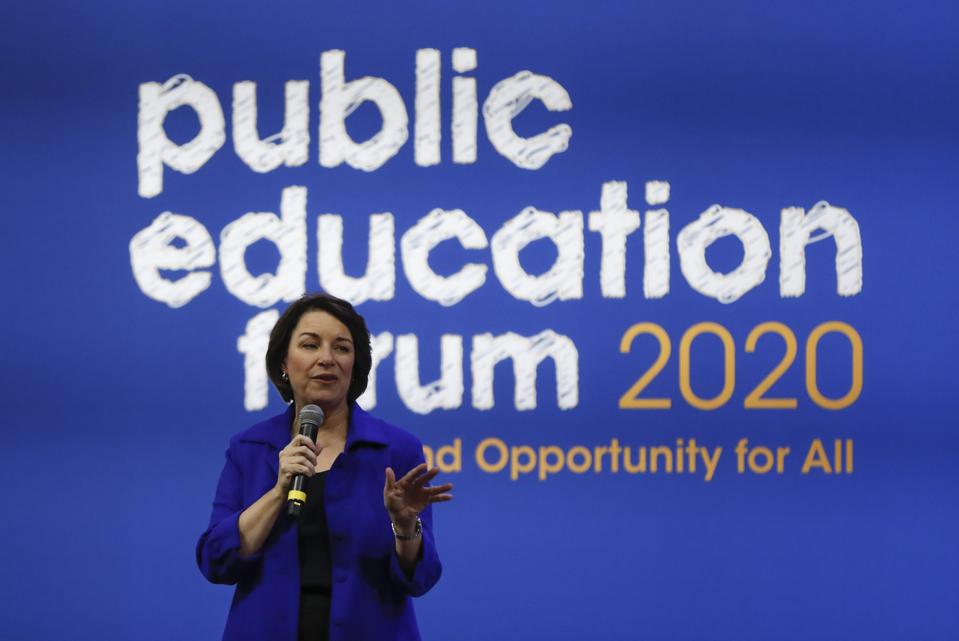
The “Public Education Forum 2020: Equity and Opportunity for All,” hosted by MSNBC at the David L. Lawrence Convention Center, focused on issues of public education, and specifically economic, racial, and social justice that affect educators, students, and their families. Sen. Michael Bennet, Vice Pres. Joe Biden, Mayor Pete Buttigieg, Sen. Amy Klobuchar, Sen. Bernie Sanders, Tom Steyer, and Sen. Elizabeth Warren addressed their plans for K-12 and higher education.
Following an opening statement, each candidate answered questions posed by audience members and moderators Ali Velshi, host of “MSNBC Live,” and Rehema Ellis, NBC News education correspondent. Some questions were submitted by educators, parents, and activists from around the country.
Topics covered include investing in public schools, the services students need for academic success, special education, college debt, and teaching conditions, along with how the candidates would address the persistent gaps in education equity experienced by students across the nation.
The National Education Association worked with 10 other public education groups to keep the candidates focused on public education as the primaries draw closer. NEA members account for one in every 100 Americans and one in 39 households, giving them a powerful voice in choosing the next president of the United States. Educators are working hard in the 2020 election cycle to ensure that students and their well-being are a priority for all candidates and for all voters. Find out more at StrongPublicSchools.org .
Image result for The NEA Interviews

The MSNBC Public Education Forum Was Terrific! | Diane Ravitch's blog

The MSNBC Public Education Forum Was Terrific! | Diane Ravitch's blog

The MSNBC Public Education Forum Was Terrific!

Hats off to Randi Weingarten and Lily Eskelsen Garcia for organizing today’s MSNBC Public Education Forum!
It was a wonderful event, and it was thrilling to see all of the major Democratic candidates competing to win the support of America’s millions of teachers, vowing their love for teachers and their dedication to public schools.
Best of all was that they all recognized that the United States has been underinvesting in education for years, and they pledged to reverse that policy.
It was wonderful to hear the candidates speak about the importance of public education.
It was good to hear Joe Biden attack standardized testing (he forgot all about Race to the Top, as did everyone else).
I was disappointed that Rehema Ellis of NBC asked almost every candidate about NAEP scores, distorting CONTINUE READING: The MSNBC Public Education Forum Was Terrific! | Diane Ravitch's blog

Democratic presidential hopefuls detail plans for education at Pittsburgh forum - The Washington Post

Democratic presidential hopefuls detail plans for education at Pittsburgh forum - The Washington Post

Democratic presidential hopefuls detail plans for education at Pittsburgh forum


PITTSBURGH — Candidates seeking the Democratic nomination for president gathered Saturday for a forum on education and described their plans to tackle major challenges besetting U.S. schools: student debt, segregation and teacher pay. Their questioners included teachers, elementary school students, parents and school janitors.
The forum — sponsored by teachers unions, civil rights groups and MSNBC — marked one of the few times the candidates have spoken about their plans for the nation’s schools beyond sound bites. The candidates addressed a mostly friendly crowd — the audience was there by invitation — and hewed closely to the teacher unions’ own agenda, speaking of reducing testing, boosting school spending and raising teacher salaries. Charter school advocates complained they were locked out of the forum and organized a protest outside the convention center where the event was staged.

The forum was called Education and Equity for All, and the candidates shared how they would tackle inequality in education, which is driven in large measure by how education is paid for in the nation.
Funding for a child’s school is largely dependent on the wealth of the surrounding community. U.S. schools, once envisioned as great equalizers, have become broadly unequal, with black and brown students disproportionately enrolled in schools that don’t have enough resources. Students from wealthier school systems are many times more likely to attend college than children who go to school in districts with fewer resources.
Sen. Bernie Sanders (I-Vt.) said he wants to rethink the use of property taxes to fund schools, although it is unclear how he would revise school funding. Communities rely largely on property taxes to cover the cost of educating their children.
In struggling communities, he said, “the property tax does not provide the kind of funding that the schools need.”
“We’ve got to break our dependence on the property tax . . . and make sure that every school district in this country gets the funding they need,” Sanders said. CONTINUE READING: Democratic presidential hopefuls detail plans for education at Pittsburgh forum - The Washington Post

CURMUDGUCATION: A Look At The Democratic Education Forum

CURMUDGUCATION: A Look At The Democratic Education Forum

A Look At The Democratic Education Forum


After live-tweeting the day, I've worked up a summary, which you'll find over at my Forbes spot. Sorry to bait and switch, but that's where you can find my take on the day...

CURMUDGUCATION: A Look At The Democratic Education Forum

Election 2020 Amy Klobuchar

Top 10 Lessons From the 2020 Public Education Forum | gadflyonthewallblog

Top 10 Lessons From the 2020 Public Education Forum | gadflyonthewallblog

Top 10 Lessons From the 2020 Public Education Forum
The school bell chimed and the class shuffled home.
But the students weren’t little children.
They were Democratic Presidential candidates!
And boy-oh-boy did they get sent packing with a ton of homework!
Teachers, students, parents and community members from all over the country sat them down with instructions on how to improve the public education system.
Kudos to the candidates for agreeing to listen.
It was billed as the MSNBC “Public Education Forum 2020: Equity and Justice for All” – and though it’s over now, its effects may be felt for months or years yet to come.
The fact that it happened at all is almost miraculous.
Who would have thought Presidential hopefuls would care enough about public CONTINUE READING: Top 10 Lessons From the 2020 Public Education Forum | gadflyonthewallblog

Can public schools have Christmas trees? What’s true — and not true — about religious expression in public schools. - The Washington Post

Can public schools have Christmas trees? What’s true — and not true — about religious expression in public schools. - The Washington Post

Can public schools have Christmas trees? What’s true — and not true — about religious expression in public schools


(Note: This is a revised version of an earlier post on this subject)
When Donald Trump was running for president, he complained that liberals were waging a war on Christmas. Nobody says “Merry Christmas” anymore because it wasn’t “politically correct,” he complained, and then declared: “We are going to start saying ‘Merry Christmas’ again.” Since then he has taken credit for making it a popular salutation again.

Actually, it never really went away — not even in public schools, where the holiday season annually brings questions and concerns about what is legally allowed when it comes to religious expression in public schools.
Can students pray in school and listen to religious music? Can teachers say “Merry Christmas” to their students? Can a Christmas tree ever be allowed? Can teachers and students talk about religion in class?
The answer to each of those questions? Yes.
Confusion began after the Supreme Court, in a landmark 1962 decision, banned school-sponsored prayer in public schools. Some parents, teachers and school officials read that as barring any type of religious expression in a public school — but that is not what federal courts have said. Schools can do plenty when it comes to religious expression:

NYC Educator: Cameras and Everything

NYC Educator: Cameras and Everything

Cameras and Everything


That's what I saw today here in Pittsburgh. Every single candidate loves teachers. They all want us to make more money. Everyone is going to triple Title One, except Elizabeth Warren. (She's going to quadruple it.) Cory Booker was supposed to show up, but didn't. He was sick. He did not send a medical note, so I marked him cutting.

Too bad. I wanted to know if he still  supported vouchers. I wanted to know if he regretted teaming up with Betsy DeVos. I wanted to know why if he loved public school teacher so much, that Broad, Gates, and the Walmart family gave him money. I don't think anyone would have asked him though. There weren't a whole lot of tough questions on charters. There were some very interesting moments, though.

I was happy to meet a few people I'd only encountered on the internet. One was Peter Green, who writes great stuff on a pretty regular basis at Curmudgucation. Another was Steven Singer, who writes Gadfly on the Wall blog. I was very happy to run into Carol Burris, who runs NPE. I was happily surprised to see my friend Adriana O'Hagen, who used to work for UFT but seems to have gotten promoted to AFT.

Michael Bennet boasted of some program he started that resulted in a huge teacher strike. I believe he's the guy who's hugely into privatization, and he announced he didn't favor CONTINUE READING:
 NYC Educator: Cameras and Everything


Listen to the Experts | Live Long and Prosper

Listen to the Experts | Live Long and Prosper

Listen to the Experts


Remember that time you called your health insurance company because they denied your claim…
You probably thought, “why should an insurance company representative deny or attempt to deny coverage for something prescribed by my family doctor? What expertise do insurance company workers have in the field of medicine?”
A recent article in the Washington Post by Dr. William E. Bennett Jr., associate professor of pediatrics at Indiana University’s School of Medicine, highlights part of the problem…
We know how important it is to have insurance so that we can get health care. As a physician, parent and patient, I cannot overemphasize that having insurance is not enough.

As a gastroenterologist, I often prescribe expensive medications or tests for my patients. But for insurance companies to cover those treatments, I must submit a “prior authorization” to the companies, and it can take days or weeks to hear back. If the insurance company denies coverage, which occurs frequently, I have the option of setting up a special type of physician-to-physician appeal called a “peer-to-peer.”
Here’s the thing: After a few minutes of pleasant chat with a doctor or pharmacist working for the insurance company, they almost always CONTINUE READING: Listen to the Experts | Live Long and Prosper

Teachers Combine Fun with Learning | Larry Cuban on School Reform and Classroom Practice

Teachers Combine Fun with Learning | Larry Cuban on School Reform and Classroom Practice

Teachers Combine Fun with Learning
Here are photos of teachers with a sense of humor who mix learning and laughter. These photos come from Taylor McAdams, “Teachers That Trolled Their Students in Fun and Creative Ways.” Enjoy!


Here are MORE Photos:  Teachers Combine Fun with Learning | Larry Cuban on School Reform and Classroom Practice

Listen to the truth-tellers - AFT Voices

Listen to the truth-tellers - AFT Voices

Listen to the truth-tellers


As the year draws to a close, I am so grateful to the educators, healthcare professionals and public employees we represent for the extraordinary work they do every day to make a difference in our lives. I’ve always encouraged others to thank them, but this year, I’m asking that we go further: Let’s also listen to the teachers and nurses in our lives. They are truth-tellers who can reveal things we need to know about our country.
Let’s listen to teachers about how they stretch themselves to fill the void left when schools lack counselors, nurses and librarians. And, as some politicians brag about “the best economy ever,” educators can tell us about the other side of an inequitable America: the more than 1.3 million homeless students in our public schools, and the 40 percent of Americans who can’t put together $400 in an emergency.
Let’s listen to teachers about childhood hunger, which makes it difficult to concentrate and learn. Educators know that, for children who experience food insecurity, school meals should be as standard a school supply as paper and pencils, and the inability to afford school lunch should never be used to shame a child. Educators are outraged that, two years after the GOP gave away $2.3 trillion in tax cuts, mostly to the wealthiest Americans and corporations, the Trump administration is cutting SNAP (Supplemental Nutrition Assistance Program) benefits for more than 700,000 people and free school meals for nearly 1 million children living in poverty.
Many people marveled at the unprecedented “Red for Ed” movement — and then moved on. We should listen closely to the message that sparked this CONTINUE READING: Listen to the truth-tellers - AFT Voices