Latest News and Comment from Education

Sunday, December 8, 2019

CATCH UP WITH CURMUDGUCATION + ICYMI: New Car Edition (12/8)

CURMUDGUCATION: ICYMI: New Car Edition (12/8)


ICYMI:  New Car Edition (12/8)


So yesterday we replaced my wife's car, which has lost an argument with an errant deer. Used car shopping is a pain, but if you want to talk about something that has truly and completely been disrupted by technology. Little browsing, because everyone does that on line. Little haggling compared to the old says because everyone can go online and see what the car is worth. Few tremendous bargains, but few total rip-offs. But still enough paperwork to fell a tree. At any rate, we're mobile again. Now here are your readings from the week.

A Harlem School That Former Students Say Was Run Like A Cult 

Rebecca Klein at HuffPost with a scary tale of one private school that promises, among other things, to save its students "from te homosexual demons in the public school system."

Life For US Students Under Constant Surveillance 

The Guardian takes a look at how bad surveillance has gotten for US students. Spoiler alert: really bad.

How the Denver School Board Flipped  

Denver's super-reformy district was a point of pride for reformsters, but public school advocates just took it back with the last school board elections. The Have You Heard podcast has the story of how it was done.

Uber's Self-driving Car Didn't Know Pedestrians Could Jaywalk 

Speaking of Betsy DeVos's metaphor for school choice, and speaking of using AI for all sorts of edubusines... Wired reports on a cyber-car fatality and its cause-- bad programming.

PISA: Illusion of Excellence, Marketing Baloney 

Okay, I paraphrased the title a bit, but this Washington Post column from Yong Zhao, an education expert with a keen knowledge of China, is the week's best antidote to all the chicken littling over PISA scores.

The Teacher Walkouts

A California Sunday Magazine piece that interviews ten teachers with different perspectives on striking. Interesting piece, with photos by student photographers.

How GreatSchools Nudges Families Toward Schools With Fewer Black and Hispanic Students   

Matt Barnum ruffled many feathers with this Chalkbeat piece that takes a look at how those school ratings really work. Not well, as it turns out.

PA's Weakest Districts Targeted

The York Dispatch editorial board offers an absolutely blistering take on charter schools.

How Corporate Tax Credits Rob Public School Budgets

The headline of this CityLab article pretty well lays it out. A look at some fresh data shows just how bad the hit is.

Support for Charters in 2020 Elections Comes with a Price

Andre Perry, at the Hechinger Report, is just the king of nuanced and balanced looks at charter policy that clarifies some of the root issues. Here he talks about the week's flap over Black leaders anjd charter support.

Teacher Turnover and Retention   

Brookings did a big fat meta-analyis of the research on teacher retention and attrition. Interesting discussion starter ensues.

America's Epidemic of Unkindness  

From the Atlantic, the best thing not ab out education that I read this week, and a hopeful, thoughtful piece. God damn it babies, you've got to be kind.

End of Semester Bingo  

From McSweeney's, the end of the semester bingo card you've been waiting for. An oldie but a goodie.


CURMUDGUCATION: ICYMI: New Car Edition (12/8)



CATCH UP WITH CURMUDGUCATION


MI: Governor Whitmer Files Private School-Whomping Brief

Back in 2016, the Michigan legislature, always on the lookout for a way to send public tax dollars into private pockets, passed Section 388.1752b , a little amendment to the School Aid act that required the state to reimburse private schools for any money they spent "complying with health, safety, or welfare requirement mandated by a law or administrative rule of this state." In other words, the s
White Flight, Without The Actual Flight

We can talk about lots of complicated economic and sociological forces that have fed the problems of school segregation in this country, but the root causes are pretty simple–historically, we have a whole lot of white folks who don’t want their children to go to school with the children of black folks, and they have been creative about finding ways to avoid it. When Brown v. Board of education fo

DEC 05

My Toddlers Can't Read

Here at the Curmudgucation Institute, the Board of Directors has taken a great interest in the printed word. We have, for instance, entered the Me Do It phase for one of our most beloved tomes ( Little Excavator, by Anna Dewdney). I am no longer allowed to read that book to the Board, but must hold it open while a Board member recites the text. We can do then same thing for select portions of that

DEC 04

Buddy, Can You Spare A Ride (To The Charter School)?

Remember the days when charter school fans were bragging that they would do more with less? That chorus has been replaced by complaints of how unfair it is that they don't get as many tax dollars for their privately-owned businesses as the public school system gets, resulting in fun new ideas like Florida's notion that charters should be entitled to a cut of any special levies that taxpayers pass

DEC 02

PA: Voucher Bill Still A Threat

Pennsylvania House Speaker and Betsy DeVos fanboy Mike Turzai has suffered a momentary setback in his drive to use Harrisburg schools as a launching pad for a PA voucher program, but he reportedly has not given up. HB 1800 targets the ailing school district at a point where it has only recently been placed in financial receivership under the control of a state-appointed overseer. One might think t

DEC 01

Patriot Act: No More Batman

This is a genius clip from Hasan Minhaj's Patriot Act show. An interview with Anand Giridharadas about his book Winners Take All, and as Giridharadas tweeted, "he explained my book better than I can." It's all about Bruce Wayne. This is a 90 second clip, well worth your time. When it comes to billionaires, we need to tax that ass. #NowStreaming pic.twitter.com/4qUwVo6Nyp — Hasan Minhaj (@hasanminh
Noblesse Oblige And the End of Public Education

Maybe you don't usually get around to reading David Dawkins, the Forbes staff member whose beat is billionaires. But back in October he ran an interview that should send a familiar chill through those of us who follow the great education disruption debates. Dawkins talked to Josef Stadler, the head of Ultra High Net Worst at UBS (the big Swiss bank, about why folks don't trust billionaires these d
ICYMI: Deer Season Edition (12/1)

Yes, it may be Thanksgiving weekend where you are, but in my neck of the woods, schools are closed tomorrow for the first day of deer season. Don't knock it if you haven't eaten some excellent deer baloney. In the meantime, hre's some reading from the week School District's Computer Servers Hacked Sign of the times. This one was in New Jersey. One more reminder of the vulnerability of school data


TX: Bigotry In The Classroom

This is a troubling story, for several reasons. Georgia Clark was an English teacher in the Fort Worth Independent School District, a district with over 80% Hispanic student population. Clark sent a message to Donald Trump, asking 

Peter Greene: Eli Broad Buys Home For His Training School At Yale

Eli Broad Buys Home For His Training School At Yale

Eli Broad Buys Home For His Training School At Yale
Billionaire Eli Broad has long worked to impose business solutions on US education, believing that education has a management problem, not an education problem. As one Broad fan is quoted in the Washingtoin Post, “You think a superintendent is like the lead principal or lead teacher for a school district, but you have to think more like a CEO of a major corporation." It’s not unlike the belief that a private sector CEO doesn’t need to know about the industry in which he’s working—he just needs to be a good CEO.

Broad is a bit of a scrapper who has described himself as a “sore winner.” He has backed his version of education reform in many ways, from pushing a plan to put half of Los Angeles students in charters schools, to making big money pushes for his favored LAUSD board candidates. His foundation disperses money to many of the big ed reform groups, and in 2014 he approached former Arne Duncan aide Peter Cunningham about creating a sort of war room rapid response press outfit to get the reformer point of view out there (Education Post was the result). The Broad Foundation has been one of the “Big Three” funders of education reform, just behind the Bill and Melinda Gates Foundation and the Walton Family Foundation. The foundation aims to “advance entrepreneurship” for education, CONTINUE READING: Eli Broad Buys Home For His Training School At Yale

Still Asleep at the Wheel - Network For Public Education

Still Asleep at the Wheel - Network For Public Education

Still Asleep at the Wheel


Big Education Ape: Carol Burris Responds to Charter Industry Critique of NPE’s “Asleep At the Wheel” | Diane Ravitch's blog - https://bigeducationape.blogspot.com/2019/07/carol-burris-responds-to-charter.html

Still Asleep at the Wheel continues our investigation of the U.S. Department of Education’s Charter Schools Program (CSP) that began with our March 2019 report, which you can find here. The Charter Schools Program has spent more than $4.1 billion dollars to fund new charter schools and to expand existing charter schools. In this report, we document over a half-billion dollars that was wasted on defunct charter schools that received grants from 2006-2014 alone. There is no data for granted money from 1995-2005. That is because the Department did not require the states to report to which schools they gave over a million dollars of taxpayer funds. Given that 28% of all of the funds spent during those select years (2006-2014) were wasted, we conclude that over $1 billion has been wasted during the 25 years that the program has been in existence.
According to our analysis, 37% of the charter schools that were funded by CSP during those years either never opened (11%) or opened and then closed (26%). That figure is the result of our confirmation of the status of nearly 5000 charter schools that received funds from CSP.
The interactive map below provides detailed information, state by state, on the waste of federal tax dollars from active CSP grants between 2006-2014. Amounts are derived from the 2015 CSP report and thus reflect actual expenditures and/or committed amounts when the report was published. For more detail, please read our report.

Case Studies

Click on the states in blue to read that state’s case study or hover over it for the quick facts. 


State case studies expose the waste of federal tax dollars on charter schools that received grant money between 2006-2014 through the U. S. Department of Education Charter CONTINUE READING: Still Asleep at the Wheel - Network For Public Education


EdAction in Congress December 8, 2019 - Education Votes

EdAction in Congress December 8, 2019 - Education Votes

EdAction in Congress December 8, 2019

Tell Congress to increase Title I and IDEA in final funding bill

House and Senate negotiators continue to seek agreement on a final funding bill for fiscal 2020 by Dec. 20, when the latest stopgap measure expires. NEA is pushing for significant increases like those in H.R. 2740, the education appropriations bill passed by the House earlier this year. The House bill includes a $1 billion increase for Title I, which provides extra financial help for school districts with high numbers or high percentages of children from low-income families, as well as a $1 billion increase for the Individuals with Disabilities Education Act (IDEA). In contrast, the pending Senate education appropriations bill provides no additional funding for either program.
Federal funding for Title and IDEA have not kept pace with inflation, growing enrollment, or student needs. This year, more than half the nation’s Title I-eligible school districts will have their Title I funds reduced, according to U.S. Department of Education allocations. The federal share of the excess cost of educating students with disabilities has declined for five consecutive years and is now just 14 percent—far below the 40 percent Congress promised to provide. Tell your senators and representative to match the House increases for Title I and IDEA in any final funding bill. TAKE ACTION 

House passes Voting Rights Advancement Act

The Voting Rights Advancement Act of 2019 (H.R. 4), passed by the House 228-127 on Dec. 6, would once again require states and localities with recent histories of voter discrimination to seek approval from the U.S. Department of Justice before making any changes in their election laws. The measure is a direct response to the Supreme Court’s 2013 decision in Shelby v. Holder, which invalidated key provisions of the Voting Rights Act first passed in 1965 to address persistent and purposeful discrimination—through literacy tests, poll taxes, intimidation, threats, and violence—that curtailed political participation for millions of Americans.
In the absence of critical federal oversight, many states implemented laws that restricted voting in the 2016 and 2018 elections. What happens next is up to the Senate, where Majority Leader Mitch McConnell (R-KY) has refused to take up more than 100 bills passed by the House, including the NEA-supported Middle Class Health Benefits Tax Repeal Act, the Equality Act, the Raise the Wage Act, the Paycheck Fairness Act, and the Background Check Expansion Act. 

Cheers and Jeers

The Senate passed a bipartisan amendment to the House-passed FUTURE Act to make permanent $255 million in annual funding for Historically Black Colleges and Universities (HBCUs) and Minority Serving Institutions (MSIs).
Rep. Ayanna Pressley (D-MA) introduced the Ending PUSHOUT Act, which will work to disrupt the school-to-confinement pipeline by investing in safe and nurturing school environments for all students, especially girls of color.
Rep. Brian Fitzpatrick (R-PA) was the only Republican to VOTE YES on the Voting Rights Advancement Act.


EdAction in Congress December 8, 2019 - Education Votes

Idea for presidential candidates' forum in Pittsburgh started in nation's capital | Pittsburgh Post-Gazette

Idea for presidential candidates' forum in Pittsburgh started in nation's capital | Pittsburgh Post-Gazette

Idea for presidential candidates' forum in Pittsburgh started in nation's capital

The conversation that spawned the idea to hold a forum on education for Democratic presidential candidates in Pittsburgh took place months ago at the American Federation of Teachers building in Washington, D.C. 
But grassroots organizations, teachers unions and public school advocacy groups in Pennsylvania and around the country. have for years been laying the groundwork that they hope will make education a key issue in the 2020 presidential race and beyond.
“You see the difference about the importance of public education right now,” said Randi Weingarten, president of the American Federation of Teachers. “As the world gets more complicated and complex, and there’s such division outside of schools, public schools become even more important.”
The Public Education Forum 2020 being held Saturday at the David L. Lawrence Convention Center in Downtown, will provide an opportunity for many of the leading candidates to air their stance on some of the major issues facing public education today.
The forum was convened by an 11-organization coalition of groups that included the American Federation of Teachers, the Pittsburgh Federation of Teachers and social justice advocacy group One PA, among others. Candidates scheduled to appear at the forum include Vermont Sen. Bernie Sanders, Massachusetts Sen. Elizabeth Warren, former Vice President Joe Biden, South Bend, Ind., Mayor Pete Buttigieg, Minnesota Sen. Amy Klobuchar and businessman Tom Steyer.
The idea to hold a forum was sparked during a conversation in early spring in Ms. Weingarten’s office in Washington between her and a group of public CONTINUE READING: Idea for presidential candidates' forum in Pittsburgh started in nation's capital | Pittsburgh Post-Gazette


How Media Turn Support for Public Schools Into Opposition to Children of Color | FAIR

How Media Turn Support for Public Schools Into Opposition to Children of Color | FAIR

How Media Turn Support for Public Schools Into Opposition to Children of Color


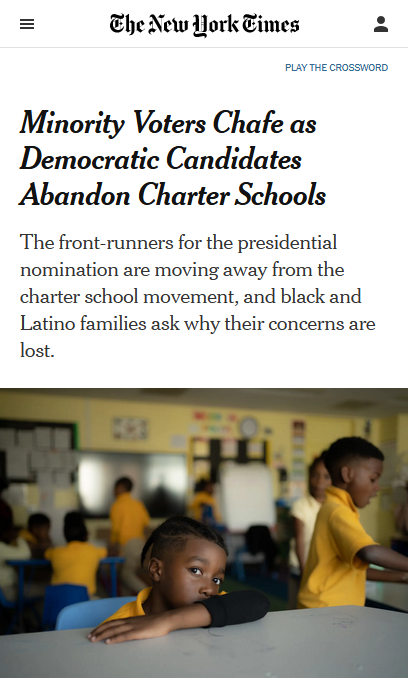
Bernie Sanders, Elizabeth Warren and other Democratic presidential candidates are rejecting the Obama administration’s embrace of charter schools, and media observers aren’t taking kindly to it. “Minority Voters Chafe as Democratic Candidates Abandon Charter Schools,” blared a recent New York Times headline (11/26/19). “The front-runners for the presidential nomination are moving away from the charter school movement, and black and Latino families ask why their concerns are lost,” read the subhead.
NYT: Minority Voters Chafe as Democratic Candidates Abandon Charter Schools
The “minority voters” who the New York Times (11/26/19) claims “chafe” at Democratic candidates’ criticism of charter schools do not include the NAACP or Black Lives Matter, both of which call for a moratorium on new charters.
The article itself was slightly more nuanced, reporting that the shift away from charters has left “some black and Latino families feeling betrayed”; buried deep within, the reporters note that “there is no consensus on charter schools among families of color.” (Black and Latino voters support charter schools at higher rates than do whites, but less than 50% view them positively; the NAACP and Black Lives Matter have called for a moratorium on new charter schools.) But the article also relied heavily on uncontested quotes from charter school founders and leaders, who accuse Democrats who would stop funding new charters of having “a lack of respect for black voters in the party” and “writing off years, if not generations, of kids.”
The pro-charter side was also given the floor a week earlier when the Times published an op-ed by Cory Booker (11/18/19) headlined, “Stop Being Dogmatic About Public Charter Schools.” (We could find no recent evidence of any pro-public school op-ed published in the paper in support of this “dogma.”)
Warren’s plan in particular has come under media fire, as the most recent education plan to be released (Sanders released a similar plan in May), and coming shortly after her brief surge to the top of the polls. In addition to a quadrupling of funding for Title I schools that serve primarily low-income families, tackling segregation, and increasing funding for schools serving students with disabilities, Warren is proposing an end to federal funding for new charters, a ban on for-profit charters, and holding charters to the same transparency and accountability standards as public schools. It’s this smaller charter-focused piece of her plan that has gotten the most attention.
US News & World Report  (10/29/19) helpfully framed the plan for readers: “Warren Embraces Teachers Unions Over Charter Schools.” The natural counterpart to “charter CONTINUE READING: How Media Turn Support for Public Schools Into Opposition to Children of Color | FAIR

Pittsburgh: A Forum for Democratic Candidates on Public Education on December 14! | Diane Ravitch's blog

Pittsburgh: A Forum for Democratic Candidates on Public Education on December 14! | Diane Ravitch's blog

Pittsburgh: A Forum for Democratic Candidates on Public Education on December 14!

Tune in!


PUBLIC EDUCATION GROUPS WILL HOST TOP DEMOCRATIC PRESIDENTIAL CANDIDATES AT 2020 PUBLIC EDUCATION FORUM
MSNBC Will MODERATE AND LIVESTREAM PITTSBURGH FORUM
ON DEC. 14
 

PITTSBURGH—The Network for Public Education Action will join with other public education groups, unions, civil rights organizations and community groups to host a forum for Democratic presidential candidates on Saturday December 14 in Pittsburgh. 
The “Public Education Forum 2020: Equity and Justice for All” will be held at the David L. Lawrence Convention Center in Pittsburgh. MSNBC will moderate and exclusively livestream the forum on public education issues.
Ali Velshi, host of “MSNBC Live,” and Rehema Ellis, NBC News education correspondent, will serve as the forum’s moderators, together interviewing candidates on priority issues facing students, educators and parents in public education today. The event will be streamed live on NBC News Now, MSNBC.com and NBC News Learn, and will be featured across MSNBC programming.
Each candidate will provide opening remarks and then answer questions from Velshi and Ellis, forum attendees and others from across the country who submitted questions.
WHO:              
Alliance for Educational Justice
American Federation of State, County and Municipal Employees
American Federation of Teachers
Center for Popular Democracy Action
Journey for Justice Alliance
NAACP
National Education Association
Network for Public Education Action
Schott Foundation for Public Education—Opportunity to Learn Action Fund
Service Employees International Union
Voto Latino
WHAT:            Public Education Forum 2020: Equity and Justice for All
WHEN:            Dec. 14, 10 a.m.
WHERE:          David L. Lawrence Convention Center
Pittsburgh: A Forum for Democratic Candidates on Public Education on December 14! | Diane Ravitch's blog


NYC Educator: On Ignoring Special Needs

NYC Educator: On Ignoring Special Needs

On Ignoring Special Needs


In an ICT class, you can have only 12 students with IEPs. That's the rule. However, in a non-ICT class, perhaps yours or mine, you can have 34. It's an odd phenomenon.

You see, there are rules regarding special education classes, and there are rules regarding special education students. Many are driven by student Individual Education Programs, or IEPs. But there are some curious oddities about IEPs. I'm far from expert, but I've learned a few things along the way.

One thing I've learned is that ICT classes, essentially classes with a mix of special education and general education students, are not required in high schools. They either have them or they don't. If they do, the notion appears to be that the special education students will be encouraged and/ or positively influenced by the general education students, and also get additional support from the special education teacher in the classroom. Of course the students will be selected for this program based on individual educational needs, and their IEPs will reflect them.

That sounds reasonable on its face. However, in practice, it may not be as good as it sounds. Some administrators will look at the classes, see that there are two teachers, and assign troubled general education students to them.

Look, this student has failed algebra twice, seems to act out in class all the time, and does not appear to be improving. Let's dump him into this ICT class and hope with two teachers he'll do better.

This is plainly detrimental to the special education students. For one thing, the extra attention they're supposed to get will be diverted. One or both teachers will likely have to deal with whatever issues the troubled general education students have, and the special education students will almost certainly get shortchanged as a result. Not only that, but by stacking the deck in this class the special education students are no longer mixing with a cross-section of general CONTINUE READING: 
NYC Educator: On Ignoring Special Needs