Latest News and Comment from Education

Thursday, December 5, 2019

Education in the Age of Globalization » Blog Archive » The PISA Illusion

Education in the Age of Globalization » Blog Archive » The PISA Illusion

The PISA Illusion

This article was originally published in the Washington Post on December 3rd 2019. It was adapted from part one of an article to appear in Journal of Educational ChangeThe longer version discusses three illusions PISA has created and relied on for its undeserved impact on global education: the illusion of excellence, the illusion of science, and the illusion of progress.
PISA is a masterful magician. It has successfully created an illusion of education quality and marketed it to the world. In 2018, 79 countries took part in this magic show out of the belief that this triennial test accurately measures the quality of their education systems, the effectiveness of their teachers, the ability of their students, and the future prosperity of their society.
PISA’s magical power in the education universe stems from its bold claims and successful marketing. It starts by tapping into the universal anxiety about the future. Humans are naturally concerned about the future and have a strong desire to know if tomorrow is better than, or at least as good as, today. Parents want to know if their children will have a good life; politicians want to know if their nations have the people to build a more prosperous economy; the public wants to know if the young will become successful and contributing members of the society.
PISA brilliantly exploits the anxiety and desire of parents, politicians, and the public with three questions:
How well are young adults prepared to meet the challenges of the future? Are they able to analyse, reason and communicate their ideas effectively? Do they have the capacity to continue learning throughout life? (OECD, 1999, p. 7).
These words begin the document that introduced PISA to the world in 1999 and have been repeated in virtually all PISA reports ever since. The document then states the obvious: “Parents, students, the public and those who run education systems need to know” (OECD, 1999, p. 7). And as can be expected, PISA offers itself as the fortuneteller by claiming that:
PISA assesses the extent to which 15-year-old students, near the end of their compulsory education, have acquired key knowledge and skills that are essential for full participation in modern societies. … The CONTINUE READING: Education in the Age of Globalization » Blog Archive » The PISA Illusion

Flip the Board: Denver and the Politics of School Reform – Have You Heard

Flip the Board: Denver and the Politics of School Reform – Have You Heard

Flip the Board: Denver and the Politics of School Reform

For more than a decade, Denver has been a model for a brand of school reform centered on closing low-performing schools, opening charter schools and rewarding teachers for boosting student test scores. But a diverse coalition of opponents says it’s time to put the brakes on that approach and showed its strength at the polls in November by “flipping” the Denver School Board. Complete transcript available here.
Note: Education will play a major role in key 2020 election contests and yet the media keeps missing the story, or worse, getting it wrong. Have You Heard has a plan for that. We have an ambitious 2020 travel agenda, but to hit the road we need your help.


The best and worst education news of 2019 -- and one item hard to categorize - The Washington Post

The best and worst education news of 2019 -- and one item hard to categorize - The Washington Post

The best and worst education news of 2019 -- and one item hard to categorize


It has been an annual tradition on The Answer Sheet for veteran teacher Larry Ferlazzo to assess what he sees as the best and worst education news of the year and then make predictions about the coming year. Here is his installment on the news of 2019 (and his predictions for 2020 will be coming soon).

Ferlazzo teaches English and social studies at Luther Burbank High School in Sacramento. He has written or edited 12 books on education, writes a teacher advice blog for Education Week Teacher and has a popular resource-sharing blog. He has written pieces for this blog over the years, including one on how teachers can help students motivate themselves and this one, one of my favorites, titled: “NEWS BREAK (not breaking news): Teacher asks students to grade him. One wrote: ‘I give Mr. Ferlazzo an A at being annoying.’”
NOTE: As in the past, Ferlazzo says he does not presume to suggest that the following compilation is all-encompassing and he hopes that you will take time to share your own choices in the comments. He starts this piece with what he thinks is the best education news of 2019 and then the worst — though the items in each category are not in any order of importance. And then there is one bit of news that he can’t categorize. Let him know if you can.

By Larry Ferlazzo

The Best Education News Of 2019
*Teachers maintained their momentum of successful organizing into 2019, beginning the year with a successful strike in Los Angeles, and continuing through OaklandDenver and Chicago. In all cases, unions won agreements for reduced class sizes, additional nurses and counselors, and more (we had our own one-day strike here in Sacramento). Teacher walkouts also occurred in West VirginiaNorth Carolina and Indiana.
*Teachers were also able to build on their organizing success by supporting candidates who won the majority in the Denver school board elections and becoming the key factor in the defeat of Kentucky’s governor.
*Several important education-related research results came out this year, including a huge study finding that teaching students about a growth mind-set can lead to increased academic achievement; CONTINUE READING: The best and worst education news of 2019 -- and one item hard to categorize - The Washington Post

“The Odessey of Joshua”: A Student’s Story | deutsch29

“The Odessey of Joshua”: A Student’s Story | deutsch29

“The Odessey of Joshua”: A Student’s Story

I teach senior English.
I noticed that one of my students, an English language learner, was reluctant to complete complex written assignments. He appeared to throw up his hands as if to ask, “What is the use?”
So, I asked him, “Will you write a paper about you? Will you tell me your story?”
He thought about it for a moment, then nodded in agreement.
Below is his unedited response, which he has allowed me to reproduce.
His name is Joshua, and this is his story:
The odyssey of Joshua
In the power of a strong kid that have to face problems of a new life. This show how a kid get in to a new era and have to adapt as his new life changes. In the course of the time we get to see how he struggled and fight emotionally. His view of everything in overall is bad. The feeling of homesickness and a new languish is the key point of is problem.
In the beginning Joshua was happy whit his friend in Puerto Rico until one day he get the news of a storm hitting Puerto Rico. He thought that it was going to be a regular storm but it was not. The storm was one of the biggest storm that ever hit Puerto Rico. By this period of time he did not CONTINUE READING: “The Odessey of Joshua”: A Student’s Story | deutsch29

CURMUDGUCATION: Buddy, Can You Spare A Ride (To The Charter School)?

CURMUDGUCATION: Buddy, Can You Spare A Ride (To The Charter School)?

Buddy, Can You Spare A Ride (To The Charter School)?

Remember the days when charter school fans were bragging that they would do more with less? That chorus has been replaced by complaints of how unfair it is that they don't get as many tax dollars for their privately-owned businesses as the public school system gets, resulting in fun new ideas like Florida's notion that charters should be entitled to a cut of any special levies that taxpayers pass to support public schools.

A new demand is surfacing now-- privatizers want taxpayers to help cover transportation costs.

Right in the front row of this new choir is Ben DeGrow. DeGrow is currently the ed policy point man for Mackinac Center, located in Michigan (motto: "We helped grow Betsy DeVos and now she's our gift to all America, you're welcome"), an advocacy thinky tank focused on "economic freedom," aka "the freedom of rich folks to get more rich." He previously worked at Denver's Independence Institute, a Libertarian thinky tank. Like many good think tank education experts, he has no actual education background. Well, okay-- according to the Mackinac website, "Ben’s classroom experiences include service as a university graduate assistant and as a substitute teacher in Michigan public schools."


DeGrow popped up at The Hill last week to make the argument for transportation scholarships (well, that, and to oddly try to accuse Jennifer Berkshire of a progressive and being weirdly obsessed with Betsy DeVos). We need these scholarships, he argues, to reduce obstacles to school choice.

We'll get to what he proposes in a moment, but first, let's note that he makes a huge, huge leap in his argument-- namely, that charter operators actually want to remove this obstacle. The patterns of segregation, the use of charters to gentrify neighborhoods, the fact that some charters do in fact provide transportation-- all of this might suggest that the transportation obstacle is just another way for charter operators to legally keep Those Peoples' Children out of their school. At a minimum, the CONTINUE READING: 
CURMUDGUCATION: Buddy, Can You Spare A Ride (To The Charter School)?


NYC Public School Parents: Testimony on the need to fully fund and provide more accountability with the Foundation funds owed NYC so that class sizes are (finally) reduced

NYC Public School Parents: Testimony on the need to fully fund and provide more accountability with the Foundation funds owed NYC so that class sizes are (finally) reduced

Testimony on the need to fully fund and provide more accountability with the Foundation funds owed NYC so that class sizes are (finally) reduced


Here is the testimony from Sarita Subramanian of the IBO which cites an Urban Institute study showing NY ranking second-to-last among 50 states because of how regressive its school funding is (including state and local.) Here is testimony from Michael Mulgrew of the UFT and Andy Pallotta of NYSUT.

Yesterday I spent most of the day at NY Senate hearings by the Education and Budget Committees on the Foundation aid formula for school funding, following a series of round table discussions that have been held throughout the state.

The Foundation aid formula which was established in 2007 but has never been fully implemented. NYC schools are owed either $1.1 billion or $1.4 billion from the state, according to different sources, as a result of the Campaign for Fiscal Equity court decision and the Contracts for Excellence law passed in 2007.  Statewide, the unmet need varies from about $3.4 billion to $4.2 billion according to whom you ask.  Some of the witnesses said there should be a two-year phase in, and others a three-year phase in of these amounts.

There were many experts in school finance, some who said the formula was so badly flawed it should be improved before funding it, and others who said we can't wait for this to happen.  They argued that our schools need more resources now because students are suffering, and can't wait.  They said that the state legislature and Governor need to fully fund the original formula and worry about tweaking the formula later.

The first witness was Lindsey Oates, the Chief Financial Officer of the NYC Department of Education  who began with a long account about how wonderfully our schools are doing, from rising graduation rates, more students taking SATs, more preK, yadda yadda yadda.  The thrust of her remarks would make any listener think that  our schools don't really need more funding at all.

When asked what they would do with the additional $1.1 billion, she echoed Carranza: all schools' Fair student funding would be brought up to 100% and then principals could CONTINUE READING: 
NYC Public School Parents: Testimony on the need to fully fund and provide more accountability with the Foundation funds owed NYC so that class sizes are (finally) reduced


Wednesday, December 4, 2019

Editorial: California can't track billions of education dollars

Editorial: California can't track billions of education dollars

Editorial: California can’t account for billions of education dollars 
Inexcusable that, six years after K-12 spending revamp, audit finds needy kids aren’t getting help they should


It’s been six years since California lawmakers revamped the state funding formula for local schools.
It was heralded by then-Gov. Jerry Brown as a way to simplify K-12 education spending and close the state’s achievement gap by giving more money to districts that disproportionately serve needy kids.

Since then, state spending on schools has increased about 50%. But, as state Auditor Elaine Howle explained in a troubling report last month, there is no way to track whether money is being spent as it should.
School officials across California have co-mingled billions of dollars of state money that was supposed to be used for children who fall into one of three categories: English learners, low-income or in foster care.
Howle’s findings confirm what critics have been saying for years: Rather than specifically helping needy kids, the money has simply been used to boost general spending.
That partially explains why California students’ test scores continue lagging the national average and the state has failed to close the achievement gap that divides along racial and economic lines.
If California has any hope of narrowing that divide, legislators and Gov. Gavin Newsom should require accountability for the $63 billion of state money currently spent annually on K-12 education.
It’s time to end this reckless spending. As we enter the state budget cycle for the 2020-21 fiscal year, lawmakers must stop doling out money without a meaningful tracking system for how it’s spent.
Brown’s original plan made sense. State spending for schools had become far too complicated, with more than 110 special “categorical” programs that had different funding and eligibility requirements.
The plan was to eliminate the categorical programs and give local school districts more control over the money. Hence, the Local Control Funding Formula was created.
LCFF is pretty simple. School districts receive a base amount determined by students’ attendance figures and grade levels. In addition, they receive a supplemental 20% for students falling into one of the three needy categories. And in districts with concentrations of more than 55% needy students, per-pupil funding increases 50% for each kid beyond the 55% threshold.
The so-called supplemental and concentration funding is supposed to be spent to provide additional help for those targeted children. But when Howle audited a sample of three school districts — Oakland, Clovis and San Diego — only Clovis tracked how the money was spent.
That’s because there are no state regulations to ensure districts separately account for the extra funds. Moreover, if the districts don’t spend the money on those needy students the year they receive the funds, they can spend it on anything the following year.
Hence, there are no rules to ensure Brown’s law is being followed. Indeed, while he was in office, Brown repeatedly resisted such a requirement. Consequently, there is no way to determine whether the additional funding is producing measurable student performance improvements.
The idea behind LCFF was to provide more local control. Parents were supposed have input into how the money is spent — something that’s meaningless if they’re not provided useful data — and school districts were supposed to be freed from the restrictions of hundreds of categorical spending programs.
But LCFF was never intended to be a giveaway of funds without obligations. Our neediest students were supposed to be better served. There’s no way to know whether that’s happened.
The lack of accountability — for how the money is spent and whether it’s producing results — is no longer acceptable.

PISA Scores Are Out. Ours Are Not Great. So What?

PISA Scores Are Out. Ours Are Not Great. So What?

PISA Scores Are Out. Ours Are Not Great. So What?

It’s PISA Day, the day when the Programme for International Student Assessment scores are released by OECD (The Organisation for Economic Co-operation and Development). This is traditionally followed by a great deal of hand-wringing.
A typically glum assessment was written by Dana Goldstein for the New York Times this morning. “The performance of American teenagers has been stagnant since 2000,” Goldstein reports. As education historian Diane Ravitch notes every time PISA scores come out, the U.S. results have always been mediocre. There has never been a golden age when the U.S. led the world in PISA results.
The top scores this year come from the usual batch of test takers, including the Chinese, who give the test to students from wealthy provinces who could not* be remotely considered a cross-section of the nation as a whole. PISA day is also the one day that some folks hear about Estonia, the tiny nation that somehow has not conquered the world even though their students do well on the PISA.
PISA coverage tends to overlook one major question—why should anyone care about these scores? Where is the research showing a connection between PISA scores and a nation’s economic, political, or global success? What is the conclusion to the statement, “Because they get high PISA scores, the citizens of [insert nation here] enjoy CONTINUE READING: PISA Scores Are Out. Ours Are Not Great. So What?

The Lucrative Loophole That Charter Operators Exploit | Diane Ravitch's blog

The Lucrative Loophole That Charter Operators Exploit | Diane Ravitch's blog

The Lucrative Loophole That Charter Operators Exploit


This article about charter real estate dealings was written by Professors Preston Green III, Bruce Baker, and Derek W. Black.
They argue that lax state laws allow charter operators to reap profits while maintaining an ostensibly “nonprofit” status.
While critics charge that charter schools are siphoning money away from public schools, a more fundamental issue frequently flies under the radar: the questionable business practices that allow people who own and run charter schools to make large profits.
Charter school supporters are reluctant to acknowledge, much less stop, these practices.
Given that charter schools are growing rapidly – from 1 million students in 2006 to more than 3.1 million students attending approximately 7,000 charter schoolsnow – shining a light on these practices can’t come too soon. The first challenge, however, is simply understanding the complex space in which charters operate – somewhere between public and private.

Unregulated competition

Charters were founded on the theory that market forces and competition would benefit public education. But CONTINUE READING: The Lucrative Loophole That Charter Operators Exploit | Diane Ravitch's blog

Andre Perry: Support for the charter school movement in this election comes with a price

Support for the charter school movement in this election comes with a price

Support for charters in 2020 election comes with a price
Black leaders must not sacrifice jobs, communities for false charter promises
At a campaign rally in Atlanta for Sen. Elizabeth Warren, a day after the fifth presidential debate in November, dozens of charter school supporters interrupted Warren’s speech to protest the presidential candidate’s plan to curb charter school growth. The New York Times reported that the protesters were members of the Freedom Coalition for Charter Schools, an alliance of black and Latino education leaders, who toted signs that read “Charter schools = self-determination,” and “Black Democrats want charters!”
Rep. Ayanna S. Pressley of Massachusetts, a black lawmaker and Warren surrogate, threw the presidential candidate a life preserver. “We are grateful for your activism and your voice and you are welcome here,” Pressley told the activists. But she also made it very clear that Warren’s voice would not be silenced.
It was, once again, an example of black leaders rushing to the rescue. Oddly enough, the charter activists and Pressley were both coming to the defense of white-led causes that could stand more vigorous feedback from black people. Because Democrats have to earn the black vote in black cities, the black community has leverage to demand that our concerns be addressed.
Warren needs to learn from black voices — but the charter school movement is not ours to defend.
Organizations such as the charter school advocacy group Families for Excellent Schools have orchestrated statewide campaigns using dark money to influence state ballots to increase the number of charter schools, hiding who’s actually behind the movement. The Associated Press reported in December of 2018 that an advocacy group that CONTINUE READING: Support for the charter school movement in this election comes with a price

Does #MeToo Apply to Students in Charter Schools?

Does #MeToo Apply to Students in Charter Schools?

Does #MeToo Apply to Students in Charter Schools?

NVMI notes that allegations contained in the disclosable public records were unfounded and strongly denied by NVMI. Further, evidence indicated the social media account(s) of the former employee may have been hacked. Please be advised that publication of any of the information or photographs contained therein will be at your own risk and NVMI bears no risk to liability for such publication.”– Law Offices of Young, Minney & Corr, LLPThe Charter Law Firm
According to a lawsuit filed on June 14, 2017, an administrator at the North Valley Military Institute College Preparatory Academy (NVMI) was alleged to have “exposed Plaintiffs and other minor children to inappropriate sexual language (including phrases like ‘suck my dick’)…exposed Plaintiffs to hardcore pornographic images…[and] assaulted and battered at least one of the minor Plaintiffs”. As a public entity that “supervised and oversaw NVMI’ s operations under an approved charter”, the LAUSD was also named in the suit with the allegation that it “had the means, resources, and oversight power to prevent the practices that led to the abuse of students” but did not do so. According to court records, this case appears to have been settled with both plaintiffs receiving monetary compensation. Left unanswered is the extent to which anyone reached out to other potential victims or what steps any entity has taken to ensure that other employees at NVMI will be properly supervised in the future.   
As this case was winding its way through the courts, high-profile actresses were helping to shine a light on the issue of institutionalized sexual harassment and assault as the #MeToo movement gained traction. Unfortunately, it appears that these students, who attended a school where 87.8% of the students receive free and reduced-price lunch, were ignored. According to the lawsuit, the parents brought the alleged conduct to the attention of school administrators but were CONTINUE READING: Does #MeToo Apply to Students in Charter Schools?

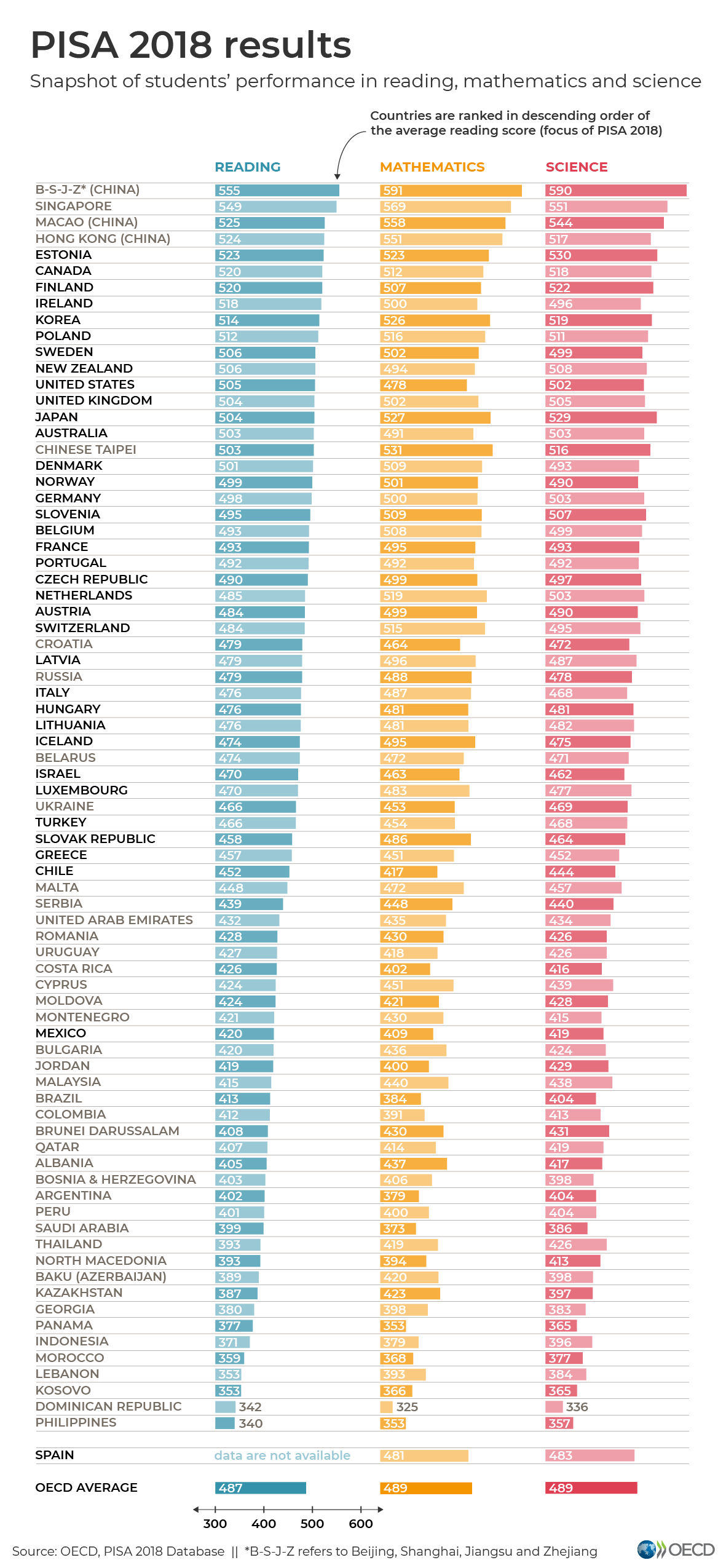
PISA 2018 results - (PISA) examines what students know in reading, mathematics and science

Publications - PISA

PISA 2018 results
The OECD Programme for International Student Assessment (PISA) examines what students know in reading, mathematics and science, and what they can do with what they know. It provides the most comprehensive and rigorous international assessment of student learning outcomes to date. Results from PISA indicate the quality and equity of learning outcomes attained around the world, and allow educators and policy makers to learn from the policies and practices applied in other countries. This is one of six volumes that present the results of the PISA 2018 survey, the seventh round of the triennial assessment. Volume I, What Students Know and Can Do, provides a detailed examination of student performance in reading, mathematics and science, and describes how performance has changed since previous PISA assessments.

Overviews

Country-specific overviews
Colombia - EnglishSpanish
France - EnglishFrench
Germany - EnglishGerman
Italy - EnglishItalian
Japan - EnglishJapanese
Mexico - EnglishSpanish
Spain - EnglishSpanish

Country snapshots

Full reports and data
Reports
Data
Publications - PISA