Latest News and Comment from Education

Tuesday, September 24, 2019

A Very Busy Day Larry Ferlazzo's Websites of the Day... | The latest news and resources in education since 2007

Video & Transcript Of Greta Thunberg’s speech to world leaders at UN Climate Action Summit | Larry Ferlazzo's Websites of the Day...

A Very Busy Day Larry Ferlazzo's Websites of the Day... | The latest news and resources in education since 2007


Classroom Instruction Resources Of The Week
Each week, I publish a post or two containing three or four particularly useful resources on classroom instruction, and you can see them all here. You might also be interested in THE BEST RESOURCES ON CLASS INSTRUCTION IN 2019 – PART ONE. Here are this week’s picks: Limiting “Teacher Talk,” Increasing Student Work! is from Achieve The Core. When Middle School Students Think Like Historians appear
A Simple Way I Differentiate TPR (Total Physical Response) Lessons – Do You Have Other Suggestions?
harishs / Pixabay Most teachers of English Language Learners are familiar with TPR (Total Physical Response) – see The Best Resources For Learning About Total Physical Response (TPR) . TPR can probably be described most simply as a teacher (or a student) modeling an action at the same time as saying that action’s verb, and then students replicate the action. I recently observed our principal mode

YESTERDAY

“Q&A Collections: Professional Collaboration”
Q&A Collections: Professional Collaboration is the headline of my latest Education Week Teacher column. All Classroom Q&A posts offering advice on Professional Collaboration (from the past eight years!) are described and linked to in this compilation post. Here’s an excerpt from one of them:
The Best Line Ever That Explains A Key “Advantage” Charters May Have Over Regular Public Schools
Thanks to our former (and exceptional) principal, Ted Appel, I learned about a New York Times book review that recently appeared about Robert Pondiscio’s new book about the large charter school network in New York City called Success Academy. The review was written by Dale Russakoff , who I’ve previously talked about in this blog . I’ve also posted an interview I did a few years ago with Robert P
You Might – Or Might Not – Find This Three Minute Video Useful Of Me Talking About Student Motivation
suju / Pixabay Awhile back, a Swedish TV show on education interviewed me via Skype about student motivation. The show just came out, and they included what I think is a relatively decent three minute clip of me talking about student motivation and growth mindset. I’ve linked directly to that short clip here (they don’t allow embedding). You might, or might not, find it useful. I’m adding it to a
“Speek” Lets You Easily Record Online Messages
GraphicMama-team / Pixabay Speek is a new website that lets you record audio of a message and then share a link or embed it somewhere, like this: Of course, there are a zillion phone apps (like FlipGrid where you can record audio while showing yourself or, even better with students because of privacy concerns, images) or Vocaroo (which is not ideal these days because it requires Flash) that let y
Video & Transcript Of Greta Thunberg’s speech to world leaders at UN Climate Action Summit
geralt / Pixabay Here’s the transcript and video of Greta Thunberg’s speech today. I’m adding it to THE BEST RESOURCES ON TEENS DEMANDING AN EFFECTIVE RESPONSE TO CLIMATE CHANGE :
Video & Transcript Of Greta Thunberg’s speech to world leaders at UN Climate Action Summit | Larry Ferlazzo's Websites of the Day...


Nick Hanauer Speaks Out Against Income Inequality in a Pair of TED Talks | Diane Ravitch's blog

Nick Hanauer Speaks Out Against Income Inequality in a Pair of TED Talks | Diane Ravitch's blog

Nick Hanauer Speaks Out Against Income Inequality in a Pair of TED Talks

Nick Hanauer, who may or may not be a billionaire, made a splash when he conspicuously dropped out of the Destroy Public Education Movement and the Billionaire Boys Club, which he had supported with donations of millions of dollars.
He loudly declared that his fellow plutocrats were wrong to blame the schools for the dysfunctions of our society, which he pinned on income inequality.
He has given some recent TED talks, which you should listen to and react to.
Wrench in the Gears on the Corporate Takeover of Sesame Street

The blogger Wrench in the Gears worries here (in a 2018 post) about the MacArthur Foundation’s Grant of $100 Million to Sesame Street, intended to help the children of Syrian refugees. The “help” these children get will be delivered by technology, she says, not by humans. As it happens, I was one of a large number of judges in this competition, though I did not review the Sesame Street proposal.
Nancy Bailey: Betsy DeVos is a Hypocrite

Nancy Bailey calls out Secretary of Education Betsy DeVos for talking about “education freedom” at the same time that she is doing everything within her power to snuff it out. Betsy DeVos’s Education Freedom: It’s Anything But


What Greta Thunberg Told the UN Today

Sixteen-year-old climate activist Greta Thunberg spoke at the UN Climate Conference today. Trump skipped the meeting to attend a discussion of religious freedom. Last Friday, Thunberg inspired millions of students around the world to demonstrate on behalf of action to address the climate crisis. She said today: “This is all wrong. I shouldn’t be standing here. I should be back in school on the ot

Jeff Bryant: How Private Search Firms Skim Millions From Public Schools | OurFuture.org by People's Action

How Private Search Firms Skim Millions From Public Schools | OurFuture.org by People's Action

How Private Search Firms Skim Millions From Public Schools

In July 2013, the education world was rocked when a breaking story by Chicago independent journalist Sarah Karp reported that district CEO Barbara Byrd-Bennett had pushed through a no-bid $20 million contract to provide professional development to administrators with a private, for-profit company called SUPES Academy, where she had worked for a year before the deal transpired. Byrd-Bennett was also listed as a senior associate for PROACT Search, a superintendent search firm run by the same individuals who led SUPES.
By 2015, federal investigators looked into the deal and found reason to charge Byrd-Bennett for accepting bribes and kickbacks from the company that ran SUPES and PROACT. A year-and-a-half later, the story made national headlines when Byrd-Bennett was convicted and sentenced to prison for those charges. But anyone who thought this story was an anomaly would be mistaken. Similar conflicts of interest among private superintendent search firms, their associated consulting companies, and their handpicked school leaders have plagued multiple school districts across the country.
In an extensive examination, Our Schools has discovered an intricate web of businesses that reap lucrative school contracts funded by public tax dollars. These businesses are often able to place their handpicked candidates in school leadership positions who then help make the purchasing decision for the same businesses’ other products and services, which often include professional development, strategic planning, computer-based services, or data analytics. The deals are often brokered in secrecy or presented to local school boards in ways that make insider schemes appear legitimate.
As in the Byrd-Bennett scandal, school officials who get caught in this web risk public humiliation, criminal investigation, and CONTINUE READING: How Private Search Firms Skim Millions From Public Schools | OurFuture.org by People's Action

CURMUDGUCATION: The College Board Tweaked The SAT Adversity Score. But It's Not Fixed-- Or Gone.

CURMUDGUCATION: The College Board Tweaked The SAT Adversity Score. But It's Not Fixed-- Or Gone.

The College Board Tweaked The SAT Adversity Score. But It's Not Fixed-- Or Gone.

Since David Coleman took the helm at the College Board, its flagship product--the ubiquitous SAT, one-time queen of college entrance exams--has been the victim of a series of unforced errors. The roll-out and walk-back of the "adversity score" is only the latest--and recent reports of that score's death may be greatly exaggerated.
The company ran into some glitches in its rush to get a new, Common Core-aligned test to market. Coleman expressed a desire for the test to be a great leveler, a test that would recognize and elevate intellectual prowess wherever it was found. The SAT has long been criticized as being loaded with cultural bias, and the College Board's own data seems to support that assertion. The other knock on the test was that it could be beaten with the help of test prep and coaching (a criticism bolstered by an entire SAT test prep industry). And the College Board has been confirming that these criticisms are valid.
In 2014, the College Board entered into a partnership with Khan Academy to offer free test prep to anyone who wanted it. Rather than designing a test that was immune to test prep (which may, in fact, be impossible), the College Board appeared to be conceding that SAT scores measured, at least in part, how well a student had been coached for the test.
Then came the Environmental Context Dashboard, featuring the Adversity Score. The score was supposed to capture the social and economic background of students through a combination of fifteen dimensions. But though it was supposedly CONTINUE READING: CURMUDGUCATION: The College Board Tweaked The SAT Adversity Score. But It's Not Fixed-- Or Gone.

“…you are still not mature enough…” | Live Long and Prosper

“…you are still not mature enough…” | Live Long and Prosper

“…you are still not mature enough…”

Sixteen-year-old Swedish climate activist Greta Thunberg scolded the world’s adults today at the U.N. Climate Action Summit.
Unfortunately, the American President didn’t listen to Ms. Thunberg’s speech. He dropped by the summit…but didn’t stay. He also hasn’t read the 2015 Department of Defense report on the national security risks caused by climate change. Instead, the current occupant of the White House has spent the last two and a half years dismantling the nation’s environmental protections.
I doubt he would have understood why she was upset since he believes that “…the concept of global warming was created by and for the Chinese…
MORE THAN THIRTY YEARS AGO?
In her speech, Thunberg said that it’s been more than thirty years since the science became “crystal clear.” In 1971, Isaac Asimov wrote an essay called, The End. In it, he wrote about the inevitable damage to the Earth from the use of fossil fuels.
If the present carbon dioxide content of the atmosphere were merely to double, the average temperature of the Earth would increase by 3.6° C. We might be able to stand the warmer summers and the milder winters but what of the ice caps on Greenland and Antarctica?

At the higher temperatures, the ice caps would lose more ice in the summer than they would regain in the winter. They would begin to melt year by year at an accelerating pace and the sea level would inexorably rise. By the time CONTINUE READING: “…you are still not mature enough…” | Live Long and Prosper

Stumbling Towards a Post-Racial World: We Have a Long, Long Path Ahead | Ed In The Apple

Stumbling Towards a Post-Racial World: We Have a Long, Long Path Ahead | Ed In The Apple

Stumbling Towards a Post-Racial World: We Have a Long, Long Path Ahead

The stain of slavery and Jim Crow appeared to be erased with election of Barack Obama in 2008.
Many commentators, both conservative and liberal, have celebrated the election of Barack Obama as president of the United States, claiming the election signified America has truly become a “post-racial” society. It is not just Lou Dobbs who argues the United States in the “21st century …is a post-racial society.” This view is consistent with beliefs the majority of White Americans have held for well over a decade: that African Americans have achieved, or will soon achieve, racial equality in the United States despite substantial evidence to the contrary.
 America was looking forward to a new emergence of Camelot. Younger voters flocked to the poles in unheard of numbers; a wave of progressive voters revived and seemed to presage the end of the Republican Party and a new era of progressive legislation waiting to become law.
A black president would influence generations of young children to embrace a new vision of American citizenship. The “Obama Coalition” of African American, white, Latino, Asian American and Native American voters had helped usher in an era in which institutional racism and pervasive inequality CONTINUE READING: Stumbling Towards a Post-Racial World: We Have a Long, Long Path Ahead | Ed In The Apple

Outside The Four Corners (Or “How Common Core Almost Broke Reading”)

Outside The Four Corners (Or “How Common Core Almost Broke Reading”)

Outside The Four Corners (Or “How Common Core Almost Broke Reading”)
The Reading Wars are a series of debates about how best to teach reading to small humans, and while the intensity of the debates themselves ebb and flow, the dates have been raging for only slightly fewer years than the printed word has existed.
One of the fronts in the debate has been the phonics vs. “whole language,” recently stirred up again by Emily Hanford, who has argued for the full phonics approach in several articles. But that debate feeds into a broader one, an aspect of the conversation might be called skills vs. content.
The skills camp views reading as a suite of teachable, transferable skills (making inferences, fluency, decoding), while the content crew leans toward that it is rich content knowledge that makes the whole business of reading work, but which is not transferable (just because I can read a high-level book about dinosaurs doesn’t mean I can also read a high-level book about knitting).


The “war” framing can seem awfully overblown to actual classroom teachers. While reading warriors may frame the choices as “either-  CONTINUE READING: Outside The Four Corners (Or “How Common Core Almost Broke Reading”)

Monday, September 23, 2019

Movies, Word Finds, and Coloring Sheets - Teacher Habits

Movies, Word Finds, and Coloring Sheets - Teacher Habits

Movies, Word Finds, and Coloring Sheets

My daughter is in eighth grade now. She’s doing math I don’t remember and solved some problems the other night that I couldn’t help her with (luckily, Alexa could). She’s taking German and is all guten this and guten that when she gets home. She’s a programmer on her robotics team. She’s read “The Lottery” and “The Monkey’s Paw” in English class. She’s getting better at playing along with Jeopardy!
She has also brought home a coloring assignment and a word find during the first four weeks of school.
In sixth grade, we joked that one of her classes should have been called Watching Movies I’ve Already Seen.
I am supposed to be upset about this. The teacher in me (who gave up word finds and coloring sheets as assignments many years ago) should be outraged. I should follow the lead of many other teachers and parents who demand more of schools and post my CONTINUE READING: Movies, Word Finds, and Coloring Sheets - Teacher Habits

Just how intertwined are racial segregation and economic inequality?

Just how intertwined are racial segregation and economic inequality?

An analysis of achievement gaps in every school in America shows that poverty is the biggest hurdle
A Stanford study finds that racial segregation matters because black and Hispanic students are concentrated in high poverty schools

Here’s a tale of three cities: Atlanta, New York and Detroit.

In all three cities, there is a high degree of racial segregation in the schools. White students go to schools with relatively few black and Hispanic students. Black and Hispanic students attend schools that don’t have many white students. When Sean Reardon, a sociologist at Stanford University, measures the racial isolation in a quantitative way, he finds that the schools in the three cities are “equally racially segregated.”
But the poverty rates in the schools are very different. In Atlanta, blacks students go to schools with very high poverty rates. The students in these schools tend to come from families whose income is low enough that the children qualify for free or reduced priced lunches, a federal measure of poverty. The white students in Atlanta tend to go to schools with very low poverty rates. In New York City, Reardon finds the same pattern but not to the same extreme. Meanwhile, in Detroit, this pattern isn’t true at all. White and black students attend different schools, but the poverty levels are high in both white and black schools.

It turns out, according to Reardon’s calculations, that the differences in poverty rates between the black and white schools are very predictive of the achievement gaps between black and white students. “The achievement gap is very small, virtually zero in Detroit,” said Reardon, in an interview. “It’s quite big, but not enormous in New York City. And it’s among one of the two or three biggest in the country in Atlanta.”
This example arises from a new study of achievement gaps and racial segregation in nearly every school in the United States. In the study, Reardon finds that racial segregation is a very strong predictor of the gaps in academic achievement between white and black or Hispanic students, but it’s school poverty — not the student’s race — that accounts for these big gaps. When the difference in poverty rates between black and white schools is larger, the achievement gaps CONTINUE READING: Just how intertwined are racial segregation and economic inequality?

Larry Cuban on School Reform and Classroom Practice | Just another WordPress.com weblog

Larry Cuban on School Reform and Classroom Practice | Just another WordPress.com weblog

Techno-Optimism Meets Schools: Schools Win (Part 1)

From Thomas Edison’s words on film revolutionizing teaching and learning in the early 1900s to the acclaim accompanying desktop computers overhauling K-12 schools in the early 1980s to MOOCs in the 2010s transforming higher education to BrainCo–software that tracks and uses students’ brainwaves in 2019–enthusiasm for the latest technological innovation is boundless.  Every ill has a cure, every problem has a solution, and every school needs the latest software to boost students’ math test scores (Dreambox) or make English-speaking students fluent in French (Duolingo).
Anyone over the age of 40 recognizes this repetitive hype and dashed expectations when it comes to the promise of new technologies in schools. What is often missed in this familiarity with exaggerated claims for new technologies (i.e., access and use of new hardware, software, and now social media) is that schools do, indeed, end up extensively using the new stuff. They domesticate the technology to fit what already exists.
In other words, techno-optimists win in getting much of their hardware and software into schools and classrooms but lose badly in seeing that what occurs as a result falls far short of their dreams of faster, more, better, and personalized teaching and learning. And schools win by having access to new technologies while tailoring their use to fit the “grammar of schooling.”
Nearly three decades ago, I wrote a few pieces on this techno-optimism (see here and here) when it comes to public schools and posed three scenarios then. In the intervening decades, each of these scenarios have real-life evidence that they occurred. Yet one in particular–here’s the spoiler–exists now.
Here are the three scenarios I sketched out in 1992.
The techno-optimist’s dream: electronic schools of the future now. These are CONTINUE READING: Larry Cuban on School Reform and Classroom Practice | Just another WordPress.com weblog

Is the Long Alliance of Betsy DeVos and Cory Booker Really Over? | janresseger

Is the Long Alliance of Betsy DeVos and Cory Booker Really Over? | janresseger

Is the Long Alliance of Betsy DeVos and Cory Booker Really Over?

I am not one for complimenting U.S. Education Secretary Betsy DeVos, but you have to give her credit for one virtue: she is not an opportunist.  She remains a dogged school choice fanatic even though for three years now, she has been unable to get Congress to fund her highest priority, her Education Freedom Scholarship neovoucher-tuition tax credit program.
This year she launched her beginning-of-school-year tour at a Lutheran school in Milwaukee, home of the oldest school voucher program in the country. The Washington Post‘s Valerie Strauss describes the start of DeVos’s September tour: “Education Secretary Betsy DeVos began her 2019 back-to-school tour Monday.  Given that she runs a publicly funded department and that most U.S. students attend schools in traditional public systems, you might think she would go to one in a district working hard to improve its academic performance.  Nope.  She didn’t go to a public school, and she didn’t choose a city because of the achievements of its public schools.  Rather, she went to St. Marcus Lutheran School in Milwaukee and touted that city as the ‘birthplace of modern education freedom.’  That is a reference to a program started under a 1989 law that was the first in the country to give substantial public funding for students to use for private, nonsectarian schools.  It later expanded to include religious schools.  That program was part of what grew to be known as the ‘school choice’ movement, which seeks to find alternatives to traditional public school districts so families can decide for themselves where to send their children and to serve as an escape for children who have poor educational options in their neighborhoods.  For decades, DeVos has played a key role in that movement, pushing against critics who argue that using public funds to support choice schools undermines the traditional public system, and that it aims at privatizing the nation’s most important civic institution.”
This week, for the Washington PostMichael Kranish profiles a politician who, unlike DeVos, has demonstrated that he is the consummate opportunist, Cory Booker, who is running for president as a Democrat and who is claiming this year that he has abjured his previous CONTINUE READING: Is the Long Alliance of Betsy DeVos and Cory Booker Really Over? | janresseger

“Important Parent Meeting” About College Funding, Yet Sponsor Withholds Identity from Mailer | deutsch29

“Important Parent Meeting” About College Funding, Yet Sponsor Withholds Identity from Mailer | deutsch29

“Important Parent Meeting” About College Funding, Yet Sponsor Withholds Identity from Mailer

On September 13, 2019, I received a mailer that at first glance appeared to be one that my southern Louisiana school district might send: No frills; just an 8 1/2″ x 11″ sheet of white paper, xeroxed ad folded three times. However, in the place of the return address was written, “Important Parent Meeting.” No address, obviously a means of getting people to open and read the mailer. This would be unusual for our district, which identified itself in the return address as the sender of mail. Still, I thought, it could be the district.
Except for the Cleveland, Ohio, postal permit.
When I opened the mailer, the first words at the top, in large type, were, “Free College Workshop.” As I continued to read, I realized that I was being invited to a meeting requiring a reservation for attendance and promising lots of “FREE” help with college financial aid, including learning
  • How to send your child to a private college for less than a state school
  • How to create a plan to pay for college in an economy without relying on 529 plans, expensive private student loans or raiding your retirement accounts
  • How to lower your “out of pocket” costs and get the maximum amount of financial aid from each school
  • How to increase your college-related tax deductions and tax credits
Sounds great!
To seal the deal regarding the marvels of this *FREE College Funding Workshop,” at the bottom of the flier were several supposed testimonials:
“Guessing I’ll gain thousands of dollars of financial aid just from what I learned in the first 30 minutes.” –Robert T, Parent of High School Junior
“Opened my eyes to look at colleges we thought were out of our price range.” –John S., Parent of High School Junior
“Extremely informative presentation– clear, concise and easy to understand.” –Emily W., Parent of High School Senior
“Where were you when I sent my first kid to college?” –Jeffrey W., Parent of High School Sophomore
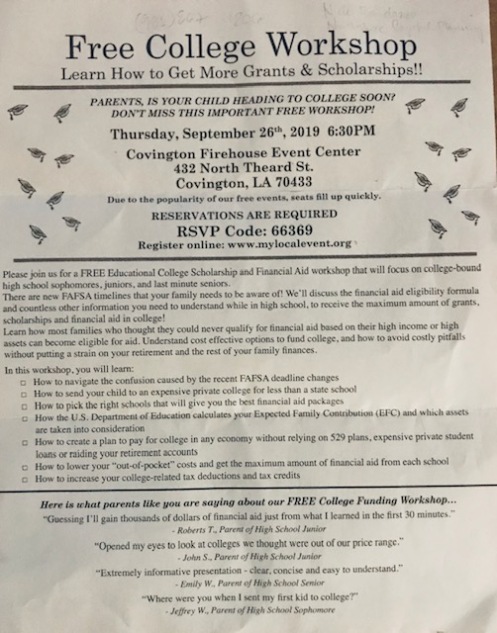
Lots of words on this mailer.
Lots of enticing promises.
Not one hint of who sent it. Not even a “sponsored by” in the finest of print.
IMG_1577
Someone wanted me to trust him/her with my financial planning without trusting me to make an informed decision about who, exactly, was asking to CONTINUE READING: “Important Parent Meeting” About College Funding, Yet Sponsor Withholds Identity from Mailer | deutsch29

Oh, Aight [Giving Them The First Word] | The Jose Vilson

Oh, Aight [Giving Them The First Word] | The Jose Vilson

OH, AIGHT [GIVING THEM THE FIRST WORD]

A little noise. A small plastic flick. A few curses. A thwop. A burst of laughter. A myriad of ways for Student X to distract themselves from the classroom activity of the moment.
I put up one finger, give myself a three-second time out and say, “I’ll be patient with you.” Student X does Action Y again. “That’s twice now and I’m asking you to please focus on the Do Now / Objective / Lesson for now.” But, but, but … “I’m not blaming you or anything like that, and if you’d like some time to discuss, we can make time for it during classwork, but not right now.” Then Student X does Action Y for the third time. “Aight, cool, let me finish what I’m doing now and I’ll deal with it then.”
The students start taking out looseleaf or get handed a sheet of problems to work on together and I look back at the student who thought I forgot. “Can we speak outside?” My firm and dulcet tone belie my sharp and directive eyes. The student usually obliges out of respect and, for a moment, we’ve suspended the routine for a quick relationship refresher.
“OK, you first. How you feeling, you good?”
[silence]
“What’s up today? How are we doing?”
[puts their head down or paces around a few tiles in the hallway looking like they just learned another pee-pee dance]
“You have nothing to say now?”
“OK, Mr. Vilson, so what happened was …”
He did. She did. They did. They shouldn’t have. I was just trying to. I don’t know, it’s just that.
“I hear you, and I don’t want to take CONTINUE READING: Oh, Aight [Giving Them The First Word] | The Jose Vilson


How The Other 1/300th Learns | Gary Rubinstein's Blog

How The Other 1/300th Learns | Gary Rubinstein's Blog

How The Other 1/300th Learns

Robert Pondiscio’s new book “How The Other Half Learns” (Avery September 2019) answers the age old question:  Can a bunch of twenty-something teachers who know nothing about education, nothing about child development, and nothing about what it is like to be a parent, get a non-random sampling of students of color to pass standardized tests?


In addition to answering that question in the affirmative, Pondiscio skillfully paints the most thorough picture of what exactly goes on behind the closed doors of Success Academy charter schools.  We get to meet the teachers, the administrators, the ‘scholars’, and the parents. I found the book very illuminating and recommend it highly.
There is a pretty short list of writers who Eva Moskowitz might trust enough to allow them to observe in a school for a year.  I’m glad that it was Pondiscio. He is one of the few reformers I have any respect for. We disagree on some things and we agree on some other things.  I even once went out to lunch with him and had a very pleasant time.
Before the book came out he wrote a blog post on The74 called “I Just Wrote a Book About Success Academy Charter Schools. It Does Not Support Your Preferred Narrative. I Hope You Hate It.”  Not to dash his hopes, but I, for one, did not hate it. Overall I thought it was great which means that only reformers who are willing to be honest with themselves will actually hate this book.
One premise of the book is that the fundamental secret to Success Academy’s amazing standardized test scores, mentioned throughout the work is the filtering of the right families.  On page 266 he writes “The common criticism leveled at Moskowitz and her schools is that they cherry pick students, attracting bright children and shedding the CONTINUE READING: How The Other 1/300th Learns | Gary Rubinstein's Blog