Latest News and Comment from Education

Wednesday, September 18, 2019

“If I Want to Go to a Good School Why Do I Have to Go to a White School?” | Ed In The Apple

“If I Want to Go to a Good School Why Do I Have to Go to a White School?” | Ed In The Apple

“If I Want to Go to a Good School Why Do I Have to Go to a White School?”

The 2014 UCLA Civil Rights Project produced a startling report,
New York has the most segregated schools in the country: in 2009, black and Latino students in the state had the highest concentration in intensely-segregated public schools (less than 10% white enrollment), the lowest exposure to white students, and the most uneven distribution with white students across schools. Heavily impacting these state rankings is New York City, home to the largest and one of the most segregated public school systems in the nation.
 With the sound of bugles the mayor issued a tepid plan to begin school integration, encouraging school communities, with financial supports, to create integration plans.
 Since the release of the report school integration (or, the other side of the coin, school segregation), has dominated the news cycles. From the mayor to the chancellor to electeds the issue resonates across the city. New York City Alliance for School Integration and Desegregation (nycASID) is one of many organizations leading the battle to integrate schools across the city. nycASID holds month meeting (see next meeting agenda here).
 Norm Fruchter and Christina Mokhtar, NYC School Segregation Then and Now: plus ca change, is by far the most thoughtful and detailed examination of school segregation in New York City, the well-researched report provides a CONTINUE READING: “If I Want to Go to a Good School Why Do I Have to Go to a White School?” | Ed In The Apple

CURMUDGUCATION: OH: Meaningless School Grades And Money

CURMUDGUCATION: OH: Meaningless School Grades And Money

OH: Meaningless School Grades And Money

Over at Cleveland.com, Rich Exner has done yeoman's work taking Ohio's school ratings and connecting them with census information from the US Census Bureaus 2017 American Communities Survey.

Ohio is another one of those states that believes it can reduce the entire issue of a school's quality to a single letter grade. This is a dumb idea, and there is no state that has ever implemented it in which it did not prove to be a dumb idea. It has been decades since we concluded that reducing student performance to a single letter grade was a dumb idea. How could it not be a dumb idea when applied to an entire complex system that is a school? If we asked a hundred parents what a B means foir a school grade, we would get over a hundred answers because many of those parents would say, "Hmm, well, it could refer to the general academic atmosphere of the school, or maybe how involved students are, or the level of enrichment offered, or, hell, I don't know."


Because giving a school a single letter grade is a dumb idea. Can a school suck in some areas and be awesome in others? Of course it can.

So if this is such a dumb idea, why does it keep cropping up? Well, its advocates have never made a coherent case for the practice (and many reformsters are judiciously silent on the practice), but we can make some educated guesses.

For one, a letter grade makes a nice way to hide the fact that you are grading an entire school based on a single standardized test of reading and math. If you just published the school's average or aggregate score, the public would shrug and say, "Okay, that's one piece of data and I'm not even sure I much care." So we have to CONTINUE READING: 
CURMUDGUCATION: OH: Meaningless School Grades And Money


When Natural Hair Wins, Discrimination in School Loses - NEA Today

When Natural Hair Wins, Discrimination in School Loses - NEA Today

When Natural Hair Wins, Discrimination in School Loses

Late last year, a video of a black high school wrestler in New Jersey hit a public nerve when he was given an ultimatum by the referee: cut your hair or forfeit the match. Several news outlets reported that Alan Maloney, who is white, told Andrew Johnson that the cover he had over his hair was non-compliant. Johnson’s hair raised no previous concerns during a match four days earlier, but under pressure, Johnson decided to have his hair cut by the team’s athletic trainer.
The problem here runs deep. “This is not about hair. This is about race,” tweeted the ACLU of New Jersey. “How many different ways will people try to exclude Black people from public life without having to declare their bigotry? We’re so sorry this happened to you, Andrew. This was discrimination, and it’s not okay.”
Anti-black hair sentiment in the U.S. has existed for centuries, with Eurocentric norms of beauty taking main stage. This sentiment is directly tied to institutional racism.
According to author Courtney Nunley, “school policies and microaggressions reinforce the idea that Black hair, as it naturally grows and as it has historically been styled, is ‘bad’ because it’s not white enough—and that those policies are part of a nationwide anti-Blackness problem,” she wrote in “Hair Politics: How discrimination CONTINUE READING: When Natural Hair Wins, Discrimination in School Loses - NEA Today

Tuesday, September 17, 2019

HAPPY BIRTHDAY NICKY! #HappyBirthdayNick #LAUSD @nickmelvoin #InvestigateMelvoin #melvoin4prison

HAPPY BIRTHDAY NICKY! - EPIC CAT Happy Birthday Song - YouTube

HAPPY BIRTHDAY NICKY!


PARTY ON DUDES!


Black teachers matter, for students and communities

Black teachers matter, for students and communities

Black teachers matter, for students and communities
We learn more from an integrated school staff than just the syllabus


When it comes to teachers’ roles in shaping anti-racist communities, it’s better to show than to tell. Meaning, society is better off when students see diversity in the ranks of teachers rather than when they hear lessons about the importance of inclusion from a monolithic group of educators. Representation matters. The number of black teachers across the country has been declining over the past twenty years, with individual schools becoming less inclusive. Research shows that black students who have black teachers have better academic outcomes, are suspended less often, and face higher expectations from their teachers.

According to a 2017 report on teacher diversity by the Albert Shanker Institute, a think tank focused on democracy and education, minority teachers are more motivated to work with minority students in extremely segregated schools. This may reduce teacher turnover in “hard-to-staff” schools. These teachers have higher academic expectations for minority students, which translate into higher achievement and social growth for this population; they also serve as positive role models.
But there’s more at stake than the educational benefits of having black teachers for black students. Ultimately, all students benefit from teachers of color, as exposure to individuals from all walks of life can reduce stereotypes, prevent unconscious bias, and prepare students to succeed in a diverse society.


When high-profile incidents of racial hatred occur — as in Charleston, South Carolina, in 2015, when nine people were shot and killed during Bible study at the Emanuel African Methodist Episcopal Church, and in Charlottesville, Virginia, in 2017, when an alt-right march precipitated the death of an antiracist protester — there is a tendency to circumscribe white supremacy and CONTINUE READING: Black teachers matter, for students and communities


Big Education Ape: Black Teachers as Reparations: My Remarks at the Congressional Black Caucus | The Jose Vilson - http://bigeducationape.blogspot.com/2019/09/black-teachers-as-reparations-my.html

Stand With Student Climate Strikers | PopularResistance.Org

Stand With Student Climate Strikers | PopularResistance.Org

STAND WITH STUDENT CLIMATE STRIKERS

Note: Join us in NYC on\Friday, September 20 – People’s Climate Strike. Starts at Foley Square at noon and then march to Battery Park. We’ll bring messages connecting militarism and the climate crisis. For more on this event and the rest of the weekend visit The People’s Mobilization To Stop War and Save the Planet. KZ

Support Student Climate Leaders

In the coming days, thousands of young people across our region are going to be taking the streets to demand bold action to confront the climate crisis. On Friday, September 20, young people are leading a march to the Capitol to demand a green new deal, respect for indigenous land, environmental justice, protection of biodiversity and sustainable agriculture. Then on Monday, September 23rd, young people are joining people of all ages for a historic mobilization to #ShutDownDC for climate justice.
The New York City Department of Education has announced that it will be allowing students to participate in the climate strike without receiving a penalty, truancy, or unexcused absence on their records. Can you write a letter to DC area school officials telling them to allow students to participate in this historic mobilization without being disciplined?
Stand With Student Climate Strikers | PopularResistance.Org

Most Americans Say Segregation in Schools a Serious Problem

Most Americans Say Segregation in Schools a Serious Problem

Most Americans Say Segregation in Schools a Serious Problem

STORY HIGHLIGHTS

  • Nonwhites more likely than whites to say segregation is a serious problem
  • Small majority says government should take action to reduce segregation
  • Busing is the least favored proposal to reduce segregation in schools
WASHINGTON, D.C. -- A majority of Americans say that racial segregation in U.S. public schools is a "very" (21%) or "moderately serious" (36%) problem. A slim majority of whites (52%) consider school segregation a serious problem, but the view is even more widespread among U.S. blacks (68%) and Hispanics (65%).
Views on the Severity of Racial Segregation in U.S. Schools

Do you feel racial concentration or segregation in U.S. public schools is a very serious problem, a moderately serious problem, not too serious a problem or not a problem at all?Democrats (75%) are more than twice as likely as Republicans (35%) to say that segregation in schools is serious, with the views of political independents falling about halfway in between.


These data come from a July 15-31, 2019 Gallup poll. The issue of racial segregation has been an ongoing challenge for U.S. schools since the Supreme Court ruled in 1954 that the concept of "separate but equal" was unconstitutional in Brown v. Board of Education. The issue gained renewed prominence this year when Democratic presidential candidates sparred over ways to address the issue in the first set of candidate debates.
Though most Americans rate racial segregation in schools as a serious problem in the U.S. today, a majority (54%) believes that U.S. schools are less racially segregated than they were 20 years ago. The rest are divided between those who say that schools are more segregated today (23%) or that segregation hasn't changed over the past two decades (20%). Whether schools are, in fact, less segregated is a matter of debate in academic circles, with the answer largely dependent on what measure of segregation is used.

Small Majority Favors Government Action to Address Segregation

Americans are slightly more likely to say that the federal government should take additional steps to reduce racial segregation in U.S. schools (53%) than they are to say CONTINUE READING: Most Americans Say Segregation in Schools a Serious Problem


Isn’t This What School Should Be About? | radical eyes for equity

Isn’t This What School Should Be About? | radical eyes for equity

Isn’t This What School Should Be About?
My chest swelled and I cried when I opened the text: “Her artwork is displayed in the hallway.”

“Her” is my granddaughter, Skylar, in her first few weeks of 5K in the rural primary school serving my hometown. Skylar is biracial and her parents are divorced; her school sits in a relatively high-poverty area of Upstate South Carolina, about the 11th most impoverished state in the U.S. and a deeply inequitable state by economics, race, and gender.
Usually, still, Skylar climbs onto my lap or beside me on the couch, just to be physically against me; I often hold tightly one of her small feet or she hooks an arm through mine as if we are tumbling through space and she needs to make sure we are tethered together forever.
This past weekend I watched her play at a bounce house and party facility, there for my grandson’s (Brees) third birthday party. Skylar ran with earnestness to maintain pace with a some of the children, her friends, but balked at a few of the bounce houses.
She stood nervously at one before turning to me and asking, “Is it dangerous in there?”
At another bounce house earlier, she initially refused to go in, shuffling up against my legs and softly telling me she didn’t like it. Later, she scrambled CONTINUE READING: Isn’t This What School Should Be About? | radical eyes for equity

Lee P. Barrios - Geaux Teacher! #ElectLeeBarrios

Geaux Teacher!

Lee P. Barrios - Geaux Teacher!


This blog represents seven years of following and researching Louisiana education reform since the years of my retirement in 2010.  

I have devoted the last two years to full-time public education advocacy and using Facebook for my daily posting in an effort to keep teachers, parents and the public updated on literally the daily changes in public education in Louisiana and throughout the United States.  

I occasionally look back and my posts and notice that my perspective has not changed because the information I share is research-backed and accurate.  

I am working full time until October 12 this year attempting for the third time to defeat the incumbent who fully backs the record policies of our unqualified and Teach for America alum State Superintendent John White.  When elected, my first action will be to move for his replacement!  I ran against the same incumbent in 2011 and 2015.  I have what you call grit and determination!

If you wish to see my position, you will get a good idea by reviewing my previous posts. And please take the opportunity to READ - LIKE - SHARE my posts on Facebook:  ElectLeeBarrios and Lee P. Barrios -  


ENJOY!


Geaux Teacher!

Symposium: Do Blaine amendments create a public-school monopoly over moral education? - SCOTUSblog

Symposium: Do Blaine amendments create a public-school monopoly over moral education? - SCOTUSblog

Symposium: Do Blaine amendments create a public-school monopoly over moral education?
Jim Kelly is President of Solidarity Center for Law and Justice, P.C., and Founder and General Counsel of Georgia GOAL Scholarship Program, Inc., Georgia’s largest K-12 tax credit student scholarship program.

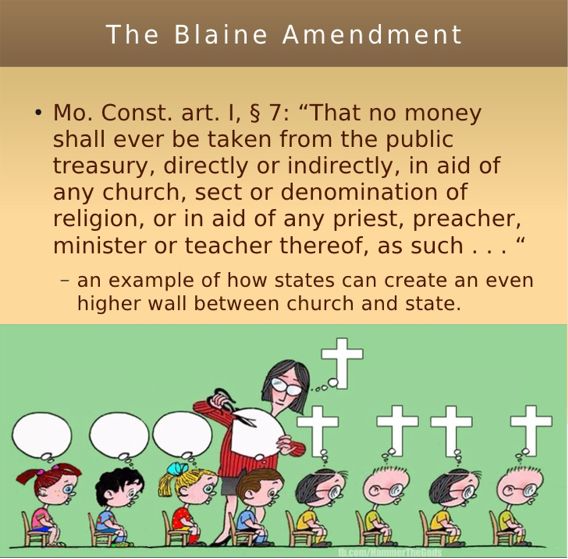
During its upcoming term, in Espinoza v. Montana Department of Revenue, the Supreme Court will decide whether it violates the religion clauses or the equal protection clause of the United States Constitution to invalidate a generally available and religiously neutral student-aid program simply because the program affords students the choice of attending religious schools. In considering the case, the court will examine whether state agencies, such as Montana’s Department of Revenue, can rely on “Blaine amendments” to deny parties direct or indirect access to public funds for use in schools operated by religious groups.
Montana’s Blaine amendment is based on an 1875 proposal by U.S. Representative James Blaine of Maine to amend the U.S. Constitution to prohibit states from using money raised by taxation, or from providing public lands, for the support of schools that are under the control of religious sects or denominations. In Espinoza, Montana officials cited the state’s Blaine amendment as the basis for denying parents seeking to educate their children in the religious schools of their choice access to a K-12 scholarship program funded by state income-tax-credit-eligible contributions to private nonprofit scholarship organizations. Because there are 37 states whose constitutions contain Blaine amendments, the question raised by Espinoza has national significance.
Most likely, during its deliberations, the court will consider the deep history evidencing the anti-Catholic animus at the root of the adoption of the Blaine amendments in the second half of the 19th century. This evidence reflects a nativist fear that providing public funds for the education of millions of children from Catholic European immigrant families would embolden the anti-democratic “Papists,” who, allegedly, would be loyal to Rome, not to liberal republican values.
Of course, supporters of the Blaine amendments made it clear that any prohibitions on the use of public funds for K-12 education conducted by “sectarian” institutions would not prevent the continued moral education of public-school children in accordance with Protestant Christian teachings that, in their view, were foundational to America’s greatness and survival. Thus, by CONTINUE READING: Symposium: Do Blaine amendments create a public-school monopoly over moral education? - SCOTUSblog

QUEST looks forward to working with new Boston Public Schools superintendent | Parents Across America

QUEST looks forward to working with new Boston Public Schools superintendent | Parents Across America

QUEST looks forward to working with new Boston Public Schools superintendent 


News from PAA’s Boston affiliate, QUEST: This past winter and spring, QUEST (Quality Education for Every Student) participated in multiple local advocacy coalitions that were active in the search process for a new superintendent of Boston Public Schools. QUEST and its coalition partners criticized the abbreviated search process and the lack of diverse parent and stakeholder representation on the search committee. But they came to believe that one candidate, Dr. Brenda Cassellius, former Minnesota commissioner of education, offered the best vision for public education of the three finalists. She was very clear and progressive about her thinking on issues such as high-stakes standardized testing, teacher diversity, district budgeting, exam school admissions and parent engagement. Dr. Cassellius was chosen and QUEST looks forward to working with her.
About QUEST: QUEST (Quality Education for Every Student) is a volunteer grassroots organization of CONTINUE READING: QUEST looks forward to working with new Boston Public Schools superintendent | Parents Across America


State of Denial: How Do Charter Schools Meet the Needs of Students in Special Education

State of Denial: How Do Charter Schools Meet the Needs of Students in Special Education

State of Denial: How Do Charter Schools Meet the Needs of Students in Special Education

These large special education enrollment differences raise serious questions about whether some charters are unlawfully either steering such children away, failing to identify students in need of special education, or pushing enrolled students with disabilities out, perhaps through harsh discipline or other means.– UTLA
When it comes to illegally discouraging the enrollment of children with severe special education needs from their publicly funded private schools, charters have a lot of tools available in their toolboxes. Some will use enrollment processes to signal to parents that these children are being screened out or they will force these students into undesirable programs. Others will stress that all of their students are expected to be college-bound or use draconian discipline policies against students who are unable to follow the rules. More blatant is the “counseling out” of students by directly telling parents that their children will do better at another school.


The “Education Reform” movement that birthed these charter schools places a high value on data and, therefore, summarily dismissed anecdotal evidence of these violations. As an example, when the California Charter School Association was asked to CONTINUE READING: State of Denial: How Do Charter Schools Meet the Needs of Students in Special Education

How My Thinking about School Reform Has Changed Over Decades (Part 1) | Larry Cuban on School Reform and Classroom Practice

How My Thinking about School Reform Has Changed Over Decades (Part 1) | Larry Cuban on School Reform and Classroom Practice

How My Thinking about School Reform Has Changed Over Decades (Part 1)

Six years ago, I posted this two-part series about changes in my thinking about school reform. It generated many comments from readers. I return to these posts because I want to see if there have been further changes in my thinking about the never-ending deluge of school reform particularly after the spread of “personalized learning” initiatives have become ubiquitous.  I offer it again since I have many new followers that may not have seen these earlier posts.
Reflections on my thinking about school reform came with a request from colleague Richard Elmore who asked me to write a piece about how my ideas have changed over the years. Daily experience in schools as a teacher, administrator, and researcher (and the writing that I did about those experiences)  altered key ideas I had about the nature of reform and how reform worked its way into districts, schools, and classrooms. He included my piece in a book called I Used to Think… And Now I Think (Harvard Education Press, 2011). I have divided the piece into two parts. Part 1 follows. 
****************************************************************************
I used to think that public schools were vehicles for reforming society. And now I think that while good teachers and schools can promote positive intellectual, behavioral, and social change in individual children and youth, schools are (and have been) ineffectual in altering social inequalities.
I began teaching high school in 1955 filled with the passion to teach history to youth and help them find their niche in the world while working toward making a better society. At that time, I believed wholeheartedly in words taken from CONTINUE READING: How My Thinking about School Reform Has Changed Over Decades (Part 1) | Larry Cuban on School Reform and Classroom Practice

Path for Improving Ethnic Studies Model Curriculum - Year 2019 (CA Dept of Education)

Path for Improving Ethnic Studies Model Curriculum - Year 2019 (CA Dept of Education)

The California Department of Education Outlines Path for Revising and Improving Ethnic Studies Model Curriculum


SACRAMENTO—State Superintendent of Public Instruction Tony Thurmond announced today that the California Department of Education (CDE) has outlined a path to revise and improve the ethnic studies model curriculum draft.
The next step in the process is for the Instructional Quality Commission (IQC) to meet regarding the draft on Friday, September 20.The CDE is recommending that the IQC pause any action on the draft, take more time to revise the draft, and ultimately send it to the State Board of Education (SBE) for action in 2020.
Last week the California State Legislature approved AB 114, extending the timeline for completion of the ethnic studies model curriculum draft through March 2021. The bill now awaits Governor Newsom’s signature. If the IQC acts to extend the timeline for completing the draft, the CDE anticipates taking the following steps:
  • Holding feedback sessions with ethnic studies teachers, ethnologists, experts, and interested parties to get input on what might go into the draft.
  • Consulting with ethnic studies experts on what might go into the draft including convening a panel discussion of experts.
  • Holding listening sessions around the state to hear from the approximately 200 districts that have successfully implemented ethnic studies curriculums.
Dr. Shirley Weber, Assemblymember and IQC member, has agreed to serve on the ethnic studies panel and consult with the CDE and SBE staff to complete the model draft curriculum. Weber is a 40-year educator of Africana Studies who has helped establish ethnic studies in K–12 curriculum throughout the State of California.
To send suggestions for revisions to the curriculum, email ethnicstudies@cde.ca.gov. More information about the ethnic studies model curriculum can be found on the CDE Model Curriculum Projects web page.
# # # #
Tony Thurmond — State Superintendent of Public Instruction
Communications Division, Room 5602, 916-319-0818, Fax 916-319-0100
Last Reviewed: Monday, September 16, 2019
Path for Improving Ethnic Studies Model Curriculum - Year 2019 (CA Dept of Education)

Time to Organize in Florida | VAMboozled!

Time to Organize in Florida | VAMboozled!

Time to Organize in Florida

A few weeks ago, a Florida reporter reached out to me for information about the nation’s value-added models (VAMs), but ialso as specific to the state of Florida. It seems that teachers in Florida were (and perhaps still are) being removed from teaching in Florida schools if their state-calculated, teacher-level VAM scores deemed them as teachers who “needed improvement” or were “unsatisfactory.”
More specifically, the state of Florida is using its state-level VAM to rate teachers’ VAM-based performance, using state exams in mathematics and language arts. If the teachers ultimately deemed in need of improvement or unsatisfactory teach in one of the state’s “turnaround” schools (i.e., a school that is required by the state to have a turnaround plan in place), those teachers are to be removed from the school and placed elsewhere. This is happening by state law, whereby the law dictates that no turnaround school may have a higher percentage of low value-added teachers than the district as a whole, which the state has apparently interpreted that to mean no low value-added teachers in these schools, at all.
Of course, some of the issues being raised throughout the state are not only about the VAMs themselves, as well as the teachers being displaced (e.g., two weeks or so after the school year resumed), but also about how all of this has caused other disruptions (e.g., students losing their teachers a few weeks after the beginning of the school year). Related, many principals have rejected these on-goings, expressly noting that they want to keep many if not most/all of the teachers being moved from their schools, as “valued” by them. I have also heard directly from a few Florida principals/school administrators about these same matters. See other articles about this here and here.
Hence, I’m writing this blog post to not only let others know about what is going on in CONTINUE READING: Time to Organize in Florida | VAMboozled!