Wednesday, June 26, 2019

West Virginia Invests in Public Schools… But Will Now Add Charter Schools | janresseger

West Virginia Invests in Public Schools… But Will Now Add Charter Schools | janresseger

West Virginia Invests in Public Schools… But Will Now Add Charter Schools

Until this week, West Virginia was one of a handful of states which had never experimented with school privatization.  But on Monday night, the West Virginia Senate adopted an omnibus education bill passed a week ago by the West Virginia House of Delegates.  Governor Jim Justice has said he will sign the bill.  The bill includes a raise for teachers, but it also introduces privately operated charter schools into West Virginia for the first time.
Some History
The debate has been long and contentious.  It began in February of 2018, when school teachers across the entire state of West Virginia walked out over the conditions in their public schools and their low pay, which has been driving fine teachers out of the profession and away from the state. With that statewide strike, West Virginia’s public school teachers launched the #RedforEd movement that swept across Oklahoma, Kentucky, Arizona, Denver, Los Angeles and Oakland.
The 2018, West Virginia teachers’ strike ended when Governor Jim Justice and both houses of the state legislature agreed to a 5 percent raise for the state’s teachers, support staff, bus drivers and West Virginia state troopers.
Then last October (2018), Governor Justice promised West Virginia’s teachers an additional 5 percent raise. In February (2019), the House of Delegates came forward with an omnibus education bill which included the raise.  But schoolteachers walked out statewide for the second year in a row to protest the addition of two forms of public school privatization—the introduction of charter schools into the state and the launching of an Education Savings Account neo-voucher program—to the House bill.  Finally, the state’s House of Delegates CONTINUE READING: West Virginia Invests in Public Schools… But Will Now Add Charter Schools | janresseger

Tapping Into the News to Teach Math (Forrest Hinton) | Larry Cuban on School Reform and Classroom Practice

Tapping Into the News to Teach Math (Forrest Hinton) | Larry Cuban on School Reform and Classroom Practice

Tapping Into the News to Teach Math (Forrest Hinton)
“Forrest Hinton is a math instructor at the North Carolina School of Science and Mathematics, a STEM-focused public boarding school for high school juniors and seniors in Durham, North Carolina. He teaches a wide range of core and elective math courses in his department and for programs like Summer Accelerator and ENC STEM. He also serves as the coordinator of the Teaching Contemporary Mathematics Conference. In his work, he inspires students to critically examine and improve systems by using analytical tools from mathematics and statistics. He is strongly committed to making the study of advanced mathematics more accessible to students who have traditionally been underrepresented in the field.”
This article appeared in Edutopia, June 7, 2019

“Why should the people who work hard and earn more money foot most of the tax bill?”
“People at the bottom need their dollars more than those at the top.”
These are snippets of a political debate that many would expect to read in The Washington Post. They wouldn’t expect to hear these ideas in a high school math class. Yet these are the types of ideas I regularly hear in my classroom. Sure, my students solve equations and graph curves like all students, but they also apply CONTINUE READING: Tapping Into the News to Teach Math (Forrest Hinton) | Larry Cuban on School Reform and Classroom Practice

Budget Victory: The Age of Newsom Begins in State Education | Capital & Main

Budget Victory: The Age of Newsom Begins in State Education | Capital & Main

Budget Victory: The Age of Newsom Begins in State Education
Still pending in a follow-up budget bill is language that would limit the ability of charter schools to cherry-pick enrollment.

“Learning Curves” is a weekly roundup of news items, profiles and dish about the intersection of education and inequality. Send tips, feedback and announcements of upcoming events to  braden@capitalandmain.com, @BillRaden. Abby Kingsley contributed to this column.

California governor Gavin Newsom racked up significant wins last week when his first education budget sailed through the legislature mostly intact. A minimum increase, mandated by Prop. 98, will bump funding for K-12 and community colleges by $2.9 billion, to $81.1 billion in 2019-20. The best news for the Golden State’s chronically cash-strapped school districts may be the estimated $850 million freed up over the next two years by the $3.15 billion pension obligation paydown Newsom unveiled in January. Also included is spending that emphasizes Newsom’s commitment to early education:
  • A $1.8 billion down payment on the governor’s long-term plan to institute universal preschool and vastly expand subsidized childcare for low-income families.
  • $646 million for special ed, with nearly $500 million earmarked for preschool.
  • $300 million in one-time facilities funding for districts expanding to full-day kindergarten (a reduction by half of the $600 million requested).
Still pending in a follow-up budget bill is language that would limit the ability of charter schools to cherry-pick enrollment, by banning the requirement of student academic records for admissions and outlawing the “counseling out” of low-achievers and students with learning disabilities.
For higher ed, lawmakers signed off on Newsom’s pledge to keep college tuition flat for 2019-20 and provided money to expand in-state undergraduate enrollments at the 10 UC campuses by 4,860, and by 10,000 in the 23-campus Cal State system. There is also aid for homeless and hungry students, and up to $6,000 for students who are parents of dependent children to pay for tuition and living costs.
One area where Newsom’s spending priorities are out of step with average Californians—not to mention the majority of Democrats vying for the party’s 2020 presidential nomination—is college affordability. According to a policy brief released this week by the nonpartisan research center, Policy Analysis for California Education (PACE), Golden State voters ranked the costliness of attending college as the second most important education CONTINUE READING:  Budget Victory: The Age of Newsom Begins in State Education | Capital & Main

The Billionaire Financed Racist Attack on Camden’s Schools | tultican

The Billionaire Financed Racist Attack on Camden’s Schools | tultican

The Billionaire Financed Racist Attack on Camden’s Schools

By T. Ultican 6/25/2019
The rape of public education in Camden, New Jersey is a classic example of “segrenomics.” In 1997, one of the only functioning organizations in the city of Camden was the public school system. This city often labeled “the most dangerous city in America” had 19,303 students registered into Camden City School District (CCSD). Ninety-five percent of those students were either Black (56.5%) or Hispanic (38.9%). In 2018, CCSD had 6800 students registered into its public schools.
In her masterpiece Cutting School, Noliwe Rooks defined “segrenomics.” She noted that to lift all children up requires racial and economic integration and she encourages us to educate poor students with wealthy students; not falling for the separate but equal fallacy. Unfortunately, today, poor children experience a recurrent push towards vocational education. Their schools often employ “cost effective” forms of funding and delivery such as cyber schools, students at screens and blended learning.  Rooks observes,
“While not ensuring educational equality, such separate, segregated, and unequal forms of education have provided the opportunity for businesses to make a profit selling schooling. I am calling this specific form of economic profit segrenomics. Segrenomics, or the business of profiting specifically from high levels of racial and economic segregation, is on the rise.”

Camden

Camden Images
Camden, New Jersey Images
When crossing the Delaware River from Philadelphia on the Ben Franklin Bridge, you arrive in Camden, New Jersey. A small city of 77,000 Camden was incorporated in 1828. It was a prosperous manufacturing center up until the 1950’s when its population peaked at 125,000 and manufacturing jobs started leaving.
By the 1990’s corruption and violence were wracking the city. In December of 2000, Mayor Milton Milan was convicted of taking bribes. Ralph Natale the former boss of the Philadelphia-South Jersey mob turned state’s evidence against Milan. The Mayor’s predecessor, Arnold Webster pleaded guilty to CONTINUE READING: The Billionaire Financed Racist Attack on Camden’s Schools | tultican


Mike Klonsky's Blog: We need a radical change in the way we rate our schools

Mike Klonsky's Blog: We need a radical change in the way we rate our schools

We need a radical change in the way we rate our schools
You know, buy a house near a Level 1 school and pay $20K more for not much of a house. 
"Education is not preparation for life; education is life itself." -- John Dewey

Watching my 2-year-old granddaughter, Izzy, learn is one of the great pleasures in my life. Whether she's helping her grandma cook up some eggs, finding a worm while digging on the lawn, pedaling a trike, or stomping around with a tap dancer at a recent birthday party, it's a joy to actually watch her grow and develop physically and intellectually at the moment it's happening.

It's authentic learning. No standardized testing required.

I bring this up once more after reading about another CPS plan to tweak the way the system rates its schools; i.e., Level 1, Level 2, Level 3, etc...  in a high-stakes competition where the loser may have their school closed. I always thought these ratings were more for the benefit of realtors than educators. You know, buy a house near a Level 1 school and pay $20K more for not much of a house.

The new tweaked plan will be presented at Wednesday's first meeting of the mayor's newly-appointed school board.

According to Chalkbeat:

Chicago Public Schools has proposed tweaking its school rating policy to reflect how well elementary schools prepare students for high school and how well high schools help students plan life after graduation — and the district also will finally grade dozens of specialty high schools that had lacked rating systems.
CPS says its School Quality Rating Policy (SQRP) is "a five-tiered performance system based on CONTINUE READING: Mike Klonsky's Blog: We need a radical change in the way we rate our schools


Report: Experienced Teachers Key to Students Beating the Odds

Report: Experienced Teachers Key to Students Beating the Odds

Report: Experienced Teachers Key to Students Beating the Odds

Experienced teachers are the common factor among 156 California school districts where black and Hispanic students, as well as white students, are beating the odds and scoring higher than expected on tests that measure higher-level critical thinking skills, according to new research from the Stanford University-based Learning Policy Institute (LPI).
“The research finds that providing students with qualified, fully prepared teachers is a critical component for raising student achievement,” said Anne Podolsky, lead author of “California’s Positive Outliers: Districts Beating the Odds,” who added that she believes the findings should show education policymakers “the importance of [educator] recruitment and retention.”
why experienced teachers matter
These findings are consistent with other research that points to the importance of a qualified, experienced teacher, and adds to the urgency around a growing U.S. teacher shortage, especially in high-poverty districts.
Like many states, California has struggled to hire highly qualified, experienced teachers for its classrooms. Last year, it issued nearly 5,000 “intern credentials” to teachers with just a few weeks of preparation, plus nearly 6,000 “short-term staff permits” that require no teacher training. The problem is particularly acute in high-poverty districts. In 2017, LPI found that two-thirds of the state’s principals in high- CONTINUE READING: Report: Experienced Teachers Key to Students Beating the Odds

As usual, a lack of transparency and accountability in DC’s public and charter schools | GFBrandenburg's Blog

As usual, a lack of transparency and accountability in DC’s public and charter schools | GFBrandenburg's Blog

As usual, a lack of transparency and accountability in DC’s public and charter schools

All that is laid out in detail by Valerie Jarrett.
Here is her article:
Tomorrow, Wednesday June 26, the city council will hold a hearing on two bills, which are generally aimed at budget transparency in our publicly funded schools—most notably, for better recording and tracking of all public funds, especially at risk funds. The latter are supposed to supplement, not supplant, other expenditures in our schools, to target resources to meet the needs of the most vulnerable children in our city.
(See here and here for each bill–0046 and 0239, respectively. School data expert Mary Levy has a good redline version of DC Code to show what would change with each.)
Transparency in at risk funding in DC’s publicly funded schools has been historically bad. While it has reported its use of at risk funds generally, DCPS has repeatedly not followed the law regarding use of the money. Charter schools, on the other hand, have only voluntarily reported their use of at risk money–and the incomplete reporting in available documents varies wildly, with CONTINUE READING: As usual, a lack of transparency and accountability in DC’s public and charter schools | GFBrandenburg's Blog


NYC Public School Parents: High levels of lead dust found in city schools via an independent WNYC investigation

NYC Public School Parents: High levels of lead dust found in city schools via an independent WNYC investigation

High levels of lead dust found in city schools via an independent WNYC investigation


Yesterday Christopher Werth of WNYC radio posted a story online at Gothamist and broadcast on WNYC about an investigation he undertook in four NYC schools in which he found high levels of lead dust on the floor and windowsills from peeling paint. WNYC had emailed the principals and PTAs at over 30 public elementary schools built before 1960 — the year lead-paint was banned in New York City --  and gained entrance to only these four.

Werth took samples in preK to second grade classrooms and in common areas shared by students age six and below -- who are at the greatest risk of lead poisoning. In each of these schools,  there were serious violations that exceeded limits adopted by the City Council for floors -- currently at 10 micrograms per square foot, to be lowered to five micrograms by 2021.  Some samples contained lead 1000 times above this limit.

The reality is there is NO safe amount of lead in the blood; and the lowest levels that can be detected have significant negative impacts on a child's cognitive abilities and behavior.


Similarly, a recent audit by the NY State Comptroller  found preK classrooms in CBOs and in public schools with "potential fire and safety hazards,  toxic cleaning supplies" - and in at least one case, peeling lead paint.


DOE has a poor history when it comes to testing for lead.  For years, district officials insisted on using a discredited method to test in school water, by flushing the water first -- even when this method violated EPA guidance and by 2016, a new state law.

As Dr. Morri Markowitz, lead expert at Montefiore hospital, says in the Gothamist article, “Do I trust the New York City Department of Education to conduct a fair, objective study CONTINUE READING: 
NYC Public School Parents: High levels of lead dust found in city schools via an independent WNYC investigation


Moving Away from the Digital in a Smartphone-Altered Universe | One Flew East

Moving Away from the Digital in a Smartphone-Altered Universe | One Flew East

MOVING AWAY FROM THE DIGITAL IN A SMARTPHONE-ALTERED UNIVERSE

Skinner teaching machine.
One of B. F. Skinner’s teaching machines. Silly rabbit [CC BY 3.0 (https://creativecommons.org/licenses/by/3.0)%5D
Never were online courses adequate substitutes for face-to-face teaching. Like correspondence courses before them, they do fill a need and they can provide motivated students with a viable alternative. But they should never have been preferred or seen as a blanket equivalent to direct interaction with a professor. That is more true today than ever before, primarily because of the stunning success of the smartphone

Yet, because they are cheaper and because they reduce the power of the faculty, online courses are still beloved by administrators and funders. They simplify educational structures and remove vexing questions of space utilization. They also reduce responsibility: When there is no direct oversight, the distant overseer can step aside from blame when the student fails.
At the same time that digital platforms for learning were digging their claws into our educational structures–far too deeply–the milieu in which education operates was also changing. Changing to the point where the new smartphone milieu is standing the assumptions of educators dedicated to the digital on their heads.
Soon after developing his teaching machine (maybe even before), B. F. Skinner realized he was not creating a replacement for teachers but a new tool for them. He always appreciated the need for direct human interaction as a part of teaching. Education administrators who have bought into the various digital-platform models, on the other hand, have long seen their avenues of digital instruction as a way to reducereliance on teachers by regularizing curricula through digital replication and turning the teachers into overseers, people there simply to solve problems as students take more and more control of their CONTINUE READING: Moving Away from the Digital in a Smartphone-Altered Universe | One Flew East

Tuesday, June 25, 2019

Diane Ravitch Wants Philanthropy to Support Rebirth of Public Schools - Philanthropy Women

Diane Ravitch Wants Philanthropy to Support Rebirth of Public Schools - Philanthropy Women

Diane Ravitch Wants Philanthropy to Support Rebirth of Public Schools

Philanthropy aimed at K-12 education in the U.S. has ramped up in the past few decades and remains complex and controversial. Funders back diverse causes like delivering new learning technologies, establishing charter schools and backing professional development for public school teachers, among many others. Along with local and regional funders, major philanthropies like the Bill and Melinda Gates, Broad and Walton Family Foundations direct hundreds of millions to education annually.
Diane Ravitch says these funders should prioritize helping under-resourced American learning institutions and families by supporting traditional public schools and their teachers, and addressing income inequality. She discussed these topics as well as funding for girls and the pitfalls of charter schools with Philanthropy Women. Ravitch is an education author and historian and a former U.S. Assistant Secretary of Education. She is currently a research professor of Education at New York University and president of the Network for Public Education, which she founded.

Ravitch on Addressing American Inequality

“Our society is reaching a very dangerous moment because of the vast increase in income inequality and wealth inequality… The richest are getting very rich, while many in the middle class are one paycheck removed from poverty,” Ravitch says. She thinks a higher minimum wage and greater investments in public schools, teachers’ salaries and public health services are necessary.
Some of the related philanthropic causes she believes in are reducing class size, protecting student privacy, women’s reproductive health and rights, civil liberties and social justice. Ravitch has also previously upheld universal PreK as a way to “make school a stronger equalizer than it is today.” She mentions the Network for Public Education, Class Size Matters, Parents Coalition for Student Privacy, Planned Parenthood, American Civil Liberties Union, People for the American Way, Southern Poverty Law Center and Education Law Center as organizations working in some of the fields she cares most about.

How Can Women Donors Fund Girls’ Education?

Ravitch shares some thoughts and advice specific to women donors and CONTINUE READING: Diane Ravitch Wants Philanthropy to Support Rebirth of Public Schools - Philanthropy Women

Big Education Ape: Pre-Order Diane's New Book - Slaying Goliath - Network For Public Education - https://bigeducationape.blogspot.com/2019/06/pre-order-dianes-new-book-slaying.html

After the Confession: How Will They Fix the Damage Done to Public Schools?

After the Confession: How Will They Fix the Damage Done to Public Schools?

After the Confession: How Will They Fix the Damage Done to Public Schools?

Nick Hanauer is described as “founder of the public-policy incubator Civic Ventures.” His piece in The Atlantic called “Better Public Schools Won’t Fix America,” is an admission that the corporate message we’ve heard for years that schools will fix the problems of the economy and society is false. Most of us knew this.
Here is some of what Nick Hanauer says.
What I’ve realized, decades late, is that educationism is tragically misguided. American workers are struggling in large part because they are underpaid—and they are underpaid because 40 years of trickle-down policies have rigged the economy in favor of wealthy people like me. Americans are more highly educated than ever before, but despite that, and despite nearly record-low unemployment, most American workers—at all levels of educational attainment—have seen little if any wage growth since 2000.
The article became more significant when President Obama, the Race to the Top President, weighed in to say he agreed with Hanauer. Many were pleased and irritated.
The President said:
This is worth a read: a thought-provoking reminder that education reform isn’t a CONTINUE READING: After the Confession: How Will They Fix the Damage Done to Public Schools?

Meet Stephanie Grisham, Charter School Propagandist, Melania Trump’s enforcer - The Lily

Meet Stephanie Grisham, Melania Trump’s enforcer - The Lily

Meet Stephanie, Charter School Propagandist, Melania Trump’s enforcer
White House staffers are learning that Grisham is not someone with whom to tangle
...before Romney, she’d created her own small public relations firm, worked for AAA Arizona, the Arizona Charter Schools Association, and Larson Public Relations, which represents education reform clients across the country.
In President Trump’s circle, Stephanie Grisham has proven her loyalty — for years.
Few in Trump’s White House have a history with him that dates as far back as Grisham’s. For nearly two years, she served as communications director for first lady Melania Trump. A few weeks ago, she received a promotion to her deputy chief of staff for communications and has become one of the more powerful figures in the ever-evolving Trump White House. In the summer of 2015, she was a lowly press wrangler on Trump’s campaign.
During the campaign she developed a good relationship with the president, and that’s carried through,” White House press secretary Sarah Sanders says. “She has developed a great amount of trust from both the president and the first lady, which is a pretty high commodity here,” Sanders adds. “There aren’t a lot of people who have a lot of regular interaction with both of them.”

Protecting the president and first lady

Grisham’s role has drawn attention for her acerbic statements directed at those who have crossed Melania Trump and her husband. When Trump attacked Mika Brzezinski in the summer of 2017 and claimed falsely in a tweet that she was “bleeding badly from a facelift,” rather than shying away from the controversy, Grisham offered this statement on Melania Trump’s behalf: “When her husband gets attacked, he will punch back 10 times harder.”
When Donald Trump’s first wife, Ivana Trump, cheekily called herself the “first Trump wife” and CONTINUE READING: Meet Stephanie Grisham, Melania Trump’s enforcer - The Lily

Nazi death camps started out very much like the American concentration camps of today | Eclectablog

Nazi death camps started out very much like the American concentration camps of today | Eclectablog

Nazi death camps started out very much like the American concentration camps of today


In our podcast this week, we interviewed journalist Andrea Pitzer, author of the important book One Long Night – A Global History of Concentration Camps. In the interview she talks extensively about how the German concentration camps during the lead up to World War II did not start out as the death factories that they eventually became. However, over time, they became something far more evil.
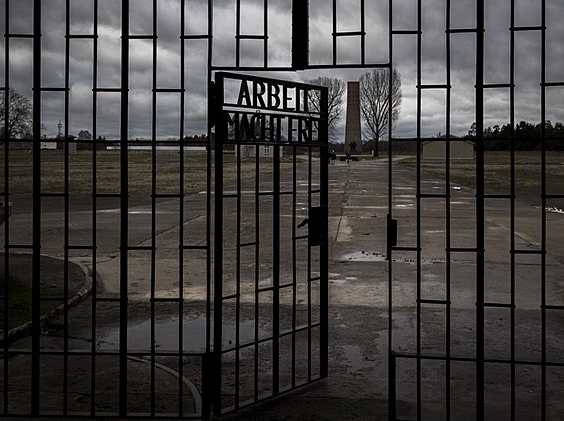
In today’s guest post, my friend Danny Steinmetz of Ann Arbor talks about his family’s experience with one of those early German concentration camps in Sachsenhausen. In his essay, Danny makes this important observation: “When AOC speaks of concentration camps I don’t think of Auschwitz’s gas chambers. I think of Sachsenhausen. I think of its harsh conditions leveraged to force a man, German to the core, to give up on living there. That is exactly the intent of the Trump regime’s policies of family separations, denials of asylum, ICE raids, and harsh conditions within the camps.”

The Sachsenhausen concentration camp in Germany

My Family’s “Concentration Camp” Story at Sachsenhausen and How it Lines Up with AOC’s Usage


Dachau was the original Nazi concentration camp and from 1933 to 1938 its prisoners were mostly non-Jewish political opponents of the regime. It was primarily a prison and labor camp. There were no gas chambers or any other mass murder facilities there during its early years. Dachau was in a suburb of Munich in the south of Germany. Sachsenhausen, opened in 1936, was CONTINUE READING: Nazi death camps started out very much like the American concentration camps of today | Eclectablog


Policy differences. Demeanor differences. None of it stopped Donald Trump from picking Betsy DeVos as education secretary. - The Washington Post

Policy differences. Demeanor differences. None of it stopped Donald Trump from picking Betsy DeVos as education secretary. - The Washington Post

Policy differences. Demeanor differences. None of it stopped Donald Trump from picking Betsy DeVos as education secretary.

Before Donald Trump nominated Betsy DeVos to be his education secretary, what information did Trump’s team consider about the Michigan billionaire?
The news organization Axios said it obtained nearly 100 internal vetting documents from the Trump camp about dozens of people hired in the administration. They included John F. Kelly, former national security adviser and later chief of staff; Jim Mattis, former secretary of defense; Ben Carson, secretary of Health and Human Services; and DeVos.
According to the documents, Trump’s team knew that DeVos didn’t care much for him, at least not before she became education secretary. You can read the entire DeVos vetting document here, but here are some key takeaways:
  • In July 2016, DeVos refused to back Trump because of “serious policy differences.” The document said she opposed his push to build a wall along the U.S.-Mexico border and his proposal to deport millions of illegal immigrants, and his “warming” to Russian leader Vladimir Putin.
  • DeVos said she had reservations about Trump “as a person,” and also “doubted his demeanor.” It quoted DeVos as saying in May 2016, “Until we have a better reason to embrace and support the top of the ticket, and see an agenda that is truly an opportunity agenda, then we have lots of other options in which to invest and spend our time helping."
  • DeVos attended the July 2016 Republican presidential convention and voted not for Trump but for Ohio CONTINUE READING: Policy differences. Demeanor differences. None of it stopped Donald Trump from picking Betsy DeVos as education secretary. - The Washington Post

6 Ways to Keep Your Students Engaged in the Classroom - Teacher Habits

6 Ways to Keep Your Students Engaged in the Classroom - Teacher Habits

6 Ways to Keep Your Students Engaged in the Classroom


Guest Writer: Paisley Hansen
Keeping your students engaged in the classroom is becoming harder than ever before. With the short attention spans of kids in today’s society, you need to do whatever you can to keep your students engaged. There are many different ways that you can create engaging class material that will stimulate and bring your kids to a whole new level of excitement in your classroom. Once you start implementing these new ways of teaching, you will find that it is much easier for you to have a classroom that is enjoyable for both you and the students. 

Utilize social media 

In our modern age, it is important that you take advantage of social media. This is something that your students are going to be on quite regularly. Starting profiles for your classroom on major social media networks is a great way to keep your kids engaged. You will be able to appeal to their love of social media and have them engage on a much more regular basis. Learning the art of social media is something that may take a while to get the hang of. However, if you keep working at it, you will become a social media natural in no time. 

Use media to make your lessons more engaging 

Kids today are so used to seeing so many engaging videos and pictures. If you aren’t taking advantage of these tools, you are greatly missing out on an awesome opportunity to engage with your students. You need to make sure that you are using CONTINUE READING: 6 Ways to Keep Your Students Engaged in the Classroom - Teacher Habits 

Music students do better in school than non-musical peers -- ScienceDaily

Music students do better in school than non-musical peers -- ScienceDaily

Music students do better in school than non-musical peers


High school students who take music courses score significantly better on math, science and English exams than their non-musical peers, according to a new study published in the Journal of Educational Psychology.
School administrators needing to trim budgets often look first to music courses, because the general belief is that students who devote time to music rather than math, science and English, will underperform in those disciplines.
"Our research proved this belief wrong and found the more the students engage with music, the better they do in those subjects," said UBC education professor and the study's principal investigator, Peter Gouzouasis. "The students who learned to play a musical instrument in elementary and continued playing in high school not only score significantly higher, but were about one academic year ahead of their non-music peers with regard to their English, mathematics and science skills, as measured by their exam grades, regardless of their socioeconomic background, ethnicity, prior learning in mathematics and English, and gender."
Gouzouasis and his team examined data from all students in public schools in British Columbia who finished Grade 12 between 2012¬ and 2015. The data sample, made up of more than 112,000 students, included those who completed at least one standardized exam for math, science and English, and for whom the researchers had appropriate demographic information -- including gender, ethnicity, neighbourhood socioeconomic status, and prior learning in numeracy and literacy skills. Students who studied at least one instrumental music course in the regular curriculum counted as students taking music. Qualifying music courses are courses that require previous instrumental music experience and include concert band, conservatory piano, orchestra, jazz band, concert choir and vocal jazz.
The researchers found the predictive relationships between music education and academic achievement were more pronounced for those who took instrumental music rather than vocal music. The findings suggest skills learned in instrumental music transfer very broadly to the students' learning in school.
"Learning to play a musical instrument and playing in an ensemble is very demanding," said the study's co-investigator Martin Guhn, CONTINUE READING: Music students do better in school than non-musical peers -- ScienceDaily