Latest News and Comment from Education

Wednesday, June 12, 2019

LAUSD's Plan To Avoid Financial Meltdown For The Next Three Years: LAist

LAUSD's Plan To Avoid Financial Meltdown For The Next Three Years: LAist

LAUSD's Plan To Avoid Financial Meltdown For The Next Three Years

Los Angeles Unified School Board members will meet Tuesday to take public comments on their proposed $9.2 billion budget for the upcoming school year. One week later, board members expect to take a final vote on the spending plan.
Even if the budget is balanced for now, officials warn that LAUSD's long-term financial health is becoming more precarious. This warning has become almost an annual routine in LAUSD, and in recent years, some skeptics have stopped taking them seriously.
But something feels different about this year's budget — if only because of the circumstances in which board members are considering it.
In the past year, Angelenos rallied behind the district's teachers, who went on strike in Januaryto demand higher salaries, smaller class sizes and more support staff for schools. LAUSD officials agreed to pay for all these things, though they warned the gains would only be temporary unless everyone involved could find a way to pay for them.
Just last week, Plan A to fund the agreement long-term — a ballot measure to raise taxes for LAUSD — failed in a special election by a wide margin.
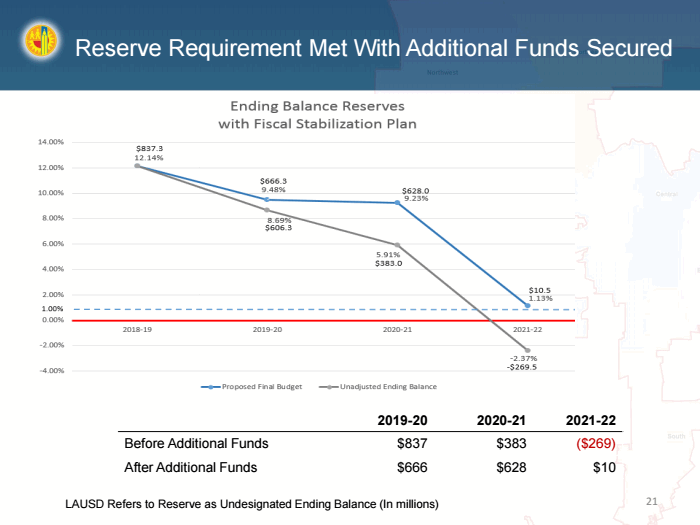
Superintendent Austin Beutner said the budget he's submitting to the LAUSD board Tuesday will avoid a deficit over its three-year course — even if a Plan B for generating that revenue doesn't come together during that period.

Selected portion of a source document hosted by DocumentCloud
"Ending balance" refers to the unassigned balances, but doesn't include "assigned balances" — funds received in previous years that it has committed to spend in future years.
But Beutner said district officials will need to burn through almost all of the $837 million LAUSD currently has in the bank — or, technically, stockpiled "unassigned" funds — to avoid straying into the red toward the end of the three-year budget period.
"The first two years are pretty solid," Beutner said. "They have been before the strike, during the strike and after the strike. The third year is still quite tenuous."
Beutner, like other LAUSD leaders before him, has issued similar warnings in the past. In fact,  CONTINUE READINGLAUSD's Plan To Avoid Financial Meltdown For The Next Three Years: LAist

Budget deal takes shape, details to come in trailer bills :: K-12 Daily

Budget deal takes shape, details to come in trailer bills :: K-12 Daily :: The Essential Resource for Superintendents and the Cabinet

Budget deal takes shape, details to come in trailer bills

(Calif.) State policymakers appear poised to complete the budget prior to California’s June 15 deadline, but a number of trailer bills will determine policies related to funding for early learning, teacher recruitment and credentialing, and special education.
The Legislature’s Conference Committee on the Budget reached agreement on new investments this last weekend, including a push to increase the number of pre-school slots for income-eligible four-year-olds–one of Gov. Gavin Newsom’s key priorities.
Thus far, the governor as well as education leaders have hailed the budget report for adding historic funding for schools, students and teachers throughout the state.
 “This is a strong budget for public schools and an important step on the road toward providing California’s 6.2 million students with the resources needed for a high-quality education,” Emma Turner, president of the California School Boards Association, said in a statement. “Much work remains.”
Some of that spending, however, will hinge on yet-to-be-released trailer bills. While Saturday marks the constitutional budget deadline for lawmakers to approve next year’s spending plan, trailer bills can be voted on later this month, and require only a simple majority to pass.
Under the current iteration of the budget bill, for instance, lawmakers carved out close to $153 million to bring all Local Educational Agencies to the statewide base rate, as well as more than $493 million to provide grants to LEAs serving 3 and 4 year olds with Individualized Education Plans. The committee also noted trailer bill language would need to require ongoing funding to be contingent upon the passage of legislation in the next budget to reform the special education system to improve outcomes for students.
Committee members approved $195 million in one-time spending on the Child Care Early Learning and Care Workforce Development Grant, while also adopting placeholder trailer bill language to “expand trainings and support activities to a broad range of providers.”
In an effort to improve teacher recruitment and preparation efforts for older children, lawmakers CONTINUE READING: Budget deal takes shape, details to come in trailer bills :: K-12 Daily :: The Essential Resource for Superintendents and the Cabinet


Sac City Unified Poised To Have New Budget, But Health Benefits And Labor Issues Remain - capradio.org

Sac City Unified Poised To Have New Budget, But Health Benefits And Labor Issues Remain - capradio.org

Sac City Unified Poised To Have New Budget, But Health Benefits And Labor Issues Remain

On Thursday, the Sacramento City Unified School District board is scheduled to approve a new budget for the next school year, but none of the parties involved are celebrating.
The district's budget proposal is $547.5 million for the coming year, but everyone is focused on the budget forecast for two years from now. If the district does not have enough money to pay its bills in future years, it faces state takeover.
SCUSD says the forecast shows it will be in the red in two years.
"We're currently looking at a $26 million structural budget deficit. That's the amount that we need to cut over the next couple of years,” said Alex Barrios, district spokesman.
But the Sacramento City Teachers Association says the district numbers can’t be trusted since the district has made several errors in its calculations.
"They were projecting a negative ending funding balance of over $54 million two years out. Now, six months later in June, they're projecting a positive ending balance two years out of almost $15 million," said David Fisher, head of the union.
Fisher says the district has another $8 million in a health care benefits fund, but the district and the Sacramento County Office of Education say touching that money is a bad idea. The county has fiscal oversight over SCUSD and says it already has $760 million in unfunded health care benefits.
The district is required by law to approve a budget and submit it to the Sacramento County CONTINUE READING: Sac City Unified Poised To Have New Budget, But Health Benefits And Labor Issues Remain - capradio.org

Teacher Tom: Making A Natural Teacher

Teacher Tom: Making A Natural Teacher

Making A Natural Teacher

People have called me a "natural teacher." I like the sound of it. I even sense the truth of the statement, at least insofar as I can't imagine doing anything else with my days. I hold a degree in journalism, not education. In fact, I've only taken a handful of ed classes. Instead, I've spent thousands of hours working with children of all ages, stretching back to my days as a baseball coach during my teen and early adult years. And yes, it feels natural. It always has.

I had reason recently to reflect on my first day as "head coach" of a team of first and second graders. I was 16-years-old. I'd already, the summer before, served as an assistant coach to a team of preschoolers (which hadn't been baseball so much as a big daily play date with a baseball theme), but this was the first time I was on my own with a team. I was nervous, of course, but only before I'd opened my mouth for the first time. I sent them to run some laps, then we re-convened for some warm up exercises before launching into baseball skills. It was my first 9-5 job, one during which I coached teams of kids from 5-14, boys and girls, and it was glorious. I did it for 4 summers all told: outdoors, all day, playing baseball with kids. It was my first job and, I'm afraid, it ruined me for every "real" job I tried until I landed on my current one.


In a way it saddens me to realize that I wasted the next couple decades figuring out that this is where I belong, playing with children, thinking with children, learning with children. It's not everyone who falls into their perfect niche right from the start, but I was too young and inexperienced, and growing up in a time when early childhood (heck, teaching in general) wasn't considered a "proper" option for a young man. I just couldn't see it. I thought that the sense of joy came from playing baseball all day long, not the kids.

I do, of course, look back over the path I've taken and, to steal a line from the Grateful Dead, "I see now how CONTINUE READING: Teacher Tom: Making A Natural Teacher

Justice Department sides with Maine families suing for right to use public funds for religious school - The Washington Post

Justice Department sides with Maine families suing for right to use public funds for religious school - The Washington Post

Justice Department sides with Maine families suing for right to use public funds for religious school
The Justice Department is throwing its support to three families suing Maine’s education commissioner, alleging he discriminated against them by not allowing public funds to be used for their children’s tuition at religious schools.
It was the Trump administration’s latest move in an effort to overturn state laws that prevent public money from being used for religious schooling, a stated goal of Education Secretary Betsy DeVos. Most states have similar laws, which are increasingly coming under legal attack in part because of President Trump’s 2017 executive order promoting “Free Speech and Religious Liberty.”
The case in Maine is Carson v. Makin, which was filed last year and takes aim at a 1981 state law restricting the use of public funds. That law was challenged more than a decade ago and was ruled constitutional by a federal court. But the Supreme Court has made recent moves suggesting it might strike down constitutional restraints on the use of public money for religious schools when such a case comes before it.
In Maine, some districts do not have a public high school for residents to attend. The state’s Town Tuitioning Program allows public money to be spent so those children can attend neighboring public or private secular schools.
The three families sued Maine Education Commissioner Robert Hasson, saying they had been discriminated against because of their exclusion from the program and that their constitutional rights invoked in the First and 14th Amendments — including rights to free speech and due process — had been violated.
The Justice Department filed a “statement of interest” in the case this week, supporting the families. The department has previously submitted amicus briefs in lawsuits aiming to overturn these laws, known as Blaine Amendments.
Last month, it filed a statement of interest in support of parents and religious high school students who sued the state of Vermont. They claimed that the state had violated their constitutional right to free exercise of  CONTINUE READING: Justice Department sides with Maine families suing for right to use public funds for religious school - The Washington Post

Ohio Senate Releases Detailed State School District Takeover Plan | janresseger

Ohio Senate Releases Detailed State School District Takeover Plan | janresseger

Ohio Senate Releases Detailed State School District Takeover Plan

You will remember that on May 1, 2019, the Ohio House passed HB 154 to repeal Ohio state school takeovers, which have been catastrophic failures in Lorain and Youngstown under HB 70—the law that set up the state seizure of so-called failing school districts. HB70 was fast tracked through the Legislature in 2015 without hearings. Youngstown and Lorain have been operating under state appointed CEOs for four years now; East Cleveland has been undergoing state takeover this year.
Not only did the Ohio House pass HB 154 six weeks ago to undo HB 70, but its members did so in spectacular fashion, by a margin of 83/12.  The House was so intent on ridding the state of top-down state takeovers that its members also included the repeal of HB 70 in the House version of the state budget—HB 166.
Yesterday afternoon, the Ohio Senate released an amended, substitute HB166—the Senate’s proposal for the state budget.  In the Senate version, there is a detailed 54 page School Transformation Proposal to replace the House’s simple action to undo HB 70.  (The Senate’s School Transformation Proposal begins on p. 14 in the linked section of the Senate Budget.)
The three districts Ohio has already seized with HB 70—and 10 others slated to be taken over in the next two years—are all school districts that serve Ohio’s very poorest children. Last evening, as I plodded through the statutory language in the Senate Budget Proposal, I found myself wondering if the people envisioning this laborious, top-down, state takeover plan—a plan that pretends not to be a state takeover—have spent time trying to transform a complex institution like a school in the kind of community where many children arrive in Kindergarten far behind their peers in more affluent communities.  And I wondered why the Senate’s plan relies on so many of the failed “turnaround” strategies of No Child Left Behind—the federal law that imposed imposed a rigid plan for raising test scores and that left an CONTINUE READING: Ohio Senate Releases Detailed State School District Takeover Plan | janresseger

With A Brooklyn Accent: Mike Hutchinson's 2015 Article on the Billionaire Takeover of Oakland Schools

With A Brooklyn Accent: Mike Hutchinson's 2015 Article on the Billionaire Takeover of Oakland Schools

Mike Hutchinson's 2015 Article on the Billionaire Takeover of Oakland Schools

The Re-takeover
How 4 billionaires have taken control of education policy in Oakland


- Mike Hutchinson -


    Public education is under attack both nationally and here in Oakland.  There has been a well orchestrated and highly financed takeover of our schools in order to privatize them through policies proponents refer to as education reform.  The most known aspect of education reform is charter schools, but these reforms also include Common Core, high stakes testing, outsourcing, virtual schools, school closures, over reliance on technology, teacher evaluations tied to students test scores, and takeovers of parts or even entire school districts. Oakland now has over 40 charter schools and the highest rate of charter schools in the state of California.  Most of the charter schools are run by private companies based outside of Oakland and were started by application, not by parents, educators, or the community.  Charter schools are not required to take all students, are non-union, have not out performed public schools, receive public facilities for little or no cost, receive tax payer support, do not pay on Oakland’s debt to the state, are not subject to public oversight, are exempt from parts of the ed code, and in Oakland, have almost entirely been started in low income communities of color.  Oakland has had charter schools that have lost accreditation, abused students, and stolen money.  Even if Oakland’s School Board rejects a charter school application, the county or the state can overturn Oakland’s decision and grant the charter.  These education reformers have largely been successful in rewriting policy due to an unlikely alliance between conservative Republicans (ALEC, Koch brothers, Jeb Bush) who oppose public education and teachers’ CONTINUE READING: With A Brooklyn Accent: Mike Hutchinson's 2015 Article on the Billionaire Takeover of Oakland Schools

CURMUDGUCATION: FCC To Throttle School Internet

CURMUDGUCATION: FCC To Throttle School Internet

FCC To Throttle School Internet

It looks like a bunch of kerfluffling about more of those oddly-named, obscure gummint programs, but the news from the FCC is ominous for schools.

According to edscoop, the FCC has filed a notice of proposed rulemaking intending to cap the FCC's Universal Service Fund. That fund subsidizes broadband infrastructure and access for schools, libraries, and rural communities. It includes the E-Rate program, which helps get wireless internet into schools.


Yeah, that looks speedy.
E-Rate is not without its controversial features. Not everyone likes the funding mechanism, and in the tradition of the finest government programs, it somehow stands accused of coming wrapped in too much red tape AND lacking sufficient oversight and accountability. People smell free federal money, and so we have examples of schools that grab E-Rate money and use it improperly, as well as internet service providers who overcharge the schools they're serving. And that's before we get to the problems that arise with attempting to implement the filtering requirements.

So E-Rate would undoubtedly benefit from an overhaul. But that's not what the FCC is proposing. What they are proposing is a ceiling on USF growth. It wouldn't hit tomorrow-- the suggested cap is $11.42 billion and the 2018 spending for the fund was $8.2 billion. So this is not an immediate assault so much as a ticking delayed choke.

There's another problematic feature of the proposal. There has already been some capping of the CONTINUE READING: 
CURMUDGUCATION: FCC To Throttle School Internet


NYC Public School Parents: NYC Parents, kids, advocates, union members and elected officials rally for smaller classes

NYC Public School Parents: NYC Parents, kids, advocates, union members and elected officials rally for smaller classes

NYC Parents, kids, advocates, union members and elected officials rally for smaller classes

For Immediate release: June 11, 2019Contact: Leonie Haimson, leoniehaimson@gmail.com; 917-435-9329
On Tuesday June 11 at noon, more than one hundred parents, students, advocates, elected officials and union members gathered on the steps of City Hall to urge the NYC Department of Education and the Mayor to allocate specific funding in next year's budget towards reducing class size.

The rally was co-sponsored by Class Size Matters, NYC Kids PAC, the UFT, Local 372, the Education Council Consortium, and others.  Among the elected officials who spoke eloquently about the need for the Mayor and Chancellor to reduce class size were Manhattan Borough President Gale Brewer, City Council Education Chair Mark Treyger, Council Majority Leader Laurie Cumbo, and Council Members Adrienne Adams, Inez Barron, Barry Grodenchik, and Brad Lander.  
Even though the state’s highest court concluded in 2003 that NYC public school classes were too large to provide students with their constitutional right to a sound basic education, class sizes have actually increased since then, especially in the early grades, where the research is strongest that smaller classes leads to higher achievement and better student outcomes all the way through college and beyond.

Among the other speakers on behalf of the need to fund for smaller classes were Kenneth Cohe,n Regional Director of the NAACP, Maria Bautista of AQE, Benny Lin of the Parent-Child Relationship Association, Eduardo Hernandez of NYC Kids PAC, Shino Tanikawa, co-chair of the Education Council Consortium, Anthony Harmon of the UFT, Donald Nesbit of Local 372 of DC 37,  and Lina Rosario, a 6th grade student in Sunset Park, Kathy Park of Citizen Squirrel and many others.
Leonie Haimson, Executive Director of Class Size Matters, said: “The mayor and the chancellor talk a lot about bringing equity and excellence to NYC schools and some the moves they are making may bring us closer to that goal. But there’s a huge gaping hole in their agenda and that is class size.  Without lowering class sizes there can be neither true equity or excellence in our schools. This fall, more than 330,000 NYC students were crammed into classes of 30 or more.   NYC class sizes are 10-30% larger on average than in the rest of the state.  Classes this large are neither equitable nor excellent, especially as studies show that students of color gain twice the benefit when class sizes are reduced.”
 “Funding for class-size reduction has to become a priority for New York City. Parents and teachers know it has a huge impact on student learning, especially for our most vulnerable populations,” said United Federation of Teachers President Michael Mulgrew.
"Class size reduction is one support that the New York City Department of Education has never fully implemented for students in NYC public schools," said NYC Council Finance Chair Daniel Dromm (D-Jackson Heights, Elmhurst).  "It only makes sense that when there are fewer students in a class, a teacher can individualize their instruction and give students extra support.  More than anything else, this is what our students need.  If we truly want to see our students succeed, we must reduce our class sizes."
“It’s common sense that smaller class sizes help set New York City students up for success,” said Manhattan Borough President Gale A. Brewer. “Funding must be allocated for this important cause—the time to stand up for our students is now.” CONTINUE READING: NYC Public School Parents: NYC Parents, kids, advocates, union members and elected officials rally for smaller classes

Alliance for Philadelphia Public Schools on the State and City’s Floundering Charters | Diane Ravitch's blog

Alliance for Philadelphia Public Schools on the State and City’s Floundering Charters | Diane Ravitch's blog

Alliance for Philadelphia Public Schools on the State and City’s Floundering Charters

Alliance for Philadelphia Public Schools June 5, 2019For immediate release: Statement of APPS Re CREDO study
The CREDO study released today presents more evidence that the charter experiment foisted upon the state’s children has been a resounding failure, especially considering the enormous amount of taxpayer dollars that have been spent on charter schools.  
For many reasons, comparing charters to district schools is not an apples-to-apples exercise. Charter schools receive outside funding from private donors, including significant amounts every year from the Philadelphia School Partnership.  PSP identifies as a non-profit funder of schools, but they have been strong financial and political advocates for privatization and charter expansion. The bulk of their corporate funding goes to non-district schools. 
Charter schools have been cited over the years for unfair practices such as presenting barriers to enrollment, failure to inform students and parents of their due process rights when facing disciplinary action, and expelling students for trivial offenses including being out of uniform and lateness.  Thus, many charters are able to exclude students with special needs, both behavioral and academic.  
Studies done by both Philadelphia City Controller’s Office and the State Attorney General’s Office have documented fraud and questionable spending in some of the city’s largest charter organizations.   Organizations including PCCY and the Education 
Law Center have conducted in-depth studies that show charters do not outperform district schools in most categories. ELC’s recent report shows: 1) the population of economically disadvantaged students is much lower in Philadelphia’s charter schools—70% in the District, 56% in charters; 2) the percentage of English learners is nearly three times higher—11% in District, 4% in charters; 3) few of the special education students in the traditional charters are from the low-incidence disability categories, such as autism and intellectual disability, that are most expensive to serve.
The diversion of public funds to privately managed charters has made it more difficult for public schools to fund essential programs, but public schools still manage to outperform charters in most categories.  Lack of CONTINUE READING: Alliance for Philadelphia Public Schools on the State and City’s Floundering Charters | Diane Ravitch's blog

Tuesday, June 11, 2019

Jeff Bryant: Charter Schools Are a Major Dividing Line for the 2020 Democratic Candidates—Education Fights in Pennsylvania Point the Way | Common Dreams Views

Charter Schools Are a Major Dividing Line for the 2020 Democratic Candidates—Education Fights in Pennsylvania Point the Way | Common Dreams Views

Charter Schools Are a Major Dividing Line for the 2020 Democratic Candidates—Education Fights in Pennsylvania Point the Way
Charter schools now cost Pennsylvania taxpayers over $1.8 billion annually and account for over 25 percent of the state’s basic education funding

Charter schools have finally broken into the national political dialogue, with presidential candidates in the Democratic Party proclaiming their stances on these schools. But a national debate about charters and “school choice” will be an exercise in empty rhetoric unless the candidates’ views are grounded in the real consequences of how charter schools and school choice affect communities.
Although much of the debate is stuck to a bumper sticker message about the need for families to have a choice to attend charter schools, few if any candidates seem willing to acknowledge providing families with an option to choose charters can come with considerable costs to everyone else in the community.
To understand those costs, consider Pennsylvania, where the costs of charter schools are most blatantly apparent but nevertheless representative of the cost of charters everywhere.
A ‘Perfect Storm’ Crushing the Middle Class
Across the state, charter schools are part of what Dan Doubet tells me is “a perfect storm of economic factors crushing down on middle- and working-class families.” Doubet is executive director of Keystone Progress, a Pennsylvania-based activist group focused on progressive issues and community organizing.
Pennsylvania passed its charter school law in 1997 and now has 179 charter schools enrolling 135,100 students, the sixth highest charter school enrollment in the nation. One in four of these students attends “cyber charters,” statewide schools that operate online.
Although charter schools are promoted to Pennsylvania families as a free option to look outside their neighborhood public schools, the costs of charters are borne by local school districts—and all the taxpayers who support them. Charter schools now cost CONTINUE READING: Charter Schools Are a Major Dividing Line for the 2020 Democratic Candidates—Education Fights in Pennsylvania Point the Way | Common Dreams Views

Have West Sacramento Charters Become Self-Segregated Enclaves? | Capital & Main

Have West Sacramento Charters Become Self-Segregated Enclaves? | Capital & Main

Have West Sacramento Charters Become Self-Segregated Enclaves?
Borders, boundaries and barriers have been a way of life in the lower Sacramento Valley since the Gold Rush days. The newest form of green line here are charter schools.
West Sacramento is hardly alone when it comes to racially isolating charter schools. A 2017 Associated Press study was the latest to find rampant self-segregation in the national charter sector, reporting that charters are “vastly overrepresented” among so-called apartheid schools — those with at least 99 percent minority enrollments. Even in majority-minority California, which scores higher on charter school integration than other states, black students have been shown to typically move from a traditional public school that is 39 percent black to a charter that is 51 percent black.
“The problem with charters is their fundamental premise that if something’s not public it’s going to be better,” says Gary Orfield, co-director of the Civil Rights Project (CRP) and a research professor at UCLA’s Graduate School of Education. “We learned in the civil rights period that you had to have requirements on [school] choice if you’re going to get a positive outcome. But a lot of these charter schools are set up in a way that explicitly [segregate]. They don’t reach out for other groups of kids and have no integration policies at all, which raises big constitutional issues.”

“Dual-language programs have been a way that many people have seen to integrate schools. But they can be used to segregate kids.”


A landmark, 2010 CRP study on school choice and segregation found that schools specifically CONTINUE READING: Have West Sacramento Charters Become Self-Segregated Enclaves? | Capital & Main

Gov. Newsom’s task force recommends more discretion to deny charter schools | EdSource

Gov. Newsom’s task force recommends more discretion to deny charter schools | EdSource

Gov. Newsom’s task force recommends more discretion to deny charter schools
Majority of members urge more restrictions, including cutbacks on appeal

In a report forwarded to Gov. Gavin Newsom, the statewide task force on charter schools is unanimously recommending that school districts be given more discretion to approve new charter schools by including “saturation” and need for new schools as factors that districts could consider.
Districts with large numbers of charter schools, like Oakland Unified and Los Angeles Unified, have clamored for financial relief and more controls over charter schools. If Newsom and the Legislature implement the task force recommendation, those districts could cite duplication of effort and charter school overload as reasons for rejecting new applications.
More leeway in decision-making on new charter schools was one of four recommendations — reached by consensus — of the California Charter School Policy Task Force, whose 11 membersinclude representatives of charter school organizations, labor unions and organizations representing county offices of education, school administrators and school districts. State Superintendent of Public Instruction Tony Thurmond has led the task force, which has been meeting privately for between 3 and 5 hours each week from March through May. The recommendations are: CONTINUE READING: Gov. Newsom’s task force recommends more discretion to deny charter schools | EdSource
Image may contain: text

Report Alleges 'School-To-Guardianship Pipeline' - Disability Scoop

Report Alleges 'School-To-Guardianship Pipeline' - Disability Scoop

Report Alleges ‘School-To-Guardianship Pipeline’

Too many people with developmental disabilities are being funneled into guardianships rather than exploring less-limiting options, a new government report suggests, and schools may be to blame.
report out this week from the National Council on Disability finds that schools often provide biased information leading many parents to pursue guardianship, creating a “school-to-guardianship pipeline.”
As a result, 58 percent of people with intellectual and developmental disabilities ages 18 to 22 have guardians. And, once established, the council said many people remain under guardianship for decades.
For the report, the federal agency tasked with advising Congress, the president and other government officials on disability issues, looked at data on guardianships, information collected from stakeholders across the country and examined the experiences of people with intellectual and developmental disabilities in Washington, D.C. both before and after guardianship reforms took effect in the city in 2015.
School officials often ask parents about guardianship when students with disabilities turn 18, and in many cases educators do not present other options because they are unfamiliar with alternatives, the report found.
Families told the National Council on Disability that they were informed by schools that guardianship was the only way that a student with an intellectual or developmental disability could continue having a family member or friend assist at individualized education program, or IEP, meetings.
“Youth with ID/DD are ultimately disempowered by schools actively encouraging guardianship to the exclusion of less-restrictive alternatives, and not providing families and students in special education with sufficient information about the CONTINUE READING: Report Alleges 'School-To-Guardianship Pipeline' - Disability Scoop

BILL AYERS: about Becoming a Teacher | Teachers College Press

about Becoming a Teacher 9780807761496 | Teachers College Press

BILL AYERS: about Becoming a Teacher
\

about Becoming a Teacher

Publication Date: April 5, 2019
Pages: 96

Education activist William Ayers invites new and prospective teachers to consider the deepest dimensions of a life in teaching. Should I become a teacher? How can I get to know my students? What commitments come with me into the classroom? How do I develop my unique teaching signature? In his new book, about Becoming A Teacher, Ayers muses on 10 such questions (and a little more) to shape and structure an indispensable guide that features hands-on advice and concrete examples of classroom practice, including curriculum-making, building relationships with students and parents, fostering an effective learning environment, and teaching toward freedom. This brilliant and concise text offers a conception of teaching as both practical art and essentially ethical practice.

Task force’s findings signal renewed fight over charters :: K-12 Daily :: The Essential Resource for Superintendents and the Cabinet

Task force’s findings signal renewed fight over charters :: K-12 Daily :: The Essential Resource for Superintendents and the Cabinet

Task force’s findings signal renewed fight over charters

(Calif.) A one-year moratorium on establishing new charter schools won majority support of a blue ribbon task force on charter reforms, the group announced Sunday.
The panel, convened by Gov. Gavin Newsom and led by state schools chief Tony Thurmond, also backed removing the California State Board of Education as the final court of appeal for charter applicants rejected on the local and county levels.
The 11-member task force, a majority of which represent labor unions and traditional public school entities, has no authority to dictate changes in state law or policy—but the backing of new restrictions on charter growth by the group signals a likelihood that lawmakers will return to battle over the question in the coming weeks.
Myrna Castrejón, president and CEO of the California Charter School Association, which was one of the organizations represented on the task force, said in a statement that the education community remains polarized over the growth of charter schools and that the work of the task force has not ended that debate.
“While we recognize that this marks an important step forward in fulfilling the charge entrusted by Governor Newsom to Superintendent Thurmond, there are elements that are deeply concerning and require more work ahead,” she said.
Earlier this year, the governor requested formation of the task force primarily to look at the fiscal impacts of charter growth on traditional public schools. That call came as a wave of legislation was being introduced targeting charter growth, the application process and management rules.
Although Newsom signed a bill in March that imposed new “good governance” requirements on charters, lawmakers set aside a number of further restrictions late last month in anticipation of the recommendations from the task force.
Now, efforts to revise the state’s charter school laws will no doubt take center stage again, and while the governor is generally not supportive of the charter movement, the question still deeply divides CONTINUE READING: Task force’s findings signal renewed fight over charters :: K-12 Daily :: The Essential Resource for Superintendents and the Cabinet

How Can Educators Navigate the STEM Technology Desert? - Teacher Habits

How Can Educators Navigate the STEM Technology Desert? - Teacher Habits

How Can Educators Navigate the STEM Technology Desert?

STEM (science, technology, engineering, and math) jobs are set to increase over the next year and likely beyond — demand has been growing for the past decade. Yet, there aren’t enough graduates pursuing STEM-related careers after graduation. Additionally, teachers who are skilled in these subjects and can teach them in a compelling way are few and far between.
STEM subjects are taught in schools everywhere, but students aren’t as excited about them as art, physical education, or theater (let alone lunch or recess). STEM classes are required, but electives and creative classes are what students get excited about. However, by approaching STEM education in a new way, teachers can show students just how thrilling STEM classes can be.
To start, they simply need to skim news headlines: From increasingly sophisticated AI finding its way into our classrooms to the possibility of insect droids pollinating Mars, what seemed like science fiction a decade ago is now reality. Technology of the future is all part of STEM, and giving learners a window into these developments is sure to spark interest.
But what can educators do once they’ve caught students’ interest? Let’s explore some ways we can improve STEM education in technology deserts.

Three Ideas for Better STEM Education

The best STEM lessons combine interesting, hands-on activities with CONTINUE READING: How Can Educators Navigate the STEM Technology Desert? - Teacher Habits