Latest News and Comment from Education

Friday, April 5, 2019

Let’s fact-check this Betsy DeVos tweet about Trump’s $5 billion school tax credit proposal - The Washington Post

Let’s fact-check this Betsy DeVos tweet about Trump’s $5 billion school tax credit proposal - The Washington Post

Let’s fact-check this Betsy DeVos tweet about Trump’s $5 billion school tax credit proposal


Despite what some may try to tell you . . . Education Freedom Scholarships are privately funded and do not take any money from public schools. #EducationFreedom
That comes from a tweet that Education Secretary Betsy DeVos posted in an attempt to sell the public on the Trump administration’s newest plan to expand alternatives to traditional public schools. And, for the record, it’s not true.
The Trump administration has included in its proposed 2020 budget spending up to $5 billion on tax credits for individuals and groups who donate to help children attend private and religious schools.
The donations, which would receive a 100 percent tax credit, could go for other education-related purposes — all aimed at expanding what DeVos now calls “education freedom” but used to more frequently refer to as “school choice."
The plan, called the Education Freedom Scholarships, has no chance of passing Congress with Democrats in control of the House, and with some Republican opposition.
That hasn’t stopped DeVos from talking and tweeting about it. In the following tweet, she presents a mini flow chart she says shows how the Education Freedom Scholarships would be funded, showing how individuals and organizations could donate to a state-approved organization that can grant scholarships to students.
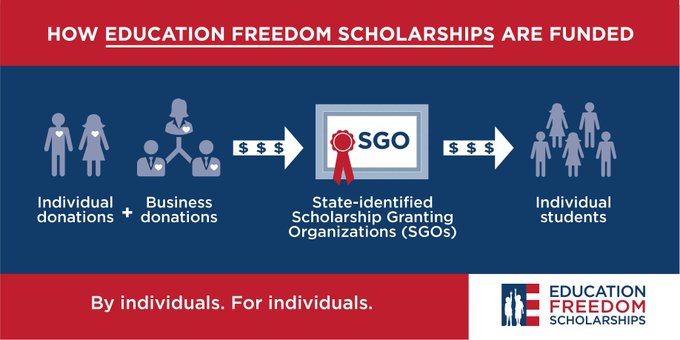


Despite what some may try to tell you…Education Freedom Scholarships are privately funded and do not take any money from public schools.

And she says because these scholarships are privately funded, they “do not take any money from public schools.”
But donors can get a dollar-for-dollar tax credit to donate. That means up to $5 billion of federal taxpayer money will go back to private individuals and groups that donate for scholarships.
That isn’t what many people would call private funding.
Her claim that the scholarships “do not take any money from public schools” is misleading, too.
For one thing, any diminution of federal revenue could affect public school funding. For another, using CONTINUE READING: Let’s fact-check this Betsy DeVos tweet about Trump’s $5 billion school tax credit proposal - The Washington Post


Choosing Democracy: SCUSD Budget Crisis

Choosing Democracy: SCUSD Budget Crisis

Community Priority Coalition 
Both the Education and Democracy Insitute, and LULAC, League of United Latin American Citizens, are part of the Community Priority Coalition.  Our goal is to improve the quality of education for those under served in SCUSD.
Below is the Coalition's response to the current Budget Crisis.


Community Priority Coalition 

 4625 44th Street, Rm 5 Sacramento, CA 95820 

 March 6, 2019 
Jessie Ryan, President 
Darrel Woo, First Vice President 
Michael Minnick, Second Vice President 
Christina Pritchett 
Lisa Murawski 
Mai Vang 
Leticia Garcia 
Rachel Halbo 
Superintendent Jorge Aguilar 

Re: SCUSD financial crisis 
Dear SCUSD Board Members: 

The Community Priority Coalition (CPC) is very concerned about the Sacramento City Unified School District's financial health and deficit spending that will negatively impact students in the District. The Community Priority Coalition members consist of Black Parallel School Board, Building Healthy Communities. Hmong Innovating Politics, La Familia Counseling Center. Making Cents Work, League of United Latin American Citizens (Lorenzo Patiño Council #2862), Sacramento Area Congregations Together, Democracy and Education Institute, and Public Advocates Inc. Since 2016, the Community Priority Coalition has submitted to the Sacramento City Unified District Board an alternative budget that reflect the following Coalition priorities: 

1) Class Size Reduction (24 to 1); 

2) Professional development in cultural proficiency and restorative justice; 

3) Additional instructional assistance for English Language Learner and increased efforts to involve their parents in their education programs. including bilingual counselors, teachers, social workers and other staff; and 

4) After-school/early intervention programs. Although, CPC clearly understands that the District will make very difficult decisions; we are most alarmed that you are unable to address the key concerns of the Coalition given the District history and current financial crisis.
On December 12, 2018, the Fiscal Crisis Management Assistance Team (FCMAT), released the Sacramento City Unified School District's Fiscal Health Risk Analysis report. The purpose of the report is to evaluate SCUSD fiscal health and risk of insolvency in the current and next two fiscal years. The report indicted the District’s financial health by stating “that the district will be cash insolvent in November 2019 (estimated to be October 2019 at the time of FCMAT’s fieldwork) unless significant action is taken.” 

Historically, the District’s mis-management in the accounting department, poor budget development process, poor board decisions, and failure to address the structural deficit have placed the quality of education for the SCUSDs' students in jeopardy. Moreover, the current financial crisis will undermine the Local Control Accountability Plan process and shut out key stakeholders in the process. 
We understand that the District doesn’t want receivership nor do the Coalition, but the historical practices of the District gives us much pause. Therefore, we are urging the district not to use the  District's budget shortfalls in a way that will balance the budget on the backs of students, teachers and staff. 

The Community Priority Coalition sincerely wants to work collaboratively with the Superintendent and SCUSD Board for the betterment of our children. 
Sincerely, 


Community Priority Coalition 

Choosing Democracy: SCUSD Budget Crisis


Thursday, April 4, 2019

We Investigated The Investigator Of All Wrongdoing In LAUSD. Here's What They Think About That: LAist

We Investigated The Investigator Of All Wrongdoing In LAUSD. Here's What They Think About That: LAist

We Investigated The Investigator Of All Wrongdoing In LAUSD. Here's What They Think About That


These were the findings of a KPCC/LAist investigation published earlier this month into how Ken Bramlett ran the Los Angeles Unified School District's Office of the Inspector General — the powerful internal watchdog unit that polices LAUSD from within for waste, fraud or mismanagement.
For L.A. Unified School Board member Nick Melvoin, KPCC/LAist's reporting reflected doubts he'd harbored about Bramlett.
"My assessment of the prior inspector general," Melvoin said in an interview, "was that no, the work product wasn't up to a quality that I would expect."
During a closed-door meeting in June 2018, board members declined to renew Bramlett's contract. Bramlett left LAUSD shortly thereafter. In his interview, Melvoin acknowledged that his concerns about Bramlett's ability to manage the office's culture and caseload played a role in that decision.
Melvoin also noted that the board has already taken action to address those concerns: "We CONTINUE READING: We Investigated The Investigator Of All Wrongdoing In LAUSD. Here's What They Think About That: LAist

Who was at the closed-door DeVos meeting? – TNJTNJ

Who was at the closed-door DeVos meeting? – TNJTNJ

Who was at the closed-door DeVos meeting?

While reporters headed out to set up for a photo-op and gaggle at a Nashville charter school, Gov. Bill Lee and U.S. Education Secretary Betsy DeVos hosted a closed-door roundtable in a conference room in the state Capitol. The specifics of what was discussed were not divulged, but attendees helpfully took photos to give hints about who was there.
Besides the usual suspects of Senate and House leadership, the Beacon Center appears to have been heavily represented with Vice Chairman Joe Scarlett (the retired head of Tractor Supply Co.), board member Fred Decosimo (Lee’s campaign treasurer), and President Justin Owen. Others included Lee Barfield (a former lobbyist and longtime voucher advocate), Victor Evans (of TennesseeCAN), Hugh Morrow (president of Ruby Falls), Bradley Jackson (head of the state Camber), and Mark Gill (president of Rodgers Capital Group). Not pictured is Scarlett’s daughter, Tara.
Seemingly not in attendance? State Education Commissioner Penny Schwinn. (We hear she was out of town on TNReady business)
Recognize anyone else?
UPDATE: Readers suggest that the man at top right, next to Gresham, is Ted Alling of the Lamp Post Group, a co-founder of the Chattanooga Prep charter school. And the on the left, next to Lee Barfield is Glen Gaugh of Madison County, who unsuccessfully challenged then-Rep. Jimmy Eldridge (R-Jackson) in the 2016 Republican primary.

A change to Proposition 13 that homeowners can get behind - Los Angeles Times

A change to Proposition 13 that homeowners can get behind - Los Angeles Times

A change to Proposition 13 that homeowners can get behind


Could a reassessment of Proposition 13 finally be in the wings?
Advocates of the long-needed change have their fingers crossed, now that a measure to revise Proposition 13 has qualified for the November 2020 ballot.
The initiative wouldn’t involve a wholesale review of the 1978 tax-cutting proposition; that’s still considered a politically impossible lift in a state where property tax breaks have become embedded in millions of homes and apartment buildings.
Instead, the measure takes aim at what long has been considered the Achilles’ heel of Proposition 13, namely its treatment of commercial and industrial properties. The idea is to create what’s known as a split roll, in which residences retain their imperviousness to reassessment but business properties don’t.

How long should we allow commercial properties to be assessed at 1975 values, costing local governments and schools billions of dollars?
 PROPOSITION 13 CRITIC LENNY GOLDBERG
“My instincts tell me that the split roll is moving into more positive ground,” Los Angeles Assessor Jeffrey Prang told me, “and if next year there is a big Democratic turnout, that is likely to benefit the initiative.”
The proposal would require that commercial and industrial properties be assessed at full market value and reassessed at least once every three years. That’s a big change from the current law, which allows them to be reassessed only upon a change of ownership.
“That’s a ridiculous, outdated, irrational system which causes damage in many different ways,” says Lenny Goldberg, a veteran critic of Proposition 13 who helped craft the new initiative. “We have this huge hole in the heart of our tax system.”
He’s right. Thanks to Proposition 13, massively profitable commercial properties that haven’t changed hands in decades — Disneyland, say — are billed property taxes at 1970s-vintage assessed valuations while homes and businesses around them have much higher bases.

Changing that system could produce as much as an additional $12 billion in tax revenues in its initial years, according to CONTINUE READING: A change to Proposition 13 that homeowners can get behind - Los Angeles Times


The Cure for Boring Curriculum | Teacher in a strange land

The Cure for Boring Curriculum | Teacher in a strange land

The Cure for Boring Curriculum


The New York Times published a story this weekend about an amazing research-based discovery: a way to fix high schools. The writers (Jal Mehta, who teaches at Harvard, and Sarah Fine, who works at High Tech High in San Diego) spent six years traveling the country, visiting 30 public schools, looking for a cure for boredom, since only about a third of students report feeling engaged in high school.
They assumed that kids were bored because the work was too conventional and easy—and that ‘innovative’ high schools and more rigorous core classes were the solution. But no. It turned out that the answer was curriculum and instructional strategies more like ‘electives, clubs and extra-curriculars.’
In essence, two different logics reign in the same buildings. Before the final bell, we treat students as passive recipients of knowledge whose interests and identities matter little. After the final bell — in newspaper, debate, theater, athletics and more — we treat students as people who learn by doing, people who can teach as well as learn, and people whose passions and ideas are worth cultivating. It should come as no surprise that when we asked students to reflect on their high school experiences, it was most often experiences like theater and debate that they cited as having influenced them in profound ways.
Well. Speaking as a former instrumental and vocal music teacher, my first question is: It took six years and 30 schools (and, undoubtedly, a hefty grant) to figure that out?
I have a few additional questions and observations:
  • The authors mention that about ¾ of fifth graders report being engaged in school. So why didn’t they start there? What is it about being 11 that makes school at least moderately interesting, across the board? Does any of this terminal ennui have anything to do with being an American teenager and all that entails?

  • The authors lump all courses that are not ‘core’ (read: not subject to standardized testing) into an ‘after the bell’ category. In fact, lots of elective courses are squarely part of the standard curriculum in any functional public high school: Visual arts, CONTINUE READING: The Cure for Boring Curriculum | Teacher in a strange land

'As society goes, school goes:’ New report details toll on schools in President Trump’s America - The Washington Post

'As society goes, school goes:’ New report details toll on schools in President Trump’s America - The Washington Post

'As society goes, school goes:’ New report details toll on schools in President Trump’s America

In this age defined by the presidency of Donald J. Trump, our nation is increasingly divided and our political atmosphere highly charged. The contentious environment contributes to other societal problems, even as it makes it increasingly difficult to deal with them. America’s schools are not immune from this division and incivility and are similarly challenged to address a range of issues that confront our society.
--From “School and Society in the Age of Trump” report
That is the start of a new report titled “School and Society in the Age of Trump" that looks at how school principals are dealing with — and how students are affected by — social issues that have been prominent during the Trump presidency: 1) political division and hostility; 2) disputes over truth, facts, and the reliability of sources; 3) opioid addiction; 4) the threat of immigration enforcement; and 5) the threats of gun violence on school campuses.
The report, written by researchers at the University of California at Los Angeles’ Institute for Democracy, Education, and Access, details findings from a nationally representative poll taken of hundreds of high schools principals. And it includes recommendations for school leaders to consider..
This post about the findings was written by Mike Rose, a highly respected research professor in the University of California at Los Angeles Graduate School of Education and Information Studies.
Rose is the author of books that include “The Mind at Work: Valuing the Intelligence of the American Worker,” which demonstrated the heavy cognitive demands of blue-collar and service work and what it takes to do such work well. Other books he has written include “Back to School: Why Everyone Deserves a Second Chance at Education,” “Possible Lives: The Promise of Public Education in America” and “Why School? Reclaiming Education for All of Us.”
By Mike Rose
Schools are porous institutions — what happens in society at large plays out in classrooms and hallways — so the disturbing findings of a masterful new report “School and Society in the Age of Trump” should not surprise. But they do, in their scope and severity.
John Rogers and his colleagues (Michael Ishimoto, Alexander Kwako, Anthony Berryman, and Claudia Diera) at UCLA’s Institute for Democracy, Education, and Access surveyed a nationally representative sample of more than 500 public high school principals from across the country and found this:
*89 percent reported that “incivility and contentiousness in the broader political environment has CONTINUE READING: 'As society goes, school goes:’ New report details toll on schools in President Trump’s America - The Washington Post

Education Privatizers Have Gone Global. So Must We If We Want to Stop Them.

Education Privatizers Have Gone Global. So Must We If We Want to Stop Them.

Education Privatizers Have Gone Global. So Must We If We Want to Stop Them.


In February 2018, West Virginia teachers launched a strike that reawakened a movement. Tens of thousands of teachers from around the country have taken part in what is now the largest strike wave in decades, demanding better public education in the face of years of austerity.
On February 11, 2019, as the U.S. wave continued, teachers union leaders from across Africa gathered in Addis Ababa for a meeting of African Union heads of state with their own demands: to halt the continent’s moves toward privatized education and provide “inclusive and equitable quality free public education for all.”
Though an ocean apart, West Virginia and Addis Ababa are two fronts in the same war. The fight for public education reminds us that working-class struggles around the world are linked—and that international solidarity is the key to victory.
In many U.S. districts, school funding still hasn’t recovered from cuts made during the Great Recession. Teachers are underpaid, classrooms are overcrowded and textbooks are out of date. Rather than increase funding, conservative public figures like Betsy DeVos, Trump’s Secretary of Education, have turned to private and charter schools that deepen inequality and further drain resources from the public system.
At the same time, foreign-owned, for-profit schools like Bridge International Academies and GEMS Education have swept Africa. There is no doubt that the status quo of public education in much of the region is dire: Education systems are largely underfunded, illiteracy remains high and a large gender gaps prevail. But an CONTINUE READING: Education Privatizers Have Gone Global. So Must We If We Want to Stop Them.

Students at school slated for closure face yet another hurdle: no bathrooms | The Lens

Students at school slated for closure face yet another hurdle: no bathrooms | The Lens

Students at school slated for closure face yet another hurdle: no bathrooms


lumbing contractors were digging up Edgar P. Harney elementary school’s lush front lawn on Willow Street Tuesday afternoon while a portable toilet trailer sat on the school’s blacktop playground along busy Claiborne Avenue.
“The bathrooms aren’t working,” one of the workers told The Lens.
A clogged sewer line was initially to blame. But when contractors finally got beneath the Central City school they said they discovered a bigger problem — a dislodged drainage pipe.
“Now, we have to tunnel in to replace it,” he said from the lawn as another worker was standing in roughly a five-foot deep hole.


Orleans Parish School Board spokeswoman Ambria Washington confirmed a line had broken beneath the school. “While repairs are underway, the use of bathrooms inside the school needs to be limited at this time.”
The repairs may take a few days, she explained in an email.
“All repairs are expected to be complete this weekend,” she wrote. “We plan to begin state testing next week.”
On Wednesday afternoon, workers had just begun digging a second hole under the school.
Kishauna Ross’ 14-year-old daughter is in the eighth grade at the 234-student school. She was not pleased with the temporary bathroom trailers because she said the facilities for girls and boys — while they have separate entrances — are housed in the same trailer.

Marta Jewson / The Lens
A portable toilet trailer sits on the blacktop at Harney elementary school in Central City on April 3, 2019. Crews are repairing the school’s drain line and bathrooms are out-of-service while they work to fix a dislodged pipe.
Washington said the portable bathrooms have separate entrances and stalls within them, but she didn’t address adult supervision.
Ross also said she was not informed of the problem.
“I do not like the fact that I didn’t get a letter stating there was a problem with the restrooms at the school,” Ross said on Tuesday.
Nor did she receive a phone call, she said, noting the school often robocalls announcements.
“I really have an issue with it,” she said.
The lack of indoor bathrooms is just one more thing in a long list of challenges for Harney, which CONTINUE READING: Students at school slated for closure face yet another hurdle: no bathrooms | The Lens