Latest News and Comment from Education

Friday, February 15, 2019

Teacher Bonuses Make So Much Sense. Why Don’t They Work? - Bloomberg

Teacher Bonuses Make So Much Sense. Why Don’t They Work? - Bloomberg

Bonuses Seem Sensible, But They Haven’t Improved Teaching
The latest evidence against incentive pay: Denver teachers on strike.


Fourteen years ago, Denver public schools embarked on what was hailed as “the most ambitious teacher compensation plan ever attempted.” It was thoughtfully planned, following a years-long pilot program. It won approval from teachers, businesses, local philanthropies and voters.
Yet, somewhat prophetically, a 2005 study of the pilot program on which the Denver incentive-compensation model was based declared that it “demonstrates why, even with thoughtful pilot leadership and broad support, a strict pay for performance system — where performance is defined as student achievement — is an inappropriate model for education.”
Now Denver teachers are on strike, and the merit-based compensation system is the key reason. It has evolved since that original pilot and now rewards far more than student performance; a chief target of striking teachers, for example, is the bonuses given to staff in high-needs schools.
Indeed, the union charges that the compensation system is overly complicated and unpredictable. At the same time, base pay in Denver, which averaged about $57,000 this year, has failed to keep up with inflation and is “among the lowest in the country when adjusted for cost of living,” according to Paul Teske, the dean of public affairs at the University of Colorado Denver.

As states scramble to placate teachers who have staged a wave of walkoutsand strikes during the past year, and to fend off an exodus of teachers from the classroom, they are confronting the need to raise wages, which in most states remain stuck below 2008 levels. For many states, incentive compensation has the appeal of promising pay for performance without substantial increases in spending.
In Texas, for example, where cities were trying to lure striking teachers from neighboring states with offers of a $52,000 starting salary, Texas Governor Greg Abbott called the need to raise teacher pay an “emergency”last week. But Abbott is also promoting a merit pay plan modeled on one in CONTINUE READING: Teacher Bonuses Make So Much Sense. Why Don’t They Work? - Bloomberg


Bruce Baker and Mark Weber: The Big Lies About Charter Schools in Newark | Diane Ravitch's blog @dianeravitch

Bruce Baker and Mark Weber: The Big Lies About Charter Schools in Newark | Diane Ravitch's blog

Bruce Baker and Mark Weber: The Big Lies About Charter Schools in Newark


Now that Cory Booker is running for the Democratic nomination for president, expect to hear a Big Lies about the transformation of the Newark’s hoops when Booker was Mayor.

Diane Ravitch's blog | A site to discuss better education for all - https://wp.me/2odLa via @dianeravitch


Are Charter Schools Losing their Cachet? Is the Narrative Shifting? | janresseger

Are Charter Schools Losing their Cachet? Is the Narrative Shifting? | janresseger

Are Charter Schools Losing their Cachet? Is the Narrative Shifting?


There is a swell of reaction against “corporate school reform.” It can’t be called a tsunami, but the wave is significant enough that people are paying attention.  Thanks to a year of strikes by public schoolteachers, for example, people seem suddenly more aware that the expansion of charter schools has left urban school districts with all sorts of collateral damage.
Earlier this week, the Washington Post‘s Valerie Strauss noted: “This country is nearly 30 years into an experiment with charter schools, which are publicly financed but privately operated, sometimes by for-profit companies. Supporters first described charters as competitive vehicles to push traditional public schools to reform. Over time, that narrative changed and charters were wrapped into the zeitgeist of ‘choice’ for families whose children wanted alternatives to troubled district schools.”
Strauss continues: “Today, about 6 percent of America’s schoolchildren attend charter schools, with 44 states plus the District of Columbia, Guam and Puerto Rico having passed laws permitting them.  Some states have only a few charters while some cities are saturated.  In Los Angeles, 20 percent of children attend charters.  In New York, it’s 10 percent.  Charter backers say the movement is an important and sustainable feature of America’s educational landscape and any problems it faces are expected growing pains. Yet the movement, which has enjoyed Republican and Democratic support—including hundreds of millions of dollars from the Obama administration—seems to be at an inflection point as supporters and detractors recognize that charters are not the panacea backers had long suggested… What looks like a backlash against charters has been several years in the making.”
Recently, as part of the agreement to end the strike by 30,000 Los Angeles teachers, not only did the district agree to smaller classes and more support staff, but it also agreed to another demand: that the district’s school board pass a resolution pressing the state legislature for an CONTINUE READING: Are Charter Schools Losing their Cachet? Is the Narrative Shifting? | janresseger


Teach for America Features Alumni Who Overwhelmingly Exit the Classroom | deutsch29

Teach for America Features Alumni Who Overwhelmingly Exit the Classroom | deutsch29
Teach for America Features Alumni Who Overwhelmingly Exit the Classroom

On its website, teacher-temp org, Teach for America (TFA), states that “many” of its alumni (those who complete two years in the classroom) “continue teaching”:
Teach For America recruits outstanding and diverse leaders to become TFA “corps members.” Corps members commit to teaching for two years in a low-income community, where they’re employed by local schools and confront both the challenges and joys of expanding opportunities for kids.
After two years, they become part of the TFA alumni network. Informed and inspired by their students, many continue teaching; others pursue other leadership roles in schools and school systems or launch careers in other fields that shape educational access and opportunity.
The 2019 version of TFA’s “many stay in the classroom” statement has been toned down over the years, ostensibly to deflect attention from the fact that “many” is not most, which means that employing TFAers leads to endless teacher churn. Consider this September 2015 version of TFA’s “many” message– and note that TFA has since dropped any hint of lack of commitment that produces instability in schools via the “others leave” point:
Our people– diverse and passionate– start in low-income classrooms, where the stakes are highest. We help them become teachers who can dramatically expand students’ opportunities. But our teachers don’t just teach students, they learn from them.
They gain a better understanding of the problems and the opportunities in our education system and use those lessons to define their paths forward. Many stay in the classroom. Others leave. Both paths matter CONTINUE READING: Teach for America Features Alumni Who Overwhelmingly Exit the Classroom | deutsch29


Teaching at MetWest (Part 2) | Larry Cuban on School Reform and Classroom Practice

Teaching at MetWest (Part 2) | Larry Cuban on School Reform and Classroom Practice

Teaching at MetWest (Part 2)


A 27 year veteran of teaching in the Oakland Unified District (OUSD), Shannon Carey greets me at the door when I arrive at 8:30 on Friday, February 1st. She is wearing a UC Berkeley shirt (teachers that day wore clothes that advertised where they attended college) over jeans and dark ankle boots. The classroom furniture is arranged in a horseshoe with tables seating two tenth graders each facing one another across the open space in the middle of the horseshoe. There are two large couches in rear of room. The walls of the large classroom hold whiteboards in the front of the room with nearby easels showing assignments and homework.  Posters adorn other walls.
IMG_2387.jpg

The schedule for this period is listed on the front white board:
Friday, February 1, 2019
I can reflect deeply on my strengths and weaknesses [Shannon mentions later in the lesson that this is the objective of the lesson]
8:30 Independent Reading
8:50-9:40 Non-Cognitive Variables: Self-Assessment and Interviews
Circles Today
HW [homework]
Gateway Project
–self assessment
–interview w/adult
–interview w/peer
Due Friday
As I scan the room at 8:45, everyone is reading a book or article—no devices or online reading that I see. Three students are sitting on the well-cushioned couches in the rear of the room. A sampling of what students are reading around CONTINUE READING: Teaching at MetWest (Part 2) | Larry Cuban on School Reform and Classroom Practice

Thursday, February 14, 2019

Love OUR Public Schools: Children & Their Teachers!

Love OUR Public Schools: Children & Their Teachers!

Love OUR Public Schools: Children & Their Teachers!


On this one-year anniversary of the shooting at Marjorie Stoneman Douglas High School, I am remembering the students and their parents and teachers, especially those who lost loved ones.
MSD represents a great public school. Beyond the sadness of that day, we saw what a good public school can be. We saw loving, supportive parents. We learned that with resources and wonderful teachers, students can grow into beautiful, strong, well-spoken individuals.
Their voices are still heard fighting for school safety!
Unfortunately, while schools are mostly safe, safety issues are still a concern.
To make a great America, we must keep our students safe and invest in the next generation. That includes the 90% of our young people who get public education.
Here are some of the problems still facing public schools. These are not in special order. If I left something out that is a concern to you, please let me know and I will CONTINUE READING:Love OUR Public Schools: Children & Their Teachers!

Schott's 2018 Impact | Schott Foundation for Public Education

Schott's 2018 Impact | Schott Foundation for Public Education

Schott's 2018 Impact 


Most popular 2018 blogposts:

  1. Journey for Justice Releases Stunning New Documentary
  2. Webinar Series: The Safe and Supportive Schools All Children Deserve
  3. New Journey for Justice Report Shows How We're Failing Brown v. Board
  4. Native Youth Education & Health: Is Philanthropy up to the Challenge?
  5. Public School Students Continue to Lead the Nation to a Better Place
CONTINUE READING: Schott's 2018 Impact | Schott Foundation for Public Education


Weaponized Journalism

Weaponized Journalism

Weaponized Journalism
– Austin Beutner
At best, the National Enquirer, published by AMI, is mindless entertainment for people stuck waiting in line at their local supermarket. While stories about aliens and other ridiculous conspiracy theories are harmless, their coverage about celebrities crosses a darker line. Intruding into a person’s private life during times of adversity to sell copies of a tabloid is bad enough when the stories are real. Churning out works of fiction using a real person as the main character shows a lack of any moral center.
This is the type of business that Austin Beutner invested in as the founder and president of Evercore Partners. After a recapitalization Evercore became the controlling shareholder of AMI. He saw a business with a raw material of human pain and focused on the possible financial gain. As parents, is the message “profit above all else” something we would like to teach our children? It is an important question to ask given the fact that Beutner is currently the Superintendent of the Los Angeles Unified School District (LAUSD), the second largest school district in the country.
– Jeff Bezos
As exposed during the 2016 election cycle, it has been clear that the CONTINUE READING: Weaponized Journalism

Denver teachers strike: Teachers end strike after big pay raise - Vox

Denver teachers strike: Teachers end strike after big pay raise - Vox

The Denver teachers strike is over. They won.
Denver teachers snagged $23 million in pay raises during a three-day strike.


Denver’s teachers may soon be returning to school.
More than 2,000 educators, who have been on strike since Monday, said they reached a tentative deal Thursday with the local school district.
Details are not yet available, but the deal includes an average 11.7 percent pay raise and annual cost of living increases, according to the school district and the Denver Classroom Teachers Association, a labor union representing more than 5,000 educators in Denver public schools. It will also include raises for school support staff, such as bus drivers and cafeteria workers.
It also addresses the teachers’ biggest concern: the need to overhaul the merit-pay system, which relies heavily on annual bonuses that fluctuate from year to year. The new system will place more emphasis on education and training when considering promotions, while keeping some bonuses in place.
Where will they find the $23 million to pay for this? The district agreed to cut back on administrative costs, and will eliminate about 150 positions in the school’s central office. Five-figure bonuses for senior school administrators will also come to an end.
The pact was reached after an all-night negotiation marathon between the union and school administrators. Henry Roman, president of the union, described it as a “historic” deal. “No longer will our students see their education disrupted because their teachers cannot afford to stay in their classrooms,” Roman said in a statement Monday morning.
Teachers did make some concessions, but the deal represents a remarkable win for Denver’s teachers, who have been picketing and rallying in the streets for the past two days, while school administrators struggled to keep classes on schedule. It’s also a sign of the overwhelming momentum teachers have on their side from months of widespread teacher strikes across the country over school funding cuts and low teacher pay.

Arbitrary bonuses and low pay

Teachers were most upset about Denver’s incentive pay system, which started more than a decade ago. The district pays bonuses based on teacher performance, and to encourage teachers to work in high-poverty schools.
But the union says the bonuses vary too much from year to year, creating financial instability for educators and their families. They also say it’s unclear how the district measures good performance and determines bonuses.
Instead, teachers wanted the district to lower bonuses and increase their base salaries, and to CONTINUE READING: Denver teachers strike: Teachers end strike after big pay raise - Vox

Assemblyman asks state for ‘deep dive’ audit of Sacramento City school district #REDFORED #SCTA #CTA

Assemblyman asks state for ‘deep dive’ audit of Sacramento City school district


Putting more pressure on Sacramento City Unified School District, under the threat of state takeover as it struggles to correct a $35 million budget gap, the assemblyman representing the district has requested a “deep dive” by the California state auditor into the district’s finances and decision-making.


Assemblyman Kevin McCarty, D-Sacramento, sent the letter last month to Assemblyman Rudy Salas, chairman of the Legislature’s Joint Audit Committee, and posted it on Facebook last week. In the letter, McCarty echoed a recent independent audit citing a district “leadership issue” as the cause of the crisis, which ballooned after a 2017 deal with the teachers union for salary increases “that the district acknowledged were not affordable without significant budget reductions.”
McCarty said that in addition to a financial analysis by the state auditor, he wanted to know: “What were the district’s key actions that caused the crisis? Who made these decisions? Why were these decisions made?”
He asked that the audit answer whether the district took “reasonable actions” to remedy the budget shortfall, and for recommendations to avoid such problems in the future.
McCarty, who is married to Sacramento City Unified board member Leticia Garcia, is a longtime ally of teachers unions.
According to the district, four entities have reviewed or audited its finances – including the state’s Fiscal Crisis and Management Assistance Team (FCMAT), which presented its findings in December – and district officials have determined that they must reduce spending.

“District staff is now working diligently to develop cost savings solutions to our budget challenges,” said district spokesman Alex Barrios in a statement to The Sacramento Bee. “To avoid a state takeover, our students and families need District staff to continue spending their time focusing on these solutions. We would hope that Assemblymember McCarty’s audit request does not divert staff time away from solving the problem we need to solve to save our schools.”
Most state audits are requested by legislators. While an audit of a school district is considered rare, in 2018, 27 of the 32 total requests to the state auditor were approved. In a statement to The Bee, McCarty said he expects the request to be approved.
After approval, the audit would be scheduled and then typically takes six months to complete. The district has said it will run out of money in November, and will know by this spring whether it will head into state takeover.
The Joint Legislative Audit Committee will hold its hearing on proposed state audits March 6 CONTINUE READING: Assemblyman asks state for ‘deep dive’ audit of Sacramento City school district


Denver Teachers Reach Tentative Deal To End Walkout | 89.3 KPCC #DCTAstrong #RedforEd #edcolo #coleg #copolitics #FairPayForTeachers

Denver Teachers Reach Tentative Deal To End Walkout | 89.3 KPCC

Denver Teachers Reach Tentative Deal To End Walkout


Updated at 10:05 a.m. ET
After a long night of bargaining, teachers in Denver who were on strike over wages and bonuses have reached a tentative agreement with school district officials to end their walkout. The strike began Monday, after 15 months of negotiations ended without a deal.
The teachers are expected to be back in most classes today.
The agreement came after more than half of the district's approximately 4,700 teachers failed to report to classrooms on Wednesday. Administrators and substitute teachers kept most schools open, but some 5,000 preschoolers saw classes cancelled.
"This agreement is a win, plain and simple: for our students; for our educators; and for our communities," Denver Classroom Teachers Association President Henry Roman, an elementary school teacher, said in a statement.
"No longer will our students see their education disrupted because their teachers cannot afford to stay in their classrooms," he said.
Roman says the agreement ensures that educators have a transparent salary schedule and will be less dependent on unpredictable bonuses.
The agreement includes a 20-step salary schedule, clear increases of between 7 percent and 11 percent in base salary, cost of living increases and "an end to exorbitant five-figure bonuses for senior DPS administrators," the teachers association said.
"All week, the nation has looked to Denver with hopeful hearts," Lily Eskelsen García, president of the National Education Association, said. "We are so proud of Denver's educators and this historic agreement that will provide greater opportunity for Denver students and stability for their schools."
To take effect, the tentative agreement must be ratified by a majority of members of CONTINUE READING:Denver Teachers Reach Tentative Deal To End Walkout | 89.3 KPCC


The Big Lie about the “Science of Reading” | radical eyes for equity

The Big Lie about the “Science of Reading” | radical eyes for equity

The Big Lie about the “Science of Reading”


While something of a Wild West frontier, inordinately dangerous for the most vulnerable, social media can be a powerful window into how we think about and judge education. Recently, the reading wars have been once again invigorated; this time driven often by parents and advocates for students with special needs and accompanied by a very familiar refrain, the “science of reading.”
One problem with public debate about education is that political and public voices often lack experience and expertise in education as well as any sort of historical context.
First, those who have studied the history of education, and specifically the ever-recurring reading wars, know that there has never been a decade in the last 100+ years absent political and public distress about a reading crisis.
However, one doesn’t need a very long memory to recognize that if we currently are (finally?) having a reading crisis, it comes in the wake of almost two decades (nested in a larger four decades of accountability birthed under Ronald Reagan) dedicated to scientifically-based education policy, specifically reading policy driven by the National Reading Panel (NRP).
The NRP was touted as (finally?) a clearing house of high-quality evidence on teaching children to read (although it proved itself to be partisan hokum).
This is all quite fascinating in the context of the current media blitz about CONTINUE READING: The Big Lie about the “Science of Reading” | radical eyes for equity

CURMUDGUCATION: Speedbumps on the Road to Curriculum's Golden Age

CURMUDGUCATION: Speedbumps on the Road to Curriculum's Golden Age

Speedbumps on the Road to Curriculum's Golden Age


Among the recent shifts in reform thought is one to a focus on curriculum and content, and I don't hate it. One of the hugely screwed up features of the last two decades has been the content-stripped focus on hollow skills. Reading is not a set of skills that can somehow be taught and practiced in a content-free vacuum, but that's what we've been trying to do for most of the 21st century, so far.

So this piece by Robert Pondiscio on the Fordham's blog is a welcome addition to the ongoing conversation about education. Pondiscio has been a rich content guy all along, and it's good to see him arguing how strong content can push aside the bad practices of recent years rather than making twisty arguments that Common Core and rich content are somehow two peas in a pod.


There are several points in the piece I want to underline, but I also want to note a huge roadblock or two on the trail to Contentville.

Most important: Under NCLB and Common Core, curriculum is judged strictly on its "alignment."

There are a variety of problems like this, not the least of which is that "alignment" can be completed successfully as a complex paperwork problem. But as Pondiscio correctly points out, alignment doesn't care about content:

“Alignment” also tells us nothing about literary merit, quality, or lasting value. You can explore themes of fratricide and revenge by studying Shakespeare’s Hamlet or Disney’s The Lion King. In no way are they “equal.” A three-star restaurant and Taco Bell may both get “A” ratings from the board of health if they’re aligned (as they must be) to safe food handling standards, but they are CONTINUE READING: 
CURMUDGUCATION: Speedbumps on the Road to Curriculum's Golden Age


We’ll Have to Reduce Test-and-Punish. Talking about Social Emotional Learning Isn’t Enough | janresseger

We’ll Have to Reduce Test-and-Punish. Talking about Social Emotional Learning Isn’t Enough | janresseger

We’ll Have to Reduce Test-and-Punish. Talking about Social Emotional Learning Isn’t Enough


Silly me!  I didn’t realize until a couple of weeks ago that SEL is a thing.  SEL is a new term in educational circles: Social Emotional Learning.  I heard Linda Darling-Hammond—Stanford University emeritus professor, CEO of the Learning Policy Institute, and chair of an Aspen Institute National Commission on Social, Emotional, and Academic Development—present the work of the commission, and then I started reading more about Social Emotional Learning (SEL).
It would appear that many of the educational academics promoting SEL are doing so as an effort to shift our schools’ focus away from the incessant drilling on basic language arts and math that has been driven by the high-stakes testing embedded in the 2002 No Child Left Behind (NCLB).  NCLB and Race to the Top, that compounded NCLB’s punitive grasp on our public schools, have created fear-driven pressure to raise scores at any cost. The stakes are high: Schools have been closed or charterized, teachers fired or their salaries cut, and school districts trapped in state takeover.  And worse—in terms of the social and emotional health of children—students whose reading scores are too low at the end of third grade have been retained in grade for an extra remedial year.
The Learning Policy Institute has been intent about trying to help state education departments take advantage of the way the 2015 Every Student Succeeds Act (ESSA) tweaks accountability.  ESSA eliminates direct federal punishments for low test scores by turning accountability over to states, but it says states must have their own plans to hold public schools accountable.  Beyond the required reporting of test scores and graduation rates, states can now add new factors, as long as the new factors are research-based. For example, the Learning Policy Institute has been explaining how research backs up the establishment of wraparound CONTINUE READING: We’ll Have to Reduce Test-and-Punish. Talking about Social Emotional Learning Isn’t Enough | janresseger

Leo Casey: Teacher Insurgency: What Are The Strategic Challenges? | Shanker Institute

Teacher Insurgency: What Are The Strategic Challenges? | Shanker Institute

Teacher Insurgency: What Are The Strategic Challenges?


The following post was the basis for a talk by Leo Casey, the Executive Director of the Albert Shanker Institute, which was delivered at “The Future of American Labor” conference held February 8th and 9th in Washington, D.C. 
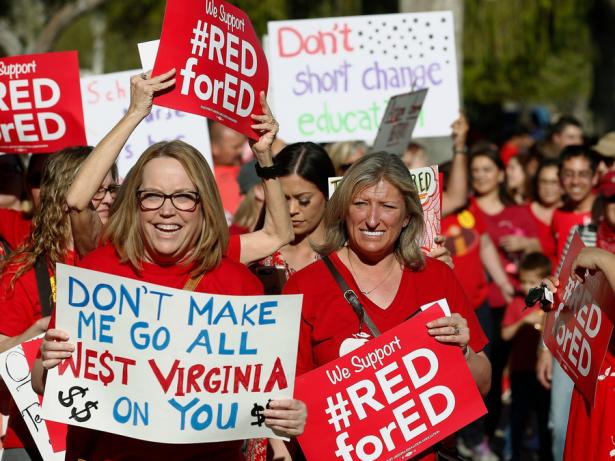
There is every reason to celebrate the “Teacher Spring” strikes of 2018 and the more recent strikes in Los Angeles and Chicago’s charter schools. They provide ample evidence that American teachers will not acquiesce to the evisceration of public education, to the dismantling of their unions and to the impoverishment of the teaching profession. A powerful new working class movement is taking shape, with American teachers in the lead. But to sustain the momentum of this movement and to build upon it, we must not only celebrate, but also reflect and think strategically – we must address the strategic challenges this movement now faces. 
Today, I want to focus on two strategic questions posed by this “Teacher Insurgency:”
  • First, how mobilization differs from organization, the changing relationship between the two and what that means for our work; and
  • Second, the relationship between protest, direct action and strikes, on the one hand, and the struggle for political power, focused on elections, on the other, as well as the role both play in our work.
At the outset, I want to be clear that my approach is a broad one, viewing the current movement not only through the lens of labor history and working class struggles, but also as part of the history of protest movements as a whole, with a particular emphasis on the civil rights movement. There are many reasons for this approach, but one particularly compelling reason lies in the intimate connections between the civil rights movement and America’s public sector unions, including teacher unions. We know, of course, that Martin Luther King was an ardent supporter of the labor movement, and was assassinated in Memphis while he was organizing support for striking sanitation workers in an AFSCME local, and that A. Philip Randolph was both a labor leader and a civil rights leader. But what is perhaps less understood is that the leaders of the teacher unions and public sector unions in the 1960s, the period during which they became established, formidable forces, were often veterans of the civil rights movement. And most of these leaders drew upon their experiences as civil rights activists as they organized their unions.
In a similar way, many of the leaders and activists of the Teacher Insurgency are veterans of the protest movements of the last eight years, and in particular, of the movements that have emerged since Trump’s  CONTINUE READING: Teacher Insurgency: What Are The Strategic Challenges? | Shanker Institute
Image result for Teacher Insurgency