Latest News and Comment from Education

Thursday, December 13, 2018

Louisiana School TM Landry Co-founder Accused of Physical and Emotional Abuse, More Details Emerge

Louisiana School TM Landry Co-founder Accused of Physical and Emotional Abuse, More Details Emerge

Louisiana School Co-founder Accused of Making Student Eat Rat Feces, Stepping on Another Student’s Face


The horrifying story of T.M. Landry College Preparatory School is getting clearer and bleaker as more details of abuse come to light during a state police investigation.
According to the New York Times, which broke the original story, Louisiana State Police have been looking more closely at abusive behavior that seemingly ran rampant at the school. In addition to lying on students’ college applications, owner Michael Landry and other “educators” at the school have been accused of physical and emotional abuse against students, including acts such as making students kneel to learn “humility,” choking students, and slamming them.


Because the school moved multiple times, the allegations of abuse fell within multiple jurisdictions, including Breaux Bridge County, which had previously closed a case about Michael Landry hitting children because it “was outside of its jurisdiction.” As such, state police have stepped in, though families have expressed skepticism after what they feel was a fumble by local law enforcement in handling these cases.
From the New York Times:
Since The Times published its article, more than a dozen people have reported additional incidents of what they called abuse to authorities, according to a law enforcement official who requested anonymity because he was not authorized to speak about the cases. Those statements include allegations that Mr. Landry placed a developmentally disabled boy in a closet, lifted another student by his collar and shoved him to the ground on his knees, and hit elementary school students with a belt.
It should be moot at this point, but unfortunately it’s not: Any form of corporal punishment is unsuitable for children and can drive the exact CONTINUE READING: Louisiana School TM Landry Co-founder Accused of Physical and Emotional Abuse, More Details Emerge

America Is Sacrificing Black Education for a False Meritocracy - The stakes of New York City’s school integration plan.

The stakes of New York City’s school integration plan.

America Is Sacrificing Black Education for a False Meritocracy


In the weeks before her election on November 27, Cindy Hyde-Smith looked vulnerable. Not enough, perhaps, to scuttle her chances at winning: She was a white Republican, after all, running for U.S. Senate against a black Democrat in Mississippi, with the country’s least-elastic electorate all but guaranteeing a 60-40 split in her favor. But the knocks against her were damning, and there seemed to be new ones every week. She joked about public hangings and suppressing unfavorable votes in a state where white supremacists once made a pastime of lynching black people to deter them from voting. She wore a Confederate soldier’s hat and described it on Facebook as “Mississippi history at its best!” And in arguably the most flagrant example of her ties to the state’s racist history, local reporters foundshe had attended an all-white “segregation academy” as a teenager — and sent her daughter to one years later.
The last two were framed as especially scandalous. They seemed deeper-rooted, more fundamental to Hyde-Smith’s character than the racist tongue-slips that had preceded them. The Jackson Free Press story about her schooling was circulated breathlessly on social media, sparking a national discussion about racism and so-called “seg” academies — private schools that cropped up across the South during the 1960s and 1970s to accommodate white children whose parents wanted to avoid integration. But it also generated talk cautioning outsiders against casting segregation as uniquely southern. Some observers pointed to purportedly liberal New York City as having some of the most segregated schools in the country.
As if on cue, a group of Manhattan parents gathered on Monday to oppose integration. Facing a proposal from New York mayor Bill de Blasio that would expand the admissions process for the city’s coveted specialized public high schools — thereby securing more spots for black and Hispanic students at institutions that are currently dominated by Asian and white children — they made impassioned arguments for why it was a bad idea. One white parent disparaged it as a dangerous “social experiment.” Another claimed it would be unfair to the new black and Hispanic students, who would find themselves floundering and underprepared. Asian parents and their advocates saw the schools’ current admissions policy — which relies on a single, high-stakes standardized-test score — as a rare color-blind means of upward mobility in a city where Asians face high poverty rates but thrive academically.

But the single-mindedness of these warring interests belies a larger, more fundamental point. Every American wants their child to have a quality education, but few seem invested in a quality education for all children. In a country where the school districts with the most students of color receive 15 percent less money per child in state and local funding than the whitest, it is an unavoidable conclusion that advantage is distributed, and hoarded, according to race. During the civil-rights movement, integration was framed as the remedy to such inequality. More than half a century later, its promise remains unrealized. Americans from New York to Mississippi internalized CONTINUE READING: The stakes of New York City’s school integration plan.

Arizona charter school history: How leaders got the votes

Arizona charter school history: How leaders got the votes

History of Arizona charter schools: 'I don’t think we realized what we’d done'
IN 1994, LEGISLATORS CAME TOGETHER TO PASS A HISTORIC BILL THAT ALLOWED CHARTER SCHOOLS IN ARIZONA.


The charter gamble: In this series, we examine how Arizona committed 25 years ago to the then-untested concept of charter schools, and what the program has meant for the state. Today, Part 1, how it all began.
Fife Symington sounded defiant.
He had run for governor on a promise to overhaul Arizona's sluggish public education system. But by April 1994, three years into his administration, nothing significant had changed. 
Now he felt pressure from all sides. The public demanded change. His re-election was in doubt. His personal entanglements were beginning to make news. 
His best hope was to do something dramatic.  
So the governor called an ally. 
Lisa Graham, a Republican state representative and chairwoman of the House Education Committee, answered the phone. Graham felt defeated. She had poured years of work into an education-reform bill Symington had supported, and then watched from the Senate gallery as it died.
Let's go back, the governor told her. He would call a special session, and they would run the bill again. But this time without its most controversial component. 
We'll take out the vouchers.
Symington was convinced the bill's small voucher program — which allowed families to use public money to send their children to private schools — had doomed the legislation. Without it, Symington said, their reforms would sail through.
The rest of the bill seemed tame by comparison. It allowed "open enrollment," letting children go to schools outside their district boundaries. It created school report cards and expanded preschool for at-risk children. And it established a new breed of public schools designed to operate independently, with fewer rules and looser oversight than their district counterparts. They would fuel competition and parent choice.
They were called charter schools. 

It was more of an idea than a movement. Only a handful of states had passed charter laws, and in those, only a few schools had opened. 
Neither Symington nor Graham had ever visited one. 
Graham had doubts about the timing of a special session. She respected Symington's instincts, but worried it was too soon to try again. She tried to be tactful. 
"I don't know if you know this: People hate you right now. And they don't like me either," she recalled telling him. "I'm not sure if you want me to run this thing."
Symington was undeterred. The November election was six months away. Education reform could spark a rebound in his popularity and give fellow Republicans a talking point for their own campaigns. 
Their recent defeat, Symington assured Graham, was just part of the process. Though he wasn't exactly sure what charter schools were, he knew they would change everything. 
We're coming back, he told her. I'm not asking you. We're coming back.

Changing the system deemed 'impossible'
The push for better schools was a nationwide concern.
In a 1993 report to Congress, the National Center for Education Statistics concluded that the country's lagging schools "continue to have serious implications." It detailed high dropout rates, stagnant test scores and wide racial gaps in American education. CONTINUE READING: Arizona charter school history: How leaders got the votes


Sacramento school district says it will be broke in November | The Sacramento Bee

Sacramento school district says it will be broke in November | The Sacramento Bee

Sac City Unified school district says it will be broke in November 2019


The Sacramento City Unified School District announced Wednesday it expects to run out of cash by November 2019 after months of financial crisis.
In a statement sent to the community, the district said unless major savings are found, it will be unable to pay employees and make necessary purchases.
The statement suggested that moving forward with recent plans to reduce health care costs is the next best step to reach solvency, especially considering it pays more for health care than any other Sacramento-area school district.
At last week’s Dec. 6 Board of Education meeting, four of the district’s five labor unions agreed to work toward trimming health expenses with the district.
The district still needs cooperation from the Sacramento City Teachers Association, which has long been at odds with the district over administrative costs.
SCTA did not sign onto a tentative plan proposed at the board meeting to work with California Education Coalition for Health Care Reform, a nonprofit group that helps districts reduce health care costs. SCTA had already been discussing possible savings with CECHCR last year, but talks between the district and the union have since come to an impasse.
District officials estimate working with CECHCR could save up to $16 million without affecting coverage.
In its statement, the district said it has already found about $19 million in savings in other areas, with $5.4 million coming from removing vacant positions and freezing hiring, $3.8 million from CONTINUE READING: Sacramento school district says it will be broke in November | The Sacramento Bee


Robert Reich VIDEO (The Truth About Privatization Privatization....)

Robert Reich (The Truth About Privatization Privatization....)

The Truth About Privatization


Privatization. Privatization. Privatization. It’s all you hear from Republicans. But what does it actually mean?
Generations ago, America built an entire national highway system, along with the largest and best public colleges and universities in the world. Also public schools and national parks, majestic bridges, dams that generated electricity for entire regions, public libraries and public research.
But around 1980, the moneyed interests began pushing to privatize much of this, giving it over to for-profit corporations. Privatization, the argument went, would boost efficiency and reduce taxes.
The reality has been that privatization too often only boosts corporate bottom lines.  
For example, consider Trump’s proposal for infrastructure. It depends on private developers, who would make money off of both tax subsidies and private tolls. So the public would get charged twice, without any guarantee that the resulting roads, bridges, or rapid transportation systems would be where they’re most needed.
It’s true that private for-profit corporations can do certain tasks very efficiently. And some privatization has worked. But the goal of corporations is to maximize profits for shareholders, not to serve the public interest.
The question should be: What’s best for the public? Here are five rules of thumb for when public services should not be privatized:
1. Don’t privatize when the purpose of the service is to bring us together – reinforcing our communities, helping us connect with one another across class and race, linking up Americans who’d otherwise be isolated or marginalized. 
This is why we have a public postal service that serves everyone, even small rural communities where for-profit private carriers often won’t go. This is why we value public education and need to be very careful that charter schools and other forms of so-called school choice don’t end up dividing our children and our communities rather than pulling them together.  
2. Don’t privatize when the service is less costly when paid for through tax revenues than through prices set by for-profit corporations. 
America’s hugely expensive for-profit health-insurance system, for example, is designed to sign up healthy people and avoid sick people, while running up huge tabs for advertising and marketing, and giving big rewards to shareholders and executives. Which is why the administrative costs of Medicare are a fraction of the costs of for-profit medical insurance – and why we need Medicare for all.
3. Don’t privatize when the people who are supposed to get the service have no power to complain when services are poor. 
This is why for-profit prison corporations have proven again and CONTINUE READING: Robert Reich (The Truth About Privatization Privatization....)


What School Choice Did To Sweden: A Cautionary Example | Diane Ravitch's blog

What School Choice Did To Sweden: A Cautionary Example | Diane Ravitch's blog

What School Choice Did To Sweden: A Cautionary Example


The Organisation for Economic Cooperation and Development convened a meeting last spring in Portugal to discuss the condition and future of the teaching profession. Each nation present discussed its perspective. The following is the official summary of the presentation by the Minister of Education from Sweden.
To download the full report click here.
SCHOOL CHOICE
Sweden:
In the early 1990s, Sweden moved to a school choice system in which the education system changed from one where the vast majority of students attended the public school in their catchment area to one where many students opt for a school other than their local school, and where schools that are privately run and publicly funded compete with traditional public schools.
Over the past twenty-five years of this unlimited choice system in Sweden, student performance on PISA has declined from near the OECD average to significantly below the OECD average in 2012, a steeper decline than in any other country. The variation in performance between schools also increased and there is now a larger impact of socioeconomic status on student performance than in the past.
Swedish participants described Sweden’s education system as an object lesson in how not to design a school choice system. Housing segregation leads to school segregation, and if you add to that market mechanisms and weak regulation, the result is markedly increased inequity.
The decline in achievement has fueled a national debate about how to improve the Swedish education system, from revising school choice arrangements to improve the access of disadvantaged families to information about school choices and the introduction of controlled choice schemes that supplement parental choice to ensure a more diverse distribution of students among schools. The Swedish government wants to modify its school choice system but this is politically difficult.


The Swedish government is increasing resources to poor schools but has not been able to solve its problem of teacher shortages, which affect the poorest schools the most. The poorest schools have the least experienced teachers, who are overwhelmed by the many problems they face. Teachers also lack time to work with students, and surveys of students report a lack of trustful relations with teachers.CONTINUE READING: What School Choice Did To Sweden: A Cautionary Example | Diane Ravitch's blog


Seclusion and Restraint: 16 Ways to Address Acting Out Behavior Without It

Seclusion and Restraint: 16 Ways to Address Acting Out Behavior Without It

Seclusion and Restraint: 16 Ways to Address Acting Out Behavior Without It
Image result for Seclusion and Restraint


Restraint or seclusion should not be used as routine school safety measures; that is, they should not be implemented except in situations where a child’s behavior poses imminent danger of serious physical harm to self or others and not as a routine strategy implemented to address instructional problems or inappropriate behavior (e.g., disrespect, noncompliance, insubordination, out of seat), as a means of coercion or retaliation, or as a convenience.
How to assist students who act out in school is a difficult challenge.
Since Public Law 94-142, now called the Individuals with Disabilities Education Act (IDEA), students with serious emotional or behavioral disabilities have attended public school. Teachers might be faced with students who act out in ways that could be injurious to other students, the teacher, or the student themselves.
Teachers are not alone. Other professionals also deal with individuals with psychiatric problems. Here is a report by the American Psychiatric Nurses Association. 
Seclusion and restraints are sometimes permitted, but are extreme, controversial, and CONTINUE READING: Seclusion and Restraint: 16 Ways to Address Acting Out Behavior Without It


CURMUDGUCATION: Why What Works Doesn't Work

CURMUDGUCATION: Why What Works Doesn't Work

Why What Works Doesn't Work


One of the dreams of reformerdom has been to identify classroom practices that are solid, successful, even foolproof, and to send them out into the world so that every teacher can use them in her own classroom. Students learn, angels sing, and education is one step closer to being neat, scientific and efficient, and one step further away from being a big higgledy piggledy mess.

This may strike you as a pretty picture, or it may not-- it doesn't really matter, because it is never going to happen.


Mike Petrilli (Fordham Institute) has been working on a series of essays about shifting reformy attention from policies to practices, and today's entry is about What Works, and it almost perfectly encapsulates what folks get wrong about this whole business.

There are many debates in education policy that will never be settled by science because they mostly involve values, priorities, and tradeoffs...Instructional practices, on the other hand, are different. Or should be. Consider elementary schools, those magical places where we work to turn pre-literate, pre-numerate kindergarteners into avid readers, writers, and problem solvers, ready to tackle the Great American Novel in middle school, capable of writing a clear five-paragraph essay, and possessing a mastery of math facts and an early understanding of algebraic reasoning.

The stock photo for the piece even features a microscope, to underline how scientific this process should be.

Petrilli rattles off a long list of practice type questions-- how do we do small groups? how do CONTINUE READING: 
CURMUDGUCATION: Why What Works Doesn't Work


The Gimmick Behind a Walton-Featured, 100-Percent-College-Acceptance Charter School | deutsch29

The Gimmick Behind a Walton-Featured, 100-Percent-College-Acceptance Charter School | deutsch29

The Gimmick Behind a Walton-Featured, 100-Percent-College-Acceptance Charter School


In April 2018, the Walton Family Foundation (WFF) announced that it formed two new nonprofits for the purpose of loaning money to charter schools “to make it easier and more affordable for public charter schools to find, secure and renovate facilities.”
One particular point about the above press release caught my attention. But first, a splash of Walton ed reform history:
Image result for Siblings Robson, Alice, and Jim Walton


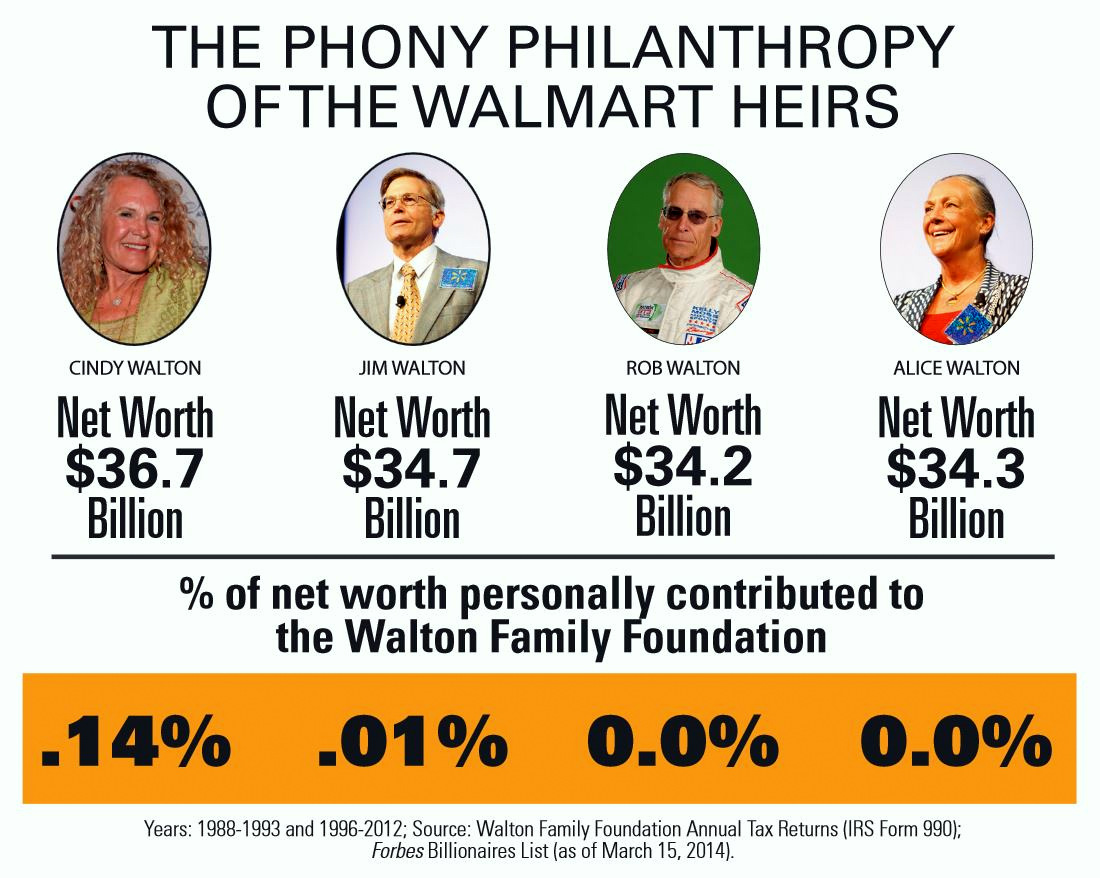
The Walton effort to advance school choice is nothing new. When it comes to promoting vouchers and charters, Walton money is scattered nationwide. For example, the Arkansas-based, billionaire Walton family pours millions into school choice, including its charter startup grants and even elections in other states, such as the November 2016 Massachusetts charter-expansion ballot initiative and Louisiana’s state board of education elections in 2011 and 2015. Also in 2015, WFF published its five-year plan to establish “choice ecosystems.”
In Arkansas, the Waltons purchased a “department of education reform” at the University of Arkansas (more about that here), which runs the “school choice demonstration project,” which is “devoted to the rigorous and unbiased evaluation of school choice programs and other school improvement efforts across the country.”

There is much more. (For a notable dose of that “much more,” peruse my Walton category of blog postings.)
Now, let us return to that WFF April 2018 press release on two new nonprofits formed to loan money to charter schools for facilities:
What caught my attention was the opening attraction– the featured, stellar, CONTINUE READING: The Gimmick Behind a Walton-Featured, 100-Percent-College-Acceptance Charter School | deutsch29

New Federal Case Launched in Rhode Island to Establish Educational Equity as a Federally Protected Right | janresseger

New Federal Case Launched in Rhode Island to Establish Educational Equity as a Federally Protected Right | janresseger

New Federal Case Launched in Rhode Island to Establish Educational Equity as a Federally Protected Right


If you think about it, you’ll remember that for more than forty years, school equity cases have been filed under the education clauses of the 50 state constitutions. That’s because, in a 1973 decision, San Antonio v. Rodriguez, the Warren Burger, U.S. Supreme Court decided that, because education is not mentioned in the U.S. Constitution, education is not protected as a fundamental right under the Fourteenth Amendment.  But late last month a new federal lawsuit was filed, a case intended by the plaintiffs and their attorneys to establish that education is indeed a fundamental right, protected for all students by the U.S. Constitution.
The Associated Press’s Jennifer McDermott reports: “The Center for Educational Equity at Columbia University’s Teachers College and the Rhode Island Center for Justice filed the lawsuit.  Michael Rebell, lead counsel and a professor at Teachers College said citizenship has always been the prime purpose of education in the United states and schools have increasingly failed to carry out this responsibility nationwide.  Rhode Island, in particular, stands out because there is no requirement for students to take a civics course and no indication that teachers receive specialized training to teach the topic, among other issues, Rebell added.  He said the case is timely because, ‘we’re living in troubled times, Our democratic institutions are being challenged like never before.'”
The NY Times‘ Dana Goldstein describes the goals of the plaintiffs: “The lawyers for the plaintiffs hope the case will have implications far beyond Rhode Island, and potentially prompt the Supreme Court to reconsider its 45-year-old ruling that equal access to a quality education is not a constitutionally guaranteed right.  ‘Our real hope for reinvigorating our democratic institutions comes with the young people and the next generation,’ said Michael Rebell, the lead lawyer for the plaintiffs. ‘What we’re really seeking is for the courts, especially CONTINUE READING: New Federal Case Launched in Rhode Island to Establish Educational Equity as a Federally Protected Right | janresseger

Wednesday, December 12, 2018

Opposing Changes Redefining the Concept of Gender - Year 2018 (CA Dept of Education)

Opposing Changes Redefining the Concept of Gender - Year 2018 (CA Dept of Education)

State Superintendent Torlakson, Washington and Oregon Education Officials Oppose Federal Changes Redefining the Concept of Gender


SACRAMENTO—State Superintendent of Public Instruction Tom Torlakson  partnered with the top education officials from Oregon and Washington to send a letter opposing federal attempts to redefine the concept of sex and gender government-wide, making that definition purely biological. The joint letter was sent to the U.S. Department of Health and Human Services today in coordination with Oregon Department of Education Director Colt Gill and Washington Superintendent of Public Instruction Chris Reykdal.
“This damaging proposal would seriously harm our nation’s children and eliminate the ability for some people to fight back against discrimination,” said Torlakson, who was a high school science teacher and coach. “Policies and facilities that assume individuals fall strictly within two categories and assume that identity is visually identifiable risk excluding and alienating individuals. This policy would allow discrimination against those whose gender identity does not line up with their biological sex.”
“Washington state law explicitly prohibits discrimination based on a student’s gender expression or identity in our public schools,” said Chris Reykdal, Washington State Superintendent of Public Instruction. “To our students who are transgender: We hear you. We see you. We support you. We will protect you.”
“It is our responsibility to create caring school environments that are safe and welcoming for all students,” said Colt Gill, Oregon Department of Education Director. “Denying a person’s gender identity or forcing conformity to this federal rule change is disrespectful, discriminatory, and harmful. Each of our children deserve more. They deserve schools that accept, respect, and serve them well.”
The assumption underlying California policy is that gender is a spectrum that is not necessarily linked to biological sex. State legislation allows all individuals, including students, to self-certify to their chosen gender category of male, female, or nonbinary—starting on January 1, 2019. While biological sex is defined by chromosomes in most cases, gender and gender identity are much more complex concepts.
“At an age when self-identity is still being formed, telling a student that their identity is invalid because it does not pair with two specific chromosomes can be deeply damaging,” the letter states. “When coming to school feels uncomfortable or even unsafe, students are implicitly prevented from receiving the same education as their gender-conforming peers. Such policies can thus create lifelong emotional, psychological, and economic harm.”
Resources for LGBTQ youth are available on the CDE’s Statewide & National Sexual Health Resources web page. Copies of the letter are available upon request.
Opposing Changes Redefining the Concept of Gender - Year 2018 (CA Dept of Education)

The ​U.S. Department of Education Will Reorganize in January | Truth in American Education

The ​U.S. Department of Education Will Reorganize in January | Truth in American Education

The ​U.S. Department of Education Will Reorganize in January


The U.S. Department of Education will undergo an internal reorganization set for January 6th, but will take several months to implement, CNN reports:
The new Education Department structure consolidates a number of offices within the agency. The Office of the Secretary will merge with the Office of the Deputy Secretary. The Office of the Chief Financial Officer will merge with the Office of Management to become a new Office of Finance and Operations, according to the email.

The new Office of Finance and Operations will also take on certain responsibilities of other agency offices including the Office of the Chief Information Officer, Office of the Deputy Secretary, and the Office of Planning, Evaluation and Policy Development, according to the email.
 The Office of Innovation and Improvement will also “integrate” into the Office of CONTINUE READING: The ​U.S. Department of Education Will Reorganize in January | Truth in American Education


A Scary Mix of Journalism & Strategic Philanthropy: Gates Spends Big on Education Journalism - Non Profit News | Nonprofit Quarterly

A Scary Mix of Journalism & Strategic Philanthropy: Gates Spends Big on Education Journalism - Non Profit News | Nonprofit Quarterly

A Scary Mix of Journalism & Strategic Philanthropy: Gates Spends Big on Education Journalism


Advertising Philanthropic Initiatives after They Bomb: Gates’s New Embarrassment - Non Profit News | Nonprofit Quarterly - https://nonprofitquarterly.org/?p=2963263

October 15, 2015; Poynter

Anyone watching the philanthropic landscape who cares about democracy should start worrying about the confluence of top-down strategic philanthropy with the rise of philanthropically-backed journalism.
Case in point: NPQ has reported previously on grants made by the Gates Foundation to media outlets covering areas where its sometimes-controversial philanthropic activity is focused, but last week, the Poynter Institute revealed that over the last five years, the Foundation has been spending about $7 million a year on education-related journalism coverage through such outlets as NPR, Hechinger, ChalkbeatEdWeek, and the Educational Writers Association. It also has partnerships with outlets like Univision and the PBS NewsHour.
Alexander Russo, author at the new education blog The Grade, points out the obvious problem with this in terms of its potential to hijack the public discourse, saying, “I don’t think that the Gates Foundation would be spending this kind of money if they didn’t think it helped their cause, however indirectly, and I’m under no illusions that newsrooms are able to completely ignore the sources of their funding, whether in the form of advertising or nonprofit funding.”
But then he backs away from that critique, saying, “The Gates Foundation agenda is focused on relatively moderate ideas like teacher quality and high standards, and it’s been pretty open about its journalism grants…So its media partnerships are less problematic to me than they would be if their agenda was ending tenure, charter school growth, or a Teach For America takeover—or if they were hiding the grants or seeming to pressure editors.”
Not everyone believes that the Gates Foundation agenda for America’s public schools is so neutral, as NPQ’s Marty Levine wrote last week and Liana Heiten wrote for Education Week, and these are certainly not the first concerns to be voiced about Gates’ funding of issues in which it is heavily involved. As far back as 2011, a well-researched and detailed article in the Seattle Times, entitled “Does Gates Funding of Media Taint Objectivity,” looked at the foundation’s funding of health journalism. At that time, it reported:
To garner attention for the issues it cares about, the foundation has invested millions in training programs for journalists. It funds research on the most effective ways to craft media messages. Gates-backed think tanks turn out media fact sheets and newspaper opinion pieces. Magazines and scientific journals get Gates money to publish research and articles. Experts coached in Gates-funded programs write columns that appear in media outlets from The New York Times to The Huffington Post, while digital portals blur the line between journalism and spin.
The efforts are part of what the foundation calls “advocacy and policy.” Over the past decade, Gates has devoted $1 billion to these programs, which now account for about a tenth of the giant philanthropy’s $3 billion-a-year spending. The Gates Foundation spends more on policy and advocacy than most big foundations—including Rockefeller and MacArthur—spend in total.
But Gates is not the only philanthropy investing in topic-specific journalism. Individual CONTINUE REAIDNG: A Scary Mix of Journalism & Strategic Philanthropy: Gates Spends Big on Education Journalism - Non Profit News | Nonprofit Quarterly


Urban Schools Are Improving, Despite Parents’ Beliefs - The Atlantic

Urban Schools Are Improving, Despite Parents’ Beliefs - The Atlantic

Parents Are Biased Against Even Quality ‘Urban’ Schools
Many of these schools are improving, but the persistent stigma against them contributes to segregation.


In recent years, many of America’s urban schools have improved significantly. A 2016 report from the Urban Institute found that while all the country’s public-school students improved in the decade starting in 2005, the gain for those in large cities was double that of the U.S. average; the advances are especially pronounced in kids’ reading scores. With these strides, the achievement gap between city districts and their suburban and rural counterparts closed by roughly a third during that same period.
In some cases, the gap is all but nonexistent. Take, for example, Chicago, which in the late 1980s was notoriously deemed the country’s “worst school system” by then-Education Secretary William J. Bennett. A number of recent studies have shown that while standardized-test scores across Illinois have been flattening for the past decade or so, achievement in Chicago Public Schools has been steadily rising.
In fact, data from 11,000 school districts studied by Stanford researchers last year suggest that CPS ranks first in the nation for academic growth, and state statistics show that its students’ college-attendance rates are steadily improving, too: 65 percent of the districts 2018 graduates enrolled in college within a year after getting their diploma, compared with an average of 75 percent across the state. CPS students’ college-going prospects still fall toward the bottom when compared with those in most nearby districts, but they’re far from the worst—and the Stanford researchers’ findings around future growth in CPS indicate its students’ postsecondary-achievement levels are poised to CONTINUE READING: Urban Schools Are Improving, Despite Parents’ Beliefs - The Atlantic