Latest News and Comment from Education

Monday, December 10, 2018

“We’re one union”: Why Chicago teachers are out on the first charter school strike in the country | Salon.com

“We’re one union”: Why Chicago teachers are out on the first charter school strike in the country | Salon.com

“We’re one union”: Why Chicago teachers are out on the first charter school strike in the country
Charter teachers’ demands include equal pay for equal work


On Tuesday, teachers at 15 Chicago charter schools voted 98 percent to authorize a strike as they continue to bargain a contract with Acero Schools, the largest unionized charter network in the city. On Friday, four locations of the Chicago International Charter Schools (CICS) will take a strike authorization vote. And teachers at nine other Chicago charter networks are also in contract negotiations, and could similarly opt to take strikes votes in the coming months. 
If no agreement is reached, Chicago could be home to the nation’s first-ever charter strike. Teachers have been inching closer to this possibility for the past two years, during which time eleventh-hour deals have narrowly averted strikes against at least three other charter operators.
That’s a stunning reversal from 2012, when Chicago charter operators bragged that, unlike unionized public schools, charters were unaffected by teacher strikes.
Since then, “Chicago has become the epicenter of charter union organizing in the country,” as Illinois Network of Charter Schools President Andrew Broy lamented in the Chicago Tribune last year.
What’s more, charter teachers are currently bargaining their first contracts as members of the Chicago Teachers Union (CTU), which also represents the city’s 27,000 public school teachers. In March, the Chicago Alliance of Charter Teachers and Staff, an affiliate of the American Federation of Teachers that represents more than 30 charters in the city, merged with the CTU in a bid to strengthen the hands of CONTINUE READING: “We’re one union”: Why Chicago teachers are out on the first charter school strike in the country | Salon.com


Big Education Ape: Breaking: Tentative agreement in first charter teacher strike. – Fred Klonsky - http://bigeducationape.blogspot.com/2018/12/breaking-tentative-agreement-in-first.html
47575896_2364352510261366_7105538274675916800_n


Heavy screen time appears to impact childrens' brains: study

Heavy screen time appears to impact childrens' brains: study
Heavy screen time appears to impact childrens’ brains: study


Researchers have found “different patterns” in brain scans among children who record heavy smart device and video game use, according to initial data from a major ongoing US study.

The first wave of information from the $300 million National Institute of Health (NIH) study is showing that those nine and 10-year-old kids spending more than seven hours a day using such devices show signs of premature thinning of the cortex, the brain’s outermost layer that processes sensory information.
“We don’t know if it’s being caused by the screen time. We don’t know yet if it’s a bad thing,” said Gaya Dowling, an NIH doctor working on the project, explaining the preliminary findings in an interview with the CBS news program 60 Minutes.
“What we can say is that this is what the brains look like of kids who spend a lot of time on screens. And it’s not just one pattern,” Dowling said.
The NIH data reported on CBS also showed that kids who spend more than two hours a day on screens score worse on language and reasoning tests.
The study — which involves scanning the brains of 4,500 children — eventually aims to show whether screen time is addictive, but researchers need several years to understand such long-term outcomes.
“In many ways, the concern that investigators like I have is, that we’re sort of in the midst of a natural kind of uncontrolled experiment on the next generation of children,” Dimitri Christakis, a lead author of the American Academy of Pediatrics’ most recent guidelines on screen time, told 60 Minutes.
Initial data from the study will begin to be released in early 2019.
The academy now recommends parents “avoid digital media use — except video chatting — in children younger than 18 to 24 months.”

Don't let Silicon Valley control what you see. Get more stories like 


Exclusive: Ed Department To Erase Debts Of Teachers, Fix Troubled Grant Program : NPR

Exclusive: Ed Department To Erase Debts Of Teachers, Fix Troubled Grant Program : NPR

Exclusive: Ed Department To Erase Debts Of Teachers, Fix Troubled Grant Program

Students and grads cross a rickety bridge.

For public school teacher Kaitlyn McCollum, even simple acts like washing dishes or taking a shower can fill her with dread.
"It will just hit me like a ton of bricks," McCollum says. " 'Oh my God, I owe all of that money.' And it's, like, a knee-buckling moment of panic all over again."
She and her family recently moved to a much smaller, older house. One big reason for the downsizing: a $24,000 loan that McCollum has been unfairly saddled with because of a paperwork debacle at the U.S. Department of Education.
But for McCollum and many public school teachers, it appears the nightmare is nearly over.
The Education Department is releasing a plan Sunday to help these teachers who have been wrongly hit with debts, sometimes totaling tens of thousands of dollars, because of a troubled federal grant program.
The move comes after an almost year-long NPR investigation that brought pressure on the department. In May, the Education Department launched a top-to-bottom reviewof the program. Amid continued reporting, 19 U.S. senators sent a letter, citing NPR, saying the problems should be fixed.
When NPR breaks the news to McCollum that the Department of Education is going to fix this, she is astonished.
"Are you serious?" McCollum says quietly. The teacher from Columbia, Tenn., is in her new home, where the walls are bare but there's a Christmas tree that she and her husband, A.J., have just put up. The floor is littered with pine needles as her 19-month-old son, Louther, plays in the next room.
Her eyes well up. She lifts a hand to her mouth and laughs. And then she cries. "That is CONTINUE READING: Exclusive: Ed Department To Erase Debts Of Teachers, Fix Troubled Grant Program : NPR


The debate over students with learning disabilities, suspensions and race - The Hechinger Report

The debate over students with learning disabilities, suspensions and race - The Hechinger Report

The debate over students with learning disabilities, suspensions and race
New research finds that learning disabilities might have nothing to do with why black students are suspended more than whites students

A look at raw numbers of who is most likely to be suspended from school indicates that black students and students with learning disabilities are at the top of the list. For example, 23 percent of black students and 18 percent of students with disabilities were suspended from high school during 2011-12 school year, compared with fewer than 7 percent of white students overall.

Combine the categories of black and disability with gender and the statistics are even more troubling. Almost 34 percent, or more than a third of black boys with a learning disability were suspended in high school, double the rate of white boys with a learning disability. On the face of it, black students with learning disabilities are the most targeted group for suspensions and account for a big chunk of the school-to-prison pipeline. (That’s a term researchers use to describe how kids who are frequently suspended become prime candidates for dropping out of school entirely. Uneducated, without employment prospects, they’re more likely to become criminals and end up in prison.)
Indeed, the Obama administration was so worried that black kids with learning disabilities were getting suspended from school too often that it used the nation’s laws that govern educating students with disabilities to create a new rule for states to monitor discipline rates among racial and ethnic groups. The new rule also called for a reallocation of funds in school districts that were found to have CONTINUE READING: The debate over students with learning disabilities, suspensions and race - The Hechinger Report


Ensuring Well-Informed Citizens through Public Education, Then and Now Education Law Prof Blog

Education Law Prof Blog

Ensuring Well-Informed Citizens through Public Education, Then and Now

Captureted6
In October, I had the privilege of participating in a Tedx event sponsored by the University of South Carolina.  The subject of my talk was the danger our democracy faces when we fail to ensure equal and adequate public education.  I offered warnings and lessons from both the perspective of our nation’s founders and those who rebuilt our nation in the period following the Civil War.  The number of parallels between the post-Civil War period and today are striking, particularly the advent of new technology—the penny press newspapers then and the 24-hour news cycle and blogs today.  The challenge today is use yesterday’s lessons to solve today’s problems in school funding, critical literacy, and democratic participation.  The following is a couple of highlights from the talk:
Democracy is a double edged sword.  It places political power in the hands of the people, but to succeed, those people need to be informed well enough to make smart decisions.  An educated citizenry cannot be easily manipulated.  Not easily oppressed.  And educated citizenry will guard its freedom jealously.  And when these citizens get it wrong—and they will—they will disagree with one another.  And this slows down any major moves in the wrong direction.
So the inherent tension of democracy revolves around the need to place power in the hands of people who may or may not be well-informed.  Our founders—the people who wrote the federal and state constitutions we live under—firmly believed the only solution was the only solution was to make sure we have public education system that cultivates the skills that citizens need to participate in democracy.
The problem
In today’s world, civics knowledge and critical literacy are, well, critical.  By civics I mean how our government works.  A large chunck of the public has next to no idea. . . . [But] we also need critical literacy to evaluate what we learn about government and its policies.  About one in three Americans are either illiterate or rudimentary readers.   Half can’t read a book written at an eighth-grade level and comprehend it.  And the sad thing is, that CONTINUE READING: Education Law Prof Blog


How School Reformers Try to Convince Us You Can Fly a Plane Without a Real Pilot

How School Reformers Try to Convince Us You Can Fly a Plane Without a Real Pilot

How School Reformers Try to Convince Us You Can Fly a Plane Without a Real Pilot


Spending time studying how to teach and how children learn has been replaced with fast-track programs that breed future workers. These people know little about children, but they follow the script. They will keep children focused on their computer lessons, and collect data on their progress.
It’s like getting on a plane and learning the pilot had only five weeks of training. The real pilot has been removed or quit because they required an adequate salary.
  • In Georgia and Idaho, hiring can take place while you’re earning a degree.
  • In Kentucky, like many other states, you can have a degree in anything and easily get certified to teach.
  • In Louisiana, with a little training, you can teach with only a high school diploma.
  • In Mississippi, if you can find a teaching job first, you can get into the alternative teaching program to learn how to teach.
  • Missouri likes the American Board for Certification of Teaching Excellence (ABCTE) if you can afford to buy online credentials.
  • There’s more.
Have a nice flight!
Recently, T.M. Landry College Prep, a private school in Louisiana duped parents CONTINUE READING: How School Reformers Try to Convince Us You Can Fly a Plane Without a Real Pilot


No Matter Who Gets Credit for the Original Idea, School Vouchers Have Yet to Shake a Racist History | deutsch29

No Matter Who Gets Credit for the Original Idea, School Vouchers Have Yet to Shake a Racist History | deutsch29

No Matter Who Gets Credit for the Original Idea, School Vouchers Have Yet to Shake a Racist History


The history of school vouchers in American K12 education is rooted in racism.
This fact is indisputable.
Economist Milton Friedman, known as “the father of school choice,” is the name most commonly connected to the use of vouchers in K12 education. His 1955 paper, “The Role of Government in Education,” is the text often cited as central to Friedman’s views on school choice in the form of vouchers. An excerpt:
In terms of effects, the denationalization of education would widen the range of choice available to parents. …
Let the subsidy be made available to parents regardless where they send their children–provided only that it be to schools that satisfy specified minimum standards–and a wide variety of schools will spring up to meet the demand. Parents could express their views about schools directly, by withdrawing their children from one school and sending them to another….
Friedman was not the first economist/scholar to promote the school voucher concept; Thomas Paine did so in 1791, and John Stuart Mill did so in 1859.However, Friedman’s writings were the ones that coincided with the America’s Civil Rights movement– a time when many in southern, white America were keen on devising ways to thwart racial integration of public schools. Thus, it was Friedman’s school voucher writings that were newly publicized a time when many southern governors and other politicians were seeking creative circumvention for public school desegregation.
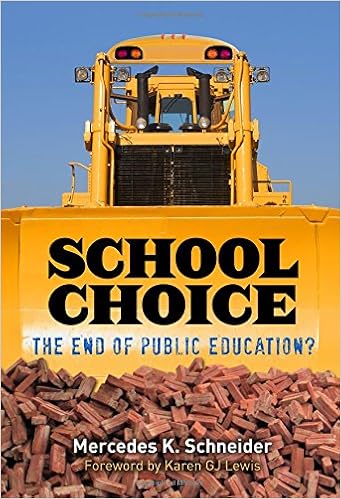
As I detail in my book, School Choice: The End of Public Education?, school voucher choice was put into practice to expressly to evade the 1954 Supreme CONTINUE READING: No Matter Who Gets Credit for the Original Idea, School Vouchers Have Yet to Shake a Racist History | deutsch29
Amazon.com: School Choice: The End of Public Education? (9780807757253): Mercedes K. Schneider, Karen GJ Lewis: Books - https://www.amazon.com/School-Choice-End-Public-Education/dp/080775725X/ref=sr_1_3?s=books&ie=UTF8&qid=1462599048&sr=1-3


Learning and Earning In This Era of Education Justice | The Jose Vilson

Learning and Earning In This Era of Education Justice | The Jose Vilson

LEARNING AND EARNING IN THIS ERA OF EDUCATION JUSTICE

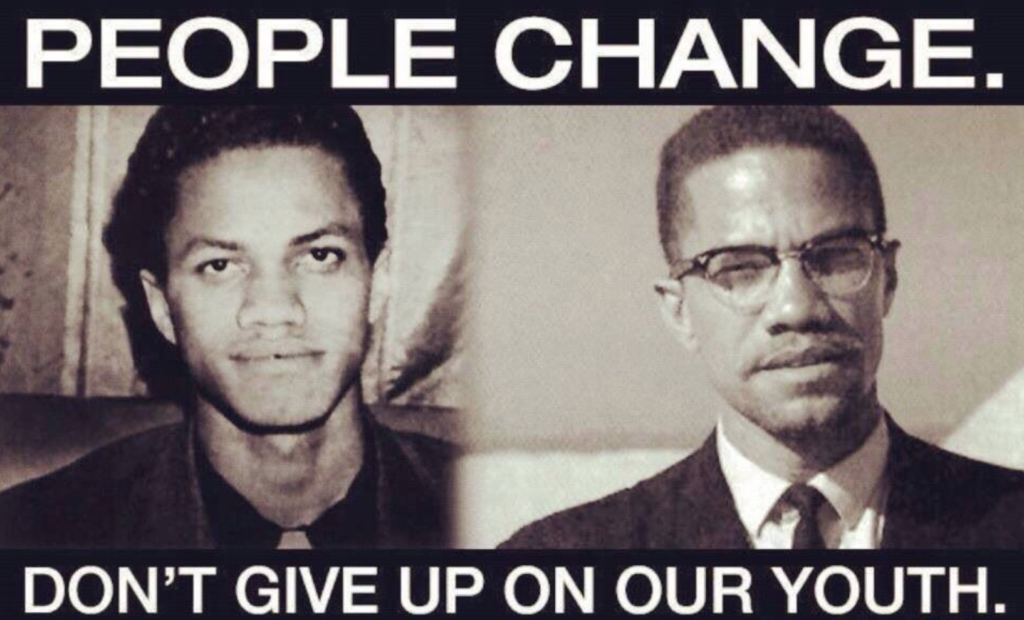
This year, as with every year, I’ve hung a little poster of both Malcolm Little to Malcolm X / el-Hajj Malik el-Shabazz with the tagline “People Change: Don’t Give Up On Our Youth.”

When I’m seated at my desk in the morning, it’s positioned so it’s slightly above my head. Curious students ask who the boy and the man are and why I decided to buy that poster. A student might chime in “That’s Malcolm X” while other students might not chime in at all.
The grumpy old man in me, trained in black liberation thought back in college and exposed to so many of the greats of the Civil Rights era, might have belted out a “YOU DON’T KNOW WHO THAT IS?” The teacher in me said, “Well, he was someone special” and build my case accordingly. 
Suppressing the urge to not do as some of my elders did has gotten exponentially easier over time, a function of empathy and actual social justice. Another part of it is knowing that students need the time to let these ideas and people foment before actualizing knowledge of the struggles to win the rights they may not fully comprehend. For adults, it also means that we understand that the work for justice did not find its genesis in us. We’re stewards for the movement forward and we hold the past for lessons and guidance. 
Learning and earning in education has so many implications for our students and their schools, but we’re reluctant to use over-abused words like status quo
The current era of what we consider justice work has proven even more perilous with the economic shift towards neoliberalism and individualism. Neoliberalism has been defined a billion different CONTINUE READING:Learning and Earning In This Era of Education Justice | The Jose Vilson 

CPS Considers Closing An Urban Prep Campus For Poor Performance | Gary Rubinstein's Blog

CPS Considers Closing An Urban Prep Campus For Poor Performance | Gary Rubinstein's Blog

CPS Considers Closing An Urban Prep Campus For Poor Performance


After the New York Times debunked the success of the T. M. Landry school in Louisiana, some very prominent reform cheerleaders have been writing about how the media needs to be more skeptical of stories in education that seem too good to be true.  Alexander Russo, for example, wrote about it in Phi Delta Kappan.
However, the ground rules for reporting on miracle schools should be clear by now: No passing along a school’s claims of test scores or graduation or college acceptance claims without independent verification. At this point, claims of 100 percent graduation rates should raise immediate red flags.
Considering the constant trolling I’ve endured over the years by reform body guards anytime I’ve uncovered a 100% college success that was worthy of further scrutiny, this is quite an admission.
Urban Prep Charter School in Chicago is the original ‘miracle school.’  Seven years ago at the Teach For America 20th anniversary alumni summit, I heard Arne Duncan talk about how they had 100% of their senior class graduate and how 100% of them went on to college after they shut down the public school in that building and replaced it with a charter school.
In my very first school policy blog post in March of 2011, I wrote about how that school had a very high attrition rate since 166 freshmen three years before had shrunk to 107  CONTINUE READING: CPS Considers Closing An Urban Prep Campus For Poor Performance | Gary Rubinstein's Blog

Sunday, December 9, 2018

CCSSO & NGA: Whom do they Serve?

CCSSO & NGA: Whom do they Serve?
The Council of Chief State School Officers and National Governors Association:
Whom do they serve?


Introduction
The Council of Chief State School Officers (CCSSO) and the National Governors Association (NGA) are member associations headquartered in Washington, DC. They are also co-owners of the Common Core Standards—the controversial educational content standards that most US states have incorporated, in whole or in part, into their K–12 education programs.[1]

Yet, despite what their names might suggest, they are not government entities, even though most of their members are elected or appointed state government officials. Peter Wood explains[2]

The standards were developed by the National Governors Association (NGA) in collaboration with the Council of Chief State School Officers (CCSSO). These are private, non-governmental bodies—in effect, education trade organizations. The National Governors Association, despite its name, isn't just a group of sitting governors. It includes many ex-governors and current or former gubernatorial staff members. The deliberations of the NGA and the CCSSO are not open to the public and the work that these bodies did to develop the Common Core State Standards remains for the most part unavailable to outsiders. Neither body, being private, is subject to Freedom of Information requests. The standards themselves are copyrighted by the NGA and the CCSSO.

The impact these organizations have on US schools via the Common Core Initiative deserves our attention and scrutiny. Also important to consider, however, is the impact their intimate association with the Common Core Initiative has had on them. Do these organizations any longer serve their members' needs on education issues? Do governors and state superintendents receive unbiased information and a full range of evidence and policy options from the association staff they pay with their member dues?

A Note on Data Sources
This report lifts most of its facts from CCSSO and NGA filings with the Internal Revenue Service (IRS)[3] and the CCSSO and NGA websites. Other sources are referenced as appropriate.

Financial accounts appeal as a source of organizational information, in part, because one expects them to be accurate and complete. They are typically filed by professionals who both have legally binding fiduciary responsibilities and are desirous of preserving their reputations (and staying out of jail). Moreover, they are subject to audit by the IRS, an agency with considerable legal authority.

That doesn't mean that IRS filings are always as informative as they could be. One will not find, for example, any record in the CCSSO's filings of the contributions it has received. Since fiscal year 2004, the CCSSO has folded all its contribution (i.e., grant and donation) revenue into the "program service revenue" category, perhaps inappropriately. Program service revenue comprises fees, dues, and direct payments for services.[4]

In 2014, The Bill and Melinda Gates Foundation awarded CCSSO $6,148,749. Granted, the money was awarded contingent upon the CCSSO using it for certain purposes. But, the Gates Foundation did not receive the services and materials the grant paid for. If it had, it could not have legally classified the expense as a charitable contribution.

CCSSO's own auditor reports, available from its website (with some digging), itemize grants received from the federal government, but not those from anywhere else.[5]

Suffice it to say that, even though the CCSSO may, perhaps, wish to obscure the origins of the grants it receives, those contributions are substantial and now dwarf the revenues received from membership dues and meeting registration fees.

As for the National Governors Association (NGA), financial data for its education activities remain well hidden. The Center for Best Practices—NGA's research and policy analysis division—is just one of several within the NGA. Likewise, the education group is just one of several groups within the Center for Best Practices, and one of the smaller ones at that. Publicly available financial data break down only to the level of the Center as a whole. Contributions from CONTINUE READING: CCSSO & NGA: Whom do they Serve?


Mitchell Robinson: The Top Five Worst Things Betsy DeVos has Done Since She Took Office | Eclectablog

The Top Five Worst Things Betsy DeVos has Done Since She Took Office | Eclectablog

The Top Five Worst Things Betsy DeVos has Done Since She Took Office


It wasn’t easy narrowing this list down to just 5 things, but here we go!
She Set the Predatory Lenders Free. By gutting regulations intended to protect students, many of whom are veterans, minorities, and first-generation college attendees, from being defrauded by predatory schools and colleges, Betsy has put the interests of these for-profit colleges—some of which she has personal financial interests in—ahead of students.


She Abandoned the Kids Who Need Her Most.  Betsy has dismissed civil rights complaints and ripped up guidance that urged public schools to allow transgender students to use restrooms that conform to their gender identity.


She Made Sexual Assault Great Again.  Sec. DeVos has rolled back sexual assault policies on college campuses, established a higher bar for victims reporting complaints, and is now forcing survivors to be cross-examined by their attackers in court—this one is especially egregious in that DeVos is from Michigan, where Larry Nassar sexually assaulted 332 young girls and women at MSU over 25 years.


She’s Still Trying to Get Us to Fund Private Schools With Taxpayer Dollars.  Betsy continuously calls public schools “a dead end”, and then advocates for a national private school voucher program by requesting $20 billion in the federal budget, even though all previous attempts in Michigan were humiliating failures, voted down by nearly 75% of the citizens of our state.


She Tried to Starve Her Own Department of Funding.  DeVos proposed to eliminate the federal Department of Education…and then suggested cutting the Department’s funding by $9 billion — about 13 percent of the Department’s full budget allocation. DeVos’ budget eliminated money for after-school programs for disadvantaged youth and axed a grant program that helps low-income students go to college…in favor of increased spending on school-choice initiatives and private school voucher programs. Her proposal also included cuts to the Office for Civil Rights. In a stunning rejection of her request, the GOP-controlled House returned a budget with an increase of $3.9 billion—a 13% hike in funding!

So, to all those people who say that Sec. DeVos hasn’t accomplished very much…who else could dream up public policy so craven and draconian and just plain cruel, that it actually forces the CONTINUE READING: The Top Five Worst Things Betsy DeVos has Done Since She Took Office | Eclectablog


What K-12 parents in Seattle need to know about proposed changes to Title IX rules on sexual assault, harassment

What K-12 parents in Seattle need to know about proposed changes to Title IX rules on sexual assault, harassment

What K-12 parents in Seattle need to know about proposed changes to Title IX rules on sexual assault, harassment


The U.S. Department of Education led by Secretary Betsy DeVos recently proposed new rules governing the way K-12 schools and colleges handle allegations of sexual harassment and assault.
Civil-rights advocates and survivors of sexual violence have expressed outrage, proclaiming that the new rules will dramatically limit schools’ obligations to students who file complaints of sexual harassment and violence under Title IX, the federal civil-rights statute that requires schools to investigate all reports of sexual harassment to find out if the harassment has made it harder for students to learn or stay in school.
The public has until Jan. 28, 2019, to comment on the proposed regulations before they are finalized into law.
Under the proposed changes, the current definition of sexual harassment — "unwelcome conduct of a sexual nature" — would include only behavior that is "severe, pervasive, and objectively offensive." This means that if a teacher makes sexually suggestive comments and a 12-year-old student feels uncomfortable, that isn’t necessarily harassment that the school is legally bound to investigate.
Under the new rules, only a teacher, Title IX coordinator or other high-level official can trigger an investigation. If a K-12 student told an adult school employee they trust — such as a sports coach, playground supervisor, or guidance counselor — that they had been sexually assaulted by another student, the school wouldn’t be obligated to intervene.

Schools would be required to ignore harassment that occurs outside of a school activity, including most off-campus and online harassment even if the student is forced to see the perpetrator at school every day.
If the new regulations are given the force of the law, advocates point out that representatives of the accused — often lawyers — will be allowed to cross-examine complainants at live hearings, a prospect that could discourage students from reporting incidents of sexual harassment and violence.
"DeVos's proposed rule will return us to a time when sexual assault survivors were ignored and felt they had CONTINUE READING: What K-12 parents in Seattle need to know about proposed changes to Title IX rules on sexual assault, harassment


Rhode Island School District to Use Collection Agency to Collect School Lunch Debt | deutsch29

Rhode Island School District to Use Collection Agency to Collect School Lunch Debt | deutsch29

Rhode Island School District to Use Collection Agency to Collect School Lunch Debt


I teach in southern Louisiana, and our school’s lunch policy does not include fronting meals to students who do not qualify for free lunch. (Over the years, I have on numerous occasions either loaned or given students lunch money or directly provided them with food. However, in all cases, this was my personal decision.)
So, the idea of a policy that allows for students (parents?) to accrue lunch debt is not part of my K12 experience either as a southern Louisiana teacher or former student.
If districts have a policy of fronting meals, those districts should also have in place a means of paying for those meals if students and parents/guardians do not pay. Otherwise, the resulting debt could put a district in fiscal crisis– one that might result in, well, employing a collection agency.
Such is the situation for the Cranston School District (Rhode Island).
The Cranston School District advertises this “unpaid meal policy”, which includes the following information for parents/guardians:
Student wanting a lunch and not having money to purchase a lunch will be allowed to charge a lunch with repayment within two (2) school days.
Once a student has charged five (5) meals (middle\high school $16.25 & elementary $12.50) and no payment has been received, that student will receive a lunch consisting of a sunny butter sandwich, fruit, and milk in place of a hot lunch. This meal maintains the USDA standards surrounding reimbursable meals and will be charged at full price to the student’s account.
Okay. Let’s see: No money; meal provided anyway with payment expected in two days– but that two-day payment isn’t really required because we’ll repeat fronting the meals four more times, and if still no payment, we’ll front a less CONTINUE READING: Rhode Island School District to Use Collection Agency to Collect School Lunch Debt | deutsch29
Image result for debt collector