Latest News and Comment from Education

Friday, October 5, 2018

The truth about money in public education politics

Opinion: The truth about money in public education politics

The truth about money in public education politics
Thurmond will fight back against the billionaires and their pro-charter school industry agenda


There is a little watched election that is projected to be the most expensive race in California this fall.  More money will be spent on the race for California State Superintendent of Public Instruction – the person who oversees over 10,000 public and charter schools – than in any congressional race, and perhaps even the race for governor.
Why will so much money be spent on this race?  The reason lies with a small group of billionaires who have no education experience but because of their outsized pocketbooks wield huge influence in education politics across the nation.  Billionaires like the Waltons (of Walmart fortune), Eli Broad, and President Trump’s Education Secretary Betsy DeVos have made it their priority to fight for the charter school industry, school vouchers, and high-stakes testing.
The billionaires are supporting candidate Marshall Tuck, a former charter schools executive with a mixed record of success and reputation for fighting not fixing – because they know they can count on him to support the charter school industry.

His opponent is Democratic state legislator and public school parent Tony Thurmond.  Tony is a social worker by training who has spent 20 years working inside and outside of schools with some of the most high-need children in California.
Tony’s passion for education stems from his own life experience.
Like many California students, Tony Thurmond comes from humble beginnings.  Tony’s mother emigrated from Panama to San Jose to become a teacher.  His father was a Vietnam veteran who, suffering from PTSD, did not return to the family.  When Tony was 6, his mother lost her battle to cancer.  He and his brother were sent to live with a distant cousin.
Tony grew up on public assistance and college was never a sure thing – but he succeeded because he was able to attend a great public school where his teachers encouraged him to apply.  At Temple University in Philadelphia, Tony became student body president.
After graduation, Tony became a social worker to give back, serving foster youth, children with incarcerated parents, folks with disabilities, immigrants, first-generation college students, and families living in deep poverty.  He went on to lead nonprofits and run school-based mental health programs.  Tony has taught civics, life skills, and career training courses.
Tony Thurmond believes, as I do, that public education can save lives.  For me, it’s a belief that stems from 50 years working in education, first as a teacher and counselor in the Continue reading: Opinion: The truth about money in public education politics
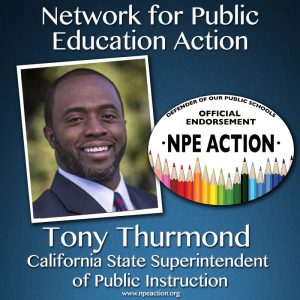
Image result for Tony Thurmond as Superintendent of Public Instruction

A Plan to Improve California's Public Schools

Tony Thurmond for State Superintendent of Public Instruction -https://www.tonythurmond.com/


It didn't start with Trump: how America came to undervalue teachers | Education | The Guardian

It didn't start with Trump: how America came to undervalue teachers | Education | The Guardian

It didn't start with Trump: how America came to undervalue teachers


The 1983 report, A Nation at Risk, spoke of a school system in ‘the grip of a crisis’ – kicking off cycles of shortcomings for American schools
t 4.20pm on 26 April 1983, in the state dining room at the White House, then president Ronald Reagan accepted a report from a panel of the country’s leading educators, offered a couple of lighthearted quips and spoke of a school system in “the grip of a crisis”. It was the Sputnik moment of American education, a visceral warning about a global superpower falling behind its rivals.
The report, A Nation at Risk, sounded the alarm about the quality of American schools and the potential for looming disaster. “The educational foundations of our society are presently being eroded by a rising tide of mediocrity that threatens our very future as a nation and as a people,” it said.
The expression of angst, amplified by the media and Reagan in public hearings around the US, is described by Dana Goldstein’s book, The Teacher Wars, as one of the most influential federal documents ever published. It had some positive outcomes, such as securing the future of the education department despite Reagan’s 1980 campaign promise to abolish it. But in creating a narrative of failure, it arguably led to a generational cycle of blaming and underpaying teachers that puts the current shortcomings of the Trump administration into perspective.
Jonathan Kozol, a veteran activist who started his teaching career in 1964 and is the author of several major books about public education, says: “In many states, teachers often have to work two jobs to lead an even marginal middle class existence, working for Uber on weekends or at night and dipping into their own salaries to buy basic school supplies. Now, Betsy DeVos and Donald Trump have certainly made the lot of kids and teachers even worse. But Trump has simply put a sinister and ugly face on contemptible conditions that existed long before he came to office. I’d like to blame him for the evils of the world, but this has been a pattern from long before.”
Recalling the Reagan-era report, Kozol continues: “A Nation at Risk alleged that our schools were flooded with ‘a tide of mediocrity’ and the culprits Continue reading: It didn't start with Trump: how America came to undervalue teachers | Education | The Guardian


How is today's political culture affecting the way women are treated at home and school? #MeTooK12 #MeToo #TimesUp #Kavanaugh #KavanaughVote

Session with Joel Levin - Quora

How is today's political culture affecting the way women are treated at home and school?
Stop Sexual Assault in Schools
#MeTooK12 @ssaisorg stopsexualassaultinschools.org

Image result for Quora


Joel Levin
Joel Levin, Co-founder/Program Director, Stop Sexual Assault in Schools
Joel Levin
Joel Levin, PhD Education, University of Washington (1996)
Joel Levin
Joel Levin, Co-founder/Program Director, Stop Sexual Assault in Schools
Joel Levin
Joel Levin, PhD Education, University of Washington (1996)
Continue reading: Session with Joel Levin - Quora


illo7-recolor2
Image result for raise awareness of students’ rights under Title IX


What to Do to Support Students Who Are Chronically Absent from School? | janresseger

What to Do to Support Students Who Are Chronically Absent from School? | janresseger

What to Do to Support Students Who Are Chronically Absent from School?


Two new reports—from the Economic Policy Institute (EPI) and from Attendance Works—explore chronic student absenteeism and its consequences for student achievement and graduation.  Under the Every Student Succeeds Act, states must begin reporting data about students’ chronic absence in their accountability reports.  Attendance Works even posts an online interactive map from the Hamilton Project at the Brookings Institution where a person can find chronic absence data about one’s own school district.
Chronic absenteeism is defined as students missing not just days but also weeks of school.  Attendance Works defines chronic absenteeism as, “missing 10 percent of school—the equivalent of two days every month or 18 days over a 180-day school year.”  While all school districts record students’ absences from school, until recent years most have not tracked each individual student’s accrued absences over the semester or the school year. Now school districts are required to watch and intervene when individual students’ attendance patterns become worrisome.
What is clear is that, while there are a number of ways researchers measure students’ chronic absence from school, the problem is serious:  When students miss too much school, they learn less, they fall behind, and they are more likely to drop out without graduating.  And students who are poor are more likely to miss school.
Writing for Attendance Works, Hedy Chang, Lauren Bauer, and Vaughan Byrnes explain: “Especially hard hit are children who live in poverty, have chronic health conditions or disabilities, or experience homelessness or frequent moves.  When chronic absence reaches high levels in a school or classroom, it can affect every student’s opportunity to learn, because the resulting churn—with students cycling in and out of the classroom—is disruptive for all Continue reading: What to Do to Support Students Who Are Chronically Absent from School? | janresseger
Related image


Mike Klonsky's Blog: Why do so many rapes go unreported? The backlash of white male power.

Mike Klonsky's Blog: Why do so many rapes go unreported? The backlash of white male power.

Why do so many rapes go unreported? The backlash of white male power.


Standing on the White House lawn, President Trump was talking about the Kavanaugh confirmation fight when he said, quote, "it's a very scary time for young men in America." 
On my way to my Urban School Policy class at Loyola yesterday, I picked up a copy of the campus newspaper and was shaken by the headline. EIGHT RAPES IN DORMS LAST YEAR.

Sixteen of the 18 students in my class are women. Several live in the dorms. Most were surprised that I was shocked by the story. There were probably more than eight, they told me. Many go unreported. Then there are the daily cases of abuse which aren't counted as rape.

I'm not naive, but still visibly shaken as I move ahead with my teaching. I'm processing all this as the Senate prepares to approve Trump's lifetime appointment of  accused sexual assaulter Brett Kavanaugh to to the highest court in the land.

The appointment, I assume is a done deal and has been from the beginning. The hearings and this week's FBI investigation have been a sham, an possibly even a worse case of abuse than Continue reading: Mike Klonsky's Blog: Why do so many rapes go unreported? The backlash of white male power.


(Special) Education in Puerto Rico: “Here, All of the Parents are Desperate.” | deutsch29

(Special) Education in Puerto Rico: “Here, All of the Parents are Desperate.” | deutsch29

(Special) Education in Puerto Rico: “Here, All of the Parents are Desperate.”


In an age in which news is “new” for only a moment, it is easy for the unaffected to quickly move past profound issues that deserve attention on behalf of the neediest individuals in our nation– not just in the contiguous US– not just in US states– but also in US territories.
In September-October 2017, Hurricane Maria ravaged Puerto Rico, a US territory that continues to suffer not only the effects of the storm, but also a terrible aftermath in which rescue and rebuilding are proving to be an American embarrassment.
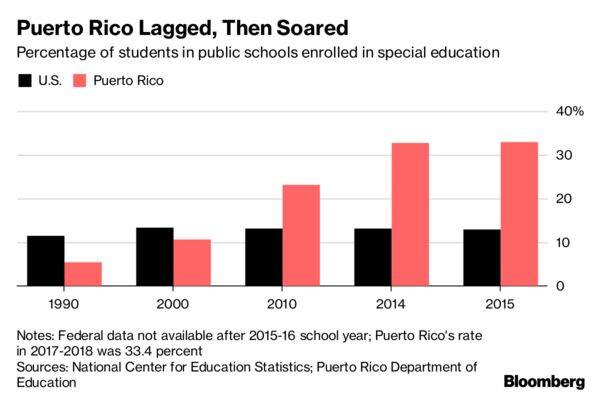
As for education in Puerto Rico, prior to Maria, the island was being subjected to school closure, ostensibly related to the territory’s fiscal problems. Following Maria, school closure in Puerto Rico is a storm in its own right, one that feeds on itself as the population of the island has dropped.
Image result for Special) Education in Puerto Rico
In this post, I offer excerpts from three articles about the state of education in Puerto Rico, particularly the state of special education. I invite readers to follow the links and read the articles in their entirety. We must not forget Puerto Rico.
The first comes from the October 02, 2018, Learning English VOA News and is entitled, “Puerto Rico Students Still Suffer Effects of Hurricane Maria”:
One year has passed since Hurricane Maria struck the United States territory of Puerto Rico.
But even before the storm hit, education officials had begun closing schools on Puerto Rico to save money.
Last year, the territory’s government sought legal protection from creditors because it owed billions of dollars in debts that could not be paid.
In the weeks and months after Hurricane Maria, the number of students on the island dropped as conditions worsened. Thousands of Puerto Rican families fled to the U.S. mainland. Many students ended up attending schools in Florida or other states along the East Coast.
At the time, education officials reported that about half of Puerto Rico’s schools had lower than normal student attendance rates. Only about 60 percent of classroom seats were filled. The government ended up closing nearly 300 schools. Education officials said the move was necessary to meet budget targets.
But the closures created problems for Puerto Rican students and their parents when the new school year started a few weeks ago. With many schools closed, some students had to travel outside their neighborhood to attend school. Their parents often were required to find transportation to and from the school. …
The effects of school closure in Puerto Rico segues into this September 28, 2018, Continue reading: (Special) Education in Puerto Rico: “Here, All of the Parents are Desperate.” | deutsch29


Thursday, October 4, 2018

Mitchell Robinson: Betsy DeVos doesn't know what she doesn't know about education | Eclectablog

Betsy DeVos doesn't know what she doesn't know about education | Eclectablog

Betsy DeVos doesn’t know what she doesn’t know about education


“Parents, by their very nature, should decide what, when, where and how their children learn,” DeVos said.
Secretary of Education Betsy DeVos is at it again. Currently on her second “Rethink Schools” tour, “DeVos will swing by four states: Georgia, Alabama, Mississippi and Louisiana.”
Two tours of public schools in two years on the job–the poor woman must be exhausted.
And while Ms. DeVos has a few ideas for how we could “improve” education in this country (i.e., school choice, vouchers, charter schools, arming teachers, grizzly bear security guards…), most of her ideas have more to do with dismantling our public schools, lowering or eliminating standards for entry to the teaching profession, busting the unions that protect those demoralized and attacked teachers, and removing the regulations that protect victims of sexual assault on college campuses.
But even amidst the barren, dystopian landscape of Ms. DeVos’ vision of American education, the quote above somehow caught my eye. You have to give it to her: Betsy has a real knack for distilling complicated, complex problems down into a single ignorant, nonsensical nugget of edu-drivel.
And she’s just clever enough to remember who her audience is here–and it’s not teachers, or teacher educators, or the 75+% of parents who are happy with their kids’ schools. No, her audience is the conservative base who believe that nothing public is better than anything private, who refer Continue reading: Betsy DeVos doesn't know what she doesn't know about education | Eclectablog

Teachers Union Accuses Supe Of Cozying Up With Charter Groups | Studio City, CA Patch

Teachers Union Accuses Supe Of Cozying Up With Charter Groups | Studio City, CA Patch

Teachers Union Accuses Supe Of Cozying Up With Charter Groups
The LA teachers union released reports claiming the new superintendent spent more time at lavish meals with charter backers than at schools.


LOS ANGELES, CA — As state mediation efforts continued Wednesday in hopes of resolving a labor-talk stalemate between the Los Angeles Unified School District and its teachers' union, the union accused Superintendent Austin Beutner of holding a lavish series of meetings with charter-school advocates.
Citing information taken from Beutner's official district calendar, obtained following a public records request and lawsuit, United Teachers Los Angeles officials noted that over a four-month period, the superintendent held meetings at restaurants including Pacific Dining Car, the members-only California Club, the Hilton Checkers and the Bel-Air Bay Club in Pacific Palisades.
Union officials said Beutner's calendar revealed 34 meetings at restaurants during the four-month period, compared to 29 visits to school campuses.
Beutner "must explain to the public why he was at these expensive restaurants and clubs during school hours," teacher Victoria Casas said at a news conference at UTLA headquarters.


She also questioned whether district credit cards were used to pay for Continue reading: Teachers Union Accuses Supe Of Cozying Up With Charter Groups | Studio City, CA Patch


Education -- and Betsy DeVos -- are issues in key political races this November - The Washington Post

Education -- and Betsy DeVos -- are issues in key political races this November - The Washington Post

Education -- and Betsy DeVos -- are issues in key political races this November


In Wisconsin, Republican Gov. Scott Walker, in office since 2011, is facing a stiff challenge from Democrat Tony Evers, the state’s superintendent of schools — and education is a key issue. Evers said at a state Democratic Party convention in the summer that he was running because he is “goddamn sick and tired of Scott Walker gutting our public schools, insulting our hard-working educators, and destroying higher education in Wisconsin.” Walker called him “pathetic” for cursing. Evers is ahead in the polls.
In Arizona, where thousands of teachers protested poor pay and insufficient funding of schools earlier this year, the first debate between incumbent Republican Gov. Doug Ducey and his Democratic challenger, David Garcia, was dominated last month by education issues. Garcia accused Ducey of not investing enough in public schools; Ducey accused Garcia of not having an education policy.
While it may not top the list of issues motivating voters to go to the polls, education is a key factor in some big races. (Depending on age, location, political affiliation or time of survey, other matters may come out on top, including the economy, immigration or health care.) And while Education Secretary Betsy DeVos isn’t on the ballot anywhere, her priorities are.
Americans have long cited education as a key concern when asked by pollsters to list issues important to them, but it has never been seen as one that could affect their vote. But for a combination of reasons, including the inevitable swing of the political pendulum, things seem different this year.

Hundreds of teachers and retired educators — an unprecedented number — are running for political office on the local, state and federal levels. There are hundreds of teachers — most of them Democrats — running for state legislative seats alone.
The Associated Press quoted Mara Sloan, spokeswoman for the Democratic Legislative Campaign Committee, as saying that in at least two states, Maine and Minnesota, teacher candidates could help flip control of state legislatures to the Democrats.
Years of what educators perceive as attacks on their profession by policymakers have taken a toll, and Continue reading: Education -- and Betsy DeVos -- are issues in key political races this November - The Washington Post


Office of Inspector General Again Condemns U.S. Department of Education’s Oversight of Federal Charter School Dollars | janresseger

Office of Inspector General Again Condemns U.S. Department of Education’s Oversight of Federal Charter School Dollars | janresseger

Office of Inspector General Again Condemns U.S. Department of Education’s Oversight of Federal Charter School Dollars

For many good reasons, we are prone to blame Betsy DeVos, our current U.S. Secretary of Education, for weakening regulations in the Department of Education.  She has, for example, eliminated regulations designed to protect student borrowers from predatory for-profit colleges and cut back civil rights enforcement in the public schools.  But a new report from the U.S. Department of Education’s Office of Inspector General (OIG) once again disparages Arne Duncan, and his lax oversight of federal dollars flowing to charter schools.  The new report documents that when charter schools have closed or been shut down, the Department has failed to ensure that federal dollars flowing to the schools from Title I, the Individuals with Disabilities Education Act, and the federal Charter Schools Program were properly tracked. Further, students’ records from the closed schools were not properly protected.

The report condemns a trend of poor oversight: This is the third major report in which the Department of Education’s OIG has documented poor management of federal dollars flowing to charter schools.  Reports from the Department of Education’s OIG in 2012 and 2016 also disparaged Duncan’s charter school oversight. It is not likely, however, that Betsy DeVos, a libertarian, will improve the Department’s regulatory role.
The new 2018, OIG report examines whether the U.S. Department of Education has a process for adequately monitoring the management of federal dollars and the management of student records and data when charter schools are closed. OIG examined charter school closures in three states between 2011 and 2015.  Defining privately operated charter schools as public schools for the purpose of this report, the OIG notes that in the 2015-2016 school year, there were 98,277 public schools across the United States, among which 6,855 were charter schools.  Between 2011 and 2015, 977 of the charter schools closed.  OIG studied charter school closures in three states: Arizona, which had the highest number of closed charter schools authorized by the same authorizer; California, which had more charter schools than any other state and more students enrolled in charter schools; and Louisiana, which had the highest ratio of Continue reading: Office of Inspector General Again Condemns U.S. Department of Education’s Oversight of Federal Charter School Dollars | janresseger


Advocates Tell FTC: Facebook is violating children’s privacy law | Parent Coalition for Student Privacy

Advocates Tell FTC: Facebook is violating children’s privacy law Complaint says controversial Messenger Kids app doesn’t comply with COPPA | Parent Coalition for Student Privacy

ADVOCATES TELL FTC: FACEBOOK IS VIOLATING CHILDREN’S PRIVACY LAW COMPLAINT SAYS CONTROVERSIAL MESSENGER KIDS APP DOESN’T COMPLY WITH COPPA

Image result for FACEBOOK IS VIOLATING CHILDREN̢۪S PRIVACY LAW


Parent Coalition for Student Privacy signed onto this complaint to the FCC about Facebook’s violation of children’s privacy and the federal law known as COPPA via its Messenger for Kids app.
Contact: David Monahan, CCFC: david@commercialfreechildhood.org; 617-896-9397
BOSTON – Wednesday, October 3, 2018 – Today, a coalition of 17 public health advocacy groups called on the Federal Trade Commission (“FTC”) to investigate and take action against Facebook for violations of the Children’s Online Privacy Protection Act (“COPPA”). The groups filed a complaint asserting that Messenger Kids, a controversial messaging application for children as young as five, collects kids’ personal information without obtaining verifiable parental consent or providing parents with clear and complete disclosures of Facebook’s data practices.
Messenger Kids is the first major social platform designed specifically for young children. The FTC complaint says that Facebook’s parental consent mechanism does not meet the requirements of COPPA because it’s not reasonably calculated to ensure that the person providing consent is actually the child’s parent. Any adult user can approve any Messenger Kids account, and testing confirmed that even a fictional “parent” holding a brand-new Facebook account could immediately approve a child’s account without proof of identity. The complaint also asserts that Facebook Messenger Kids’ privacy policy is incomplete and vague. The policy allows Facebook to disclose data to unnamed third parties and the “Facebook Family of Companies” for broad, undefined business purposes. The policy does not specify what companies are in the “Facebook Family.” COPPA requires that privacy policies list the name and contact information of any third parties who have access to children’s data.
The complaint was organized by the Campaign for a Commercial-Free Childhood (CCFC) and drafted by the Communications & Technology Law Clinic in the Institute for Public Representation (“IPR”) at Georgetown University Law Center. “Despite Facebook’s promises to the contrary, Messenger Kids blatantly violates Continue reading: Advocates Tell FTC: Facebook is violating children’s privacy law Complaint says controversial Messenger Kids app doesn’t comply with COPPA | Parent Coalition for Student Privacy