Latest News and Comment from Education

Wednesday, September 26, 2018

The $3.5 Trillion West Coast Public School Privatization Plan

Schock Market seeks auction of public schools--for $3.5 Trillion

Schock Market seeks auction of public schools--for $3.5 Trillion


BEND, Ore., Sept. 26, 2018 /PRNewswire/ -- Internet startup, Schock Market, Inc. (www.schockmarket.com) will seek to auction off the public school systems of OregonWashington, and California—for half a trillion dollars.  Success would extrapolate to a $3.5 trillion sale for public schools nationwide.
The auctions are being managed through newly-conceived reservation markets.  These markets have been pioneered by Stanford University graduate, Spencer Schock.  Schock hopes U.S. Secretary of Education, Betsy DeVos, will support the experiment.
The markets are designed to unfold in phases.
In the first phase, individuals and businesses register as investors at www.schockmarket.com/Profiles/Register.  Investors attempt to predict savings that may be achieved by privatizing government agencies.  When investors guess well, they may earn payouts, potentially in the millions of dollars.
In the second phase, corporations bid on these same government agencies.  In the case of schools, corporations will bid to purchase and operate public schools within a state.
During this second phase, proceeds from privatization are revealed to taxpayers.  The California K12 market, for example, could conceivably reap $436 billion for California citizens.  If so, every Californian would receive a check for $11,000.
In the final phase, completed markets are approved through statewide voter initiatives.  These initiatives are backed by winning corporations as well as investors and taxpayers seeking the payouts described above.
Benefits
Schock suggests that democratic societies fail to embrace innovative solutions, often due to uncertainty associated with free markets.  This hesitation causes voters to choose safe, but underperforming, government services over free markets.
Reservation markets resolve this problem by providing a high definition look into the future of a proposed market.  It is important to note that reservation markets do not model a future outcome.  Instead, reservation markets are the future outcome.  Schock achieves this distinction by replacing a single financial transaction, with a multitude of reservations.
Schock suggests knowing market winners in advance will provide citizens with an opportunity to privatize much of the public sector, including schools.  Says Schock, "Reservation markets represent an opportunity to reboot Western civilization . . .  and earn a windfall profit, for everyone, while doing so."
Cost
Individuals and businesses may invest at Schock Market for $3 per month. 
The site opens with three education markets:  Oregon K12, Washington K12, and California K12.  The potential taxpayer payout for each is $36 billion$69 billion, and $436 billion respectively.
SOURCE Schock Market, Inc.

Related Links

Schock Market seeks auction of public schools--for $3.5 Trillion


Big Education Ape: Charter-School Movement Grows—for Real-Estate Investors - WSJ - http://bigeducationape.blogspot.com/2015/10/charter-school-movement-growsfor-real.html

Big Education Ape: Charter Schools: ALL ABOUT THE MONEY - http://bigeducationape.blogspot.com/2018/08/esj-capital-partners-llc-bought-four.html

Big Education Ape: Q&A: Will the New Charter School Bill Impact Commercial Real Estate? WTF is a PRIVATE CHARTER SCHOOL? - http://bigeducationape.blogspot.com/2018/07/q-will-new-charter-school-bill-impact.html


MARKET OVERVIEW
Reservation markets have many potential uses.  In the example below, we discuss the most common application, which is privatization of a government agency.
U.S. taxpayers oversee trillions of dollars in public services.  Taxpayers must choose a government agency or market solution to deliver these services.
Market solutions enjoy a reputation for efficiency.  On the other hand, market outcomes cannot be predicted with certainty.  For this reason, taxpayers often choose government agencies to deliver public services.  For example, only 13% of the U.S., $4 trillion-dollar federal budget is outsourced to private contractors.
Reservation markets address this shortcoming of markets by:
a) Revealing the hidden value of privatization to taxpayers.
b) Revealing market outcomes to taxpayers, before they vote for those outcomes.
In this example, we also discuss the important role investors play in this discovery.
MARKET EXAMPLE
Imagine Schock Market launches a reservation market exploring privatization of a county landfill.  Savings will be split between investors, taxpayers, and local environmentalists seeking restoration of a nearby, polluted stream.
In the first phase, investors enter the market and attempt to predict the savings that will be achieved through privatization.  
When bidding, investors attempt to acquire reservations at a price at or below the actual savings from privatization.  Investors that bid well are eligible to receive a payout. Investors that bid too high, are ineligible to receive a payout.
Over time, market prices will plateau.  Why? Because investors are concerned that the market is reaching full valuation.  If they now bid too high, they risk losing their payout.
The role of investors is to reveal for the public, the value of privatizing a government agency.  When a market plateaus, we assume this value has been revealed and the market is closed.
In the second phase, the market is reopened for corporations.  Corporations that specialize in waste management bid on purchasing the landfill and operating it for the local community.  Imagine the winning bid is $30 million for the purchase of the landfill and $10 million in operational savings over ten years.  In this case, the total windfall for taxpayers is $40 million.
In this phase, the winning corporate bidder is announced along with the total savings of $40 million.
The payout to investors is also announced.  A payout might be 1% of the windfall, or in this example, $400,000.  This payout will be shared among investors that acquired reservations priced at or below a market value of $40 million.
The payout to environmentalists is also announced.  Let’s say the environmentalists have been promised 5% of the windfall or $2 million for restoration of the polluted stream.
Finally, the payout to taxpayers is announced.  Imagine the $40 million in proceeds will be distributed to 50,000 county residents.  This equates to a $752 check for every man, woman, and child living in the county ($40 million - $400,000 for investors - $2 million for environmentalists = $37.6 million / 50,000 = $752).
In the final phase, the now completed market is launched as a voter initiative for county residents.  The initiative is backed by investors, the winning corporation, environmentalists, and taxpayers all wanting their payouts.
If the initiative passes, the landfill is privatized.  The winning corporation purchases the landfill at the agreed upon price.  Money from the sale of the landfill and ongoing operational savings provides for payouts to investors, environmentalists, and taxpayers.
KEY POINTS
Schock Market replaces a financial transaction with a multitude of competing reservations.  This creates a sort of crystal ball where market activity today, reveals an outcome that will occur in the future.
This crystal ball is of immense value to voters.  In the past, voters choosing market solutions could only hope for the desired outcome.  Now, voters can choose a market solution and know in advance what the market outcome will be.
Also note that Schock Market creates advocates for change.  In our example, the investors, winning corporate bidder, environmentalists, and taxpayers all have a financial stake in overcoming the status quo.  They want their payout, so they push for change. This represents a new dynamic for voter initiatives.
INVESTORS
Investors play a critical role at Schock Market.  Here is an overview of their role:
Investors are U.S. citizens that have registered at Schock Market.  The cost of participation is a $3 per month subscription.
Investors receive $5 million in their account at time of registration.  (This high value is required if investors are to make meaningful bets in a nation where government spending and assets are counted in the trillions.)
It is impossible for investors to lose their $5 million.  When an investor cancels a reservation, 100% of the funds spent on that reservation are returned to the investor.
Investors review open markets at Schock Market.  Investors then choose a market in which they would like to predict savings from privatization.
Investors that make accurate predictions are eligible to receive a payout or percent of the actual savings from privatization.
To receive a payout, investors must secure reservations for a price at or below the actual savings from privatization.  Using our example above, investors that make bids at or below a market value of $40 million are eligible for a payout.
Investors that bid above the actual savings from privatization are ineligible for a payout.
Investors compete for a limited number of reservations in each market.  Investors attempt to pay a low price for a reservation and hang on to that reservation for as long as possible.  Payouts are based upon how much time an investor accumulates in a market, at or below the actual savings from privatization.
A low-priced reservation may be taken from an investor by a new investor bidding more for that same reservation.
In this manner, competition for reservations causes the price of reservations to rise over time.
As markets approach what many consider full valuation, investors become cautious and slow their trading.  Why? Because these investors don’t want to bid too high and have all of their accumulated time become ineligible for a payout.
At this point, the market has plateaued and is thus telegraphing a likely maximum savings from privatization.  Investors have fulfilled their role which is to inform the public about possible savings.
At this time, the market is closed to investors.  It is then reopened as a market for corporate bids.
Each reservation market is a proposal.  It is a form of free speech.
Many obstacles stand between this free speech and actual implementation of the market proposal.  Some reservation markets may be contrary to existing local, state, or federal laws, making implementation impossible without changes to applicable law.  Schock Market makes no representation as to whether any particular reserve market will result in tax savings, voter initiative, privatization, or any changes or outcomes proposed by investors or other participants.  Schock Market cannot guarantee that our market proposals will be implemented or that investor payouts will be paid.
All investing is subject to the Market Rules, available here:www.schockmarket.com/marketrules.
http://www.schockmarket.com

Could another Oklahoma teacher walkout happen in 2019?

Could another Oklahoma teacher walkout happen in 2019?

Could another Oklahoma teacher walkout happen in 2019?


WHAT will happen if, as the 2019 legislative session gets rolling, it appears common education isn't in line for another big boost in funding? Will teachers strike again, as they did this year?


It wouldn't be surprising if the answer is yes. And why not? The threat of a walkout paid off handsomely in 2018, with the Legislature approving large tax increases for pay raises that were even larger than the teachers' union had demanded. The new revenue also went to boost pay for support staff and for additional school funding.


All this was approved before the strike, which lasted two weeks and was used to demand more money, including some that wouldn't have necessarily ended up going to education. The end of the strike left many walkout attendees frustrated that the Legislature didn't do more.


Lawmakers this year approved a record $2.9 billion appropriation for common education, but got little to no thanks. The walkout spurred dozens of teachers to file for legislative seats, and more than four dozen made it through to November's ballot. Meanwhile, members of the Legislature who voted against the tax increase were labeled “anti-education” and, in some cases, lost their primaries or runoffs.


That sentiment — if you don't see things as we do, you're the enemy — is sure carry over to next year, fueled by the Oklahoma Education Association with the guidance and support of its parent group, the National Education Association, which directed the Oklahoma walkout and others around the country this spring, and the American Federation of Teachers union.


The AFT sponsored an event Saturday at Northwest Classen High School called “Stand Up Continue reading: Could another Oklahoma teacher walkout happen in 2019?


LA teachers are ready to walk | SocialistWorker.org

LA teachers are ready to walk | SocialistWorker.org

LA TEACHERS ARE READY TO WALK
Image result for UTLA


EDUCATORS IN United Teachers of Los Angeles (UTLA) voted overwhelmingly in late August to authorize a strike in a vote in which an impressive 83 percent of members cast a ballot.
Now a showdown looms in the coming months between a fired-up union and a labor-hating school superintendent — a showdown that could add important new dimensions to the wave of educators’ strikes that began last spring in West Virginia.
If LA teachers do walk off the job, it will build on the strikes this fall in Washington state to show that the miserable conditions facing teachers and public schools aren’t confined to Southern states run by Republicans, but exist in some of the richest and most Democratic states in the country.
A teachers’ strike would also shine a national spotlight on the network of militants who have won leadership in the UTLA; increase pressure on other “blue state” union leaders to use their resources and legal protections join the rebellion started in states dominated by anti-union Republicans; and expose the ways that even supposedly pro-labor laws are used to keep workers from using their power to strike.
Finally, a UTLA strike would show — just as the 2012 Chicago teachers strike did — the importance of “bargaining for the common good” by taking up issues of racial justice and other community concerns, and linking those to issues of teacher pay, in order to build effective resistance to the divide-and-conquer tactics of those trying to destroy public education.
Image result for UTLA

CALIFORNIA — THE home of the most billionaires in the country, as well as mega-corporations like Apple, Chevron and Disney — also has the nation’s highest poverty rate when cost-of-living is factored in, and ranks 43rd out of the 50 states in per-pupil funding.
More than 80 percent of students in the Los Angeles United School District (LAUSD) live at or below the poverty level. The town that gives us #OscarsSoWhite has a public school system with 90 percent students of colorand class sizes “limits” that can reach 46 for many high school classes.
“My classroom is so crowded with student desks that my students and I sometimes can’t get from one side of the room to the other unless we walk outside and enter through the other door,” UTLA activist Gillian Russom wrote in an article for Socialist Worker earlier this year.
“I teach at a large high school with a sprawling campus which once had 18 Continue Reading: LA teachers are ready to walk | SocialistWorker.org


FL Teacher Fired for Giving Zeros When Students Did Not Turn in the Work | deutsch29

FL Teacher Fired for Giving Zeros When Students Did Not Turn in the Work | deutsch29

FL Teacher Fired for Giving Zeros When Students Did Not Turn in the Work


On September 25, 2018, WFTV reported that eighth-grade social studies teacher, Diane Tirado, says she was fired for refusing to assign 50 percent credit to students who did not hand in assignments.
IMG_1264
Diane Tirado
According to the Florida teacher certification website, Tirado was first licensed in 1999.
Tirado began teaching at West Gate K-8 School in Port St. Lucie, FL, in August 2018. She was terminated on September 14, 2018; apparently no details about the terminating event were included since Tirado was still in her probationary period for employment at West Gate K-8.
Upon being fired, Tirado left a message for her students on her classroom’s white board: “Bye Kids. Mrs. Tirado loves you and wishes you the best in life! I have been fired for refusing to give you a 50% for not handing anything in. Mrs. Tirado.”
Tirado posted a picture of her message on Facebook on September 15, 2018:
IMG_1259
Now, here’s where it gets interesting.
The West Gate CIO (chief info officer) denies that such a policy exists. From the Continue reading: FL Teacher Fired for Giving Zeros When Students Did Not Turn in the Work | deutsch29


The straw man in the new round of the reading wars - The Washington Post

The straw man in the new round of the reading wars - The Washington Post

The straw man in the new round of the reading wars

Image result for National Council on Teacher Quality,


The “reading wars” never go away — at least not for long.
What exactly are they? Fights in the education policy world about the “best way” to teach reading to kids — as if there were a single best way.
So what are the “reading wars” and when did they start? They go back to the 1800s, when debate began about the best way to teach kids to read. Horace Mann, the influential educational reformer who was secretary of education in Massachusetts, argued against teaching the explicit sounds of each letter, arguing that students would then not learn to read for meaning and that they should first learn to read whole words.
A debate over emphasizing “phonics” or “whole language” has been voiced ever since — at least by scholars and policymakers, who often don’t bother to pay attention to what teachers are actually doing in the classroom.
The debate flared in 2013, when the National Council on Teacher Quality, a group created by a conservative think tank to diminish the influence of teacher education schools, published negative ratings of many of these institutions and attacked their literacy instruction.
Rachael Gabriel, associate professor of literacy education at the University of Connecticut, wrote a piece for this blog at the time critiquing the ratings — and now she is back with a new piece looking at a flare-up in the reading wars, sparked by some articles in the news media attacking “balanced literacy.” Though the term suggests that is a combination of whole language and phonics, it is actually more. Gabriel explains:
By Rachael Gabriel
We are seeing new articles in the media saying that American elementary school educators don’t understand the science of how to teach kids how to read — and even if they do, some resist it. Continue Reading: The straw man in the new round of the reading wars - The Washington Post

Tuesday, September 25, 2018

Study: Girls 'Significantly' Better Than Boys At Reading, Writing - Study Finds

Study: Girls 'Significantly' Better Than Boys At Reading, Writing - Study Finds

Study: Girls ‘Significantly’ Better Than Boys At Reading, Writing

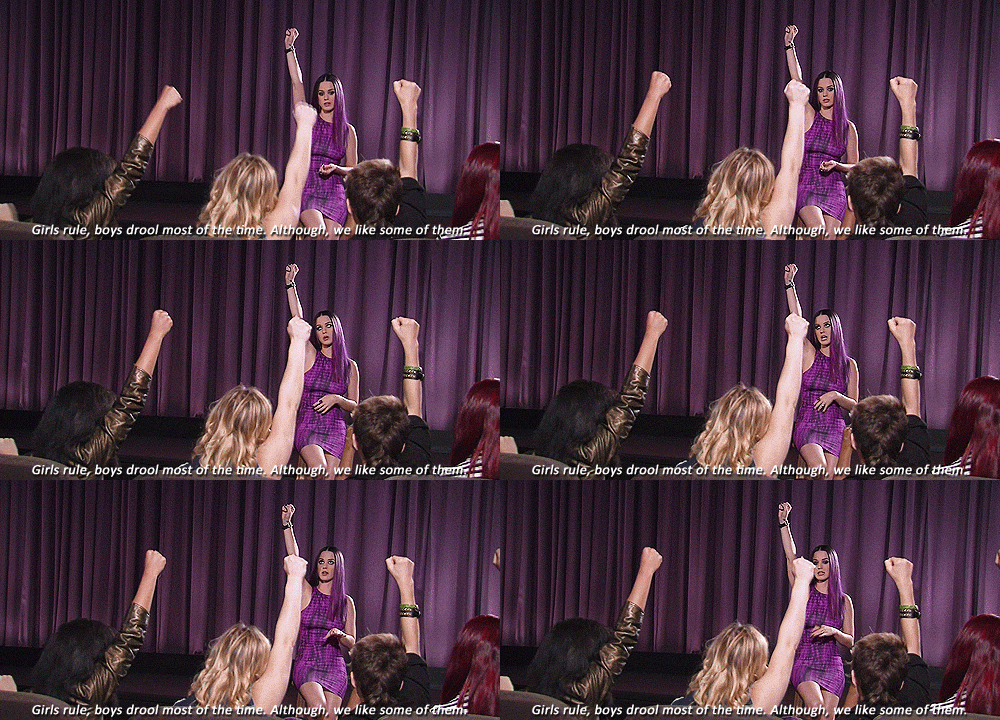
Image result for Girls rule animated gif

QUEENSLAND, Australia — Maybe they’re born with it. In the never-ending battle of the sexes, its the girls who prove victorious when it comes to grade-school English class skills. A new study finds that girls perform significantly better than boys in the U.S. on standardized tests of reading and writing abilities.
Researchers from Griffith University in Australia say the results are clear after reviewing the scores of more than 3.9 million American students from a 27-year span. Data was gathered from the the National Assessment of Educational Progress, which collected standardized test scores from students in the fourth, eighth, and twelfth grades.
The authors found that girls fared markedly better in both reading and writing in the fourth grade, only to see the gap widen in eighth and twelfth grades, especially when it came to writing.
“The common thinking is that boys and girls in grade school start with the same cognitive ability, but this research suggests otherwise,” says lead author David Reilly, a doctoral student at Griffith, in a release by the American Psychological Association. “Our research found that girls generally exhibit better reading and writing ability than boys as early as the fourth grade.”
Reilly and his team believe the surprising findings could be a result of boys being more likely to be diagnosed with a learning disability. Similarly, behavioral problems typically seen more frequently among boys may also make them more prone to delays, which Reilly says could even signal a neurological condition.
The authors also suggest the peer pressure boys face to follow masculine norms could contribute, making reading less of a priority for some.
“The magnitude of the writing gender gap was really quite surprising, as was the fact that there was no evidence for a decline in the gap for reading and writing over time. Many boys are highly proficient in reading, and yet really struggle when it comes to writing tasks,” Reilly argues in a university news release.
Other research has shown that girls use both brain hemispheres for reading and writing, while boys typically rely on just one.
“Reading and writing sets the stage for later schooling. While we’ve concentrated on basic literacy, the demands on students for writing grow stronger as they progress through education,” adds Reilly. “In particular, it’s crucial for high school and college entry. Each year, more women than men apply for college entry, and more women than men complete their college degrees. It has a cascading effect on students, either up or down.”
Reilly says curriculum needn’t be any different for either gender, but schools should consider pushing expressive writing exercises on boys earlier. Teachers could also work to make writing as big of a priority as reading and other subjects, such as the “STEM” (science, technology, engineering, and mathematics) courses that have gained greater attention in recent years.
“For educational practice, I believe this study shows the need for a greater focus on writing beginning in primary continuing throughout high school, but in an ever-crowded curriculum that is focusing more on STEM, it highlights the increased need for further work,” he concludes.
The full study was published September 20, 2018 in the journal American Psychologist.
Study: Girls 'Significantly' Better Than Boys At Reading, Writing - Study Finds


Charter’s $30m payout sparks political backlash :: K-12 Daily

Charter’s $30m payout sparks political backlash :: K-12 Daily :: The Essential Resource for Superintendents and the Cabinet

Charter’s $30m payout sparks political backlash


(Ariz.) Charter schools and policies supporting parental choice may have no greater champions than the Republican leadership in the Arizona state house, but a recent school real estate deal could test that commitment.
In a quiet move made earlier this month that has sparked headlines, a state oversight board voted unanimously to approve the transfer of a Phoenix area charter school from a for-profit corporation to a non-profit entity.
The action triggered a windfall profit of up to $30 million in tax money to the owner of the dispensing company, who also happens to be a member of the Arizona House of Representatives, according to published reports.
Eddie Farnsworth, R-Chandler, told the Arizona Republic last week that he deserved the profit-taking because he had invested millions of dollars in launching the charter school twenty years ago.
“I make no apologies for being successful,” he told reporters.
Farnsworth–an attorney and a one-time staff member to U.S. Sen. Orrin Hatch of Utah–is also on the ballot in November, running for a seat in the state Senate.
Although the move has raised eyebrows among his GOP colleagues, few if any have criticized his action publicly. That said, Gov. Doug Ducey–who is locked in a dead-heat in his election bid with his Democratic challenger, reversed gears shortly after the Farnsworth deal became public, and endorsed a package of bills that would impose more accountability on charter schools and new restrictions on charter operators for profit-taking at public expense.
“Republicans ignore all the evidence of a problem while joining hands and chanting, “school choice, school choice, school choice,” wrote Republic columnist Laurie Roberts last week. “Indeed it is a choice to focus only on charter school successes—and there are certainly some—while ignoring problems rampant in the charter school industry.”
The Farnsworth controversy comes at a bad time for Republicans, who have been locked in an continue reading: Charter’s $30m payout sparks political backlash :: K-12 Daily :: The Essential Resource for Superintendents and the Cabinet


No Thank You to Naviance – Seattle Education

No Thank You to Naviance – Seattle Education

NO THANK YOU TO NAVIANCE

feral families


The district has designed a scope and sequence of how to use Naviance with a focus on 11th and 12th grade but actual implementation will be left school to school. Once parents have forfeited their chance to opt out there will not be any other chances to give consent for certain portions. They told me it is an all in system with individual schools being left to make decisions about how they will accommodate students who opt out….
Through my daughter’s eighth grade year, I started to familiarize myself with how high school is organized nowadays in SPS. It’s been a long time since my Ingraham days of “tennis shoe registration” where we ran station to station with little index cards and golf pencils signing up for our courses manually. So with a few weeks until school let out when I received this email from Seattle Public Schools, my interest was peaked,
Dear families,
We are pleased to announce the district’s college and career planning tool, Naviance, will be available in the 2018-19 school year to support your student’s personalized journey through high school. This is a web-based, mobile-friendly tool that you and your student can use to explore interests and options, consider post-high school plans, and ensures all students can have access to post-high school planning supports.
The Naviance college and career planning tool will allow students to:
• Research careers and colleges: Learn about career fields linked to personal interests, compare data from college admissions offices, take personalized surveys to understand strengths and goals.
• Get involved in the planning process:Build a resume, manage timelines and deadlines for making decisions about colleges and careers; organize and track documents related to the college application process, such as requesting and submitting letters of recommendation and transcripts.
• High School and Beyond Plan: Schools will be using Naviance to deliver high school and beyond plan lessons in grades 8-12.  The high school and beyond plan is a graduation requirement, which Continue reading: No Thank You to Naviance – Seattle Education

New Yorker Profile Warns: When It Comes to Mark Zuckerberg, Be Careful! | janresseger

New Yorker Profile Warns: When It Comes to Mark Zuckerberg, Be Careful! | janresseger

New Yorker Profile Warns: When It Comes to Mark Zuckerberg, Be Careful!


Evan Osnos’s extraordinary profile of Mark Zuckerberg, published in the September 17, New Yorker, wouldn’t seem a fitting topic for coverage in this blog about public education. Osnos hardly touches on Mark Zuckerberg’s ventures thus far into education philanthropy—the Chan-Zuckerberg Initiative, which has made education-based philanthropy one of its primary foci, or the $100,000,000 gift to help Chris Christie and Cory Booker charterize the public schools in Newark, New Jersey, a controversial and poorly conceived initiative that did not improve the education of children in Newark.
Osnos’s profile explores the question of who has the power,”to pull the lever of what we see, hear, and experience.” Osnos is, of course, examining the role of Facebook and whether and how it functions as an arbiter of free speech. The central subject of the profile, however, is Mark Zuckerberg himself and how he thinks and operates.  Continuing to explore the issue of free speech, Osnos explains: “Zuckerberg is hoping to erect a scalable system, an orderly decision tree that accounts for every eventuality and exception, but the boundaries of speech are a bedevilling problem that defies mechanistic fixes.”
Last spring when Zuckerberg testified before Congress, the Washington Post‘s Dana Milbank described Zuckerberg as “the boy billionaire,” a caricature that precisely captures the Mark Zuckerberg Osnos depicts: a naif who knows coding and tech systems but who cannot comprehend his own and his company’s power.  Unfortunately, Zuckerberg also seems unable to grasp what he doesn’t know.
How the Chan-Zuckerberg Initiative will affect public education remains unclear. Writing forChalkbeatMatt Barnum explains: “In late 2015, Mark Zuckerberg and his wife Priscilla Chan promised to donate 99 percent of their Facebook shares to their philanthropy, which would focus part of its work on improving American education… But the organization remains one of the least transparent funders in education.  Unlike a number of other philanthropies, CZI does not publicly list its grants, instead announcing only certain awards on Facebook or in press releases…  As a limited liability company, CZI is not required to list donations on its tax forms, unlike private foundations… The Chan Zuckerberg Initiative’s recent giving vaults CZI into the top echelon of education funders, though it remains behind the Gates Foundation and Walton Family Foundation for now.  Whereas CZI averaged a bit over $100 million in grants Continue reading: New Yorker Profile Warns: When It Comes to Mark Zuckerberg, Be Careful! | janresseger


Monday, September 24, 2018

After the Education Wars: Someone Needs to Save Us from Our Billionaire Saviors

After the Education Wars: Someone Needs to Save Us from Our Billionaire Saviors

After the Education Wars: Someone Needs to Save Us from Our Billionaire Saviors


After failing to prop-up Antonio Villaraigosa’s flagging gubernatorial campaign last June, Michael Bloomberg apparently spent the summer pondering whether it would be wiser for him to personally save the United States rather than waste his time trying to rescue California by proxy. Last week the New York Times reported that Bloomberg was mulling a run for the Presidency as a Democrat because that represented the most viable path to victory. As the Timesstory observed, while Bloomberg has engaged in some good work on guns and the environment, many of his other positions might not be very likely to win over the liberal base of the Democratic Party.
Interestingly, the New York Times piece listed Bloomberg’s more conservative views on criminal justice reform, #MeToo, and bank regulation, but was strangely silent on education, one of the central fronts where Bloomberg has spent millions of dollars promoting largely terrible ideas and candidates that have done far more harm than good to American public education.
As Andrea Gabor, (ironically) the Bloomberg chair of business journalism at Baruch College/CUNY, writes in her excellent new book After the Education Wars: How Smart Schools Upend the Business of Reform, Bloomberg’s reign in New York hardly represented a golden era for education: “to be an educator in Bloomberg’s New York was a little like being a Trotskyite in Bolshevik Russia—never fully trusted and ultimately sidelined.”
The corporate education reform crusade of the last several decades that folks like Bloomberg, Bill Gates, Eli Broad, and the Walton family have funded and nurtured is a top-down movement of billionaires guided by, Gabor astutely notes, an unquestioned gospel of neoliberal “truths”:
The business reformers came to the education table with their truths: a belief in market competition and quantitative measures. They came with their prejudices—favoring ideas and expertise forged in corporate boardrooms over knowledge and experience gleaned in Continue Reading: After the Education Wars: Someone Needs to Save Us from Our Billionaire Saviors


35 Years Adrift on an Ocean of Reforms - The Crucial Voice of the People

35 Years Adrift on an Ocean of Reforms - The Crucial Voice of the PeopleThe Crucial Voice of the People
35 Years Adrift on an Ocean of Reforms


A Nation at Risk began as a commissioned report to define problems in America’s schools. It became known more for the longstanding political debates that developed. But did this single report produce the ocean of reforms that now threaten to destroy our public schools? Was it the report that forced us to set our course on national standards and testing? Or did a few choice words, and powerful people, set us drifting on the ocean of reforms that are now eroding the educational foundation of America?
“The educational foundations of our society are presently being eroded by a rising tide of mediocrity that threatens our very future as a Nation and a people.”
Like or loathe them, those words from A Nation at Risk live on in education reform infamy.

MormonWiki Secretary of Education Terrel Bell with President Reagan
As President Reagan explained, he and his Secretary of Education T. H. Bell “agreed that it was imperative to assemble a panel of America’s leading educators, an assembly of such eminence that the Nation would listen to its findings.” So when Continue reading:35 Years Adrift on an Ocean of Reforms - The Crucial Voice of the PeopleThe Crucial Voice of the People


‘It’s Like Amazon, But for Preschool’ (Audrey Watters) | Larry Cuban on School Reform and Classroom Practice

‘It’s Like Amazon, But for Preschool’ (Audrey Watters) | Larry Cuban on School Reform and Classroom Practice

‘It’s Like Amazon, But for Preschool’ (Audrey Watters)

Audrey Watters describes herself as “ … an education writer, an independent scholar, a serial dropout, a rabble-rouser, and ed-tech’s Cassandra.”
 
A year ago, the richest man in the world asked Twitter for suggestions on how he should most efficiently and charitably spend his wealth. And today, Jeff Bezos unveiled a few details about his plans – other than funding space travel, that is. His new philanthropic effort, The Day 1 Fund, will finance two initiatives: the Families Fund will work with existing organizations to address homelessness and hunger; and the Academies fund “will launch an operate a network of high-quality, full-scholarship, Montessori-inspired preschools in underserved communities.”
“We’ll use the same set of principles that have driven Amazon,” Bezos wrote in a note posted to Twitter. “Most important among these will be genuine intense customer obsession. The child will be the customer.”
The child will be the customer.
Bezos then went on to cite a phrase that is so often misquoted and misattributed in those shiny, happy motivational PowerPoint slides – you know the ones – that people like to post to social media: “Education is not the filling of a pail but the lighting of a fire.” W. B. Yeats never said this, for the record, but words get so easily twisted, history so easily co-opted.
The assurance that “the child will be the customer” underscores the belief – shared by many in and out of education reform and education technology – that education is simply a transaction: an individual’s decision-making in a “marketplace of ideas.” (There is no community, no public responsibility, no larger civic impulse for early childhood education here. It’s all about privateschools offering private, individual benefits.)
This idea that “the child will be the customer” is, of course, also a nod to Continue reading: ‘It’s Like Amazon, But for Preschool’ (Audrey Watters) | Larry Cuban on School Reform and Classroom Practice