Latest News and Comment from Education

Wednesday, September 26, 2018

The straw man in the new round of the reading wars - The Washington Post

The straw man in the new round of the reading wars - The Washington Post

The straw man in the new round of the reading wars

Image result for National Council on Teacher Quality,


The “reading wars” never go away — at least not for long.
What exactly are they? Fights in the education policy world about the “best way” to teach reading to kids — as if there were a single best way.
So what are the “reading wars” and when did they start? They go back to the 1800s, when debate began about the best way to teach kids to read. Horace Mann, the influential educational reformer who was secretary of education in Massachusetts, argued against teaching the explicit sounds of each letter, arguing that students would then not learn to read for meaning and that they should first learn to read whole words.
A debate over emphasizing “phonics” or “whole language” has been voiced ever since — at least by scholars and policymakers, who often don’t bother to pay attention to what teachers are actually doing in the classroom.
The debate flared in 2013, when the National Council on Teacher Quality, a group created by a conservative think tank to diminish the influence of teacher education schools, published negative ratings of many of these institutions and attacked their literacy instruction.
Rachael Gabriel, associate professor of literacy education at the University of Connecticut, wrote a piece for this blog at the time critiquing the ratings — and now she is back with a new piece looking at a flare-up in the reading wars, sparked by some articles in the news media attacking “balanced literacy.” Though the term suggests that is a combination of whole language and phonics, it is actually more. Gabriel explains:
By Rachael Gabriel
We are seeing new articles in the media saying that American elementary school educators don’t understand the science of how to teach kids how to read — and even if they do, some resist it. Continue Reading: The straw man in the new round of the reading wars - The Washington Post

Tuesday, September 25, 2018

Study: Girls 'Significantly' Better Than Boys At Reading, Writing - Study Finds

Study: Girls 'Significantly' Better Than Boys At Reading, Writing - Study Finds

Study: Girls ‘Significantly’ Better Than Boys At Reading, Writing

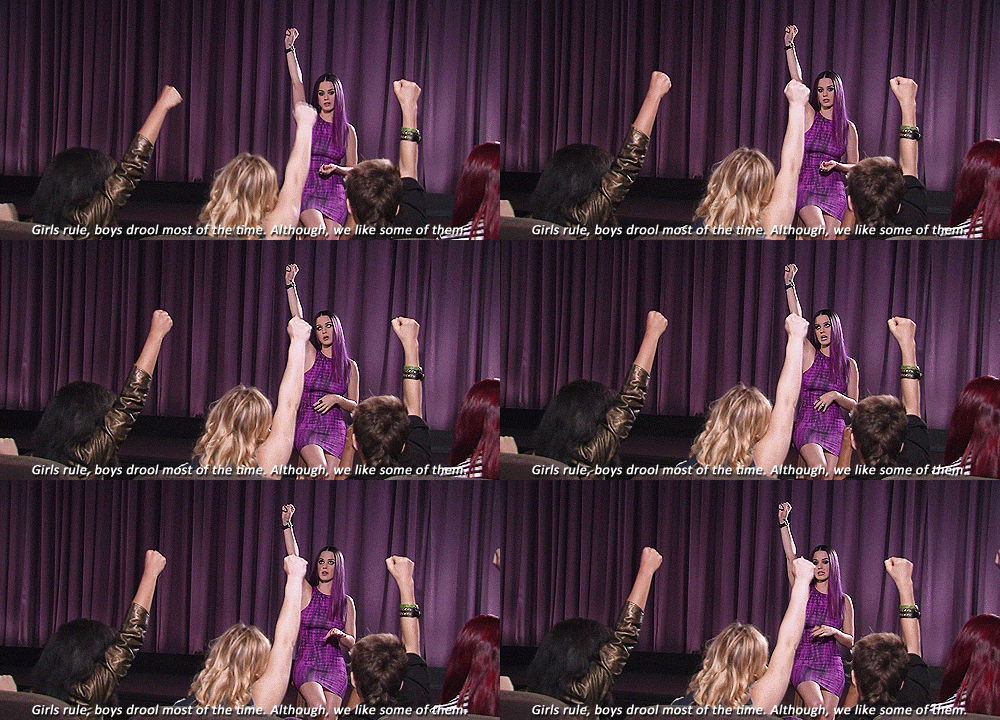
Image result for Girls rule animated gif

QUEENSLAND, Australia — Maybe they’re born with it. In the never-ending battle of the sexes, its the girls who prove victorious when it comes to grade-school English class skills. A new study finds that girls perform significantly better than boys in the U.S. on standardized tests of reading and writing abilities.
Researchers from Griffith University in Australia say the results are clear after reviewing the scores of more than 3.9 million American students from a 27-year span. Data was gathered from the the National Assessment of Educational Progress, which collected standardized test scores from students in the fourth, eighth, and twelfth grades.
The authors found that girls fared markedly better in both reading and writing in the fourth grade, only to see the gap widen in eighth and twelfth grades, especially when it came to writing.
“The common thinking is that boys and girls in grade school start with the same cognitive ability, but this research suggests otherwise,” says lead author David Reilly, a doctoral student at Griffith, in a release by the American Psychological Association. “Our research found that girls generally exhibit better reading and writing ability than boys as early as the fourth grade.”
Reilly and his team believe the surprising findings could be a result of boys being more likely to be diagnosed with a learning disability. Similarly, behavioral problems typically seen more frequently among boys may also make them more prone to delays, which Reilly says could even signal a neurological condition.
The authors also suggest the peer pressure boys face to follow masculine norms could contribute, making reading less of a priority for some.
“The magnitude of the writing gender gap was really quite surprising, as was the fact that there was no evidence for a decline in the gap for reading and writing over time. Many boys are highly proficient in reading, and yet really struggle when it comes to writing tasks,” Reilly argues in a university news release.
Other research has shown that girls use both brain hemispheres for reading and writing, while boys typically rely on just one.
“Reading and writing sets the stage for later schooling. While we’ve concentrated on basic literacy, the demands on students for writing grow stronger as they progress through education,” adds Reilly. “In particular, it’s crucial for high school and college entry. Each year, more women than men apply for college entry, and more women than men complete their college degrees. It has a cascading effect on students, either up or down.”
Reilly says curriculum needn’t be any different for either gender, but schools should consider pushing expressive writing exercises on boys earlier. Teachers could also work to make writing as big of a priority as reading and other subjects, such as the “STEM” (science, technology, engineering, and mathematics) courses that have gained greater attention in recent years.
“For educational practice, I believe this study shows the need for a greater focus on writing beginning in primary continuing throughout high school, but in an ever-crowded curriculum that is focusing more on STEM, it highlights the increased need for further work,” he concludes.
The full study was published September 20, 2018 in the journal American Psychologist.
Study: Girls 'Significantly' Better Than Boys At Reading, Writing - Study Finds


Charter’s $30m payout sparks political backlash :: K-12 Daily

Charter’s $30m payout sparks political backlash :: K-12 Daily :: The Essential Resource for Superintendents and the Cabinet

Charter’s $30m payout sparks political backlash


(Ariz.) Charter schools and policies supporting parental choice may have no greater champions than the Republican leadership in the Arizona state house, but a recent school real estate deal could test that commitment.
In a quiet move made earlier this month that has sparked headlines, a state oversight board voted unanimously to approve the transfer of a Phoenix area charter school from a for-profit corporation to a non-profit entity.
The action triggered a windfall profit of up to $30 million in tax money to the owner of the dispensing company, who also happens to be a member of the Arizona House of Representatives, according to published reports.
Eddie Farnsworth, R-Chandler, told the Arizona Republic last week that he deserved the profit-taking because he had invested millions of dollars in launching the charter school twenty years ago.
“I make no apologies for being successful,” he told reporters.
Farnsworth–an attorney and a one-time staff member to U.S. Sen. Orrin Hatch of Utah–is also on the ballot in November, running for a seat in the state Senate.
Although the move has raised eyebrows among his GOP colleagues, few if any have criticized his action publicly. That said, Gov. Doug Ducey–who is locked in a dead-heat in his election bid with his Democratic challenger, reversed gears shortly after the Farnsworth deal became public, and endorsed a package of bills that would impose more accountability on charter schools and new restrictions on charter operators for profit-taking at public expense.
“Republicans ignore all the evidence of a problem while joining hands and chanting, “school choice, school choice, school choice,” wrote Republic columnist Laurie Roberts last week. “Indeed it is a choice to focus only on charter school successes—and there are certainly some—while ignoring problems rampant in the charter school industry.”
The Farnsworth controversy comes at a bad time for Republicans, who have been locked in an continue reading: Charter’s $30m payout sparks political backlash :: K-12 Daily :: The Essential Resource for Superintendents and the Cabinet


No Thank You to Naviance – Seattle Education

No Thank You to Naviance – Seattle Education

NO THANK YOU TO NAVIANCE

feral families


The district has designed a scope and sequence of how to use Naviance with a focus on 11th and 12th grade but actual implementation will be left school to school. Once parents have forfeited their chance to opt out there will not be any other chances to give consent for certain portions. They told me it is an all in system with individual schools being left to make decisions about how they will accommodate students who opt out….
Through my daughter’s eighth grade year, I started to familiarize myself with how high school is organized nowadays in SPS. It’s been a long time since my Ingraham days of “tennis shoe registration” where we ran station to station with little index cards and golf pencils signing up for our courses manually. So with a few weeks until school let out when I received this email from Seattle Public Schools, my interest was peaked,
Dear families,
We are pleased to announce the district’s college and career planning tool, Naviance, will be available in the 2018-19 school year to support your student’s personalized journey through high school. This is a web-based, mobile-friendly tool that you and your student can use to explore interests and options, consider post-high school plans, and ensures all students can have access to post-high school planning supports.
The Naviance college and career planning tool will allow students to:
• Research careers and colleges: Learn about career fields linked to personal interests, compare data from college admissions offices, take personalized surveys to understand strengths and goals.
• Get involved in the planning process:Build a resume, manage timelines and deadlines for making decisions about colleges and careers; organize and track documents related to the college application process, such as requesting and submitting letters of recommendation and transcripts.
• High School and Beyond Plan: Schools will be using Naviance to deliver high school and beyond plan lessons in grades 8-12.  The high school and beyond plan is a graduation requirement, which Continue reading: No Thank You to Naviance – Seattle Education

New Yorker Profile Warns: When It Comes to Mark Zuckerberg, Be Careful! | janresseger

New Yorker Profile Warns: When It Comes to Mark Zuckerberg, Be Careful! | janresseger

New Yorker Profile Warns: When It Comes to Mark Zuckerberg, Be Careful!


Evan Osnos’s extraordinary profile of Mark Zuckerberg, published in the September 17, New Yorker, wouldn’t seem a fitting topic for coverage in this blog about public education. Osnos hardly touches on Mark Zuckerberg’s ventures thus far into education philanthropy—the Chan-Zuckerberg Initiative, which has made education-based philanthropy one of its primary foci, or the $100,000,000 gift to help Chris Christie and Cory Booker charterize the public schools in Newark, New Jersey, a controversial and poorly conceived initiative that did not improve the education of children in Newark.
Osnos’s profile explores the question of who has the power,”to pull the lever of what we see, hear, and experience.” Osnos is, of course, examining the role of Facebook and whether and how it functions as an arbiter of free speech. The central subject of the profile, however, is Mark Zuckerberg himself and how he thinks and operates.  Continuing to explore the issue of free speech, Osnos explains: “Zuckerberg is hoping to erect a scalable system, an orderly decision tree that accounts for every eventuality and exception, but the boundaries of speech are a bedevilling problem that defies mechanistic fixes.”
Last spring when Zuckerberg testified before Congress, the Washington Post‘s Dana Milbank described Zuckerberg as “the boy billionaire,” a caricature that precisely captures the Mark Zuckerberg Osnos depicts: a naif who knows coding and tech systems but who cannot comprehend his own and his company’s power.  Unfortunately, Zuckerberg also seems unable to grasp what he doesn’t know.
How the Chan-Zuckerberg Initiative will affect public education remains unclear. Writing forChalkbeatMatt Barnum explains: “In late 2015, Mark Zuckerberg and his wife Priscilla Chan promised to donate 99 percent of their Facebook shares to their philanthropy, which would focus part of its work on improving American education… But the organization remains one of the least transparent funders in education.  Unlike a number of other philanthropies, CZI does not publicly list its grants, instead announcing only certain awards on Facebook or in press releases…  As a limited liability company, CZI is not required to list donations on its tax forms, unlike private foundations… The Chan Zuckerberg Initiative’s recent giving vaults CZI into the top echelon of education funders, though it remains behind the Gates Foundation and Walton Family Foundation for now.  Whereas CZI averaged a bit over $100 million in grants Continue reading: New Yorker Profile Warns: When It Comes to Mark Zuckerberg, Be Careful! | janresseger


Monday, September 24, 2018

After the Education Wars: Someone Needs to Save Us from Our Billionaire Saviors

After the Education Wars: Someone Needs to Save Us from Our Billionaire Saviors

After the Education Wars: Someone Needs to Save Us from Our Billionaire Saviors


After failing to prop-up Antonio Villaraigosa’s flagging gubernatorial campaign last June, Michael Bloomberg apparently spent the summer pondering whether it would be wiser for him to personally save the United States rather than waste his time trying to rescue California by proxy. Last week the New York Times reported that Bloomberg was mulling a run for the Presidency as a Democrat because that represented the most viable path to victory. As the Timesstory observed, while Bloomberg has engaged in some good work on guns and the environment, many of his other positions might not be very likely to win over the liberal base of the Democratic Party.
Interestingly, the New York Times piece listed Bloomberg’s more conservative views on criminal justice reform, #MeToo, and bank regulation, but was strangely silent on education, one of the central fronts where Bloomberg has spent millions of dollars promoting largely terrible ideas and candidates that have done far more harm than good to American public education.
As Andrea Gabor, (ironically) the Bloomberg chair of business journalism at Baruch College/CUNY, writes in her excellent new book After the Education Wars: How Smart Schools Upend the Business of Reform, Bloomberg’s reign in New York hardly represented a golden era for education: “to be an educator in Bloomberg’s New York was a little like being a Trotskyite in Bolshevik Russia—never fully trusted and ultimately sidelined.”
The corporate education reform crusade of the last several decades that folks like Bloomberg, Bill Gates, Eli Broad, and the Walton family have funded and nurtured is a top-down movement of billionaires guided by, Gabor astutely notes, an unquestioned gospel of neoliberal “truths”:
The business reformers came to the education table with their truths: a belief in market competition and quantitative measures. They came with their prejudices—favoring ideas and expertise forged in corporate boardrooms over knowledge and experience gleaned in Continue Reading: After the Education Wars: Someone Needs to Save Us from Our Billionaire Saviors


35 Years Adrift on an Ocean of Reforms - The Crucial Voice of the People

35 Years Adrift on an Ocean of Reforms - The Crucial Voice of the PeopleThe Crucial Voice of the People
35 Years Adrift on an Ocean of Reforms


A Nation at Risk began as a commissioned report to define problems in America’s schools. It became known more for the longstanding political debates that developed. But did this single report produce the ocean of reforms that now threaten to destroy our public schools? Was it the report that forced us to set our course on national standards and testing? Or did a few choice words, and powerful people, set us drifting on the ocean of reforms that are now eroding the educational foundation of America?
“The educational foundations of our society are presently being eroded by a rising tide of mediocrity that threatens our very future as a Nation and a people.”
Like or loathe them, those words from A Nation at Risk live on in education reform infamy.

MormonWiki Secretary of Education Terrel Bell with President Reagan
As President Reagan explained, he and his Secretary of Education T. H. Bell “agreed that it was imperative to assemble a panel of America’s leading educators, an assembly of such eminence that the Nation would listen to its findings.” So when Continue reading:35 Years Adrift on an Ocean of Reforms - The Crucial Voice of the PeopleThe Crucial Voice of the People


‘It’s Like Amazon, But for Preschool’ (Audrey Watters) | Larry Cuban on School Reform and Classroom Practice

‘It’s Like Amazon, But for Preschool’ (Audrey Watters) | Larry Cuban on School Reform and Classroom Practice

‘It’s Like Amazon, But for Preschool’ (Audrey Watters)

Audrey Watters describes herself as “ … an education writer, an independent scholar, a serial dropout, a rabble-rouser, and ed-tech’s Cassandra.”
 
A year ago, the richest man in the world asked Twitter for suggestions on how he should most efficiently and charitably spend his wealth. And today, Jeff Bezos unveiled a few details about his plans – other than funding space travel, that is. His new philanthropic effort, The Day 1 Fund, will finance two initiatives: the Families Fund will work with existing organizations to address homelessness and hunger; and the Academies fund “will launch an operate a network of high-quality, full-scholarship, Montessori-inspired preschools in underserved communities.”
“We’ll use the same set of principles that have driven Amazon,” Bezos wrote in a note posted to Twitter. “Most important among these will be genuine intense customer obsession. The child will be the customer.”
The child will be the customer.
Bezos then went on to cite a phrase that is so often misquoted and misattributed in those shiny, happy motivational PowerPoint slides – you know the ones – that people like to post to social media: “Education is not the filling of a pail but the lighting of a fire.” W. B. Yeats never said this, for the record, but words get so easily twisted, history so easily co-opted.
The assurance that “the child will be the customer” underscores the belief – shared by many in and out of education reform and education technology – that education is simply a transaction: an individual’s decision-making in a “marketplace of ideas.” (There is no community, no public responsibility, no larger civic impulse for early childhood education here. It’s all about privateschools offering private, individual benefits.)
This idea that “the child will be the customer” is, of course, also a nod to Continue reading: ‘It’s Like Amazon, But for Preschool’ (Audrey Watters) | Larry Cuban on School Reform and Classroom Practice


Sunday, September 23, 2018

Florida charter schools are “wasteful” and prone to corruption - enrique baloyra YouTube

DeSantis: Let them each choice - YouTube

 Florida charter schools are “wasteful” and prone to corruption 


This week GOP nominee for Florida governor Ron DeSantis unveiled his education plan. Not much of a plan, really, just recycling a bunch of old talking points.
Predictably, the former congressman promised to help poor kids by expanding school choice. But on the same day Integrity Florida published its latest report adding to the growing body of evidence that shows Florida charter schools are “wasteful” and prone to corruption.
The report goes on to say, “Some public officials who decide education policy and their families are profiting personally from ownership and employment with the charter school industry…”
http://www.jacksonville.com/news/2018...
It bears repeating here that school vouchers don’t really help a lot of poor kids. They predominantly help families that already send their kids to private school pay tuition. And there’s little to no oversight. So uncertified teachers are free to teach that the Bible is the literal truth using taxpayer dollars.
One of DeSantis’ top priorities is to “cut bureaucratic waste and administrative inefficiency” by ensuring that at least 80% of K-12 spending be “used in the classroom.” But administrative costs in Florida schools already run around 6%. So, the plan seems like another giveaway to the corporations making bank off the charter school scam.
http://www.governing.com/gov-data/edu...
DeSantis promises to do away with Common Core, but Florida doesn’t follow Common Core.
And, as if to really drive home how little he understands about education policy, DeSantis credits the last twenty years of corporate takeover as a victory over the previous “cookie-cutter approach to educating our diverse youth…”
“[But] Florida politicians are the ones who have stifled innovation in education by needlessly meddling in curriculum and turning schools into testing assembly lines. Teachers have little discretion in the classroom, and creativity is discouraged because their jobs are dependent on tests that are created and graded by faceless corporations […]”
https://www.tampabay.com/news/educati...
If DeSantis really wanted to help poor kids in Florida, he and his corporatist buddies in Congress would’ve renewed the Children’s Health Insurance Program last year, instead of holding it hostage so that they could pass that $multi-trillion tax cut for the wealthiest Americans.
He’d promise to accept the Medicaid expansion to help 100s of thousands of Florida parents afford healthcare.
And he’d quit with those race-baiting tactics that have proven so effective in previous elections. Poor and minority kids have suffered enough already at the hands of his party. And the whole country is watching now.


DeSantis: Let them each choice - YouTube


Support Andrew Gillum for Florida Governor - https://andrewgillum.com/

Poverty vs Test Scores: Ranking all Ohio school districts income adjusted for their test scores on report cards cleveland.com

Ranking all Ohio school districts (income adjusted) for their test scores on report cards; Steubenville is No. 1 | cleveland.com

Ranking all Ohio school districts (income adjusted) for their test scores on report cards; Steubenville is No. 1


CLEVELAND, Ohio - The 2018 Ohio school report cards released last week again produced a predictable result. Generally, higher income districts scored better than lower income districts.
That especially showed up in a look at the rankings for Performance Index, which is a guide for how well students in each district tested.
But, of course there are outliers.
Steubenville students, for example did a great job. Same goes for those in Girard, Hicksville and Columbiana. More than any other districts in Ohio, students there ranked significantly better for the Performance Index than their district ranking for income.
Scroll below to see how much higher, or lower, each school district ranked for Performance Index in the 2018 report card than its ranking for median federal adjusted gross income for all households in each district.
But first a little about income and grades.

Grades trend with incomes


Jersey Jazzman: Charter Schools Do Not Promote Diversity

Jersey Jazzman: Charter Schools Do Not Promote Diversity

Charter Schools Do Not Promote Diversity

Image result for Charter Schools Do Not Promote Diversity
Peter Greene had a useful post the other day about how to spot bad education research. One sure sign is cherry-picking: focusing on a few observations – or even just one – and then suggesting these few are representative of the whole. This tactic is a favorite among charter school cheerleaders, who will extoll X's high test scores and Y's high special education rates – without mentioning X's special education rates and Y's test scores.

Here's a recent example from New Jersey:

Earlier this month, the New Jersey Charter School Association (NJCSA) filed a motion to intervene in a lawsuit: Latino Action Network v. State of New Jersey. The lawsuit contends New Jersey has some of the most segregated public schools in the nation (it does), and proposes a series of remedies. One notable feature of the lawsuit is that it is critical of charter schools:

Because charter schools are thus required to give priority in enrollment to students who reside in their respective districts, and because they tend to be located predominantly in intensely segregated urban school districts, New Jersey’s charter schools exhibit a degree of intense racial and socioeconomic segregation comparable to or even worse than that of the most intensely segregated urban public schools. Indeed, 73% of the state’s 88 charter schools have less than 10% White students and 81.5% of charter school students attend schools characterized by extreme levels of segregation, mostly because almost all the students are Black and Latino. [emphasis mine]
As you can imagine, this didn't sit well with the NJCSA:

On Thursday, September 6, the New Jersey Charter Schools Association asked a state court judge for permission to intervene into the historic school desegregation case [Latino Action Network v. State of New Jersey] on behalf of its member schools. Charter schools are part of the desegregation solution—they are not the problem. In fact, an important tool to combat school segregation is empowering parents with meaningful public school choice.While we share the values and goals of diverse, high-performing schools that serve a broad range of students, we are intervening to address baseless attacks on charter schools and ensure that our students and families have a seat at the table. [emphasis mine]
Now that is a provocative claim: NJCSA is stating not just that New Jersey charters aren't making school segregation worse, they are actually contributing to the desegregation the Continue reading: Jersey Jazzman: Charter Schools Do Not Promote Diversity

Image result for schools are more segregated today than in the 1950s


Who is Behind the Leaders in Education PAC? | deutsch29

Who is Behind the Leaders in Education PAC? | deutsch29
Who is Behind the Leaders in Education PAC?


In preparing for my presentation on “dark money” in purchasing elections for promoting ed reform (i.e., charters, vouchers), a presentation for the Fifth Annual Network for Public Education (NPE) conference in Indianapolis, IN, on October 20 – 21, 2018, I have been reviewing some campaign finance forms.
In reviewing 2015 relection contributions to Louisiana state ed board (BESE) member and Teach for America exec director, Kira Orange-Jones, I noticed on her February 2016 filing that a Washington, DC PAC named “Leaders in Education,” donated a total of $10,000. (Another out-of-state $10K came from former NY mayor, Michael Bloomberg.)
Of course, I wanted to know who was lurking behind that PAC.
The site, Open Secrets, proved useful for the search. I like Open Secrets because it links to the original Federal Election Commission (FEC) filings for the PAC in question.
First, for some background:
Leaders in Education PAC is associated with the TFA-created lobbying nonprofit founded in 2014Leadership for Educational Equity (LEE). (Associated 501c3: LEE Foundation.)
2018 LEE Board members include Walton grandson, Steuart Walton; former NYC mayor, Michael Bloomberg‘s daughter, Emma Bloomberg; TFA CEO Elisa Villanueva Beard, and Silicon Valley venture capitalist, Arthur Rock.
According to the LEE site, LEE membership is free to all TFAers. And why not? The purpose of TFA and its related orgs is to catapult those who taught for five minutes into positions of power and authority over the American classroom.
Such catapulting requires loads of money– which brings us to those financially-loaded, Leaders in Education PAC donors:
The PAC is primarily funded by members of the Walton family (note that Carrie Continue reading: Who is Behind the Leaders in Education PAC? | deutsch29


Thirteen Things I learned While Blogging for Education Week - Teacher in a Strange Land - Education Week Teacher

Thirteen Things I learned While Blogging for Education Week - Teacher in a Strange Land - Education Week Teacher

Thirteen Things I learned While Blogging for Education Week


This is the 500th blog I've written as the Teacher in a Strange Land, for Education Week Teacher. As it turns out, it's also my final blog for EdWeek. I'm leaving because it's been nearly nine years since I started, and because I want to write, especially in this political cycle, about other things in addition to education.
I have to note that Education Week Teacher has let me write about anything I wanted, year after year. They've been diligent about promoting my blogs. They've fixed a lot of my wonky blog titles. Best of all, they've paid me to write--something most teacher bloggers only dream about. I genuinely appreciate the opportunity and hope that there are always outspoken teacher bloggers writing for Teacher.
Image result for Nancy Flanagan teacher
Thanks, Education Week. It was a great gig, but it's time for the Teacher in a Strange Land to ramble on. Look for the same name in a new site.
In the meantime, here are 13 things I learned in the past nine years of observing and writing about Ed World:
1. The largest (and nicest) part of my audience has always been teachers. I've had long, fruitful dialogues with teachers, including those who didn't agree with what I wrote. Parents also read the blog and often express strong opinions. I've almost never had a comment or exchange with a school administrator, however. Probably this is because the blog is hosted by Education Week's Teacher division, and school leaders are most interested in policy and management. Their jobs and reputations depend on different issues and metrics than the issues that most concern teachers. Closing that gap between teachers' and school leaders' commitments and enthusiasms would, in my opinion, lay a greater foundation for education that works for all kids.
2. Any blog with a number in the title will draw more traffic. Doesn't matter what the topic is--or even the size of the number. Two Reasons to Talk Back to Your Principal? Thirty-seven Things Your Legislator Needs to Know about Your Classroom? Somebody wants to know. Because numbers.
3. Writing a blog speculating about why 80% of the K-12 teacher workforce is female, but only about quarter of the best-known and most-followed education bloggers and thought leaders are women will make people angry. And when I say people, I mean men.
4. Until lately, what teachers were most interested in, blog-wise, was pragmatic advice and ideas about practice. My most-read blogs were about things like parent-teacher conferences, five paragraph essays or back-to-school tips. Lately, however, my readership on education policy and political-themed commentary has spiked upward. Can't imagine why.
5. Of all the topics I've addressed, the one that's consistently drawn the most heat and long, link-laden commentary is education for the gifted. Most of the ire and arguments boil down to parent anger over the fact that public schools seldom have enough resources to treat very bright children differently from their peers--and the trend toward public education spending for all groups has gone in the wrong direction.
And since this is the last chance I'll get to say this here... I still believe the best education option for gifted children is a sharp, caring teacher (or three). I subscribe to the idea that 'gifted' is a Continue reading: Thirteen Things I learned While Blogging for Education Week - Teacher in a Strange Land - Education Week Teacher