Latest News and Comment from Education

Friday, September 21, 2018

For-Profit Charter School Founder Chuck Stockwell Resorts to Extortion and Voter Manipulation With CSA Parents – Up North Progressive

For-Profit Charter School Founder Chuck Stockwell Resorts to Extortion and Voter Manipulation With CSA Parents – Up North Progressive
For-Profit Charter School Founder Uses Extortion and Threats in Letter to Parents


Livingston Developmental Academy Co-Founder Chuck Stockwell is considered an institution in the Michigan for-profit charter school industry. Who knew a loving parent relying on vision therapy to cure his daughter of an inoperable brain tumor would over two decades later be the successful businessman of the charter school campus now known as Charyl Stockwell Academy? Chuck Stockwell is semi-retired these days, but he’s still very active in promoting the for-profit charter school agenda and overall operations of CSA through his management company, CS Partners.
CSA is one of the highest ranking schools academically of all for-profit charter schools operating in the state. The school has an overall achievement score of 67 percent proficient in reading and 42 percent proficient in math. Boasting 1000 students, CSA expanded and moved into a new building in 2010. In 2013, for-profit charter school authorizer Central Michigan University granted CSA the status of “school of excellence.”
With all of that wonderful news, it would seem highly unlikely CSA would ever fall on hard times. According to a letter Chuck Stockwell sent out to parents of CSA students, however, things appear to not be going so well after all:
Dear CSA District Community,
I would like to share with you some information about how the state of Michigan funds public charter schools.
• Public charter schools in Michigan are funded from the state education budget.
• The amount each school receives is determined by the number of students enrolled at that school, based on the October student count.
• The per-student amount of money that each school district receives is determined by how much money that the school district was collecting 25 years ago when Proposal A was passed.
• Proposal A was passed to equalize funding between schools. Prior to the passage of Proposal A, the amount of public tax paid to each school district ranged from $2,500 to $12,000 per enrolled student. Now, most school districts receive about $7700 per student. Some still get more and some still get less. Last year CSA District received $7871 per student
• Charter schools receive the same amount of funding as the traditional public school district in which they are located unless that amount is higher than the state average. If that amount is higher than the state average, the charter school receives the state average and the traditional public school receives the higher amount.
• CSA District has about 1,000 students which means the District receives about $7,600,000 from public taxes this year.
• CSA District has nice buildings but not as nice as those in Hartland or Brighton or Howell. Teachers in Hartland, Brighton, and Howell get paid more than teachers in the CSA District. The nicer buildings and higher teacher pay are directly related to each other. How?
◦ Every year, CSA District makes payments on the money they borrowed to buy or build their buildings. This year that payment will be $1,136,900. ALL of that debt payment comes out of the general fund, the per-pupil allotment that CSA District receives from the state.
• All of the traditional public schools in Livingston County use absolutely none of the money they Continue reading: For-Profit Charter School Founder Chuck Stockwell Resorts to Extortion and Voter Manipulation With CSA Parents – Up North Progressive


Charters vs. District: The Battle for San Francisco Public Schools | San Francisco Public Press

Charters vs. District: The Battle for San Francisco Public Schools | San Francisco Public Press

Charters vs. District: The Battle for San Francisco Public Schools
Charter boosters cite results. Critics say they drain funds, manufacture support and cherry-pick students.


When students at Malcolm X Academy returned to their elementary school in the Bayview neighborhood of San Francisco last month to begin a new year, they came back to a changed environment. Over the summer, part of their school building had been taken over by KIPP Bayview Elementary, a charter school operated by Knowledge is Power Program, the largest charter network in the country and in San Francisco.
For Malcolm X students and staff, the KIPP school was hardly welcome. The San Francisco School Board voted unanimously last year to reject KIPP’s application to open a new school, its third in the neighborhood and fourth in the city. Teachers and students at Malcolm X were also opposed, and marched around the neighborhood in May in protest.
But local preferences didn’t matter. The State Board of Educationoverruled the city’s school board and approved KIPP’s application. The conflict between the two schools — and activists on both sides of the issue — reflects a growing battle playing out in San Francisco and across the state.
Critics say charter and traditional public schools aren’t operating on equal footing — that charters take less than their fair share of the most challenging students, including homeless children and those with learning disabilities, and that they suspend and expel students at higher rates. That selectivity may boost charter test scores, but it erodes hard-won progress in public classrooms and siphons resources from public schools, these critics contend. They argue that the increasingly aggressive, privately funded push for charters amounts to a massive effort to privatize public education by turning public dollars over to private, self-governing entities.
This conflict may have a profound effect on the future of the city’s Continue Reading: Charters vs. District: The Battle for San Francisco Public Schools | San Francisco Public Press


What's Happening With H.R. 610? Everything Parents Need To Know About Betsy DeVos' Proposed Education Bill

What's Happening With H.R. 610? Everything Parents Need To Know About Betsy DeVos' Proposed Education Bill

What's Happening With H.R. 610? Everything Parents Need To Know About Betsy DeVos' Proposed Education Bill


Many parents are aware of H.R. 610 — aka the "Choices in Education Act of 2017" — an education bill that was first introduced to the House of Representatives in January 2017. The bill falls in line with Education Secretary Betsy DeVos' views about school choice, as it proposes to implement a voucher program that would theoretically give parents the opportunity to homeschool their kids or send them to private schools. But critics of the bill argue it would limit the U.S. Department of Education's ability to distribute federal assistance to schools, which would lead to the decline of public schools across the United States. And considering there's a long list of concerns and questions about the proposal, it's understandable that parents out there are wondering what's happening with H.R. 610 at the moment.
Iowa Rep. Steve King sparked a major debate about education when he introduced H.R. 610 the House of Representatives on Jan. 23, 2017, just one month before DeVos was confirmed as the Secretary of Education. The heated public discourse wasn't too surprising given the bill's questionable goals, one of which is to repeal a rule that sets nutritional standards for national school lunch and breakfast programs, according to HuffPost.
H.R. 610 also proposes to establish "an education voucher program, through which each state shall distribute block grant funds among local educational agencies (LEAs) based on the number of eligible children  Continue reading: What's Happening With H.R. 610? Everything Parents Need To Know About Betsy DeVos' Proposed Education Bill


Is California's New Ban on For-Profit Charters a Charade or a Step in the Right Direction? Education Law Prof Blog

Education Law Prof Blog

Is California's New Ban on For-Profit Charters a Charade or a Step in the Right Direction?


My recent post on California's new charter school bill may have been too quick to lavish praise on the state for banning for-profit groups from managing charters.  For-profit charter operators are definitely a problem.  Allowing them is the equivalent of laying out a welcome sign to exploitation and legalized corruption.  For-profit operators can, for instance, entering into self-serving lease and contract agreements. They can do things that would land public school officials in jail, but which are relatively common  among  charter school operators.  Barring open corruption is a big deal, at least, symbolically.  And California does have some for-profit operators that will have to change their status and practices in the future for those charters to move forward.
But whether this new ban on for-profit charter operators changes the fundamental reality of what is occurring in most charter schools in California is a different question.  And, if it does not change the industry overall, the symbolic victory of this new law may make it harder to actually go after less obvious problems in the future.  The public might simply think the state has cleaned the sector cleaned up and, thus, be more forgiving of other questionable charter expansions in the future. 
As I emphasized in my recent post, 
there is still more to be done to ensure that non-profit charters are acting like non-profits.  The California law stops charters from acting purely as shell companies for outside entities, but they don't stop non-profit charters from paying their upper level staff and management unreasonably high salaries while paying their teachers unreasonably low ones. They also don't stop non-profit charters from entering into unreasonable leases.  As Tom Kelley has shown, exorbitant leases appear to be one of the biggest profit-taking mechanisms.  No non-profit acting in its and its students' own best interests would every enter into some of these lease agreements.  California's new statute prohibits for-profit management, but it does not prohibit lease deals that are not on the up-and-up.  To be clear, the point of leasing out one's land is to make money.  So leases that send profits to landlords are not inherently problematic. but California should not think its job is done with this statute.  It still needs to exercise enough oversight to ferret out problematic contracts and leases and ensure that state money is spent on students.
Carol Burris's new essay in the Washington Post's Answer sheet digs deeper into the facts and shows that this new bill may not be that big of a deal at all.  First, "Only 34 of California’s approximately 1,200 charter schools are Continue reading: Education Law Prof Blog


#PhilanthropySoWhite: Challenging Structural Racism as White Leaders in Philanthropy | Schott Foundation for Public Education

#PhilanthropySoWhite: Challenging Structural Racism as White Leaders in Philanthropy | Schott Foundation for Public Education

#PhilanthropySoWhite: Challenging Structural Racism as White Leaders in Philanthropy
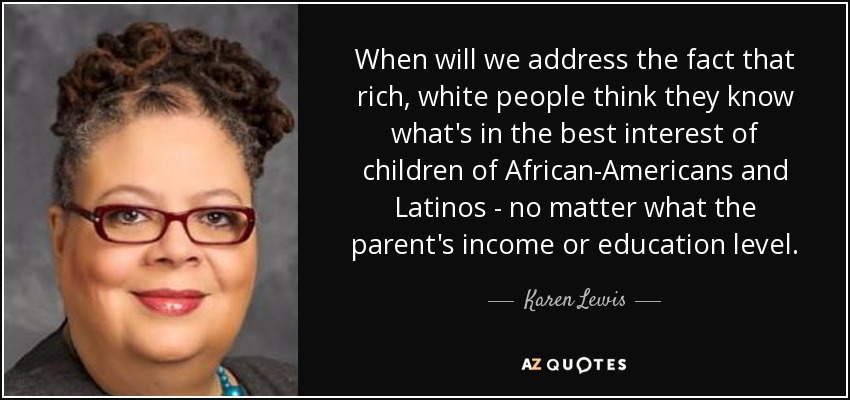
Image result for rich white people knows what's best for you

For over two decades the Schott Foundation has been a bridge, connecting philanthropy with community to resource broad based community-led movements for education equity. Part of building and reinforcing that bridge includes challenging structural racism in philanthropy and uplifting solutions rooted in equity through critical and thoughtful dialogue and trust in the power of community voices and community organizing for sustained change. In his new book, Decolonizing Wealth, Schott Vice President Edgar Villanueva writes:
Ultimately, the call to philanthropy is clear: it must fundamentally change its ivory tower culture, what it accepts as acceptable behavior, how it defines success and leadership, in order to really walk its talk: to embody the love of humanity. Up until now, diversity and inclusion tactics have been about getting different kinds of people in the door, and then asking them to assimilate to the dominant white culture. The issue is not recruitment of diverse humans—the “pipeline” focus of the past, getting people in the door, laying a seat at the table, as is often said—the issue is creating a culture of respect, curiosity, acceptance and love. It’s about building a whole new table.
We explored the unique journeys of three white philanthropic leaders striving toward race, gender and economic equity. Participants talked about when they first got “woke,” what they consider their role in philanthropy to be, how they have dealt with mistakes and criticism along the way, where they go for resources and support in their journey, how they hold themselves accountable to communities of color, and much more!
In addition, Vanessa Daniel, Executive Director of Groundswell Fund and Schott Vice President Edgar Villanueva began the webinar by sharing calls to action for white leaders and served as respondants to the conversation. For our many colleagues in philanthropy, this was opportunity to listen and understand how we as a sector contribute to racial inequities and our ability to change that.
Our speakers included:
Vanessa Daniel, Executive Director, Groundswell Fund
Nick Donohue, President, The Nellie Mae Education Foundation
Greg Jobin-Leeds, Founder and First President, Schott Foundation for Public Education and author of When We Fight, We Win!
Pamela Shifman, Executive Director, Novo Foundation
Edgar Villanueva, Vice President of Programs and Advocacy, the Schott Foundation for Public Education and author of Decolonizing Wealth


Richie Rich’s Schools Targeted by Destroy Public Education Movement | tultican

Richie Rich’s Schools Targeted by Destroy Public Education Movement | tultican

Richie Rich’s Schools Targeted by Destroy Public Education Movement


Schools in wealthy white communities are no longer immune to the destroy public education (DPE) movement. A review of San Dieguito Union High School District (SDUHSD) in San Diego County makes the point.
SDUHSD serves an area within the 1845 Mexican land grant to Juan Osuna known as Ranch San Dieguito. Osuna’s 1822 adobe home still stands on a knoll in the Rancho Santa Fe section. The school district includes the beach communities of Del Mar, Solana Beach, Encinitas and Carlsbad. Away from the beach it covers the communities of Rancho Santa Fe and Camel Valley.
A 2017 study sponsored by SDUHSD indicates how financially comfortable the families in this school district are.
Table 1: Economic Data
District Family Data
Sixty-five percent of the students come from families making more than $75,000 and almost a quarter of those families are making greater than $200,000 a year. Whites and Asians constitute 87% of the district population.
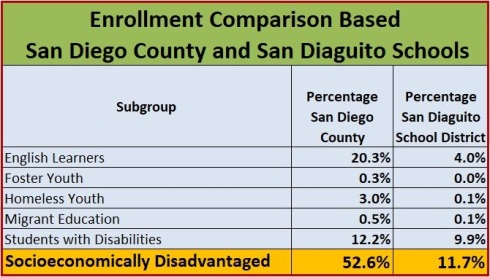
California’s 2017-2018 enrollment data by subgroups shows the dramatic difference between SDUHSD and the rest of San Diego County.
Table 2: Subgroup Percentages
Enrollment Data Table
During the no child left behind (NCLB) era, the school I worked at had 75% English learners and 80% socioeconomically disadvantaged. The big metric that literally determined whether a school survived was the academic performance index (API). Its 1,000 point scale score was based on California’s standardized testing. Early on my school focused on scoring higher than a 600 API and latter we challenged a 700 API. Failure to meet those goals, meant by NCLB rules, the school would be closed, a minimum of 50% of the staff would be let go and new Continue reading: Richie Rich’s Schools Targeted by Destroy Public Education Movement | tultican


Thursday, September 20, 2018

We Came to Learn: A Call to Action for Police-Free Schools - Advancement Project - Advancement Project

We Came to Learn: A Call to Action for Police-Free Schools - Advancement Project - Advancement Project
We Came to Learn: A Call to Action for Police-Free Schools 


Safety does not exist when Black and Brown young people are forced to interact with a system of policing that views them as a threat and not as students. For many Black and Brown youth, the presence of police in their schools disrupts their learning environments. There is a culture clash that exists between law enforcement and the learning environment: police enforce criminal laws, while schools are supposed to nurture students. This report addresses the stark reality that police in schools is an issue of American racial disparity that requires deep structural change. We will explore the question of why police are in schools at all and conclude that police are incongruent with the educational environment we envision for our children.

First, this report examines the advent of policing practices in America’s public schools and their historical roots in suppressing Black and Latino student movement and the criminalization of Black childhood. We discuss the documented harms of school policing, including the disparate impact that policing has on students of color, students with disabilities, and students who are lesbian, gay, bisexual, transgender, queer/questioning, intersex, and asexual (LQBTQIA).

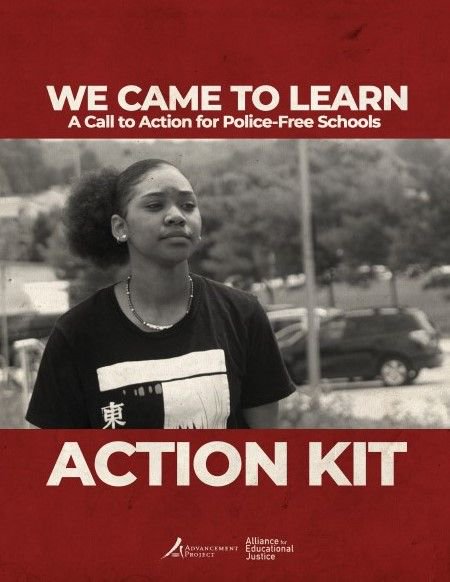
Image result for We Came to Learn: A Call to Action for Police-Free Schools

The report centers the voices of young people from around the country who describe the everyday indignities that they experience at the hands of school police. It also, for the first time, catalogues known assaults of young people by school police officers. The report shines a spotlight on three particular cases where young people were assaulted by school police and how their communities responded. These case studies – in Oakland, CA, in Philadelphia, PA, and in Spring Valley, SC, serve as models in the fight to end school policing. The report chronicles how Black and Brown youth have used organizing and advocacy to advance a vision of school safety that is not reliant on policing.

This report then documents the school policing model and discusses how school police became institutionalized in America’s public education system through funding and policy at both the federal and local level. This report exposes the broad lack of accountability that school police benefit from. By illustrating how different school police operations are structured and function, this report provides readers with a clearer understanding of how pervasive and negative the impact on educational outcomes for students of color truly is.

Finally, the report calls for the removal of police from schools and envisions schools where Black and Brown students are afforded the presumption of childhood that they deserve.  Policing in our schools must be supplanted by divesting from militarization and investing in community-building strategies that not only improve the quality of safety for students of color, but the quality of their educational experience


Learn More: We Came to Learn: A Call to Action for Police-Free Schools - Advancement Project - Advancement Project

Image result for We Came to Learn: A Call to Action for Police-Free Schools

Learn More: We Came to Learn: A Call to Action for Police-Free Schools - Advancement Project - Advancement Project


Mitchell Robinson: Please save us from self-appointed "education experts"… | Eclectablog

Please save us from self-appointed "education experts"… | Eclectablog

Please save us from self-appointed “education experts”…


Mike Petrilli is one of the self-appointed leaders of the corporate reform of education movement, and also has a day job as president of the Fordham Institute, a conservative think tank with a focus on education. His bio says that “he is one of the nation’s most trusted education analysts,” so I guess he knows what he’s talking about.
In his most recent essay, “Why don’t districts do the easy things to improve student learning?”, Petrilli offers solutions to some of the most pressing problems facing schools today…but he doesn’t start on solid footing.
I’ve never led a school, run a school system, or served on a school board. So maybe I am about to ask something that is incredibly naĆÆve and possibly insulting. But here goes…
If this is your first sentence in a critique of public education, maybe just stop. If you even remotely suspect that the question you’re about to ask is “incredibly naĆÆve and possibly insulting,” then maybe…just maaaybe…don’t ask it?
Do we think the banking industry would be very interested in an evaluation of their practices by someone who has never worked in a bank, didn’t study finance, and doesn’t currently have a savings or checking account? Or would the American Medical Association solicit a critique of the medical profession from someone who didn’t have a medical degree, and didn’t believe in science or research?
And yet, Petrilli soldiers on…
Let me offer two examples: 1. Adopting an aligned, high-quality Continue reading: Please save us from self-appointed "education experts"… | Eclectablog


Randi Weingarten: Guns in Schools 'Fending for Themselves' Mentality

Teachers Union Boss: Guns in Schools 'Fending for Themselves' Mentality

Teachers Union Boss: Guns in Schools Harm Community with 'Fending for Themselves' Mentality

American Federation of Teachers President Randi Weingarten at walkout


WASHINGTON – Randi Weingarten, president of the American Federation of Teachers, argued that school choice and voucher programs wrongly create “winners and losers.”
She lamented that supporting school choice programs has led to attempts to establish “an alternative system that is used to undermine public schools.”
“There’s been the kind of policy that creates, in some ways, winners and losers and you see it in terms of school choice and charter schools and vouchers and things like that,” Weingarten said during a recent conference call organized by The Jewish Democratic Council of America on education policy in the Trump administration.
“There are some people who came to this totally because of legitimate frustration that said ‘we can’t shake the system up enough – we need to have alternatives to the system.’ And, frankly, some of those people were people like my predecessor, Al Shanker, who said ‘we hate bureaucracy – can’t we do things like charter schools or other kinds of alternatives where teachers and parents have a right to actually figure out what they want for schooling and make it an incubator,’ and so if something really works then you bring it to the main system,” she added.
Weingarten said advocating for new ideas in education has been “hijacked” as a way to convince states to move funds away from public schools and into other education programs.
“So, I understand there are folks who are saying let’s try something new, and I Continue reading: Teachers Union Boss: Guns in Schools 'Fending for Themselves' Mentality


Charter School Corruption Is Changing Education Policy And Politics

Charter School Corruption Is Changing Education Policy And Politics

Charter School Corruption Is Changing Education Policy And Politics


After years of credible reporting on the rampant corruption in the charter school industry, the schools are now drawing more scrutiny from state lawmakers and regulators, and political candidates are making negative stories about charters a contentious issue in the upcoming November midterm elections.
Government officials from California to New York are increasingly considering, proposing, or passing new regulatory restraint on these privately operated, publicly funded schools, and in electoral contests from Arizona to Ohio, Democratic challengers are challenging Republican incumbents to defend their lax governance that has allowed charter schools to run amuck, costing the taxpayers millions and undermining the financial stability of public education.
As scandalous news stories and scathing reviews of the charter industry continue to emerge, the negative impacts these schools have on families and communities will prompt more to question the wisdom of expanding these schools and draw more attention to the need to ratchet up regulations for the charters already in existence.

Charter Scandals Continue
With the new school year barely underway, negative news headlines about charter schools abound. Among the hits so far:
  • A Dallas charter school leader who suddenly quit after local reporters obtained statements from a school-issued credit card showing charges for air travel, accommodation at ritzy hotels, and meals at high-end restaurants.
  • Parents and students from a North Carolina charter school complaining to a local news outlet that when experienced teachers leave their school, the administrator fills in with substitutes and low-grade online courses, even in core subjects such as math and reading.
  • A South Carolina charter school that may close one month into the new school year because, while the school was approved for 380 students, budgeted for 180, and claimed 150 enrolled, only 50 students showed up and 32 attend currently.
  • New school A-F ratings issued by Ohio that show among Dayton’s 22 charter schools, there are no A-rated schools, only two rate B, five are C-rated, and the rest are D and F schools.
  • An Arizona Republican lawmaker who’ is set make as much as $30 millionafter selling his for-profit charter school chain, largely funded by taxpayers, to a non-profit company with the same name operated by a board of his close associates.
In Florida, a state-based watchdog group monitoring corruption in  Continue reading: Charter School Corruption Is Changing Education Policy And Politics
Image result for Charter School Corruption


Bill Gates calls for more global education assessments data - ABC News

Bill Gates calls for more global education assessments data - ABC News

Bill Gates calls for more global education assessments data

Bill Gates is rallying behind school quality in developing nations with a push for more assessment data, a new initiative that links the Microsoft co-founder's signature U.S. education priorities with his more prominent global philanthropy work.
The Bill and Melinda Gates Foundation as the world's largest philanthropy issued its latest "Goalkeepers" report on Tuesday, urging for more comparable student assessment data worldwide and help getting girls through their schooling.
"The world, in education, focused a lot on access, which is super important, and in most countries made huge progress on gender-equal access, but now there needs to be a focus on quality," Gates said in a press call on September 11.
The majority of the Gates foundation's resources are dedicated to global health and development, with much of that work rooted in deep poverty issues in Africa, from tackling malaria, HIV and contraceptives to boosting crop production and financial services. In the U.S., Gates and his wife focus on reshaping America's struggling school systems.
This year marks new intertwining priorities for Gates' domestic and international work as it focuses on global education quality while also broadening its U.S. agenda to look at overarching poverty issues. In June, Gates announced a new initiative that would focus on "global education learning," committing $68 million over the next four years to help improve primary and secondary education in India and African countries. And in May, the foundation also committed to delving deeper into systemic poverty in the U.S. by looking at both defined and abstract challenges such as racism and housing.
The foundation said the U.S. and global education work are both rooted in their belief that a quality education can best uplift those in poverty, though its two programs will operate separately because the challenges and solutions are different.
Gates said it will support new data systems that will make it possible to compare student outcomes across the globe. Gates said last year that the first step to measuring education quality will be to develop better "cross-national assessments," particularly for math and reading among younger students. Its new report cites UNESCO's estimates that over 600 million students are not minimally proficient, lamenting that few countries collect enough data points that would identify where their "learning crisis" lies.
The Gates foundation also said it wants to work with local school systems to find better, cost-effective ways to teach and learn, and fight the barriers that keep girls from completing their secondary education.
These new goals ultimately align with Gates' strategy on how to improve school.
Back home in the U.S., Gates has long defined his local philanthropy legacy by deploying data to measure what kids are learning and how teachers are teaching. His foundation has supported the Common Core academic standards, new teacher evaluation policies, smaller and charter schools, library technology access, and lately, networks of schools working Continue reading: Bill Gates calls for more global education assessments data - ABC News

Enemies of the State? How Billionaire Philanthropists Think About Government — Inside Philanthropy

Enemies of the State? How Billionaire Philanthropists Think About Government — Inside Philanthropy
Enemies of the State? How Billionaire Philanthropists Think About Government

Are wealthy philanthropists hostile toward government? It’s easy to think so if you read critiques of the billionaire donor class—most recently Anand Giridharadas’s book, Winners Take All. Today’s leading benefactors, we’re told, vastly prefer privatized solutions to social problems—especially ones that they themselves devise by tapping their business chops and channeling the free market’s magical powers.
Image result for Giridharadas book, Winners Take All.This argument is most familiar in regard to public education, where philanthropists are said to be leading the charge to privatize America’s most cherished public institution—our schools.
In my own book, The Givers, I looked at how a cabal of wealthy donors and conservative foundations have bankrolled a 40-year assault on government—with the goal of cutting taxes, downsizing the regulatory state and eviscerating civil rights protections.
My book also examined how private donors are increasingly stepping into the void left by weak government. You can see this most vividly in higher education, where mega-givers are riding to the rescue of public universities battered by declining state investments in these systems. Wealthy philanthropists, who’ve benefited hugely from historically low tax rates since the early 1980s, now receive accolades for solving problems that their class helped create. The fall of government and the rise of big philanthropy, I wrote in The Givers, can seem like entwined subplots in a larger story about a plutocratic power grab.
In fact, though, the story is not so simple.
The crusade to shrink government down to the size “that it can be drowned in a bathtub”—to paraphrase Grover Norquist’s memorable phrase—has never been a shared project of the upper class, but of a powerful libertarian faction within that class. Even the ceaseless drive for tax cuts over a generation has mainly animated wealthy people on the right. Many less ideological rich people aren’t so worked up over taxes; after all, when you’re loaded, you can easily afford them. And while polls show that the wealthy are more fiscally conservative than the public writ large, it’s also true they tend to favor many government functions: a globalist foreign policy, infrastructure, education, scientific research, space exploration, environmental protection, and so on. They understand that these things cost money.
In Winners Take All, Anand Giridharadas doesn’t much explore this larger context, but rather argues a tighter brief: that today’s wealthy elite has contempt for government and a reflexive affinity for privatized solutions. Like the many progressive critics of charter schools, Giridharadas depicts philanthropists as trying to shove government aside so they can call the shots, guided by market ideology and their own brilliance. Diane Ravitch has been most trenchant on this point, arguing that a clueless “billionaire boy’s club” of education reformers has done an end-run around democracy—only to make a mess of things in places like Newark, with kids of color paying the price.
These and similar criticisms offer a devastating picture of an overclass that’s become a powerful adversary of government by and for the people. But this is neither a full nor accurate accounting of how wealthy philanthropists think about the public sector. In fact, it’s misleading in key respects.
If you put aside the libertarian ideologues like the Koch brothers and the DeVos family, what you’ll find is that most of today’s wealthy philanthropists think about government in much the same way that big donors Continue reading: Enemies of the State? How Billionaire Philanthropists Think About Government — Inside Philanthropy

Hijacked by Billionaires: How the Super Rich Buy Elections to Undermine Public Schools - NPE Action - http://npeaction.org/?p=7962 via @NPEaction


CURMUDGUCATION: Non-wealthy People and Choice

CURMUDGUCATION: Non-wealthy People and Choice
Non-wealthy People and Choice


When it comes to school, the poor, the argument goes, should have the same choices that wealthier folks have. The ability to choose a neighborhood gives wealthier folks the ability to choose a school, so even folks who attend public school are making use of school choice, the argument goes.

Let's skip over the usually-ignored part of that argument, which suggests that the problems of school selection could be addressed via zoning. Break up the last bastions of redlining, and put low cost housing in every neighborhood, including the ritzy ones and voila! everyone can exercise real estate based choice. I wonder why we never talk about that solution.

Instead, the preferred solution is to set loose the power of the free market to provide the non-wealthy with all sorts of choicey alternatives, a rich buffet of options. Reformsters used to say that choicey competition would create excellence as well, but that's no longer part of the pitch. Choice need not promote excellence; it's enough for reformsters that choice promotes choice.

It doesn't matter; any way you frame it, you run up against the same problem-- choice will not accomplish what its fans say it will accomplish.

The problem is that the free market is not a friend of poor people.

Oh, it likes them when it comes to marketing. Note-- the unwealthy are not stupid and they are not lazy, but they are busy just trying to hold things together between jobs and families and too few resources. Just the mechanics of being a family with two or three jobs but just one car can make for a very busy week, People who are spending all their energy just to tread water don't have a lot of time to extensively research advertising and PR claims.

Add to that Greene's Law: The free market does not foster superior quality; the free market fosters superior marketing. The market has a vested interest in making sure that consumers don't make Continue reading: 
CURMUDGUCATION: Non-wealthy People and Choice