Latest News and Comment from Education

Monday, September 17, 2018

Multifaceted reforms needed to reach California’s education goals, research project finds | EdSource

Multifaceted reforms needed to reach California’s education goals, research project finds | EdSource

Multifaceted reforms needed to reach California’s education goals, research project finds

Studies organized by Stanford document need for better data systems, more funding and more early ed

Researchers on Monday released a massive collection of education studies timed to inform the next California governor’s and Legislature’s preK-12 agenda. 


Among the findings of Getting Down to Facts II:
  • The big achievement gap for California’s low- and middle-income children relative to their peers in other states starts in kindergarten, indicating a need to significantly expand preschool and quality child care.
  • California would have to increase K-12 funding by 32 percent — $22 billion — to prepare all children adequately in the state’s academic standards, according to experienced educators and analysts who did the math.
  • California has fewer adults in schools, with higher ratios of students to teachers, administrators and counselors than in most states.
  • The lack of effective data systems is preventing schools and districts from determining which programs and practices are effective and which aren’t.
  • California provides fewer general physical health and mental health services than almost any other state.
  • Principals with the least experience are assigned disproportionately to the lowest-achieving schools. Nearly three-quarters of school districts report teacher openings they can’t fill,  with the most severe shortages in special education, math, and science.
Two years in the making, Getting Down to Facts II consists of 36 reports and 19 briefs by more than 100 authors, including many prominent researchers from California. They took deep looks into a range of long-standing and pressing issues: the teacher shortage, inadequate funding, disparities in achievement, charter school oversight and English learner achievement. They examined unmet challenges in special education, school facilities, children’s mental health and other issues. Stanford University and Policy Analysis for California Education or PACE, which is affiliated with Stanford, USC, UC Davis, UCLA and UC Berkeley, coordinated the project.
The research comes at a pivotal time, with the retirement of State Superintendent of Public Instruction Tom Torlakson, Gov. Jerry Brown and longtime Brown confidant Michael Kirst, president of the State Board of Education. Sweeping changes they initiated have altered the K-12 landscape since the first Getting Down to Facts studies were published in 2007.
In surveys detailed in the studies, educators argued strongly that California should stay committed to the major reforms already in place. These reforms include academic standards in math, English language arts and other subject areas; a funding formula championed by Gov. Brown that targets more funding to low-income students, English learners and other high needs students; and a new school accountability system that views counties and the state as partners with schools and districts, not overseers. Three-quarters of superintendents agreed that the new flexibility under the Local Control Funding Formula has enabled their district to spend in ways that match local needs.
But the funding formula, which remade school funding and shifted decision-making over how state funds are spent, has yet to significantly narrow the wide gaps in achievement among ethnic and racial groups in California. And California students, with the exception of wealthy children, continue to lag a full grade behind the nation, according to a study led by Sean Reardon, an education professor at Stanford University.
There are some hopeful signs. Reardon did find that low-income elementary and middle school students in California have improved in reading slightly faster than low-income students nationwide. And a study led by Rucker Johnson, a professor of public policy at UC Berkeley, found a correlation between extra spending under the funding formula on poor children and improvements in their graduation rates and reading scores. That research could not document how the extra money made a difference.
But the studies underscored that the principal goal of the funding formula — to give all students the opportunity and resources to achieve their post-high school ambitions — may be unattainable without not only additional funding but also policy changes, including:
Christopher Edley, president and co-founder of the Opportunity Institute, criticized the state’s hands-off approach to overseeing spending under the Local Control Continue reading: Multifaceted reforms needed to reach California’s education goals, research project finds | EdSource

Join us next month in Indy to discuss privacy & online learning! | Parent Coalition for Student Privacy

Join us next month in Indy to discuss privacy & online learning! | Parent Coalition for Student Privacy

JOIN US NEXT MONTH IN INDY TO DISCUSS PRIVACY & ONLINE LEARNING!


Next month in Indianapolis, the Network for Public Education will be holding our annual conference on Saturday and Sunday, Oct. 20-21.  More info and how to register here.
I will be participating in two amazing panels focused on how protect students and teachers from the growing threat to data privacy and resist the  the expansion of online learning which is undermining the quality of public education.
The first workshop, to be held on Saturday Oct. 20 morning at 10:50 AM is entitled Outsourcing the classroom to ed tech & machine-learning: why parents & teachers should resist .  Presenting with me are two brilliant bloggers and thinkers whose work I never fail to learn from, Audrey Watters and Peter Greene. 
Audrey has single-handedly and fiercely taken on the ed tech industry for many years and  critiques their claims on her essential blog,  Hack Education.  If you haven’t subscribed to her newsletter, you absolutely should do so.  She is currently writing a book to be published by MIT Press called Teaching Machines.
Peter is a Pennsylvania teacher who retired last year, but even while teaching was among the most prolific and incisive education bloggers at Curmudjucation. He also now writes a regular column for Forbes.    In his writings, he deconstructs and eviscerates the agenda of the corporate reformers and faux philanthropists, whether it be the promotion of online education, Common Core, high-stakes testing or any of the other snake oil  disseminated by private interests bent on disrupting public education.  He shows how they are based neither on research, common sense, or the experience of teachers or parents.
During the second workshop, held later the same day, our panel will present A Teacher Data Privacy Toolkit: How to protect your students’ privacy and your own.  Marla Kilfoyle and Melissa Tomlinson of the Badass Teachers Association, Rachael Stickland co-chair of the Parent Coalition for Student Privacy and I will offer some of the highlights and practical tips of our yet-to-be released Toolkit, the product of  a year-long collaboration between the PCSP and the BATs, with support from the Rose Foundation, the NEA and the AFT.
From responses to an online survey and focus groups of teachers, administrators and other school staff, we heard loud and strong how educators were deeply frustrated by the lack of training and knowledge they had about how to minimize and safeguard the increasing amount of personal data being collected by schools and vendors, and how they can work to ensure it isn’t breached or improperly used.  This toolkit, like the Parent Toolkit for Student Privacy we along with Campaign for a Commercial Free Childhood released in 2017, represents an attempt to provide the support and information that teachers need to act as responsible guardians of their students’ privacy — and their own.
Please join us in Indianapolis – more amazing speakers and panels are described here. — Leonie Haimson

Sunday, September 16, 2018

You caused charter school corruption, so stop whining

You caused charter school corruption, so stop whining

You caused charter school corruption, so stop whining
Opinion: You've elected and re-elected individuals who built a system that some of them can use to get rich. On your money.


Eddie Farnsworth makes no apologies. And he shouldn’t.
Farnsworth is the Republican legislator who is making millions for himself by cleverly using taxpayer dollars available by way of  Arizona’s corrupt charter school system.
It is a system that allows charter operators like Farnsworth to use taxpayer money to build their private businesses and then turn themselves into millionaires doing things that would send regular public school administrators to prison.
The lawmaker/millionaire said last week in the most smugly sanctimonious way:
"I make no apologies for being successful.”

No apologies...none necessary


Nor should he.
It is not Farnsworth’s fault that he was elected to the Arizona Legislature.
It is not his fault that he supports laws allowing charter school operators to scoop buckets of cash from the public treasury and stuff the bills into their own pockets.
It is not his fault that Republicans fashioned laws creating strict procurement and conflict-of-interest rules for regular public school administrators but made charter school operators, like Farnsworth, exempt.
It is not Farnsworth’s fault that the Arizona State Board of Charter schools approved the transfer of his for-profit charter-school operation to a non-profit company, a move The Arizona Republic’s Craig Harris reported will make Farnsworth something between roughly $12 million and $30 million.
It is not Farnsworth’s fault that he and many other individuals, including other legislators, have used Arizona’s fast and loose charter school rules to raid the state’s cookie jar for personal gain.

That’s why someone like Farnsworth is so comfortable saying in the most holier-than-thou self-righteous manner, “I make no apologies for being successful.”
Believe me when I tell you that this is…Not. His. Fault.
It’s yours.
Farnsworth has been getting elected for roughly 20 years. If you didn’t like what was being done – or not done – at the Legislature when it came to charter schools, you could have voted him out.
You didn’t.

You had your chance to stop it

The same is true of Gov. Doug Ducey and other lawmakers.
For quite some time The Republic has been outlining the flaws and outright abuses of Continue reading: You caused charter school corruption, so stop whining

"Punitive Discipline Policies Have Proven to Be Destructive to Children"

"Punitive Discipline Policies Have Proven to Be Destructive to Children"

“Punitive Discipline Policies Have Proven to Be Destructive to Children”


Janine Jackson: Nothing says America 2018 like a spate of storieson how back-to-school shopping includes bulletproof backpacks. Arming teachers and gearing kids up like commandos are presented as more-or-less reasonable responses to concerns about school safety.
Any violence in schools is too much, of course, but a conversation about school safety that’s focused on guns and bullets is a narrow and distorted conversation. Recasting our definition of a “safe school environment” could lead us in some very different directions.
Karen Dolan is director of the Criminalization of Race and Poverty Project at the Institute for Policy Studies, and co-author, with Ebony Slaughter-Johnson and Myacah Sampson, of the recent report Students Under Siege: How the School-to-Prison Pipeline, Poverty and Racism Endanger Our SchoolchildrenShe joins us now by phone from Washington, DC. Welcome to CounterSpin, Karen Dolan.
Karen Dolan: Thank you, Janine. It’s a pleasure.
Take us through what you see as the most salient observations in this report. What were you looking at, and what did you find?
We were looking at the ways in which children can have the most support and the best chance at the best life. And while we are doing this work and this research, the Parkland shooting happened, of course, and it has been in the news a lot, gun violence and school shootings, which of course endanger our public school students. But at the same time, there’s a larger number of students, there’s millions of students, who are also being endangered simply by having their future cut short by excessive expulsions, suspensions, referrals to the criminal justice system, lack of proper supports in school for academics, for social and emotional learning, and for well-being.
And as we hear the discussions on the airwaves, as we read it in the newspaper, as you said, about going back to school, and the Education Department suggesting that we take money away from student supports and put them into arming teachers and putting more cops in the hallways, it’s really exactly the wrong thing that we should be doing. And what we would like to do is see the debate broaden into looking at safety measures in a deeper, more holistic way as our students return to school.
When you say it’s the wrong thing to do, or the wrong direction, that has to do with the impacts of these punitive, “get tough” school policies, that people often say are aimed at safety, but the fallout from them falls out in certain kinds of ways.
That’s right. The impacts can be very devastating and very long term. So you see everything from a child having one suspension doubling their  Continue reading: "Punitive Discipline Policies Have Proven to Be Destructive to Children"

At G20, Betsy DeVos puts America last

At G20, Betsy DeVos puts America last

At G20, Betsy DeVos puts America last


On September 5th, 2018, in what can only be described as a mind-boggling stab to the gut of Americans, the US Secretary of Education committed US education to the globalist agenda of collectivism, corporatism, and social engineering; to a global agenda that was decidedly rejected by a diverse array of Americans through the election of Donald Trump in 2016.
DeVos attended the G20’s first ever Education Ministerial Meeting, held in Argentina. Out of those meetings came the eight-page G20 Education Ministers’ Declaration 2018. The document details the goals, priorities, and world-wide agenda of the G20 ministers in the areas of Education and Skills PoliciesFinancing EducationInternational Cooperation, and The Way Forward.

THE PURPOSE OF EDUCATION

The first statement of the document’s Preamble illustrates what the authors grievously believe to be the purpose of education (italics and spelling patterns in the original):
We, the Ministers of Education of the G20 members and invited countries, met in Mendoza, Argentina on 5 September 2018 to affirm the unique role of education as a key driver for sustainable development for all nations, recognise the need to place education at the centre of the global agenda and call for collective action.
This is a distressing indication that the US Secretary of Education’s philosophical beliefs are gravely inharmonious with those of most American parents who humbly and rightfully desire a quality education for their children; education which bestows the fundamental skills and knowledge necessary to thrive.

VOWS OF COMMITMENT TO GLOBALIZATION

Statements 20-22, among others, are especially illuminating: the statements therein shine a spotlight on both the relativistic-globalist mindset of DeVos and the other G20 education ministers, as well as these ministers’ narcissistic presumptuousness.
Reading the declaration, it becomes evident that the authors believe themselves to be the noble representatives of the “shared” aspirations and values of all peoples the world over, and the bearers of a fruitful philosophy which will usher in a new and prosperous future to be welcomed with open arms.
Key statements to this effect include:
We commit to facilitating the internationalisation of education.
We will work to meet our commitments affirmed in this Declaration… to building a robust set of education and skills policies from a global perspective that fosters inclusive and sustainable human progress in every nation.

ALLEGIANCE TO UNESCO’S AGENDA 2030

The second statement is quite curious, given that the United States has pulled out of the United Nations Educational, Scientific and Cultural Organization (UNESCO), which will officially take place at the end of this year. Statement 2 reads (italics in original):
In line with the United Nations 2030 Agenda, we affirm our commitment to ensuring Continue reading: At G20, Betsy DeVos puts America last
Image result for america last devos


Black Boxes, Student Data & Playing Moneyball for Education – Seattle Education

Black Boxes, Student Data & Playing Moneyball for Education – Seattle Education

BLACK BOXES, STUDENT DATA & PLAYING MONEYBALL FOR EDUCATION

Removing errors from contact list records sets future marketing campaigns up for success.


We’re rapidly entering a world of evidence-based decision making in public education. These decisions will be powered by vast amounts of data run through proprietary black boxes that parents will have no way of understanding. The approach is called Moneyballand the goal is to justify ration resources to students –while investors make a tidy profit.
One of the most difficult challenges I’ve had as a parent is convincing other parents that the endless collection of our kids’ data isn’t benign and technology isn’t inherently benevolent.
Big Data, Like Big Brother, Isn’t Your Friend
As adults, we’ve chosen to ignore this cold hard fact: that by using electronic devices, we are allowing ourselves to become a product. Von Shoshana Zuboff calls this evolution in big data mediated economics surveillance capitalism:
It’s now clear that this shift in the use of behavioral data was an historic turning point. Behavioral data that were once discarded or ignored were rediscovered as what I call behavioral surplus. Google’s dramatic success in “matching” ads to pages revealed the transformational value of this behavioral surplus as a means of generating revenue and ultimately turning investment into capital. Behavioral surplus was the game-changing zero-cost asset that could be diverted from service improvement toward a genuine market exchange. Key to this formula, however, is the fact that this new market exchange was not an exchange with users but rather with other companies who understood how to make money from bets on users’ future behavior. In this new context, users were no longer an end-in-themselves.  Instead they became a means to profits in  a new kind of marketplace in which users are neither buyers nor sellers nor products.  Users are the source of free raw material that feeds a new kind of manufacturing process.
As adults we’re vaguely aware that certain choices we make will impact our credit report. The inputs seem arbitrary and frankly ridiculous. Unless, there’s a problem, THEN, the unfairness of the system quickly comes into focus.
How your credit report is determined is an example of a black box. Inputs go in, something happens inside the box, and then your credit report comes out. What happens inside the box? Who knows? It’s a proprietary predictive model.
What sorts of random digital bits could impacts your credit report? Things like what operating system you use, if you do your browsing using a desktop or cellphone, even what you decided to use as your email address.

Saturday, September 15, 2018

If I Were Secretary of Education – A Classroom Teacher’s Fantasy | gadflyonthewallblog

If I Were Secretary of Education – A Classroom Teacher’s Fantasy | gadflyonthewallblog

If I Were Secretary of Education – A Classroom Teacher’s Fantasy


I will never be Secretary of Education.
Frankly, I’m just not qualified.
I’m only a classroom teacher. The powers that be don’t trust someone like me with that kind of responsibility. It’s okay to give me a roomful of impressionable children everyday, but there’s no confidence I can make sound policy decisions. For that we need someone with experience in management – not schools, pedagogy, children or psychology.
The presiding incumbent in this prestigious position, John King, somehow overcame that handicap. He had taught for three whole years at a charter school, but the bulk of his experience is in administration – administrating a Boston charter school with high suspension and attrition rates. He also was New York State Education Commissioner, where he single-handedly dismantled the state system of education and sparked one of the largest parental revolts in the nation in the state’s opt out movement.
The previous Secretary of Education, Arne Duncan, was much more qualified, having never taught a day in his life. Before getting Congressional approval, he was appointed to run a charter school and later was entrusted as CEO of Chicago City Schools where he likewise blundered his way to the top with policy decisions that devastated a great system of public education.
What do I have to offer compared to all that? I only have more than a decade’s worth of experience helping kids learn. I’m only one of 3% of teachers nationwide who are Nationally Board Certified. I’ve only earned a Masters degree in Education. I only help run a more than 56,000 member national education advocacy group, the Badass Teachers Association, and write a popular blog dedicated to education and civil rights.

I’ve never sunk a major metropolitan school. I’ve never been run out of a populous state chased by citizens armed with torches and pitchforks.
But let’s close our eyes and imagine that somehow through the magic of education bloggery I was whisked into office at the U.S. Department of Education.
What would a person like me do as Secretary?

1) Respect the Limits of the Job

Though George W. Bush and Barack Obama come from opposite ends of the political spectrum, these two Presidents did more to increase the powers of the Department Continue reading: If I Were Secretary of Education – A Classroom Teacher’s Fantasy | gadflyonthewallblog


DeVos: You Don't Know Dick | YourTango

Who Is Betsy DeVos' Husband? New Details About Dick DeVos Jr. | YourTango
Who Is Betsy DeVos' Husband? New Details About Dick DeVos Jr.

He's heir to a fortune.
Betsy DeVos, the Secretary of Education, is mainly known for her support of school voucher programs and charter schools. In layman's terms, she wants to privatize public education. But who is Betsy DeVos’ husband? Well, there’s no doubt about it that her husband is extremely wealthy.
So, what do we know about Dick DeVos Jr. and their family? Here are 10 things to know about the Amway heir.

RELATED: Betsy DeVos' School Voucher Plan Hurts Poor Kids. PERIOD.

1. They met in college.

The couple dated while she was a student at Calvin College, a Christian college in Grand Rapids, Michigan. Apparently, he’d come by campus in his Mercedes to pick her up. They married in 1979 when Betsy was 21 and Dick was 23. He says that their relationship is, “based on our honest sharing of love, faith, and commitment. For me, my first commitment is to God, followed by my commitment to my wife Betsy and to our children.”

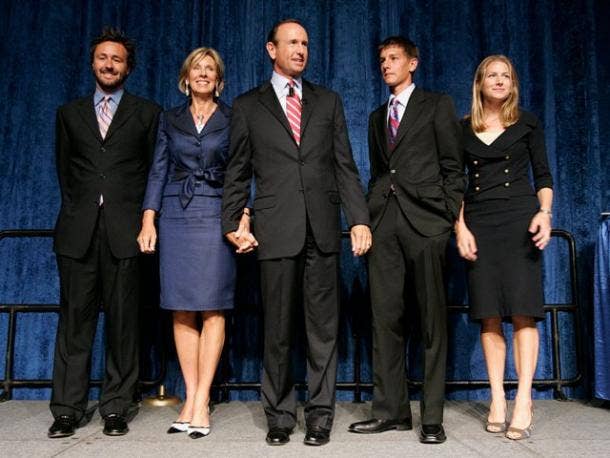
2. They have four kids.

Photo: AP
Their children — Richard Marvin (Rick) III, Elisabeth (Elissa), Andrea, and Ryan — are all grown now, and the DeVos’ have one grandchild.

3. He has a college degree.

DeVos has a Bachelor’s degree in business administration from Northwood University, and attended — but didn’t complete — a degree from the Harvard Business School at the Wharton School's Executive Study Programs. He does, however, have honorary doctorates from Grove City College, Central Michigan University and Northwood University.

4. He’s heir to the Amway fortune.

Photo: Getty
Dick is the son of Richard DeVos, the founder of Amway, a “a multi-level marketing company” that has been deemed a pyramid scheme many times. As of earlier this year, his father has a net worth of $5.1 billion. In 1991, Dick DeVos was appointed the president and CEO of Amway, after his father purchased the Orlando Magic basketball team. He only served the position for two years before working for the Windquest Group, an investment management firm.

5. He was involved in the family business even as a child.

DeVos has said, “I still remember when it was in the basement of our home when I was growing up. I remember the offices being down there and people working down there.” He and his brother Doug were assigned to greet attendees to Amway’s conventions and “helped out with everything from clearing plates during gatherings to ferrying guests to play tennis or waterski. That evolved to speaking in front of groups and even giving product demonstrations.”

6. He ran for governor of Michigan in 2006.

He lost to Democrat Jennifer Granholm by 14 percentage points, and hasn’t run since. But the campaign spent $39 million, of which $35 million was DeVos’ Continue Reading: Who Is Betsy DeVos' Husband? New Details About Dick DeVos Jr. | YourTango


Betsy DeVos Wants To Make It Easier For Religious Schools To Avoid Title IX

Betsy DeVos Wants To Make It Easier For Religious Schools To Avoid Title IX

Betsy DeVos Wants To Make It Easier For Religious Schools To Avoid Title IX
The proposed rule would prevent people from knowing which religious colleges discriminate against women and LGBT students.


The US Department of Education wants to make it easier for religious schools to reject the gender equity law Title IX, according to a leaked draft of new regulations.
The proposed Title IX regulations, which were leaked late Thursday by a higher education organization, would automatically exempt religious schools and universities from having to comply with the gender equity law if they have faith-based objections. Title IX already lets religious schools out of following the law, but the department asks them to submit a letter to the government explaining why an exemption is necessary. Schools would not have to do this anymore under the new policy, meaning there would be no way of tracking which educational institutions were opting out of Title IX rules, and why they were doing so.
“There’s no way now for advocates that help students understand what schools are intending to do,” Sarah Warbelow, legal director of the Human Rights Campaign, told BuzzFeed News.
Schools could use this exemption to justify their right to expel a student for taking birth control or coming out as gay or trans, according to Warbelow. “It’s incredibly infuriating that the administration is discouraging schools from ensuring that their students understand when the school may take disciplinary action against them,” Warbelow added.
A draft of the proposed regulations, dated Aug. 25, was uploaded to the website of the Association of Title IX Administrators, a professional group for school officials that deal with the gender equity law. The proposals were first reported last month by the New York Times.
The highly anticipated rules lay out how K–12 schools and colleges must deal with sexual harassment and assault allegations. They propose a number of ways to limit the circumstances in which a school has to investigate a sexual assault complaint and to raise the bar for the Education Department to find that a school violates Title IX. Secretary of Education Betsy DeVos said in 2017 that she wanted to change Title IX regulations because too many accused students were being treated unfairly, and many schools used too broad of a definition of sexual harassment.
Tucked away within the draft is a change to how the department handles religious exemptions to Title IX. In order to gain exemption from the civil rights law currently, the highest-ranking administrator at a religious school has to send a letter to the department explaining how a Title IX rule would go against their faith-based convictions — a practice that dates back to the Reagan administration. Religious colleges with rules that can result in punishing students for being gay or having an abortion, for example, would then be assured it was allowed to discriminate against those students without penalty.
During the Obama administration, LGBT rights groups like the Human Rights Campaign pressured the government to Continue reading: Betsy DeVos Wants To Make It Easier For Religious Schools To Avoid Title IX