Latest News and Comment from Education

Saturday, September 15, 2018

Why LAUSD Superintendent Austin Beutner Wants To Talk About Teacher Quality Right Now: LAist

Why LAUSD Superintendent Austin Beutner Wants To Talk About Teacher Quality Right Now: LAist
Why LAUSD Superintendent Austin Beutner Wants To Talk About Teacher Quality Right Now


This week, the head of the Los Angeles Unified School District delivered his first major policy speech, four months after he took on the job. It was an opportunity for Superintendent Austin Beutner to lay out challenges he sees facing the nation's second largest school district.
"If that's all we talk about," Beutner told KPCC/LAist on Friday, "then we are going to stick with the same old status quo we've got that's just not good enough."
Beutner didn't change the subject to talk about easy issues. His speech Thursday took on an issue at the center of some of the most bitter teachers union battles in recent years: teacher quality.
Here's what he said in the speech:

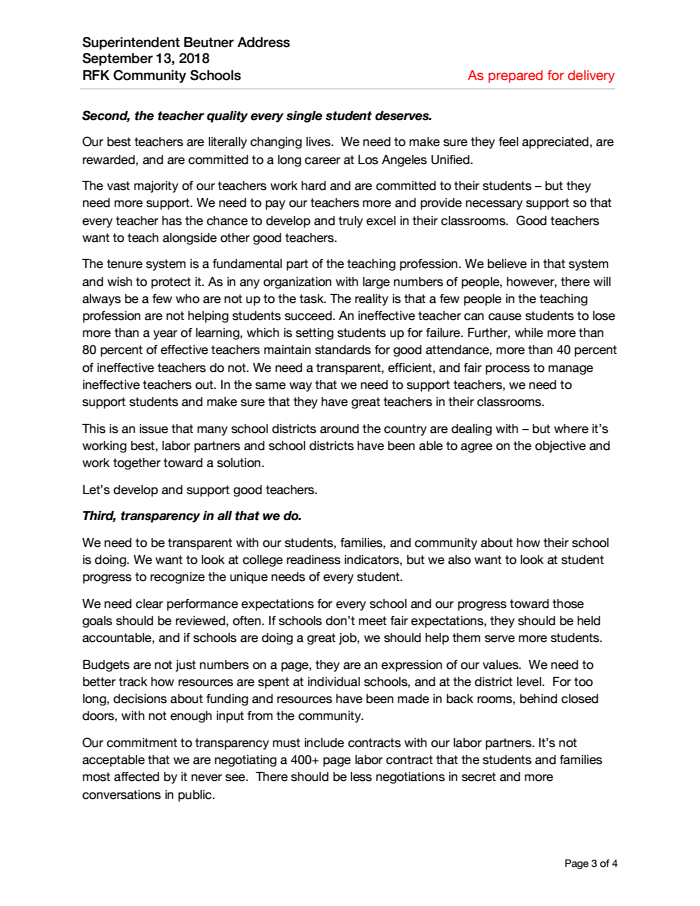

Selected portion of a source document hosted by DocumentCloud
Beutner went on to say that, in “many school districts around the country,” school administrators and teachers unions have been able to “work together toward a solution.”
A little backstory here: public school administrators have long argued it's too difficult to fire ineffective teachers, especially after they get tenure. In California, teachers earn tenure earlier than in most other states.
But in Sacramento, efforts to overhaul the tenure system have hit dead ends. In the courts, the high-profile Vergara lawsuit, which aimed to throw out tenure laws in the name of improving teacher quality, left teachers unions feeling demonized — and was ultimately unsuccessfulanyway.
In an interview with KPCC/LAist Beutner emphasized he isn't trying to make a "fundamental attack" on tenure but he does remain concerned about making sure teachers are effective.
"Vergara being tried and adjudicated, right, wrong or otherwise, didn't address the issue of a high-quality teacher in every class," he said. "The challenge still exists."
Still, why bring up the issue now — two weeks after the rank-and-file of United Teachers Los Angeles voted to authorize a possible strike?
Beutner's answer: focusing only on the issues at dispute in contract negotiations sidelines other worthy conversations.
"There's common ground we can find," the superintendent said in his interview, "and maybe we have to broaden the conversation to find that common ground, rather than going back to the same two or three places where the district and labor have been butting heads for a long time and haven't found solutions."
District officials have spent a lot of time talking about the union's priorities — such as salary increases and class size reductions — that administrators believe LAUSD cannot afford. (UTLA would vigorously debate them on this point, of course.)
As Beutner said in his speech — delivered to an invitation-only crowd at the RFK Community Schools campus in Koreatown — UTLA and LAUSD ought to be fighting for more funding, not each other:
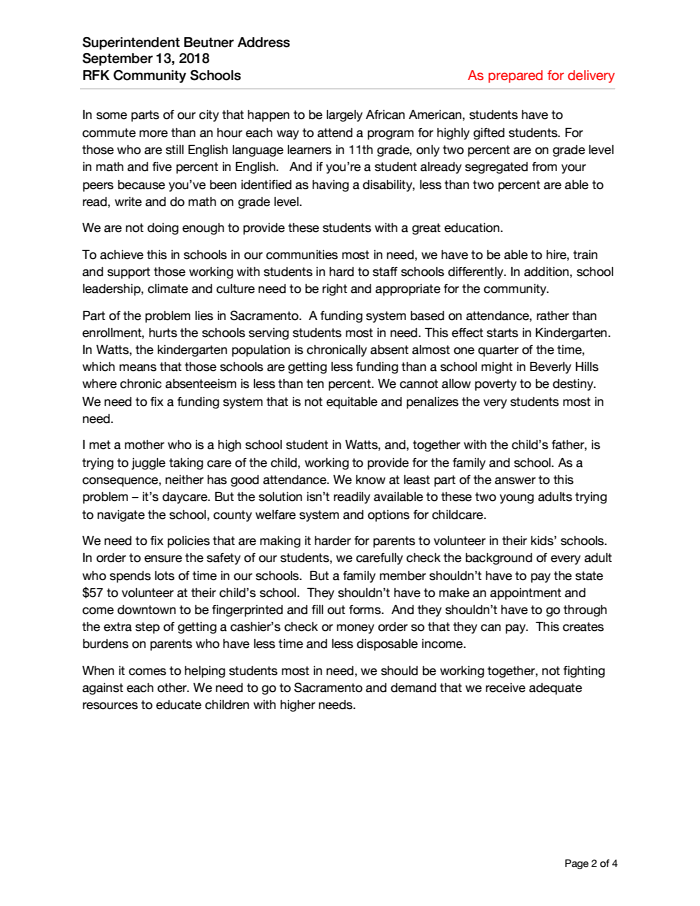


So did Beutner open up new lanes for compromise? Or reopen old wounds?
Legislating teacher quality "is a policy narrative that has come and went," said UTLA vice president Daniel Barnhart, speaking outside the school library where Beutner delivered his speech.
And "it's a non-starter when you are unable to sit down and negotiate the basics of class size, the basic student and staff supports that we need at every school," Barnhart added — referencing the union's charge that the district has been dragging its feet in returning to contract Continue reading: Why LAUSD Superintendent Austin Beutner Wants To Talk About Teacher Quality Right Now: LAist

School-year screen-time rules from a teacher | Salon.com

School-year screen-time rules from a teacher | Salon.com
School-year screen-time rules from a teacher
Kids need to manage their online activities — and parents need to help them do it

ast year "Fortnite" invaded my middle school classroom — as I believe it did to middle school classrooms across the country. Students who were usually on task and high-performing were nodding off and "forgetting" to do their homework. The morning conversations about how late they stayed up or who was the last man standing became part of our early morning check-ins. Then the phone calls with parents started: Over several months, I had numerous telephone and after-school meetings with parents concerned about their kids' performance. When I brought up screen time, there were a range of reactions. Some parents seemed oblivious as to what their children were doing after hours, some didn't know how to rein in screen time, and some thought they had it all under control — but clearly did not.

I get it. I'm not just a teacher: I'm a mom who struggles with screen time, too. I spent last summer trying to keep my own middle school daughter unplugged in the rural English countryside. After the first week, when the iPad started appearing little by little, I tried to use my own advice — "However much you read is how much screen time you get" — and reasoning, "Make sure you balance your learning games with your other games." But then I'd hear my daughter yelling at a friend who'd just left her online game, and I'd feel like I'd lost the battle.
The thing is, I'm not anti-screen. I've seen technology bring some amazing teaching moments to my classroom — and to my own life. One student, whom I could never get to write a complete sentence on paper, wrote the most heartfelt poem about how he "nearly won" in "Fortnite." It became his breakthrough, and he hasn’t stopped writing since. Other kids made parallels to the dystopian booksthey were reading and wrote very poignant compare-and-contrast papers to prove their points. And, far away from her friends in the United States, my daughter was able to stay in touch with her friends online, keep herself occupied with Roblox, and feel a part of pop culture by watching every Miranda Sings video ever made.
Those breakthrough moments of connection, creativity, and critical thinking are what I strive for as a teacher and a mother. What it tells me is that however parents handle the management of their kids' screen time, it really does have to be a balance. And knowing middle school kids as well as I do, I know that they aren't always able to shut down "Fortnite" or YouTube without the guidance and support of their parents. I've also discovered that tech is never going to be a one-size-fits-all thing. What works for some kids will not work for others. Finding what is best for your family can involve a bit of trial and Continue reading: School-year screen-time rules from a teacher | Salon.com

“Montessori, Inc.” Pre-K: Predictive Profiling for Power and Profit – Wrench in the Gears

“Montessori, Inc.” Pre-K: Predictive Profiling for Power and Profit – Wrench in the Gears

“Montessori, Inc.” Pre-K: Predictive Profiling for Power and Profit


This week Jeff Bezos of Amazon announced plans to direct $2 billion, in part, to the creation of a “Day 1 Academies Fund,” which would underwrite the costs of full-scholarship “tier one” Montessori model preschools in low-income communities.
I spent much of this past summer researching the construction of a speculative social impact investment market dealing in pre-school children’s human capital data (herehereherehereherehere, and here). Major players including University of Chicago economist James Heckman; hedge fund manager Robert Dugger; former Minneapolis Federal Reserve economist Arthur Rolnick; billionaire politician JB Pritzker; and Utah tech entrepreneur Jim Sorenson carried out this work quietly, diligently, steadily over the past decade.
The machine they’ve built is vast with tentacles reaching into influential foundations, institutions of higher education, venture capital firms, global banks, bipartisan political circles, and NGOs. It’s the puppet master behind all the Smart Start, Early Literacy, Grow Up Great, Grade Level Reading campaigns you see posted on buses and billboards in your town.
Image result for montessori Amazon
They use cute baby pictures in the advertising, but we need to recognize these efforts for what they truly are. This is about power, using digital technologies and predictive analytics, to mine rising global poverty rates for profit. Ever more vicious forms of innovative finance, like Social Impact Bonds and now impact securities, seek to transform human life into fictitious capital the elite can manipulate to enrich themselves. In this end Continue reading: “Montessori, Inc.” Pre-K: Predictive Profiling for Power and Profit – Wrench in the Gears


Friday, September 14, 2018

Amendment 8 Behind the Scenes: Political ideology, religion, dark money, billionaires, and of course, the money trail | LWVeducation

Amendment 8 Behind the Scenes: Political ideology, religion, dark money, billionaires, and of course, the money trail | LWVeducation

Amendment 8 Behind the Scenes: Political ideology, religion, dark money, billionaires, and of course, the money trail


Florida’s 652 charters run the gamut from small ‘mom and pop’ charters to large chains organized by for-profit management companies. Some serve children and districts well. Many others tell different stories. They involve not only political ideology but also religion, dark money networks, billionaires, and of course, self-interest.
The Erika Donalds version of the charter story starts simply. A small group of members seceded from the Florida School Boards Association (FSBA) in 2015 to form the Florida Coalition of School Board Members (FCSBM). Erika Donalds, a member of the Collier County school board and wife of Florida Representative Byron Donalds, fronts this coalition, but the political network behind it is extensive. It goes all the way to our nation’s capital.
About 14 of the 50 alternative school board association members have been publicly identified, including:


• Rebecca Negron, who has just been defeated for a seat on the Martin County school board even though her supporters raised over $250,000 to unsuccessfully attack her opponent. She is the wife of Senate President Joe Negron. Senator Negron wrote the initial legislation for the Florida Tax Credit Scholarship program to give corporate taxes to private schools.
Some FCSBM members also have strong dark money ties to national conservative political advocacy groups.
• Erika Donalds openly displays the Americans for Prosperity logo on her Collier 912 Freedom Council website. This is a tea party group supported by the Koch brothers and others.
• In the March 29, 2018 article in the Tampa Bay Times, Speaker of the Florida House Richard Corcoran’s wife Ann, who operates her own charter school, is identified.
• Shawn Frost, who is Chair of the Indian River school board, is part of this coalition. He announced in the Indian River Guardian that he expects to be appointed to the Florida State Board of Education. Frost reported campaign contributions from Betsy DeVos, the U.S. Secretary of the Department of Education. In 2014, Frost received $20,000 in campaign contributions from the American Federation of Children run by Betsy DeVos. Frost lives in Vero Beach, but maintains a room in his father’s house in Indian River to meet the residence requirements for being on the school board. He is also the head of MVP Strategy and Policy which specializes in consulting for school board races.
• A Duval School Board member Scott Shine has reportedly joined the FCSBM. He withdrew from his 2018 reelection campaign due to ‘personal attacks’.
• Sarasota school board members Erik Robinson, a former Republican Party Chairman and Bridgit Ziegler are listed members. Ziegler’s campaign reported $45,000 in donations from the out of state Phoenix Media LLC. According to the Herald Tribune, the money was funneled through a PAC run by fellow board member Erik Robinson, who is often called ‘The Prince of Dark Money’.
Some FCSBM members are collaborating to build a Florida chain of Classical Academy Charters. This isn’t just any group of charter schools. They are sponsored by the Hillsdale College Barney Charter School Initiative. The College, located in Michigan, has a long religious/conservative/libertarian agenda. The DeVos immediate family and close business associates have several Hillsdale  Continue reading: Amendment 8 Behind the Scenes: Political ideology, religion, dark money, billionaires, and of course, the money trail | LWVeducation


Stop the Voucher Tax Scam - Network For Public Education

Stop the Voucher Tax Scam - Network For Public Education

Stop the Voucher Tax Scam


There is no nice way to say it–it’s a tax scam to promote vouchers.
Twelve states have designed ingenious ways to use the U.S. tax code so that businesses and the wealthy can make money when they “contribute” to voucher programs.
Here is how it works. A business or taxpayer makes a donation to a state voucher “scholarship.” Then the state gives all or most of the “donation”  back as a tax credit. The donor then deducts the donation as a charitable deduction on federal taxes, even though they got the money back.

And right now it is perfectly legal.
The profiteering resulting from these tax credit voucher schemes has been marketed by tax accountants, private schools, and voucher proponents. And all of this means less money for public schools in state and federal coffers.
The good news is that the IRS is now trying to stop this.
The bad news is that Betsy DeVos’s American Federation for Children and EdChoice are mobilizing thousands to pressure the IRS to keep the scam going.
Please file your comment today with the IRS and tell them “close the loophole.”
This is all you have to do.
  • Go to https://www.regulations.gov/comment?D=IRS-2018-0025-0001
  • In the ‘Comment” box, type the phrase I submit the attached comment in response to the IRS proposed regulations on Contributions in Exchange for State and Local Tax Credits.”  Then continue with your comment. We give you a model comment to paste in below.
  • Enter your first and last name.
  • Follow the directions to submit.
  • Below is a comment you can use:
    —————————————————-
    I submit the attached comment in response to the IRS proposed regulations on Contributions in Exchange for State and Local Tax Credits.​ I am writing to thank the IRS for proposing the ending of a tax shelter that allows taxpayers to turn a profit when they fund private schools through state tuition tax credit programs.  This comes at the expense of state and federal budgets. Meanwhile, people line their pockets while the rest of us pay our fair share of taxes.
    Please stay the course and make sure that tax accountants, private schools, and others can no longer exploit the federal charitable deduction to promote voucher tax credits. Thank you.
    —————————————————-
    It is extremely important that you do this.  Please add your comment here today.
    Then post this link on your Facebook page. Continue Reading:Stop the Voucher Tax Scam - Network For Public Education


NPE 2018 National Conference - Network For Public Education - https://wp.me/p3bR9v-2Iy via @Network4pubEd


Incorrect Data Drives Major Education Decisions | The Report | US News

Incorrect Data Drives Major Education Decisions | The Report | US News
When the Data’s No Good
Serious education policy decisions are being driven by data. The problem is, it’s not always accurate.


IT'S BEEN A ROUGH YEAR for education data – one that's challenged the accuracy of federal databases, uncovered discrepancies that call into question major policy decisions and now, with another school year underway, one that will ask states, districts and schools to collect, report and use more data than ever before.
Take, for example, the revelation last month from an NPR investigation that only 11 of the roughly 240 schools that reported a school-related shooting actually experienced one. Or the inexplicable doubling of the number of districts reporting they were under a federal mandate to desegregate racially imbalanced schools, which itself, as Education Week uncovered, comes on the heels of an equally inexplicably 86 percent drop in the number of school districts reporting that. Or the graduation scandal in the District of Columbia, where 1 in 3 students who earned a diploma in 2017 shouldn't have, in large part because of administrators fudging attendance data.

"At some point, wouldn't you think someone would say, 'Two hundred and forty [shootings]? That's more than one a day. Obviously we don't have that,'" says Robert Pondiscio, senior fellow and vice president for external affairs at the Thomas B. Fordham Institute, a D.C.-based education think tank. "If you are casual about releasing data that at a moment's reflection would say to you, 'No that can't be right,' then are you casual about releasing other data? What does it take for data not to pass the smell test?"

The data discrepancies can have serious ramifications for researchers who rely on federal databases to study any number of things, as well as policymakers and practitioners who use such information to make decisions for their communities. Moreover, that data is often used to determine how billions of dollars in education funding is distributed to states and school districts, making it all the more imperative that it's accurate.
Nora Gordon, an associate professor at Georgetown University's McCourt School of Public Policy, says she especially worries about the databases that rely on self-reported information, like the Department of Education's Civil Rights Data Collection, which was the source of information for both the erroneous school shooting data and the unexplained increases and decreases in desegregation orders.
"I feel like there is a lot of policy attention to that data source, with good reason, but I don't know Continue reading: Incorrect Data Drives Major Education Decisions | The Report | US News


THE ALTERNATIVE REALITY OF LAUSD SUPT. AUSTIN BEUTNER - Perdaily.com

THE ALTERNATIVE REALITY OF LAUSD SUPT. AUSTIN BEUTNER - Perdaily.com

THE ALTERNATIVE REALITY OF LAUSD SUPT. AUSTIN BEUTNER


What is most disingenuous about the L.A. Times "Reporter" Howard Blume's latest article entitled "LAUSD chief signals desire to limit teacher job protections and change funding rules" is that virtually nothing in the article is even remotely true. And worst yet, ersatz "Reporter" Blume knows it's not true. But at least he's got a good excuse for not telling the truth, since at the L.A. Times, they have gone from 1400 to 350 reporters. And where all remaining reporters like Blume know full well that they too will be out the door, if they even attempt to actually report the truth as to what is going on at LAUSD and elsewhere.
Howard Blum knows the truth and at an earlier time in his reporting life, when he was a real reporter, Blum might just have posed some of the following questions:
You now talk about wanting to "limit teacher job protections," but given the assault LAUSD has already waged against more expensive high seniority teachers over at least the last 10 years for their sole "crime" of being at the top of the salary scale, can you tell me Supt. Beutner what real job protections do any LAUSD teachers still have?
How many thousand teachers with no prior negative evaluations- 73% of whom are over 40 and at the top of the salary scale- have you and your immediate predecessors gotten rid of on completely fabricated charges in order to balance your budget and avoid nonetheless impending bankruptcy?
If LAUSD is in such dire financial straits, why has the number of administrators Continue reading: THE ALTERNATIVE REALITY OF LAUSD SUPT. AUSTIN BEUTNER - Perdaily.com


Thursday, September 13, 2018

LAUSD chief signals desire to limit teacher job protections and change funding rules

LAUSD chief signals desire to limit teacher job protections and change funding rules

LAUSD chief signals desire to limit teacher job protections and change funding rules
Los Angeles schools Supt. Austin Beutner has yet to lay out his plans to help the nation’s second-largest school district shore up its finances and improve its academics. But on Thursday, in a speech to an invitation-only audience, he gave strong signals that he might fight to place some limits on job protections for teachers and to get Sacramento to change the way it determines funding.
Beutner defended the concept of tenure but expressed dissatisfaction with the results.

“We need a transparent, efficient and fair process to manage ineffective teachers out,” he told the crowd of students, parents, district leaders and representatives of community organizations gathered in the library of the Robert F. Kennedy Community Schools complex in Koreatown. “In the same way we need to support teachers, we need to support students and make sure that they have great teachers in their classrooms.”
Only “a few, a very few, people in the teaching profession are not helping students succeed,” he said, but “an ineffective teacher can cause students to lose more than a year of learning, which is setting students up for failure.”
Tenure rules in California’s traditional public schools provide strong protections for fully trained teachers after two years.
Changing teachers’ job protections or the way in which they are evaluated would most likely have to be accomplished through contract negotiations, state legislation or a ballot initiative. Beutner acknowledged the Los Angeles Unified School District could not just decide such highly contested matters on its own.
His speech was part of a public relations counter-offensive against the teachers union, which Continue reading: LAUSD chief signals desire to limit teacher job protections and change funding rules