Latest News and Comment from Education

Monday, July 23, 2018

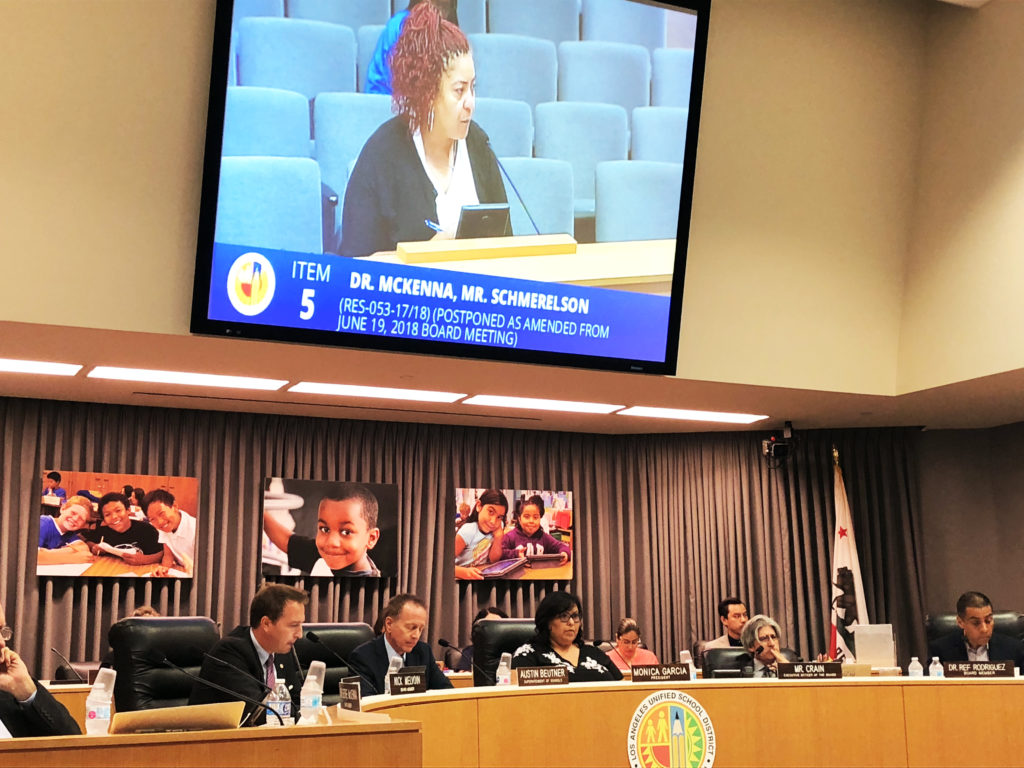
BREAKING NEWS: Ref Rodriguez pleads guilty to conspiracy and resigns from L.A. school board

Ref Rodriguez pleads guilty to conspiracy and resigns from L.A. school board

Ref Rodriguez pleads guilty to conspiracy and resigns from L.A. school board


Dogged by accusations of political money laundering, Los Angeles school board member Ref Rodriguez pleaded guilty Monday to a felony count of conspiracy and resigned from office.
Rodriguez, 47, who had no previous criminal record, will avoid jail time. Instead, he will get three years’ probation and 60 days of community service. His resignation was effective immediately.
As part of an agreement with prosecutors, Rodriguez also pleaded guilty to three misdemeanor counts of assumed-name contribution.
Rodriguez had faced three felony charges and 25 misdemeanor counts and could have received several years in prison if convicted.
The deal ends a strange and stormy saga for Rodriguez, a widely admired educator who became the first charter school executive elected to the governing board of the nation’s second-largest school system.
Just over a year ago, Rodriguez was selected school board president by a narrow 4-to-3 margin, which included Rodriguez’s vote on the seven-member Board of Education. He became board president as a result of a first-ever majority elected with substantial financial support from charter school backers.
Charter schools are independently operated and compete with L.A. Unified for students — and for the government funds that follow them. Los Angeles has more charters and more charter students — about 18% of district enrollment — than any other school system.
Many charter enthusiasts had long believed that the district treated their schools unfairly in terms of sharing campuses and other resources. They saw the rise of Rodriguez as the herald of a new day.
But the campaign finance problems surfaced within months of his becoming board president. Rodriguez had known about the investigation for as long as two years but had kept the Continue reading: Ref Rodriguez pleads guilty to conspiracy and resigns from L.A. school board


Will He Still Be Running His Charter School?
Big Education Ape: OMG: CCSA's Ref Rodriguez's PUC Lakeview Charter Academy Audit http://bigeducationape.blogspot.com/2015/04/ccsas-ref-rodriguezs-puc-lakeview.html


End of Public Schools in Milwaukee? | tultican

End of Public Schools in Milwaukee? | tultican

End of Public Schools in Milwaukee?


This past school year, Wisconsin taxpayers sent $250,000,000 to religious schools. Catholics received the largest slice, but protestants, evangelicals and Jews got their cuts. Wisconsin’s Department of Public Instruction (DPI) reveals that private Islamic schools took in $6,350,000. Of the 212 schools collecting voucher money, 197 were religious schools.
The Wisconsin voucher program was expanded before the 2014-2015 school year. The Milwaukee Journal Sentinel reported, “Seventy-five percent of eligible students who applied for taxpayer-funded subsidies to attend private and religious schools this fall in the statewide voucher program already attend private schools, ….”
Money taken from the public schools attended by the vast majority of Milwaukee’s students is sent to private religious schools. Public schools must adjust for stranded costs while paying to serve a higher percentage of special education students because private schools won’t take them. Forcing public schools to increase class sizes, reduce offerings such as music and lay off staff.
A mounting social division like those faced after the civil war is developing. Katherine Stewart shared that history in her stunning book, The Good News Club:
By the latter half of the nineteenth century, Lutherans as well as Catholics had developed extensive systems of parochial education. For many Protestants, however, the loss of students from those denominations was not a welcome development. It was feared that the combined force of the Lutheran and Catholic electorate would endanger the existence of public education altogether. The tensions between those who wanted universal public education and those who wanted their schools to look like their churches continued to grow. In 1874, President Ulysses S. Grant declared that if a new civil war were to erupt, it would be fought not across the Mason-Dixon Line but at the door of the common schoolhouse. In an 1876 speech in Des Moines, Iowa, he articulated the conclusion many people had already drawn concerning the continuing struggles over religion in the public schools: “Leave the matter of religion to the family altar, the church, and the private school, supported entirely by private contributions,” he said. “Keep the church and state forever separate. With these safeguards I believe the battles which created the Army of Tennessee will not have been fought in vain.” (pages 73-74) (emphasis added)
Privatizing Public Schools Not Achieving Predictions
John E. Chubb was a cofounder of the for-profit Edison Schools and a senior fellow at the Brookings Institute. Terry M. Moe was a professor of political Continue reading: End of Public Schools in Milwaukee? | tultican

New Study: The Genetics of Staying in School - The Atlantic

New Study: The Genetics of Staying in School - The Atlantic

Why Study the Genetics of Staying in School?

Researchers have found 1,271 gene variants associated with years of formal schooling. That’s important, but not for the obvious reasons.

Image result for genes for education


When scientists publish their research, it’s rare for them to write an accompanying FAQ that explains what they found and what it means. It’s especially rare for that FAQ to be three times longer than the research paper itself. But Daniel Benjamin and his colleagues felt the need to do so, because they work on a topic that is frequently and easily misunderstood: the genetics of education.
Over the past five years, Benjamin has been part of an international team of researchers identifying variations in the human genome that are associated with how many years of education people get. In 2013, after analyzing the DNA of 101,000 people, the team found just three of these genetic variants. In 2016, they identified 71 more after tripling the size of their study.
Now, after scanning the genomes of 1,100,000 people of European descent—one of the largest studies of this kind—they have a much bigger list of 1,271 education-associated genetic variants. The team—which includes Peter Visscher, David Cesarini, James Lee, Robbee Wedow, and Aysu Okbay—also identified hundreds of variants that are associated with math skills and performances on tests of mental abilities.
The team hasn’t discovered “genes for education.” Instead, many of these variants affect genes that are active in the brains of fetuses and newborns. These genes influence the creation of neurons and other brain cells, the chemicals these cells secrete, the way they react to new information, and the way they connect with each other. This biology affects our psychology, which in Continue reading: New Study: The Genetics of Staying in School - The Atlantic


Image result for Genetics of Staying in School

Saturday, July 21, 2018

KIPP Refuses Agreement To Abide By Conflict of Interest Law; Gets Approved By State Board of Education | EduResearcher

KIPP Refuses Agreement To Abide By Conflict of Interest Law; Gets Approved By State Board of Education | EduResearcher

KIPP Refuses Agreement To Abide By Conflict of Interest Law; Gets Approved By State Board of Education


[Original Title]: Will KIPP Be Allowed To Bypass Conflict of Interest Law In Its Bid For State Funds?
[3/14/18] Update: The California State Board of Education has voted to approve two KIPP petitions to expand campuses into San Francisco and San Jose despite strong community resistance and knowledge of the charter chain’s refusal to agree to abide by a basic conflict of interest law – Government Code 1090. The following is an open letter that had been sent to the State Board of Education to urge a no vote on the expansions.   For related posts on past State Board of Education votes, see here and here.
______________________
Dear California State Board of Education Trustees,
We urge you to uphold local decisions by publicly elected board trustees to deny the KIPP charter petitions that will be up for appeal at your March 14th meeting.  San Jose’s East Side Union High School District has more charters than traditional public schools and is facing budget drains of over 15 million dollars per year as a result. Such losses impact valuable student supports, human resources, and programs. Charter schools are the recipients of millions of dollars of public funding, yet many insist on private governance without equivalent standards for transparency, open meetings, or compliance with conflict of interest laws. To see the impact of these lax governance and oversight policies as they have unfolded, consider the following:
1) NAACP Calls For a Moratorium on Charter School Expansion 
The following links lead to the official NAACP statement about the resolution and the original resolution with research links. See also the recent Task Force report/recommendations, which specifically highlight the importance of local governance in decision-making about charter schools.
KIPP is mentioned several times throughout this report (see refs for p. 7 and 21 in addition to the quotes below).

A study of KIPP charter schools – the largest corporate charter school chain in the U.S. – found that they enrolled a much lower percentage of students with disabilities (5.9%) than did their local public schools (12.1%). The same was true for English language learners (11.5% compared to 19.2%). p. 11   
and
“For example, the KIPP network of charter schools, well- known for their strict, military-style atmosphere,
 loses 15% of their students per year, far higher than their surrounding school districts.”


Related: 

Big Education Ape: A Topsy-Turvy Week for Charter Schools and School-Choice Tax Credits | Capital & Main - http://bigeducationape.blogspot.com/2018/07/a-topsy-turvy-week-for-charter-schools.html


Don’t Make Me Enforce School Uniforms. Just Let Me Teach. - NWLC

Don’t Make Me Enforce School Uniforms. Just Let Me Teach. - NWLC

Don’t Make Me Enforce School Uniforms. Just Let Me Teach.
Image result for school dress code enforced


A typical morning, when I was a middle school teacher, went something like this:
Arrive at school by 7:30 am. Run to the copier with any last-minute printing for my classes. Get back to my classroom by 7:50 when students begin arriving. Greet students. Remind them to bring necessary materials to class. Address any conflicts in the hallway while also keeping an eye on students already in the classroom. Make sure students are quiet enough to hear morning announcements. Observe student moods—does anyone seem off today? Sad? Angry? Check in with students individually. Offer encouragement. Diffuse tensions. Give warnings. Take attendance. Listen to whatever life updates, issues, and anxieties students bring to me that day. Provide informal counseling. Make note of anyone that needs extra assistance so I can follow up with them later. Find out which teacher is out that day and who needs me give up my lunch or prep period to cover their class.
Oh, and before the 8:00 am bell sends students to their first class, send an email to the front office naming which students are out of uniform.
In this email, I was required to note numerous and arbitrary uniform violations: who is missing their lanyard, whose shoes have the wrong color soles, who has a vest without the school logo on it, who doesn’t have a tie, who has the wrong brand pants, whose shirt isn’t tucked in. The list went on and on.
To my administrators’ eternal frustration, I did not send that email every day like I was supposed to. It was a miracle if I could even take attendance by 8:00 am instead of playing catch up in my lunch period (if I had one). And the problem wasn’t just time, though that was a huge factor. Writing that email made me feel uneasy. Don’t get me wrong; my problem wasn’t discipline—I was voted strictest teacher my very first year teaching. I had high standards, because holding students to high standards was one of my ways of showing them they mattered. I wasted no time in addressing disruption and disrespect in the classroom.
But this—this always felt different. I hated writing that “out of uniform” email. I internally raged about how it was a waste of time, which it absolutely was. More than that, it never felt right to listen to a student tell me about their most recent Continue Reading: Don’t Make Me Enforce School Uniforms. Just Let Me Teach. - NWLC


Embattled L.A. Unified school board member is poised to take plea deal in money-laundering case

Embattled L.A. Unified school board member is poised to take plea deal in money-laundering case

Embattled L.A. Unified school board member is poised to take plea deal in money-laundering case


The stage appears to be set for a deal that would resolve political money-laundering allegations against Los Angeles school board member Ref Rodriguez, based on a filing posted by the city's Ethics Commission.
The deal is likely to include his resignation from office, although parties involved in the negotiations would not confirm that.
In the filing, Rodriguez, 47, admits that he “engaged in money laundering to further his 2015 campaign for a seat on the Los Angeles Unified School District Board of Education.”
The commission staff is recommending a $100,000 penalty that would be paid by Rodriguez and his co-defendant, Elizabeth Melendrez.

That fine would resolve Rodriguez’s case before the Ethics Commission, but that is just one half of his troubles related to political money laundering. The other — and the more serious — is a criminal case based on the same actions.
In that proceeding, Rodriguez is charged with three felonies and 25 misdemeanors. If convicted on all counts, he could face several years in prison.
Because Rodriguez has now apparently admitted guilt to the city’s Ethics Commission, it would be seemingly impossible for him to claim that he is not guilty of the same offenses in the criminal case. For that reason, all signs suggest that the criminal case also has been resolved with a separate plea deal.
Details of the expected deal in the criminal case have not been made public.
Legally, Rodriguez could probably remain in office if prosecutors agreed to lower the felony charges to one or more misdemeanors. But observers and those close to the case said it’s difficult to imagine a deal that would allow Rodriguez to keep his board seat, even if he is able to avoid time in jail.
The ethics filing describes in some detail what happened, according to investigators.
Late in 2014, Rodriguez, who was then a senior executive at a charter school organization, was putting together his first run for office.
That December, he instructed Melendrez, his cousin, to enlist contributors and later reimburse them with Rodriguez’s money. Melendrez worked under Rodriguez as an administrator in the same charter-school organization.
Rodriguez held an event at a family member’s residence later that month to announce his Continue reading: Embattled L.A. Unified school board member is poised to take plea deal in money-laundering case

Big Education Ape: OMG: CCSA's Ref Rodriguez's PUC Lakeview Charter Academy Audit - http://bigeducationape.blogspot.com/2015/04/ccsas-ref-rodriguezs-puc-lakeview.html

Big Education Ape: Schools Matter: Is CNCA paying parents to support CCSA's Ref Rodriguez's LAUSD Board campaign? - http://bigeducationape.blogspot.com/2015/04/schools-matter-is-cnca-paying-parents.html


Big Education Ape: Schools Matter: PROFITS! Why Ref Rodriguez and his CCSA covet the LAUSD Board Seat - http://bigeducationape.blogspot.com/2015/04/schools-matter-profits-why-ref.html


Big Education Ape: Schools Matter: Guest Post: Citizen Jack responds to LA Weekly's fluffing Ref Rodriguez - http://bigeducationape.blogspot.com/2015/05/schools-matter-guest-post-citizen-jack.html

Citizen Jack responds to LA Weekly's fluffing Ref Rodriguez


Friday, July 20, 2018

Do Not Follow New Orleans’ Lead on Charter-School Education. | deutsch29

Do Not Follow New Orleans’ Lead on Charter-School Education. | deutsch29

Do Not Follow New Orleans’ Lead on Charter-School Education.

Image result for danger turn back sign

On July 1, 2018, the Washington Post published an op-ed entitled, “Following NewOrleans’ Lead on Charter-School Education.” The author, education policy analyst Emily Langhorne of the Progressive Policy Institute, uses this opportunity to promote what she terms the “quiet milestone” of Hurricane Katrina’s “wip[ing] out the city’s abysmal public schools” and the “rebuilding from the ground up as a laboratory for charter schools” operated under the direction of the state via the Recovery School District (RSD), an “experiment” that Langhorne declares “proved successful.”
On July 6, 2018, the Network for Public Education (NPE) published a report that I drafted and that counters the claims of New Orleans’ charter-experiment success. My report, entitledNew Orleans Schools Post-Katrina: Rebirth or Afterbirth?,counters claims of the New Orleans, Post-Katrina, All-Charter Miracle narrative on three important fronts, which I briefly describe in this posting.

First of all, white student privilege is alive and well in New Orleans, schools, just as it was pre-Katrina. Perusal of 2017 letter grades for New Orleans schools shows that schools with notable concentrations of white students are mostly graded A and B, with one C and one DMoreover34 of the 85 New Orleans schools—or 40 percent—were graded D or F in 2017.
Only one of these 34 D-F schools had a notable white population. All had predominately black populations. So, not only does one see that 40 percent of almost-all-charter New Orleans schools (four are still direct-run schools by Orleans Parish School Board, or OPSB) still have grades D and F in 2017—12 years post-Katrina; one also sees that these D and F schools demonstrate racial inequity in an almost-all-charter school system.
One might even use the term, “abysmal” to describe such equity and arguably, quality, failure.
A second point in my report is that state takeover of New Orleans schools did not counter corruption; it seems to have magnified opportunities for it. The section on fraud and corruption is extensive; in it, I trace the roots of corruption to then-Louisiana-state-superintendent, Cecil Picard, and his manipulation of US Department of Education (USDOE) Office of Inspector General (OIG) report on Continue reading: Do Not Follow New Orleans’ Lead on Charter-School Education. | deutsch29

Want to read about the history of charter schools and vouchers?

School Choice: The End of Public Education? 

school choice cover  (Click image to enlarge)

Schneider is a southern Louisiana native, career teacher, trained researcher, and author of two other books: A Chronicle of Echoes: Who’s Who In the Implosion of American Public Education and Common Core Dilemma: Who Owns Our Schools?. You should buy these books. They’re great. No, really.

both books

Don’t care to buy from Amazon? Purchase my books from Powell’s City of Books instead.


A Topsy-Turvy Week for Charter Schools and School-Choice Tax Credits | Capital & Main

A Topsy-Turvy Week for Charter Schools and School-Choice Tax Credits | Capital & Main

A Topsy-Turvy Week for Charter Schools and School-Choice Tax Credits
Teacher pension fund is in the money . . . Is a Kevin De León bill in the IRS’s crosshairs? . . . The State Board of Education greenlights yet another Oakland charter school.


California’s public school and community college teachers can expect good news tomorrow when the $208.7 billion California State Teachers’ Retirement System (CalSTRS) releases its official net returns for fiscal year 2017-18. Last year, the pension fund posted a 13.4 percent gain — nearly twice its official seven percent discount rate. Coming on the heels of the robust 8.6 percent return announced last week by the California Public Employees’ Retirement System (CalPERS), expectations are running high. Public sector pensions continue to top neoliberal hit lists, and a second year in the double digits will buy political breathing space for one of the last pillars of ironclad middle-class retirement security.
“When public sector pension funds hit their mark or do better than the market, [the anti-union media] downplay it, and every time they go below the mark, it’s ‘the sky is falling and [we] have to take everybody’s pensions away,'” chairman of Californians for Retirement Security Dave Low quipped to Learning Curves. (Disclosure: Low sits on this website’s board of directors.)
On the other hand, the L.A. Times reported this week that so-called neovouchers, which have been embraced by Betsy DeVos and are popular with school-choice proponents, are among more than 100 charitable tax-credit programs now endangered by IRS blowback to dueling tax measures from DC Republicans and resistance states like California.
Proposed IRS rules that target blue state legislative workarounds to the $10,000 cap for state and local income taxes (SALT) in last year’s $1.5 trillion, Republican tax bill would almost certainly also eliminate deductions for neovouchers. In the crosshairs is SB 227, the public education charity proposed by state Senator and U.S. Senate candidate Kevin De León (D-Los Angeles) that Californians could use to make up the pre-SALT write-offs.
“Even before the tax rule, there were things in this gray area between charity and public services,” explained Kim Rueben, a Public Policy Institute of California adjunct fellow and Urban-Brookings Tax Policy Center senior fellow. “If they’re going to try and put a bright line in and say that people can’t take this as a charitable deduction because of the value in terms of savings from their state taxes, that same value is already accruing to people across this country from these existing tax credits.”
Charter school politics don’t get more topsy-turvy than in Sacramento, where the State Board of Education (SBE) is charged with doing good for California’s 6.2 million-student system of public schools, but which last week nudged Oakland’s financially stricken school district closer to the brink by saddling it with another new charter school that parents, students, the historically pro-charter OUSD board and an Alameda County Grand Jury say it neither needs nor can afford.


“It shows how disconnected they are from what’s going on in our cities … or what’s happening with underfunded public schools in California,” said activist Mona Treviño of the green light given at SBE’s July 12 meeting for Latitude charter high school to open its doors in the fall.
The unexpected at the board’s otherwise business-as-usual session came with a mea culpa offered by the state’s chief deputy superintendent of public instruction, Glen Price, who also called for “modernizing” 1998’s dated AB 544, the Reed Hastings-lobbied law that transformed California’s formerly benign Charter School Act into a poison pill for districts, by making it illegal for authorizers such as local school boards to consider the financial damage charters inflict on their hosts.
“At some point we have to consider the whole ecosystem — the whole community that we’re operating in when making these decisions,” Price reasoned. “There’s no other area of local or community planning where we would not consider the financial impact of a decision.” More Education News @ Capital & MainA Topsy-Turvy Week for Charter Schools and School-Choice Tax Credits | Capital & Main

 7
Learning Curves: New Column Reports on the Education Wars | Capital & Main - https://capitalandmain.com/?p=80437 by @billraden on @capitalandmain
Editor’s Note: Today Capital & Main’s education reporter, Bill Raden, begins a new weekly column covering the contentious, ever-changing landscape of California’s education system. A staccato-paced selection of news items, profiles and dish, “Learning Curves” will report on everything from charter school controversies in K-12 schools to the skyrocketing costs of attending college. Other issues will include school funding, equity, and the intersection of education and inequality.
Send tips, feedback and announcements of upcoming events to  braden@capitalandmain.com.