Latest News and Comment from Education

Thursday, May 10, 2018

Teachers Are Leading the Revolt Against Austerity | The Nation

Teachers Are Leading the Revolt Against Austerity | The Nation:

Teachers Are Leading the Revolt Against Austerity

The strikes aren’t just about pay. They’re a rejection of tax cuts for the wealthy and a rallying cry for public goods and services.
Arizona-Teacher-strike-2018-ap-img

In less than three months, rank-and-file teachers and educational support staff in five states—West Virginia, Kentucky, Oklahoma, Colorado and Arizona—have turned the entire country into their classroom. They haven’t just pushed for—and won—better pay and working conditions for themselves. They’ve also mounted a direct challenge to decades of bipartisan tax cuts for corporations, helping us all understand what austerity means. And by championing a raft of policy proposals to redistribute wealth away from the 1 percent and back to the working and middle-class, they’ve shown us how austerity can be defeated. As Emily Comer, a middle-school Spanish teacher who was a leader in the strikes in West Virginia, put it, “The phase we are in now—to win a real, progressive solution to the health-insurance crisis—forces us to dream bigger. This isn’t just about our healthcare plan. It’s about rebalancing the power of workers and corporations in our state.” 
Remarkably, these strikes have garnered overwhelming support from the public, despite years of well-funded attacks on teachers unions. In a recent NPR/Ipsos poll, just one in four respondents said they think teachers are paid enough, and three-quarters said teachers have the right to strike. Remarkably, this support cut across party lines. “Two thirds of Republicans, three-quarters of independents and nearly 9 in 10 Democrats” support the teachers’ right to strike, the poll showed. 
The most recent walkouts have shifted to western states. On April 26, 50,000 teachers and their supporters march through Phoenix in 100 degree heat. That same day, thousands of protesters descended on the capitol of Colorado.
Every walkout has resulted in victories, some more than others. In Kentucky, educators forced the governor’s veto of new taxes to be overturned, providing some additional funds for schools. But they fell short of preventing the conservative legislature from weakening their pension plan. In Oklahoma, while educators failed to stop a raft of tax cuts and increase overall funding, they still won their first raise since 2007 by $6,000 a year, which by is huge by local standards. In Arizona, the teachers won a 9 percent immediate raise, with Governor Doug Ducey pledging 11 percent more to achieve what he calls the 2020 deal, a 20 percent pay raise Continue Reading: Teachers Are Leading the Revolt Against Austerity | The Nation:
Image result for Teachers Lead


Wednesday, May 9, 2018

Arne Duncan and Margaret Spellings: What ails education? ‘An absence of vision, a failure of will and politics’ - The Washington Post

What ails education? ‘An absence of vision, a failure of will and politics’ - The Washington Post:

What ails education? ‘An absence of vision, a failure of will and politics’


We have long benefited from a broad coalition that has advanced bold action to improve America’s education system.
That coalition has waned. It’s time to rebuild it.
Today, education is blessed with bipartisan agreement on what works, and cursed with bipartisan complacency at every level on taking action.
Both sides recognize the need to balance strong federal accountability with local innovation; to support high standards for teachers; and to encourage choice and diversity while keeping public schools as the core focus of national policy.
Current federal education policy, governed by the Every Student Succeeds Act, encourages states to implement those principles in accordance with local needs and context. But today, even the country’s greatest champions for local control see state efforts as underwhelming and insufficient.
In the absence of an aggressive national push, even the best ideas lack the momentum to create effective change on the ground.
It wasn’t always like this. While we didn’t always agree about the best way to get there, for years we agreed on the destination. Far-sighted presidential and legislative leadership, an engaged business community and an enduring civil rights movement saw quality education as the key to all other forms of progress.
 That alliance allowed President Ronald Reagan to oversee “A Nation at Risk,” a report that made education a priority in the national consciousness; President George H.W. Bush to convene the governors and catalyze state-level education progress; President Bill Clinton to push for rigorous student achievement standards and charter school expansion to promote school innovation; President George W. Bush to champion the bipartisan No Child Left Behind to address achievement gaps through strong federal standards; and President Barack Obama to create Race to the Top and incentivize continuous improvement in school performance.

For decades, national leadership rejected the soft bigotry of low expectations and insisted that every student, regardless of race, background or economic hardship, deserved the American ideal of equal opportunity. A promise that’s given life through education.
Today, we lack the national leadership to fulfill that promise. We see the consequences in state education plans that lack vision, commitment or ambition, and in recently released National Assessment of Educational Progress scores showing stagnant progress in our “national report card.” Students are suffering because of an absence of vision, a failure of will and politics that values opposition over progress. There is a moral imperative to act.
Last month, four U.S. secretaries of education representing 16 years of experience as secretary, serving under George W. Bush and Obama, shared a stage at the Reagan Institute. We were marking the 35th anniversary of “A Nation At Risk,” which galvanized national resolve around education.
The stark report outlined our national failure: “We have, in effect, been committing an act of unthinking, unilateral educational disarmament.”
After decades of momentum across different administrations, all of us believe we’re headed toward another round of unilateral disarmament. Federal education policy is rudderless and adrift.
What, today, is the national priority for K-12 schools? For higher education? What policy proposal exists today that can plausibly achieve the progress we need?
At a moment when students are marching in the streets for their right to a safe, quality education; when teachers across the country are demanding attention and investment from their political leaders; when every economic indicator confirms the growing importance of a sound education in forging a full, productive life, what is our shared national vision for our children?
Higher expectations and strong standards — backed by federal policy that protects the enormous taxpayer investment in K-12 schools and higher education — are bipartisan concerns. Respect for teaching, and the accompanying need for better preparation and support for teachers, must be one unifying goal.
Each of us has different views about the right balance of federal oversight and incentives when it comes to America’s schools and colleges. We all welcome a lively debate on the best way for Congress, the president and the Department of Education to encourage school improvement.
But whatever the precise policies, we believe there’s a crucial role for national policymakers to set ambitious goals, marshal resources and enact policies that benefit our students. That’s not happening with the urgency we need.
Education is what makes America the country it is. An educated populace, versed in civics, trained to reason and empowered to act is what safeguards our democracy. Equitable access to education — our greatest force for economic mobility, economic growth and a level playing field for all — is what underwrites the American meritocracy.
We urgently need a new generation of business leaders who see the alignment between their corporate priorities and the national interest. We need teacher unions and school leaders ready to play a vital, constructive role in setting fair standards. We need civil rights advocates who can mobilize around the foundational importance of equal access to education. And we need political leaders who know that a fair, prosperous country is forged in classrooms, not at campaign rallies.
Without that renewed coalition, we are once again a nation at risk. After decades fighting for equitable, high-quality education, many across the country are exhausted. We know. But our progress is real, and the consequences if we relent are real as well. It’s time for us to rally, to step up to the plate once more and rebuild American education’s grand coalition.
Arne Duncan, managing director of the Emerson Collective, was U.S. education secretary under President Barack Obama. Margaret Spellings, president of the University of North Carolina System, was U.S. education secretary under President George W. Bush.What ails education? ‘An absence of vision, a failure of will and politics’ - The Washington Post:

Tuesday, May 8, 2018

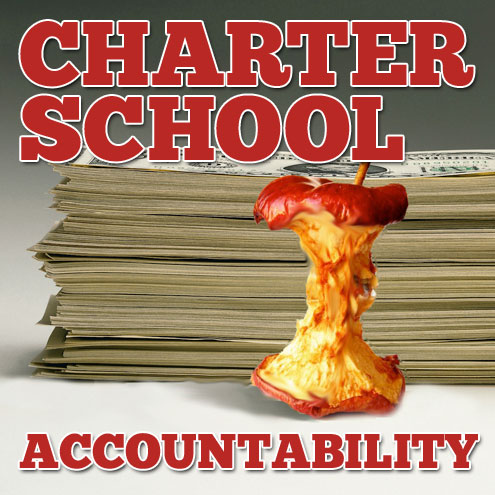
Love Public Schools Read This: How Much Charter Schools Cost

How Much Charter Schools Cost:

How Much Charter Schools Cost


Image result for How Much Charter Schools Cost


In a first-of-its-kind analysis, In the Public Interest has found that public school students in three California school districts are bearing the cost of the unchecked expansion of privately managed charter schools.
The report, Breaking Point: The Cost of Charter Schools for Public School Districts, calculates the fiscal impact of charter schools on Oakland Unified School District, San Diego Unified School District, and San Jose’s East Side Union High School District.
  • Charter schools cost Oakland Unified $57.3 million per year. That’s $1,500 less in funding for each student that attends a neighborhood school.
  • The annual cost of charter schools to the San Diego Unified is $65.9 million.
  • In East Side Union, the net impact of charter schools amounts to a loss of $19.3 million per year.
The California Charter School Act doesn’t allow school boards to consider how a proposed charter school may impact a district’s educational programs or fiscal health when weighing new charter applications.
However, when a student leaves a neighborhood school for a charter school, all the funding for that student leaves with them, while all the costs do not. This leads to cuts in core services like counseling, libraries, and special education, and increased class sizes at neighborhood public schools.
In the Public Interest recommends that public officials at both the local and state levels should be empowered to take fiscal and educational impacts on neighborhood schools into account when deciding whether to authorize a new charter school.

Wondering what the cost is in your district?

In the Public Interest has designed a template to enable any California school district to calculate the net fiscal impact of charter schools in its community. Email info@inthepublicinterest.org to get a copy.

Watch

Share the findings

Get involved

Help us make sure that every public school student thrives. Want updates on charter schools from In the Public Interest? Sign up here.


How Much Charter Schools Cost:

Monday, May 7, 2018

Debate: How Should Unions Deal With Free Riders? | Labor Notes

Debate: How Should Unions Deal With Free Riders? | Labor Notes:

Debate: How Should Unions Deal With Free Riders?

Image result for Unions Deal With Free Riders?

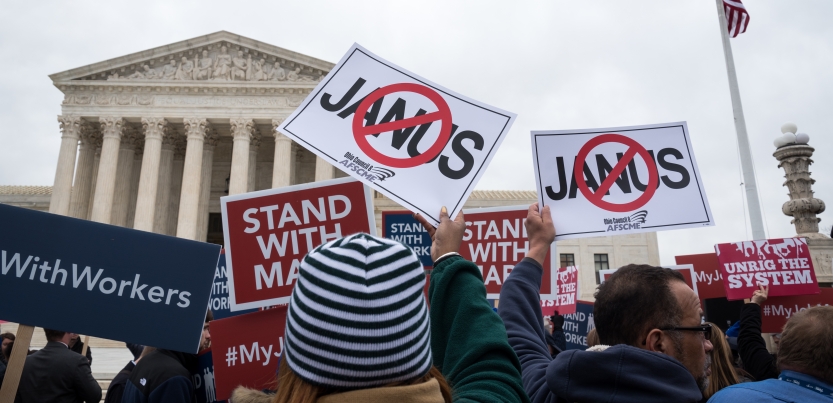
The U.S. is quickly becoming an open-shop country. A majority of states now have “right-to-work” laws, and the Supreme Court’s decision in Janus v. AFSCME is likely to make right to work the law of the land in the public sector. Many unions are bracing for an immediate exodus of dues- and fee-payers.
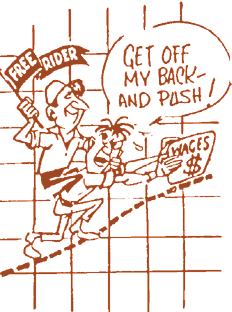
In a right-to-work setting, workers have the option to be free riders, receiving the benefits of unionization without paying membership dues or fees. Yet the duty of fair representation requires the union to represent everyone in the bargaining unit, even non-members. This duty arises from a union being the exclusive representative of a group of workers—no other union or organization can speak for them.
Those are the rules in the private sector, anyway. In the public sector, certain states already allow some form of “members-only unions.” In Florida, for instance, public sector unions are not obliged to represent non-members in grievances. The same is true for teacher unions in Tennessee, where multiple organizations compete to represent teachers in the same workplace.
The anticipated Janus decision has sparked a debate. Should public sector unions try to get “members-only” laws passed? Where such laws are in place, should unions really stop representing non-members?
These questions aren’t hypothetical. In April, New York state passed a law, backed by the AFL-CIO, that public sector unions no longer have to provide representation to non-members in disciplinary hearings, grievances, or arbitrations.
Meanwhile national anti-union groups are promoting a similar idea for their own reasons.
Below are links to several perspectives Labor Notes readers sent in. Want to join in the debate? Email us at editors@labornotes.org.
Image result for Unions Deal With Free Riders?
Debate: How Should Unions Deal With Free Riders? | Labor Notes:

 Image result for Unions Deal With Free Riders?
Image result for Unions Deal With Free Riders?

ECOT used for-profit companies to hide source of attack-ad money, Yost says

ECOT used for-profit companies to hide source of attack-ad money, Yost says:

ECOT used for-profit companies to hide source of attack-ad money, Yost says

Using private companies owned by Electronic Classroom of Tomorrow school founder Bill Lager, plus a media-production company run by his daughter, ECOT tried to hide the source of payment for nearly $250,000 worth of TV attack ads aimed at the Ohio Department of Education.
That is the conclusion reached by the office of state Auditor Dave Yost, who, in a draft finding for recovery obtained by The Dispatch, lays out details of a plan designed to avoid the appearance that ECOT illegally used taxpayer money to pay for political ads.
As a result, Yost is ordering a pair of Lager’s ECOT-affiliated for-profit companies, Altair Learning Management and IQ Innovations, along with Third Wave Communications, where Lager’s daughter Jessica Harris is an owner, to repay ECOT a total of nearly $250,000 for illegally spent public money.
ECOT, formerly the state’s largest charter school, was closed in January. The recovered money would go into a fund that is under the control of an interim master who was appointed by a Franklin County judge; the fund is to be used to continue paying the school’s obligations. The companies can formally respond to the finding this week.
>> Join the conversation at Facebook.com/dispatchpolitics and connect with us on Twitter @OhioPoliticsNow
ECOT and the Department of Education engaged in warfare in the courts and a public relations campaign last year after the department found that the online school was unable to verify about 60 percent of its reported enrollment, based largely on the duration of computer log-ins showing that students didn’t meet state-minimum hours of instruction. The state ordered ECOT to repay the state $60 million.
As part of its strategy, ECOT took to the airwaves, launching a string of television ads attacking the Department of Education, urging it to keep ECOT open and accusing it of wanting to end school choice and not caring about ECOT students. Lager is a major contributor to Republican campaigns.
Although charter schools can legally run ads in an effort to recruit students, no public school — charter or traditional — is allowed to spend taxpayer money on political-type ads, including levy campaigns.
On June 13, according to the auditor’s report, Midwest Communications & Media sent ECOT an invoice in the amount of $249,962 related to the placement of the political ads.
Two weeks later, when contacted by The Dispatch, then-ECOT spokesman Neil Clark confirmed that the ads were paid for with public money. He argued that the school had a right to use those funds for “any activity that they believe can lead to making ODE change its current position or affect the General Assembly to try to change ODE.”
The same day that story appeared in the paper, Yost sent ECOT a letter demanding that the school cease using taxpayer money on such ads.
Four days after the story and letter, according to the report, Melissa Vasil, director of operations for Altair, the school’s for-profit management company, sent an email to Amy Davis, marketing coordinator with IQ Innovations, the school’s software provider. Again, Lager owns both companies.
Vasil told Davis to have Third Wave Communications — a company that shares a street address and family ties with IQ — pay the $249,962 invoice. That same day, bank records show that Third Wave made the payment, which, Yost’s office noted, was a departure from the payment practice in the first half of 2017.
“Third Wave Communications had no apparent reason to pay a large sum of money for this and only these advertisements,” the report said, noting that prior Midwest invoices were sent to ECOT for payment.
Since June 2016, ECOT had been paying Third Wave $45,000 per month, plus $4,950 per additional video, as detailed by the contract. Those consulting payments made up a significant portion of Third Wave’s available cash to pay Midwest Communications, and there is no evidence that a third party ever reimbursed Third Wave for the payment, the report said.
“The only reasonable understanding of this process is that it was designed to disguise the use of public money to pay for the non-public purpose of the lobbying ad,” the report said.
Yost is expected to release a new financial audit of ECOT soon.
 ECOT used for-profit companies to hide source of attack-ad money, Yost says:


Sunday, May 6, 2018

Diane Ravitch and the education debate | My View | santafenewmexican.com

Diane Ravitch and the education debate | My View | santafenewmexican.com:

Diane Ravitch and the education debate


Thank you to the Lannan Foundation for bringing Diane Ravitch to address our community on the challenges that she sees to strengthen our public education system to best serve children (“Author assails state of education in N.M.,” April 16). Obviously our community values public education, as the Lensic Performing Arts Center was packed for the presentation.
We appreciate Ravitch’s clear message that poverty compromises learning and that federal and state mandates that require excessive testing can be punitive. We welcome her strong advocacy for supporting and recognizing teachers, and her emphasis on child-centered learning. We agree that we need to be aware of some corporations’ agendas to privatize our public education system; and that the present agenda of the U.S. Department of Education is to fund the expansion of public charter schools, thereby diminishing funding of traditional public schools. We lament, along with Ravitch, that the testing industry drives and profits from excessive testing, to the detriment of quality education. Best practice requires only occasional testing, and only to diagnose how a child needs to be supported. Best practice then provides additional support for that child.
However, we do not agree with Ravitch that a solution is to do away with national standards. The standards provide a common point of reference for children, families, teachers, principals and school administrators as a student moves from state to state, system to system, and from school to school.
In addressing the Santa Fe audience, Dr. Ravitch may have been unaware that our community strives to address the issues of poverty daily through the work of the Santa Fe Public Schools Student Wellness Division; the Adelante Program, serving 1,700 homeless children and their families yearly; and through partnership with the nonprofit organization Communities in Schools, linking children to wrap-around services related to their health and well-being. While inadequately funded, our school system has struggled to budget for school counselors, nurses and school security. Each week The Food Depot provides backpacks full of food to school children and their families.
We as a community need to support and collaborate with SFPS to expand and implement effective strategies to address poverty and lift student achievement. The Interfaith Coalition for Public Education joins others in recruiting and placing tutors in classrooms, coaching teachers, providing teacher workshops, advocating for increased funding and accountability, and orchestrating education forums to inform the public. We, along with other entities in Santa Fe work collectively in the Birth to Career (now Opportunities Santa Fe) collaborative to maximize support for our children.
Ravitch and many others point to best practices in Finland and other nations as models for New Mexico. We agree that the prenatal years are critical for developing the initial capacity for learning. But our national and state policies have never adequately addressed or funded universal prenatal health care, paid family leave, home visitation for expecting and new mothers, and universal public school pre-K. In our society, teachers do not yet have the status in pay and respect of corporate CEOs, doctors, lawyers, entertainers and athletes. Until we dedicate public funds to rigorous teacher education, high-quality classroom and teacher support and abundant teacher salaries, teachers will continue to be demoralized as they fight for bare necessities. This is inexcusable; we as voters and taxpayers need to demand legislation that will put teacher-honoring policies into effect.
Thank you, Dr. Ravitch, for stirring our thinking and helping us to recognize the important work in progress in our city. There is work enough for all of us to put power into effective strategies that benefit our children and community.
K. Elise Packard, Ph.D., is a learning consultant and co-founder of the Interfaith Coalition for Public Education. She lives in Santa Fe.Diane Ravitch and the education debate | My View | santafenewmexican.com:

Don’t let charter schools cloud the race for Brown’s successor. Vote Newsom or Chian | The Sacramento Bee

California primary: Newsom or Chiang are top two for governor | The Sacramento Bee:

Don’t let charter schools cloud the race for Brown’s successor. Vote Newsom or Chiang
20160209_HA_Gavin_Newsom0093


Gov. Jerry Brown is a hard act to follow. No California governor has served longer, or more consequentially.
In the past eight years alone – his second stint in the office – the state has gone from a $27 billion budget deficit to a $6 billion surplus. Unemployment has fallen from 12.2 percent to 4.3 percent, a record. Along the way, Brown has realigned the state’s criminal justice system, overhauled public school finance, licensed more than a million undocumented drivers, put the state at the forefront of addressing climate change and taught Californians a little Latin.
Whoever succeeds him will not only have to pick up where he left off on those issues, but also maintain his defense of California against Trump administration assaults on our environment, trade, diversity and tolerant values. Not to mention our many in-state challenges – affordable housing, health care, underfunded public employee pensions, higher education, water policy and so on. Oh, and the near-term likelihood of a downturn in the state economy.
So voters have their work cut out on June 5 in culling two candidates from a field of more than two dozen contenders. A few prospects are prepared, but let us stipulate: None are Jerry Brown.
The best-equipped candidate for the economy to come – state Treasurer John Chiang – is running an anemic campaign and is probably terminally underfunded. The best-financed and most experienced candidates – former Los Angeles Mayor Antonio Villaraigosa and Lt. Gov. Gavin Newsom – have, in their personal lives, made unnerving and public errors in judgment.
More immediately, there are the great gobs of money from billionaire charter school advocates going to independent expenditure campaigns backing Villaraigosa. Though Newsom, too, has his billionaires – hello, Silicon Valley – the charter movement has direct Continue Reading: California primary: Newsom or Chiang are top two for governor | The Sacramento Bee: