Latest News and Comment from Education

Wednesday, May 2, 2018

New L.A. schools chief Beutner pledges to learn and to take action

New L.A. schools chief Beutner pledges to learn and to take action:

New L.A. schools chief Beutner pledges to learn and to take action
New L.A. schools Supt. Austin Beutner proved on Wednesday that he's a quick learner despite lacking a background in education. Like a stream of public officials before him, he appeared at an important event — his first speech and news conference — in front of a group of students, who served as a photogenic backdrop.
His message — that he would put students first — was nothing original but he pledged to push cooperatively but unflinchingly to improve the district's academic performance and stabilize its finances.
Details to come.
Beutner, a former investment banker who made a fortune on Wall Street, offered no specifics on how he would deal with the district's gravest academic and fiscal challenges or its stalled negotiations with the teachers union.
Union representatives on Wednesday came out battling, saying his selection was a sign that L.A. Unified's leadership is steering the nation's second-largest school system in the wrong direction.
The Board of Education selected Beutner by a 5-2 vote on Tuesday, passing over interim Supt. Vivian Ekchian, who has spent her career in the L.A. Unified School District, rising from teacher to senior management.
"To state the obvious, I'm an unconventional choice, unconventional by lots of measures," Beutner, a former deputy mayor and L.A. Times publisher, said in prepared remarks at Belmont High School. "But the district is at a crossroads. We face some tough issues. But I believe we can move forward together and address these issues to unlock the enormous  Continue reading: New L.A. schools chief Beutner pledges to learn and to take action:


Cathie Black debacle just the latest in a long line of miscues by education reformers - NY Daily News - http://www.nydailynews.com/opinion/greenman-cathie-black-reformers-failed-test-article-1.114418 via nydailynews


Big Education Ape: Billionaire Blunders: Appointing Education Chiefs Who Know Little about Public Schools | Larry Cuban on School Reform and Classroom Practice - http://bigeducationape.blogspot.com/2017/02/billionaire-blunders-appointing.html

Cathie Black

Cathie Black and the privatisation of education | Daniel Denvir | Education | The Guardian - https://www.theguardian.com/commentisfree/cifamerica/2011/apr/07/schools-school-funding on @guardian

Cathie Black, the new chancellor of New York City schools calls herself a born saleswoman

Cathie Black, the new chancellor of New York City schools calls herself a born saleswoman - NY Daily News - http://www.nydailynews.com/new-york/education/cathie-black-new-chancellor-new-york-city-schools-calls-born-saleswoman-article-1.451260 via nydailynews




BROOKINGS: Charter school growth puts fiscal pressure on traditional public schools

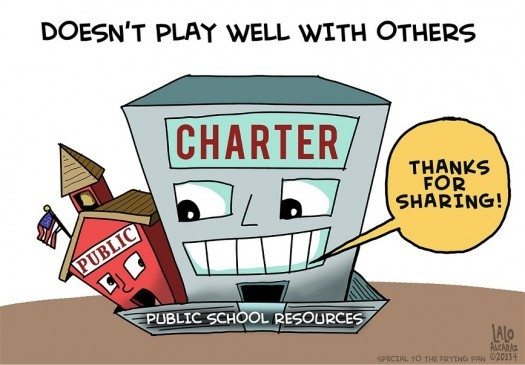
Charter school growth puts fiscal pressure on traditional public schools:

Charter school growth puts fiscal pressure on traditional public schools

Image result for Charter school growth puts fiscal pressure on traditional public schools

Policy debates about the net effects of charter schools on students and on the delivery of K-12 education are ongoing and remain highly contentious. 

In a recent paper, we contribute to the policy discussion by drawing attention to the fiscal externalities of charter schools, a finance topic that deserves more attention in the overall discussion. Fiscal externalities are the additional burden that charter schools place on the budgets of traditional school districts, and we find evidence that they are consequential in North Carolina.


Although such burdens may manifest themselves in higher local tax burdens, the more likely outcome is reduced spending per pupil on educational services–and hence lower educational quality–for students who remain in the district’s traditional public schools. The presence of charter schools typically means that some of the funding that would otherwise have been available to the local school district is diverted to the charter schools. For example, assume that the funding arrangements are such that if 10 percent of a district’s students shift to a charter school, the district loses 10 percent of its revenue. The main problem is that the district cannot simply reduce its costs by 10 percent because some of its costs are fixed, especially in the short run. As a result, unless the district is able to offset the lost revenue with higher local tax revenue, it must cut its spending on variable inputs, such as teachers, by more than 10 percent.

EVIDENCE FROM NEW YORK AND NORTH CAROLINA

In drawing attention to these fiscal externalities, we follow the lead of scholars Robert Bifulco and Randall Reback, who measured the adverse fiscal impacts of charter schools in two New York districts, Albany and Buffalo. They correctly point out that estimated magnitudes depend on state and local funding arrangements, and require explicit assumptions about how readily local districts can modify their spending patterns in response to revenue losses, as well about the proportion of charter students who otherwise would have attended private schools.
Our study goes beyond theirs in several ways, including applying the analysis to one medium-sized urban district and five non-urban districts in North Carolina. Attending to effects in these smaller districts is useful given the spread of charter schools beyond the large urban districts where charters have been most common.
In North Carolina, the state is the sole authorizer of charter schools and its authorizing legislation specifies that charter schools are to be funded at the same per-pupil rate as the public schools in the district where the students live. Funding for these purposes includes state funding which accounts for about 65 percent of statewide funding, and local supplemental funding which differs by district based largely on the wealth of the local county.
We collected financial data on school spending from six districts around the state to conduct the analysis. We selected Durham, N.C., (a county district with a traditional public school enrollment of 33,000 students) as our urban district because of: its relatively large share of charter school students (15 percent); its high local funding; and the explicit concerns of district policymakers that charters are adversely affecting the district’s ability to serve its students, many of whom are economically disadvantaged. We selected five illustrative non-urban districts based on their growing shares of charter school enrollments, and our success in obtaining the detailed local expenditure data needed for the analysis.


MEASURING FISCAL EXTERNALITIES

Estimating fiscal burdens in an art, not a science. Central to the analysis is categorizing local district expenditures into one of two categories. Variable costs–such as spending on teachers–represent those that can be cut back relatively easily with a change in the number of students. Conversely, fixed costs – such as those on administration and facilities–represent long-term funding commitments and are much harder to adjust in the short run.
For the simplest models, we assume that the district can reduce its variable spending on line with the loss of students and that fixed costs cannot be adjusted at all. In fact, however, the district will not be able to adjust its variable spending in this way if the students who shift to charter schools are spread across schools and grades. Hence, we also calculate short-run fiscal burdens that assume some stickiness in variable spending. For some of our estimates, we also vary the treatment of fixed costs by assuming that even in the relatively short run, the introduction of charter schools may allow a Continue Reading: Charter school growth puts fiscal pressure on traditional public schools:

Tuesday, May 1, 2018

New LAUSD superintendent Austin Beutner isn't an educator. Here's what we know about how he thinks about schools. | 89.3 KPCC

New LAUSD superintendent Austin Beutner isn't an educator. Here's what we know about how he thinks about schools. | 89.3 KPCC:

New LAUSD superintendent Austin Beutner isn't an educator. Here's what we know about how he thinks about schools.


Austin Beutner is a former investment banker with no history working as an educator. But the newly appointed superintendent of the Los Angeles Unified School District he does have a history with the school system – one that gives clues about how he might direct the education of the more than half a million students the district serves.

THE BACKSTORY

LAUSD board members voted Tuesday to offer a three-year contract to Beutner.
It's the biggest civic project yet for Beutner, who has spent much of the last decade deeply involved in the civic life of Los Angeles. He served as the city's deputy mayor from 2010 to 2011 and then spent just over a year as publisher and chief executive of the Los Angeles Times. In 2012, he founded a non-profit organization that provides children with free eye exams and glasses that has worked closely with LAUSD.
Beutner has been scrutinizing the district's finances and operations since 2017. That's when he began co-chairing a task force of civic leaders advising the school board on accelerating the pace of change. 
In late 2016, Beutner had breakfast with board member Richard Vladovic. At the time, former superintendent Michelle King was struggling to gain the board's support for her Strategic Plan. The plan called for raising the district's graduation rate to 100 percent, increasing school choice for parents and reducing absenteeism. But board members were frustrated and were pushing King to get more specific
Beutner saw a disconnect.
“Every kid graduating and perfect attendance … that’s interesting and those are laudatory goals," he later recalled telling Vladovic in an interview with KPCC. "But this is something different, in my view, than a plan.”
That breakfast led to a meeting with Superintendent King herself. And Beutner pitched an idea: how about a task force of civic leaders from outside LAUSD?  The Strategic Plan had already outlined some goals; a task force could recommend some strategies to meet those goals. King agreed.

WHAT HAPPENED NEXT

Beutner recruited 12 other leaders from local foundations, philanthropies, non-profits, advocacy organizations and academia for the task force. They began meeting in May 2017.
By December, they had concluded that more than 80,000 students were chronically absent the previous school year, costing the district about $20 million in revenues. The group also released its first set of recommendations, outlining several pilot Continue reading: New LAUSD superintendent Austin Beutner isn't an educator. Here's what we know about how he thinks about schools. | 89.3 KPCC:

Nation’s Top Teachers Confront Betsy DeVos In Private Meeting | HuffPost

Nation’s Top Teachers Confront Betsy DeVos In Private Meeting | HuffPost:

Nation’s Top Teachers Confront Betsy DeVos In Private Meeting
Teachers say they left the meeting disappointed and frustrated.


At a roundtable with the nation’s top educators on Monday afternoon, at least one teacher told Education Secretary Betsy DeVos that her favored policies are having a negative effect on public schools, HuffPost has learned.
DeVos met privately with over 50 teachers who had been named 2018 teachers of the year in their states. As part of the discussion, teachers were asked to describe some of the obstacles they face at their jobs and were given the opportunity to ask the education secretary questions.
Jon Hazell, Oklahoma’s teacher of the year, told DeVos that school choice policies are draining traditional public schools of resources in his state. He specifically referenced charter schools and private schools in voucher programs, Hazell told HuffPost. His comment received support from other teachers in the room. 
But Hazell, a Republican who voted for President Donald Trump, said he found DeVos’ responses to his concerns unsatisfactory.
DeVos told Hazell that students might be choosing these schools to get out of low-performing public schools, he said.
“I said, ‘You’re the one creating the ‘bad’ schools by taking all the kids that can afford to get out and leaving the kids who can’t behind,’” Hazell said he told DeVos in response. (Hazell said he was not referring to DeVos specifically as creating the “bad” schools but to school choice policies generally.)
The centerpiece of DeVos’ education agenda involves expanding school choice policies. Before entering the White House, she spent years advocating for these programs and pouring money into the cause.  
Brian McDaniel, California’s teacher of the year, confirmed Hazell’s version of events. He described the two as nearly engaging in a “verbal sparring session” and said DeVos’ Continue reading: Nation’s Top Teachers Confront Betsy DeVos In Private Meeting | HuffPost:

Billionaires Buyout LAUSD school board Poised to name Beutner as superintendent

L.A. school board poised to name Beutner as superintendent:

L.A. school board poised to name Beutner as superintendent

The Los Angeles Board of Education is poised to select philanthropist and former investment banker Austin Beutner to be the next superintendent of the nation's second-largest school system.
Barring a last-minute development, the only mystery is whether Beutner emerges with four or five votes from the board's seven members. Terms of his contract already have been under discussion, according to sources close to the process who requested anonymity because they are not authorized to speak.
The selection of Beutner, 58, who has no experience managing a school or a school district, would be a signal that the board majority that took control nearly a year ago wants to rely on business management skills instead of insider educational expertise.
L.A. Unified has serious financial problems. The district faces rising pension costs, vastly underfunded retiree health benefits and union pressure to raise salaries — all as declining enrollment is draining financial resources.
Fixing that imbalance would be a central duty suited to Beutner's skill set, but L.A. Unified also has struggled academically. His efforts also would have to be in the service of better preparing students for higher education and careers, which is the school system's primary task.
"He's not an educator," said Ama Nyamekye, head of the local branch of Educators 4 Excellence, a nonprofit funded by foundations that recruits teachers to take part in policy debates. "You'd hope the board would have some plan for establishing a vision and philosophy for education and a team in the district that would complement his experience in finance and management."
The district has been without a permanent superintendent since September, when Michelle King went on medical leave. King announced in January that she had cancer and would not return to the job. While some district insiders criticized the search that began soon after as too rushed, others pointed out that the district had already been without a long-term leader for most of the school year.
Beutner's recent record in the public and private sector is marked by brief stays in important jobs and a couple of roles that involved analysis more than action.
In 2010, Beutner became first deputy mayor of L.A. under Antonio Villaraigosa, overseeing business and job development. He was part of the Villaraigosa administration for about a year, also filling in as interim director of the Department of Water and Power.
He ran for mayor in 2012 when Villaraigosa termed out, but his campaign never caught on and he dropped out early.
In 2014, Beutner co-chaired the 2020 Commission, which made recommendations for the future of Los Angeles. He then became publisher and chief executive of The Times, but was fired after a year over disagreements about the newspaper's direction.
He became notably close to L.A. schools Supt. John Deasy during his tenure from 2011 through 2014. Deasy became a polarizing presence, with adamant admirers and vociferous critics. At Deasy's behest, Beutner served on a board that raised money to benefit local Continue reading: L.A. school board poised to name Beutner as superintendent:

Big Education Ape: Beutner emerges as a top pick for L.A. schools superintendent amid last-minute jockeying - http://bigeducationape.blogspot.com/2018/04/beutner-emerges-as-top-pick-for-la.html

Big Education Ape: Charter schools boom in California. Here's where they grew | The Sacramento Bee - http://bigeducationape.blogspot.com/2018/04/charter-schools-boom-in-california.html

Big Education Ape: Parents want ‘voices counted’ in search for LAUSD superintendent – Daily News - http://bigeducationape.blogspot.com/2018/04/parents-want-voices-counted-in-search.html

Big Education Ape: The Danger of California Charter Schools - UConn Today - http://bigeducationape.blogspot.com/2018/04/the-danger-of-california-charter.html

Image result for california charter school segregation


What Is Guerrilla Marketing?

What Is Guerrilla Marketing?:

WHAT IS GUERRILLA MARKETING?

Guerrilla Marketing is an advertising strategy that focuses on low-cost unconventional marketing tactics that yield maximum results.
The original term was coined by Jay Conrad Levinson in his 1984 book ‘Guerrilla Advertising’. The term guerrilla marketing was inspired by guerrilla warfare which is a form of irregular warfare and relates to the small tactic strategies used by armed civilians. Many of these tactics includes ambushes, sabotage, raids and elements of surprise. Much like guerrilla warfare, guerrilla marketing uses the same sort of tactics in the marketing industry.
This alternative advertising style relies heavily on unconventional marketing strategy, high energy and imagination. Guerrilla Marketing is about taking the consumer by surprise, make an indelible impression and create copious amounts of social buzz. Guerrilla marketing is said to make a far more valuable impression with consumers in comparison to more traditional forms of advertising and marketing. This is due to the fact that most guerrilla marketing campaigns aim to strike the consumer at a more personal and memorable level.

The History of Guerrilla Marketing

Advertising can be dated back to 4000 BC where the early Egyptians used papyrus to make sales messages and wall posters. What we consider traditional advertising and marketing slowly developed over the centuries but never really boomed until the early 1900s.
It was at this time that the main goal of advertisements were to educate the consumer on the product or service rather than to entertain and engage them.
In 1960, campaigns focuses on heavy advertising spending in different mass media channels such as radio and print.
It wasn’t till the late 1980s and early 1990s that cable television started seeing advertising messages. The most memorable pioneer during this time was MTV where they focused on getting the consumer to tune in for the advertising message rather than it being the by-product of a featured show.
Jay Conrad Levinson
Agencies struggled to make an impression on consumers and consumers were tired of being marketed to. It was time for a change.
In 1984, marketer Jay Conrad Levinson introduced the formal term in his book called, “Guerrilla Marketing.”
Levinson comes from a background as the Senior Vice-President at J. Walter Thompson and Creative Director and Board Member at Leo Burnett Advertising. In Levinson’s book, he proposes unique ways of approaching and combating traditional forms of advertising. The goal of guerrilla marketing was to use unconventional tactics to advertise on a small budget. During this time, radio, television and print were on the rise, but consumers were growing tired. Levinson suggests that campaigns need to be shocking, unique, outrageous and clever. It needs to create buzz.
Small businesses started changing their ways of thinking and approached marketing in a brand new way. The concept of guerrilla marketing continues to develop and grow organically.
You can find more information about What Is Guerrilla Marketing?:


Monday, April 30, 2018

The Danger of California Charter Schools - UConn Today

The Danger of California Charter Schools - UConn Today:

The Danger of California Charter Schools 
Image result for california charter school segregation


Black and Latino students in California are attending schools as racially segregated and unequally funded as those of the “separate but equal” era of late 19th-century America. And parents eager to give their children a better education are responding by enrolling them in charter schools.
But although charter schools are intended to offer students better educational opportunities, they also pose a danger of making inequities worse than they were.
That’s according to a new study by Preston Green, professor of education and law at the University of Connecticut, and Joseph Oluwole, associate professor of counseling and educational leadership at Montclair State University.
In a forthcoming paper in the Journal of Transformative Leadership & Policy Studies, Green and Oluwole compare charter schools, which by design have greater latitude from state rules and regulations than traditional public schools, to the “schools of excellence” established by the African-American community in the wake of the 1869 U.S. Supreme Court decision Plessy v. Ferguson.
Those schools – so-called “separate but equal” – were characterized by high-quality teachers and administrators determined to prepare students for the racism they would face as adults in a segregated society, a stern but caring educational environment, and a partnership with their communities to overcome the deprivations caused by unequal funding.
Related image
I think we are not taking seriously the dangers that privatization creates.— Preston Green
While charter schools can offer black and Latino students a modern-day version of that opportunity, there are outside entities that put financial gain ahead of educational quality looking to open charter schools in these communities, warn Green and Oluwole.
Unfettered expansion of the schools driven by these groups could further drain the educational resources of these communities, creating conditions even worse than those in the Jim Crow-like era after Plessy.
“A lack of restrictions in California’s charter school regulations could potentially create a situation that would be even worse than Plessy, as a result of  black and Latino communities losing control of education funding allocated to them,” says Green.
California is certainly not the only state attempting to offset segregation and funding inequality with charter schools, but a complex set of factors in that state has heightened the risks associated with them. A series of court decisions and ballot initiatives have limited the ability of local school districts to raise taxes to pay for education. That has left the funding of schools largely up to the state, but the state failed to adequately do so.
In 2013, state lawmakers enacted a funding formula aimed at correcting that, funneling $18 billion in supplemental grants to school districts, based on their population of English language learners and low-income students – an initiative that a study shows has increased math scores and graduation rates among poor black and Latino students.
That’s where the danger lies, says Green. If outside organizations are allowed to develop charter schools without restrictions, they could drain these resources away from already underfunded traditional public schools serving poor minority students, he says.
In 2017, the state supreme court shut down one such strategy: resource centers.
Before that ruling, rural districts fueled the growth of resource centers – non-classroom-based independent study programs typically housed in office buildings, strip malls, and even former liquor stores located outside the authorizing school district’s borders. Rural districts would create resource centers to generate revenue for themselves from the authorizing fees, even Continue reading: The Danger of California Charter Schools - UConn Today:
Related image
The History of Institutional Racism in U.S. Public Schools - Garn Press - https://wp.me/P3I85u-5Lw
Big Education Ape: Charter schools boom in California. Here's where they grew | The Sacramento Bee - http://bigeducationape.blogspot.com/2018/04/charter-schools-boom-in-california.html


Control Issues in Charter Schools - The CPA Journal

Control Issues in Charter Schools - The CPA Journal:
Control Issues in Charter Schools
An Examination of New York State Comptroller’s Audits


In Brief
Charter schools are a controversial topic in education and politics because the public funding they receive makes them quasi-public organizations; thus, political groups, authorizing bodies, and local communities are all greatly interested in their financial results. Even CPAs who specialize in school district audits may need a refresher on charter schools, which have very different governance concerns and audit risks. This article provides an overview of New York State charter schools, including funding, governance structure, and audit requirements—and how these characteristics create unique financial audit issues for CPAs. The authors’ examination of 54 internal control audits of New York charter schools conducted by the Office of the State Comptroller over the past six years can help CPAs become familiar with some common charter school control deficiencies.
* * *
Charter schools are privately managed public schools, independently operated under an authorizing body; in New York State, this is the Board of Regents (sometimes through an approved application forwarded by a chartering entity, such as the State University of New York Board of Trustees). The type of authorizer and level of oversight varies from state to state, but in New York State, charters are required to file an annual report that includes detailed enrollment and fiscal information. The New York State legislature decided in 2010 that charters would be subject to the same ethics and conflict of interest laws that pertain to school districts, which empowered the New York State and New York City comptrollers to audit charter school operations. The New York State charter board reassesses schools every five years and, at that time, can deny continuation of a charter.
Management of charter schools varies: though every New York State charter school must be a nonprofit organization under Internal Revenue Code section 501(c)(3), they may operate independently or under either a nonprofit or for-profit management company or sponsoring organization. Though a small number of schools operate under for-profit management, starting in 2010 this practice was not allowed for new charters. Regardless of the charter’s organization, school board members are forbidden from having a financial interest in the management company or any other vendor of the school. Any conflicts of interest should be disclosed in the annual report filed with the New York State Department of Education.
Charter schools are funded in accordance with state law, based on per-pupil spending in the students’ home school district. They may receive donations as a charity, but are not allowed to charge tuition or impose special entrance requirements; they can issue bonds, but may not pledge per-pupil funding to repay the debt. Charters generally have increased autonomy with respect to budgeting and governance because they are independent of local school boards.

Required Audits

New York State charter schools are required under the terms of their charters to have at least one annual financial statement audit, conducted in accordance with U.S. GAAS and U.S. Generally Accepted Government Auditing Standards (GAGAS) and comparable in scope to school district audits (although, as nonprofits, charter schools follow FASB rather than GASB standards). In addition, an initial statement on internal controls is required for new schools within 120 days of issuance of a charter; any deficiencies must be remedied promptly. Schools might also be subject to particular agreed-upon procedures if they receive certain grant funding from the state. Federal funding of $750,000 or more will subject a charter school to the Single Audit Act, which requires an independent audit with specific guidelines issued by the Office of Management and Budget.

Audit Guidance for CPAs

In 2016, New York State charter school audits took on added importance as additional funding was allocated to charters and the cap on the number of schools was raised to 460. Following these changes, the New York State Department of Education noted variations in the audit quality and in auditors’ understanding of charters; it also published an audit guide for charter schools (“Charter School Audit Guide,” http://bit.ly/2Jfm4T5). The guide addresses some issues unique to charter schools:
  • A legal requirement to maintain an escrow account with monies to cover legal and audit expenses related to potential dissolution
  • The need to confirm receivables from school districts billed for tuition and other parties, such as USDA food service
  • Payroll for teachers at nonprofit charters who are on 10- or 11-month employment contracts
  • FASB accounting standards for pensions applied to state retirements
  • Investment policies
  • Per-pupil funding
  • Co-locations of charters in public school buildings that would otherwise be empty
  • Management fees
  • Other fraud considerations, such as misappropriation of assets due to the high use of credit cards and related-party transactions.
The guide also outlines issues specific to financial statement presentation in charters and the separate report on internal controls required under GAGAS. In addition, it includes Single Audit Act guidance for schools receiving significant federal funding, as well as the agreed-upon procedures guidance required for recipients of certain New York State grants. Finally, the guide contains many useful audit schedules and templates for CPAs conducting audits of New York State charters.

Control Issues at Charter Schools

The National Alliance for Public Charter Schools estimates that there were 6,939 charter schools educating 3.1 million students in the United States during the 2016/17 school year (http://bit.ly/2H4S4bR). Thus, strong financial controls and CPA audit expertise are crucial for prudent management of this growing education sector.
The Center for Popular Democracy is one proponent of increased accountability for charter schools. In its 2014 report, “Charter School Vulnerabilities to Waste, Fraud and Abuse” (http://bit.ly/2GyA0Jz), examining large charter markets across 15 states, it found evidence of control failures, including—
  • public funds being used for personal gain,
  • school revenues being used to support charter operators’ other businesses,
  • illegal inflation of enrollment numbers, and
  • revenue generated from services not provided.
The economic magnitude, rapid growth, and relatively new and variable regulatory environment constitute significant fraud risk, which merits a closer look at the audit practices and control pitfalls in charter schools.
Many charter schools in New York State are located in New York City, where audit responsibility rests with the city comptroller; however, a search of the city comptroller’s website revealed only four audits of charter schools. As a result, this discussion examines audits of charter schools outside the city, which are subject to audit by the Office of the State Comptroller (OSC). The OSC conducted audits of internal controls in 54 charter schools between 2011 and mid-2017.
Many of the control issues uncovered by the OSC are related to internal control issues common in both traditional school districts and charter schools, such as procurement, payment, and payroll or a need for information technology policies (“Routine Public School Audit Issues” in the Exhibit). Other internal control problems might be less familiar to auditors because they deal with matters that would not arise in a regular school district (“Charter-Specific Issues” in the Exhibit). This examination of the state comptroller’s audits yielded 205 audit recommendations (see the Exhibit).

Exhibit

Public School Issues versus Charter School Issues
Audits; Recommendations Routine Public School Audit Issues Procurement and purchasing; 11; 35 Payment practices; 9; 25 Payroll and benefits; 5; 13 Budget issues; 4; 10 Information technology; 7; 26 Other; 3; 5 Subtotal; 114 Charter-Specific Issues Contracts with sponsoring organizations; 16; 45 Conflicts of interest; 5; 6 Space issues; 7; 15 Residency and billing; 10; 25 Subtotal 91 Total 205
The economic magnitude, rapid growth, and relatively new and variable regulatory environment constitute significant fraud risk.
Of the 54 audits, 38 addressed charter school–specific control issues related to the following four areas: contracts with sponsoring organizations, conflicts of interest, space issues, and residency and billing issues.

Contracts with Sponsoring Organizations

Charter schools typically have a sponsoring organization (i.e., a foundation or a management company) that Continue reading: Control Issues in Charter Schools - The CPA Journal: