Latest News and Comment from Education

Friday, November 3, 2017

Astroturf School Board Electioneering | janresseger

Astroturf School Board Electioneering | janresseger:
Astroturf School Board Electioneering
Image result for Astroturf School Board


In many communities across the United States, school board elections are a local, grassroots affair. In my own community, for example, we will elect three new members to the board of education. I have signs in my front yard for three of the four candidates who are running for office and I have modestly donated to one of the campaigns. My choice of candidates is based on considerable conversation with one of the candidates and a careful study of the priorities of each of the others. I spent three hours last week at a local candidates’ night listening to candidates for local offices including all of those running for school board. My choices are based on my grasp of the issues in our local schools and personal information I’ve been able to gather.
But in a growing number of mostly bigger cities, school board elections are being dominated by Astroturf campaigns that merely pretend to be run on a grassroots level. Outside money, frequently from out of state and pooled anonymously by dark money super PACs, is being heavily invested in advertising for particular local candidates chosen for their corporate-reform, pro-privatization ideological purity.
This November an Astroturf school board election is happening in Denver, Colorado, where Raising Colorado, a super PAC, is bundling money. Carol Burris and Darcie Cimarusti, writing for the Network for Public Education, expose a national fund raising network working hard to influence local school board elections.
Burris and Cimarusti report: “Raising Colorado is the name of a super PAC that spends money in Colorado elections. According to the Office of the Colorado Secretary of State, Raising Colorado is run by Jennifer Walmer from an office in Littleton, Colo. Its stated purpose is to support Colorado candidates who ‘advocate for high-quality public education’ through ‘uncoordinated, independent expenditures.’  The reality of Raising Colorado, however, is something far more complex. Walmer is not a lone activist collecting donations to support candidates who advocate for public schools. The real action happens at Raising Colorado’s true address: 32 Gold Street in Brooklyn, New York.  At that same address, in the same suite, you will find: Democrats for Education Reform-Arizona, Philadelphia 30 PAC, and Fairness for Colorado.”
Then there is ERNA: “In 2014, that same address housed a ‘charitable nonprofit’ called Education Reform Now Advocacy (ERNA), from which Wolmar received part of her salary. ERNA listed its 2015 address as 222 Broadway, 19th Floor in NYC, the same address as the New Astroturf School Board Electioneering | janresseger:
Please read this expose of Astroturf money flowing into school board elections.

Is Your Local School Board A Wholly Owned Broad/CCSA Board


Alameda County Board of Education 
  • Trustee Area 2 - Amber Childress
  • Trustee Area 3 - Ken Berrick
  • Trustee Area 5 - Fred Simms
  • Trustee Area 6 - Eileen McDonald 
Alum Rock Union Elementary School District
  • Karen Martinez
Antioch Unified School District
  • Alonzo Terry
  • Fernando Navarro
  • Crystal Sawyer-Wright
Calistoga Unified School District
  • Matt Reid
Capistrano Unified School District
  • Area 1 - Wendy Shrove
  • Area 2 - Jim Reardon
  • Area 3 -Laura Ferguson
  • Area 4 - Jake Vollegregt          
Centralia Elementary School District
  • Irv Tinkle
Chico Unified School District
  • Linda Hovey
  • Liz Griffin
Chino Valley Unified School District
  • James Na
Contra Costa County Board of Education
  • Fatima Alleye
  • Vikki Chavez
Coronado Unified School District
  • Julie Russell
Cotati-Rohnert Park Unified School District
  • Tim Nonn
  • Chrissa Gillies
Desert Sands Unified School District
  • Cheryll Dahlin
Elk Grove Unified School District
  • Chris Baker
  • Marlon Hill
Encinitas Unified School District
  • Anne-Katherine Pingree
  • Leslie Schneider
Evergreen Unified School District
  • Tony Qin
Fontana Unified School District
  • Barbara Chavez
  • Lorena Corena
Fresno Unified School District
  • Elizabeth Jonasson
  • Carol Mills
  • Claudia Suarez
Irvine Unified School District
  • Mark Newgent
Live Oak School District
  • Mike Lelieur
Morgan Hill Unified School District
  • Rick Badillo
  • Thomas Arnett
Mount Baldy Joint School District
  • Ronald Thomas
Mount Diablo Unified School District
  • Herbert Lee
Napa Valley Unified School District
  • Susan Larson-Bouwer
Natomas Unified School District
  • Susan Heredia
  • Scott Dosick
  • Michah Grant
Nevada County Board of Education
  • Caleb Buckley
Oakland Unified School District
  • District 3 - Jumoke Hinton Hodge
  • District 5 - Huber Trenado / Michael Hassid
  • District 7 - James Harris
Orange Unified School District
  • Brenda Lebsack
  • John Ortega
Pajaro Valley Unified School District
  • Georgia Acosta
Panama-Buena Vista Union School District
  • John Lake
Palm Springs Unified School District
  • Kari Middleton
Paradise Unified School District
  • Donna Nichols
  • Roger Bylund
Placer County Board of Education
  • Dave Patterson
  • Kelly Gnile
Poway Unified School District
  • Debra Cooper
Redlands Unified School District
  • Enson Mason
Rincon Valley Unified School District
  • Mike Cook
Riverside County Board of Education
  • Trustee Area 4 - Bruce Dennis
  • Trustee Area 5 - Ray "Coach" Curtis
  • Trustee Area 7 - Barbara Hale
Roseville Joint Unified School District
  • Andrew Tagg
Rocklin Unified School District
  • Kathy Turner
Sacramento City Unified School District
  • Christina Prichett
  • Michael Minnick
  • Jessie Ryan
Sacramento County Board of Education 
  • Trustee Area 4 - Joanne Ahola
  • Trustee Area 5 - Al Brown
  • Trustee Area 6 - Heather Davis
  • Trustee Area 7 - Roy Grimes, Jr.
Santa Ana Unified School District
  • Cecilia Iglesias
  • Angie Cano
Santa Clara County Board of Education 
San Diego County Board of Education
San Diego Unified School District
  • District E - LaShae Collins
San Diego Unified School District
San Dieguita Unified High School District
  • Lucille Lynch
  • Randy Berholtz
San Francisco Unified School District
  • Phil Kim
  • Ian Kalin
San Jose Unified School District
San Juan Unified School District
  • Saul Hernandez
San Bernardino County Board of Education
  • Ben Rich
Solano County Board of Education
  • Amy Sharp
Stockton City Council
  • Jesus Andrade
Tustin Unified School District
  • Matthew Singer
Valley Unified School District
  • Marianne Kearny-Brown
Valverde School District
  • Alesia Fuller
Ventura Unified School District
  • Lou Cunningham
Vista Unified School District
  • Bud Balmer
Washington Unified School District
  • Alicia Cruz
West Contra Costa Unified School District
Does Your Board Look Like This: 

See Which Of Your Elected Officials Are On The Broad Payroll and Who Is Promoting Charter Schools And Privatization! 
2016 Elections - CCSA Advocates - http://www.ccsaadvocates.org/november_2016_elections 


Monday, October 2, 2017

Jersey Jazzman: Education "Reform" Is a Right-Wing Movement

Jersey Jazzman: Education "Reform" Is a Right-Wing Movement:

Education "Reform" Is a Right-Wing Movement


One of the perils of "success" is that it opens you up to increased scrutiny. Just ask Eva Moskowitz, the founder of the "successful" Success Academies chain of charter schools. Her constant self-promotion was nothing less than an open invitation to the press and others to take a look at how her schools achieved their "success."


Sure enough, a hard look at SA reveals disturbing disciplinary practices, a highly questionable curriculum, huge resource advantages (gained by appealing to wealthy donors and by wage "free riding" on public district schools), a distinctly different student population compared to neighboring public district schools, and patterns of significant student cohort attrition.

In other words: the "success" of Success Academies is largely attributable to the chain's ability to game the system. There's just no evidence Moskowitz and her staff have found any innovative, let alone scalable, methods to improve schooling for urban students.

But more recent scrutiny of SA has revealed something else: Moskowitz's financial patrons are much more closely aligned with the far political right than the current "reform" narrative would like us to believe.

The problems for Moskowitz on this front started last August, when the chairman of SA's board, Dan Loeb, compared an African-American New York state senator to the KKK:
The hedge fund manager Daniel S. Loeb, a prominent supporter of charter schools and a major financial backer of Gov. Andrew M. Cuomo and congressional Republicans, accused the African-American woman who leads the Democrats in the New York State Senate of having done “more damage to people of color than anyone who has ever donned a hood.” [emphasis mine]
Somewhat lost in the outrage, however, was the fact that this wasn't Loeb's first time getting caught saying something offensive and stupid. As Chalkbeat notes:

This isn’t the first offensive comment he’s made. Far from it, in fact. Loeb is fast-fingered on Facebook and frequently uses derogatory language to lash out at people who have made him unhappy. Here are a few of the examples that have been reported previously:


Friday, September 29, 2017

Sarah Mondale talks Backpack Full of Cash | Westword

Sarah Mondale talks Backpack Full of Cash | Westword:

Documentary Backpack Full of Cash Explores School Choice

Sarah Mondale.
Sarah Mondale.Courtesy of Stone Lantern Films

Image result for Backpack Full of Cash

New York-based filmmaker Sarah Mondale is no stranger to education. As a teacher, she's spent years seeing firsthand what makes public schools in the United States tick. And as a filmmaker, she's devoted much of her career to two documentaries exploring America's public schools. The latest, Backpack Full of Cashwhich premiered late last year, takes viewers inside public school systems on the East Coast to examine how the pivot toward "school choice" initiatives like charter schools and voucher programs impact the education system as a whole. In advance of a film screening tonight, Wednesday, September 27, at 7 p.m. at the Sie FilmCenter, Westword spoke with Mondale about the project's motivations and lessons.
Westword: Your family history is intertwined with public education. How does that inspire your work?
Sarah Mondale: My father was an American Studies professor. I come from a family of teachers. My mother taught English as a Second Language to adult students in the D.C. public schools, my grandmother taught in a one-room schoolhouse in Minnesota, I believe, and I was a teacher myself. And I had grown up with my father, who was from rural Minnesota originally, telling us kids that public schools were a pillar of American democracy.
And you’ve filmed education documentaries before?
I worked on a series called School: The Story of American Public Educationthat aired on PBS in 2001, and it was about the history of the democratic promise of public schools. It was narrated by Meryl Streep.
What are you seeing in education that pushed you into this project?
I’ve been a filmmaker all of my adult life, but I went into teaching after the PBS series aired and taught for about seven years. And after it aired, I began hearing this narrative that the public school system is broken, American public schools are failing, they are way below schools in other countries, and we need to get rid of this system and try something else – which means turning the schools over to the private sector in the form of charter schools [which are public schools that are privately run], vouchers to religious schools and private schools, and cyber-charter schools.
So the film explores privatization of the school system. But to be fair, public education isn't a perfect system.
While public schools do face challenges, especially in areas where there are large numbers of poor kids who are being educated, by and large the system is successful. I’m not downplaying the challenges that we face – we have to make public schools better – but the issue in this country is not that public schools are failing; they are unequal. We don’t want to throw away the school system that we have.
I saw this film called Waiting for Superman, which I felt to be kind of a propaganda piece about how charter schools have been a positive force in the lives of some children. And that’s true, I’m not denying that, but I felt what I wanted to look at was really, what is the impact of these programs on the kids in the public schools? We wanted to flip the perspective, and that was the goal of the film.
What is the "backpack full of cash?"
The idea of [charter-school advocates] is individual market-based choice – that you should be able to take money from the government and go shop for a school. Schools are not a consumer good like restaurants or supermarkets; they’re civic institutions. Once you reduce schooling to a mere “backpack full of cash,” this is draining and undermining public schools.
In the film, you explore change inSarah Mondale talks Backpack Full of Cash | Westword:
 Image result for Backpack Full of Cash

Backpack Full of Cash - http://www.backpackfullofcash.com/


Wednesday, September 27, 2017

A Los Angeles School Board Scandal Could Upend Plans By Charter Backers to Take Over Public Schools

A Los Angeles School Board Scandal Could Upend Plans By Charter Backers to Take Over Public Schools:
A LOS ANGELES SCHOOL BOARD SCANDAL COULD UPEND PLANS BY CHARTER BACKERS TO TAKE OVER PUBLIC SCHOOLS


THE DISTRICT ATTORNEY of Los Angeles County filed criminal charges this month against Ref Rodriguez, the school board president of the nation’s second-largest public school district. Accused of laundering money into his 2015 political campaign with the help of his cousin, Rodriguez faces three felony charges and 25 misdemeanors.
It’s not your typical money-laundering case. In fact, it’s one that veteran campaign consultants and money-in-politics watchdogs have been calling the most bizarre they’ve ever seen. And it was part of a successful multimillion dollar, multi-cycle campaign by pro-charter school advocates to seize control of the board.
Run-of-the-mill campaign money laundering involves donors funneling cash in through business associates, family, or friends. In this instance, Rodriguez allegedly funneled more than $24,000 of his own money into his campaign, despite facing no contribution limits himself. According to the 14-page complaint filed on September 13, Rodriguez reimbursed 25 friends and relatives, who each contributed between $750 and $1,100 – and signed a form under penalty of perjury that they had all been legitimate campaign donors.
Following his 2015 victory, Rodriguez became the first charter school operator to join the Los Angeles school board. He was backed by the well-heeled charter school movement, which spent more than $2 million to help elect him. This past spring, education reform advocates won three more seats, giving the board a slim pro-charter majority for the first timeever. Rodriguez was then elected board president in July.
In response to the felony charges, Rodriguez announced that he would step down as president, but remain on the seven-person school board, thus preserving the charter faction’s grip on power. United Teachers Los Angeles, the district’s teachers union, is now calling on Rodriguez to resign entirely, while some Rodriguez allies say the whole thing is being blown way out of proportion.

The struggle over the school board, and consequently for public education in Los Angeles, reflects larger proxy battles playing out in school systems across the United States. These fights typically pit so-called education reform advocates against backers of traditional public schools and teachers unions. Messy money-in-politics scandals have come to be defining features of these fights, as corporate money and funds from stratospherically wealthy activists flood in to what was once the sleepy politics of public education. How this all plays out in California will almost surely affect education politics elsewhere. 
Ref Rodriguez's announcement to step down as Board President posted on Twitter.
Ref Rodriguez’s announcement to step down as board president posted on Twitter.


 THERE WERE RED flags back in 2015 that something was amiss with political contributions to Rodriguez’s campaign. KPCC, the Southern California public radio station, reported early that year that Rodriguez had collected $21,000 in donations from employees of his charter school network, Partnerships to Uplift Communities. “Most striking, a handful of his workers – a janitor, maintenance worker, tutor — are donating at or near the contribution limit, $1,100,” KPCC wrote.


When asked in February 2015 about the generous donations he had received from his former employees, Rodriguez stressed that the contributions had not been coerced and would not be reimbursed. “I know for many of them, this is a tremendous sacrifice,” he said at the time. “It’s just been sort of an outpouring of folks’ belief in me and what we are trying to do for the city.”
There are only two real explanations floating around for why Rodriguez would launder his own money. One is that he somehow missed the memo that candidates can donate as much as they want to their own campaign — which is unlikely. (Rodriguez has not explicitly denied the district attorney’s allegations.)
The more credible rationale is that early into his weeks-long campaign, he wanted to project an image of having more popular grassroots support than he actually had. And, by misrepresenting his donors, he could cast himself as more financially competitive than he actually was.
Harvey Englander, a longtime Los Angeles political consultant, says there’s a lot of pressure on candidates, especially first-time candidates, to show they’ve raised a lot of money by the time the first campaign finance reports are released. These reports are often treated as rough proxies for candidate viability, and when a candidate puts their own money into the race, it’s hard to know if that money will ever be spent, or if it’s just being used to create the illusion of a well-financed bid. But if there are dozens of people writing four-figure checks, well, that looks like a serious campaign.
“The only reason I could think of is that whoever advised Ref suggested he go find family members and others to contribute to his campaign because it would look very real, it would show a lot of community support, and you’d assume that money could be spent,” Englander tells The Intercept“I understand the reason for doing it, but it’s just so unusual. It’s really A Los Angeles School Board Scandal Could Upend Plans By Charter Backers to Take Over Public Schools:

Big Education Ape: OMG: CCSA's Ref Rodriguez's PUC Lakeview Charter Academy Audit - http://bigeducationape.blogspot.com/2015/04/ccsas-ref-rodriguezs-puc-lakeview.html

Big Education Ape: Schools Matter: Is CNCA paying parents to support CCSA's Ref Rodriguez's LAUSD Board campaign? - http://bigeducationape.blogspot.com/2015/04/schools-matter-is-cnca-paying-parents.html


Big Education Ape: Schools Matter: PROFITS! Why Ref Rodriguez and his CCSA covet the LAUSD Board Seat - http://bigeducationape.blogspot.com/2015/04/schools-matter-profits-why-ref.html


Big Education Ape: Schools Matter: Guest Post: Citizen Jack responds to LA Weekly's fluffing Ref Rodriguez - http://bigeducationape.blogspot.com/2015/05/schools-matter-guest-post-citizen-jack.html

Citizen Jack responds to LA Weekly's fluffing Ref Rodriguez

Monday, September 25, 2017

Segregation lingers in US schools 60 years after Little Rock

Segregation lingers in US schools 60 years after Little Rock:

Segregation lingers in US schools 60 years after Little Rock

None


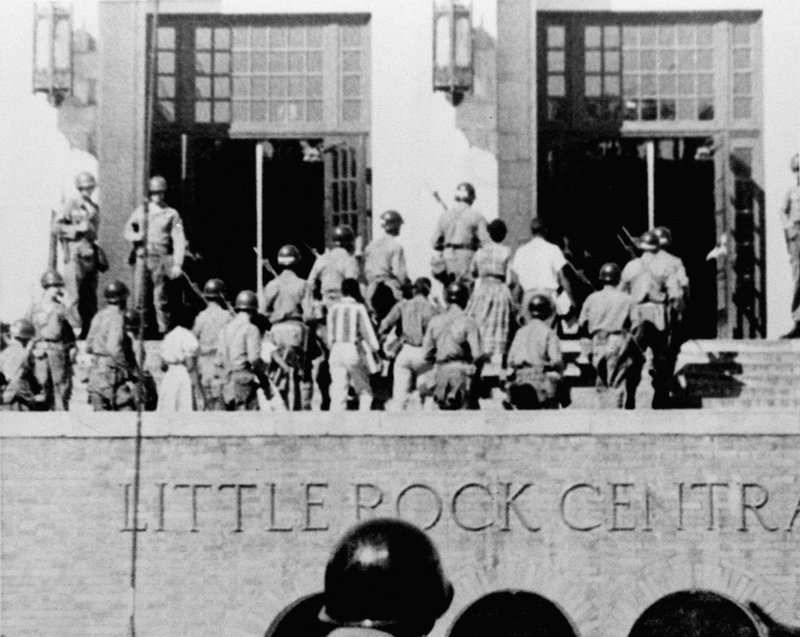
LITTLE ROCK, Ark. (AP) — Among the most lasting and indelible images of the civil rights movement were the nine black teenagers who had to be escorted by federal troops past an angry white mob and through the doors of Central High School in Little Rock, Arkansas, on Sept. 25, 1957.
It had been three years since the Supreme Court had declared “separate but equal” in America’s public schools unconstitutional, but the decision was met with bitter resistance across the South. It would take more than a decade before the last vestiges of Jim Crow fell away from classrooms. Even the brave sacrifice of the “Little Rock Nine” felt short-lived — rather than allow more black students and further integration, the district’s high schools closed the following school year.
The watershed moment was “a physical manifestation for all to see of what that massive resistance looked like,” said Sherrilyn Ifill, director of the NAACP Legal Defense Fund.
“The imagery of these perfectly dressed, lovely, serious young people seeking to enter a high school ... to see them met with ugliness and rage and hate and violence was incredibly powerful,” Ifill said.
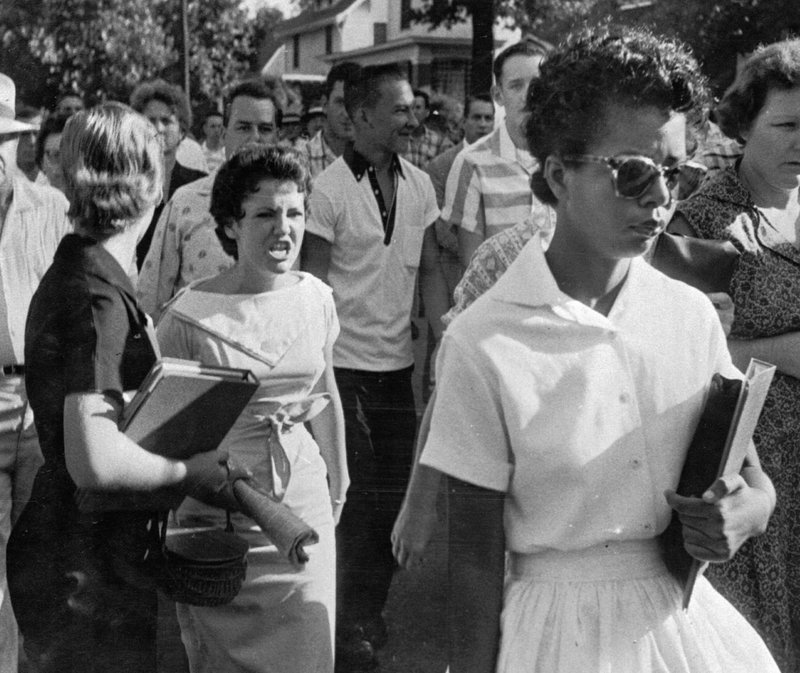
In this Sept. 4, 1957, file photo, students of Central High School in Little Rock, Ark., including Hazel Bryan, shout insults at Elizabeth Eckford as she calmly walks toward a line of National Guardsmen. (Will Counts/Arkansas Democrat-Gazette via AP, File)

Six decades later, the sacrifice of those black students stands as a symbol of the turbulence of the era, but also as a testament to an intractable problem: Though legal segregation has long ended, few white and minority students share a classroom today.
The lack of progress is clear and remains frustrating in the school district that includes Central High. The Little Rock School District, which is about two-thirds black, has been under state control since 2015 over the academic performance of some of its schools. The district has seen a proliferation of charter schools in recent years that opponents say contributes to self-segregation.
Ernest Green still remembers the promise of the era that put him and the eight other students on the front line. After reading about the May 17, 1954, Brown v. Board of Education decision in the local newspaper, he recalled: “I thought to myself, ‘Good, because I think the face of the South ought to change.’”
He and his classmates came face-to-face with Southern opposition after integrating Central. The first day of school was only the beginning of the hardships they would endure.
Green described the experience as “like going to war every day.” Threatening phone calls came to their homes nightly. Students threw acid on them at school.
Nationally, the numbers are similarly stark. The average black student nationwide in 1980 went to a school that was 36 percent white. In the 2014-2015 school year, a black student would have gone to a school that was 27 percent white.
Overall enrollment in public schools has been declining, and the racial gap has widened, according to NCES. In 2004, 58 percent of students enrolled were white, compared to 17 percent black and 19 percent Hispanic. In 2014, public schools were 49.5 percent white — less than half for the first time since such data was first collected — 16 percent black and 25 percent Hispanic.
Additionally, while nearly two-thirds of black and Hispanic students attend schools with at least 75 percent minority enrollment, only 5 percent of white students are enrolled in similar schools. While public schools are indeed more diverse, that diversity is including a decreasing share of white students.
Community leaders have vented over the “Reflections of Progress” theme that’s been attached to the slate of events marking the 60th anniversary of Central High’s desegregation, saying it doesn’t acknowledge the backslide they’ve seen the district undergo. They’re using the milestone to call attention to the state takeover of the district, comparing it to Gov. Orval Faubus’ efforts to block integration in 1957.
“They’re coming back to visit and to see what? They can visit any number of schools where there isn’t any hint of desegregation,” state Sen. Joyce Elliott, a Democrat from Little Rock, said, referring to the eight surviving members of the group, now in their 70s, who will return to mark the day. “For the Little Rock Nine to come back to the same place where they started and the schools are under state control now by the state Board of Education, I think that is something that is the ultimate embarrassment for the state. That is not something to be celebrated, and it is not something to be remotely proud of.”
Some trace much of the current public school debate over school choice to what began in the wake of the Brown v. Board decision as segregationist academies, and later Christian academies, opened throughout the South in response to desegregation.
“There has never been a moment where there has not been vociferous resistance to desegregation,” Jeffries, the historian, said. “They used to couch it in explicitly racist terms. Now, it’s this sort of colorblind language, but the desire remains the same.”
Civil rights lawyer Catherine Lhamon, who now serves as chairwoman of the U.S. Commission on Civil Rights, noted that while meaningful integration happened across the country during the mid-1960s and 1970s, it was only through aggressive federal enforcement. As integration became less of a political priority in the 1980s, re-segregation emerged.
“Local control has never resounded to the benefit of black students,” Lhamon said. “More often than not, it has been a means to mask discrimination and a failure to offer meaningful opportunity to all. It takes federal intervention now, too. That is something Congress promised us and that we have been able to rely on.”
Efforts by Sen. Elliott and others to stem the growth of charter schools in the district so far have had little success in the Republican state. The Arkansas Board of Education approved three new charter schools in the district earlier this month, despite a request from the district’s superintendent to hold off.
“I would say pause for two years and allow the existing charter seat expansions that have already been approved to take place, allow what’s going on in the Little Rock School District to play itself out, because we have really positive things going on with our academic scores,” Superintendent Michael Poore said before the three charter schools were approved.
Republican Gov. Asa Hutchinson said he believes the district is showing it can innovate and compete with the charter schools.
Ifill said the unlearned lessons of Little Rock remain, and that the 60th anniversary cannot only be about lamenting re-segregation.Segregation lingers in US schools 60 years after Little Rock:


For more on the Little Rock Nine, including historical stories and photos, and video interviews with people who lived through the era, visit http://www.apnews.com/tag/LittleRockNine .


Monday, September 18, 2017

Education Research Report: Confidence in U.S. Public Schools Rallies

Education Research Report: Confidence in U.S. Public Schools Rallies:

Confidence in U.S. Public Schools Rallies


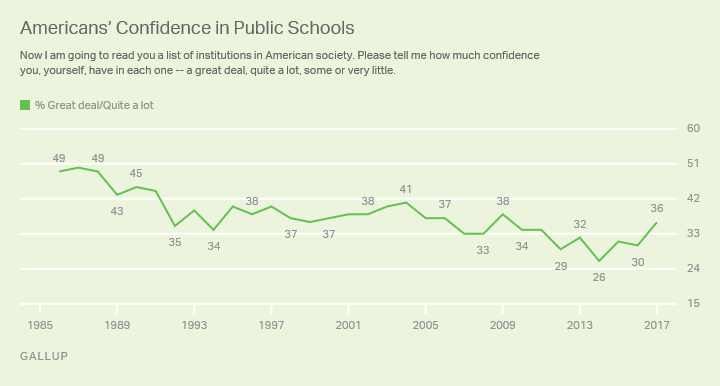
Americans' confidence in the nation's public schools edged up in 2017. The 36% of U.S. adults who express "a great deal" or "quite a lot" of confidence in public schools is a six-percentage-point increase from 2016 and marks the highest confidence rating in eight years.

Graph 1

Gallup has measured Americans' confidence in public schools since 1986. Confidence hit its lowest point in 2014, when about one in four U.S. adults (26%) expressed confidence in the nation's public schools. This low was nearly half the high mark of 50% in 1987.


In the first three years that Gallup measured views of public schools, about half of Americans expressed confidence. But significant dips in 1989 and in 1991 suggested that confidence would not quickly return to the high levels initially measured. From 1995 through 2006, the confidence rating for public schools remained fairly stable, hovering near 40%. From 2007 to 2014, with the exception of a significant bump in 2009 -- the year that many states committed to the development of the Common Core State Standards -- and a smaller uptick in 2013, confidence declined incrementally.

The boost in public school confidence this year is part of an uptick in the average confidence rating (35%) across all institutions that Gallup measures. Public school confidence ranked second in positive year-over-year change among 15 institutions tested in the June survey. Eleven institutions received a confidence boost from 2016, largely attributable to rising confidence among Republicans, which might be ascribed to the election of President Donald Trump.

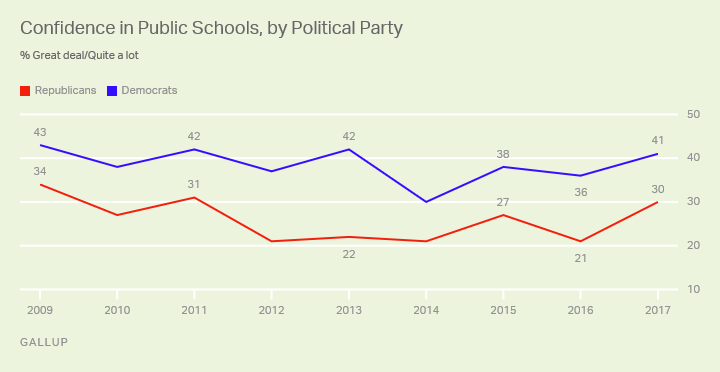
The upswing in confidence in public schools from 2016 to 2017 is evident among both Republicans (up nine points) and Democrats (up five points). The tendency for Democrats to be more confident than Republicans in public schools has been generally constant over the past nine years, and is evident this year, with 41% of Democrats and 30% of Republicans confident in public schools.

Graph 2

The 11-point spread between Democrats and Republicans is much smaller than the 23-point gap in partisan confidence in "colleges and universities" measured in a separate poll in August. The wider party gap in ratings of higher education appears to reflect Republicans' perception that a liberal political agenda is driving what is taught in colleges -- a perception that apparently has not spread to their views of public schools.

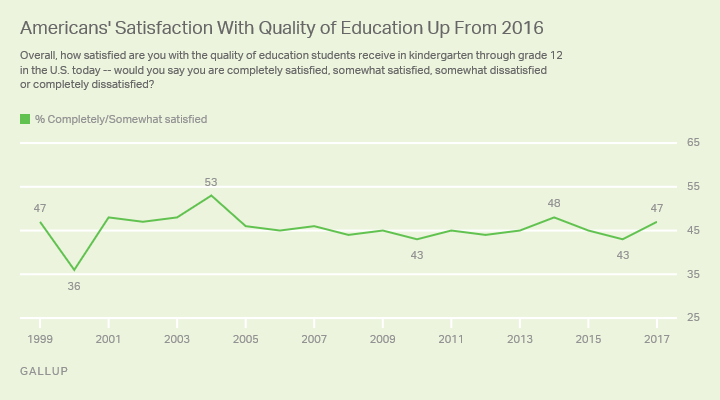
This year's bump in confidence in public schools parallels the increase in Americans' satisfaction with public school education as measured in Gallup's annual Work and Education survey, conducted in August. Nearly half of U.S. adults (47%) say they are "completely" or "somewhat" satisfied with the quality of education for K-12 students, up four percentage points from 2016 but still trailing the high mark for satisfaction (53%) that occurred in 2004.

Graph 3

Implications

While U.S. public schools have struggled to boost their national image in the past decade, there is a hint of progress. The six-point improvement in confidence in public schools from 2016 to 2017 matches the largest year-over-year positive change for schools in Gallup's trend.

Some recent education successes may be helping to nudge confidence in schools upward. The Every Student Succeeds Act, a bipartisan measure signed by President Barack Obama in December 2015, provides increased autonomy and flexibility for state and local education agencies to steer innovation and accountability measures -- and Gallup research suggests that Americans are more trusting of local than federal government. Additionally, the U.S. graduation rate is now at an all-time high of 83%, and the dropout rate is down.

Gallup research shows the nation's public school leaders are likewise optimistic about their school systems. A recent poll of U.S. superintendents shows a significant majority (85%) are excited about their district's future. However, there is clearly more work to be done to improve the quality of education and how it is perceived. Just 32% of these school leaders say they are excited about the future of U.S. education generally -- a percentage that aligns closely with the 36% of Americans expressing confidence in the nation's public schools.


Sunday, September 17, 2017

Only democratic schools will save us - Salon

Only democratic schools will save us - Salon.com:

Only democratic schools will save us


“Not everything that is faced can be changed; but nothing can be changed until it is faced.”
—James Baldwin, from “I Am Not Your Negro”
These days it is hard to be as optimistic about the future of public education generally, let alone the possibility of significantly scaling up democratic schooling, as I had at one time thought we might be ready to do. In the mid-1980s, for instance, a more heady time for progressive educators, my colleagues and I started the Center for Collaborative Education (CCE) as an advocacy and support organization that would facilitate the expansion of our network of small, democratic schools across New York City. Later, in my proposal to scale up that work even further as part of the 1993 Annenberg Challenge, we wrote, “The goal . . . is to bring present city school reform efforts to scale, creating a critical mass of small, effective schools, committed to equity, that serve the full range of New York City’s children so that the principles on which such schools are based are no longer considered ‘alternative’ but rather ‘good practice’”
Today, while there are still schools that have held true to their early innovations, managing to dodge mandates that would undermine their ability to meet the actual needs of their constituents, we are far from making such schools the norm. Instead, many of the democratic school projects that I was involved in over the past half century are in various states of peril or have already faded from existence: with New York City’s District 4, once internationally recognized as a model of what was possible for a public school district to become, its garden of small, interesting schools has now all but dried up; two of the four Central Park East schools have closed and only one remains somewhat democratically governed; the original CPE 1—though it had a good thirty-year run—has been struggling for the past decade to hold on to its progressive practices and democratic spirit. What’s more, conservative analysts have panned the Annenberg Challenge as a failure for its diffuse funding plan; the Coalition of Essential Schools held its last conference and closed its offices in 2016; and the very institution of public education is under attack as never before.
Now, a grossly unqualified billionaire president has appointed equally inexperienced, self-interested “one-percent-ers” to essentially dissolve the very public institutions they are entrusted to lead. True to this mission, secretary of education Betsy DeVos’s 2018 education budget proposes to cut $10.6 billion from public education, eliminating twenty-two programs, including teacher training, after-school programming, and student-loan forgiveness programs (fittingly, she has appointed the CEO of a student loan company to head the student loan agency). In addition, the secretary’s budget would spend $1.4 billion to fund school choice, including a national voucher program. While the rhetoric claims this is intended to “empower” poor families, research on existing voucher programs shows that such claims are based on free market ideology rather than on honest interest in improving the odds for those of us outside of the top 1 percent.
Selling out our public schools in this manner effectively shreds the social contract upon which our democracy depends. As someone who has spent a lifetime struggling against the top-down and impersonal tendencies of our public bureaucracies, I am the first to acknowledge that there is much room for improvement! Nevertheless, it is important to keep in mind that the guiding principles underlying our public institutions—imperfect though they may be—are based on the assumption that we all share interest in a common good. The guiding principles of the free market are profit and individual self-interest.
Some proponents of the charter and, now, voucher movements truly believe that Only democratic schools will save us - Salon.com:


Friday, September 15, 2017

NPE Releases 8 Powerful Voices for Public Ed Film Series: First up is Diane Ravitch - Network For Public Education

NPE Releases 8 Powerful Voices for Public Ed Film Series: First up is Diane Ravitch - Network For Public Education:

NPE Releases 8 Powerful Voices for Public Ed Film Series: First up is Diane Ravitch


The first of the eight powerful voices in our series is none other than that of our our own beloved president, Diane Ravitch. In this film, Diane Ravitch explains the serious threat that Betsy DeVos poses to public education. She explains why charters, vouchers and so-called choice undermine our democracy, warning that the DeVos agenda is no more than a thinly veiled attempt to privatize our schools and transform us from citizens into consumers. It is a film we must get out to the public at large. Watch it here:


We need your help to get this film out to a wide audience.
If you are on FB or Twitter, here’s what to do:
Sharing via Facebook
●    “Like” and/or comment on the video on the NPE page on Facebook, then use the share button to share it to your own page.
Sharing via Twitter
Below are five tweets you can send with two clicks. It will take but a moment. Just “Click To Tweet” and if you’re logged in to your twitter account, the tweet will be generated automatically.
WATCH #RavitchVideo DeVos removes false veneer of progressivism from charters #8PublicEdVoices https://ctt.ec/D7yUd+
Network for Public Education Click To Tweet

WATCH #RavitchVideo Schools, not parents, get the choice #StopPrivatization #8PublicEdVideos https://ctt.ec/e6u7B+
Network for Public Education Click To Tweet

WATCH #RavitchVideo Public schools serve the community #CitizensNotConsumers #8PublicEdVoices https://ctt.ec/6n1b8+
Network for Public Education Click To Tweet

WATCH #RavitchVideo RT if U believe ALL kids deserve a great public education #8PublicEdVoices https://ctt.ec/1dKdH+
Network for Public Education Click To Tweet

WATCH #RavitchVideo See why this grandmother scares @BetsyDeVosED @BillGates #8PublicEdVoices https://ctt.ec/1bxb2+
Network for Public Education Click To Tweet

Sharing via Email

Or, simply share the video link by email: https://networkforpubliceducation.org/?p=9617
You can find more ideas for social media promotion here.

 The Network for Public Education Welcomes Steve Nelson to the NPE Action Board
The Network for Public Education is pleased to announce that Steve Nelson has joined the NPE Action Board of Directors.
Steve Nelson was Head of School at the Calhoun School, on Manhattan’s Upper West Side, for 19 years.  Calhoun is one of America’s most notable progressive schools and serves 750 students, from pre-Kindergarten through 12th grade. Calhoun is particularly well regarded for its commitment to diversity, social justice and its intent to be a private institution with a public purpose.
Since 1997 Steve has been a columnist for the Valley News, the daily newspaper in the mid-VT/NH area on both sides of the Connecticut River. He has been a regular contributor to the Huffington Post since 2010, writing about education and politics, particularly as a passionate advocate for public education.   Before assuming his current position, he worked as an administrator at Vermont Law School and Landmark College. He is an avid violinist and also served for six years as President of a performing arts school in the Midwest.
Steve tells us that he has competed in many marathons, triathlons, bicycle races and XC ski races, with steadily decreasing success. He says that he now primarily races the grim reaper.
He is married to Wendy Nelson, has two children, Jennifer and Christopher, and three perfect grandchildren – Quinn, Maddie and Jack.

Conference Time is Almost Here: Just a Few Tickets Left
And finally, if you haven’t yet registered for NPE’s 4th Annual National Conference, there’s still time!
We’ll be in Oakland, CA on October 14 and 15. This year’s theme is “Now More Than Ever: Fight for Public Education.” We are also planning a special event for Friday evening for those who can come early – NPE President Diane Ravitch in conversation with Journey 4 Justice National Director and NPE Board Member, Jitu Brown.
 
You’ll find all of the details on our registration website.
 
We’re getting close to selling out, so make sure to register soon.
 
Thank you for all you do.
Carol Burris
Executive Director, Network for Public Education
NPE Releases 8 Powerful Voices for Public Ed Film Series: First up is Diane Ravitch - Network For Public Education: