Latest News and Comment from Education

Monday, July 10, 2017

Charter Schools: Who Is Working Together to Improve Them? – Cloaking Inequity

Charter Schools: Who Is Working Together to Improve Them? – Cloaking Inequity:

Charter Schools: Who Is Working Together to Improve Them?

Image result for Charter Schools

During the past decade the number of students in charter schools has nearly tripled, with approximately 3.1 million students enrolled in 2016-17. In fact, one in eight black students now attends a charter in the United States. But while the popularity of charters is growing, so is concernabout charter schools, particularly in the civil rights community and among grassroots educators in teachers unions.
Last summer the NAACP made national news when it called for a charter moratorium until various civil rights concerns were addressed. Other civil rights organizations—including the Journey for Justice Alliance and the Movement for Black Lives—also called for a moratorium on charter schools.
These calls are leading the way for a shift in the national conversation about school choice, and help distinguish privatization and market-based education from real efforts to improve public education.
Last summer the leadership of the National Education Association faced an uprising of sorts from grassroots educators demanding that more critical questions be asked about transparency and accountability for charter schools. In response, NEA President Lily Eskelsen García convened a twenty-one member taskforce on Charter Schools last September, charging members to “fundamentally rethink what NEA policy should be on charter schools.”
This past week, the taskforce delivered their policy statement to a representative assembly at the NEA, and it was overwhelmingly voted into policy by educators from across the United States.
The new policy lays out three criteria charter schools must meet to provide students with the support and learning environments they deserve.
The first is that charter schools should only be authorized by a local and democratically accountable authorizing entity— i.e. a local school district—so that local school officials can closely monitor charter performance, and spread any potential innovations to local public schools.
The statement also calls for an empirical assessment of how a new charter school will serve to improve the local public system before any charter enters a community.
Finally, the statement requires that charter schools comply with the same safeguards and standards that apply to neighborhood public schools such as “open meetings and public records laws, prohibitions against for-profit operations or profiteering, and the same civil rights, employment, labor, health and safety laws and staff qualification and certification requirements.”
Educators at the assembly went further to pass an amendment calling for state and local moratoriums if charter schools do not meet these basic standards. Other amendments included stronger language on protections for special education students and limits on the state-level role in the approval of charter schools.
Market-based school choice supporters have often insisted that teachers’ unions have always been against charter schools.
In fact, Albert Shanker, former President of the American Federation of Teachers union, is credited with popularizing the charter idea as an alternative community-based, teacher-driven approach for the governance of schools in the early 1990s.
As a token academic on the NEA Charter School Taskforce, and in conversations with union leaders and educators, I know that this simplification is far from the truth. In fact, teacher unions have organized tens of thousands of charter school teachers over the years. As a result, the conversations about charter schools inside teachers’ unions are much more nuanced and balanced than market-based school choice supporters would have the public believe.
Market-based education reformers would also have us believe that education reform has been a “mainstream” movement over the past twenty years. Mike Petrilli argued just that in USA Today in response to the NEA’s new policy statement. During the Senate confirmation hearing for Secretary of Education Betsy DeVos, Senator Lamar Alexander essentially made the same argument on behalf of charters.
But goals for charters are far from mainstream; they have been strongly influenced by neoliberal ideals for privatization and private control of education in the United States.
Over the past year, civil rights organizations, grassroots educators, and citizen supporters of public schools organized to push back against this direction of charter schools, and to demand a reassessment.
The NEA’s new statement on charters is hopefully a turning point in our national discourse. The public is becoming more and more aware that the common sloganeering that underlies the various private-control and privatization school choice approaches are red herrings, and that educators and the communities that civil rights organizations represent are the experts when it comes to public education.
This article was first published by The Progressive Magazine here.
Please Facebook Like, Tweet, etc below and/or reblog to share this discussion with others.
Check out and follow my YouTube channel here.
Want to know about Cloaking Inequity’s freshly pressed conversations about educational policy? Click the “Follow blog by email” button in the upper left hand corner of this page.
Twitter: @ProfessorJVH
Click here for Vitae.
Charter Schools: Who Is Working Together to Improve Them? – Cloaking Inequity:

DeVos and Defrauding | By Christopher Brauchli | Common Dreams

DeVos and Defrauding | By Christopher Brauchli | Common Dreams:

DeVos and Defrauding

"Not surprisingly, in this administration, if a choice has to be made between taking steps to help the needy, in this case students, or the taxpayer, the taxpayer wins."

Education Secretary Betsy DeVos has moved quickly to dismantle Obama-era regulations aimed at protecting students from predatory for-profit schools. (Photo: Ted Eytan/Flickr/cc)
D’ye think th’ colledges has much to do with th’ progress iv th’ wurruld?” Asked Mr. Hennessey.
“D’ ye think ,” said Mr. Dooley, “tis the mill that makes th’ wather run?”
— Finley Peter Dunne [Mr. Dooley], Colleges and Degrees
The good news is that the DJT administration has finally come up with a plan to help businesses that does not benefit one of DJT’s enterprises and, therefore, does not represent a conflict of interest for DJT. That comes as a welcome surprise for those who have marveled at how DJT has transformed the White House from a policy center to a profit center. This was most recently demonstrated when the Republican National Committee selected the Trump International Hotel in Washington, to host a $10 million re-election fund raiser in that venue. According to the hotel, the Republican National Committee that put on the event paid “regular prices” for all the services and space provided by the hotel. That blatant conflict of interest made it all the more important to alert the public to the fact that, appearances notwithstanding, the most recent political decision made by the administration does not benefit DJT in any way. That is because, as far as can be determined, DJT no longer has any financial interest in making money by defrauding students. That was not always the case.

A while back, DJT was the poster child for an unethical enterprise that purported to offer training to its victims in get rich schemes. His fraud was called Trump University. It was a complete scam. It had no campus or classrooms. Although it touted the qualifications of its faculty when recruiting students, its faculty lacked academic credentials, the university granted no degrees, and most of its students discovered that promises of lucrative careers in the real estate world following completion of the program were illusory. Because of its palpable fraudulent conduct, it was subject to a class action lawsuit from those who had DeVos and Defrauding | By Christopher Brauchli | Common Dreams:


Seattle Schools Community Forum: HALA and Public Schools

Seattle Schools Community Forum: HALA and Public Schools:

HALA and Public Schools

Image result for What is HALA? The Housing Affordability and Livability Agenda (HALA) is a multi-pronged strategy for addressing housing affordability in Seattle.


You may recall that when the Mayor's HALA plan for our city came out, the plan consistently referred to schools as "amenities."  That's just wrong because no city is great without great schools which are part of the infrastructure of a city.  (They also had it in the plan that if the City built housing that could support a school at the street level, that school would go to a charter group.  When I challenged that idea, the word "charter" mysteriously disappeared.  No one at any HALA meeting will explain how it got in there and why it went away.)

You may have recently received an e-mail about the EIS for the HALA planwith a link for public comments.  I have to smile because while I think it important that citizens have access to the entire plan, it's a huge document.  I think if you really wanted input, a detailed synopsis would have been helpful. That's if you really wanted public input.

A reader did alert me to a section I had missed in the plan, called Public Services and Utilities (with public schools being part of that).   (And thank you to this reader; I depend on readers to send me this kind of information.)

What this reader noted:


In addition to my dismay that the Comprehensive Plan seemingly did not include Crown Hill in its study of schools by sector (not listed on page 4), and omitting Whitman Middle School from the list of schools lacking full sidewalk infrastructure (page 5 and 15), the DEIS does not offer sufficient mitigations on the impact of Seattle Schools Community Forum: HALA and Public Schools:

Fear and Longing: Life for Students with Undocumented Parents

Fear and Longing: Life for Students with Undocumented Parents:

Fear and Longing: Life for Students with Undocumented Parents
With parents targeted for deportation, students are traumatized, often unable to learn - and increasingly turn to educators for solace and advice.


AUSTIN, Texas—”Would you go?”
This is the question that silences 16-year-old Jacqui, tightens her wide smile into a thin line, and provokes a low sigh.
Her mother sits next to her—motionless—her gaze transfixed on a crack in the sidewalk.
The answer is no. Simply, reluctantly, painfully, no. If push comes to shove, and federal immigration agents deport Jacqui’s parents to Mexico, a country they left 18 years ago to find work, she would not go.
Jacqui would stay in the U.S., alone, to finish high school, go to college, and make good on her considered plans to earn a law degree. She is a citizen. They are not.
It’s a no-win situation that promises nothing but agony for millions of undocumented U.S. immigrant parents and their children.
“It is not something I like to think about,” says Jacqui quietly, closing the topic of conversation. Her mother still does not speak.
We are not criminals. We are mothers, and we are fathers. We are people who work, and who take care of our children. That’s it! Not criminals. Not criminals.” – Jacqui’s mother
About one in 14 students, or 6.9 percent from kindergarten through twelfth grade, have at least one undocumented immigrant parent, according to a 2014 Pew Research Center report. Most are U.S.-born, American citizens, like Jacqui, while a much smaller number (1.4 percent) are undocumented themselves.
Their numbers vary widely across the U.S., from nearly 18 percent, or about one in five students, in Nevada, to 0.1 percent in West Virginia.
For the most part, their parents are like Jacqui’s. They crossed the border to find work at least a decade ago, statistics show, and then put down roots as their Fear and Longing: Life for Students with Undocumented Parents:

CURMUDGUCATION: What About Flat Earthers?

CURMUDGUCATION: What About Flat Earthers?:

What About Flat Earthers?


This week the Denver Post ran an.... intriguing? unexpected? gob-smacking? piece about the Flat Earther community in the US, which is, for some reason, centered in Colorado. And these folks are committed.


You might think that this is some sort of hipster irony thing, like the Church of the Flying Spaghetti Monster. But take a stroll through just one flat earther youtube channel-- Globebusters-- and you'll realize that nobody means to be funny here. The international space station? A huge fake.The edge of the world? A barrier of ice. Why don't we feel the alleged speed at which we're supposed spinning with the earth's surface? And is NASA, as another flat earth-- well, I'd call it a group but it appears to be just one guy-- asserts, a secret arm of the Freemasons? And why do conspiracy theorists always have such bad spelling skills?

The Post piece offers a hint at the appeal:

“They want you to think you’re insignificant, a speck on the earth, a cosmic mistake,” Sargent says. “The flat earth says you are special, we are special, there is a creator, this isn’t some accident.”...

He and other Flat Earthers can only speculate why the global conspiracy has had such staying power for more than 500 years, or why “the top” — the uber-elite heads of governments, universities and major corporations that allegedly know “the truth” — would continue to uphold a scheme that offers little in the way of riches or strategic power.

But I'm not here to discuss the merits of Flat Earth Theory which is, after all, well-destroyed bunk. 

My question is-- what do we do with these folks?

Sure, it's a free country and you can believe whatever dumb thing you want to believe. You can
CURMUDGUCATION: What About Flat Earthers?: 

Big Education Ape: CURMUDGUCATION: ICYMI: Stuff To Read Edition + Catch up with CURMUDGUCATION - http://bigeducationape.blogspot.com/2017/07/curmudgucation-icymi-stuff-to-read.html

Nancy Willard: Deliberate Indifference to a Hostile Environment: A Call for Attorneys to Protect Vulnerable Students

Education Law Prof Blog:

Deliberate Indifference to a Hostile Environment: A Call for Attorneys to Protect Vulnerable Students
 By Nancy Willard


Public school districts violate federal civil rights laws when discriminatory harassment of students based on race, color, national origin, sex, or disability is sufficiently serious to create a hostile environment that is interfering with the students’ rights to receive an education, and school staff encourage, tolerate, do not adequately address, or ignore such harassment.
An unacceptably high number of students in public schools in the U.S. are suffering from daily bullying and harassment by their peers--and sometimes school staff. This emotional, and sometimes physical, abuse is known to have a life long harmful impact and to significantly interfere with the targeted students’ ability to receive an education.
While bullying and harassment of students has received a higher degree of focus in recent years, there is no evidence of any significant decrease in the number of students reporting being bullied and harassed. In fact, in some states, it appears that the approach promoted by the state’s anti-bullying statute is having an opposite effect.
For example, in the state of New York, the much-touted Dignity Act for All Students (DASA) was enacted in 2010. On the Youth Risk Behavior Survey in 2011, 18% of New York students reported being bullied. By 2015, this rate had increased to 21%. Under DASA, schools are required to make annual public reports of the number of bullying incidents--a black-mark on the school. In the 2015-16 school year, 71% of New York City schools reported zero bullying incidents.
The approach incorporated into state statutes has created the misperception that all educators must do is have Education Law Prof Blog:

Emily Talmage; Is Wall Street About To Take Over Public Education Once And For All? | PopularResistance.Org

Is Wall Street About To Take Over Public Education Once And For All? | PopularResistance.Org:

Is Wall Street About To Take Over Public Education Once And For All?

Image result for wall street hostile takeover of public schools


Across the country, teachers are being asked to collect, record, and slog through mountains of data that “experts” insist is meant to improve their practice.
There are pre-assessments and post-assessments, habits of work rubrics, writing prompts, social and emotional screeners, standards-based grading systems, RTI data, student learning objectives, professional growth goals, student surveys, self evaluations, administrator evaluations, office discipline referrals, results from progress monitoring programs  …the data demands go on and on, and all of it must be entered and stored in learning management systems.
Recently, a few brave teachers have begun to publicly state the obvious: that we don’t need all of this data to do our jobs well.
Unfortunately, no one seems to be listening, as there is a far more powerful entity that does need all this data:
Wall Street.
As Pay for Success schemes – also known as Social Impact Bonds – sweep the country, data collection in schools is reaching new heights.
“[It’s] an approach that has come of age,” Andy Sieg, Managing Director and Head of Global Wealth and Retirement Solutions at Bank of America Merrill Lynch said of Pay for Success contracts. “We see the confluence of investor demand, government innovation and access to data leading to the dawn of this new market.”
Here’s how they work: private investors provide upfront capital to start a program (a pre-K, for example). If the program meets a set of agreed-upon metrics of “success” (reducing the number of children receiving special education services, for example), investors get repaid with interest.
Despite ethical concerns and doubts about the actual public benefit of these contracts, they are rapidly advancing nationwide due to promises of big payouts for lenders. Goldman Sachs, for example, put up $16.6 million to fund an early childhood education program in Chicago, yet it is getting more than $30 million from the city.  According to The Rockefeller Foundation and Merrill Lynch, the impact investing market will reach between $400 billion to $1 trillion by 2020.
And they don’t intend for the profits to stop there. Investors also have plans to package these bonds up and turn them into a derivatives market. Using performance-based data to inform risk, investors will be able to gamble on these bond-backed securities just as they Is Wall Street About To Take Over Public Education Once And For All? | PopularResistance.Org:
 Image result for wall street hostile takeover of public schools

The Supreme Court, religion and the future of school choice

The Supreme Court, religion and the future of school choice:

The Supreme Court, religion and the future of school choice


The Supreme Court recently decided that Trinity Lutheran Church should be eligible for a Missouri state grant covering the cost of recycled playground surfaces. Though the state originally rejected the church’s application on grounds of separation of church and state, the Supreme Court ruled that this rejection was, in fact, religious discrimination.
The case’s impact will probably reach well beyond playgrounds.
As a scholar of education law, I’ve been following the Trinity Lutheran case and what it could mean for the hottest issue in education: school choice. Where in the past states have decided for themselves whether religious schools are eligible for school vouchers and scholarship tax credits, the Trinity Lutheran decision likely signals that the Supreme Court will soon require states to include religious private schools in their programs.
This would be a huge win for school choice advocates and would complete a revolution in the Supreme Court’s understanding of the law on government funding of religious institutions.

Of church playgrounds and discrimination

In 1995, Missouri established a program offering reimbursement grants to qualifying nonprofits that installed playground surfaces made from recycled tires. Trinity Lutheran Church, which runs a preschool and daycare center, applied for a grant in 2012, but the state rejected the church’s application. Why? The Missouri Constitution states that “no money shall ever be taken from the public treasury, directly or indirectly, in aid of any church, sect or denomination of religion.”
Trinity Lutheran challenged the state’s decision as a violation of the Free Exercise Clause, and in June the U.S. Supreme Court agreed.


The Scrap Tire Surface Material Grant was awarded to two applicants in the 2017 fiscal year. ssedroCC BY-NC-ND

This result will strike many as intuitively correct. A playground is a playground whether or not it’s run by a church, so the threat to separation of church and state seems slim, and the cry of religious discrimination seems plausible.
The case’s reasoning, however, may signal a significant shift in how the law views the separation of church and state. To understand why, we need to review some history.

1784: Three pence to religious education


In 1785, James Madison wrote his ‘Memorial and Remonstrance Against Religious Assessments,’ asserting that religion should be kept separate from government. Library of Congress

In 1784, Patrick Henry proposed a bill in the Virginia legislature that would have levied a tax to support “teachers of the Christian religion” (i.e., ministers). James Madison, however, successfully opposed the bill.
On the question of funding religion with tax money, Madison asked: “Who does not see that the same authority which can force a citizen to contribute three pence only of The Supreme Court, religion and the future of school choice:

Detroit district may rethink authorizing charter schools

Detroit district may rethink authorizing charter schools:

Detroit district may rethink authorizing charter schools

The Detroit Public Schools Community District currently authorizes 13 charter schools.

636258185300565536-NVitti.jpg


 From almost the moment Michigan began allowing charter schools more than 20 years ago, the Detroit school district has been active in authorizing them. But that could soon change.

Members of the board of education for the district have indicated in recent meetings they want to have a deep discussion about the district's role as an authorizer — a role that has contributed to the growth of charter schools in the city.
And last week, new Superintendent Nikolai Vitti said he would recommend the Detroit  Public Schools Community District get out of the charter school authorization business and instead focus its efforts on improving traditional public schools.
"We have to get it right with traditional public schools and our focus, our energy, our resources need to be on that," Vitti said.
Vitti said there may also be value in continuing as an authorizer and setting the standard in the city for quality authorizing and oversight — and for the district playing an even bigger role as a charter authorizer.
The big question, he said, is whether it's "possible to communicate to the community that we are focused on traditional public schools while still approving charters." 
"I feel uncomfortable trying to message both, to be honest," Vitti said.
His comments drew cheers from a few people in the audience of the board's academics subcommittee last week. But others hope Vitti and the board — which would make the ultimate decision — will consider staying in the game.
"I would advocate for DPSCD staying in the charter sector in a limited and high quality way," said Doug Ross, a charter advocate who once oversaw the district's charter schools office.
His argument: Charters "can often innovate more easily and more quickly than centrally managed schools."
"Those urban systems that are beginning to make progress ... have used successful charter experiences in their cities to improve the design and management of their traditional schools," said Ross, who until June 30 headed American Promise Schools, a nonprofit that manages four charter schools in the city.

Vitti wants options

Vitti, who took the helm of the school district May 23, raised the issue at the academics Detroit district may rethink authorizing charter schools:

Schools of Thought: The War Over Public Education and Charter Schools - NBC News

Schools of Thought: The War Over Public Education and Charter Schools - NBC News:

Schools of Thought: The War Over Public Education and Charter Schools


NBC News’ Craig Melvin goes inside the fight over charter schools by visiting an all-boys high school in West Philadelphia. He also sits down with Secretary of Education Betsy DeVos for her first network news interview.


Schools of Thought: The War Over Public Education and Charter Schools - NBC News:


School choice at the top of Betsy Devos' agenda - Videos - CBS News

School choice at the top of Betsy Devos' agenda - Videos - CBS News:
School choice at the top of Betsy Devos' agenda

President Trump and Education Sec. Betsy Devos have placed school choice at the top of their education agenda. Their proposed agenda calls for hundreds of millions of dollars in funding for vouchers and charter schools. But some educators in rural areas are worried about cuts to funding in public schools. Jim Axelrod has more.


Mike Klonsky's SmallTalk Blog: WEEKEND QUOTABLES

Mike Klonsky's SmallTalk Blog: WEEKEND QUOTABLES:

WEEKEND QUOTABLES


“I’m here because I oppose how education in Germany is structured, that they’re training us to be workers and not thinkers.” -- Hendro Myrow, 18, a student in Hamburg.

Sydney Chaffee, 2017 National Teacher of the Year


Let’s work to ensure that education represents liberation. Let’s keep our ears and hearts open to our students’ brilliance, even when it makes us uncomfortable. Let’s envision education as a time machine that helps our students travel to worlds we have only imagined — ones that are built on ideals of justice and equity and collaboration. -- National Education Association 
47th Ward Ald. Ameya Pawar, candidate for governor in IL

Ald. Ameya Pawar
"You have to have a progressive income tax. We owe what we owe [to state pensioners] and if I'm elected, we will make good on that promise...We can't allow the pension system to go belly-up and by extension, to allow the city to go belly-up. I have always voted to protect pensions. I don't know that everyone in the race can say that." -- Interview on Hitting Left with the Klonsky Bros. 
Rahm Emanuel's big lie

“What’s very, very important for the people in Chicago, all of the taxpayers and all Mike Klonsky's SmallTalk Blog: WEEKEND QUOTABLES:

TEACHER VOICE: When it comes to teacher training, the U.S. could learn a thing or two from Canada - The Hechinger Report

TEACHER VOICE: When it comes to teacher training, the U.S. could learn a thing or two from Canada - The Hechinger Report:

TEACHER VOICE: When it comes to teacher training, the U.S. could learn a thing or two from Canada

How the province of Alberta handles preparation and certification

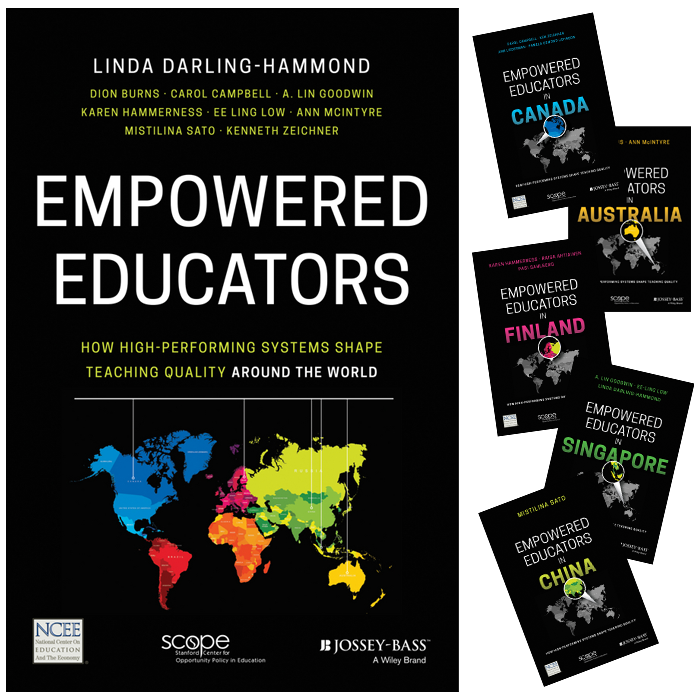
Empowered Educators


 here and how do teachers get their training in preparation for the demands of the 21st century classroom? This is an essential question educators and policy makers face in education systems across the globe.

The Empowered Educators international study from Linda Darling-Hammond finds that the process of teacher training and certification is quite centralized in the high-performing systems studied, with a small number of degree-granting institutions: a single teacher training institution in Singapore, eight in Finland and nine in Alberta. In contrast, Colorado has 35 such avenues for certification, and Washington state has 53 different routes to gaining a teaching certificate. (Here’s a link to order the book associated with the study. Note: a print copy of the book costs $31. The Canada brief can be read free of charge here. Other country briefs can be accessed free by scrolling to the bottom of this page. )
I often wonder about the multitude of routes to certification available in countries like the U.S., and the trade-off between ease or efficiency and consistency. While the numerous routes may allow for flexibility in finding and developing teaching staff, the cost of inconsistency likely does not serve students or schools very well.
I teach social studies in Edmonton, Alberta in what we would consider a medium-sized school of slightly under a thousand students. Alberta’s population is around four million, similar to Kentucky, but with demographics more like California.TEACHER VOICE: When it comes to teacher training, the U.S. could learn a thing or two from Canada - The Hechinger Report:

What they just did to the Illinois teacher pension system. | Fred Klonsky

What they just did to the Illinois teacher pension system. | Fred Klonsky:

What they just did to the Illinois teacher pension system
Tier III  pensions and Governor Rauner is smiling.


On Friday evening those of us who are members of the Illinois Teachers Retirement System received an email blast informing us that “significant changes” had taken place to the pension system as a result of the budget resolution, SB9.
The TRS notice explained that the legislature had created a new Tier III which would allow for younger teachers and future teachers (in Illinois but not Chicago) to opt to invest their retirement savings in a private annuity, like a 401k.
The conversion of our Defined Benefit system (DB) to a Defined Contribution (DC) has been a part of the Rauner Turnaround Agenda since he was elected.
Let’s take a step back.
In order for there to be a “Tier III” there had to have been a “Tier II”.
In 2010 the Illinois Democratic legislature, in a nearly secret vote pushed through in less than 24 hours with no hearings or input from anybody, a law that created Tier II for any teacher hired after January 1, 2011.
It was a disaster.
Pension blogger Glen Brown posted in 2015:
According to Bob Lyons, TRS Trustee, “the financial inequities of the Tier II funding and benefit structure must be fixed. Current law requires Tier II 
What they just did to the Illinois teacher pension system. | Fred Klonsky:


Author strips key parts of bill requiring more transparency in school spending | EdSource

Author strips key parts of bill requiring more transparency in school spending | EdSource:

Author strips key parts of bill requiring more transparency in school spending

The author of legislation that would have required school districts to detail how much state funding they give to each school has stripped that language from the bill.
Assemblywoman Shirley Weber, D-San Diego, agreed to change Assembly Bill 1321 amid increased resistance from groups representing districts and a potential veto by Gov. Jerry Brown.
The Assembly had passed the bill 77-0, and two student advocacy groups that co-sponsored it, Children Now and Education Trust-West, lined up dozens of groups behind it. But groups representing county superintendents, school administrators and business officers, which had been silent in Assembly hearings, subsequently registered their opposition in a letter to the Senate Education Committee. After meeting with opponents and measuring the resistance, and likely opposition from the Brown administration, Weber and co-sponsors agreed last week to gut the bill of its strongest language. Groups including the California School Boards Association (see letter) and the Association of California School Administrators
, in turn agreed to support the revised bill.
The bill had continued a running debate over the question: What information does Author strips key parts of bill requiring more transparency in school spending | EdSource: